Your ShelfYour Projects

Review and Herald, Vol. 86, No. 18.

The First Number of The Protestant Magazine

Review and Herald

May 6, 1909

Review and Herald Publishing Association · Takoma Park Station, Washington, D. C. · May 6, 1909

The First Number of The Protestant Magazine
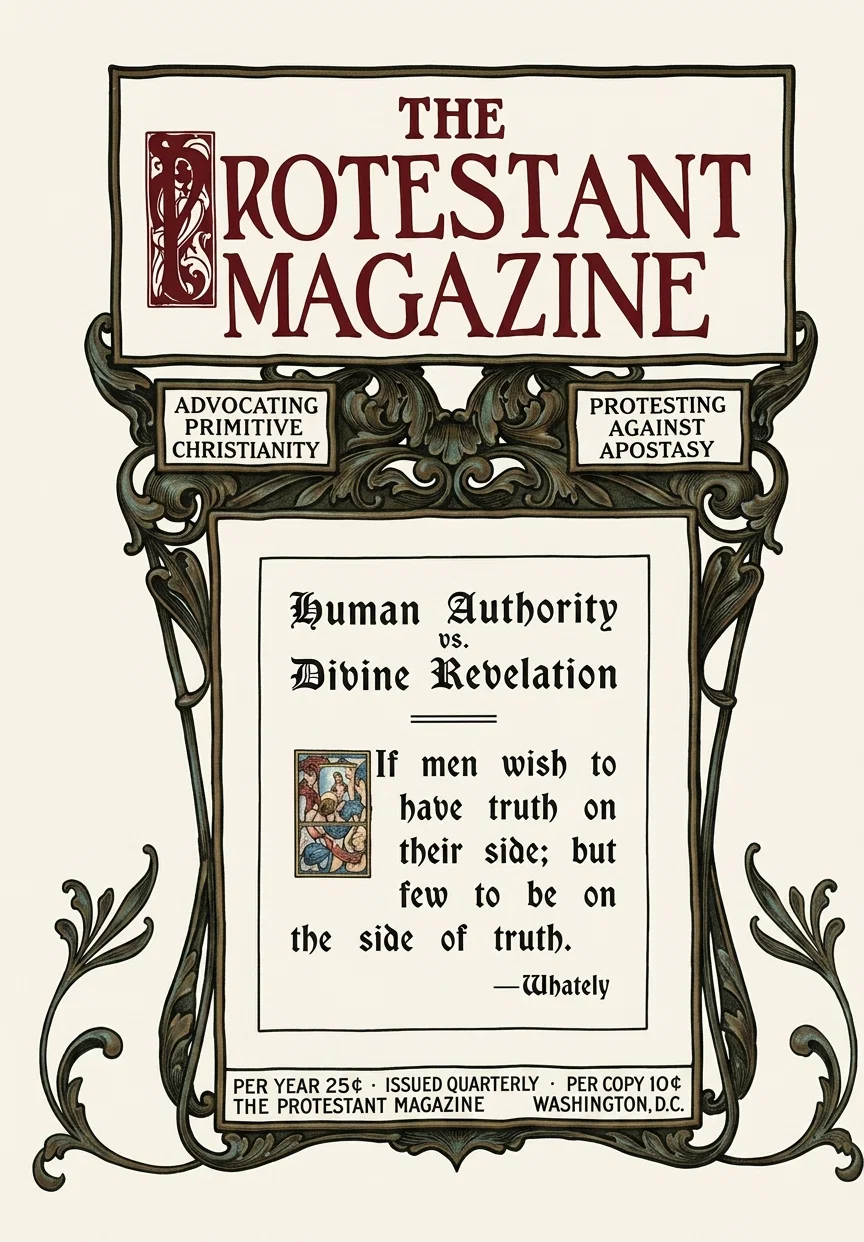
According to promise, the first number of our new quarterly, the Protestant Magazine, is now ready for delivery. In contents, make-up, and general appearance it is unlike any of our other ten-cent magazines. It is printed in large, bold-face type, on non-glossy paper, making easy reading for the eyes.
This new publication discusses the fundamental principles of Protestantism and Catholicism. It advocates primitive Christianity, and protests against apostasy. Its entrance into the literary world will mark a new epoch in the history of modern Bible Protestantism.
The cover design, in two colors, is unique and instructive. The front cover page contains a notable sentiment on Truth, by Whately.
FACSIMILE OF COVER PAGE. ORIGINAL PRINTED IN TWO COLORS
On the second page will be found “Our Theses,” a series of nine declarations of Protestant principles. A notable sentiment on “What Is True Protestantism?” by the famous historian Wylie, appears on the third page of cover. On the last cover page is found the picture of the Good Old Book, with the motto, “An Open Bible for the World.”
ILLUSTRATIONS. — The frontispiece, “Christ or Diana,” is a reproduction of Edwin Long’s famous painting; printed in luxotype. Beneath are these words, “The choice between Christianity and paganism must be made in all reformation times.” “Pilate’s Staircase,” sometimes called “The Holy Stairs,” a reproduction of the famous staircase at Rome, on which Luther was doing penance when the words, “The just shall live by faith,” again rang in his ears.

Articles

“WITNESSING AND PROTESTING,” showing that true Protestantism is not merely negative in character, but that it witnesses for the truth.
“ROME’S OPPORTUNITY,” showing that the failure of Protestantism gives Rome a greater opportunity to assert her claims.
“A FOREWORD,” a brief note as to the plan of conducting the Protestant Magazine.
“A PROTESTANT PLATFORM,” adopting the declaration made by the protesting princes at the Diet of Spires, and rejecting the Roman Catholic idea of tradition and custom as authority in faith or practise.
“THE GIFT OF RIGHTEOUSNESS,” emphasizing the gospel truth that righteousness is a free gift, and not to be obtained at any price by money or works.
“THE ROMAN CATHOLIC PROGRAM,” including extracts from the New World (Chicago) and the Western Watchman (St. Louis), setting forth the purpose to make America a Catholic country.
“THE SAME PAPACY,” quoting from the recent sentence of the major excommunication upon an Italian priest, making it clear that the spirit of the papacy now is the same as in the Middle Ages.
“THE MEANING OF ‘ANTICHRIST,’” extracts and quotations concerning the meaning and use of this word, to prove that “vicar of Christ” is the English equivalent of the Greek word antichristos, from which comes the English word Antichrist.
“THE PAPACY IN PROPHECY,” the first of a series of articles interpreting the leading prophecies concerning the papacy, and aiming to show that the pope is Antichrist.
“MAN AND HIS MAKER,” C. M. Snow. The purpose of this article is to show that the principle of putting man between the sinner and God, as in the papacy, is the continuation of this same principle which was adopted by Lucifer in causing the division in heaven.
“THE PAPACY IN POLITICS,” the first of a series of articles by J. O. Corliss, dealing with the papacy as a political power.
“THE RE-DISCOVERY OF A VITAL DOCTRINE,” an extract from “D’Aubigne’s History of the Reformation,” telling the story of Luther’s experience at Wittenberg and at Rome when the text, “The just shall live by faith,” came to him. It is really an exposition of the great doctrine of justification by faith.
“ROMANIZING THE UNITED STATES,” by Charles J. Little, D. D., president of Garrett Biblical Institute. This article refers to the missionary congress at Chicago, and tells its declared purpose to make America a Catholic country, and says that it is a call to Protestants to set forth the truth as the proper means of counteracting this policy.
“SOME ERRORS OF MODERN THEOLOGY,” an address by Rev. Charles Hillman Fountain, at Crozer Theological Seminary, in June, 1908. This is a severe arraignment of the New Theology, and an emphatic teaching of the primitive gospel.
“ANCIENT BABEL AND MODERN BABYLON,” by Percy T. Magan. The interpretation of the name Babel, or Babylon, as applied to the papacy. It shows that the effort of modern Babylon to establish a world-wide creed is after the same order as the attempt to build ancient Babylon under the control of Nimrod, “the exceedingly impious rebel.”

Price of this Magazine

Single copies, 10 cents; 5 to 20 copies, 5 cents each; 25 to 400 copies, 4 cents; 500 to 800 copies, 3½ cents; 1,000 or more, 3 cents.

THE WORK — AND — THE WORKERS

“Daniel and the Revelation,” morocco, $2.25. Printed from the old plates. Binding perfect; books still in the original wrappers. Former price, $4.50.
---
“Great Controversy,” library, $1.50. Old edition without the scripture references. Contains all the reading-matter that is found in the new edition. Former price, $3.50.
---
The trade edition of the “Desire of Ages” is out of print. We can supply no more in either the cloth or the leather style. The regular subscription edition sells for only $3, in the cloth. The present size is the same as “Great Controversy.”
---
Consumption is curable without the aid of medicine. The things which God has supplied us with freely will both cure and prevent tuberculosis. Read what Dr. Stanley Davis says in “Consumption: Its Prevention and Cure.” 218 pages; $1, post-paid.
---
Those who wish a copy of the Year Book for 1909 should order at once. Second edition nearly gone. You will need it to use in connection with the reading of the General Conference Bulletin. Send for a copy of the Year Book to-day. Price, 25 cents.
---
The book, “Education,” which has been out of print for some time, can now be supplied. The price is $1.25. It is a book which should appeal to every school-teacher, whether of our peculiar belief or not. Try to sell a few copies to the teachers in the public schools of your town. Home-workers’ discount.
---
“The Law in Christ” (W. T. S. 11) shows very clearly the relation which Christ sustained to the law of God. It also shows that the only way in which we can keep the law of God is through Christ. There are over one hundred texts given. The Bible references are printed at the bottom of the page. Dozen, 18 cents; $1.50 a hundred.
---
Twenty-five per cent of the new “Christ in Song” which are being sold are in the half-morocco binding. This shows that our people know the book will never be out of date, and that it is therefore worthy of the best binding. Remember the half-morocco binding costs only $1; this is an average of nearly ten songs for one cent. Better binding for $2.50 and $3. Cheaper bindings for 60 cents and 45 cents.
---
“Fundamental Principles of Seventh-day Adventists” is a brief statement of the truth held by this denomination. When your friends ask, “What do Seventh-day Adventists believe, anyway?” “Why do they keep Saturday for Sunday?” hand them a copy of this little tract. It will answer all their questions, and may lead to a more exhaustive study of the Bible. The tract is an excellent “entering wedge.” Dozen, 12 cents; $1 a hundred.

“The Two Great Crises: The End of the Jewish Nation and the End of the World”

Deliverance From Destruction

Many centuries before Jesus uttered the prophecy which we are considering, the prediction was made through Moses that if the chosen people should not harken unto the voice of God, “to observe to do all his commandments and his statutes,” they would suffer terrible things at the hands of “a nation . . . from far.” This utterance is worthy of special consideration:—
“The Lord shall bring a nation against thee from far, from the end of the earth, as swift as the eagle flieth: a nation whose tongue thou shalt not understand; a nation of fierce countenance, which shall not regard the person of the old, nor show favor to the young: and he shall eat the fruit of thy cattle, and the fruit of thy land, until thou be destroyed: which also shall not leave thee either corn, wine, or oil, or the increase of thy kine, or flocks of thy sheep, until he have destroyed thee. And he shall besiege thee in all thy gates, until thy high and fenced walls come down, wherein thou trustedst, throughout all thy land: and he shall besiege thee in all thy gates throughout all thy land, which the Lord thy God hath given thee.” Deut. 28:49-52.
It was by no arbitrary decree that the fate here foretold befell the Jewish nation. The failure to appreciate their mission to the world, and the substitution of manifold forms and ceremonies for a genuine Christian experience in the life, and the consequent loss of power which saves from sin, brought the Jewish people into spiritual bondage, and opened the way for them to become subjects of the Roman power. Their persistent refusal to listen to the warning and instruction of the prophets, and the greater longing for their old-time place and power as a nation than for that Christian experience which would restore them to their place in God’s kingdom, led them on to the rejection of the message borne by John the Baptist, and as a natural consequence, to the rejection and crucifixion of Him who took the flesh in order that he might save his people from their sins. This crowning act of unbelief determined the fate of the nation, and brought upon it the experiences foretold through Moses.
In view of this impending calamity, Jesus instructed his disciples how to make their escape from the doomed city:—
Matt. 24:15-18: “When ye therefore shall see the abomination of desolation, spoken of by Daniel the prophet, stand in the holy place (whoso readeth, let him understand): then let them which be in Judea flee into the mountains: let him which is on the housetop not come down to take anything out of his house: neither let him which is in the field return back to take his clothes.”
By comparing this instruction with that recorded in the Gospel by Luke, we learn clearly what is intended by “the abomination of desolation, spoken of by Daniel the prophet:” “And when ye shall see Jerusalem compassed with armies, then know that the desolation thereof is nigh. Then let them which are in Judea flee to the mountains;” etc. Luke 21:20, 21. “The abomination of desolation,” which prefigured the desolation of Jerusalem, was the Roman army surrounding the city.
The full meaning of the reference to Daniel’s prophecy will become more apparent after we consider what was suggested to the Jewish mind by the term “abomination.” Anything which savored of, or suggested, idolatry was, according to the divine definition, an abomination in the sight of the Lord, so that the word was applied to the idol itself. Thus we read:—
“And Solomon did evil in the sight of the Lord, and went not fully after the Lord, as did David his father. Then did Solomon build an high place for Chemosh, the abomination of Moab, in the hill that is before Jerusalem, and for Molech, the abomination of the children of Ammon. And likewise did he for all his strange wives, which burnt incense and sacrificed unto their gods.” 1 Kings 11:6-8.
Concerning the reform work carried on by King Josiah, we learn:—
“And the high places that were before Jerusalem, which were on the right hand of the mount of corruption, which Solomon the king of Israel had builded for Ashtoreth the abomination of the Zidonians, and for Chemosh the abomination of the Moabites, and for Milcom the abomination of the children of Ammon, did the king defile.” 2 Kings 23:13.
Writing of the experiences of one who forms his own god from the stock of a tree, the prophet Isaiah declares:—
“He burneth part thereof in the fire; with part thereof he eateth flesh; he roasteth roast, and is satisfied: yea, he warmeth himself, and saith, Aha, I am warm, I have seen the fire: and the residue thereof he maketh a god, even his graven image: he falleth down unto it, and worshipeth it, and prayeth unto it, and saith, Deliver me: for thou art my god. They have not known nor understood: for he hath shut their eyes, that they can not see; and their hearts, that they can not understand. And none considereth in his heart, neither is there knowledge nor understanding to say, I have burned part of it in the fire; yea, also I have baked bread upon the coals thereof; I have roasted flesh, and eaten it: and shall I make the residue thereof an abomination? shall I fall down to the stock of a tree? He feedeth on ashes: a deceived heart hath turned him aside, that he can not deliver his soul, nor say, Is there not a lie in my right hand?” Isa. 44:16-20.
It is thus evident that an idol is an abomination, and that when one substitutes a false god for the true and living God, he is putting a lie in place of the truth, even as the apostle Paul writes of the worshipers of pagan deities in his day, who exchanged the truth of God for a lie, and worshiped and served the creature rather than the Creator, who is blessed forever.” Rom. 1:25.
The Roman army which was to accomplish the desolation of Jerusalem was fittingly designated as “the abomination of desolation,” since the ensigns and images borne upon its standards were objects of worship—false gods and abomination; for, as Tertullian says (Apologetic, chap. XVI, page 162), “The entire religion of the Roman camp almost consisted in worshiping the ensigns; in swearing by the ensigns; and in preferring the ensigns before all other gods.” To the same effect Josephus testifies:—
Now the Romans upon the flight of the seditious to the city, and upon the burning of the holy house and of all the buildings around about, brought their ensigns to the temple, and set them over against its Eastern gate, and there did they offer sacrifices to them.—“Wars of the Jews, Book 6, chap. 6, par. 1.”
Not only the space included within the walls of the city, but also all that within a circuit of a certain number of furlongs outside the walls was considered holy ground. When, therefore, the Roman army planted their standards inside this territory “the abomination of desolation,” was standing in the holy place.
The reference which Jesus makes to the prophecy of Daniel is an indirect, but none the less strong testimony in favor of the study of prophecy, with the assurance that an understanding of the words read will be granted. Those who pronounce the prophecies of Daniel as the product of a disordered imagination, or as being too obscure to be understood, or as being the work of an impostor who lived at a later time than the Daniel who was prime minister at the court of Darius, should weigh these words of Jesus. To him the predictions of the prophecy were of divine authority, and he commended them to his disciples as containing the key to the hope of their deliverance from the doomed city.
The Christian believers acted upon the instruction given to them by the divine Teacher, and at the opportune moment fled from Jerusalem and other cities of Judea to places of safety, and were thus delivered from death; and, as Bishop Newton writes, “We do not read anywhere that so much as one of them perished in the destruction of Jerusalem.”
The circumstances which opened the way for heeding the Saviour’s instruction may be briefly summarized: The first expedition against Jerusalem was led by the Roman general, Cestius Gallius, who “pitched his camp upon the elevation called Scopus, or the watch-tower; which was distant seven furlongs from the city.” Some particulars of his attempt to capture the city are given by Josephus:—
When Cestius was come into the city, he set the part called Bezetha, which is called Cenopolis, or the new city, on fire: as he did also to the timber market, after which he came into the upper city, and pitched his camp over against the royal palace; and had he but at this very time attempted to get through the walls by force, he had won the city presently: and the war had been put an end to at once. . . .
In the meantime many of the principal men of the city were persuaded by Ananus, the son of Jonathan, and invited by Cestius into the city, and were about to open the gates for him; but he overlooked this favor, partly out of his anger at the Jews, and partly because he did not thoroughly believe that they were in earnest. . . .
Now it was that a horrible fear seized upon the seditious, insomuch that many of them ran out of the city, as though it were to be taken immediately. But the people upon this took courage; and where the wicked part of the city gave ground, thither did they come in order to set open the gates and admit Cestius as their benefactor; who, had he but continued the siege a little longer, had certainly taken the city. . . .
It then happened that Cestius was not conscious either how the besieged despaired of success, nor how courageous the people were for him; and so he recalled his soldiers from the place; and by despairing of any expectation of taking it, without having received any disgrace, he retired from the city without any reason in the world.—“Wars of the Jews, Book 2, chap. 19, pars. 4-7.”
The Jews were greatly elated at the withdrawal of Cestius, and pursued the fleeing army “as far as Antipatris.” They then “came back running and singing to their metropolis.”
To all human appearances, victory had turned on the side of the Jews, and Jerusalem was now a safe place in which to reside, but the Christians recognized that the time mentioned by Jesus had come, and therefore, obeying his words implicitly, they fled from both the city and the country to the mountainous districts, out of the path of contending armies. Thus they were saved from the destruction soon to come upon Jerusalem, not as the result of their own foresight, but through trustful obedience to the words of Jesus.
The downfall of Jerusalem was a type of the downfall of the world; and as the believers in that time were delivered through their faith in, and obedience to, the divine instruction, so will it be at the last day. While those who are guided by human wisdom are saying, “Peace and safety,” and are assuring their followers of a millennium of glorious prosperity, the believers in the divine message for this generation will know that the end of all things is at hand, and will be prepared for their escape from the fires of destruction. In the olden time it was necessary for the believers to remove only a comparatively short distance from their homes, as Jerusalem and Judea alone were the prey of the invading army; but in this generation, with the whole world doomed to destruction, those who are delivered must be taken from the earth; therefore the apostle Paul writes: “The Lord himself shall descend from heaven with a shout, with the voice of the archangel, and with the trump of God: and the dead in Christ shall rise first: then we which are alive and remain shall be caught up together with them in the clouds, to meet the Lord in the air.” But it will require “the faith of Jesus” “to escape all these things that shall come to pass, and to stand before the Son of man.”

Editorial

Perfect peace can come only by surrender of the human will to God. He only is infinite in wisdom, and can wisely choose for his children. His great love enlists for them the exercise of his divine power. Truly such a Being can be trusted to work out every problem, both as relates to this world and the world to come. To the trusting child he will give perfect peace.

The Infallible Guide

IN these days of new faiths and fancies, there is great need of heeding the admonition of the Scriptures to “prove all things,” holding fast the good only. The seeker after truth is confronted by a confusing maze of theories, each claiming to be truth. Voices from every quarter are inviting a following. There are lords many and gods many. He whose course is guided safely must be guarded indeed. He can not trust to caprice or feeling, to the pleadings of friends, or even to the counsel of the learned. Man, at best, no matter how great his qualifications or pious his professions, is an unsafe guide in religious experience. But God has not left the honest seeker after truth without a guide. He has given him the Scriptures of truth as a chart and compass. By this infallible guide-book he may safely choose his way, distinguishing the path of truth from the by-roads of error. By this infallible rule faith and character alike may be measured. Following its instructions, the seeker after truth shall know of the doctrine, whether it be of God, or whether it be of the evil one.

Our Imperishable Inheritance

What Say the Prophets?

WE have seen that man, placed on probation to determine for himself which he would have, life or death, made the choice that entailed mortality upon himself and his posterity; that Satan’s promise of eternal life and godlike attributes on condition of disloyalty to God, was a false promise, and man’s attempt to grasp the reward held out by Satan brought in sin, whose wages is death.
The thought of a cessation of existence has never been pleasing to man since its first announcement was made in Eden, and there is no doubt that the great deceiver has fostered that feeling in man, and through it he has framed a system of belief as deceptive as was his first proposal to the mother of the race. Man in all ages has clung to the thought that the human body is a chrysalis out of which emerges the immortal soul when the visible body has ceased to live. Every heathen people has held that doctrine; and the farther away from God they have wandered, the more deeply has that belief been burned into their being, and the more elaborately have they fashioned the rituals that proclaim their faith in that idea. Egypt, Assyria, Babylon, Persia, Greece, and Rome werenot the only nations that fostered faith in the immortality of the soul. Among the most primitive peoples, beyond the far fringes of civilization, that doctrine was inculcated with weird and mystic rites. The fact that so many different peoples in all parts of the world have held a belief in the immortality of the soul is used by many as a conclusive argument that man does in very truth possess such an imperishable entity.
Perhaps among no people of ancient times was the belief in the immortality of the soul more strongly rooted than among the Egyptians. The pains taken to preserve the bodies of their dead is proof of this. But it is doubtful if any people ever went farther from God than they when they made gods of birds and four-footed beasts and creeping things, and “worshiped and served the creature rather than the Creator.” It is one of the anomalies of sacred history that out from among such a nation God could bring forth a people who would be known as his people, among whom he would deign to dwell, and who would preserve his worship and his name through the long night of heathendom’s domination. It is an illustration of the power and resourcefulness of the Almighty, and shows out of what unpromising material God can produce jewels worthy of his crown of rejoicing.
Heathenism was in the heyday of its glory when Egypt was in its prime; and the doctrine of the soul’s immortality had an unlimited opportunity to demonstrate what it could do for man in that epoch. It turned men so far from God that the Pharaoh of the oppression pretended never to have heard of him, and the Apis, the Ibis, and the beetle were given more homage than the God who made the heavens and the earth.
When God called out his people from among the Egyptians, he gave them, as well as the Egyptians, an object-lesson of the utter nothingness of that whole system of worship and the powerlessness of all the objects to which that people rendered homage. Every tenet of their faith was smitten by the hand of the Almighty, whom they had forgotten. Their gods became festering carcasses, and the river Nile, to which they looked as the great source of their temporal blessings, was turned into a breeding-place for the pestilence and the plague. In those visitations Israel and Egypt had a sufficient lesson that “the Lord, he is the God,” and the only legitimate object of worship.
But Israel, whose land was a highway of the nations, was to bear witness to another truth. The idolatry of the nations sprang largely, if not wholly, from a wrong conception of the nature of man. Satan’s declaration to Eve has been reiterated to every generation— “Ye shall not surely die: . . . ye shall be as God.” If man be immortal, why not the beasts also? If man be as God, and God is worshiped, why may not man be worshiped? If the beasts, like man, be immortal, and man, like God, is worthy of worship, why are not the beasts, which are immortal like man, also worthy of worship? Through such reasonings did the ancients turn their backs upon the God of the heavens, and bow down to the gods of the air, the field, and the stream. The acceptance of Satan’s flattering deception opened the door and paved the way for all the idolatry that has cursed the world.
The Creator did not leave man to his own imaginings as to this great truth. He testified against the error by his power and by his leadings; but through the prophets he has multiplied testimony concerning the nature of man that leaves his children without excuse for falling into the error of believing man immortal. Through Job he speaks thus: “Man dieth, and wasteth away: yea, man giveth up the ghost, and where is he? . . . Man lieth down, and riseth not: till the heavens be no more, they shall not awake, nor be raised out of their sleep. . . . If a man die, shall he live again? All the days of my appointed time will I wait, till my change come. Thou shalt call, and I will answer thee: thou wilt have a desire to the work of thine hands.” Job 14:10-15. Remaining in the grave “till the heavens be no more,” does not signify remaining in the grave through all eternity; for there will come a time when “the heavens shall pass away with a great noise, and the elements shall be dissolved with fervent heat, and the earth and the works that are therein shall be burned up.” 2 Peter 3:10. That time is “the day of God” (verse 12), and the “call” for which Job would wait was the call of his Redeemer: “The Lord himself shall descend from heaven, with a shout, with the voice of the archangel, and with the trump of God: and the dead in Christ shall rise first.” 1 Thess. 4:16. Job expected to be among the number wakened from the sleep of death by the voice of the Son of God.
When the Lord was giving his final instruction to the Israelites before permitting them to go over into the promised land, he set before them precisely the same choice that he set before Adam and Eve in Eden. It was, obedience and life, or disobedience and death. He said: “I have set before thee this day life and good, and death and evil; in that I command thee this day to love Jehovah thy God, to walk in his ways, and to keep his commandments and his statutes and his ordinances, that thou mayest live and multiply, and that Jehovah thy God may bless thee in the land whither thou goest in to possess it. But if thy heart turn away, and thou wilt not hear, but shalt be drawn away, and worship other gods, and serve them; I denounce unto you this day, that ye shall surely perish. . . . I call heaven and earth to witness against you this day, that I have set before thee life and death, the blessing and the curse: therefore choose life, that thou mayest live, thou and thy seed; to love Jehovah thy God, to obey his voice, and to cleave unto him; for he is thy life, and the length of thy days.” Deut. 30:15-20.
Mark the plainness of speech, the simple alternative, the antithesis of choice. It was not a continuation of existence in two different environments—happiness and misery; but on the one hand life, and on the other its opposite, death. There is no intimation of a deathless entity, an immortal soul; no suggestion of eternal torment as a punishment for disobedience. They have the same warning as that given to Adam. They could have eternal life only through obedience. Life is life without respect to whether it is possessed in misery or in joy. If obedient and loyal, they were promised life; but they could not have life, even in misery, through disobedience. No life of any kind is promised as the wages of such service. “Ye shall surely perish;” “the wages of sin is death.”
That was God’s warning to his people on the borders of the promised land,—a people who were to stand as God’s light to enlighten the world. The message he gave them they were to repeat to the world, testifying for him against idolatry of every kind, and necessarily against the root of idolatry—the deification of the creature and the immortality of the soul. We shall see in another article how God multiplied testimony to the ancients upon this subject, and left them, as he has left us, without excuse for holding to such belief. C. M. S.

A Glimpse at the Work Under the Apostle Paul's Oversight

Gospel Order—No. 7

A Glimpse at the Work Under the Apostle Paul's Oversight

THE apostle Paul's commission to the Gentiles led him to the regions now known as the Levant and southern Europe. Associated with Paul were other apostles, as Barnabas and Apollos, with many evangelists and other laborers. But as the chosen apostle to the Gentiles, the responsibility of general oversight fell to him. He certainly had that spiritual gift of “governments,” so important in administering a work in which many are engaged. He was an organizer, as testified by every glimpse of his labors given us in the very brief record. His writings, more than any others, emphasize again and again the organic unity of the church of Christ, and the importance
of recognizing order and organization in gospel service.
As churches multiplied in all parts of his field, Paul was continually visiting them, or sending laborers among them, building them up in faith and unity. As the work grew, and particularly as disorderly and evil elements began to develop, it is plain from his epistles that the responsibility of his apostleship—bringing “the care of all the churches”—laid upon him a heavy burden. 2 Cor. 11:28. It was with him “daily.”
As the churches increased in the different provinces, those geographically located together were evidently grouped so as to act together as a conference of churches. Thus, “the churches of Galatia,” “the churches of Macedonia,” “the churches of Asia,” “all Achaia,” etc., were given direction by the apostle as to concerted action to be taken, or sent salutations to churches in other parts. When the general fund was to be made up for the Judean believers, Paul wrote to the Corinthians: “As I have given order to the churches of Galatia, even so do ye.” 1 Cor. 16:1. The second epistle shows that this instruction was for the churches of “all Achaia,” of which province Corinth was the center. The churches were instructed to make up the gift, and to appoint representatives to go with it to Jerusalem. “Whomsoever ye shall approve by your letters, them will I send.” The Macedonian churches had the same instruction, and sent a representative, “chosen of the churches,” to join in carrying the bounty to Judea. 2 Cor. 8:19. Thus each group of churches acted in concert, as one provincial or state conference organization, and had their representatives appointed to look after certain work.
Again: we find Paul appointing ministerial laborers to the general oversight of provinces or conferences. Timothy was assigned to the province of Asia for a time, with instruction from Paul as to the ordering of the churches, the appointment of elders and deacons, and the care of the general interests of the churches grouped together in that province. See 1 Timothy. Titus was assigned for a time to Crete: “For this cause left I thee in Crete, that thou shouldest set in order the things that are wanting, and ordain elders in every city, as I had appointed thee.” Titus 1:5.
As the one in charge of the work in Crete, Titus was asked to see that Zenas the lawyer and Apollos, when they should arrive, were sent forward on their journey, provided with means so that nothing should be lacking to them. Titus 3:13. Those were not the days of bank drafts and postal remittances; but the instructions to Titus, and other similar references, show provision of funds available for the conduct of the work.
As Paul told the Corinthians, the Lord, who ordained men to the ministry of the temple in former times, had also made provision for their support, and “even so hath the Lord ordained that they which preach the gospel should live of the gospel.” 1 Cor. 9:14. They were familiar enough with the manner of supporting the Lord’s work in the former time, by tithes and offerings, and “even so” it was ordained that the work of the gospel should be carried forward.
While Paul acted with the authority of an apostle, called to the general oversight or “care of all the churches,” he assumed no arbitrary authority over any. “Not for that we have dominion over your faith,” he wrote, “but are helpers of your joy: for by faith ye stand.” 2 Cor. 1:24. Though evil men often represented him as self-seeking and arbitrary in his work, assuming authority not belonging to him, he was really servant of all. He counseled his associate workers, not as an overlord, but as a fellow laborer, a comrade in the common service. But, as some one must lead out in all associate work, there was necessity in gospel effort for a directing supervision to keep all interests moving harmoniously forward. Hence ministers, like Mark, Timothy, Titus, Silas, Tychicus, Artemas, Crescens, and many others, were sent here and there, called to come and go, appointed to one field and then another, all responding as the loyal soldiers of Christ that they were. They recognized the increased efficiency given to their labors by organization and union of effort.
The unity of the world-wide work was provided for in the supervision of the committee of apostles, ordained to represent the whole church. Paul’s visits to Jerusalem to counsel with the other apostles, as well as his constant teachings, bear witness to his efforts to maintain union and co-operation between the churches in all the world. They were all members of the one body, Christ the head,—
“From whom the whole body fitly joined together and compacted by that which every joint supplieth, according to the effectual working in the measure of every part, maketh increase of the body unto the edifying of itself in love.” Eph. 4:16.
The member is connected with the head only as it is a part of the body. Independent of the body, the hand or foot would be severed from connection with the head. The head can move the finger or the hand only as the finger or hand is united with the body.
The gifts and offices set in the church were to preserve the oneness and compactness of the body of Christ, the church, even after the first apostles had passed away. The churches were “set in order” by the appointment of proper officers. This was an important part of the ministerial oversight, and as Paul appointed Timothy to attend to this in Asia, and Titus in Crete, he gave instruction as to the qualifications of officers.
The elders were ordained to take “oversight” of the local church, not as “lords over God’s heritage, but being ensamples to the flock.” 1 Peter 5:3. Careful selection was also to be made in filling “the office of a deacon,” as assistants to the elders in the administration of church work. 1 Tim. 3:8-15. The work of deaconess was also recognized. Rom. 16:1, R. V., margin.
The church was an organized body, officered and equipped for harmonious and concerted service, every member having his responsibility and individuality before God, while this very relationship to God bound the members together in sacred fellowship with one another.
W. A. S.
Continue reading: Questions Regarding Tithing