Pacific Press Publishing Association · Mountain View, California · May 23, 1911
Behold, He Cometh
By Delwin Rees Buckner
By Delwin Rees Buckner
Earth's rebel race on trembling knees are bowed
Before the reeling hills, their only cry
A prayer to hide them from the searching eye
Of Him who rides triumphant on His cloud
While trumpet blasts, so clear and long and loud,
Proclaim the Judge of all the world is nigh,
His glory blazing through the midnight sky,
Consuming fire for all the evil crowd.
A King He comes, upon His brow a crown.
No marvel that earth's base transgressors cower,
For all their wilful lives they have defied
His law; yet now they fall before the frown
Of Him they've crucified, whose very power
Lies in those prints in hands and feet and side.
Question Corner
By Editor
"IF YE WILL INQUIRE, INQUIRE YE."
This Inquirers' Department is conducted for the purpose of helping those who are studying the Bible. The answers are oftentimes only suggestive. They are never to be considered infallible, only as they agree with the infallible Word. The writer who may answer them does not consider that his opinion is infallible. He will simply give the best that he has, and plead with the inquirer to search the Word. Such questions only will be answered as, to the editors, seem to minister to the good of the readers and to the mission of the paper. We can not answer repeatedly in the same volume questions upon the same scripture. The name and address must accompany question, not for publication, but as an evidence of good faith, and that answer may be made by letter if deemed advisable. No letters are answered which do not contain the name of the writer. It is well always to enclose stamp for reply.
3437 — Cause of Lucifer's Rebellion
By Editor
Kindly state in your "Question Corner" the particular, definite reason or cause for Lucifer's defection and subsequent rebellion. Is there a specific statement made anywhere in the Scriptures as to his casting out of the heavenly home with his deceived adherents? Rev. 12:4-9 seems to be allegorical. Why has he been allowed to continue in rebellion and usurpation of government in the earth to the awful detriment and destruction of God's creatures? F. O. E.
It is a long question, which we must answer too briefly. 1. If there were a real cause for sin, sin would be excusable. There is none, and its beginning is unexplainable. Yet the Bible presents the developments of the motives that resulted in rebellion. Under the figure of the king of Tyre, the Lord speaks thus to the great despoiler: "Thine heart was lifted up because of thy beauty, thou hast corrupted thy wisdom by reason of thy brightness." See Eze. 28:11-19. This was selfishness manifest in pride. Through another prophet the Lord speaks to Lucifer: "Thou hast said in thine heart, I will ascend into heaven, I will exalt my throne above the stars of God: I . . . I . . . I will be like the Most High." Isa. 14:12-14. To pride is added unholy ambition, which would dethrone God to attain its object. But how it found place in his heart we know not.
2. Because of his sin Lucifer was cast out of heaven. 2 Peter 2:4 is quite specific, and while the term "dragon" is figurative, the devil and Satan and his angels are not; nor is the earth, nor Christ, who conquered. Rev. 12:9.
3. God suffers this awful lesson of sin and its consequences to the universe that all His intelligent creatures may learn, and learn for all eternity, that sin — the transgression of God's law — unrestrained works out inevitably misery and wo and crime and disease and death. If God had cut off the transgressors in the beginning, who then posed as accusers, Satan's falsehoods against God's justice would have seemed to be true. God's plan has been placed on trial, is on trial till the great judgment-day will vindicate God and prove that not might is right, not expediency is right, not deception is right, but that right is everlasting might.
3443 — Tithing and the Promises
If the law of tithing is still binding on Christians, why is it that they do not receive the promises after having complied with Mal. 3:10? The boll-weevil and other devourers prey upon the crops of tithe-payers as they do others. H.
1. We will not attempt to prove the duty of tithe-paying; it is abundantly supported by the Scriptures and abundantly confirmed by the experience of thousands.
2. Verses 8 and 9 should be considered with verse 10. Have offerings been considered as well as tithe, not only of the present, but of the past? Are we bringing, as the Revised Version expresses it, "the whole tithe" into the storehouse?
3. Are we paying tithe as a commercial affair? Are we giving God His tithe in order to get His blessing? or are we doing it because it is right whether we are blessed temporally or not?
4. The true motive of tithe-paying is to render to the Lord that which is His regardless of our desires or needs or future, because it is His and as faithful stewards we can do no other way.
5. Then, too, God does not design that all His promises shall be for this world. Here we must suffer many things for others' sake with others that we may manifest the power of His life. In the new earth God "will restore to you the years that the locust hath eaten, the canker-worm, and the caterpillar, and the palmer-worm [and the boll-weevil and all the other pests]." Joel 2:25.
6. The Lord intimates that some will suffer and complain. They will say, "It is vain to serve God: and what profit is it that we have kept His ordinance?" Mal. 3:14. Do not be among the murmurers. Be sure that you have met God's demands with the nine tenths also.
7. Then trust God; wait till He speaks and makes all plain, and you will say with that redeemed company, "Just and true are Thy ways, Thou King of Saints." Rev. 15:3. The tithe is not only a duty but a privilege.
Schedule for Week Ending June 3, 1911
3434 — Other Worlds
By H. E. S. H.
What proof have we of other worlds from the Bible?
There is no positive proof; that is, the Bible does not say in so many words, "There are other worlds." But incidentally it does recognize suns and stars; it does recognize heaven as a different place from earth; it does recognize other beings besides man, angels for instance, and sons of God, who gathered from different quarters to present themselves before the Lord. See Rev. 5:11; Job 1:6; 2:1. All these beings must have dwelling-places; hence there must be other worlds.
2435 — First the Children
Kindly explain Mark 7:27, "But Jesus said unto her, Let the children first be filled: for it is not meet to take the children's bread, and to cast it unto the dogs."
Jesus spoke to the woman as a Jew, who regarded all Gentiles as dogs, while they themselves were children. He did this to test her faith. Would she let race pride or prejudice hinder her seeking? Not at all. She was willing to be counted among the dogs if she could but have some of God's crumbs of blessing. Wonderful were her faith and humility, and Jesus honored her faith.
3436 — Both Houses of Israel
What is meant by "both the houses of Israel," as found in Isa. 8:14?
At the time the scripture was written, nearly 750 years before Christ, it would mean the kingdom of Judah and the kingdom of Samaria. Prophetically it would refer to the Israel that rejected our Lord at His first advent (John 19:15; Matt. 27:25); and the engrafted house of Israel, His professed people, many of whom will not accept His second coming (Rom. 11:17-21; 2 Peter 3:3, 4; Matt. 24:37-51; 1 Peter 2:8).
3438 — Withdrawing — Uniting
By Editor
Will you be so kind as to answer me this question,—Is it right for me to withdraw as a member from the Congregational Church and become a member of a Christian body whose teaching is absolutely according to the Word of God?
The words of Jesus are, "Walk while ye have the light, lest darkness come upon you." John 12:35. We are under no such obligation to any man or set of men as to lead us to disobey God. The church is but an incident, a very important agency, in God's plan; but that church should not hold us back from obeying God. God's work in every reformation has meant advance steps. If a whole denomination goes forward, well; if not, the individual soul must step out and go on himself. Many came into the Congregational Church in the beginning from other bodies. Many came into the Methodist Church from other churches; and so with the Baptist, etc. Duty, these men felt, demanded that they should change; and our inquirer ought to follow the light of God's Word wherever it leads.
3439 — Judging the Quick and the Dead
Does the statement, "Who shall judge the quick and the dead at His appearing" (2 Tim. 4:1), refer to all the dead back to Adam's time?
As the "quick," or living, refers to all the living, we see no reason why the dead should not include all the dead. See John 5:28, 29. But there are several steps in God's judgment work. See the tract on "The Great Day of the Lord," Bible Students' Library, No. 65, price 2 cents.
3440 — Time of the Plagues and Armageddon
By Editor
If the seven last plagues consume one year (Rev. 18:8), and under the sixth plague the demons gather the world to battle to Armageddon (Rev. 16:12-16), how would there be time for the nations to get there? Could the nations assemble in a year?
Doubtless the time of the outpouring of the plagues is a prophetic day or year. This also seems evident from Isa. 34:8. But the events of the plagues, the evils which lead to their culmination, operate long before they reach their climax indicated by the pouring out of the vials of wrath. Men have been fitting themselves for the "noisome and grievous sore" for many years; and so they fit themselves for the other plagues. The preparation for war goes on long before the great war of Armageddon is waged. When that vial of wrath is poured out, the powers of earth will be ready for the climax for which the demons are now gathering their forces.
This was fulfilled in Jesus the Jew. Men of all nations have sought Him. "Unto Him shall the nations seek, and His resting place shall be glorious." Isa. 11:10. "Salvation is of the Jews." John 4:22. Jesus is the center of that salvation.
3442 — Wrote on the Ground
By Editor
In John 8:6-8 what was Jesus writing on the ground? P.
Evidently the sins of those who accused the woman. Each man, beginning with the eldest, seemed to see his own sins staring him in his face, and as they read, they went out one by one. We do not need to know. As Jesus showed them their own hearts, they did not feel like condemning the woman.
Lessons from Ecclesiastes and the Prophets
The note of disappointment that runs through the first part of Ecclesiastes issues in better things as we near its close. It contains excellent practical instruction, and chapter 11 opens with splendid missionary sentiments, often quoted. To what a glorious conclusion "the preacher" comes in the close of the book, faithfulness in God's service in view of the judgment! The book also reveals this,—that Solomon, its author, repented of his folly and returned to God. In the face of his instruction, how sad it is that many follow the same path of folly, the same "vanity of vanities," and never return!
The Song of Solomon, called also "the Song of Songs," and "Canticles," is, as held by many devout men, a poetic allegory, representing in strong Oriental imagery the love of Christ to His church, and her affection for Him. It is composed of various parts,—soliloquies, monologs, and dialogs.
Jonah is the oldest of the shorter prophets. He prophesied in the reign of Jeroboam II. 2 Kings 14:23-25. He was the only prophet sent to a distant, pagan city to declare the divine will. His personal character shows great defects, as well as noble traits under severe testing.
Joel is the next prophet in time, probably, in the days of Uzziah or Amaziah, about B.C. 800, tho some place him later, in the times of Manasseh, B.C. 697 to 660. It matters little. God uses calamities of the prophet's time to point out similar ones in the last days. The coming of the great day of God, the famines, the world-wide call for war which will precede that day, the necessary preparation, and the message of warning, as well as God's gracious promises, are graphically set forth. Joel was a prophet of Judah.
Amos, while a native of a Judean village, was a prophet in Israel. His time of prophecy was about B.C. 800 to 750. His discourse is remarkably vivid, filled with figures and imagery natural to his occupation as a herdsman. Some of his descriptions are extremely beautiful. He prophesies against not only God's backslidden people, but the wicked nations around them. Profession and ceremony are nothing; God demands righteousness. There are mighty lessons in the little book, for these days.
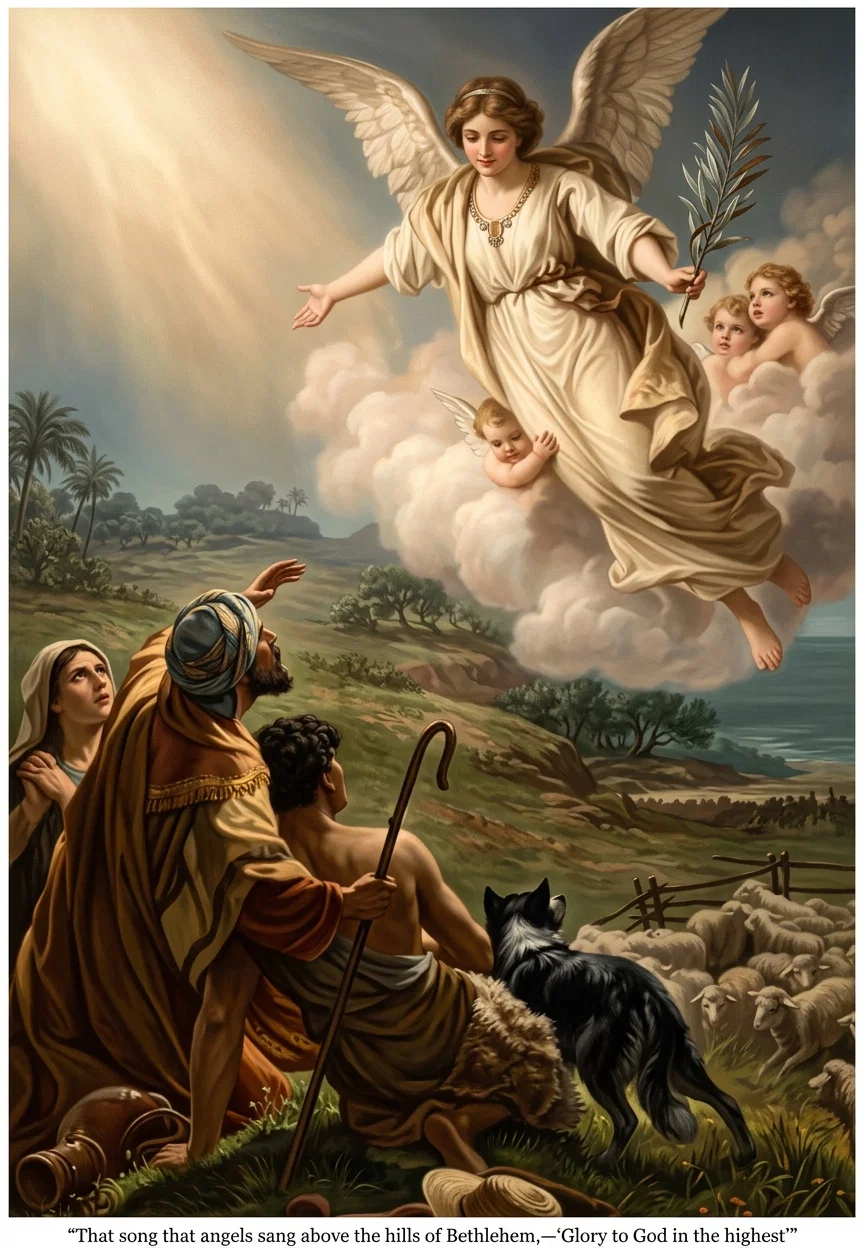
WHEN the plan of salvation was revealed to the angels, joy, inexpressible joy, filled heaven. The glory and the blessedness of a world redeemed outmeasured even the anguish of the Prince of Life. Through the celestial courts echoed the first strain of that song that angels sang above the hills of Bethlehem,—"Glory to God in the highest, and on earth peace, good-will toward men." And the lost pair in the Garden of Eden, standing as criminals before the righteous Judge, waiting the sentence their transgression merited, heard the first notes of the divine promise. Before the life of toil and sorrow which sin had brought upon them was depicted before them, before the decree that the wages of sin is death was pronounced, they heard the promise of redemption. Tho they must suffer from the power of their mighty foe, still through the merits of Christ they could look forward to victory. The mystery of the Gospel was spoken in Eden, when God said to the serpent, "I will put enmity between thee and the woman, and between thy seed and her seed; it shall bruise thy head, and thou shalt bruise his heel." If Satan could have touched the head with his specious temptations, the human family would have been lost; but the Lord had made known the purpose and plan of the mystery of grace, declaring that Christ had bruised the serpent under His feet.
The Lost Dominion
But not only had man come under the power of the deceiver, but the earth itself, the dominion of man, was usurped by the enemy. Through the plan of salvation, the sacrifice of Christ, not only was man but his dominion to be redeemed.
“That song that angels sang above the hills of Bethlehem,—‘Glory to God in the highest’”
Through the merits of Christ all that man lost through sin was to be restored. The time would come when there would be no more curse, but the throne of God should be in it, and His servants should serve Him. The promise would be fulfilled, "The righteous shall inherit the land, and dwell therein forever."
Through the plan of salvation a larger purpose is to be wrought out even than the salvation of man and the redemption of the earth. Through the revelation of the character of God in Christ, the beneficence of the divine government would be manifested before the universe, the charge of Satan refuted, the nature and result of sin made plain, and the perpetuity of the law fully demonstrated. Satan had declared that the law of God was faulty, and that the good of the universe demanded a change in its requirement. In attacking the law, he thought to overthrow the authority of its Author, and gain for himself the supreme allegiance. But through the plan of salvation the precepts of the law were to be proved perfect and immutable, that at last one song of love might rise to God throughout the universe, ascribing glory and honor and praise to Him that sitteth upon the throne and to the Lamb forever and ever.
What It Cost
To fallen man was revealed the plan of infinite sacrifice through which salvation was to be provided. Nothing but the death of God's dear Son could expiate man's sin, and Adam marveled at the goodness of God in providing such a ransom for the sinner. Through the love of God, a star of hope illumined the terrible future that spreads before the transgressor. Through the institution of the typical system of sacrifice and offering, the death of Christ was ever to be kept before guilty man, that he might better comprehend the nature of sin, the results of transgression, and the merit of the divine offering. Had there been no sin, man would never have known death. But in the innocent offering slain by his own hand, he beheld the fruits of sin—the death of the Son of God in his behalf. He sees the immutable character of the law he has transgressed, and confesses his sin; he relies upon the merits of the Lamb of God, who taketh away the sins of the world.
Ever the Same
The plan of saving sinners through Christ alone was the same in the days of Adam, Noah, Abraham, and in every successive generation that lived before the advent of Christ, as it is in our day. The patriarchs, the prophets, the martyrs from righteous Abel, looked forward to a coming Saviour, and they showed their faith in Him by sacrifices and offerings. The sacrifice of beasts shadowed forth the sinless offering of God's dear Son, and pointed forward to His death upon the cross. But at the crucifixion type met antitype, and the typical system there ceased.
The Son of God is the center of the great plan of redemption which covers all dispensations. He is the "Lamb slain from the foundation of the world." He is the Redeemer of the fallen sons and daughters of Adam in all ages of human probation. "Neither is there salvation in any other; for there is none other name under heaven given among men, whereby we must be saved." Christ is the substance or body which casts its shadow back into former dispensations. When Christ died, the shadow4ceased. At the death of Christ the typical system was done away, but the law of God, whose violation had made the plan of salvation necessary, was magnified and made honorable. The Gospel was good tidings of great joy to Adam, Noah, Abraham, and Moses; for it presented to them a coming Saviour. A more clear and glorious light now shines upon the Christian. Those who lived before the coming of Christ looked forward by faith to His coming; but what had to be grasped by faith by them is assurance to us, for we know that Christ has come, as foretold by the prophets. It is just as essential for us to have faith in our Redeemer, who came to earth and died our sacrifice, as it was for the ancients to believe in a Redeemer to come, represented by their offerings and sacrifices.
God's Law Exalted
In becoming man's substitute, in bearing the curse which should fall upon man, Christ has pledged Himself in behalf of the race to maintain the sacred and exalted honor of His Father's law. He came to convince men of sin, which is the transgression of the law, and through divine mediation bring them back to obedience to God's commandments. God has given the world into the hands of Christ, that He may completely vindicate the binding claims of the law, and make manifest the holiness of every principle. Jesus exchanged a throne of light and glory which He had with His Father, counting it not a thing to be desired to be equal with God, while man was lost in sin and misery. He came from heaven to earth, clothed His divinity with humanity, and bore the curse as surety for the fallen race. He was not compelled to do this; but He chose to bear the results of man's transgression, that man might escape eternal death.
(To be continued)
Christ's Coming the Salvation of His People
By H. W. Cottrell
By H. W. Cottrell
JESUS CHRIST has announced a grand reception. The announcement has been printed, and is being published to earth's remotest bounds—to every nation, kindred, tongue, and people.
No event in history is of such moment as this one that is yet to occur. This occurrence is not to be a mere happening, or something brought about by some device of man, but rather in fulfilment of the foreknowledge of man's Redeemer.
This reception marks the beginning of an endless era of righteousness and true holiness, where crime and sin can not enter. Thenceforth there will be no separation of the guests, but they will always abide with the Master of assemblies. The zenith of earthly prosperity, applause, and humanly bestowed honor will then have been reached, and overshadowed by the gifts celestial from King Jesus—salvation, immortality, eternal life, all of which are His to bestow.
Christ's coming is the crowning event of all occurrences since the world began, as it has been the hope of God's people from the days of righteous Abel until now.
In that day, death yields all its usurped power, and gives right of way to an endless life, sickness to health, sin to righteousness, sorrow yields up all its claims to joy, and that joy will be full in the experience of each soul.
The Reception
Said He, "I will come again, and receive you unto myself." And the reason is, "that where I am, there ye may be also." John 14:3. He understood as none others can the unspeakable joy His personal, divine presence would afford the redeemed saints.
Paul looked forward to that great reception, or reunion day, as the time of final, unalterable salvation; for said he, "Unto them that look for Him shall He appear the second time without sin unto salvation." Heb. 9:28.
Salvation of His people in that day has a deeper shade of meaning than the salvation of sinners during probation. In this time the spiritual indwelling of Christ in the heart saves from sin, and conquers, subdues, brings into subjection, all the evil tendencies in the soul to commit sin, just as long as the individual is willing to abide with the Christ.
Rev. 3:20; Gal. 2:20; 1 Cor. 9:27. No harm can befall while the soul abides—trusts—in Christ. The individual must learn the lesson not to loose "from Crete." Acts 27:21.
But in the day of Christ's second coming, when mortal men are immortalized, and "death is swallowed up in victory" (1 Cor. 15:51-53), every tendency in the child of God to do evil will be eternally annihilated in the change to immortality—swallowing up of life. When "death" is swallowed up in victory," sin, which brought death, with all its tendencies, with all their environments, will be no more forever.
Salvation, dear reader, will be obtained then in its entirety—physical, spiritual, and mental.
Christ's coming, blessed be His holy name, brings a glorious salvation, which is freedom from every possibility of sin, death, or of doubt; for all these must of necessity, being of the same family, go down, eternally down, together into utter oblivion. Freedom then in God will be the freedom of God as pertaining to man's relation to every phase of the environments of sin. It is "impossible for God to lie." Heb. 6:18. So it will then be impossible for His children to die; for they have the highest type of heavenly freedom—at liberty to be tempted no more throughout eternity. "Neither can they die any more: for they are equal unto the angels; and are the children of God, being the children of the resurrection." Luke 20:36.
In the interest of this completed salvation, prophets have searched, and the angels desire to look into; should not we? "Of which salvation the prophets have enquired and searched diligently, who prophesied of the grace that should come unto you: searching what, or what manner of time the Spirit of Christ which was in them did signify, when it testified beforehand the sufferings of Christ, and the glory that should follow. Unto whom it was revealed, that not unto themselves, but unto us they did minister the things, which are now reported unto you by them that have preached the Gospel unto you with the Holy Ghost sent down from heaven; which things the angels desire to look into." 1 Peter 1:10-12.
The General Assembly
"But ye are come unto Mount Zion, and unto the city of the living God, the heavenly Jerusalem, and to an innumerable company of angels, to the general assembly and church of the first-born, which are written in heaven, and to God the Judge of all, and to the spirits of just men made perfect." Heb. 12:22, 23.
This assembly will be the result of an individual response to the trumpet-call of King Jesus, and it involves the resurrection of all the sleeping saints of all ages, and the translation of the surviving righteous. At this time He fulfils His former promise, and appears in person.
"For the Lord Himself shall descend from heaven with a shout, with the voice of the Archangel, and with the trump of God: and the dead in Christ shall rise first: then we which are alive and remain shall be caught up together with them in the clouds, to meet the Lord in the air: and so shall we ever be with the Lord. Wherefore comfort one another with these words." 1 Thess. 4:16-18. This is the culminating period. "Behold, I show you a mystery; We shall not all sleep, but we shall all be changed, in a moment, in the twinkling of an eye, at the last trump: for the trumpet shall sound, and the dead shall be raised incorruptible, and we shall be changed." 1 Cor. 15:51, 52.
Mysterious as it is, Christ will come, the resurrection will occur, the reception will be held in the air. His attending angels5gather the resurrected ones from all parts of the inhabited globe, and the living are "caught up together with them . . . to meet the Lord in the air."
The Heavenly Home-Coming
Then Christ, the divine Son of God, escorts them heavenward to the mansions in His Father's house, which He had promised them He would prepare for them. And as6they near the heavenly courts, His voice is heard to sound forth to His attending angels, in unparalleled melodious strains, "Open ye the gates, that the righteous nation which keepeth the truth may enter in." Isa. 26:2. And the gates of pearl on their glittering golden hinges swing wide open, and the nation born in a day enters in. Home at last! And they sang, "And after these things I heard a great voice of much people in heaven, saying, Alleluia; Salvation, and glory, and honor, and power, unto the Lord our God: for true and righteous are His judgments." Rev. 19:1, 2.
All will join in singing that song. Reader, will you be there? You may be. And you will be there if you are willing to comply with the conditions. Man can not save himself. It will require the life of a divine Christ to assure us the blessing so gloriously portrayed in His Word. "Neither is there salvation in any other: for there is none other name under heaven given among men, whereby we must be saved." Acts 4:12.
In that city of God we will live with Christ face to face. "And they shall see His face; and His name shall be in their foreheads." "And the city had no need of the sun, neither of the moon, to shine in it: for the glory of God did lighten it, and the Lamb is the light thereof." Rev. 22:4; 21:23.
The blind eyes will be opened, deaf ears unstopped; the cripples will be perfectly sound, and the dumb will join in the song of eternal glory to the Father and the Son of all mercies. "He which testifieth these things saith, Surely I come quickly. Amen. Even so, come, Lord Jesus." Rev. 22:20.
The Word of God
By S. O. James
What Is It Like?
By S. O. James
LIKE the hammer that crumbles the hardest stone;
Like the gentle drops of the morning dew;
Like a legend of old with mystic tone;
Like a book that ever is fresh and new;
Like a true reprover that shows the way;
Like a comforter sweet that soothes our grief;
Like a thunderclap on the clearest day,
Yet still as the grave or the midnight thief;
Like a sword that pierces the calloused heart;
Like a balm that mollifies the pain;
Like a shield that quenches the fiery dart,
And turns it upon the foe again;
Like the cooling waters that fill the bowl
To the parched lips on the burning sand;
Like a friendly letter to cheer the soul
Of the pilgrim lone in a weary land;
Like a pillar of cloud o'er Israel's camp;
To the wicked a fire that burns the chaff;
Like the cheering light of a burning lamp;
To the righteous a comforting rod and staff;
As an innocent lamb so meek and mild;
As a lion fierce on the desert wild.
But where would comparisons ever end
In telling the goodness of such a friend?
O, priceless gem to a lost world given,
My guide to happiness, home, and heaven!