Signs of the Times, Vol. 33, No. 20.

With Our Inquirers

Signs of the Times

May 15, 1907

Pacific Press Publishing Company · Mountain View, California · May 15, 1907

With Our Inquirers

"If ye will inquire, inquire ye." Isa. 21:12
[All questions to this department will be answered which to the editors will minister to the general good of the readers and to the mission of the paper. The same question can not be answered repeatedly in the same volume. The name and address must accompany question, not for publication, but as an evidence of good faith, and that answer may be made by letter if deemed advisable. It is well always to enclose a stamp for reply.]

2073.—Character of a Witch.

Does the idea of one's being a witch mean that she is a mean person? Does 1 Sam. 15:23 indicate that witchcraft is the same as rebellion? R. F. C.
A wizard (feminine, witch), was one who had a "familiar spirit," one who, generally speaking, was controlled and influenced by that spirit. If he truly had a familiar spirit and was not shamming, as many pretended spiritualistic mediums are at the present time, he was under the control and influence of Satan's minions, or demons. Outwardly it is possible for one to be pleasing in manner, so as not to be considered a "mean person," but utterly without moral principle. It was for that reason that God prohibited their very existence among His people. They would lead to destruction all who heeded their teachings or who fell under the mysterious, baleful influence of those thus possessed. Better indeed under God's guidance that the one person should die than that thousands should be corrupted. As to the text 1 Sam. 15:23, "Rebellion is as the sin of witchcraft," it is not implied that rebellion is witchcraft, or identical, but that rebellion is opposition to God just as witchcraft is opposition to God. Both of them are the same in result, an utter turning away from God to the great original enemy of God. Saul was rebellious against God in that he did not follow the Lord's command concerning Amalek. That is the lesson of the chapter. He ended his career by seeking unto one who had a familiar spirit. 1 Chron. 10:13, 14. See also Lev. 19:31; 20:6, 27; 1 Sam. 28:3-10.

2074.—Divorce and Marriage.

If a man (or woman) puts away his wife (or husband) for fornication, does that free him (or her) so that he (or she) is at liberty to marry again? M. J. M.
This is our understanding of the teaching of the word, according to Matt. 5:32. The innocent party has the Scriptural right to remarry.

2075.—A Mixed Case of Marriage.

If a man had been married three times and his first wife was living when he married the second time, but was dead when he married the third time, which of the two living would be the true wife, the second or the third?
The question is not clear. Was he divorced from the first wife when he married the second? Was the divorce obtained on Scriptural grounds? The question implies that the second wife is still alive. How did he separate from her before he married the third time? If there was no true separation from the first wife when he married the second, the second marriage is certainly null and void, the man was guilty of bigamy, or the second wife is not a legal wife. In some States a man may have more than one legal wife. When the first wife died the duty of the man without any question would be to legally marry the second wife, if he had not done so before. If he forsook the second wife, which was not a legal wife, and married the third, the third would be the legal wife, after the death of the first. It seems to us that the question is not so much a question of the true wife as it is a true husband. With one so mixed in his marriages as that, it would be quite a question whether he could have been a true husband.
It is almost utterly impossible to give a satisfactory answer in such cases as this. We would advise these parties, and all others, if they want to know just what the Lord teaches in this respect to seek the counsel of some good minister, one who will give them the teachings of the word and not answer the desire of their hearts. If the Lord says, remain single, remain single. If there had been regular legal divorces and new family ties formed, and new fruit of the families, it certainly is a question that ought to be wisely and faithfully deliberated before families are broken up and children disgraced before the world. These are questions that can not be settled by a categorical answer to some question asked thru the mails. Our loose marriage and divorce laws are responsible for not a little of this trouble. The things that Christians ought to follow, however, are God's word and a true conscience.

2076.—A Living Soul. Gen. 2:7.

Gen. 2:7 declares that "the Lord God formed man of the dust of the ground, and breathed into his nostrils the breath of life; and man became a living soul." Will you please tells us, was that soul mortal or immortal? If neither, what kind of a soul did Adam possess? L. D. W.
Our inquirer ought to have read the text more carefully. It does not say that the Lord breathed into the man a living soul, or breathed into him a soul, a man within a man. It declares that when that breath of life came into the man, the man became a living soul; Adam was the living soul or living creature. If he was a living soul after the breath of life was breathed into him, he was a lifeless soul before; and so the term soul is used to mean persons. Take, for instance, Joshua 10, over and over again we are told that so many souls were slain. In the original we have the term "dead soul." Adam was a living being possessing eternal life, a life which God breathed into him, possessing it conditionally by faith. He was not mortal or he would then have been subject to death. He was not immortal, for then he could not have died. He was a candidate for immortality. If by faith he had held to the eternal life of God by living righteously, he would have developed an incorruptible character upon which God would have placed the stamp of immortality.

2077.—The Wicked and the One Thousand Years.

Will the wicked dead live during the one thousand years? G. P.
The wicked dead will not live during the thousand years. This is clearly stated in Rev. 20:5: "The rest of the dead lived not again until the thousand years were finished." All who were not of Christ perished in the glory of His second coming. 2 Thess. 2:8, and other passages.

2078.—Isa. 65:20.

Do you know any translation of this text that is better than King James? If so, will you please give it? A. L. M.
There are other versions that give slightly different shades of meaning, but none that are materially different from that of King James.

2079.—Spirit of Man. Eccl. 3:21.

Does not Eccl. 3:21 imply that the soul of man ascends upward at death? D. E. O.
The text does not use the term soul but spirit, and it does not make any statement as to that. "Who knoweth the spirit of man, whether it goeth upward, and the spirit of the beast, whether it goeth downward to the earth?" So reads the American Standard Revised Version, and that is the thought of the text. Moreover the word translated spirit, ruwach, is the same that in verse 19 is translated breath, "they have all one breath." It comes from a word meaning to blow, to breathe. It is translated air, anger, blast, breath, courage, mind, spirit, wind, etc. It simply means their breath or breath of life. It came from God as breath of life; it goes again as breath of life. It is not an intelligent entity of itself. If it ascends to God it simply ascends to Him as life, not as a personality. Eccl. 12:7.

2080.—The Ribbon of Blue. Num. 15:38.

What is meant by the ribbon of blue in ancient Israel? E. V. W.
The passage of Scripture in question, with its context, tells us very clearly why the Lord asked Israel to wear the ribbon of blue. We quote from the Revised Version: "Speak unto the children of Israel, and bid them that they make them fringes in the borders of their garments throuout their generations, and that they put upon the fringe of each border a cord of blue; and it shall be unto you for a fringe, that ye may look upon it, and remember all the commandments of Jehovah, and do them; and that ye follow not after your own heart and your own eyes." It was to be to them a constant reminder that they were separated from the world and separated unto God.

2081.—In Heaven While on Earth. John 3:13.

Please explain this text. Was Christ in heaven when He was talking? Is the Authorized Version a good translation of the text? A. L. M.
Yes, it is a fair translation of the Greek that is there. The American Revised Version has this note, "Many ancient authorities omit 'who is in heaven.'" The sense of it seems to be very clear that Jesus was as truly one with the Father as tho He were literally, physically in heaven. Compare with Eph. 2:6, "And raised us up with Him, and made us to sit with Him in the heavenly places, in Christ Jesus." Christians, therefore, while physically in this world, yet literally are citizens of the heavenly kingdom and are as truly represented there as tho they were physically present. Even so the place of our Lord Jesus Christ in heaven was not forfeited when He came to this earth. While physically He was here, yet in God's great plan and system, He was in perfect oneness with the Heavenly Government.

2082.—Prince of Tyrus.

Please explain Ezekiel 28, as regards the prince of Tyrus. W. H. D.
Back of all the evil perverted kingdoms of earth is Satan. He is therefore sometimes called "King of Babylon," as in Isa. 14:4. Later on in that same chapter "Lucifer." In the 28th chapter of Ezekiel he is represented as the "king of Tyrus," or Tyre, while the real king of Tyre is called the prince of Tyre. Verses 2 to 10 refer to the earthly king of Tyre as the prince of Tyre, and show his selfish exaltation; so much so that he makes himself as God, calls himself God. This overweening ambition is inspired by Satan, who is referred as the king of Tyre in verses 11-19. This language clearly shows that he was once an angel of God; for this language could be spoken of no mortal man. Verse 14: "Thou wast the anointed cherub that covereth;" verse 15: "Thou wast perfect in thy ways from the day that thou wast created, till unrighteousness was found in thee." All those things were true of Lucifer before he fell, and the doom pronounced upon him will be true of Satan when it is fulfilled.

2083.—"Thy Seed." Gen. 3:15.

Do not the words "thy seed" in Gen. 3:15 refer to fallen angels and not to the seed of the snake? A Subscriber.
They refer to all of Satan's followers. Jesus said to the Jews, "Ye are of your father the devil, and the lusts of your father ye will do." It is a common thing in the Scriptures to call persons sons of the one they follow. The fallen angels are not the seed of Satan in the sense of generation, but only in the sense in which wicked men are; they are led by him and infused with his spirit. It is a curious fact, however, that there probably is no animal in all the creation which has aroused the enmity of man as has the snake. Yet the prophecy is not primarily as regards the snake, but as regards the followers of Satan and the followers of Christ.

Christ Will Come Again

FOR four long millenniums the coming of the World's Redeemer, the Light of Life, was foretold. By seer and priest, by sacrifice and oblation, it was predicted. Abel, by faith, saw in the slain lamb the Lamb of God. Noah saw in his sacrifices and covenant-bow, the promise of the Rest he could not give the world. Abraham saw in the ram of Moriah the Substitute-sacrifice of God's furnishing, and in his child of promise the Promised Seed. And so Moses and Joshua and Samuel and David and Isaiah, and all the others of faith looked forward for the Hope of Israel, from the tribe of Judah.
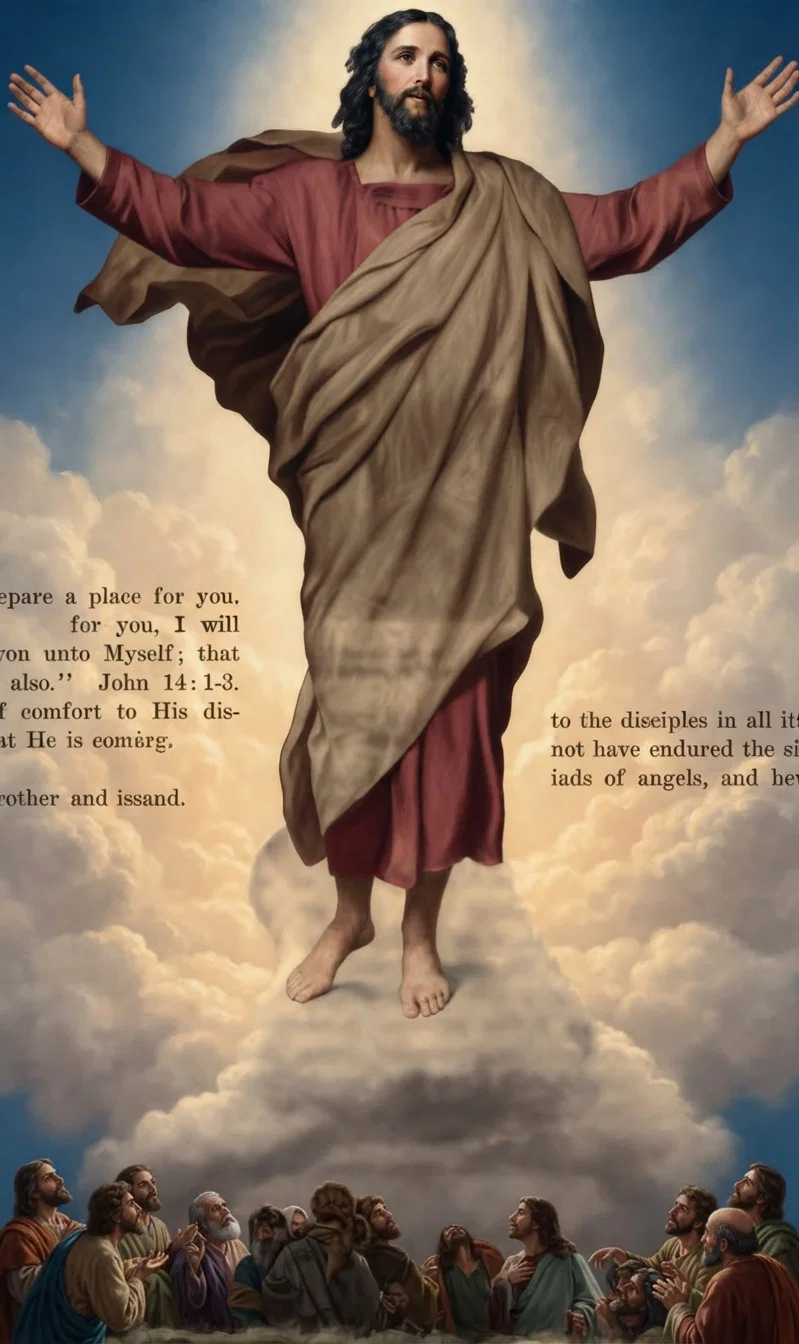
“This same Jesus, which is taken up from you into heaven, shall so come in like manner as ye have seen Him go into heaven.” Acts 1:11.
In "the fulness of the time" He came, "born of a woman, born under the law." Gal. 4:4. He was a real person. He was nursed at His mother's breast. He grew up among other children and youth. He was baptized, tempted, and He overcame. He lived and died, preached and prayed, taught and healed, loved and labored, among men.
"This same Jesus" is coming again. His apostle declares: He "will come again." Heb. 9:28. Jesus Himself said: "Let not your heart be troubled; believe in God, believe also in Me. In My Father's house are many mansions; if it were not so, I would have told you; for I go to prepare a place for you. And if I go and prepare a place for you, I will come again, and will receive you unto Myself; that where I am, there ye may be also." John 14:1-3.
These are Christ's words of comfort to His disciples. The core of them is that He is coming again. How must those disciples have understood His words? Could they have come to any other conclusion than this, that Jesus, the literal, personal Master, was coming again?—They could not have concluded otherwise. Did not Jesus know that they would so understand it?—He certainly did. Did He ever teach otherwise?—He certainly did not.
The Lord does not tantalize His people. He did not give His word for the great and learned, for the mystic or the philosopher. It was given for the great mass of mankind; for those of whom it is said, "The common people heard Him [Jesus] gladly." His word is for the common people. His promises are for the common people. For them He made the earth. For them He died. The common people He is coming to redeem.
How have the common people understood God's plan? In simplicity of faith they have believed Him. They believe He came; that He was born of a virgin; that He was the Word made flesh; that "He died for our sins;" that He pleads His blood in our behalf; that He is coming again, Friend, Redeemer, Saviour, King. From Genesis to the Revelation, in type and symbol and shadow and literal promise, His coming is foretold. And the volume of Sacred Scriptures closes with promise and prayer: the promise of Christ to the last generation, "Yea, I come quickly;" the responsive prayer of the church, "Amen, come, Lord Jesus." Reader, in this "fulness of time" can you thus respond?

The Ascended Lord.

By Mrs. E. G. White.
THE disciples not only saw the Lord ascend, but they had the testimony of the angels that He had gone to occupy His Father’s throne in heaven. The last remembrance that the disciples were to have of their Lord was as the sympathizing Friend, the glorified Redeemer. Moses veiled his face to hide the glory of the law which was reflected upon it, and the glory of Christ’s ascension was veiled from human sight. The brightness of the heavenly escort, and the opening of the glorious gates of God to welcome Him, were not to be discerned by mortal eyes.
Had the track of Christ to heaven been revealed to the disciples in all its inexpressible glory, they could not have endured the sight. Had they beheld the myriads of angels, and heard the burst of triumph from the battlements of heaven, as the everlasting doors were lifted up, the contrast between that glory and their own lives in a world of trial, would have been so great that they would hardly have been able to again take up the burden of their earthly lives, prepared to execute with courage and faithfulness the commission given them by the Saviour. They were to keep distinctly before their minds the beauty and majesty of His life, and the mysterious union of the divine and human in His nature. His visible ascent from the world was in harmony with the meekness and quietness of His life. The disciples returned to Jerusalem, rejoicing because Jesus had wrought out salvation for man. He had ascended to heaven to carry forward the work of atonement, as man’s Advocate and Intercessor with the Father.

The Manner of Christ's Coming

By Abdiel
THE work of Jesus Christ in the great scheme of salvation is made up of different steps and acts. He stepped down from the throne of Deity and gave Himself for the salvation of His creatures. He became an Angel-messenger of God—among the angels. He stoops lower, and is incarnated, a Man among men. He met the climax of His eternal sacrifice by His death upon the cross. He arose again. He ascended on High. He ministers as priest before God. He comes again in glory transcendent, supernal.
Of all the steps or events in that great drama of love and power there is nothing more important than His second coming; for around it cluster all the hopes of the redeemed; and if it be not consummated, all the work of the past is for naught.
Small wonder, then, it is that the devil has done his best, or worst, to make of no effect the second coming of Christ in the minds of men. He has belittled it by His first falsehood, "Ye shall not surely die." He has brought upon it reproach by leading men to teach above that which is written. He has connected with it fanatics of every sort, and has made many believe that the doctrine was responsible for the fanaticism. He has thrown round about the doctrine a mysticism, an indefiniteness, that is entirely foreign to the word of truth. It is made to mean death, and spiritual revival, and Spiritualism, and Christian Science, and New Thought, and "the secret rapture" (whatever that may be), and still other things. The devil is at the bottom of it all with all the various schemes, if by some means he may deceive all. "Be not deceived" is the repeated injunction of the Master.

His First Advent.

How will He come the second time? Let us first ask, How did He come the first time?—Literally, personally, visibly. Men saw Him, handled Him, talked to and with Him, ate with Him, walked with Him. He was a literal, personal Being. No believer in the word questions this as regards His first advent.
He lived here upon this earth thirty-three years. He wrought miracles, preached the word, saved souls from sin, died on the cross, was raised from the dead, the same literal Jesus. Forty days after His resurrection He ascended to heaven. Clouds of angels of God met and escorted Him on His way. Two remained behind to instruct and comfort His disciples who sorrowfully watched their ascending Lord. And this is what the angels told them:
"Ye men of Galilee, why stand ye gazing up into heaven? THIS SAME JESUS, which is taken up from you into heaven, shall SO COME in LIKE MANNER as ye have SEEN HIM GO into heaven." Acts 1:11.
Note the emphasis. It is the "same Jesus," not another, not a representative. The "same Jesus" with whom they had associated for over three years, who died upon the cross, whom they had seen laid in the tomb, who rose again, the same Jesus is coming again.
They had seen Him rise Master over earth's attraction, and received by a cloud of angels. This same Jesus shall so come in like manner; even as they saw Him ascend, so shall He come again.
And this scripture is confirmed by many others. Listen:
"Behold, He cometh with clouds; and EVERY EYE SHALL SEE HIM." Rev. 1:7.
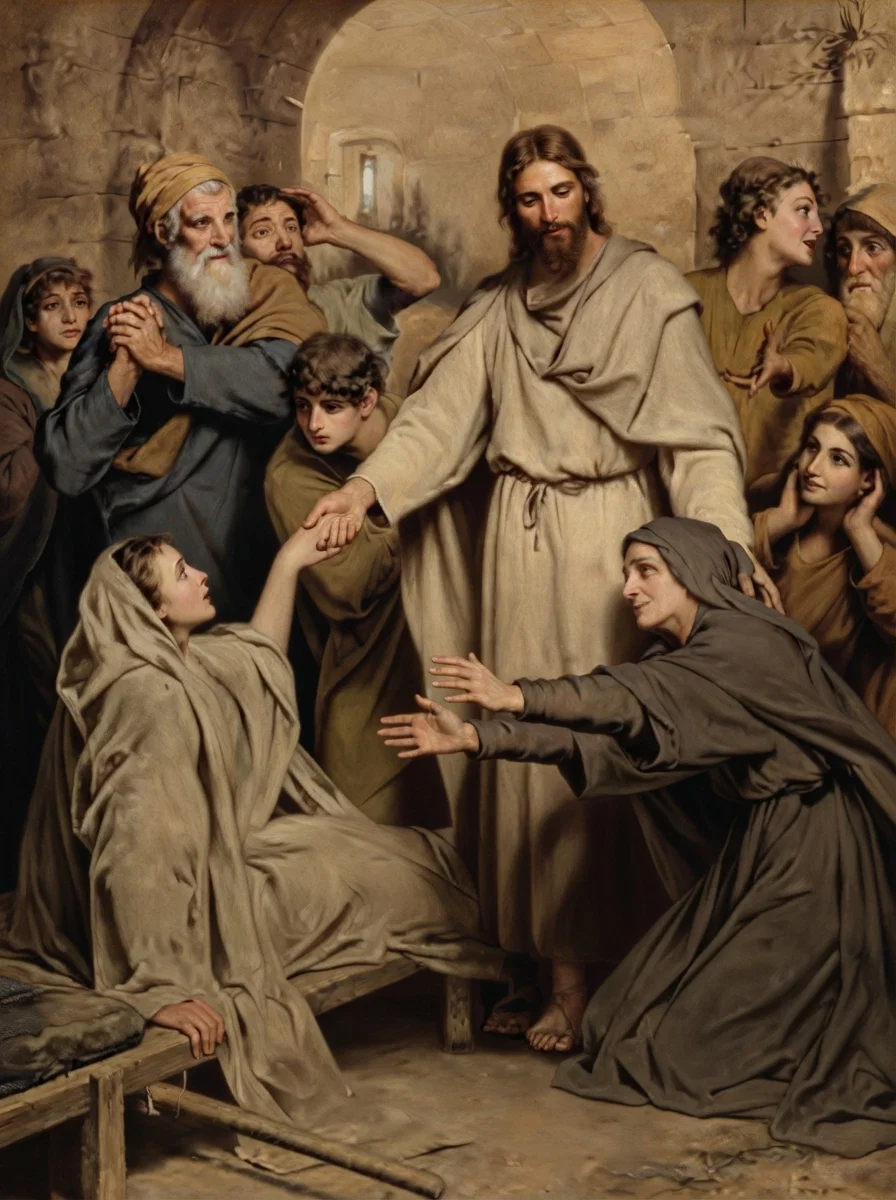
Jesus Restoring Life to the Young Man of Nain. 'This same Jesus' is coming again.
"Then shall they SEE THE SON OF MAN COMING in a cloud with power and great glory." Luke 21:27.
"The Son of Man shall come in the glory of His Father with His angels; and then He shall reward every man according to his works." Matt. 16:27.
What more testimony can we ask? Yet, notwithstanding this, there are those who teach that when Christ comes the second time for His people, it will be a secret coming, known only to His people. That, they tell us, is the parousia (pronounced, par-oo-see-ah), or presence of Christ. Some even contend that He is now here gathering out His bride; and that by and by He will come with His bride in a visible form.
But neither the Greek terms nor the Scriptures in general give any such idea as that. There are six different Greek words used of the Master's coming as follows: (1) The verb erchomai and its derivatives; it simply means to come, to go, to pass, without particular reference to manner. The noun denotes the simple act of coming, going, passing.
(2) The verb ephistemi, meaning to place upon, over, close by, to stand by or near, to come suddenly upon. Used of the judgments of God, in Luke 21:34; 1 Thess. 5:3. (3) Heko, defined to mean "to become, to have arrived." It simply means that the coming to which it refers is accomplished. (4) Parousia, meaning "presence, a coming, arrival, a being present, presence of persons." It means personal, bodily presence. See 2 Cor. 10:10; 7:6. The word is rendered in our Common Version by "coming," and "presence" only. (5) Apokalupsis, meaning disclosure, revelation, manifestation, appearance, uncovering, making known; the Greek title of the book of the Revelation. (6) A word not translated "coming," but "appearing," and "brightness;" namely, epiphaneia, "glorious display."
These last three words, when used of Christ's second coming, are erroneously applied to different comings, when they are descriptions of different phases of the same event. There are, in connection with Christ's priesthood, closing events which may be and are spoken of as comings, but not to be confounded with His visible coming for His people. A study of Christ's priesthood and the sanctuary question will make this clear. Without a knowledge of His priesthood, all is dark and confused. One of those "comings" is when Christ comes in before His Father to receive the kingdom (Dan. 7:13, 14). The other "coming" is when His priestly work is closed and He comes to reckon with His servants before He comes in glory. Matt. 25:19. This is not a coming to earth or for His servants. It is a judgment act previous to Christ's coming, when probation shall close, the beginning of the day of God's wrath, known only to Him. Rev. 22:11, 12; 2 Peter 3:10; Matt. 24:42-44, 46; 25:10, 19; Mark 13:35; Rev. 3:3, et al. Then Christ is no longer priest, but comes into relationship to His people as judge.
But His second personal coming of promise and declaration is revealed under the parousia, the epiphaneia, the apokalupsis. The first word referring to His personal presence, the second to the forthshining of His glory, the third to His true disclosure as King of Kings, the glorious Son of God. That the personal presence (parousia) of Christ is not a secret affair, note the following Scriptures:
"For this we say unto you by the word of the Lord, that we that are alive, that are left unto the coming (presence, parousia) of the Lord, shall in nowise precede them that are fallen asleep. For the LORD HIMSELF shall descend from heaven, with a SHOUT, with theVOICE of the archangel, and with the TRUMP OF GOD: and the dead in Christ shall rise first." 1 Thess. 4:15, 16.
"Whom the Lord Jesus shall slay with the breath of His mouth, and bring to naught by the manifestation of His coming [the epiphaneia of His parousia; literally by the FORTHSHINING of His PERSONAL PRESENCE]." 2 Thess. 2:8.
"For as the lightning cometh forth from the east, and is seen even unto the west; so shall be the coming [parousia, presence] of the Son of Man." Matt. 24:27.
Certainly none of these scriptures indicate a secret, quiet, still coming. It is over a quaking earth, with trumpet tones and outbursts of supernal glory that Christ comes the second time—literal, personal, visible, "this same Jesus" will come. Then men will see Him revealed in all His divine glory, unveiled. "Every eye shall see Him." Some in the light of that glory will pale and die. Others with glad hearts, having His glory within, will say, "Lo, this is our God; we have waited for Him, and He will save us."

The Second Coming of Christ--the Hope of the Church

HOPE is made up of desire and expectation. The hope of the world is confined to things of time and sense, and is void of satisfaction at the last, because, beyond the sleep of death, there appears no gleam of light to gladden the intellect. The hope of the church pierces the gloom of earth's closing scenes, and sees glory immortal, and joy unending in realms of bliss which are unmeasured by material tests.
It is therefore in place to ask at once, Upon what is based such an extravagant hope as that held by the church? Does nature, or science hold out such allurements? —By no means. The things of nature are material and evanescent. Science has never penetrated the house of the departed to reveal its secrets. To what, then, does the church turn for its comfort? There is but one source from whence it can gather knowledge of man's eternal destiny, and that is the word of Jehovah.
This being true, there can be but one spring of hope reaching beyond the confines of this state of being. He who would have this to comfort him amid the trials of life must therefore receive the statements of the Lord's own word concerning the Gospel of the kingdom.
The name of Him whose kingdom is promised to be shared with men, is Emmanuel—"God with us." Matt. 1:23. The Gospel which engages to do this, is, therefore, the good news of His willingness to dwell in men, and thus rule over their lives and actions. This is so to change sinful men as to remodel them after His own image. But having done so much for men here in the flesh, is the mission of Christ then completed? The apostle has well replied to such a question: "If in this life only we have hope in Christ, we are of all men most miserable." 1 Cor. 15:19.
How unsatisfying would be such a hope. Indeed, no one could be induced to leave the attractions of the world for such a prospect. The only real comfort, therefore, held before men in the Gospel is the hope, not only of being like Him in this world, but of being with Him where He is.
That which so sorely grieved Christ's immediate disciples was the thought received from His discourses that He was to be taken away from them, and they did not know but forever. His knowledge of their wretched state of mind called for this exhortation:
"Let not your heart be troubled: ye believe in God, believe also in Me. In My Father's house are many mansions: if it were not so, I would have told you. I go to prepare a place for you. And if I go and prepare a place for you, I will come again, and receive you unto Myself; that where I am, there ye may be also." John 14:1-3.
Continuing His discourse, the Saviour added words of encouragement and promise for their benefit while in their earthly work, asking them to rejoice because He was to go away in order to prepare a place for their reception. Verses 27, 28. Then, after telling them that in the meantime they were to have His representative—the Holy Spirit—to be their Comforter, they became reconciled, saying, "Lo, now speakest Thou plainly, and speakest no proverb. Now are we sure that Thou knowest all things, and . . . by this we believe that Thou camest forth from God." Chap. 16:29, 30. From this time forth the hope of Christ's return to earth became the source of their constant joy.
The "beloved disciple" refers to this hope thus, when exhorting the faithful: "Beloved, now are we the sons of God, and it doth not yet appear what we shall be; but we know that, when He shall appear, we shall be like Him; for we shall see Him as He is." 1 John 3:2. The whole matter of his future being, the disciple willingly left to be determined at the appearance of the Master, and with this he was entirely satisfied.
Another, seeing with prophetic eye the jeopardy in which the church would sometime be placed thru the greed of gain, exhorts to steadfastness in these words: "Be patient therefore, brethren, unto the coming of the Lord." James 5:7. Pressing the word a little further he exclaims: "Stablish your hearts, for the coming of the Lord draweth nigh. Grudge not one against another, brethren, lest ye be condemned; behold, the judge standeth before the door." This language would imply that the apostle's entire hope centered in the coming of the just One. Until then the church would be oppressed; but at that time it would not only be relieved of vexation, but would witness justice visited upon its oppressors.
Again, one of the Lord's most honored associates, while in the flesh, also points to the second coming of the Lord Jesus, as the time when the reward of the faithful will be received. In exhorting the church leaders to conscientious loyalty, he said that, being ensamples to their flocks, they would surely "receive a crown of glory that fadeth not away," when the chief Shepherd shall appear." 1 Peter 5:3, 4.
Such persuasive discourse seems all the more appropriate to the generation which is to witness, with the apostle, the fruition of such a hope, when we read the prophecy of what the trend of men's minds is to be regarding that ground of confidence. Thus he says: "Knowing this first, that there shall come in the last days scoffers, walking after their own lusts, and saying, Where is the promise of His coming? for since the fathers fell asleep, all things continue as they were from the beginning of the creation." 2 Peter 3:4. This language reveals that the faith and hope cherished by the apostolic church, would, in a measure, give place to other desires, more in conformity with the tendency of the times, and that a revival of the ancient belief in the second advent would call forth ridicule upon the heads of those propagating it. "But," says the apostle, notwithstanding such derision, "the day of the Lord will come as a thief in the night; in the which the heavens shall pass away with a great noise, and the elements shall melt with fervent heat, the earth also and the works that are therein shall be burned up." Concerning the certainty of this doctrine, the apostle exhorts the church as follows: "Wherefore, beloved, seeing that ye look for such things, be diligent that ye may be found of Him in peace, without spot and blameless." Verses 10-14.
But one may ask, Why preach such a doctrine? Why not leave the matter to every one's predilection, so as not to stir up differences of opinion? If salvation were a question of mere opinion, there would be no need to preach any sort of gospel, because then every one, of every shade of opinion, could revel in pleasures of the basest kind, and still have assurance of eternal bliss, after some fashion. The Bible, however, is very definite regarding the form of faith to be taught and practised. Not only does it prescribe the rules of daily life, but opens to all its readers the very method by which one and all must enter into the presence of the great King. "I would not have you to be ignorant, brethren," says the great missionary apostle, "concerning them which are asleep, that ye sorrow not, even as others which have no hope. For if we believe that Jesus died and rose again, even so them also which sleep in Jesus will God bring with Him." 1 Thess. 4:13, 14.
What a promise! Just so surely as one believes that Jesus came forth from the prison-house of death, even so, after the same manner, will God bring forth that believer as He brought forth the Master in whom such belief rests. But how, and when will this be done? The answer is ready:
"For this we say unto you by the word of the Lord, that we which are alive and remain unto the coming of the Lord shall not prevent [go before] them which are asleep. For the Lord Himself shall descend from heaven with a shout, with the voice of the archangel, and with the trump of God: and the dead in Christ shall rise first. Then [after that] we which are alive and remain shall be caught up together with them in the clouds to meet the Lord in the air; and so [after this manner] shall we ever be with the Lord." Verses 15-17. The order of events stated in the foregoing, and the conclusion following, are all worthy of grave consideration. First of all, the

Christ's Coming, the Hope of the Church.

(Continued from page 5)
Lord assures us that those who sleep in Him, tho hidden beneath the sod, will not be forgotten in the great day of His coming. To give assurance of this, He promises that these shall be brought forth from their dusty beds, even before the living saints receive exaltation. The dead being first raised incorruptible, the living saints will join them and the Lord Jesus in an upward flight to those mansions He went to prepare, when He ascended to heaven from before Bethany nineteen centuries ago, in sight of His sorrowing disciples. The sacred text then significantly adds: 'And so [in this way] shall we ever be with the Lord.'
But is there no other way for the redeemed to 'ascend above the heights of the clouds,' and to 'sit upon the mount of congregation,' in the presence of the Most High? Upon this point let us hear the word of the Lord: 'For the Son of Man shall come in the glory of His Father with His angels; and then [at that time] He shall reward every man according to his works.' Matt. 16:27.
One thing may be accounted certain. If every one is rewarded 'according to his works,' at the very time of the Lord's second coming, they could not have received that reward, even tho having died a thousand years before. On this point the writer of the book of Hebrews says of those who, in ages before his time, obtained a good report thru their faith, even to martyrdom, did not then receive the promise, because that thru God's own arrangement, they could not be made perfect until others were ready for the same result. Heb. 11:39, 40.
The same apostle when preparing for his execution by the decree of Cæsar, wrote from Rome to Timothy:
'I am now ready to be offered, and the time of my departure is at hand. I have fought a good fight, I have finished my course, I have kept the faith: henceforth there is laid up for me a crown of righteousness, which the Lord, the righteous Judge, shall give me at that day: and not to me only, but unto all them also that love His appearing.' 2 Tim. 4:6-8.
On the very border of the grave, this veteran missionary looked with an undimmed eye of faith to the time of the Lord's appearing, when he, with all others who love that appearing, will receive a crown of life. This was the cheering hope of Enoch, the seventh descendant from Adam (Jude 14). It was the sheet anchor of Job, of David, of Isaiah (Job 19:25, 26; Ps. 17:15; Isa. 25:8, 9;), and of all the prophets. The seer of Patmos closes his visions of eternal glory with the ecstatic words, born of victorious hope in behalf of the church in all ages: 'He which testifieth these things saith, Surely, I come quickly. Amen. Even so, come, Lord Jesus.' May we all be in that frame of mind to re-echo the response of the exalted prophet, with one long and hearty Amen.
Continue reading: When Ye Shall See These Things, Know