Your ShelfYour Projects

Signs of the Times, Vol. 37, No. 38.

Our God Is Good
Earlier text: Out of Babylon to Zion

Current Events

That Mr. Ballinger has proved false to his trust as secretary of the interior was the decision of the five Democratic members of the committee who had the Ballinger, Pinchot, Glavis, et al case under investigation. They urge that the secretary should be asked by proper authorities to resign his office. The Republican members issued no report. An independent report was given by Mr. Madison, the insurgent Republican from Kansas, which also declared that Ballinger "was an unfaithful trustee of the people's interests, and should not be retained."
A new world's health organization, headquarters of which is in Cincinnati, Ohio, is waging a campaign against kissing. Their claim is that some of the most dreadful diseases, like consumption, are imparted by kissing, and especially kissing the baby by well-meaning but infected relatives. For that reason they are circulating a pledge, and have organized an anti-kissing club, the motto of which is, "Kiss not." Their plan is to induce mothers to put these mottoes on buttons on the bib of every baby to be worn till the child is eighty years old.
Drs. Ehrlichs and Hala of Vienna have compounded a new remedy which they claim is a cure for contagious blood diseases. It is a compound of arseno-benzol. It is also arbitrarily named 606. American physicians are studying the matter, and think that in some way it may prove to be a specific for cancer. It may prove to be, as have many other highly lauded medicines in the past, an utterly false hope.
Boston is trying to prevent tuberculosis by feeding anemic school children with "penny lunches." The effort so far, it is reported, has met with success, both financially to the schools that have adopted the method, and in the desired physical effect on the children. There are now nine schools serving 2,000 children.
That President Diaz of Mexico has assured Mormons that polygamy will be permitted without interference of the Mexican authorities, is a statement made by Hamilton Smith, a priest of the Mormon Church. Smith declares his people will abandon Utah, since the United States has enacted laws restricting certain practises of the Mormon faith. We pity Mexico.
In an article describing the insecurity of British rule in Egypt, Dr. A. Berger, a well-known oriental traveler, asserts that he has positive information that the Egyptian Nationalists have smuggled in firearms and have a concealed arsenal of over 40,000 English repeating rifles with plenty of ammunition.
Fernando Mesa, Spanish consul at Lisbon and formerly a member of the Spanish embassy at Washington, was assassinated September 1 on board a train from Paris to Lisbon. The assassination, it is said, was due to his allegiance to the Spanish government in its dispute with the Vatican.
Asiatic cholera of a virulent type has broken out in Southern Italy, and a Turin despatch states that King Victor Emmanuel and Queen Helena are displaying great anxiety over the situation. So far the death-rate has been very high.
Floods in the Indus Valley are causing the collapse of many mosques and temples. Robberies, political murders, and the finding of concealed stores of firearms indicate a state of unrest throughout India.
Rolan Moeller, a young civil engineer of Denver, Colorado, fasted fifty-seven days and lost fifty pounds, but regained his hearing, which was almost destroyed by catarrh.
It is said that Col. O. P. Colt, the head of the rubber trust, will succeed Senator Nelson W. Aldrich as United States senator from Rhode Island in the next Congress.
Funds have been allotted for a project by which it is hoped to irrigate annually an area of 263,000 acres in central India, in a district which suffered considerably during recent famines.
Twenty-one of the principal cities in Iowa have been scheduled by a Philadelphia wireless company for wireless stations before January 1.
A ferry-boat on Lake Michigan sank September 9, and thirty persons drowned. Forty-five were rescued.
Ireland, the poorest country in the world, spends annually $55,000,000 for drink.
Canada proposes to have an international exposition at Winnipeg in 1914.

Religious Liberty in Spain

The Canalejas government, in its fight for religious liberty in Spain, proposes to reduce the number of religious institutions erected by the numerous Catholic orders, and deny them the privilege of exemption from military service and taxation. It also intends to reduce the state appropriation for the support of the church, and to give Protestants more freedom in their worship.
Wanted Men.—The Word and Way, a Baptist paper, in a recent issue has an editorial entitled "People for a Time Like This." It refers to God's raising up men in the past like David, Joseph, Daniel, and Paul to meet specific demands, and it feels that there ought to be men to meet these demands at the present time. One of the difficulties that church is finding is that so many of its real good men who ought to be able to meet these demands are tied up with other churches matrimonially, and that brings trouble; just as it did when Herod married his brother Philip's wife, and Ahab, the sun-worshiping Jezebel. The editorial says, a Baptist minister in China has a wife who is not a Baptist, perhaps the leading man in a community is in his family mixed matrimonially with other denominations; and declares, "It would be an immense help to our Baptist work throughout the world if we could quit forming matrimonial alliances that put us into embarrassing and compromising positions in relation to our Baptist faith and work." And there is splendid good sense in the editorial. God's true men ought not to put themselves in a compromising position in any way. If our Baptist brethren would look beyond the truth of Scripture regarding baptism and take hold of God's message for this time they would find among them a good many men that were fitted for the work which the Lord now has to do.

Modern Superstition.

Milo Hastings says in the San Francisco Examiner of August 31 that one of the modern superstitions is that of drugs. He remarks that the drug superstition originated in the theory that disease was caused by an evil spirit, and vile tasting, repulsive, poisonous medicines were used to drive the spirit out. Adders' tongues and toads' skins were among the early prescriptions. These cruder ideas have largely passed away, but the idea still holds that there is some "It" that will cure the disease. Just recently a patent medicine faker finished a several weeks' course in this town. When he left he had taken about five thousand dollars, it is said, of the people's money, in selling things that had no potency in them whatever in the cure of disease. A century or so ago an enterprising Frenchman sold slightly acidulated Seine River water by the thousands of bottles with very careful directions as to how it should be taken. People thought the medicine a marvel and lauded the maker of the miracle, but after a while the truth crept out. The cures resulting from its supposed efficacy were due to the better methods of living which his rules enforced. The Seine water was what the people were drinking all the time.
Drugs do not cure, and Mr. Hastings quotes the following from Dr. Osler as one among thousands who have similarly expressed themselves:
"For generations the people of the United States have indulged in an orgy of drugging. Between pharmacy in the profession and quack medicines the American body has become saturated ad nauseam, and here, indeed, was a boon even greater than homeopathy. No wonder the American spirit, unquiet in a drug-soaked body, rose with joy at a new evangel. In every country there were dyspeptics and neurasthenics in sufficient numbers to demonstrate the efficacy of the new gospel."

Against Pistol Toting

The "Farmers' Union News" of Georgia thinks that life would be a great deal safer in the Southern States if the Georgia farmers would take a hand in demanding the enforcement of the law in reference to "pistol toting." It declares: "There is absolutely no excuse for carrying a pistol in this enlightened age and in countries where people claim to be civilized. That the practise is really an evidence of coarseness; the lower type of citizens think of destroying life; the higher type of preserving it; and that the man who depends on brute force admits his mental weakness. A man of a fine mind will not stoop to the level of the brute." And there is lots of good sense in this counsel.

Unrest in India

According to the London "Times" there is a great deal of unrest in India at the present time. What is stirring this up as much as anything is the native press. The Times correspondent prints extracts from several papers which are steeped in rebellion. One of the great difficulties of course is the union of the various states and tribes against England. There is practically no union among them. There was not when England took hold of India. Bad as the English administration has been in some respects, India is vastly better than it ever was previous to that time.

Protecting Birds From Extinction

At present there is an international movement represented by fourteen world powers to prevent the destruction of birds for commercial purposes. An international committee has been appointed composed of a score of ornithological experts selected from the nobility of scientists. Owing to high prices offered for the plumes of white herons, birds of paradise, humming-birds, and similar species, these birds have been slaughtered almost to the point of extinction.

There Are Too Many Creeds

Our facetious, good-natured editor of the Mountain View Register-Leader, in an editorial with the self-evident heading, "There Are Too Many Creeds," with large liberality says: "If the Adventist wants to have his Sunday on what other people are pleased to term Saturday, that is his right and privilege, and the man that would seek to interfere with it ought to be basted behind the ear with a brickbat. Never interfere with another man's religion, unless you have something better to offer, which you have not." With the broad liberal spirit of the editorial we are pleased. The editor does not believe in compulsion or coercion. Good; neither do we. We have no right to coerce a man into our way of thinking if we know ours is the better way. Man's right to believe or disbelieve is not to be infringed. But say, no Seventh-day "Adventist wants to have his Sunday on what other people are pleased to term Saturday." He wants his Sunday right where it comes, the first day of the week. The Sabbath is quite another thing.

Shiloh: the Man of Sorrows

Chapter XXX—Iscariot of Kerioth

RUSHING from the cell of the murdered prophet at Tiberias, the man Matthias turned his white face northward toward Bethsaida.
The April sun was already swinging low above the western hills, and Tabor and Little Herman arose in solemn grandeur toward the south and west. Matthias's one thought was to find the Master; but as he knew not His exact whereabouts, he thought first to visit Bethsaida, where dwelt some of the disciples of the Baptizer, and thence onward to Capernaum. From here he hoped to turn southward, that he might visit his friends in Jericho, whence he would hasten to Jerusalem and Bethany, where, if not before, he felt certain to meet the Master.
Burdened with his awful message, he hurried onward. "Ha!" he muttered to himself, as he hastened along the rocky pathway, "my garment is even now stained with blood — the blood of that just man!"
"If thy soul be not stained with blood, thou doest well, stranger." Distracted and half mad with horror, Matthias had not noticed the tall, gaunt form, which in his haste he had overtaken and almost passed.
He raised his eyes, still distended with terror, to those of the stranger, which, even in the fading light, were noticeable for their deep, dark brilliancy. The brow was massive, but narrow and strongly receding, from beneath which gleamed the small, restless eyes, which had a habit of continually shifting their glance. The hair was coarse and black, and the nose prominent, thin, and aquiline as the beak of an eagle; the mouth large, the lips thin, the under jaw massive and as receding as the brow; the complexion dark.
"Who art thou? and whither goest thou?" continued the man, before Matthias could find speech.
"I am Matthias, son of Sylvanus, of Capernaum, but—"
"Wast thou not born in the city of Bethlehem?" interrupted the stranger, "and was not thy father, Sylvanus, a shepherd? and is not one Bar-jona, the fisherman, thy brother-in-law?"
"Thou hast spoken truth; and now will I call thee brother; for I perceive thou art also of the seed of Abraham. But what is thy name? and where dwellest thou? and how knowest thou me?" and Matthias gazed searchingly into the dark face beside him.
"I dwell in the country apportioned to the tribe of Judah; and Kerioth, of Judea, is the home of Simon, my father, and I dwell there also. I now journey toward Northern Galilee, whither my business hath led me. This night I bide in Bethsaida."
"Verily, then, we will journey on in company; but stay — thou hast not yet told me thy name."
"Thou mayest call me Iscariot; for even thus am I named. But of a truth, thou art in most unseemly haste,—and thou hast not answered me; whither goest thou?" and the speaker gave Matthias a keen, questioning glance from beneath his dark, overhanging brows.
"I go up to Bethsaida and Capernaum, that I may make known the facts concerning the death of John the Baptizer, and that his disciples may go to bury him."
"What is this thou sayest! is the prophet of the wilderness dead? What sayest thou?" and the stranger raised his hands in astonishment and dismay.
"Alas! that which I say unto thee is truth. I see that thou also art acquainted with him,—which indeed is not strange, for all Galilee and Judea knew of his imprisonment by Antipas. But I will tell thee the awful thing which my eyes have seen even this day. But first tell me, where hast thou seen me that thou knowest me?" and Matthias fixed his gaze more searchingly upon the dark face which towered above him, wondering where he had seen this man from Kerioth.
"I am acquainted with thy brother-in-law, Bar-jona," replied the stranger; "and also, thou hast a brother, one Heber, a wild man. Many a time have I heard from the lips of Bar-jona, the story of the saving of thy life from the sword of the father of Antipas, even Herod called the Great. Is it not like to the story of Moses, the prophet of God? Verily, man, thou shouldst be able to earn many a shekel, telling thy strange tale in the courts of the temple;" and the fires of lust—the lust for gold—ever smoldering in the heart of this man, flamed up for an instant, and lighted the sunken, greedy eyes.
"As the Lord liveth," he continued, "I believe thou mightest prophesy, as well as the seven sons of Sceva, who have but recently removed to Ephesus. But I saw thee first on the banks of the Jordan, on the day when the prophet of the wilderness baptized the Nazarene,—for I was present as well as thou, and heard the Voice from heaven. But now tell me, Matthias, who hath slain this prophet of the wilderness," demanded the stranger, glibly.
"One of the guards of Herod Antipas," replied Matthias. "I was this day visiting the prophet, in the room where he has been this long time confined, for I was one of his disciples, having been baptized of him in the Jordan. I shall not soon forget the conversation we held," continued Matthias, speaking more to himself than to his companion. "'Thou art still confined in this gloomy place,' I said. 'Will not the mighty Nazarene send messengers for thy release? Will He not come and open these thy prison doors, that thou perish not? Surely He will not leave thee in this accursed place, where thou canst not breathe the free air of heaven. Behold,' I said, 'I have seen the lame walk; have heard the dumb shout; have seen the loathsome body of the leper cleansed by His healing touch, until it became like unto the flesh of a little child. Yes, I have seen a dead man, the son of a certain widow who dwelleth in Nain,—I have seen him awaken from the sleep of death at the call of the Man: surely He will not forget thee—His prophet messenger; of a truth I must believe—'"
"What said the Baptizer?" interrupted Iscariot, with deep interest. "I myself, as well as many others, have wondered that the prophet should have been left alone and unnoticed so long. But what said the Baptizer?"
"What said he? He laid his fingers gently across my lips. 'Say no more, O thou son of Sylvanus,' he replied. 'Time was, when the adversary had almost caused my feet to slip; for I sent messengers to Him—the Son of the Highest, the Anointed of Israel, the Shiloh of Jacob—saying, "Art Thou He that should come? or look we for another?" But the Almighty hath forgiven me, O Matthias. He hath brought to my remembrance the dove-like form at the Jordan, and the voice of the Eternal, when He declared Him whom I had baptized to be the Beloved of the Father. And now, no more do the fiends of the pit cause my heart to doubt or my spirit to tremble. And even tho I perish without again beholding Him—the Desire of the Nations—yet shall I stand in my lot at the end of the days.' Thus spake he. I had been but a short time in the cell, and was about relating other of the marvelous miracles of the Man of Nazareth, when one of the soldiers of Antipas Herod, a repulsive and fierce appearing Roman, entered suddenly and cried out:"
"'O thou prophet of the wilderness! prepare thyself to die; for Antipas hath sent me for thine head; for behold it is the birthday of the king!'"
"Then drew he his sword and stood beside the prophet, who at once fell upon his knees. The face of the soldier grew black, like unto that of a fiend; but that of the Baptizer was calm and beautiful, and shone with the light of heaven. He opened his mouth in prayer. Then I saw the sword of the executioner flash in the afternoon sunlight, which streamed in at the tiny window with its bars of iron, which was set in the wall toward the west."
"In another instant, the bloody head fell at my very feet and stained my raiment!" and Matthias shuddered. But the countenance of Iscariot remained unmoved, as he fixed his shifting, restless eyes upon Matthias.
"Thou hast spoken of the wonderful miracles of the Nazarene; what thinkest thou, Matthias? when will the Master go up to Jerusalem, having raised an army, and seat Himself upon the throne of David to deliver Israel from the yoke of the Roman,—that such deeds as this be no longer possible?" he questioned, as together they plodded onward.
"I thought, verily, that thou wast a follower of the Man of Nazareth," replied Matthias, "and I bethink me now that I have surely seen thee with Him, in company with Andrew and Philip and my brother-in-law, Bar-jona; tho as yet I confine not myself entirely to their company, biding sometimes with my father Sylvanus, at Capernaum, whither we have removed from Bethsaida,—stay! I remember thee, of a truth. I saw thee at Capernaum, a day not long ago," continued Matthias, pressing his hand to his forehead as if to refresh his memory. "It was the day in which my mother Esther had been healed of a dangerous fever by the Master; for Bar-jona had entreated Him to enter our house, saying, 'Behold, my wife's mother lieth sick with a fever.' That same day, leaving my dear mother in good health once more, I, with the multitude, followed the Man even to the shores of the Galilee. Then I saw one coming unto Him,—one tall and dark, with eyes of restless brilliancy, and he said unto the Master, 'Lord, I will follow Thee whithersoever Thou goest;' and thou art the man, Iscariot of Kerioth, art thou not?"
(To be continued)

The House of Life

(By Ella Wheeler Wilcox, in New York Evening Journal)
ALL wondering and eager eyed, within her portico, I made my plea to Hostess Life, one morning long ago. "Pray, show me this great house of thine, nor close a single door; But let me wander where I will and climb from floor to floor! For many rooms, and curious things, and treasures great and small, Within your spacious mansion lie, and I would see them all." Then Hostess Life turned silently her searching gaze on me, And with no word she reached her hand and of- fered up the key. It opened first the door of Hope; and long I lingered there, Until I spied the room of Dreams, just higher by a stair. And then a door whereon the one word "Happi- ness" was writ; But when I tried the little key, I could not make it fit. It turned the lock of Pleasure's room, where first all seemed so bright; But after I had stayed a while, it somehow lost its light. And wandering down a lonely hall, I came upon a room Marked "Duty," and I entered it, to lose myself in gloom. Along the shadowy walls, I groped my weary way about And found that from dull Duty's room a door of Toil led out. It led out to another door, whereon a crimson stain Made sullenly against the dark the word: "The Room of Pain." But, O, the light! the light! the light! that spilled down from above! And upward wound the stairs of Faith, right to the tower of Love. And when I came forth from that place, I tried the little key, And, lo! the door of Happiness swung open, wide and free.

IN THREE DAYS

SAN FRANCISCO

Overland Limited

TAKES YOU

To Chicago

ACROSS GREAT SALT LAKE AND HIGH SIERRA BY DAYLIGHT
Luxurious High-class Equipment Electric Lighted Throughout
Pullman Drawing-room Stateroom Vestibuled Sleeping-cars Careful and Attentive Dining Service Parlor Observation-car with Library and Cafe Ladies' Reading-room Gentlemen's Smoking-room Daily News Bulletins Latest Papers and Magazines

Southern Pacific

CHRISTIAN SCIENCE

In the Light of Reason and Revelation

BY R. A. UNDERWOOD
EVERY one who has any question as to the truth or falsity of the doctrines of Christian Science, in fact, every seeker after truth and light, should give this pamphlet a careful reading.
Fifty pages, printed on fine eggshell paper, with attractive colored cover. Issued as No. 197 Bible Students' Library. Price, post-paid, ten cents.
PACIFIC PRESS PUBLISHING ASSOCIATION Mountain View, Cal. Portland, Ore. Calgary, Alberta Kansas City, Mo.

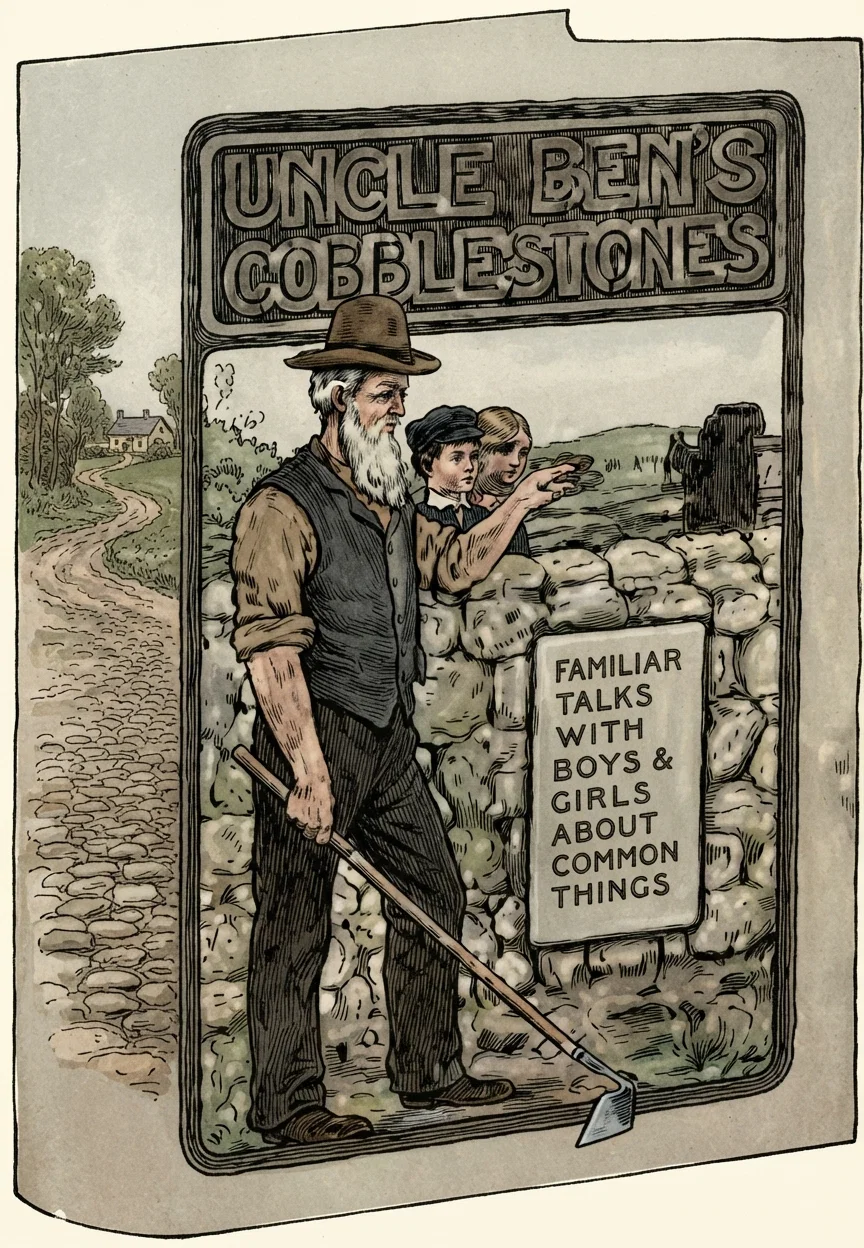
Uncle Ben's Cobblestones

Familiar Talks with Boys and Girls About Common Things

UNCLE BEN has such a pleasing way of telling about the origin and use of common, every-day articles, that he holds the interest of the reader from the start in his talks about air, water, sunshine, fire, smoke, glass, coal, salt, paper, matches, etc.
He tells about more than one hundred different things in all, and intersperses with many happy thoughts that bring good cheer to young and old.
Two hundred and twenty-one pages, nicely bound. Price, post-paid, $1.00.
Pacific Press Publishing Assn. Mountain View, California Portland, Ore. Calgary, Alberta Kansas City, Mo.

Story of Pitcairn Island

Told by a Native Daughter

THIS fascinating story begins with the mutiny on the sloop-of-war Bounty in 1789, when Captain Bligh was dragged from his bed and cast adrift in an open boat with eighteen unfortunate companions.
From murderous mutineers to peaceable Christians, faithfully observing the commandments of God, is the wonderful history of the settlement of Pitcairn Island by the Bounty's mutinous crew.
In simple but beautiful language the writer of this tale, Miss Rosa Young, a native daughter, unfolds the story of love and hate, crime and its punishment, and the development of a happy race of islanders.
266 pages, tastily bound in cloth. Price, postpaid, $1.00
Pacific Press Publishing Association Mountain View, Cal. Portland, Ore. Calgary, Alberta Kansas City, Mo.

The Missionary Idea

BY MRS. A. E. ELLIS
THIS little volume aims to be a suggestive help to every missionary worker whose heart has been touched with a sense of the world's need.
Part One is designed to stimulate a healthy interest in missionary work, both "Home" and "Foreign." Each of the 16 subjects is arranged in the form of a "Lesson" with carefully prepared questions.
Part Two consists of contributed, selected, and arranged matter which, besides its inspiring character, will suggest to the thoughtful reader ways in which missionary information may constantly be gathered and missionary sentiment encouraged.
Part Three gives an outline of the work done in mission fields since 1874, with a brief history of each mission and outline map of the more important.
317 pages in two handsome bindings. Paper covers 50c. Cloth bound $1.00, post-paid
Pacific Press Publishing Association Mountain View, California Portland, Ore. Calgary, Alberta Kansas City, Mo.

THE BOY PUZZLE

A Picture Book for Mothers

By Rev. Joseph F. Flint

BUT this book is not written alone for mothers. Every father, in fact all who have an interest in the welfare of the boys of this nation will find a wealth of help and encouragement in this presentation of the boy question. The author goes to the bottom of things and shows very clearly where the trouble lies if your boy or your neighbor's boy goes wrong.
As the hope of this Republic lies in our boys a careful reading of "The Boy Puzzle" will do much to help solve the difficulties that confront us.
217 Pages, beautifully bound in cloth, post-paid, 75 cents Pacific Press Publishing Association Mountain View, Cal. Portland, Ore. Calgary, Alberta Kansas City, Mo.

ELO THE EAGLE

AND OTHER STORIES

BY FLOYD BRALLIAR
THIS new animal book for young folks is receiving an eager welcome by all nature lovers. ELO THE EAGLE is the first of a series of ten interesting stories of animals, wild and otherwise; being, with one exception, the life histories of boyhood friends of the author. Many strange and laughable anecdotes are related by Mr. Bralliar, all of which are strictly true and vouched for by reliable witnesses.
The book is lavishly illustrated by special drawings, with a full-page half-tone design printed in Luxotype at the beginning of each chapter. Two hundred pages, printed on egg-shell paper, beautifully bound in red cloth. Price, post-paid, $1.00.
Easily sold by young people. Agents wanted.
Pacific Press Publishing Assn. Mountain View, California Portland, Ore. Calgary, Alberta Kansas City, Mo.

Bibles

Bibles.—Remember that we are headquarters for anything in the Bible line. We shall be pleased to send you our catalog of Bible selections on application. Pacific Press, Mountain View, Cal.

THE HOUSE

WE LIVE IN
OR THE MAKING OF THE HUMAN BODY
BY VESTA J. FARNSWORTH
THIS is a book for home reading and it is a great help to mothers in teaching their children how to care for themselves physically. The structure of the human body is set forth in a most interesting and instructive manner, and all its wonders, uses, functions, etc., are told in a most attractive way.
The style of the book is conversational—a mother talking with her children. It makes a splendid birthday gift.
Two hundred and eighteen pages, nearly 150 illustrations, attractive cloth cover. Price, post-paid, $1.00.
Pacific Press Publishing Assn. Mountain View, California Portland, Ore. Calgary, Alberta Kansas City, Mo.
Continue reading: Contrasting Conditions