AFTER having given in clear delineation the terrible mistake of the Jews in their rejection of Christ and their cessation as a nation, in the 12th chapter we have a prophecy of the restoration to power of the true Israelites. In the closing days of time all the nations are to be gathered in the Valley of Jehoshaphat to the battle of Armageddon. Rev. 16:14, 16. At that time Michael will stand up, the great Prince that standeth for the children of His people, and then Jerusalem will become a burdensome stone for all people. Compare Dan. 11:45 with Zech. 12:2, 3. Then it is that Christ's coming shall bring hope to His waiting people. Zech. 12:5. And then it is that the presence of God destroys the wicked. Zech. 12:6. Then Christ will spare those who have been rejected by the wicked and counted as naught; and when Christ appears, the wicked will realize that the victims of their hate, whom they supposed to be feeble, and destined for destruction, are now stronger than David when he slew Goliath and through him the thousands of the Philistines; and the house of David, the church of God, shining with the glory of God, are seen to be as strong as the might of their Redeemer, as powerful as the angels of the Lord that surround them and stand before them. Then it is that the wicked shall look upon Him whom they have pierced, and shall be destroyed. And this work will be upon individuals, each one being judged according to his own works. See verses 11-14.
Rightly Dividing the Word of Truth
In the 13th and 14th chapters of Zechariah we have many prophecies referring to times widely separated. If we try to read them consecutively we shall make mistake. It is interesting for us to remember how Christ divided the Word the day that He spoke at Nazareth, when He claimed Himself to be the fulfilment of the prophecy, "The Spirit of the Lord is upon Me, because He hath anointed Me," etc.; and that as He quoted these words He divided one sentence at the last, leaving off the words "and the day of vengeance of our God." The vengeance of God was not due at the time that He delivered the prophecy, altho all the other parts of this prophecy were then applicable.
Similar to the division of that prophecy that day at Nazareth must be the true teacher's division of the Word of God. He must be able to know by other scriptures exactly where the prophetic Word applies. It is not to be by any private interpretation; it is not to be by any dogmatic assertion of his own, but testing scripture with scripture, spiritual things with spiritual. He is to know just where each part applies. So as we read the first verse of the 13th chapter of Zechariah we know at once that it is a prophecy of Jesus Christ. When He was crucified a fountain was open to the house of David and to the inhabitants of Jerusalem for sin and for uncleanness, and we still sing:
"There is a fountain filled with blood,
Drawn from Immanuel's veins;
And sinners plunged beneath that flood,
Lose all their guilty stains."
And as a result of that cleansing, every evil thing shall be removed from the land that God grants to His people. But there was also to be a removing of prophets before that day. Because of the unfaithfulness of God's people there were no prophets from the time of Malachi until Jesus came; and if one appeared as a prophet it was inevitable that he was a false prophet, and his own father and mother must turn against him; and so the false prophets themselves were often ashamed of their own visions, because they were deceptive, and so they turned away from manifestations of the evil one, and said, "I am no prophet, I am an husbandman; for man taught me to keep cattle from my youth."
"And one shall say unto Him, What are these wounds in Thine hands? Then He shall answer, Those with which I was wounded in the house of My friends." Zech. 13:6.
Here suddenly we find a prophecy introduced that manifestly refers to Christ, and to Christ in the future state. It is true that this question is asked during the Gospel age, and that answer is also given. We are all saying, Why was Christ wounded, why was He allowed to suffer? And so the prophecy in a measure is fulfilled in this life; but it seems quite evident that there will be those who are living up to all the light and truth they have had, who have not learned of the crucifixion of Christ. Some of these who lived before that event, and some in heathen lands who have lived since that event, when they see Christ in the better world, will wonder at the prints of the nails in His hands. They will ask the question of this verse, and Christ will give them its answer. Verses 7, 8, and 9 refer evidently to the death of Christ and to results that follow; and the ninth verse brings in the results that were prophesied to come under the new covenant. All are taught of the Lord; all who participate in the covenant come to say, "The Lord is my God."
The Closing Scene
Again we have reference, in the first part of the 14th chapter of Zechariah, to the destruction of Jerusalem, especially at the close of time. No doubt it has some reference to the taking of the city in A.D. 70, but the complete fulfilment as seen by verse 3 can not take place until the great battle of Armageddon. A thousand years after this the events of verses 4 to 11 take place. This is the new earth state. The Mount of Olives becomes a plain, and on this plain the city of God rests. Even at eventide it shall be light in that city, for it has no need of the sun or the moon, since God and the Lamb are its light. In that city shall be the living waters, the River of Life, and the Lord shall be King. Jerusalem shall be safely inhabited.
Verse 12 refers back again to those mentioned in the first part of the chapter, in verse 3. This is the great battle of Armageddon, and the terrible plague upon the ministers and the false teachers who have opposed the truth of God. The plague is not only upon men, but upon animals as well. Verse 15.
Verses 16 to 21 are a promise that all that are opposed to God will be destroyed, and that all that survive will come up from year to year to the city of Jerusalem to worship the Lord. In Isaiah we find that this journeying to Jerusalem takes place on the Sabbath and also once a month. The punishment of those who come not up to Jerusalem is not to be visited upon the people in the new earth state, as verses 17 and 18 might seem to teach. The punishment is to be visited upon them when the wicked are punished, for God knows who they are. They are those who have rebelled against His commands all their lives. These are smitten and destroyed in the destruction of the wicked. It is plain from some of the references in verses 16 to 21 that much of this would have been fulfilled in this life, and for the Jews; but they failed to obtain the benefits predicted, and therefore it must be referred now entirely to the new earth state.
Let us remember that the consecration delineated in the 21st verse, the closing verse of the book of Zechariah, is a consecration that must take place in this life, and that is voluntary, each man making that consecration for himself. May we be among those who thus have inscribed upon their lives, not in words merely, but in fact, "Holiness unto the Lord of Hosts." There is to be no Canaanite, no sinner, in the house of the Lord of Hosts. There shall in no wise enter into it anything that defileth. "Blessed are they that do His commandments, that they may have right to the Tree of Life, and may enter in through the gates into the city." "Open ye the gates, that the righteous nation which keepeth the truth may enter in." May we be of those who enjoy the glories of that blessed state.
The Passion for Money
By Richard Fuller
It is impossible to conceive any contrast more entire and absolute than that which exists between a heart glowing with love to God, and a heart in which the love of money has cashiered all sense of God—His love, His presence, His glory; and which is no sooner relieved from the mockery of a tedious round of religious formalism, than it reverts to the sanctuaries where its wealth is invested, with an intenseness of homage surpassing that of the most devout Israelite who ever, from a foreign land, turned his longing eyes toward Jerusalem.—Richard Fuller.
The Perfect Law of God
By T. Godfrey
By T. Godfrey
“HE law of the Lord is perfect, converting the soul: the testimony of the Lord is sure, making wise the simple.” Ps. 19:7. Law, says Webster, is a rule of action, a rule of directing, a fixed principle. Therefore the law of God is a perfect rule of conduct, a perfect rule of directing, an eternal fixed principle. This law was spoken by the Lord at Mount Sinai, in the presence of all Israel, with a loud voice, and God wrote it upon two tables of stone (Deut. 5:22), and gave it to Moses, that he might teach it to the people (Ex. 24:12). This law is now revealed in the Decalogue, and is known as the Ten Commandments. Ex. 20:3-17.
These principles are inherent principles in God from everlasting to everlasting (Ps. 90:1, 2), and are the organic principles in the throne of universal empire. Therefore they are the eternal and unchangeable rule of His moral government. Says the psalmist, “Thy righteousness is an everlasting righteousness, and Thy law is the truth.” Ps. 119:142. The Word of God is righteousness and truth. Ps. 119:172; John 17:17. Therefore the throne of God is established in righteousness and truth. Deut. 32:4; Ps. 117:1, 2; 100:5.
The transgression of these principles is sin (1 John 3:4; James 2:8-11); and “the soul that sinneth, it shall die” (Eze. 18:4, 20), “for the wages of sin is death” (Rom. 6:23; James 1:15). It was these principles that Lucifer, son of the morning, and his confederates, transgressed in heaven, in consequence of which they were expelled from the government of God (Isa. 14:12-15; Eze. 28:12-15), and were cast out into the earth (Rev. 12:7-12). It was these principles that Adam and Eve transgressed in the Garden of Eden, thus bringing sin and death into the world. 1 Cor. 15:22; Rom. 5:12, 19.
These principles are a rule of right living. Eccl. 12:13; Matt. 19:16-19. Therefore they will be the rule of the judgment. Eccl. 12:13, 14; James 2:8-12. To be able to stand in the judgment one must have these principles written in his heart by the Spirit of the living God. 2 Cor. 3:3; Heb. 8:10-12.
The object of Christ’s mission to this world was to reveal the Father in His own life (Heb. 1:3; Col. 1:14, 15; John 14:5-9), and to reconcile fallen man to God and His government, and its eternal and unchangeable laws (2 Cor. 5:18-20; Col. 1:19-21; Rom. 5:10; Eph. 2:16). After the death and resurrection of Jesus, the ministry of reconciliation was committed to His disciples. 2 Cor. 5:18, 19; 4:10, 11. Therefore the law is the underlying principle of the Gospel of Christ. Rom. 1:16, 17. “Think not,” said Jesus, “that I am come to destroy the law, or the prophets: I am not come to destroy, but to fulfil.” Matt. 5:17. “Blessed are they that do His commandments, that they may have right to the Tree of Life, and may enter in through the gates into the city.” Rev. 22:14.
Convinced Too Late
By M. A. Dake
By M. A. Dake
ESUS died on the cross to save you from sin and its doom. He never would have left the purity, glory, and comforts of heaven, to live, suffer, and die amid the sin and anguish of earth, if you had not been in deadly danger. Can you not see the truth of this?
O, that somehow you might be enabled to feel the exceeding sinfulness of sin, and realize the depth and breadth and awfulness of its results and penalty! If you would only pause to note the ill effects of sin, and consider the probability and reasonableness of its doom as revealed in the Bible, you would surely shun all forms of sin, and make haste to seek the closest acquaintance with Christ, who alone can take sin out of your heart and life, and save you from its terrible penalty. Sin’s havoc abounds on every side. Not all diseases, nor every case of any disease, is due to sin in the suffering one; but vice and crime are directly responsible for some of the most hideous and revolting forms of insanity, disease, and deformity!
Sin is a dangerous, repulsive thing, but has every feature skilfully disguised. It is such an insidious, cunning, ever-growing thing, that none but the all-wise, all powerful Sin-Bearer has power to disentangle you from its increeping roots, keep you from its onsweeping, overwhelming tide, and save you from its deadly penalty.
“All have sinned, and come short of the glory of God,” and only “with the heart man believeth unto righteousness; and with the mouth confession is made unto salvation.” Reader, have you believed that Christ’s righteousness is yours through faith, and have you praised God “in the great congregation” because Jesus’ blood “cleanseth from all sin”?
We need the unchanging measure of God’s law; for sin can not be detected and recognized except as we bring our ambitions and our lives to the one unfailing standard of morals. Studying the lives of men and nations carefully in the light of divine ethics, we see that Christian faith and love, truth and purity, sobriety and industry, have promise, not only of this life, but also of the life which is to come; while “the way of the transgressor is hard,” and “sin, when it is finished, bringeth forth death”—the resultant death to the individual and the nation now, and the final, hopeless, fiery, penal death, in the judgment-day, to all whose names are not written in the Book of Life.
Surely sinners would be wise enough to “flee from the wrath to come” if they could once realize their swiftly nearing doom; but men and women in authority fail to execute human law properly, and so men scoff at any impending penalty for broken divine law. When I look forward to the awful doom of sin, my heart cries out, “O, is there no way to show our generation their danger? Is there nothing that can convince them that for the ungodly wrath is treasured up against ‘the day of judgment and perdition of ungodly men’?”
How can we see the alarming multiplication of frivolity, selfishness, and crime, and note the startling increase of shocking casualties and overwhelming disasters, and fail to understand that once again Jehovah’s judgments are abroad, and men need to be exhorted to repent lest final justice overtake them unprepared?
Listen! Above the Slocum disaster, the Iroquois holocaust, mine and fire and ocean and plague disasters, and the untimely deaths of indifferent or unholy workmen or gay pleasure-seekers, we should be able to hear “the still small voice” whisper, “Love the Lord thy God with all thy heart, . . . and thy neighbor as thyself.” “Love not the world, neither the things that are in the world. If any man love the world, the love of the Father is not in him.” And out of groaning earthquake, roaring volcano, and rushing cyclone, we may hear a loud voice saying, “All have sinned, and come short of the glory of God,” and “except ye repent, ye shall all likewise perish,” for “the Lord cometh . . . to execute judgment upon all, and to convince all that are ungodly . . . of all their ungodly deeds . . . and hard speeches.”
There Is a Blessed Hope
By George E. Tack
By George E. Tack
EARTH'S philosophers and wise men
Live their little day, and then
Back to dust they turn, and ages
Pass ere they shall wake again.
Great men rise unto the summit
Of earth's glory and its power,
But they can not stay the clock-stroke
Of time's solemn, fateful hour.
Fools may laugh and gaily dance
As they flit among the flowers
In life's dewy, fragrant gardens;
But at death's frost, how each cowers.
And the sands of life forever
Flow, like man, forever down;
And earth's hopes but grow and perish,
Like the leaves that wax so brown.
Yet there is a hope that ever,
Like the fadeless Tree of Life,
Blooms all seasons for the peaceful
Dwellers 'mid earth's din and strife.
'Tis the hope that past life's sorrows,
In the land of endless day,
We shall meet our loved departed,
And all tears be wiped away.
There, 'mid scenes of joy and gladness,
We shall dwell with Him who died
That we all might be forgiven,
And in realms of peace abide.
Keuka Park, New York
The Grandeur of Difficulties
By Spurgeon
MANY men owe the grandeur of their lives to their tremendous difficulties.—Spurgeon.
Give Generously
“GIVE with a heart glowing with generous sentiments; give as the fountain gives out its waters from its own swelling depths; give as the air gives its vital breezes, unrestrained and free; give as the sun gives out its light, from the infinite abysses of its own nature.”
A Talk With Our Readers
By Editor
We do not wish to spend one part of the year to tell you what we will publish in the other part, nor one half of the paper to inform you what is in the other half. But we do wish to tell of a six-month series of our journal.
Six months of present truth! Six months of God's message to the world for this time! Six months in which will be met by positive truth the great errors which are afloat in the world at the present time, and which are destroying millions of souls!
Does it not appeal to you? Does it not appeal to you for your friends, your relatives, those for whom you feel a real burden? Does it not appeal to you also for the unwarned souls around you, for some souls in heathen lands whom you might reach by contributing papers containing this message? Nay, more, does not the study of these things appeal to your own heart, that you may become better acquainted with the Lord and His message for this time?
But you ask, What is this series? Read the prospectus on the next page.
1. In the first place, the series will begin November 1, and close April 25—twenty-five numbers.
2. In the second place, there will be twenty-five articles from the pen of Mrs. E. G. White, articles on living Christian experience, such as "Watchfulness and Prayer," "Christian Homes and How to Help Make Them," "Temperance Reform from a Bible Standpoint," "A Lesson from Noah's Time," "The Character of the Law of God," "The Permanence of Truth," "Value of Bible Study," "Christ and the Law," "Right Methods of Education," "The Power of Love," and others of the same kind, of most excellent instruction for these very times.
3. A study of the book of Revelation, covering from chapter one to the close of chapter eleven, bringing out the great thoughts of the purpose of the book, the prophecies of the Seven Churches, the Seven Seals, the Seven Trumpets, and the Two Witnesses. In connection with this study there will be a diagram which will present the great drama of the book so as to make it more easily understood, and which will enable the earnest student to get a much better and more comprehensive idea of this seven-fold letter.
4. Twenty-five Bible readings, on great Bible themes. In fact, in these general topics and studies will be included the great truths of the message for our time.
5. In addition to this there will be eight or more articles on The Coming of the Master, treating of that coming in all its various phases, by C. L. Taylor.
6. There will be eight or more articles on the Sabbath Question in its various phases, by Elder R. A. Underwood. We should understand a question which is before the world both religiously and politically.
7. There are six or more articles on Man's Nature, by such strong writers as G. W. Rine and Earle A. Rowell. How important is this subject in view of the claims of Spiritualism, Christian Science, and other cults.
8. There are four articles on the signs which God has hung out in the heavens, by Elder R. S. Owen. There will be many others on the unmistakable meanings of occurrences in church and state.
9. There are eight or more articles on Religious Liberty, by one of the strongest religious liberty workers in this country, William M. Healey. There will be others noting the progress made on both sides of the question.
10. There will be one special feature connected with this series shown in a very striking cartoon by Maybell of the great black hand that is stretched out over the nations with its five restless, grasping fingers like the tentacles of a devil-fish, which are gathering souls for destruction. These five digits of the great black hand are Greed, War, Apostasy, Spiritism, Tradition. There will be from three to five articles on each one of these, showing their use by Satan in these last days; and this setting forth of the evils which the world must face is worth more than the whole series will cost.
11. There will be news from the great countries of earth. What are they? Among the very greatest empires in earth is England. Then the nations of Europe. Japan is a problem in the international arithmetic. China is another. Restless, seething India is another. There will be not less than a dozen or thirteen Outlook articles from such men as Prof. F. W. Field of Japan, Dr. A. C. Selmon of China, Mr. John Vuilleumier, editor of Les Signes des Temps, of Gland, Switzerland, Mr. W. T. Bartlett, editor of the Present Truth, of London, Mr. George F. Enoch of India, from Constantinople Mr. C. Voigt. These are one and all men on the ground, men who see conditions with their own eyes, who listen with their own ears; and our readers can depend upon the reports which they give of conditions in these countries which are factors in the world's progress or retrogression.
12. The interesting story on Shiloh will continue through twenty-three numbers of this series, every one of which brings out some new phases and throws new side-lights on the work of our Lord.
13. There will be not less than fifteen interesting mission articles of various foreign missions. As a people we have entered nearly all of the great mission fields of the world. You wish to hear from them.
14. There will be beside the story, not less than ten articles on Temperance and the Home.
15. Throughout the entire series there will be the Bible Band, beginning anew next year, and there will be twenty-five Question Corner departments.
16. In addition to all these there will be the editorials, and the notes which are written on various topics, doctrinal, practical, and always Biblical throughout the entire series. We believe that it will be one of the best series which we have ever published,9preachers of righteousness that will bring souls to the truth as it is in Jesus.
There will be something in every paper which will be of interest to every reader if he is interested at all in religious matters.
The articles on the Revelation will be specially illustrated, as will many other articles. In every way we can commend the series to our readers, friends, and coworkers. Political parties of all sorts are entering upon eager, enthusiastic propaganda to win men to things which perish with the using. Surely the Christian should not be less enthusiastic in heralding abroad the everlasting Good Tidings to the souls who are waiting.
This Present Truth Series of twenty-five special numbers, will be furnished at the following
RATES
To one name and address...........................$ .90
Five or more copies to one name and address, each.... .62½
Five or more copies mailed direct from the office of publication to names and addresses furnished, each ..... .65
Yearly subscription ............................... 1.75
Cash must accompany all orders not sent through tract society.
Send in your orders at once. Between October 15 and November 1, our listing clerks will be deluged with orders. Help make it easier for them by ordering before October 15, if possible.
The Persistence of Superstition
Prevalent Superstitions.—It is said many times that we are beyond the age of superstitions, and that Regnant Reason rules the world; and yet in a recent daily there is almost a whole page telling us of prominent theatrical people who are governed by superstitions—people before whom the world is bowing. For instance here is one actress who has worn one skirt in 1,000 performances, and believes she would make a failure unless she still wears it. There is another who has in her dressing-room a little Hindu idol. It has never left her, she declares, and it never will. "I dread the consequences should I lose it." Another believes that bad luck would come to her should she hear any11one whistle. Another wears a little bit of grease paint in a solid silver box to frighten off the hoodoos. Another keeps with her a little faded artificial flower, which having left one time behind her, all sorts of bad luck came to the company. A trusted employee was sent back to the last town, found that crumpled flower in the room of a third-rate actress who was having wonderful success, and brought it to its owner. Luck changed, and the third-rate company went to ruin. Another, a big, strong man, feels that everything will be a failure unless he hums the chorus of the first song before he begins anything else. Another one declares she never could ride behind a white horse, if she had to walk ten miles. Most of them, it is said, have a superstition against peacocks. Another feels that he would not have success at all if he did not have a little piece of amber on which was an Arabic inscription. And so it goes on and on; it is a name, it is a word, it is which shoe is put on first, it is a pocket-piece, it is a pigeon-blood ruby, it is swinging a rapier around in the air, etc., etc., till one sickens at the silly superstitions which possess men and women, basing their whole faith on things inanimate generally; yet these very ones would call it superstitious to trust in the living God.
The Cause of Spain's Troubles
CATHOLIC writers are denouncing the attitude of the Spanish premier Canalejas as an attitude of war against religion. If it be so, the Papacy has only itself to blame that such a war threatens. If there is a country anywhere that has been subject to the Church of Rome, surely it is Spain. There, if anywhere, the real fruits of Romanism may be looked for. A writer in the Westminster Gazette gives the following account of the situation:
"The program of Canalejas, the Spanish premier, translated into plain English, is, equal rights for all and special privileges for none. This statement is accepted as a political truism by the majority of the Anglo-Saxon race. In Spain the clericals denounce it as blasphemy. In many respects, in the country districts, Spain is still the Spain of Philip II. To make the causes of the present acute crisis clear to English readers it is necessary to go briefly into the past. The secret of the fall of Spain from her high estate can be summed up in one word—clericalism. The dew of privilege has soaked the clerical fleece, while that of the laity has remained dry.
"How is it that the races which inhabit this peninsula, and which are brave and honest—how is it that they are not masters in their own house? The answer is that the Church of Rome has been (since the fall of Granada in 1492) absolute mistress of a country where nothing is modern, nothing is commonplace. Three memorable acts of cruelty have firmly planted the clerical yoke on Spain. These mile-stones on the road to ruin are—the founding of the Inquisition, the expulsion of the Jews, and the expulsion of the conquered Moriscos. By the expulsion of these two industrious races the church got rid of the two peoples which dared to think for themselves; by the Inquisition they penned the men of Spain into one fold. The effect of clerical dominion both on church and people was disastrous.
"Spain, which, so long as the Moorish and Jewish religions flourished there by the side of the Christian, had been the freest country in Europe, became the most enslaved as soon as the Catholic was the sole form of faith permitted by the state. It is no figure of speech to say that for three centuries the path of knowledge led in Spain to the stake. Mental silence does not further a nation's growth. The population of Spain sank in two centuries from twelve millions to about six millions. No one can deny that the policy of Spain, both foreign and home, was completely under priestly influence during the sixteenth and seventeenth centuries, and also for most of the eighteenth and nineteenth centuries. The cassock, south of the Pyrenees, has always been on the side of absolutism and ignorance. Those have been the pillars on which clericalism has securely rested in Spain. Canalejas is the Spanish Samson, who has laid patriotic hands on these two pillars."
— The Present Truth (England).
Korea Is No More
KOREA, the "Hermit Kingdom," is a matter of history. Scarcely did she come out into the open ere she was snapped up by earth-hungry Japan.
Her annexation to Japan caused no surprise; it was expected from the day that the little island empire of the Orient conquered the great Russian nation. Korea unfortunately lay between Russian and Japanese ambition. Inert, almost dead, utterly corrupt in her government, she was doomed to fall a prey to either one or the other of the warring nations, unless the great powers of earth intervened, and they have not thought it worth while. If they can save Manchuria to China, it will be a marvel.
Korea, of course, loses her independence. Doubtless she will be taxed to the limit to meet the war burdens of Japan, and will be exploited by the Japanese government to the fullest. Apart from that, her people will probably enjoy as great or greater freedom than they did under their own government.
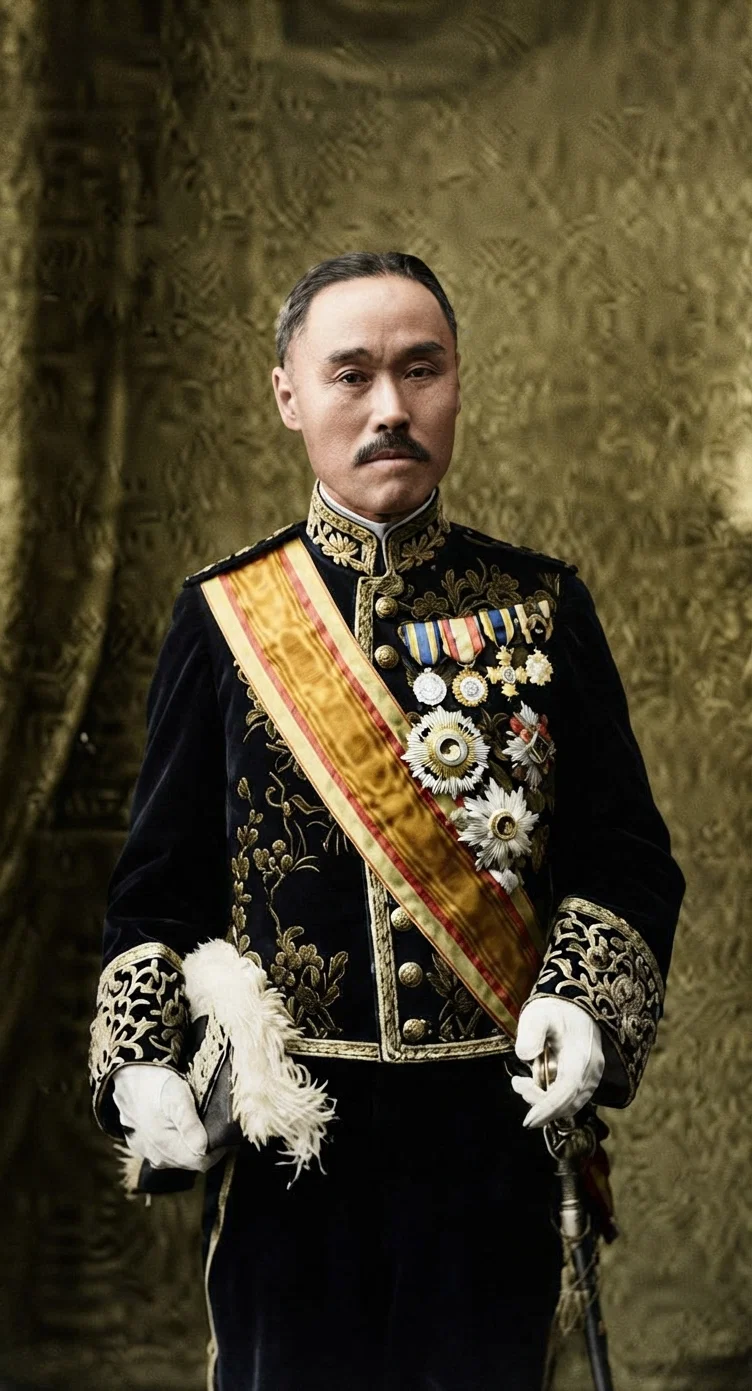
Yi Syk, the last Emperor of Korea, who has abdicated to Japan
Crown Prince Yei, heir to the vanished throne
General Viscount M. Terauchi, Resident-General of Korea
Yi Wanyong (Korean), Prime Minister under Japan
Regarding outside nations, trade will be more or less affected. Great Britain will probably be one of the heaviest losers. The Times remarks, "We do not rejoice over it" (the annexation), and further observes that Japan is not enthusiastic. The Japanese government had tried to govern Korea with the cooperation of Korean officials, but had found it impossible, and the only solution was the taking of the kingdom. The late Prince Ito is said to have been Korea's true friend, but he was a foreigner, and the only way for a foreign power to rule is to rule.
The Koreans have been offered a balm in the change of name, "Cho Sen," meaning "The Land of the Morning Calm." The emperor of Korea, Yi Syk, becomes a Japanese prince, ranking next to the crown prince, with a liberal allowance to the royal family of $750,000 a year. Certain other plums are offered to various Korean nobility. The emperor of Korea on his abdication issued the following proclamation:
"Notwithstanding our unworthiness, we have succeeded in the arduous task handed down by our ancestors. We have endeavored up to the present to follow modern administrative principles, but long existing evils and deep-rooted weakness make it impossible for us to effect reforms in a reasonable time. Therefore we feel constrained, believing it wise, to entrust the great task to other hands. I appeal to all my people not to create commotion."
The treaty of annexation was signed August 22, 1910. Whether "The Land of the Morning Calm" will develop midday tempests is a serious question. A prominent Japanese assures us that missions will not suffer.
Japan herself takes an important step. She is no longer an island empire. She could have so remained by withdrawing from Korea, when her Manchurian leases ended. But she chose to become a mainland power; will her ambitions be satisfied with the absorption of Korea? Will not her appetite demand at least a portion of the rich province of Manchuria?
We may guess. God knows. It is still true that "the Most High ruleth in the kingdom of men, and giveth it to whomsoever He will." Thank God the doors are swinging wide open to His Gospel,