Your ShelfYour Projects

Signs of the Times, Vol. 37, No. 38.

Our God Is Good

Signs of the Times

Sep 27, 1910

Pacific Press Publishing Association · Mountain View, California · Sep 27, 1910

Our God Is Good

The vines their luscious fruits display, The trees bend low with harvest hoard, The barns are filled with fragrant hay, And all the bins with grain are stored. From out God's hand the blessings fall--- His open hand---alike to all. Should all not serve the Giver kind With heart and soul and strength and mind? W.

"IF YE WILL INQUIRE, INQUIRE YE."

This Inquirers' Department is conducted for the purpose of helping those who are studying the Bible. The answers are oftentimes only suggestive. They are never to be considered infallible, only as they agree with the infallible Word. The writer who may answer them does not consider that his opinion is infallible. He will simply give the best that he has, and plead with the inquirer to search the Word. Such questions only will be answered as, to the editors, seem to minister to the good of the readers and to the mission of the paper. We can not answer repeatedly in the same volume questions upon the same scripture. The name and address must accompany question, not for publication, but as an evidence of good faith, and that answer may be made by letter if deemed advisable. No letters are answered which do not contain the name of the writer. It is well always to enclose stamp for reply.

To Our Readers

THIS is the first time for many years when all questions on hand were answered and all published. We have almost invariably closed each paper with questions unanswered or else waiting on the galleys. Some have in the past been discouraged regarding their questions, thinking that they had been neglected. The reason has been that there have been many questions ahead of theirs in all probability. We are grateful indeed for the kind words of appreciation which we receive concerning the Question Corner. Questions answered therein must necessarily be brief and must necessarily be answered briefly. When more space is demanded we sometimes reply to the question in some article elsewhere in the paper.
We hope that those who ask questions will not only look for the answer to their own initials or whatever they may have signed to the question, but to other questions. They may find their question answered in other questions. In many cases the answer to one is an answer to many others. For instance two weeks ago there was a question on the brothers of Jesus. This is in reply to many inquirers who have asked practically the same question. Write the questions as briefly and succinctly as possible. State definitely just the information you desire and this will always be helpful to the one who answers the questions.

Our Bible Band

Our Bible Band.—One old lady remarked some time ago: "When I began my journey through the Word of God, I slipped two or three sheets of writing-paper in my Bible for the purpose of marking all the best points as I went along. It was only a very few readings and I had those sheets of paper full, so I arrived at the conclusion quickly that there is no best. All the Word from Genesis to Revelation is full of light; and I found it a wonderful thing to go down to the potters and learn the lesson that the Lord gave Jeremiah. I started from the beginning and have not missed a lesson. Praise the Lord."
A tablet has been discovered in Upper Egypt which records the honorable discharge of a soldier who had taken part in the siege of Jerusalem by Titus. While other historical records give us the names of some of the officers of the Roman army under Titus, this man, M. Valerius Quadratus, is the only private soldier whose name we know who fought against Jerusalem.

OUR BIBLE BAND

Schedule for Week Ending October 8, 1910

Sunday October 2 Luke 9
Monday " 3 " 10, 11
Tuesday " 4 " 12, 13
Wednesday " 5 " 14-16
Thursday " 6 " 17, 18
Friday " 7 " 19, 20
Sabbath " 8 " 21, 22
OUR BIBLE BAND
OUR BIBLE BAND
OUR readings for the week are all in the Gospel by Luke, chapters 9-22 inclusive. There is little that needs explaining. There are many precious things to learn. The mighty power and wisdom and love manifest through Christ as shown in the feeding of the five thousand, the transfiguration—a type of Christ's second coming—the healing of the epileptic boy, the lesson of humility, the rebuke of our Lord to overzealous disciples, the sending out of the seventy, parable of the good Samaritan, lessons in prayer, woes upon the Pharisees, the parable of the foolish rich man, exhortations to watchfulness in the time of His coming, the parable of the barren fig-tree, the healing miracles, the lament over Jerusalem, parables of the supper, the lost sheep, the lost piece of silver, the prodigal son, the unrighteous steward, the rich man and Lazarus, the likeness of the last days to Sodom and Gomorrah, the parable of the pounds, weeping over Jerusalem, controversies with the Pharisees and Sadducees, the signs of Christ's coming, and His last Passover with His disciples and apprehension in the garden, and many other things are told in this week's reading. What a revelation it is, and how it ought to stimulate devotion and promote spiritual growth.

The First People on Earth

3251.—Peopling of the Earth. Gen. 1:25-31

Were Adam and Eve and their children the first people upon the earth? It seems to me there were other people before this, as Cain went to a barren place and got his wife. And was man created before the beast? C. J. A.
It seems to us that the accounts in Genesis 1 and 2 are very clear. Genesis 1 gives the general statement of the creation of man; Genesis 2, the particular statement. Genesis 1 shows that the beast was created before man, the creation of man following.
Genesis 2 tells us how these beasts were brought before man, evidently on the sixth day; were named by man; but among them all man found no companion. Hence woman was created. Note what name was given her in Gen. 3:20, "And the man called his wife's name Eve; because she was the mother of all living." All then sprang from her.
There are other intimations in the writings of Paul which show the same with Adam. "As in Adam all die, even so in Christ shall all be made alive." 1 Cor. 15:22. See also his argument in verses 44-49, showing that the children of earth sprang from Adam. Read Rom. 5:12, "Wherefore, as by one man sin entered into the world, and death by sin; and so death passed upon all men, for that all have sinned." The wife of Cain was one of the children of Adam and Eve, or of Seth. A long period of time probably passed away before Cain took his wife. This the Bible gives us no account of.

Our Bible Reading

The Gospel Grain Field

1. What is the scope of this field? "The field is the world." Matt. 13: 38.
2. Who is the sower of the good seed? "He that soweth the good seed is the Son of Man." Verse 37.
3. What is the good seed? "The seed [represented by wheat, Matt. 13: 25] is the Word of God." Luke 8: 11.
4. In what do the sowing and growth of the good seed result? "The good seed are the children of the kingdom." Matt. 13: 38.
5. Who sows the evil seed? "His enemy came and sowed;" "the enemy that sowed them is the devil." Verses 25, 39.
6. What is the evil seed called? and in what does it result? "His enemy came and sowed tares among the wheat." "The tares are the children of the wicked one; the enemy that sowed them is the devil." Verses 25, 38, 39.
7. Will the evil be rooted out from among the good? "Nay; lest while ye gather up the tares, ye root up also the wheat with them." Verse 29.
8. How long will these two classes exist together? "Let both grow together until the harvest." Verse 30.
9. What is the harvest? "The harvest is the end of the world [age]." Verse 39.
10. Who are the reapers? "The reapers are the angels." Same verse.
11. What became of those represented by the tares? "As therefore the tares are gathered and burned in the fire; so shall it be in the end of this world. The Son of Man shall send forth His angels, and they shall gather out of His kingdom all things that offend, and them which do iniquity; and shall cast them into a furnace of fire: there shall be wailing and gnashing of teeth." Verses 40-42.
12. How will it be with "the children of the kingdom"? "Then shall the righteous shine forth as the sun in the kingdom of their Father." Verse 43.

3250.—Absent from the Body, etc. 2 Cor. 5:6-9

What does Paul mean in 2 Cor. 5:6-9, and Phil. 1:21-23?
Note the condition presented in verses 1-9; for the passage is one: (a) "The earthly house," "in this," "in this tabernacle," "mortality," "at home in the body," "absent from the Lord," are expressions which refer to Christians in this earthly life. (b) "Found naked," "unclothed," refer to a state or condition in death. (c) "A building of God," "house not made with hands," "clothed upon," "being clothed," "house which is from heaven," "swallowed up of life," "absent from the body" (from the mortal state), "present with the Lord," refer to the condition of immortality which awaits the people of God. Compare with Rom. 8:23. What Paul longed and groaned for in Romans he did in Corinthians. He wanted a better condition than mortality here gave; but that was not death. He did not wish to be naked or unclothed; he wanted mortality to be swallowed up of life, in the resurrection and the gift of immortality at Christ's coming.
The same three conditions are set forth in the second scripture: to live or to die, or the departing and being with Christ. Paul did not know which to choose—life or death. In either way God would get glory. But Paul did have choice of another thing, namely, to go to Christ, to be translated, to be with Him. This was "far better" than the other two things. The word rendered "departing" is in Luke 12:36 rendered "return." The comfort offered to mortals is through the resurrection or translation. 1 Thess. 4:13-18.

3252.— Dipping or Sprinkling.—T.—

Both dipping and sprinkling have been used as so-called forms of baptism for hundreds of years, but the Bible gives no instances of this sort. The only baptism that the Bible knows is what the word indicates, whelming or immersion.

Man's Sin and Saviour

XII. Court Week in Heaven
THE most solemn event of which man can conceive, is the assembly of the hosts of heaven before the throne of God, when the judgment is set to consider the lives of men. The Scriptures reveal the fact that this event will take place while some men are living and acting in the common affairs of life. Daniel describes the scene thus: "I beheld till the thrones were cast down, and the Ancient of Days did sit, whose garment was white as snow, and the hair of His head like the pure wool: His throne was like the fiery flame, and His wheels as burning fire. A fiery stream issued and came forth from before Him: thousand thousands ministered unto Him, and ten thousand times ten thousand stood before Him: the judgment was set, and the books were opened." Dan. 7:9, 10.
This reveals the fact that sometime judgment will set, or begin, that books will be used in the judgment, and that myriads of beings will surround God's throne. But these beings are not men, for the next verse declares that earth scenes are still in progress while the judgment in heaven is proceeding.
In Paul's time that event was yet future, for he reasoned of righteousness and temperance and of a judgment to come. Acts 24:25. He also stated in his sermon on Mars Hill that God "hath appointed a day, in the which He will judge the world in righteousness;" therefore the conclusion that the judgment-day itself was future when Paul wrote. But tho the day was future, yet the appointment of that day was past. "He hath appointed a day, in the which He will judge the world."
John adds his testimony to the effect that when the judgment-day begins God will send word to everybody living on earth: "And I saw another angel fly in the midst of heaven, having the everlasting Gospel to preach unto them that dwell on the earth, and to every nation, and kindred, and tongue, and people, saying with a loud voice, Fear God, and give glory to Him; for the hour of His judgment is come: and worship Him that made heaven, and earth, and the sea, and the fountains of waters." That message began in the year 1844, or a little previous to that time, and has continued ever since. Was it on time? Did God inspire it?
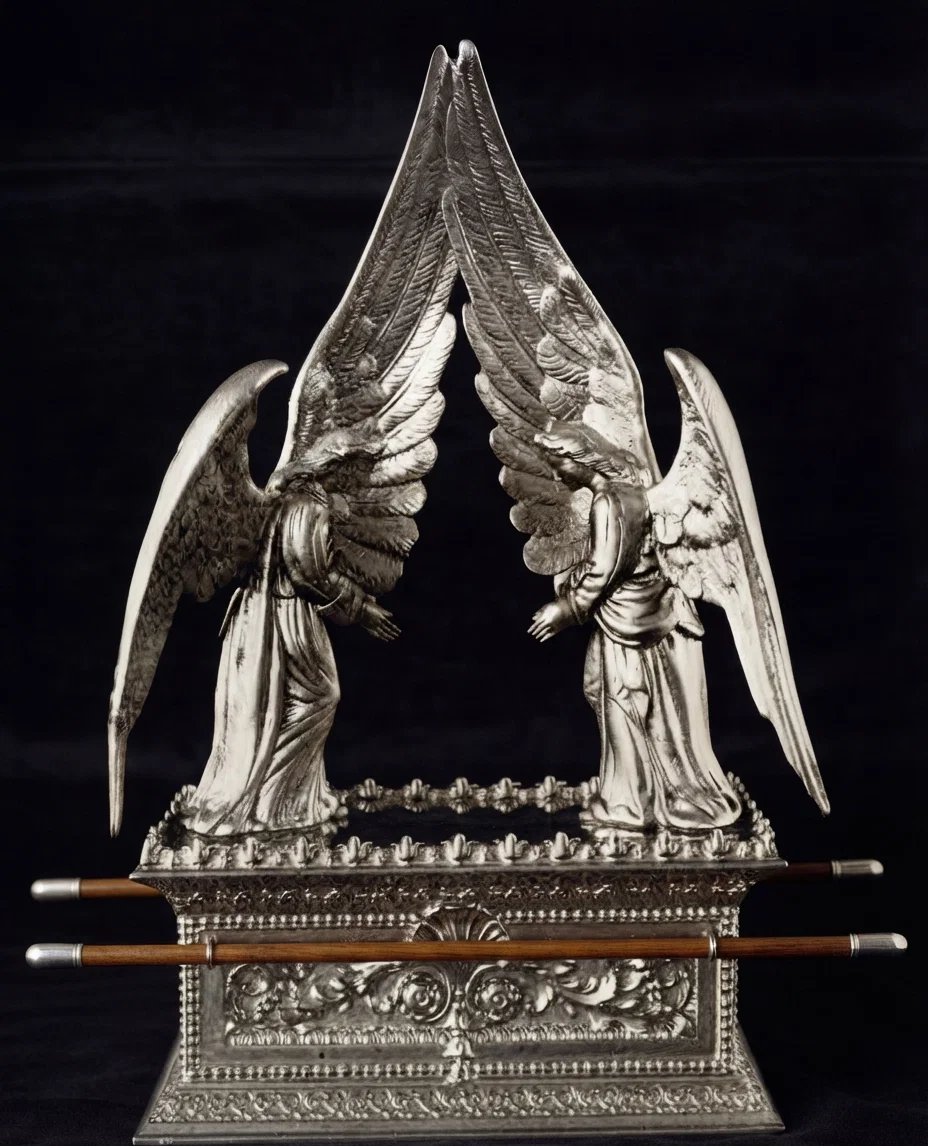
THE ARK OF GOD'S TESTAMENT
We who read this journal last week noted that some important event was to take place beginning in 1844. That event we learned was the cleansing of the heavenly sanctuary. And we are as sure of it as we are that Jesus is the Messiah; for the same prophecy that points out the year of His first advent, also reaches the latter date, 1844. We refer the reader to this article in last week's SIGNS for the proof of this fact, and will not repeat the evidence here.
In this article two sanctuaries were compared, the earthly and the heavenly. The former was found to be the type of the latter. The earthly sanctuary was cleansed once a year, while the heavenly sanctuary was to be cleansed once only, and that near the end of this world. The cleansing of the earthly sanctuary was not a house-cleaning operation, but a cleansing from sin, which was done by the sprinkling of blood. It was a work of judgment, for it decided the destiny of every worshiper of God at that time, were he Hebrew or alien; and this, being the type of the heavenly sanctuary and its cleansing, is evidence that when that event shall take place, every professed follower of Christ will have his case in review before the God of heaven.In connection with this solemn event, and just before the end of the world, John says, "The temple of God was opened in heaven, and there was seen in His temple the ark of His testament: and there were lightnings, and voices, and thunderings, and an earthquake, and great hail." Rev. 11:19. This was at the time, as John states in the previous verse, that "the nations were angry, and Thy wrath is come, and the time of the dead, that they should be judged." Therefore in this solemn time God points every one who has acknowledged the name of Christ, to the heavenly sanctuary and to the ark of His testament.
Now the ark of God’s testament on earth contained but one thing, and that was the tables of stone upon which were inscribed the sacred law of God, the Ten Commandments. This fact, being apparent to the minds of such as, in the year 1844, found what the cleansing of the sanctuary means, led their minds to an investigation of that law which had been enthroned in the earthly sanctuary within the ark of God’s testament in the most holy place; and by investigation they found that this law had not been changed by divine appointment, and that every precept remains as when it was given by God from the summit of Sinai.
If we are correct in believing that the hour of God’s judgment began at the end of that long prophetic period in 1844, then the rule of that judgment is vital to every living person. What is that rule? I will bring three witnesses to testify. First Solomon: "Let us hear the conclusion of the whole matter: Fear God, and keep His commandments; for this is the whole duty of man. For God shall bring every work into judgment, with every secret thing, whether it be good, or whether it be evil." Eccl. 12:13, 14. Second, Paul’s words, "For as many as have sinned without law shall also perish without law: and as many as have sinned in the law shall be judged by the law." Rom. 2:12. And last, James says, "So speak ye, and so do, as they that shall be judged by the law of liberty." James 2:12. Therefore, Solomon, Paul, and James all agree that God’s rule of judgment is His law. And John says that during that judgment God’s temple was opened in heaven, and there was seen the ark of His testament. That is enough to convince every intelligent Bible student that God desires we should conform to the law contained within that ark. Man can not do this of himself, for the carnal mind is enmity against God, for it is not subject to the law of God, neither indeed can be. But in Jesus Christ carnality ceases and spirituality takes its place; therefore the spiritual mind is in harmony with God’s law, and subject to it, as every converted person truly knows.
It has been thought by some that the Ten Commandments were intended only for the Israelites and not for Gentile converts; that the Israelites were commanded to keep that law, while Gentiles were permitted to transgress it without guilt. But this is not the Gospel; for in Rom. 2:17-27 we find by even a casual reading that the Jew who rejected Christ, tho he made great pretensions in reference to the law and taught it to others, was a transgressor of it himself, but the
Gentiles who accepted Christ were doers of that law which the Jews continually broke. Hence it is written: "Circumcision verily profiteth, if thou keep the law: but if thou be a breaker of the law, thy circumcision is made uncircumcision. Therefore if the uncircumcision keep the righteousness of the law, shall not his uncircumcision be counted for circumcision? And shall not uncircumcision which is by nature, if it fulfil the law, judge thee, who by the letter and circumcision dost transgress the law?" Rom. 2:25-27. Now every intelligent person knows that "circumcision" stands for the Jew, and "uncircumcision" for the Gentile. Here the uncircumcision, or Gentile, keeps the righteousness of the law and fulfils the law, which the circumcision, or Jew, breaks, or transgresses. No Gentile can keep God’s law until he is converted, because the carnal mind is not subject to the law of God, nor can it be. Therefore the "uncircumcision" here referred to must be converted Gentiles; and no Gentile or other person can be converted except through faith in the Lord Jesus Christ, and the acceptance of the Gospel of His salvation. It is therefore plain that in the days of Paul the Gentiles who accepted Christ kept the law, while the Jews who rejected Christ broke, or transgressed the law.
It is evident, therefore, that in the days of the cleansing of the heavenly sanctuary, in the time of the judgment of men upon earth, any power which would seek to belittle God’s law and lead men to transgress it, must be a power not in harmony with God nor the best interests of His people.
John says "the dragon [or Satan] was wroth with the woman [the church], and went to make war with the remnant of her seed, which keep the commandments of God, and have the testimony of Jesus Christ." Now the remnant of the church is the last; and this makes it plain that before the return of Christ to this earth, those who truly worship Him will have their attention called to all His commandments. Is it not true also that the new covenant promise, being that God will write His law in the mind and heart of His people, makes it clear that all who have this blessed experience will, with Christ, exclaim, "I delight to do Thy will, O my God: yea, Thy law is within my heart"?
"Blessed are they that do His commandments, that they may have right to the Tree of Life, and may enter in through the gates into the city." "And as many as have sinned in the law shall be judged by the law." And "the hour of His judgment is come."

The Strong Weak Man

A Lesson from Samson

THE divine promise to Manoah was in due time fulfilled in the birth of a son, upon whom the name of Samson was bestowed. By the command of the angel no razor was to come upon the child’s head, he being consecrated to God as a Nazarite, from his birth. As the boy grew up, it became evident that he possessed extraordinary physical strength. This was not, however, as Samson and his parents well knew, dependent upon his well-knit sinews, but upon his condition as a Nazarite, of which his unshorn hair was a symbol.
Had Samson as faithfully obeyed the divine command as his parents had done, his would have been a nobler and happier destiny. But he became corrupted by association with idolaters. The inheritance of the tribe of Dan, to which Manoah’s family belonged, was adjacent to the country of the Philistines. Indeed, the little town of Zorah, which was Samson’s early home, was in close proximity to the dwelling-places of this alien race, and in his youth he came to mingle with them on friendly terms. Thus intimacies sprang up, whose evil influences darkened his whole life.

An Unwise Marriage

A young woman dwelling in the Philistine town of Timnath so engaged Samson’s affections that he determined to make her his wife. In those days marriages were arranged by the parents. Hence Samson requested his father and mother to secure for him this daughter of the Philistines. Manoah and his wife sought to dissuade the young man from his purpose. They warned him of the danger of forming an alliance with idolaters, and besought him to seek a wife among his own people. But arguments and entreaties were alike in vain. His only answer was, “She pleaseth me well.” Seeing his determination, the parents decided that the Lord might design thus to accomplish His purposes; hence they yielded to Samson’s wishes, and the marriage was consummated.
Thus at the time above all others when he should have maintained entire consecration to the will of God, just as he was entering upon the stage of manhood, the period when he must execute his divine mission,—at this critical point in his life history, Samson yielded to the tempter, and by an unwise marriage placed himself in alliance with the enemies of God. This important step was not carefully considered. Samson did not ask himself whether he could better glorify God when united with the object of his fancy, or whether he was placing himself in a position where he could not fulfil the purpose to be accomplished by his promised wisdom; but there is no promise to those who desire only to please themselves.
The Lord has in His Word plainly instructed His people not to unite themselves with those who have not His love and fear before them. Such companions will seldom be satisfied with the love and respect whichare justly theirs. They will constantly seek to gain from the God-fearing wife or husband some favor which shall involve a disregard of the divine requirements. To a godly man, and to the church with which he is connected, a worldly wife or a worldly friend is as a spy in the camp, who will watch every opportunity to betray the servant of Christ, and expose him to the enemy's attacks.
Satan is constantly seeking to strengthen his power over the people of God by inducing them to enter into alliance with the hosts of darkness. And to accomplish this he endeavors to arouse unsanctified passions in the heart which is naturally prone to evil. It is not safe for Christians to imitate the example of the ungodly, or to yield to their influence. The wisest counsels of the wicked are not to be relied upon. If accepted, they may bring trouble and sorrow upon the child of God. The Lord would not have His people take ungodly persons into their confidence. The apostle Paul exhorts us "to have no fellowship with the unfruitful works of darkness, but rather reprove them." For "what concord hath Christ with Belial? or what part hath he that believeth with an infidel? and what agreement hath the temple of God with idols?"

"Evil Companionships Corrupt Good Morals"

At his marriage feast Samson was brought into familiar association with those who despised the God of Israel. Whoever voluntarily enters into such relations will feel it necessary to conform, to some degree, to the habits and customs of his companions. The time thus spent with vain and trifling persons is worse than wasted. Thoughts are entertained, words spoken, that weaken the citadel of the soul.
The wife, to obtain whom Samson had transgressed the command of God, proved treacherous to her husband ere the close of the marriage feast, and at last was put to death by the very class whose threats had caused her perfidy. Samson had already given evidence of his prodigious strength, by slaying, single-handed, a young lion, and by killing thirty of the men of Ashkelon. Now, moved to anger at the barbarous murder of his wife, he attacked the Philistines, and "smote them . . . with a great slaughter." Then, wishing a safe retreat from the Philistines, and fearing to trust his own countrymen, he withdrew to a strong rock called Etam, in the tribe of Judah.
To this place he was pursued by a large body of Philistines, whose presence excited great alarm among the inhabitants of Judah. When they learned that the sole object of the invasion was to take Samson captive, they basely agreed to deliver him up to his enemies. In so doing they hoped to secure the favor of the Philistines, and thus lighten their own oppression. Accordingly three thousand men of Judah went up to take the mighty warrior. But even at such odds they dared to make the attempt only because they felt assured that he would not harm his own people. Samson consented to be bound and delivered to the Philistines, but first exacted from the men of Judah a promise not to fall upon him themselves, and thus compel him to destroy them. He permitted them to bind him with two new ropes, and to take him down to the Philistines.
He was led into the camp of his enemies amid demonstrations of great joy. But while their shouts were waking the echoes of the hills, the Spirit of the Lord came mightily upon Samson. He burst asunder the strong new cords as if they had been flax burned in the fire. Then seizing the first weapon at hand, which tho only the jawbone of an ass, was rendered more effective than sword or spear, he smote the Philistines on every side, until they fled in terror, leaving a thousand of their number dead upon the field.

A Lost Opportunity

Had the Israelites been prepared to unite with Samson, and follow up the victory gained, they might at this time have freed themselves from the power of the Philistines. But they had become weak and discouraged. They had basely neglected the work which God had commanded them to perform with diligence, thoroughness, and valor; not only failing to dispossess the heathen, but uniting with them in their degrading practises, tolerating their cruelty, and, so long as it was not directed against themselves, even countenancing their injustice. When at last the tyrant power was triumphant, Israel submitted to the degradation which they might have escaped, had they only obeyed God. Even when the Lord raised up a deliverer for them, they would frequently desert the one chosen to set things in order, and would unite with their bitterest oppressors.
If those who acknowledge God would but obey His voice, how much suffering might be spared them. God's eye is fixed upon every individual, and every one must render an account to Him for all they do, and for what they permit themselves to be. Wherever we are, in storehouse and workshop, in all our business, every day in the week, and every hour in the day, His eye scrutinizes all our works, His ear listens to our every word. In the deepest solitude every act and word of our lives has still one witness,—the infinite God. When we are true to the high destiny which He has marked out for us, we become colaborers with Him. If our responsibility be fully and heartily accepted and faithfully discharged, it will secure for us the joyful commendation by the Majesty of Heaven, "Well done, thou good and faithful servant: enter thou into the joy of thy Lord."
Thousands of Israelites witnessed Samson's defeat of the Philistines, yet no voice was raised in triumph, till the hero, elated at his marvelous success, celebrated his own victory. But he praised himself, instead of ascribing the glory to God. No sooner had he ceased than he was reminded of his weakness by a most intense and painful thirst. He had become exhausted by his prodigious labors, and no means of supplying his need was at hand. He began to feel his utter dependence upon God, and to be convinced that he had not triumphed by his own power, but in the strength of the Omnipotent One.
He then gave God the praise for his deliverance, and offered an earnest prayer for relief from his present suffering. The Lord harkened to his petition and opened for him a spring of water. In token of his gratitude Samson called the name of the place Enhakkore, or "the well of him that cried."
After this victory the Israelites made Samson judge over them, and he ruled Israel for twenty years.

Quiet Confidence Amid Sorrow

THE secret of quiet confidence in a world that furnishes us with the sight of so many sad things does not lie in shutting our eyes. That is the expedient of the cowardly and the faithless. It lies in looking at things as they are, and letting the sad vision force us back upon the mercy and power of God.
—P. C. Ainsworth.

The Greatest of These Is Charity

By the Late Mrs. R. C. Baker
Tho burning eloquence were mine, As might befit an angel's tongue; The listening multitudes, entranced, Upon my words of wisdom hung,— Yet were they void of life and soul As tinkling cymbal's empty sound, Unless sweet love pervade the whole, And stir my soul to depths profound. O charity! sweet charity! How oft we err for lack of thee!
Altho mine eye with prophet's glance Into the distant future looks; Can comprehend all mysteries, And all the lore contained in books; Tho mountains move at my command, And launch their bases in the sea,— Yet all were vain and profitless Without thy grace, sweet charity! O charity! sweet charity! How much we lose for lack of thee!
Altho I never turn away The destitute that throng my door; Altho my goods I freely give To feed and clothe the suffering poor; Tho with a martyr's fiery zeal I give my body to the stake,— Yet I am naught in Heaven's regard If 'twere not done for love's sweet sake. O charity! sweet charity! To heaven's gate thou hast the key.
Love envies not the rich and great; It suffers long, and still is kind; Is not puffed up with vanity, Nor of a proud and boastful mind; Commits no rash, unseemly act; Seeks not for selfish gain or ease; With patience bears life's countless ills, Nor e'en a brother's failing sees. O charity! sweet charity! How vain our hopes devoid of thee!
Over the sins of men it weeps, Yet lifts a firm, dissenting voice; Dark deeds of shame will favor not, But in the truth alone rejoice; All things it bears for Jesus' sake; Hopeth, believeth, to the end; All pain, all shame, all grief endures Which God's wise providence may send. O charity! sweet charity! Exemplified on Calvary!
Prophetic visions all will fail, Hope shall in glad fruition cease, And earthly knowledge be forgot, Lost in the wondrous reign of peace; Yet charity shall never fail, But in that glorious, perfect day, When we shall see as we are seen, Shall reign enthroned for aye and aye. O charity! sweet charity! Greatest of all the lovely three!
Continue reading: Out of Babylon to Zion
