Signs of the Times, Vol. 42, No. 32.

The Kings of the East in Prophecy

Signs of the Times

Aug 17, 1915

Pacific Press Publishing Association · Mountain View, California · Aug 17, 1915

The Kings of the East in Prophecy

When the Turk Goes to Jerusalem — The Euphrates Power Drying Up — The Oriental Kingdoms Arousing — What the Significance?
By JOHN E. FULTON
THE Eastern question is one of engrossing interest and of vital importance, not only to the statesman, but especially so to the student of prophecy.
The great war now raging in Europe bears decided relations to the Eastern question. Austria's well-known desire to obtain Saloniki, if possible, as a base on the Ægean Sea, had the support of Germany, both as a pledged ally, and also because of the large interests which these powers, especially Germany, have in Turkish territory. A necessary occasion was found by Austria for starting a war with Servia; and so one after another, in quick succession, the great powers of Europe, and several of the smaller ones, are embroiled in a cruel, destructive, and prolonged war.
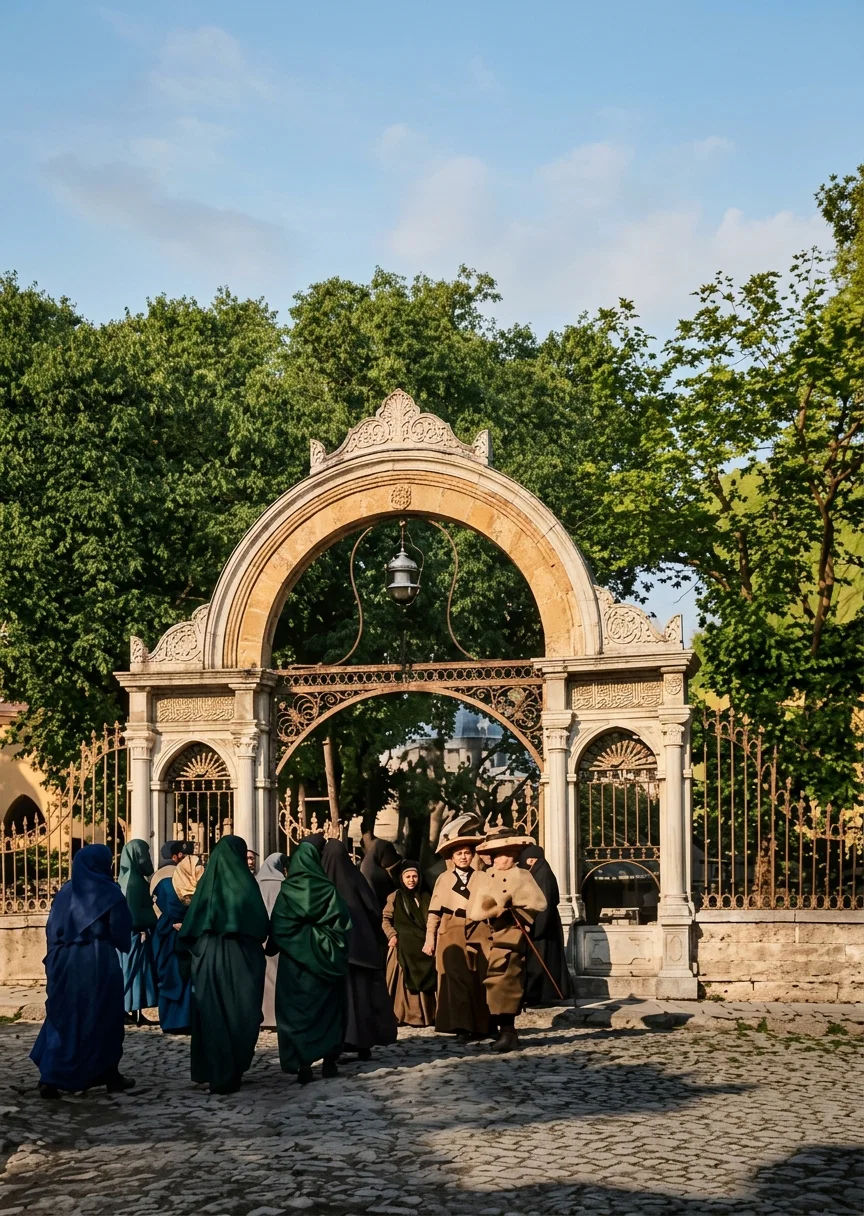
ENTRANCE TO TOMB OF SULTAN OTHMAN, FOUNDER OF THE TURKISH EMPIRE, BRUSA, TURKEY

HER DEATH KNELL

Turkey was induced to take the part of Germany; but she was warned that in doing so, she had “sounded her death knell.” Yet the “sick man of the East” appears to be making frantic efforts for life; but we are assured, on the authority of God's word, that the end of the Turk is near. Whether he will be driven out in the present awful struggle, as seems likely, or whether some arrangement may be devised by the powers which will leave him for a little time longer master of the coveted Constantinople, is difficult to say; but be driven out soon he must.

TO STAND AT JERUSALEM

The closing chapter in Turkey's eventful history will be the setting up of its capital at Jerusalem; and when the Turk establishes himself at Jerusalem, then will soon take place the final world struggle, known in the Bible as Armageddon. Then not only will the European nations, now so interested in Turkey, figure in that war, but all the nations of the world will be represented there.
“And the sixth angel poured out his vial upon the great river Euphrates; and the water thereof was dried up, that the way of the kings of the east might be prepared. And I saw three unclean spirits like frogs come out of the mouth of the dragon, and out of the mouth of the beast, and out of the mouth of the false prophet. For they are the spirits of devils, working miracles, which go forth unto the kings of the earth and of the whole world, to gather them to the battle of that great day of God Almighty. Behold, I come as a thief. Blessed is he that watcheth, and keepeth his garments, lest he walk naked, and they see his shame. And he gathered them together into a place called in the Hebrew tongue Armageddon.” Rev. 16: 12-16.
The river Euphrates stands for the power occupying the territory through which it flows; for water in prophecy is said to represent “peoples, and multitudes, and nations, and tongues.” Rev. 17: 15. The prophet Isaiah speaks of this same river as a symbol of the Assyrian army (Isa. 8: 7); but Turkey has now for centuries occupied this part of the world, and is therefore represented by this symbol. The waters are to be “dried up,” says the prophet John. Rev. 16: 12.

HER TERRITORY DRYING UP

That for many years the process of disintegration has been going on in the Ottoman empire all are aware. In other words, Turkey is “drying up.” Her territory in Europe, which at one time was very extensive, is now only a shabby remnant of what she possessed in the days of her glory. In fact, what she now has is just sufficient to contain her capital, and that she has held many years only at the sufferance of the powers. The corrosive influence of misgovernment is now telling its tale. The strongest moral fiber, under such blighting conditions, mustgive way. The prophecy is fulfilling. Turkey is “drying up” before our eyes.

THE “KINGS OF THE EAST” ENTER THE FRAY

But not only does the prophecy include the nations that have now for many years been so vitally interested in the near East, but the “kings of the earth and of the whole world” are to be gathered, says the prophet. Rev. 16: 14. This, then, includes the nations of the far East. In fact, they are very specifically included. “And the sixth angel poured out his vial upon the great river Euphrates; and the water thereof was dried up, that the way of the kings of the east might be prepared.” Verse 12. The Revised Version renders the last part of this verse, “the kings that come from the sunrising.” It is self-evident that such language must lead us to apply the prophecy to such nations as China and Japan.

THE “SUNRISE KINGDOM”

Japan is significantly named the “Sunrise Kingdom.” That she is a powerful nation, and now has a dominating influence in the far East, has been demonstrated. Until a short time ago, she had been shut up in her exclusiveness of centuries; but now she is awakened, and stands watchful, eager, and ready.
CONSTANTINOPLE WITH GOLDEN HORN — A PLACE CONSPICUOUS FOR CENTURIES IN WORLD EMPIRE

THE MIGHTY FORCES OF CHINA

China, which surprised the world by establishing a republic so recently, has not yet made such rapid strides; but she is a nation of great resources and latent power. Her misfortune has been that of a badly governed nation, which has resulted in a condition of stagnation. Her rulers have exploited the country for centuries, until it passed the limit of endurance. Hence the uprisings and the recent revolution, out of which the republic was born. But evidently China is not yet ready for a republican form of government; and the so-called republic is not a republic in fact, but rather a dictatorship. Yuan Shi Kai, the president, is a shrewd leader, and is doing his best, undoubtedly, to steer the ship of state away from danger; but the task is difficult, and the end most uncertain.
China has just passed through a crisis—or it should be said, is passing through a crisis, for the end of the difficulty is not yet. China has been humiliated by her aggressive neighbor, Japan. The latter has taken advantage of the present European situation, to impose demands upon China which she would most likely hesitate to make at another time. Territorial rights, coöperative interests in a great iron mine in China, insisting that China shall buy arms and munitions of war from Japan, and that she shall appoint Japanese advisers,—these are some of the demands which were backed up by an ultimatum from Japan.

PARTNERSHIP OF CHINA AND JAPAN

China has submitted. What will be the outcome? It is difficult to say what the immediate future may bring forth, but it is predicted that sooner or later a close alliance will be made between China and Japan. From an English daily published in Japan, in an editorial under the caption, “China as Japan's Partner,” we quote the following:
“What appears to be the position at present is that the two governments are gradually drawing toward a compromise whereby they may enter a kind of partnership, rather than an alliance. . . . The material for exchange in such a partnership is not wanting. China has natural resources to develop and protect. Japan has some acquired resources for developing and protecting the same. Moreover, China's undeveloped riches and military weakness are a constant menace not only to herself but also to Japan, seeing that there are constant temptations to foreign aggression. Let us become partners, says Japan—peaceful partners—and we shall both become rich and strong. Let us, in this peaceful plan, not arouse foreign criticism by foolish fighting, which can only end in one way, or by foolish talk of an offensive or a defensive alliance—quite unnecessary at this stage, and even likely to arouse antagonism. In fact any such sweeping arrangement necessarily disturbs the status quo in the far East, which we, under the Anglo-Japanese alliance, etc., are pledged to maintain. Let us quietly work out a little business partnership, which may some day develop into something more, and at any rate lay the foundations of a vast permanent guarantee of Asiatic strength.”
Let us imagine China, with her undeveloped resources and her four hundred millions of people, united in not merely an alliance, but a partnership, with Japan, the pushing, wide-awake, diplomatic, and military nation of the far East, and we can well calculate what a power may soon develop under such a mighty combination. Can we not then see more clearly what is meant by the “kings that come from the sunrising” in the great world struggle just before us?

NOT SICK, BUT A POTENT FORCE

Some one has termed China the “sick man of the far East,” just as Turkey is said to be the “sick man” of the near East; and in harmony with this idea, a French writer spoke of China as a great corpse floating about on the water of civilization, disturbing the harmony of nations by her pollutions. But E. F. P. Hatch, M. P., in his book entitled “Far Eastern Impressions,” written just before the revolution, refutes such a thought, in the following vigorous words:
“Dead she certainly is not. Heavy as are the blows that have fallen upon her in recent years, sorely though she has been stricken, her wonderful vigor remains practically unimpaired, and she continues what she has been for centuries, the greatest self-contained empire in the world. We speak of the break-up of China when we mean the break-up of her effete government. . . . The great nation of four hundred million souls, inhabiting a vast area that is almost a continent in itself, is what it has always been, a potent force in the world's history.”
Thus we have the most numerous race on the earth, with brain and sinew, and with unlimited resources, to be linked up, in all probability, with Japan, a nation trained in diplomacy, war, and commerce. Under her wise tutorship, what may not China become? United as one, what powers could afford to be their foes?

MAY COME VERY QUICKLY

Here, then, is one of the world's greatest disturbing forces; and in the rapid kaleidoscopic changes of this world's politics, who can tell how quickly all that is involved in this movement may be brought about?
We live in days of rapid transition. The end is near. God's word is fulfilling. Referring to this great final conflict, the Saviour gives this timely admonition: “Behold, I come as a thief. Blessed is he that watcheth, and keepeth his garments, lest he walk naked, and they see his shame.” Rev. 16:15.

Loved Those Who Hated Him

JESUS came into the world to save men and women. He came because He loved us. He loved us when He came. He loved those He knew hated Him. He prayed for those who spit in His face. He loved His own in the world to the end, even when one of these same denied with cursing that he knew Jesus at all, and another sold Him for thirty pieces of silver, and traitorously betrayed Him into the hands of a mob, while all the rest forsook Him and went home.
He loved the men who drove the spikes into His hands and feet, and He breathed a prayer for them, because He knew that they knew not what they did, nor whose hands those were they were nailing to that tree. He loved the two thieves beside Him, and told one of them, because of his faith in Him as the Redeemer of the world under these humiliating circumstances, that he should one day be with Him in Paradise.
Where can we find such love as this displayed? It is through love, and love only, and love under all conditions, however trying, that souls are won to Him who loved as none other ever before loved.
In the face of the same world hatred that hated Him who loved as none other ever loved, we are commanded by Him, “Love one another, even as I have loved you.” Do we?
T. E. BOWEN.

The Judgment Standard

THE fourteenth chapter of Revelation reveals the last gospel message that will go to the world before the second coming of Christ. In this gospel message, the standard of holy living presented before the people, which is the law of God (Rev. 14:12), will be the standard of the Judgment. If we refuse to meet that standard here, by the help of the Lord, how will we fare in the Judgment?
A. S. BOOTH.

THE KING IS COMING

By ELIZA H. MORTON
A MESSAGE comes to you, dear soul, From heaven’s high throne. It bids you lend your ear just now. While ’tis made known. The battle of the ages nears— ’Mageddon’s strife. Would you escape, and claim as yours Eternal life?
Hearken, and search your Bibles through, Looking for light, And it will come. The day’s at hand, Also the night. Let scoffers scoff. It is the sign The end is near. As ’twas before the Flood, so now, Thus saith the seer.
List ye. The Spirit pleads. Beware, O, softly tread. A King is coming from afar To raise the dead. That King is King of all the earth. Bow down your knee. Or by and by forth from His face In terror flee.

THEY ARE TRULY GREAT

Motive and Character the Determining Factors—Suffering an Honor and a Trust—How to Plan the Future
By the late MRS. E. G. WHITE
Mrs. E. G. White, who had been a constant contributor to this paper for the forty years of its history, left with us as a legacy numerous articles and valuable manuscripts. Our readers will appreciate and prize this matter as it appears from week to week. EDITOR.
Not by their wealth, their education, or their position does God estimate men. He estimates them by their purity of motive and their beauty of character. He looks to see how much of His Spirit they possess, and how much of His likeness their life reveals. To be great in God’s kingdom is to be as a little child in humility, in simplicity of faith, and in purity of love. “Ye know,” Christ said, “that the rulers of the Gentiles lord it over them, and their great ones exercise authority over them. Not so shall it be among you: but whosoever would become great among you shall be your minister.” Matt. 20:25, 26, A.R.V.

SUFFERING AS A TRUST AND HONOR

Of all the gifts that heaven can bestow upon men, fellowship with Christ in His sufferings is the most weighty trust and the highest honor. Not Enoch, who was translated to heaven, not Elijah, who ascended in a chariot of fire, was greater or more honored than John the Baptist, who perished alone in the dungeon. “Unto you it is given in the behalf of Christ, not only to believe on Him, but also to suffer for His sake.” Phil. 1:29.

PLANNING THE FUTURE

Many are unable to make definite plans for the future. Their life is unsettled. They cannot discern the outcome of affairs, and this often fills them with anxiety and unrest. Let us remember that the life of God’s children in this world is a pilgrim life. We have not wisdom to plan our own lives. It is not for us to shape our future. “By faith Abraham, when he was called to go out into a place which he should after receive for an inheritance, obeyed; and he went out, not knowing whither he went.” Heb. 11:8.
Christ, in His life on earth, made no plans for Himself. He accepted God’s plans for Him, and day by day the Father unfolded His plans. So should we depend upon God, that our lives may be the simple outworking of His will. As we commit our ways to Him, He will direct our steps.
Too many, in planning for a brilliant future, make an utter failure. Let God plan for you. As a little child, trust to the guidance of Him who will “keep the feet of His saints.” 1 Sam. 2:9. God never leads His children otherwise than they would choose to be led, if they could see the end from the beginning, and discern the glory of the purpose which they are fulfilling as coworkers with Him.

WAGE QUESTION MINIMIZED

When Christ called His disciples to follow Him, He offered them no flattering prospects in this life. He gave them no promise of gain or worldly honor, nor did they make any stipulation as to what they should receive. To Matthew, as he sat at the receipt of custom, the Saviour said, “Follow Me. And he left all, rose up, and followed Him.” Luke 5:27, 28. Matthew did not, before rendering service, wait to demand a certain salary, equal to the amount received in his former occupation. Without question or hesitation he followed Jesus. It was enough for him that he was to be with the Saviour, that he might hear His words and unite with Him in His work.

THEY LACKED NOTHING

So it was with the disciples previously called. When Jesus bade Peter and his companions follow Him, immediately they left their boats and nets. Some of these disciples had friends dependent on them for support; but when they received the Saviour’s invitation, they did not hesitate, and inquire, “How shall I live, and sustain my family?” They were obedient to the call; and when afterward Jesus asked them, “When I sent you without purse, and scrip, and shoes, lacked ye anything?” they could answer, “Nothing.” Luke 22:35.
To-day the Saviour calls us, as He called Matthew and John and Peter, to His work. If our hearts are touched by His love, the question of compensation will not be uppermost in our minds. We shall rejoice to be coworkers with Christ, and we shall not fear to trust His care. If we make God our strength, we shall have clear perceptions of duty, unselfish aspirations; our life will be actuated by a noble purpose, which will raise us above sordid motives.

POWER OF CHOICE

THE power of choice is the most sacred trust the Creator has conferred upon His intelligent creatures. By this gift God has made us “free moral agents.” He has placed our eternal destiny in our own hands. By it we become the builders of characters that are destined to stand forth in imposing grandeur, resplendent with the light of eternal glory, or to go down to destruction in the final collapse of sin. It is so sacred a trust that God Himself will not invade it, and He has placed it beyond the possibility of control by any outside influence.
Men may deny that we possess this marvelous gift, and may claim that we are only creatures controlled by circumstances; but since the extreme to which any power can go in trying to force one’s choice, is to put to death, therefore every martyr who has died, has proved that the power of choice rests with the individual, and beyond outside control.
Responsibility always accompanies the power of choice. Men who deny man’s power of choice, belie their own theory by punishing their children and by calling their neighbors to account for conduct. R. S. OWEN.

International Lord’s Day Congress

Fourteenth Session Held in Oakland, California — What the Congress Stands for Is Significant, Even Though Its Meeting Was Small
By W. MAYHEW HEALEY
“THE Fourteenth International Lord’s Day Congress” convened in Oakland, California, July 27 to August 1, 1915. Dr. Duncan J. McMillan called the congress to order at 8:00 P. M., July 27.
H. W. Johnson, governor of California; C. C. Moore, president of the Panama-Pacific International Exposition; and John L. Davie, mayor of Oakland, were advertised on the program to give addresses of welcome. None of these men were present. Governor Johnson was represented by F. J. O’Brien, President Moore by Frank L. Brown, and Mayor Davie by Mr. Higgins. These gentlemen made addresses of from three to fifteen minutes in length, and then excused themselves from further attendance at the congress.

ALTON B. PARKER PRESIDES

D. J. McMillan introduced Judge Alton B. Parker as permanent chairman. Judge Parker delivered an address on “The Sabbath and Civil Liberty.” He seemed desirous of having liberty, and at the same time having a law that would take it away.
Duncan J. McMillan was elected permanent secretary of the congress.

IN STATUTES AND ON HEARTS

Bishop E. H. Hughes, of the Methodist Episcopal Church, gave a brief address of welcome in behalf of the churches on the Pacific coast. In giving the reasons and need of this congress, he said, “We have need of your presence that we may have written in our statute books and on our hearts the words, ‘Remember the Sabbath day.’”
The words of Bishop Hughes have a meaning and significance that the speaker evidently did not see, nor intend to convey. They show a dependence on the power and influence of man, instead of the Spirit and power of God, to write this human sabbath on human statutes and human hearts.

FIFTY COOPERATING ASSOCIATIONS

The handbook of the congress claims about fifty cooperating associations and societies in different parts of the world, with about one third of them in the United States. It names as vice chairman all “the governors of the states and territories of the United States”; and as “patron and honorary chairman his excellency the Hon. Woodrow Wilson, president of the United States”; and as “patron and honorary vice chairman, his royal highness the duke of Connaught, governor-general of Canada.”
About one hundred and fifty were advertised as delegates to deliver addresses or read papers before the congress. Among these are many eminent and noted divines and educators from every country of Europe, Asia, Africa, America, Australia, and the islands of the sea.

ONLY SMALL AUDITORIUM REQUIRED

Any one not acquainted with the methods employed would naturally look for a large attendance, judging from the claim and advertising of the congress. But evidently this was not expected by the committee of arrangements, as the audience room secured in the Oakland Municipal Auditorium, for the meetings of the congress, is only seated for 465 persons; but this was more than ample, for only once during the session were the seats half filled.
Many of the parties announced to be present were “conspicuous by their absence.”
Some of them sent papers. The idea of bringing about a more general and sacred observance of Sunday ran through every speech and paper, but there was a wide diversity of opinion as to what to do and how to do it in order to bring this about.
Some of the papers contained the spirit and words of liberty. It is evident that some of these men and women are groping in the dark, and feeling after God and His truth. May their eyes be opened to see the way of righteousness that leads along the path of “Whatsoever ye would that men should do to you, do ye even so to them.” And when contemplating the making of laws to compel others to observe Sunday, or accept any other of their religious views, may they consider how they would like to have others force some unacceptable religious or pro-religious institution or practice upon them.

BITTERNESS WITH SOME

Some of the papers were filled with a spirit and clothed in language so bitter and unjust as to remind one of the councils of the Dark Ages.
The citizens of Oakland and vicinity ignored the congress by their nonattendance. Even the ministers of the city gave it scarcely any attention. Evidently they had little or no sympathy with the purpose of the congress to aid in obtaining a Sunday law in California.

MORE SIGNIFICANT THAN MIGHT APPEAR

While the congress was so slimly attended as to cause the casual observer to regard it as almost a farce, it nevertheless has a place, a purpose, a power, in fulfilling the word of God.
A man busy with his toil, casting his eyes over the ocean, might see what appears to be a few pieces of wood tossing upon the waves, and he turns thoughtlessly from the scene to his labor. But the watchman in the tower sends forth a piercing cry of alarm. He has seen, in those apparently harmless pieces of wood, the masts of an enemy’s fleet stealthily approaching to destroy his liberty and his home and loved ones. Likewise the reader of history and student of God’s word may see, by the prophetic telescope, the approaching danger to religious liberty, by the tops of the masts of this “congress” in its demands for religious legislation.
Of the teaching and influence of the congress, we hope to say more from time to time in the future.

The Partition Wall Broken Down

What Was Nailed to the Cross? — Is the Seventh-Day Sabbath One of the Shadows That Vanished?
By J. W. McCOMAS
BETWEEN the Jew and the gentile, until the first advent of Christ, there was a marked difference. The Jew was God's man, with all the promises, with all the glory, and the covenants, and the law, and the service of God. Rom. 9: 4. Such was the man God chose to be a vessel through which and in which He might carry to a thirsty world the waters of salvation. He was to be a cup in God's hand. Gen. 26: 4.
But this people rebelled in the beginning of their work, and became a stiff-necked race. So it became necessary for God to bring to them some work which would constantly remind them that they were rebellious. This law “stood only in meats and drinks, and divers washings, and carnal ordinances, imposed on them until the time of reformation.” Heb. 9: 8-10. This law was not of itself good, neither would it give them life. Eze. 20: 25.

THE ONE BLOTTED OUT

This law of ordinances was blotted out, and nailed to the cross with Christ. The wall was broken down. These meat offerings, drink offerings, holy days, new moons, and sabbath days, “which are a shadow of things to come; but the body is of Christ” (Col. 2: 14-17), all came to an end in Christ; hence they must have pointed to Christ.
Did this law include the Ten Commandment law? If so, this Ten Commandment law would be a shadow, and when we reach Christ, its binding obligation would cease, and the people would be privileged to break it, and still be justified in the sight of God; for man is held guiltless now in disregarding the law of ordinances, which was nailed to the cross.

IS IT LAWFUL TO STEAL AND LIE?

It would be lawful for a man to lie, steal, commit adultery, and break every other command, if this law against such things came to an end at the cross. But no one would take such a position; and those who believe that the Ten Commandment law was nailed to the cross, are glad to resurrect nine of them, leaving out the fourth, and making the nine binding upon Christians. Thus they show that in truth they do not believe that the Ten Commandments were abolished—nailed to His cross.
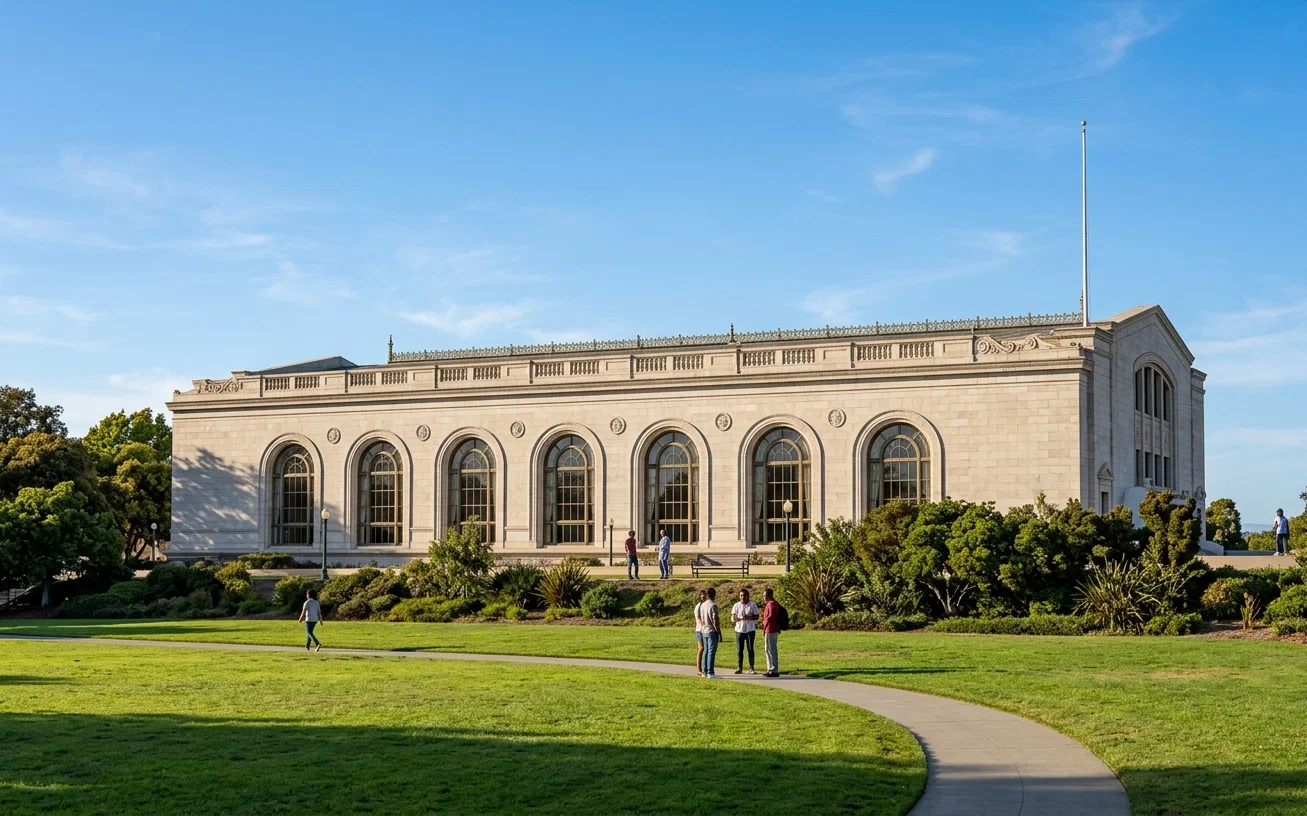
Municipal Auditorium, Oakland, California, is one of the small audience chambers of which the International Lord's Day Congress was held.
That whole story is told to make the fourth commandment—which requires the seventh-day Sabbath—of none effect, not binding upon the world with the other nine. Jesus says, “It is easier for heaven and earth to pass, than one tittle of the law to fail.” Luke 16: 17.

THE SABBATHS NAILED TO THE CROSS

Then how does God account for these sabbath days that were nailed to the cross? In Deut. 31: 9 we find that Moses wrote a law, and in verses 24-26 we are told that he wrote it in a book. But there was another law, written upon stone, and God Himself wrote this one with His own finger. Deut. 9: 10. This law James refers to when he says, “Whosoever shall keep the whole law, and yet offend in one point, he is guilty of all.” James 2: 8-12.
In the law that Moses wrote, we find sabbath days which came to the Jews just as our fourth of July comes to us, once a year. Lev. 23: 24 says, “In the seventh month, in the first day of the month, shall ye have a sabbath.” Again in verses 27-32 we find that the tenth day of this seventh month was to be a sabbath. This chapter also tells us in verses 37 and 38, that these and other feast days were besides the Sabbath of the Lord.
Then God made a distinction between theSabbath found in the law which He wrote, and those commanded in the law Moses wrote. In fact, God says, “I will also cause all her mirth to cease, her feast days, her new moons, and her sabbaths, and all her solemn feasts.” Hosea 2: 11. He calls them “her sabbaths”; but in His law, He calls the seventh-day Sabbath “the Sabbath of the Lord thy God.” Again in Isa. 58: 13, He calls it “My holy day.”
By this we see there were sabbaths besides the seventh day of the week. Their origin was with Israel, and continued until Christ; but the making of the seventh day as a blessed, sanctified rest day was in Eden, before sin came into the world. And in Eden restored, the good Book tells us, “as the new heavens and the new earth, which I will make, shall remain before Me, saith the Lord, so shall your seed and your name remain. And it shall come to pass, that from one new moon to another, and from one Sabbath to another, shall all flesh come to worship before Me, saith the Lord.” Isa. 66: 22, 23.
This Sabbath, says the Saviour, was made for man. Mark 2: 27, 28. And by the text quoted from Isaiah, it is plain that in our redeemed state, we will still observe the Sabbath which God made in Eden.
For a man to belong to the family of the eternal world, he must be a stranger in this world. Heb. 11: 10-13. He must live as did Billy Miner, who said, when asked how the world was getting along, “I don't know, I haven't lived there for twenty years;” and as did the old Scotchman who was asked, “Are you on your way to heaven?” and said, “I live there.”
Then let us begin now, so that the scenes of the new home will not be strange; for Sabbath keeping is a part of the worship of Jehovah.
Continue reading: Papal Persecutions in the Light of Prophecy