The ark represents the center of God's worship; in ancient times, on earth; now, in heaven, where Christ our great High Priest ministers. In it is the holy law, above is the mercy-seat, where “Mercy and Truth are met together” and “Righteousness and Peace have kissed each other.”
With Our Inquirers
By Editor
“If ye will inquire, inquire ye.”
[All questions to this department will be answered which to the editors will seem to minister to the good of the readers and to the mission of the paper. The same question can not be answered repeatedly in the same volume. The name and address must accompany question, not for publication, but as an evidence of good faith, and that answer may be made by letter if deemed advisable. It is well always to enclose a stamp for reply.]
2321.—Lack of Power to Repent.
Will you please explain Heb. 6:4-6, and what is the reason of the lack of power to repent as stated in Question 2182?
W. F. K.
Let us read carefully the text from the American Revised Version. “For as touching those who were once enlightened and tasted of the heavenly gift, and were made partakers of the Holy Spirit, and tasted the good word of God, and the powers of the age to come, and then fell away, it is impossible to renew them again unto repentance; seeing they crucify to themselves the Son of God afresh, and put Him to an open shame.” This certainly shows that those who thus fall away have no power, because, having known the power, having tasted of His kingdom, right in the very face of this they turn from all the wonderful things which God has shown them and yield themselves to sin. Note the illustration that is used to impress the lesson: “For the land which hath drunk the rain that cometh oft upon it, and bringeth forth herbs meet for them for whose sake it is also tilled, receiveth blessing from God.” God gave those blessings in order that the soul might bear fruit, and if it had continued to bear fruit it would have continued to receive blessings. The illustration continues, “But if it beareth [that is, continues to bear] thorns and thistles, it is rejected and nigh unto a curse; whose end is to be burned.” The whole thought is that it is the constant sinning which hardens heart and conscience, so that there is no means of reaching them. Read this text in connection with Heb. 10:26-29. It is sinning wilfully after receiving the knowledge of the truth. God has two means of reaching souls, the sacrifice of the Son of God and the life-giving power of His Holy Spirit, but when men count the blood of the covenant an unholy thing, reject the sacrifice of Christ by crucifying Him afresh, by continual sinning and turning from the pleading of the Spirit, the Lord has no other means of saving them. That does not mean, however, that if one has sinned he can not turn again to God. “If any man sin, we have an Advocate with the Father, Jesus Christ the righteous.”
2322.—Keeping the First Day.
Can you explain why all commentators, Bible publishers, and Bible students generally, who have given their lives to the study of the Scriptures, do not keep the seventh day?
C. K.
In the first place, all Bible students would not fall in this category. We have one list of devoted, earnest, faithful soldiers of God reaching from Enoch, the seventh from Adam, Noah, the comfort of God, Abraham, the father of the faithful, and Moses, the man of God, down to Paul, the apostle to the Gentiles, and John, the beloved, as well as Him who spake as never man spake, who were all observers of the seventh day. Prophets tell us then that there will be a departure, tell of a certain power that would think to change the times and the laws of God, tell us that they should be given into the hands of that power for 1,260 long years; during that time the church of the Lord would wander in the wilderness of confusion; but at the end of that time new light would spring forth. The word of God would again be searched. Men began to search it; they did not see all things clearly at first, but they were imbued by the Spirit of God to search earnestly the Scriptures for light; and they have done this. Gradually the light has been coming in. Martin Luther brought some of it. The Wesleys brought more light. Other light came from the Baptists, and from William Miller and the hundreds of others who preached the second coming of Christ, and now the last revelation includes the restoration of God’s holy Sabbath, which the world has been trampling underfoot. This is why it is that good men have not kept it in the past, they have not seen in the light of God’s word the necessity of it; they have followed early teaching without studying the word. Now the agitation is becoming world-wide. Souls must range themselves on one side or the other of the great question. They must decide it by the word of God or by tradition.
2323.—A Form of Prayer.
I have been much perplexed over the question whether I should teach my children a form of prayer or simply the importance of prayer.
A MOTHER.
We see no reason whatever why little children should not be taught a form of prayer, a comprehensive form of prayer, and then explain to them what that means. For instance, to illustrate, here is a little prayer that has been taught to children for the evening:
“Father, I thank Thee for the way
Thou hast kept me all the day.
O Saviour, keep me thru the night,
That I may see the morning light.
O from my heart all evil take,
All this I ask for Jesus’ sake.”
Now that is comprehensive in thanksgiving, in keeping power, and cleansing from sin. Jesus taught His disciples a comprehensive form of prayer in the Lord’s prayer. As your children learn a proper form of prayer, a proper way of expressing their wishes, then teach them that they can pray for other things which are proper, and frame it in their own language. Follow the sanctified mother-instinct and it shall be well.
2324.—Unfulfilled.
Have the words of the prophet in Eze. 39:8-10 been fulfilled as yet?
C. K.
To our mind Ezekiel 36-48 will never be fulfilled as there given. If God’s children had yielded to the conditions which the Lord then laid down, if they had come to Him with all their hearts, all that is recorded in the last chapters of Ezekiel would have been fulfilled to them at that time, in the Babylonian restoration; but Ezra and Nehemiah show clearly just how they came back, half-heartedly, mingling with other nations, and doing the deeds of other nations. God could not fulfil to them the promises which He gave thru His prophet Ezekiel. The conditions on which God gives His promises are plainly stated in Jer. 18:7-10. Please read it. If the Israelitish nation had yielded to God, the glorious things of which Ezekiel spoke would have been fulfilled; their enemies would have been subdued before them, as recorded in chapters 38, 39; but they turned from Him and would not obey His voice; consequently He could not fulfil all the blessings there pronounced. However, there will come a time when all that God has promised concerning the restoration of His people will be fulfilled in glorious measure, as recorded in Revelation 20, 21.
2325.—The Wages of Sin.
If the wages of sin is death, does it mean the first death only? Christ died for our sins; He passed thru or suffered the first death only. All sinners must pass thru or suffer both deaths. Will you explain?
C. K.
The Bible does not qualify the express statement, “The wages of sin is death.” The parallel of Rom. 6:23 is found in James 1:15. “Sin, when it is finished, bringeth forth death.” Death is the very fruit of sin, ripened and gone to seed. When Christ died He died the death of the sinner. It would have been eternal death for all the race if He had not lived a righteous life; but He rose again, and by virtue of that righteous life conquered the power of the grave. As the posterity of Adam were not responsible for Adam’s sin but for their own merely, Christ redeems from the grave irrespective of character. But what man chooses for himself in the probation which God gives him, he must meet when his own individual case comes before God in judgment. If he has chosen life and sought for life, life it shall be; if he has sown for death, he will reap its fruitage. When Christ died upon the cross He bore the awful load of sin in seeming despair, so as to wring from His heart, “My God, My God, why hast Thou forsaken Me?” He did that in order that the sinner might turn to Him and feel that he was not forsaken of God. In other words, He who knew no sin became sin for us, that we, the sinners, might be made the righteousness of God in Him. His children go down in the grave because of inherited mortal nature, but they rise to immortality because they are possessed of the righteousness of God in Christ.
2326.—Parable of the Rich Man and Lazarus.
If the dead are not conscious, why does Jesus represent the rich man as having a great desire to see his five brethren saved? May we suppose that he still has a desire to see them saved when he comes up in the second resurrection? This seems to be proof to many souls that man is conscious after death, while probation lingers, or else he would have no interest in the salvation of his brethren.
A. D. F.
No parable is ever designed to teach doctrine. It may be used to illustrate what is taught by plain Scripture, but no sound Biblical exegesis bases doctrine on a parable. At the very most the parable could only represent the rich man and Lazarus as saying what they would say if they were able to say it; but to our mind the parable is not a representation of things after death. It was simply using a parable which was common among the Jews to illustrate the different attitudes toward Christ of the Jews and the Gentiles. See the tract “Rich Man and Lazarus,” or “Christ’s Object Lessons,” in which this phase of the parable is set forth. If our inquirer has access to these works he will get much better satisfaction than anything we could say in this department. The Bible very clearly teaches the unconscious state of the dead. There is nothing in the parable which should be used to militate against the plain teaching of the word. If the story were to be used as a literal occurrence in all its details, it would make God’s dealings with men not only ridiculous but cruel.
2327.—J. R. W.
—The talents of Matthew 25 are gifts which the Lord bestows. They include the gifts mentioned in Romans 12, 1 Corinthians 12, and Ephesians 4, and perhaps others. No one list gives all the gifts of the Spirit which God bestows upon His children. One of these gifts is liberality. That would perhaps include the power to make money. There are some who have special gifts in this direction, ability to make and save money in honorable, proper ways. See Deut. 8:18, “Thou shalt remember Jehovah thy God, for it is He that giveth thee power to get wealth.” And all these gifts should be employed for the Master as He has given them—according to our several abilities.
2328.—C. K.
—John 20:19 was in all probability in the beginning of the second day of the week, in stead of the first. It was toward evening when the disciples went to Emmaus, seven and one-half miles from Jerusalem. Jesus met with them and they returned. It must have been past sunset when they reached Jerusalem. They found the disciples gathered together with the doors shut, for fear of the Jews. The first day must have been over, and the evening of the next day begun. Doubtless they met together first in the close of the first day, but when Jesus met with them, the first day must have been past and the second day begun.
2329.—N. M. B.
—Ps. 90:10, “We fly away” simply means that we die, as used in Prov. 23:5, “Riches make themselves wings and fly away;” that is, we lose them just the same as we lose life.
Feeding the Multitude.
By Mrs. E. G. White
ALL day the people had thronged the steps of Christ and His disciples as He taught beside the sea. They had listened to His gracious words, so simple and so plain that they were as the balm of Gilead to their souls. The healing of His divine hand had brought health to the sick and life to the dying. The day had seemed to them like heaven on earth, and they were unconscious how long it had been since they had eaten anything.
The sun was sinking in the west, and yet the people lingered. Finally the disciples came to Christ, urging that for their own sake the multitude should be sent away. Many had come from far, and had eaten nothing since morning. In the surrounding towns and villages they might be able to obtain food. But Jesus said, "Give ye them to eat." Then turning to Philip, He questioned, "Whence shall we buy bread, that these may eat?"
Philip looked over the sea of heads, and thought how impossible it would be to provide food for so great a company. He answered that two hundred pennyworth [about $34 worth] of bread would not be enough to divide among them, so that each might have a little.
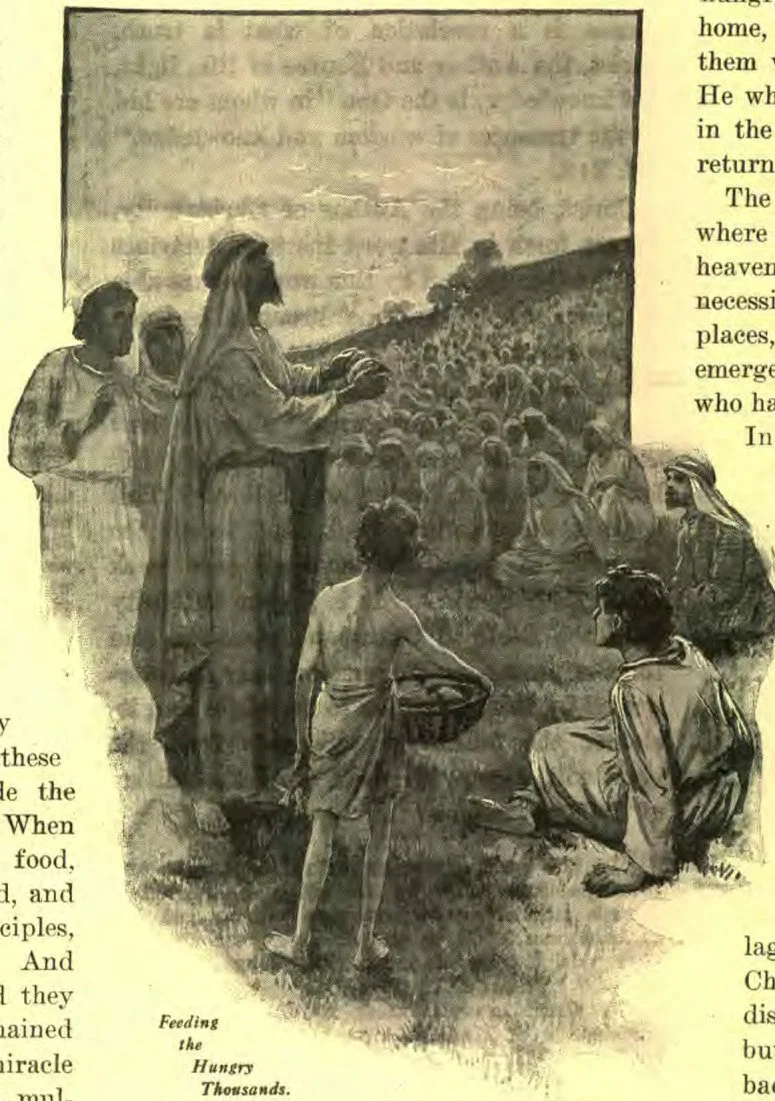
Jesus inquired how much food could be found among the company. "There is a lad here," said Andrew, 'which hath five barley loaves, and two small fishes; but what are they among so many?'" Jesus directed that these be brought to Him. Then He bade the disciples seat the people on the grass. When this was accomplished, He took the food, "and looking up to heaven, He blessed, and brake, and gave the loaves to His disciples, and the disciples to the multitude. And they did all eat, and were filled: and they took up of the fragments that remained twelve baskets full." It was by a miracle of divine power that Christ fed the multitude; yet how humble was the fare provided,—only the fishes and barley loaves that were the daily fare of the fisherfolk of Galilee.
Christ could have spread for the people a rich repast, but food prepared merely for the gratification of appetite would have conveyed no lesson for their good. Through this miracle Christ desired to teach a lesson of simplicity. If men to-day were simple in their habits, living in harmony with nature's laws, as did Adam and Eve in the beginning, there would be an abundant supply for the needs of the human family.
But selfishness and the indulgence of appetite have brought sin and misery, from excess on the one hand, and from want on the other.
Jesus did not seek to attract the people to Him by gratifying the desire for luxury. To that great throng, weary and hungry after the long, exciting day, the simple fare was an assurance both of His power and of His tender care for them in the common needs of life. The Saviour has not promised His followers the luxuries of the world; their lot may be shut in by poverty; but His word is pledged that their need shall be supplied, and He has promised that which is better than earthly good,—the abiding comfort of His own presence.
After the multitude had been fed, there was an abundance of food left. Jesus bade His disciples, "Gather up the fragments that remain, that nothing be lost." These words meant more than putting the food into baskets. The lesson was twofold. Nothing is to be wasted. We should neglect nothing that would serve to benefit a human being. Let everything be gathered up that will relieve the necessities of earth's hungry ones. With the same carefulness are we to treasure the bread from heaven to satisfy the needs of the soul. By every word of God we are to live. Nothing that God has spoken is to be lost. Not one word that concerns our eternal salvation are we to neglect. Not one word is to fall useless to the ground.
Dependence upon God.
The miracle of the loaves teaches dependence upon God. When Christ fed the five thousand, the food was not nigh at hand. Apparently He had no means at His command. There He was, with five thousand men, besides women and children, in the wilderness. He had not invited the multitude to follow Him thither. Eager to be in His presence, they had come without invitation or command; but He knew that after listening all day to His instruction they were hungry and faint. They were far from home, and the night was at hand. Many of them were without means to purchase food. He who for their sake had fasted forty days in the wilderness, would not suffer them to return fasting to their homes.
The providence of God had placed Jesus where He was; and He depended on His heavenly Father for means to relieve the necessity. When we are brought into strait places, we are to depend on God. In every emergency we are to seek help from Him who has infinite resources at His command.
In His miracle, Christ received from the Father; He imparted to the disciples, the disciples to the people, and the people to one another. So all who are united to Christ will receive from Him the bread of life, and impart it to others. His disciples are the appointed means of communication between Christ and the people.
When the disciples heard the Saviour's direction, "Give ye them to eat," all the difficulties arose in their minds. They questioned, "Shall we go into the villages to buy food?" But what said Christ?—"Give ye them to eat." The disciples brought to Jesus all they had; but He did not invite them to eat. He bade them serve the people. The food multiplied in His hands, and the hands of the disciples, reaching out to Christ, were never unfilled. The little store was sufficient for all. When the multitude had been fed, the disciples ate with Jesus of the precious, heaven-supplied food.
As we see the necessities of the poor, the ignorant, the afflicted, how often our hearts sink. We question, "What avail our feeble strength and slender resources to supply this terrible necessity? Shall we not wait for some one of greater ability to direct the work, or for some organization to undertake it?" Christ says, "Give ye them to eat."4Use the means, the time, the ability, you have. Bring your barley loaves to Jesus.
Tho your resources may not be sufficient to feed thousands, they may suffice to feed one. In the hand of Christ they may feed many. Like the disciples, give what you have. Christ will multiply the gift. He will reward honest, simple reliance upon Him. That which seemed but a meager supply will prove to be a rich feast.
"He that soweth sparingly shall reap also sparingly; and he that soweth bountifully shall reap also bountifully. . . . God is able to make all grace abound unto you; that ye, having always all sufficiency in everything, may abound unto every good work: as it is written: He hath scattered abroad, He hath given to the poor; His righteousness abideth forever. And He that supplieth seed to the sower and bread for food, shall supply and multiply your seed for sowing, and increase the fruits of your righteousness; ye being enriched in everything unto all liberality which worketh thru us thanksgiving to God."
Mrs. E. G. White.
Christian Science in the Light of Reason and Revelation
By R. A. Underwood
By R. A. Underwood
Creation, Sin, Atonement.
IN the investigation of Christian Science, every person should be fair-minded enough to bring its claims to the same test that the noble Bereans did when the apostles brought to them new light and truth. Acts 17:11. We are admonished, however, by the inspired word not to believe every message that may come without putting it to the test of the Bible. In 1 John 4:1-3, we are exhorted, “Beloved, believe not every spirit, but try the spirits, whether they are of God; because many false prophets are gone out into the world. Hereby know ye the Spirit of God: Every spirit that confesseth that Jesus Christ is come in the flesh is of God; and every spirit that confesseth not that Jesus Christ is come in the flesh is not of God.”
By what means, then, shall we test the teachings of Christian Science? Answer—“To the law and to the testimony; if they speak not according to this word, it is because there is no light in them.” Isa. 8:20. Not all that claims to be Christian is found to bear the genuine stamp of Christianity. Nor is all that is claimed to be science worthy of the name, for we read of a “science falsely so-called; which some professing have erred concerning the faith.” 1 Tim. 6:20, 21.
In view of the fact that many are being led to accept the faith of Christian Science without a knowledge of what its teaching involves, I beg to present to the reader some of the plain statements of Mrs. Eddy’s book, “Science and Health with Key to the Scriptures,” as compared with the teaching of the Bible. If the claims of Christian Science are founded upon the doctrines of Christianity and the facts of science, then every lover of Christianity and science should hail the teaching of Mrs. Mary Baker G. Eddy with delight, and accept the claims of Christian Science. If it is not founded upon the word of truth, it should be rejected and exposed. We should test the doctrines of Christian Science by the word of Jesus Christ, who is the Alpha and Omega of Christianity, and the Author of all laws by which true science is discovered and maintained. John 1:3; Heb. 1:2, 3.
To be entitled to bear the name “Christian,” one must believe in the religion of Christ, and conform to the system of doctrines and precepts taught by Him. We shall test the claim of this teaching to the name “Christian” by this simple rule. True science is a revelation of what is truth. Christ, the Author and Source of life, light, and knowledge, is the One “in whom are hid all the treasures of wisdom and knowledge.” Col. 2:3.
Christ, being the Author of Christianity, has set forth in His word the true doctrines of Christianity, and by this word we are able to judge every doctrine brought forward in the name of truth.
I will quote from “Science and Health with Key to the Scriptures,” showing how the book must be used and absolutely followed by patient, healer, and believer. This book is the standard book used in all the churches of Christian Scientists each week at all their services. It is higher authority than the Bible to Christian Scientists, and the Scriptures are understood only as interpreted by this book. As to its origin and its claims, the following statements from the book will show. We read from the edition of 1905 as follows:
“In the author’s work of retrospection and introspection may be found a biographical sketch narrating experiences which led her in the year 1866 to the discovery of the system which she denominated ‘Christian Science.’” Page VIII, Preface.
“A Christian Scientist requires my work, ‘Science and Health,’ for his text-book, and so do all his students and patients. Why?—First, because it is the VOICE OF TRUTH TO THIS AGE, and contains the whole of Christian Science, or the science of healing thru mind. Second, because it was the first published book containing a statement of Christian Science; because it gave the first rules for demonstrating this science, and registered the revealed truth uncontaminated by human hypotheses. Other works, which have borrowed from this book without giving it credit have adulterated the science. Third, because this book has done more for teacher and student, for healer and patient, than has been accomplished by other books.” Pages 456, 457.
“Expose and denounce the claims of evil or disease in all their forms, but acknowledge no reality in them.” Page 447.
“Whoever would demonstrate the healing of Christian Science must abide strictly by its rules, heed every statement, and advance from the rudiments laid down.” Page 463.
That the reader may see clearly the fact that whosoever accepts the doctrine of Christian Science must abandon the teaching of the Holy Scriptures, I will place side by side some of the fundamental doctrines of Christ compared with the teaching of Christian Science. The reader can judge whether Christian Science is of God or from another source.
The Gospel of Christ as taught in the Bible.
1. The creation of man and the universe taught as fundamental truth in the Bible.
“In the beginning God created the heaven and the earth.” “So God created man in His own image, in the image of God created He him; male and female created He them.” Gen. 1:1, 27.
“And the Lord God formed man of the dust of the ground, and breathed into his nostrils the breath of life; and man became a living soul.” Gen. 2:7.
“For in six days the Lord made heaven and earth, the sea, and all that in them is.” Ex. 20:11.
2. The Gospel of Christ affirms sin to be.
“Wherefore, as by one man sin entered into the world, and death by sin, and so death passed upon all men, for that all have sinned.” Rom. 5:12.
“This is a faithful saying, and worthy of all acceptation, that Christ Jesus came into the world to save sinners; of whom I am chief.” 1 Tim. 1:15.
“If we say that we have no sin, we deceive ourselves, and the truth is not in us.” 1 John 1:8.
“And ye know that He was manifested to take away our sins; and in Him is no sin.” 1 John 3:5.
3. The Gospel of Christ is based on the atonement.
“So Christ was once offered to bear the sins of many.” Heb. 9:28.
“For Christ also hath once suffered for sins, the just for the unjust, that He might bring us to God, being put to death in the flesh, but quickened by the Spirit.” 1 Peter 3:18.
“For He hath made Him to be sin for us, who knew no sin; that we might be made the righteousness of God in Him.” 2 Cor. 5:21.
4. The Gospel of Christ affirms Christ’s death.
“For I delivered unto you first of all that which I also received, how that Christ died for our sins according to the Scriptures.” 1 Cor. 15:3.
“I am the first and the last: I am He that liveth, and was dead; and, behold, I am alive forevermore.” Rev. 1:17, 18.
5. The Gospel of Christ offers pardon.
“If we confess our sins, He is faithful and just to forgive us our sins, and to cleanse us from all unrighteousness.” 1 John 1:9.
“Let the wicked forsake his way, and the unrighteous man his thoughts: and let him return unto the Lord, and He will have mercy upon him; and to our God, for He will abundantly pardon.” Isa. 55:7.
6. The Gospel of Christ is itself a miracle and affirms miracles.
“What do we? for this Man doeth many miracles. If we let Him thus alone, all men will believe on Him.” John 11:47, 48.
“Then all the multitude kept silence, and gave audience to Barnabas and Paul, declaring what miracles and wonders God had wrought among the Gentiles by them.” Acts 15:12.
5
Christian Science, as found in “Science and Health with Key to the Scriptures,” edition 1905.
1. Christian Science denies the material creation of man and the universe.
“Man is deathless, spiritual. He is above mortal frailty. He does not cross the barriers of time into the vast forever of life, but co-exists with God and the universe. Man and the universe co-exist with God.” Pages 266, 267.
“And the Lord God formed man of the dust of the ground, and breathed into his nostrils the breath of life; and man became a living soul.” Gen. 2:7. After quoting this text, the book says: “Is this addition to His creation real or unreal? Is it the truth, or is it a lie concerning man and God?—it must be the latter.” Page 524.
2. Christian Science denies the existence of sin.
“Question.—Is there no sin? . . . The only reality of sin, sickness, or death is the awful fact that unrealities seem real to human belief, until God strips off their disguise. They are not true. . . . Error is illusion possessing neither reality nor identity, the seeming to be real and identical with truth. The science of mind disposes of all evil.” Pages 472, 473.
“Sin, sickness, and death must be deemed as devoid of reality, as they are of truth.” Page 525.
“You conquer error by denying its verity.” Page 339.
“In reality there is no evil. . . . Sin exists only so long as the material illusion of mind in matter remains.” Page 311.
3. Christian Science denies the atonement for sin thru Christ.
“One sacrifice, however great, is insufficient to pay the debt of sin. The atonement requires constant self-immolation on the sinner’s part. That God’s wrath should be vented upon His beloved Son is divinely unnatural. Such a theory is man-made.” Page 23.
“The eternal Christ, His spiritual selfhood, never suffered.” Page 38.
4. Christian Science denies the death of Christ.
6
“Jesus’ students, not sufficiently advanced to that fully understand their Master’s triumph, did not perform many wonderful works until they saw Him after His crucifixion, and learned that He had not died.” Pages 45, 46.
5. Christian Science denies the forgiveness of sin.
“Divine mercy destroys error, but never pardons it.” Page 329.
6. Christian Science denies miracles.
“Miracles are impossible in science, and here it takes issue with popular religions.” Page 83.
The denial of the creation, of the existence of sin, of the forgiveness of sin, of the death of Christ, and of the atonement of Christ, is a repudiation of all the fundamental truths underlying the Gospel of the Son of God. If the claims made by the “discoverer and founder of Christian Science” are true, then the claims of Christ and the apostles and prophets, as well as the experiences of man, are false. In fact, if Mrs. Eddy’s doctrine is true, Christ and His whole believing church have been chasing a delusion for nearly six thousand years. There can be no half-way ground to stand upon in this question.
Yet teachers and writers advocating Christian Science claim to build the doctrine of Christian Science upon the religion of the Bible. They claim that Christ and the apostles teach the healing of the body, and so they do. But Christian Science claims that sin, sickness, and death are all illusions of the mind, and that there is no reality in them. Therefore when this doctrine is compared with the teaching of Christ and the apostles on the subject of healing, as well as upon other points, there is as wide a difference between the doctrines of Christian Science and the Gospel of Christ as between light and darkness, reality and unreality, truth and falsehood.
This doctrine of Christian Science is a Christless, human effort to save men from their present entanglements of sin, disease, and death by teaching them that there is no reality in sin, disease, and death; that all this is a delusion; and that the only way of freedom from this delusion is to deny their reality. This is the light shed upon the gloom of death and the grave by Christian Science. It is the hope offered to man for the future.
The text-book called “Science and Health with Key to the Scriptures,” is the standard by which the utterances of the Bible are measured and interpreted. Hence the claim that without this key to the Scriptures no one is able to unlock the mysteries of the truth in the Bible. This exalts the work of Mrs. Eddy above that of Christ, His apostles, and prophets. It makes their teaching, as set forth in the Bible, an error; for Christian Science denies the existence of every evil from which Christ promises to deliver man thru the Gospel.
Reader, by which of these guides do you want to leave this world to enter the realities of the future?
Evil Alliances.
By Josephine Schubert
THERE is no character that more clearly puts forth the injudiciousness and the fatality of evil alliances than does Jehoshaphat, king of Judah. Possessing, as he did, an auspicious heredity as the son of Asa, a noble father and a good king, one would naturally suppose that his reign would be altogether prosperous; and when he walked in the ways of Jehovah, the Lord was with him, and success followed in his wake. "The Lord was with Jehoshaphat, because he walked in the first ways of his father David, and sought not unto Baalim." 2 Chron. 17:3.
As peace is necessary for the welfare of any nation, we can readily see how the Lord prospered the reign of Jehoshaphat by giving him the vantage ground of peace. The kingdoms round about Judah were, for a time, filled with the fear of the Lord, "so that they made no war against Jehoshaphat." 2 Chron. 17:10.
Thus might Jehoshaphat's reign have continued in prosperous quietude, had not the evil day come—the day on which he decided to go to Samaria as a guest of the idolatrous King Ahab. Alas for the day on which the righteous man visits the ungodly for the purpose of establishing a mutual friendship. Tho the wicked may entertain royally, as did the Baal-worshiping Ahab on this occasion, killing sheep and oxen in abundance, yet how often visits of this kind ring a death knell to future influence for God and His kingdom! How often do evil associates bring the calm, righteous, peace-loving man into a grappling war with the powers of Satan!
"Wilt thou go with me to battle to Ramoth-gilead?" Wilt thou, Jehoshaphat, be in league with one who is a bitter enemy of the God whom thou servest? 1 Kings 22:4. Jehoshaphat had not the moral courage to refuse this wicked, enticing request of King Ahab, and so formed the alliance which brought him many sad regrets and cost King Ahab his life. O, the wonderful, miraculous providence that brought Jehoshaphat thru that terrible battle safely to Jerusalem! We may be sure he was a sadder if not a wiser man.
Jehoshaphat was so thoroly humiliated by this rash alliance that he sought to make amends for his wrong-doing by resuming, with commendable energy, the work of reformation in church and state. For a time his work was positively uplifting and noble. He went among the teachers of righteousness and helped to preach in Jehovah's name.
It is sad to reflect that after Jehoshaphat had once been a coadjutor of the wicked he could so easily be drawn into the same snare again; but we read, "After this did Jehoshaphat king of Judah join himself with Ahaziah king of Israel, who did very wickedly." 2 Chron. 20:35. This time he formed a commercial alliance, and his punishment was nothing more serious than a grief-stricken conscience and the destruction of all their ships in a storm.
This does not end the sinful alliances of Jehoshaphat, for the worst is yet to come. He now makes a matrimonial alliance between his son, Jehoram, and the idolatrous daughter of Jezebel and Ahab, who have become proverbial for all that is despicable.
It is a lamentable fact that parents are sometimes extremely near-sighted when scheming for the welfare of their children, and especially is this true when financial gain is the highest aim. By one man's mistake Judah is destined to be governed sixteen years by wicked rulers. Thru the evil influences of his wife, Jehoram became so despotic and cruel that he slew his own brothers with the sword, and also many of the princes of Israel. How often does the selfish blunder of one man cause a whole nation to mourn!
JOSEPHINE SCHUBERT.
From Darkness to Light.
By Max Hill
Deut. 6 : 23.
Out of the shadow the Lord hath brought me,
Out of the land of darkest night,
Out of the doubt that had gathered round me,
Out of the way that leads from light,
Out of the halting and fear He guided,
Out of the paths of human sin,
Out of the trembling and terror brought me,
Out of the world—to bring me in.
Into the presence of life and beauty,
Into the way of truth and life,
Into the highway of joyful duty,
Into the path all free from strife,
Into the knowledge of peace and freedom,
Into the hope that leads above,
Into the trusting that grasps the promise,
Into the life of God's own love.
Max Hill.
Temperance in Eating
By Ellen G. White
Some of you feel as tho you would like to have somebody tell you how much to eat. This is not the way it should be. We are to act from a moral and religious stand-point. We are to be temperate in all things, because an incorruptible crown, a heavenly treasure, is before us. And now I wish to say to my brethren and sisters, I would have moral courage to take my position and govern myself. You eat too much, and then you are sorry, and so you keep thinking upon what you eat and drink. Just eat that which is for the best, and go right away, feeling clear in the sight of Heaven, and not having remorse of conscience.—Mrs. E. G. White.