Your ShelfYour Projects

Signs of the Times, Vol. 21, No. 47.

WE MAY KNOW

Signs of the Times

Nov 28, 1895

Pacific Press Publishing Company · Oakland, California · Nov 28, 1895

WE MAY KNOW.
BY W. N. GLENN.
“Surely the Lord God will do nothing, but he revealeth his secret unto his servants the prophets.” Amos 3:7.
“When the Son of man shall come in his glory, and all the holy angels with him, then shall he sit upon the throne of his glory.” Matt. 25:31.
When the Lord would destroy the ungodly antediluvian world, he made known his intention to his servant Noah. It was definitely stated that in 120 years a flood of waters would come upon the earth. With full faith in the word of God, the patriarch gave the warning message and preached the Gospel of salvation to the people, while he “prepared an ark to the saving of his house.” Then when the preparation of the ark was finished, the Lord informed Noah of the definite day when the rain would begin to descend. “For yet seven days, and I will cause it to rain upon the earth forty days and forty nights; and every living substance that I have made will I destroy from off the face of the earth.” Gen. 7:4.
When it had been determined to cut off the wicked, incorrigible inhabitants of Sodom and Gomorrah, the Lord said: “Shall I hide from Abraham that thing which I do; seeing that Abraham shall surely become a great and mighty nation, and all the nations of the earth shall be blessed in him? For I know him, that he will command his children and his household after him, and they shall keep the way of the Lord, to do justice and judgment; that the Lord may bring upon Abraham that which he hath spoken of him.” Chapter 18: 17–19. Then Abraham was informed of the doom of the place where lived the family of his kinsman, Lot, and the Lord heard his petition in behalf of the people, that they might be spared if ten righteous persons could be found among them.
The Lord had before made known to Abraham the future servitude of his descendantsin a strange land, and their final deliverance: “Know of a surety that thy seed shall be a stranger in a land that is not theirs, and shall serve them; and they shall afflict them four hundred years; and also that nation, whom they shall serve, will I judge; and afterward shall they come out with great substance.” Chap. 15:13, 14. It was possible for the people of Israel to have known when the time of their deliverance was at hand, if they had kept in touch with the promise to Abraham, their father; for the covenant with Abraham had been renewed to Isaac and to Jacob. Ex. 2:24. It seems that Moses had received instruction regarding the time in the earlier part of his life, for when, at the age of forty years, he went to pay his brethren a visit, “he supposed his brethren would have understood how that God by his hand would deliver them; but they understood not.” Acts 7:25. The reason they did not know the approximate time of their deliverance was because of their unbelief. If it was possible for Moses to know, it was also possible for others. In Bliss’ “Analogy of Sacred Chronology” it is shown that from the weaning of Isaac, when Ishmael mocked him, to the exode, was just 400 years. In Gal. 4:29 the mocking of Isaac by Ishmael is called persecution, and Bliss reckons the 400 years of affliction upon Abraham’s seed from that occasion.
Daniel said that he “understood by books the number of the years, whereof the word of the Lord came to Jeremiah the prophet, that he would accomplish seventy years in the desolations of Jerusalem.” Dan. 9:2. It is highly probable that the masses of the Jewish captives did not so understand the situation, notwithstanding the plain declaration of the prophet. They did not believe Jeremiah when he had foretold the captivity, and he was most cruelly treated by the rulers because he had so proclaimed. In fact, it was a rare thing for them to understand their prophets, because they did not believe them.
There were some faithful servants of God who had knowledge of the time of the first advent of Christ. If even one, by diligent study of the word of God and faithfulness in duty, could know of the time concerning which it was the privilege and duty of all to be prepared, then it was possible for all. Zacharias and his wife “were both righteous before God, walking in all the commandments and ordinances of the Lord blameless.” Luke 1:6. This is the same character that was attributed to Abraham, and for which reason the Lord took him into his confidence concerning the judgment upon Sodom and Gomorrah.
So an angel of the Lord showed Zacharias concerning the time of the advent of the Messiah. The angel told him that his wife would bear him a son, who should “be filled with the Holy Ghost, even from his mother’s womb.” Luke 1:15. This son was to be named John, and his mission was to “make ready a people prepared for the Lord.” Verse 17. The angel also appeared to Mary, espoused to Joseph, “a just man,” and told her of the birth of the coming Saviour. And Joseph himself was likewise informed concerning the advent. Matt. 1:18–21.
When the parents of the child Jesus presented him at the temple in conformity to the law, he was recognized by a man named Simeon, a “man just and devout,” who was “waiting for the consolation of Israel.” Evidently he believed the prophecies, and was watching for their fulfillment. Therefore “it was revealed unto him by the Holy Ghost, that he should not see death, before he had seen the Lord’s Christ.” And Anna, a prophetess, who “served God with fastings and prayers night and day,” recognized the child as the coming Messiah, and “spake of him to all that looked for redemption in Jerusalem.” Thus all who believed the word of God and were looking for Christ, were informed of his coming thirty years before he was publicly manifested as the Messiah.
Six months before the anointing of Christ, John the Baptist was proclaiming to the people of Judea: “Repent ye; for the kingdom of heaven is at hand. For this is he that was spoken of by the prophet Esaias, saying, The voice of one crying in the wilderness, Prepare ye the way of the Lord, make his paths straight.” How did John know that the kingdom was at hand?—Evidently he studied and believed the prophecies, and the Spirit of the Lord led him to a life commensurate with his calling. Therefore he had knowledge, and confidence to proclaim the message due to the people.
Thus we see that such just, righteous, obedient, devout persons as are here cited have been able to discern the approach of the prominent times set forth in the word of God as pertaining to his purpose. On account of their close walk with God—their diligent study of his word and obedience to his commandments—he has revealed his secret unto them. For “the secret of the Lord is with them that fear him; and he will show them his covenant.” Ps. 25:14.
Now God never changes, nor is he a respecter of persons; “but in every nation he that feareth him, and worketh righteousness, is accepted with him.”—Acts 10:35. The word of God says, ‘If ye be Christ’s, then are ye Abraham’s seed’ (Gal. 3:29); and Jesus said to the Pharisees, “If ye were Abraham’s children, ye would do the works of Abraham” (John 8:39). From this we may conclude that if we do the works of Abraham we will share with him the confidence of God; for all the promises to Abraham are to his seed also. Therefore, if God would not “hide from Abraham” the thing which he was about to do in bringing judgment upon the wicked and deliverance to the righteous, we may know that he will not hide from Abraham’s children the approximate time of the far greater judgment and deliverance, of which the case of Sodom was but a miniature representation. 2 Peter 2:6.
Again, Abraham was the “friend of God” (James 2:23); therefore his children are the friends of God. Christ says: “Ye are my friends, if ye do whatsoever I command you. Henceforth I call you not servants; for the servant knoweth not what his lord doeth; but I have called you friends; for all things that I have heard of my Father I have made known unto you.” John 15:14, 15. He told his disciples of the coming destruction of Jerusalem by a Roman army, and gave them explicit directions that they might know when to flee. Why then may his people not know of the approaching doom of the entire wicked world and the redemption of all the righteous, at his second coming?
Not only may we know when the coming of the Lord is near, but we are positively enjoined to know. In the twenty-first chapter of Luke are given certain physical signs of the second advent of the Saviour; and upon the announcement of these signs, the Lord continues as follows: “And when these things begin to come to pass, then look up, and lift up your heads; for your redemption draweth nigh. . . . Behold the fig tree, and all the trees; when they now shoot forth, ye see and know of your own selves that summer is now nigh at hand. So likewise ye, when ye see these things come to pass, know ye that the kingdom of God is nigh at hand.” The Lord does not expect, much less enjoin, impossibilities at the hands of his disciples.

THE NEARNESS OF HIS COMING

THE COMING OF THE LORD.
BY U. SMITH.
Coming, coming, coming! Who! Christ, the Lord of life and glory, He who once for me and you Died!—O, depth of sin’s sad story! Coming, not a helpless stranger, Cradled in the friendless manger; Coming, Lord of earth and heaven! King! to whom all power is given; Judge! at whose all-searching bar All must stand, just what they are, And the wicked tell with shame Why they’ve cursed his holy name.
THE COMING OF THE LORD.
Coming, coming, coming! How! Clothed in strange, unearthly splendor, Glory men ne’er dream of now, Grandeur earth ne’er had attend her; At his sight the heavens shall wither; From his presence earth shall flee, Islands move, and mountains thither Seek the caverns of the sea. Every eye shall then behold him, All the nations feel his ire; While the brightness that enfolds him Is to them consuming fire, Thunders all the air shall thrill, All the heavens with lightnings blaze, And the universe stand still, While through all its realms is heard That profound, omnific word Which to life the dead shall raise.
Coming, coming, coming! Why? To redeem his purchased treasure, All his saints o’er sin who sigh, All who make his will their pleasure; To bring back within their borders His whom hades holds to-day; To arrest sin’s wild disorders, And the monster, Death, to slay; Coming to fulfill his plan, Make his oath and promise good, Which secures repentant man Life eternal through his blood.
Coming, coming, coming! When? Ah, that question, solemn, thrilling, For when he appeareth, then All their earthly scenes, fulfilling, His sure word shall have an end! And, behold, the day is near! Signs in heaven and earth portend That the Lord will soon appear; Angry thrones through wars proclaim it, Scoffers, by their scoffing, name it, And the mute and solemn sky Has hung forth its prophecy. Coming! While we wait and dally. Coming! While we sleep in sin. Swift as light o’er hill and valley, That great day is coming in. Sinner, rouse thee to thy fate. Saint, be watchful at thy gate. Saviour, make us meet t’ appear At thy coming, now so near.

HAIL TO THE CHRIST!

BY HERMAN H. FOWLER.
[Sung to Scotch air, "Hail to the Chief."]
HAIL to the Christ, our Father's Anointed! Worthy is he o'er all nations to reign, Who, at the time which the Lord God appointed, Took on our nature, our sins, and was slain; Then by his mighty power, While Death and Hell did cower, Rose from the grave and ascended on high, Whence he shall soon come down With our eternal crown. Saviour, Master, quickly come and thy waiting ones glorify. Amen.
Our blessed hope is not founded on fable; Faithful and true is the Witness divine; Though he may tarry, we know he is able Fully to perform all his wondrous design; Hid in the rifted Rock, We fear no hateful shock Dealt us by Satan, through men led astray; For if we suffer shame Or death in Jesus' name, Brothers, sisters, we shall be more than conquerors in that day. Praise the Lord!
Search ye the Book, and the records of history! Note that the prophets all things did unfold. Dare any truthful man clothe all in mystery, Plainly as 'tis put, and fulfilled as foretold? He who will read aright, Willing to heed the light, Blest shall he be, "for the time is at hand;" What God hath so revealed Let none regard as sealed. Dear one, hearken! only wise ones—no wicked— shall understand. O, be wise!
Work, Christians, work, for we're near the world's reaping! O fill your lamps, and keep watching alway, "Lest, coming suddenly, he find you sleeping," Failing his parting advice to obey! Sad, O, so sad your lot If the "I know you not" Leave you in darkness and utter despair; But, if we overcome, Our God will take us home! Glory! Glory! We will now trust in Jesus, and soon be there. Hallelujah! [All Rights Reserved.]

A LITTLE WHILE.

BY E. J. JOHNSON.
The morn is breaking—time’s dark sinful night Will soon be past, and heaven’s eternal light Dawn upon all who stand for truth and right Firmly, a little while.
Above earth’s warring sounds His voice we hear: “I have overcome, be strong, be of good cheer, For thy deliverance I will soon appear. ’Tis but a little while.”
Then all the mystery of life will be plain, And what we now count loss we’ll see was gain; Then will these weary years of grief and pain Seem but a little while.
Erelong we’ll stand upon the crystal sea With crowns of gold and palms of victory; And may it not enhance our joy that we Suffered a little while?
The warfare o’er, the bright, unending years Will bring us rich rewards for all our fears. Till God’s own hand shall wipe away the tears, ’Tis but a little while.

EVIDENCES FROM DANIEL'S PROPHECIES.

BY BETA.
There are evidences of facts stronger than that of the senses. In 2 Peter 1:16–19 we are told that “more sure” than the hearing of God's voice and the seeing of Christ's glory is the “word of prophecy; whereunto ye do well that ye take heed, as unto a light that shineth in a dark place, until the day dawn, and the day-star arise in your hearts.” The world is now passing through the long, dark night of sin; the eternal day of righteousness lies on before; and the “more sure word of prophecy” is given as God's light to reveal the snares and pitfalls of the way, and to guide the pilgrim feet to the better land. By that light we may now see that “the night is far spent, the day is at hand.” Rom. 13:12.

Daniel's Prophecies.

That these predictions are given for the people of God, and may be understood, we are expressly told by our Lord: “Whoso readeth, let him understand.” Note also what we are told in the book itself:—
“He that revealeth secrets maketh known to thee what shall come to pass. But as for me, this secret is not revealed to me for any wisdom that I have more than any living, but for their sakes that shall make known the interpretation to the king, and that thou mightest know the thoughts of thy heart.” Chapter 2:29, 30.
“But thou, O Daniel, shut up the words, and seal the book, even to the time of the end; many shall run to and fro, and knowledge shall be increased.” Chapter 12:4.
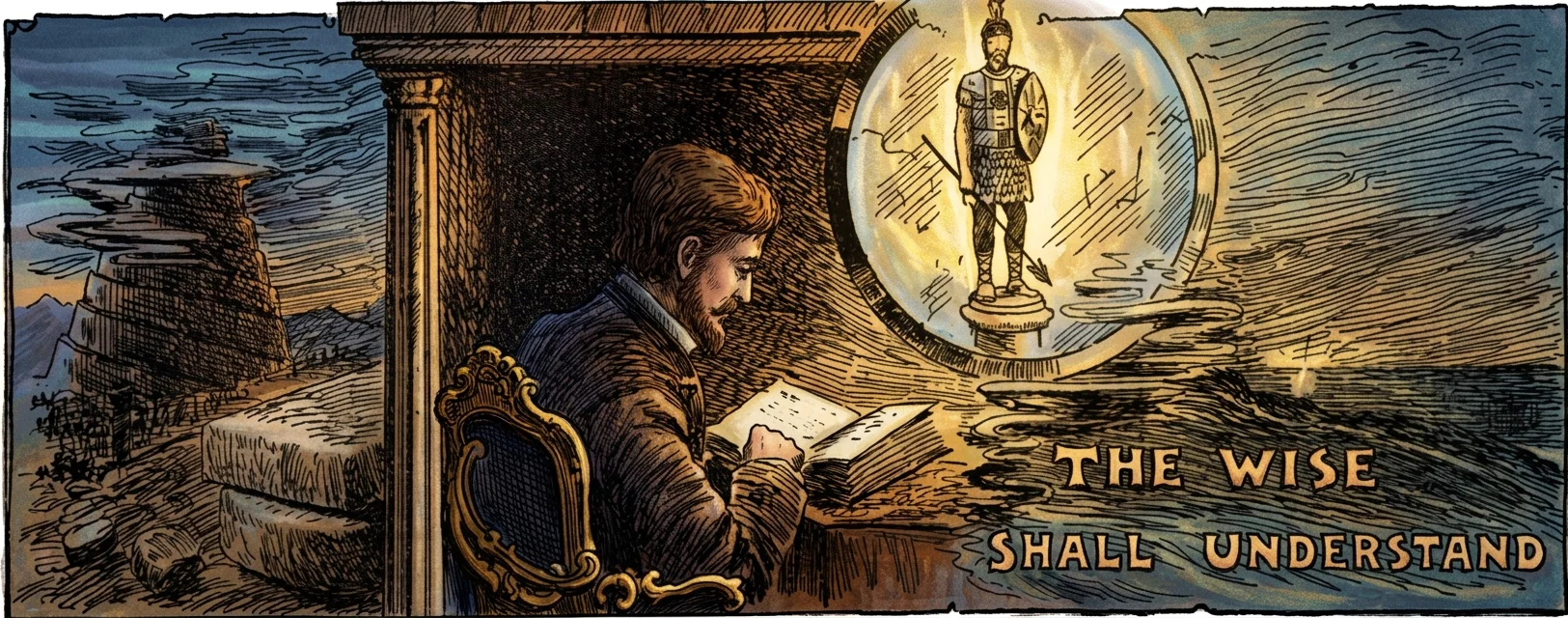
“And he said, Go thy way, Daniel; for the words are closed up and sealed till the time of the end. Many shall be purified, and made white, and tried; but the wicked shall do wickedly; and none of the wicked shall understand; but the wise shall understand.” Verses 9, 10.
We have reached the time of the end; many have been running to and fro in the treasure house of God's word, and knowledge has been increased. Let us briefly survey in the light of prophetic truth the rise and fall of empires, the waymarks to the kingdom of God.

Three Lines of Prophecy.

There are three symbolic lines of prophecy, to which we will largely confine this paper, given in the second, seventh, eighth, and ninth chapters. The general outline of these prophecies are the same. In the first chapter we have a great metallic image, composed of five different materials, representing the various changes to take place in the great world empires, or ruling dynasties of earth, especially those having a molding influence on the religion and civilization of the world. These empires are shown to Nebuchadnezzar, an idolater, in the form of a great image, as being more likely to impress him. The same are shown to Daniel, the prophet of God and the representative of his people, in the form of cruel and rapacious beasts, devouring and breaking in pieces. These latter symbols are found in chapters 7, 8 and 9.

The First Empire.

The first symbol of the image is “the head of gold,” which we are expressly told represents the Babylonian dynasty, of which Nebuchadnezzar, the greatest of all its rulers, was the head. Chapter 2:38. Here was represented its character as compared with succeeding empires. This empire was founded on the ruins of the old Assyrian Empire. Its seat of government was the renowned city of Babylon, greatly enhanced and beautified by Nebuchadnezzar. It was dowered with both riches and splendor, and its city is called by inspiration “the glory of kingdoms, the beauty of the Chaldees' excellency.”
In chapter 7 Babylon is represented in moral character and its attitude as respects the people of God. Its symbol is that of a lion with eagle's wings (Jer. 4:7, 13), indicating power, strength, and occasional ferocity, combined with soaring pride. These traits were marked in Babylon's conquests over other nations (Jer. 25:9; 27:6–8), in its persecution of the people of God (Dan. 3:1–22), and in the self-exaltation of Nebuchadnezzar (chapter 4:30). But proud Babylon was forced to succumb. The gold was to yield to a baser metal, the lion to an ignoble brute.

The Second Empire.

Babylon fell in B.C. 538 before the Medes and Persians under Cyrus. The Medo-Persian Empire is represented in the image by the breast and arms of silver (chapter 2:32, 39), among the beasts by a bear (chapter 7:5), and by a two-horned ram (chapter 8:3, 4, 20). Concerning the application of the second symbol we need have no doubt; it is definitely settled by the facts of history, in the reference last given. There is no symbol given of Babylon in chapter 8, because that empire was just passing under the control of Medo-Persia. The two horns of the ram, the bear raising itself up upon one side, are met in the union of the two powers, Media and Persia. “The higher came up last,” refers to Persia, which soon became the dominant power in the empire. Medo-Persia was supreme until B.C. 331, when, at the battle of Arbela, at the river Granicus, the empire was overthrown by

The Third Empire, Grecia.

To the silver of the image succeeded brass (chapter 2:39), a metal stronger and more brilliant, but less valuable; to the bear succeeded the winged leopard (chapter 7:6); to the ram, the rough goat (chapter 8:5–8), symbolizing Grecia (verse 21). The notable first horn of the goat symbolized Alexander the Great, the first Grecian king of universal conquest (verse 21; chapter 11:3); and the four heads, and the four horns, the four divisions of Grecia shortly after Alexander's death (chapter 8:22; 11:4). These divisions were as follows, Syria, Thrace, Egypt, and Macedon, and were ruled respectively by leading officers in the Grecian Empire, Seleucus, Lysimachus, Ptolemy, and Cassander. The independence of these did not long continue.

The Fourth Empire.

The brass of the image was broken by the stronger iron (chapter 2:40); after the leopard came a great, cruel, nondescript beast (chapter 7:7), symbolized in chapter 8 by a little horn which came out of one of the four horns of the goat, and waxed exceeding great (chapter 8:9–12, 23–25). The world empire which succeeded to the dismembered Grecian dynasty was, as all know, Rome. In the year B.C. 168 Rome conquered the Macedonian horn of the goat, demonstrating her superiority in the contest for world empire, and stimulating to further conquest. Hence she is represented to the prophet as coming out of one of the horns of the goat. Chapter 8:9, 23. Seven years later (B.C. 161) Rome came into connection with the people of God. Shortly after this Syria and Egypt fell, and at the time of our Lord's first advent the Roman Empire filled the known civilized world. At this time she was Satan's agent, through both Herod and Pilate, against the Son of God.

A Divided Empire.

Rome remained a united government till the fourth century, when, through the incursions of the northern barbarians, the empire was broken to pieces, symbolized by the clay mixed with iron. Chapter 2:41. The strength of the imperial iron was broken. Between the years A.D. 351 and 476 just ten kingdoms were evolved out of the broken empire, as follows: Franks, Alemanni, Burgundians, Vandals, Suevi, Visigoths, Anglo-Saxons, Ostrogoths, Lombards, Heruli. Chapter 7:7. These continued intact till A.D. 493. Previous to this period of seventeen years another power, religious, ecclesiastical, clamoring for political power, had been pushing itself up among the ten kingdoms. This power is symbolized by the little horn of Dan. 7:8, 11, 20–26. Concerning this little horn the prophecy gives not less than ten specifications, all of which have been fulfilled in one power, and but one power, of all the earth, namely, the Papacy, which religiously dominated the powers of Europe for 1,260 long years (time, and times, and the dividing of time, verse 25), from A.D. 538, when, by a decree of Justinian and the overthrow of the Heruli, Vandals, and Ostrogoths, the Papacy was set up, to 1798, when under the French the spiritual domination of the Papacy was destroyed. The rise of the little horn, the blasphemous, assuming, persecuting character, the work it was to do, the time of its continuance, are all met in the system of the Papacy.

The Next Great Empire.

All of these things have been fulfilled, and, according to these three lines of prophecy, the next great event is the destruction of all earthly kingdoms, broken by the stone “cut out without hands (chapter 2:35), “broken without hand” (chapter 8:25), “given to the burning flame” (chapter 7:11). Then “shall the God of heaven set up a kingdom, which shall never be destroyed; and the kingdom shall not be left to other people” (chapter 2:44); when “the kingdom and dominion, and thegreatness of the kingdom under the whole heaven, shall be given to the people of the saints of the Most High, whose kingdom is an everlasting kingdom, and all dominions shall serve and obey him” (chapter 7:27). This, according to Daniel's prophecies, is the next great event to dawn upon the world. Soon will it come. Oppression and persecution and conflict and death will yield before the reign of peace, rest, and life.

Prophetic Periods

There are important prophetic periods in the book of Daniel. One—the 1,260 years of persecution—we have already referred to. This brought us to 1798, the beginning of the time of the end. Chapter 11:35. Then began the opening of these prophecies to the world, in a fuller sense than ever before, when the great prophetic periods culminated (chapter 12:4), and the sealed book in God's providence was opened, as shown in Rev. 10:2, 6, 7.
Space will permit the consideration of but one other prophetic period of the book of Daniel, namely, the 2,300 days of chapter 8:14; other publications will more clearly reveal the great truths involved in this scripture. Upon this only the briefest outline can be given. In Dan. 8:13 is the following question, asked of the angel: “How long shall be the vision concerning the daily [or continual desolation], and the transgression of desolation, to give both the sanctuary and the host to be trodden underfoot?” The reply is addressed to Daniel and the church: “Unto two thousand and three hundred days; then shall the sanctuary be cleansed.” Verse 14.
The question pertained to the people of God and the persecution from the two great phases of oppressive powers,—the “daily” (“sacrifice” is a supplied word), or continual desolation—paganism—and the transgression of desolation—the Papacy. By these two the work of God for fallen man (represented by the sanctuary), and the people (by the host who there worship) have been trodden down. How long shall the truth and people of God be subject to earthly powers? The answer is that in 2,300 days the sanctuary would be cleansed. Does this answer the question? Let us see.
The beast symbols, representing persecuting powers, every one, reach from Daniel's day to the great day of God's reckoning. The period concerning this persecution must be also a long period of time. The divine rule in prophecy is a day for a year. Eze. 4:6. The 2,300 days therefore represent 2,300 literal years.

Explanation of the Time

The ninth chapter, recording a vision a few months later, is the key to chapter 8. To Daniel was explained the vision of chapter 8 excepting the time. When the angel returns, he begins by referring Daniel to the vision of the previous chapter, and immediately begins upon the explanation of the time. See chapter 9:21–27.
Briefly stated, the days begin with the going forth of the commandment to restore and build Jerusalem. This went forth in B.C. 457, in the seventh year of Artaxerxes Longimanus. Ezra 7. Seven weeks, or forty-nine full years, reach to the restoration of the wall under Nehemiah—B.C. 408. See Prideaux. Sixty-two weeks more, or 434 full years, in all 483 full years, beginning in the autumn of B.C. 457, reach to Messiah the Prince, in A.D. 27. Luke 4:18. The fulfillment of this time was proclaimed by John the Baptist. Mark 1:15. Three and one-half years more reach to the cutting off of Messiah the Prince (Dan. 9:26), and the last half of the seventh week of years, making in all 490, closes with the cutting off of the Jewish nation as the special people of God, and the giving of the Gospel to the gentiles, A.D. 34. See Acts 8 and 9. From 2,300 years subtract 490, and there remains 1,810, which, added to A.D. 34, brings us to 1844. Or, 2,300 full years from the autumn of B.C. 457 reach to the autumn of A.D. 1844, when the 2,300 years ended.

Then Shall the Sanctuary Be Cleansed.

The sanctuary of the Levitical dispensation was that built by Moses in the wilderness, later giving way to the temple. That sanctuary in its building appointments, priesthood, and service was typical of Christ and his priesthood in the heavenly sanctuary. See Heb. 4:14; 8:1–5; 9:1–12. Jesus began that priesthood when he ascended on high.
In the typical sanctuary there was a complete round of service every year (Lev. 1–16; Heb. 9:6, 7), typifying in each year the service of Christ, which was once for all (Heb. 9:12). The last day in the year the typical priest entered upon the cleansing of the sanctuary, the blotting out of sin, which was a judgment work. See Lev. 16:7–21; 23:26–32. In the close of Christ's ministry the heavenly sanctuary is cleansed from all remembrance of sins, the mystery of God is finished, and the judgment work begins with the investigation of the names of those in the book of life. See Heb. 9:22, 23; Rev. 10:6, 7; 14:6, 7. That the investigative judgment precedes the coming of Christ, the resurrection of the just, and their reward, is shown by Luke 20:35; 1 Cor. 15:51, 52. They are “accounted worthy” before they are raised immortal.
This judgment work began in 1844. In the type it was comparatively brief. How long it may now last we can not tell. Suffice to say that it will close with the last generation to which its warning message comes, “The hour of his judgment is come.” Rev. 14:7. The next event is the coming of Christ to reward the faithful. We know not the day or the hour, but we do know that the coming of the Lord is near, “even at the doors.”
Thus briefly is merely sketched the outlines of the Gospel of prophecy in Daniel. Let the reader study the outline, fill it up with the facts of history and the word of God, and he will “know” that the Lord cometh quickly. “The wise shall understand.”
Continue reading: EVIDENCE FROM THE APOCALYPSE