Pacific Press Publishing Association · Mountain View, California · Jun 27, 1911
IF YE WILL INQUIRE, INQUIRE YE
By Editor
This Inquirers' Department is conducted for the purpose of helping those who are studying the Bible. The answers are oftentimes only suggestive. They are never to be considered infallible, only as they agree with the infallible Word. The writer who may answer them does not consider that his opinion is infallible. He will simply give the best that he has, and plead with the inquirer to search the Word. Such questions only will be answered as, to the editors, seem to minister to the good of the readers and to the mission of the paper. We can not answer repeatedly in the same volume questions upon the same scripture. The name and address must accompany question, not for publication, but as an evidence of good faith, and that answer may be made by letter if deemed advisable. No letters are answered which do not contain the name of the writer. It is well always to enclose stamp for reply.
The text reads in our common version: "There shall be no more thence an infant of days, nor an old man that hath not filled his days: for the child shall die a hundred years old; but the sinner being a hundred years old shall be accursed."
1. Read the context. The Lord rebukes the wickedness of a rebellious people. Verses 2-7. He promises a seed that shall serve Him. Verses 8-10. He draws a contrast between the two classes in verses 11 to 16. Then we are told how great the change will be which ushers in that new era: "For, behold, I create new heavens and a new earth: and the former shall not be remembered, nor come into mind. But be ye glad and rejoice forever in that which I create: for, behold, I create Jerusalem a rejoicing, and her people a joy. And I will rejoice in Jerusalem, and joy in My people; and the voice of weeping shall be no more heard in her, nor the voice of crying."
2. Then comes verse 20. In that new earth there shall be no more what we have seen here, infants dying in a few days, men prematurely old. In this world very frequently the infant does not grow to maturity, and among adults few fill out the days of threescore and ten years. But all that will have passed when God visits upon the wicked the judgment written.
3. That time is more fully referred to in Rev. 20:5-9. At the end of the 1,000 years the wicked — all who have wrought unrepented wickedness — will be raised from the dead. To the universe and to themselves will be given demonstration to show that there is no sorrow for sin in their hearts, no loyalty to Christ. They are deceived by the devil, and join his warfare against God and His children and the holy city, instead of yielding glad obedience.
4. During that comparatively "little season" preparation will be made for the most colossal warfare the earth has ever known, Satan with all the warriors and soldiers of the wicked great of earth against the probably comparatively few visible hosts of God. This we know, that His children of earth bear no other armor than that of righteousness.
5. They occupy a part of that mighty plain made by the power of God, cleansed by His divine touch, in the center of which the New Jerusalem will descend. Zech. 14:4. The outcome of that battle will be decided by the forthshining of the illimitable, overpowering splendor of the presence of God, which will set on fire everything contaminated with sin, burning to the very foundations of the deepest sheol. Isa. 30:33. Then will the whole earth become a lake of fire in the burning glory of His presence, which will only devour sin. Compare Ex. 24:17 with 20:18-20. Then God's children, sinless, will dwell in the midst of the devouring fire of His glory unharmed, while the wicked shall perish. Isa. 33:12-16. Compare with Dan. 3:19-27.
6. The time of this "little season" is not given in the Revelation, but Isa. 65:20 seems to indicate that it will be 100 years. Young and old among the wicked will live during that time, and at its end die. Deceived by the devil to claim immortality, they perish. Deluded into believing in self-salvation, they find it self-destruction. Rejecting every appeal of His goodness and love in the past, they enroll in the army of God's great adversary, and perish in the glory that God longed to make their life, but they would not.
I am quite sure that Nicodemus knew about right living better than we do, and as all Protestants teach; yet neither he nor the other disciples understood the resurrection birth as Christ taught it. Did not Christ teach the resurrection rather than the regeneration?
1. Nicodemus had the same opportunity and the same source of knowledge to learn the resurrection that he did regeneration. The same Holy Scriptures taught both; and one of the strong tenets of the Pharisees, of which sect Nicodemus was one, was that of the resurrection of the dead. (See Acts 23:6-8.) They are never reproved or corrected concerning their views of the resurrection.
2. But resurrection to life implies character, the one prerequisite to such a resurrection. Over that we need not to worry, nor can we understand it. We may leave it safely with God; for if character be right, as was that of Jesus our Saviour, the grave can not hold us. Acts 2:24.
3. Therefore the important thing is character, which not only involves right living, but more important, and precedent to that, right being. Nicodemus did doubtless understand more or less of the necessity of right living, but like other Pharisees he felt it must be worked out by the human. His righteousness was to count, not God's. They sought the righteousness not by faith, but by works, and it could never be acceptable to God. Rom. 3:19-22; 9:31, 32; 10:3. Man must be right in order to live right, and just as radical a change must take place in man's character as takes place in the physical man at the resurrection. "Ye must be born from above" will ultimately include the resurrection, but it touches primarily upon the moral man.
4. The agency which accomplishes this is the Holy Spirit by the Word. Compare John 3:3-5 with 1 Peter 1:23 and James 1:18. That Spirit is not subject to human disabilities or limitations. "The Spirit [not the wind] breatheth where it will, and thou hearest the voice thereof, but knowest not whence it cometh, and whither it goeth: so is every one that is born of the Spirit." John 3:8, A.R.V., margin. Nicodemus and the Pharisees believed that their rigid system was the channel in which the Spirit of God worked. Jesus taught that it worked not in harmony with man's will but God's will. John 1:13; 3:8. It has its mighty effects seen of men, but man does not control the workings of that Spirit in the human or elsewhere. "Ye must be born again," not of your own will and way, but God's will and way; not of your own power, but by the Spirit.
3487 — The Mother of Our Lord
By C. M. D.
What became of the mother of our Lord? C. M. D.
She probably sleeps as do millions of others of God's children, till the Life-giver comes. We know naught to the contrary. She will be awakened without the conscious loss of a moment by the voice and presence of Him who was once a babe upon her breast, but now glorified King forevermore.
Locusts Permitted for Food
By C. M. D.
3488 — C. M. D. Lev. 11:21 — This passage is a general description of four kinds of locusts, or grasshoppers, permitted for food and named in the next verse. "Beetle," and "cricket" as in A.R.V., are both probably misleading. See the margin of A.R.V., which reads: "Four kinds of locusts or grasshoppers, which are not certainly known." John the Baptist ate locusts, Matt. 3:4, a food used by the poor nomadic tribes of the desert.
Unity of God’s Children
3489 — A. K. John 17:21 — God's children were one on the Day of Pentecost. Acts 2: 42, 44. They will be one again when they come out of Babylon and are ready to welcome the coming of their Lord. Rev. 14:12; Isa. 25: 9.
Jesus and His Brothers
3490 — A. K. Acts 9:7 with 22:9 and Matt. 1:25 and its bearing upon Jesus and His brothers have been answered.
Schedule for Week Ending July 8, 1911
3484 — The Pre-Existence of Christ
By C. B. C.
Was Christ a personal being before He came to this earth? C. B. C.
As to whether our Lord existed before He was born of the Virgin Mary is a purely Biblical, not philosophical, question. If we depend upon our early teaching, upon pure human reason, upon some theological system, we shall go astray; if we take the literal teaching of the Word, there will be no difficulty. Briefly we present the following evidences of our Lord's pre-existence as a personal being:
1. When God created the heavens and the earth, He addressed not creatures, but some One His equal, possessing creative power. "Let Us make man in Our image, after Our likeness." The very term "Elohim," from which "God" is translated, is plural.
2. There is one Being, existing at least four hundred years before Christ, whom Jehovah designates "My Fellow," who is in future to be smitten. Zech. 13:7. The context clearly shows that the term refers to Him who became Jesus, the Great Shepherd of His sheep.
3. There is one Person revealed to us in the Old Testament again and again called "the Angel of Jehovah," the especial representative of God in ministering to His children. Of Him the great God declares, "My name is in Him." Ex. 23:21. He is called in Isa. 63:9 "the Angel of His presence." When this angel came to Abraham it is said, "And Jehovah appeared unto him." Gen. 18:1. Jacob met Him by the brook Jabbok, in the night of wrestling, and said in the morning, "I have seen God face to face, and my life is preserved." Gen. 32:22-31.
Michael Identified With Christ
4. This Angel-Jehovah bore a name among the angels; namely, Michael, the meaning of which is "Who is like God." He is represented as a person, one who goes and comes, greater and mightier than Gabriel. Dan. 10:13. In fact He is called "Michael the Archangel," the chief of all the angels. Jude 9. It is His voice that raises the dead. 1 Thess. 4:16. But our Lord Himself shows that it is His voice which will raise the dead (John 5:28, 29); therefore, the personal Michael of the Old Testament is identical with the Christ of the New.
5. Seven centuries before Christ a prophet of God foretold our Lord's birth as a human, and His birthplace. Micah 5:2. Out of Bethlehem would come "One . . . whose goings forth are from of old, from everlasting"—language that could not refer to an abstract Word. It implies that the "One" referred to is as personal before that time as He was after it.
6. Paul, in speaking of the Son of God's love, calls Him "the image of the invisible God, the first-born of all creation;" that "in Him were all things created;" and that "He is before all things." Col. 1:13-18. Surely this language applies to a person, and fits that in Genesis, "Let US make." Another writer by inspiration teaches the same thing. "Thou, Lord, in the beginning didst lay the foundation of the earth, and the heavens are the works of Thy hands: they shall perish; but Thou continuest." Heb. 1:10-13.
7. One more evidence from among others, the words of our Lord Himself: "And now, Father, glorify Thou Me with Thine own self with the glory which I had with Thee before the world was." John 17:5. "As Thou didst send Me into the world, even so sent I them." The apostles were persons before they were sent. Even so our Lord was a personal being.
As a member of the great Godhead, our blessed Lord stepped down to live a servant of God, an Angel among the angels, a Man among men, filled all vacancies with His fulness of life and character, and triumphed for every sinful soul. But all the mysteries we may not, can not understand, any more than we can understand the process of digestion or creation.
Lessons from Chronicles
The last chapters of 1 Chronicles deal with the establishment of the worship of God under David, his preparation for the building of the temple, and the accession of Solomon to the throne, under the especial blessing of God. The magnificence of Solomon's temple is better indicated by the treasure prepared for it. The gifts of gold, reckoning the gold talent at $32,800, aggregated $2,843,740,000; the silver gifts ($1,883 to the silver talent) amounted to $1,670,422,000; a total of $4,514,000,000, in round numbers. This takes no account of the vast amount of brass, iron, copper, and precious stones.
Chapters 1 to 20 of 2 Chronicles cover the reigns in Judah of Solomon, Rehoboam, Abijah, Asa, and into the reign of Jehoshaphat. After Solomon and the united kingdom the greatest king is Asa.
On the side of backsliding Israel, there were more kings, but their reigns were much briefer. From Solomon's death, when the kingdom was divided, to good King Jehoshaphat, there reigned seven kings; namely, Jeroboam, Nadab, Baasha, Elah, Zimri, Omri, Ahab, early swung away from God by Jeroboam's calves of gold. There were appeals from God's prophets, but they had little care for God's voice or service. These lessons may be of great practical benefit to us.
“Even as we have been approved of God to be entrusted with the Gospel, so we speak; not as pleasing men, but God, who proveth our hearts.”
The Gospel in Type and Antitype
By Loretta V. Robinson
By Loretta V. Robinson
III. The Earthly Priesthood and Its Services
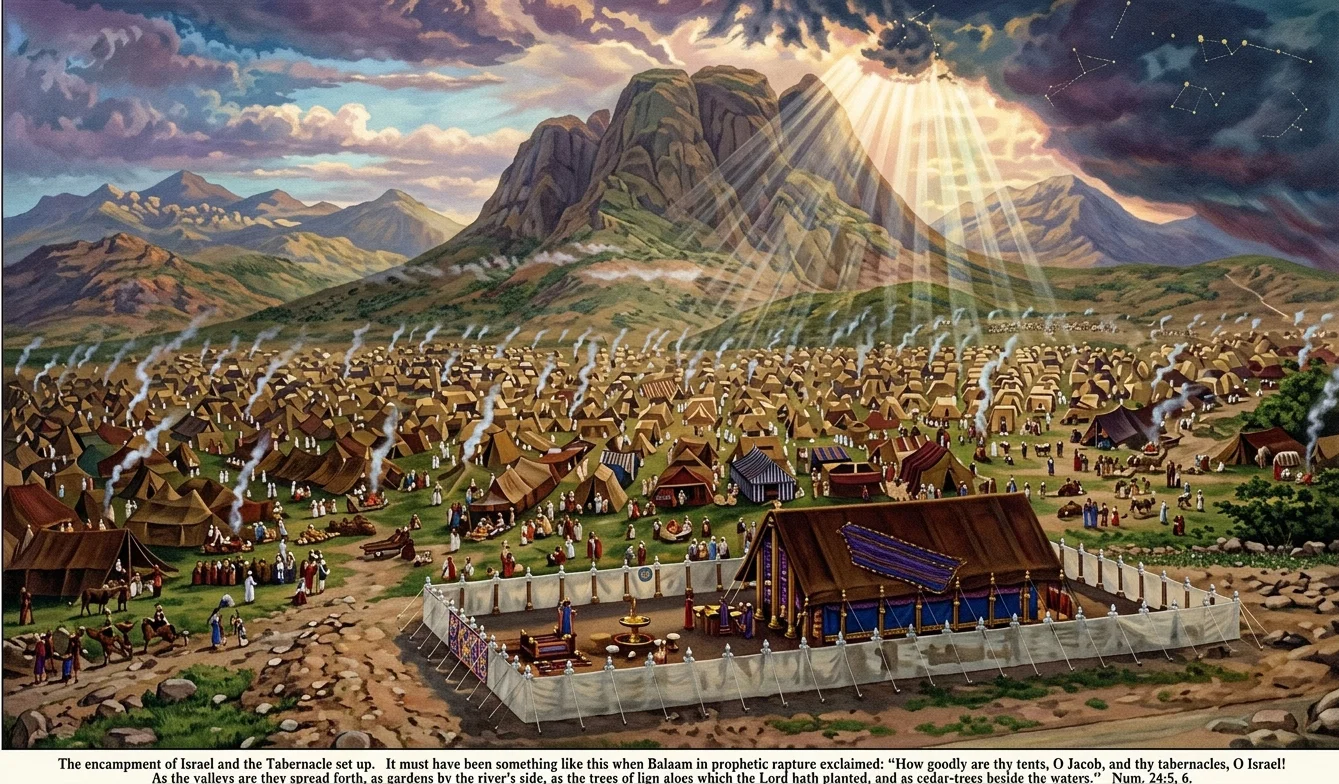
WHEN Israel came out of Egypt, their minds were so beclouded by sin that they could no longer see the promised Saviour in the simple offerings made by the father as priest of the household. Consequently when God gave Moses instruction in regard to the building of the sanctuary, He connected with it the Levitical priesthood, which was to continue until the Saviour Himself should officiate as our great High Priest in the sanctuary above.
By divine direction the tribe of Levi was set apart for the service of the sanctuary. The priesthood, however, was restricted to the family of Aaron. Num. 18:2, 7.
Purpose and Character of the Priesthood
The purpose and character of a priest are set forth in Heb. 5:1-3: "For every high priest taken from among men is ordained for men in things pertaining to God, that he may offer both gifts and sacrifices for sins: who can have compassion on the ignorant, and on them that are out of the way; for that he himself also is compassed about with infirmity. And by reason hereof he ought, as for the people, so also for himself, to offer for sins." Before Aaron and his sons entered upon their ministry for others, special consecration ceremonies were performed, and consecration offerings were made.
Holy garments "for glory and for beauty were put upon them." The anointing oil was poured upon Aaron, also upon the tabernacle and all that pertained to it. When all was thus sanctified, Moses and Aaron came out of the tabernacle to bless the people, and the glory of the Lord appeared to all the people, and filled the tabernacle. "And fire came out from before the Lord and consumed the burnt offering." See Leviticus 8 and 9; Ex. 40:34, 35. Likewise when we consecrate our all to God, the anointing oil of His Holy Spirit is poured upon us, and the glory of the Lord fills these temples of clay, and we are then fitted for service and for the indwelling of the Most High.
That there were sinners connected with the sanctuary and priesthood, the following plainly shows: "The first covenant had also ordinances of divine service, and a worldly sanctuary." "The priests went always into the first tabernacle, accomplishing the service of God." Heb. 9:1, 6. Not only the sanctuary itself, but the ministration of the priests, was to "serve unto the example and shadow of heavenly things." Heb. 8:5. Thus it was of great importance that the Lord should give the most definite and explicit instruction concerning every point of the typical service.
The ministration of the sanctuary consisted of two divisions, daily and yearly service. Heb. 9:6, 7. The daily service was performed at the altar of burnt offering and in the holy place, and consisted of the morning and evening burnt offering, the offering of sweet incense on the golden altar, and the special offerings for individuals. The yearly service was in the most holy place. The Israelites were in every sense a typical people. Their history in all its details was typical; and all their ordinances have a typical meaning, and admit of — nay, require — a spiritual application.
The Daily Service
We will now consider the daily service. Every morning and evening there was burned upon the altar a lamb a year old,4which symbolized the daily consecration of the nation to Jehovah. As this sacrifice was offered, the priests went into the holy place and offered sweet incense, while the whole congregation stood without praying. Luke 1:9, 10. The incense, ascending with the prayers of Israel, represents the merits and intercession of Christ, His perfect righteousness, which through faith is imputed to His people, and which alone can make the worship of sinful beings acceptable to God. The most important part of the daily service was that performed in behalf of individuals. The very order in which their offerings were to be made, was designed to teach a sinner how to come to Christ.
After Aaron and his sons had made their consecration offerings, they then offered for the people. Note the order: "And he brought the people's offering, and took the goat, which was the sin-offering for the people, and slew it, and offered it for sin. . . . And he brought the burnt offering, and offered it according to the manner. And he brought the meat-offering. . . . He slew also the bullock and the ram for a sacrifice of peace-offerings." Lev. 9:15-18.
From this we learn that a man must first come to God as a sinner to have his sin put away — sin-offering. He must consecrate himself to God to be accepted in Christ — burnt offering. He must feed on Christ, the living bread — food- or meat-offering. The result of this will be peace.
Different Aspects of Christ's Sacrifice
In these different sacrifices we get so many different aspects of Christ's own sacrifice. It took every offering to represent feebly the one great offering of Christ for us. All the sacrifices also stood for the persons that offered them; for Christ gave Himself for us. Eph. 5:2.
When a man came with a proper sin-offering, he never failed to get rid of his sin; and when a man comes to God bringing Christ as his sin-offering, he obtains pardon and peace, he is saved from his sin.
Altho we much desire to dwell at length upon each of these offerings, our space will permit of but the briefest mention of one or two that deal the most directly with the sanctuary service; namely, the sin-offerings, in which the fourth chapter of Leviticus is wholly devoted. In this chapter are brought to view four classes of individuals for whom offerings were made,—the priests, the whole congregation, the ruler, and one of the common people.
The offerings were dealt with in two ways, representing the two ways in which Christ bore our sins. Every individual was represented in both kinds of offerings. The sin-offering for the priest and the whole congregation was dealt with in the following manner: The priest that sinned, or the elders if it was the whole congregation, laid their hands upon the head of the victim, virtually saying: "We are sinners. We deserve to die, and to be accursed of God." That offering stood in the sinner's place, and his sin and his guilt were laid upon it, and it was cast out and burned as an accursed thing. The fire outside the camp at the spot that has been termed "the Calvary of the wilderness," was expressive of the anger of God at sin. The wrath of God fell upon it, and it was not spared. The fire was unquenchable so long as a bit of flesh or bone remained. The offering was made sin by imputation. It had not committed any sin, it knew no sin; but the sins of another were laid upon it, and it died for those sins, while the real sinner went free. Thus "Christ hath redeemed us from the curse of the law, being made a curse for us" (Gal. 3:13); "for Christ also hath once suffered for sins, the just for the unjust, that He might bring us to God." 1 Peter 3:18.
The Sinner Really Separated from His Sin
But a further work must be done for the sinner. He must be separated from his sin; atonement must be made. An atonement is satisfaction rendered for disobedience. What could satisfy a broken law?—Only the life of the transgressor, or his substitute. What stood for the life? See Lev. 17:11; "For the life of the flesh is in the blood: and I have given it to you upon the altar to make an atonement for your souls: for it is the blood that maketh an atonement for the soul." The priest took of the blood of the offering, and brought it into the sanctuary, and there sprinkled it before the veil seven times, and put some upon the horns of the altar of incense. The remainder was poured out at the bottom of the altar of burnt offering. Lev. 4:5-7. "Thus shall ye separate the children of Israel from their uncleanness; that they die not in their uncleanness, when they defile My tabernacle that is among them," was God's word to Moses. Lev. 15:31.
The sinner went to his tent free from the load of his guilt; but every spot of blood in the sanctuary and on the altar testified of sin committed, of the defilement of God's dwelling-place, yet spoke pardon to the transgressor.
When a ruler or one of the common people sinned, the blood, instead of being taken into the sanctuary, was put upon the horns of the altar of burnt offering, and the remainder poured out at the bottom of that altar. Lev. 4:25. The flesh was not burned outside the camp, but was eaten in the holy place, by the priest that offered it (Lev. 6:26); for "God hath given it you to bear the iniquity of the congregation, to make atonement for them before the Lord." Lev. 10:17.
Christ Became the Real Sin-Bearer
The ceremonial act of eating the sin-offering, was expressive of full identification. To eat the sin-offering, meant to make another's sin one's own. The blessed Lord Jesus did this perfectly. Not only on the cross was He identified with sinners, but He was "made of a woman, made under the law." He came "in the likeness of sinful flesh." "He took on Him the seed of Abraham. Wherefore in all things it behooved Him to be made like unto His brethren."
We have already seen that the priest could not eat of his own sin-offering, or the sin-offering of the congregation; for when the whole congregation sinned, the priests would be responsible, for they were "to teach the people all the statutes" of the Lord. Lev. 10:10; 11. Hence to eat of the sin-offering of the congregation, would be the same as eating of their own sin-offering; which they could not do without typically feeding upon sin.
Since the priest desired freedom from his sin, he must transfer it, with the sin of the whole congregation, to the sanctuary, through the blood, and with the same blood make the atonement. The flesh in every such instance was to be burned outside the camp. Lev. 6:30.
Two Lives in the Blood of the Offering
The question might be raised, How could the blood convey defilement to the sanctuary, and at the same time cleanse the sinner?—From the fact that two lives were represented in the sin-offering,—the innocent life of the lamb, and the imputed sinful life of the one who offered it. This is clearly shown in the offering of the red heifer, Numbers 19. Even the priest that sprinkled her blood was made unclean; and the clean person that gathered up the ashes, as also the one that sprinkled the ashes mingled with water upon an unclean person, had to wash his clothes, and be unclean until evening, while the unclean person was cleansed by the same ashes. Thus Christ on the cross was made sin, and was even suffering as the vilest of sinners; yet at the same time, by virtue of His own pure life, He cleansed the thief.
Note again how every spot of blood from the sin-offering on a garment conveyed defilement, as being loaded with sin, and was taken into the holy place and cleansed. Also all vessels used for such sacrifices had to be either broken or scoured. Yet the same offering is said to be "most holy." Lev. 6:27-29.
Paul makes the application of the offering to Christ in the following language: "We have an altar, whereof they have no right to eat which serve the tabernacle. For the bodies of those beasts, whose blood is brought into the sanctuary . . . for sin, are burned without the camp. Wherefore Jesus also, that He might sanctify the people with His own blood, suffered without the gate." Heb. 13:10-12. Those priests had "no right to eat" of their own sin-offering; but we have a right to feed upon — nay, must feed upon — our sin-offering, Christ, and by so doing will partake only of His righteous life.
Here the type failed because of the imperfections of the earthly priests. The purpose of the Gospel is not simply to free the sinner from his guilt, but also to remove sin from the universe; but day by day throughout the year the sins of Israel were transferred in a figure to the sanctuary. The holy places were defiled. It is therefore evident that a further work of the high priest is necessary in order to make a final and everlasting end of sin. This further work of the priest will be considered in our next article.
Nearing the Day
By Curtis Shingler
By Curtis Shingler
'Twas a long, weary night; we were almost in fear
That the future was more than we knew.
'Twas a long, dreary night; but the morning is near,
And the words of our Leader are true.
There are signs in the sky that the darkness is gone;
There are tokens in endless array;
While the storm that so seemingly banished the dawn,
Only hastens the advent of day.
Forward
By David Livingstone
SEND me anywhere, provided it be forward.—David Livingstone.
The Way to Christ
By Ellen G. White
By Mrs. E. G. White
THE commandments of God are comprehensive and far-reaching; in a few words they unfold the whole duty of man. "Thou shalt love the Lord thy God with all thy heart, and with all thy soul, and with all thy mind, and with all thy strength. . . . Thou shalt love thy neighbor as thyself." In these words the length and breadth, the depth and height, of the law of God is comprehended; for Paul declares, "Love is the fulfilling of the law." The only definition we find in the Bible for sin is that "sin is the transgression of the law."
The Word of God declares, "All have sinned, and come short of the glory of God." "There is none that doeth good, no, not one." Many are deceived concerning the condition of their hearts. They do not realize that the natural heart is deceitful above all things, and desperately wicked. They wrap themselves about with their own righteousness, and are satisfied in reaching their own human standard of character; but how fatally they fail when they do not reach the divine standard! and of themselves they can not meet the requirements of God. We may measure ourselves by ourselves, we may compare ourselves among ourselves, we may say we do as well as this one or that one; but the question to which the judgment will call for an answer is, Do we meet the claims of high Heaven? Do we reach the divine standard? Are our hearts in harmony with the God of heaven?
Hopeless Ruin—but a Plan to Save
The human family have all transgressed the law of God, and as transgressors of the law, man is hopelessly ruined, for he is the enemy of God, without strength to do any good thing. "The carnal mind is enmity against God: for it is not subject to the law of God, neither indeed can be." Looking into the moral mirror—God's holy law—man sees himself a sinner, and is convicted of his state of evil, his hopeless doom under the just penalty of the law. But he has not been left in a state of hopeless distress in which sin has plunged him; for it was to save the transgressor from ruin—that He who was equal with God offered up His life on Calvary. "God so loved the world, that He gave His only-begotten Son, that whosoever believeth in Him should not perish, but have everlasting life."
Jesus was the majesty of heaven, the beloved Commander of the angels, who delighted to do His pleasure. He was one with God, "in the bosom of the Father," yet He thought it not a thing to be desired to be equal with God while man was lost in sin and misery. He stepped down from His throne, He left His crown and royal scepter, and clothed His divinity with humanity. He humbled Himself even to the death of the cross, that man might be exalted to a seat with Him upon His throne. In Him we have a complete offering, an infinite sacrifice, a mighty Saviour, who is able to save unto the uttermost all that come unto God by Him. In love He comes to reveal the Father, to reconcile man to God, to make him a new creature, renewed after the image of Him who created him.
The Atoning Sacrifice of Christ
Jesus is our atoning sacrifice. We can make no atonement for ourselves; but by faith we can accept the atonement that has been made. "For Christ also hath once suffered for sins, the just for the unjust, that He might bring us to God." "Ye were not redeemed with corruptible things, . . . but with the precious blood of Christ, as of a lamb without blemish and without spot." It was through infinite sacrifice and inexpressible suffering that our Redeemer placed redemption within our reach. He was in this world unhonored and unknown, that, through His wonderful condescension and humiliation, He might exalt man to receive eternal honors and immortal joys in the heavenly courts.
During His thirty years of life on earth His heart was wrung with inconceivable anguish. The path from the manger to Calvary was shadowed by grief and sorrow. He was a man of sorrows, and acquainted with grief, enduring such heartache as no human language can portray. He could have said in truth, "Behold, and see if there be any sorrow like unto My sorrow."
The World's Sin upon Him
Hating sin with perfect hatred, He yet gathered to His soul the sins of the whole world. Guiltless, He bore the punishment of the guilty. Innocent, yet offering Himself as a substitute for the transgressor. The guilt of every sin pressed its weight upon the divine soul of the world's Redeemer. The evil thoughts, the evil words, the evil deeds, of every son and daughter of Adam, called for retribution upon Himself; for He had become man's substitute. Tho the guilt of sin was not His, His spirit was torn and bruised by the transgressions of men, and He who knew no sin became sin for us, that we might be made the righteousness of God in Him.
He Did It Voluntarily
Voluntarily our divine Substitute bared His soul to the sword of justice, that we might not perish, but have everlasting life. Said Christ: "I lay down My life, that I might take it again. No man taketh it from Me, but I lay it down of Myself. I have power to lay it down, and I have power to take it again." No man of earth or angel of heaven could have paid the penalty for sin. Jesus was the only one who could save rebellious man. In Him divinity and humanity were combined, and this was what gave efficiency to the offering on Calvary's cross. At the cross mercy and truth met together, righteousness and peace kissed each other.
As the sinner looks upon the Saviour dying on Calvary, and realizes that the Sufferer is divine, he asks why this great sacrifice was made, and the cross points to the holy law of God which has been transgressed. The death of Christ is an unanswerable argument as to the immutability and righteousness of the law. In prophesying of Christ, Isaiah says, He shall "magnify the law, and make it honorable." The law has no power to pardon the evil-doer. Its office is to point out his defects, that he may realize his need of One who is mighty to save, his need of One who will become his substitute, his surety, his righteousness.
Jesus meets the need of the sinner; for He has taken upon Him the sins of the transgressor. "He was wounded for our transgressions, He was bruised for our iniquities: the chastisement of our peace was upon Him; and with His stripes we are healed." The Lord could have cut off the sinner, and utterly destroyed him; but the costlier plan was chosen. In His great love He provides hope for the hopeless, giving His only-begotten Son to bear the sins of the world. And since He has poured out all heaven in that one rich gift, He will withhold from man no needed aid that he may take the cup of salvation, and become an heir of God, joint heir with Christ.
I saw a heaven and earth all new,
And there was no more sea;
A New Jerusalem coming down
From heaven on earth to be,—
A city with twelve gates of pearl,
And twelve foundation wall;
It hath no need of sun or moon,
For God doth lighten all.
That city is transparent gold,
Its walls twelve precious stone,
Each several gate one great white pearl,
And Christ sits on the throne.
Those pearly gates will not be shut,
For there shall be no night.
I saw no temple stand therein;
God and the Lamb are light.
A river pure, a crystal stream,
Proceeding from God's throne,
On either side the Tree of Life,
With leaves which heal His own;
And those who kept God's holy law
Eat of that Tree of Life,
And freely drink the waters of
That everlasting life.
The nations saved shall walk therein;
There'll be no sorrow then,
And they shall all behold His face,
And He will dwell with men,
And God shall wipe away all tears,
And death shall be no more;
For with Him we shall ever dwell
And reign forevermore.
Springfield, Missouri.
Air-Ship Powers
By S. S. Times
THERE is no power more enviable than that of being able to rise above the things that would keep us down. Air-ships fascinate us, for they will enable us literally to get up among the clouds, where there will be nothing to remind us of the worries that we would fain forget, as there is practically everywhere on this vexatious earth. But that is quite unnecessary to the Christian, if he is living up to the privileges of Christianity. "Religion" means "binding back" to God, and it does this by breaking the wearisome fetters of the world's gravitation, and giving us the freedom of the upper air. Every true Christian is an aeronaut, a detached being. The globe revolves beneath his feet. The Spirit of God is within him, and he also goes where it listeth him to go. There are few deeper tests of a man than his ability, or lack of ability, to rise above his worries.—S. S. Times.