Your ShelfYour Projects

Signs of the Times, Vol. 33, No. 4.

CHRIST SAVING PETER

Signs of the Times

Jan 23, 1907

Pacific Press Publishing Company · Mountain View, California · Jan 23, 1907

CHRIST SAVING PETER.
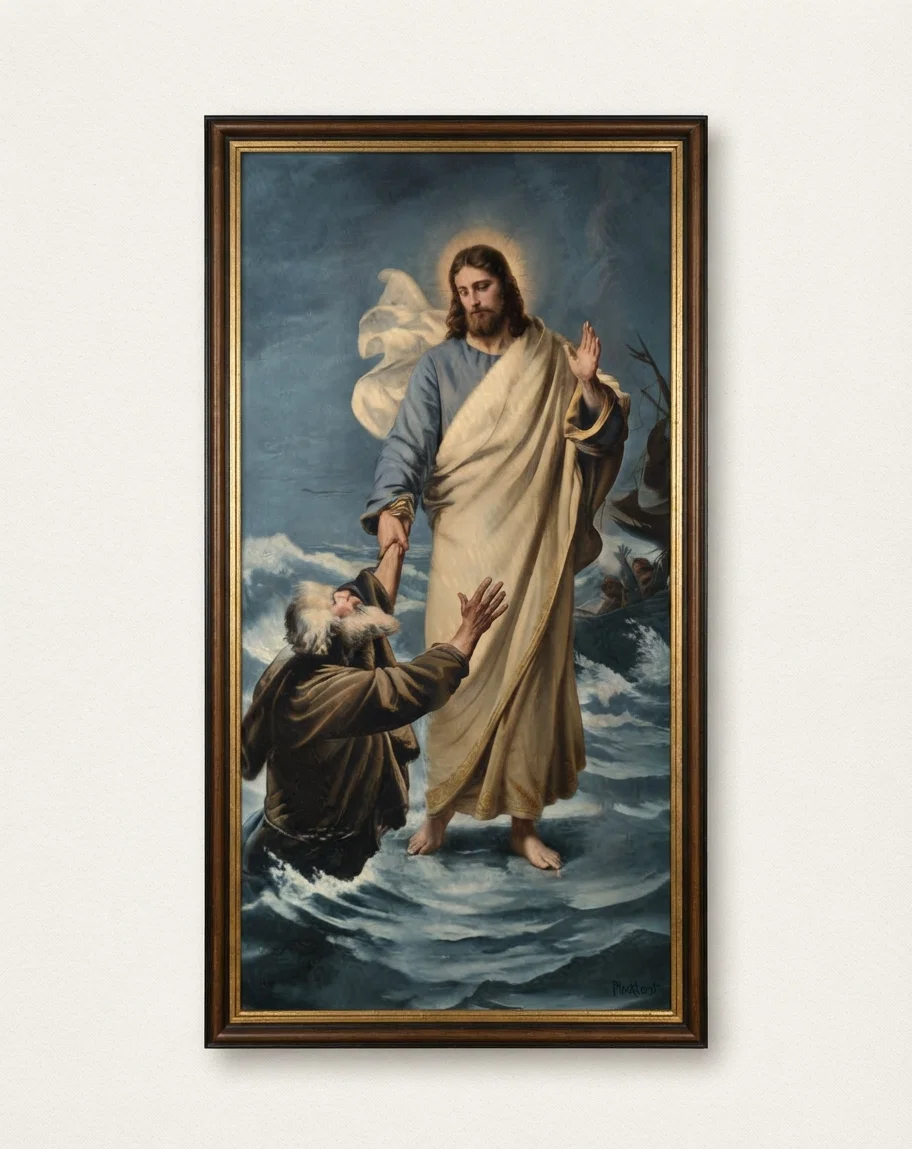
From Plockhorst's Painting.
CHRIST SAVING PETER. From Plockhorst's Painting.
"IF ANY MAN HEAR MY WORDS, AND BELIEVE NOT, I JUDGE HIM NOT; FOR I CAME NOT TO JUDGE THE WORLD, BUT TO SAVE THE WORLD." JOHN 12:47.

A Boon to Parents and Teachers

True Education Reader No. 2 has just been published. It is for use in Grade 2, that is, the second school year.
It is also admirably adapted for use in the homes where children do not have church-school privileges.
It will, in connection with Book One of the same series, put the children in possession of a complete key to English reading.
Its lessons are developed from the school-room work of the author, Miss Katharine B. Hale, who has successfully taught primary, public, and church schools, and is now teaching in Walla Walla College.

THE GOOD SHEPHERD

NEW PHONOGRAM LESSON BLEND DRILL
eth call' eth put' teth strān' gēr hirē' ling
lēad' eth gō' eth Shēp' hērd thêrē' fōrē
tāk' eth flē' eth scăt' tēr eth cătch' eth
lēav' eth sē' eth fōl' low cār' eth
  1. The Good Shepherd calleth His own sheep by name, and leadeth them out.
  2. When He putteth forth His own sheep, He goeth before them. The sheep follow Him, for they know His voice.
  3. A stranger will they not follow, but will flee from him, for they know not the voice of strangers.
  4. Jesus said, "I am the Good Shepherd. The Good Shepherd giveth His life for the sheep.
  5. "An hireling, and not the shepherd, fleeth."
It presents, in connection with Books One and Three of the series, a great panoramic view of God’s plan for this earth in the beginning, the successive steps in the wonderful work of creation, something about each of these steps, a sketch of certain selected Bible biographies, including the life of the perfect Child Jesus, His work, His sacrifice, the plan of salvation finished, and the new earth.
It contains 256 pages, is fully illustrated, and is bound in cloth. Price, post-paid, 75 cents.

DURING 1907.

Every week during 1907 the readers of the SIGNS OF THE TIMES will have spread before them “a feast of good things.”
Besides its regular departments being filled with interest—and that which will entertain, educate, and uplift—during the year will occur a series of twenty-six issues, each setting forth as a special feature a certain great Bible subject. You will have a better understanding of this series by reading the list of a portion of the subjects:
  1. The Bible.
  2. Prophecy.
  3. The Coming of the Lord.
  4. Our Sacrifice and Priest.
  5. The Signs of the Times.
  6. The Law and the Gospel.
  7. Man and His Destiny.
  8. Spiritual Gifts.
  9. Election, Predestination, and Free Will.
  10. The Great Threefold Message.
  11. The Church.
  12. Bible Temperance.
  13. The Sabbath, the Test of the Ages.
  14. The Great Federation Movement.
  15. Religious Liberty.
  16. The Outpouring of the Spirit.
Do you not believe that this series will add greatly to the value of this year’s volume?
Prophecy is rapidly fulfilling. Ought not the SIGNS OF THE TIMES—this journal whose primary object is to give the truth concerning these prophecies—be read by at least one hundred thousand people every week?
We believe you will be glad to help in making this possible. Perhaps this minute there comes to your mind some friend or relative who would gladly read the SIGNS this year. Many are taking advantage of the one dollar rate allowed on each new yearly subscription when four or more are sent at one time, sending lists of subscriptions to begin with the first issue in the year.
Or, you may prefer to receive copies each week to your own address to use as you desire. Ten copies each week costs just twenty cents per week; five copies, ten cents a week.
The SIGNS OF THE TIMES booklet contains club rates and helpful suggestions. Request your tract society to send you a copy, also copy each of “Plans for the SIGNS during 1907,” and “Missionary Work by Correspondence” leaflet.
In a personal letter recently, one of our eastern representatives who is in touch with the social and political conditions in the world to-day, after enumerating some of the great questions, thus closes:
“May God grant that the SIGNS OF THE TIMES may remain a fearless exponent of the right; and that its circulation and influence grow beyond the sanguine expectations of its most ardent supporters. “Let there be no lack of determination. The battle-cry: A Hundred Thousand Circulation for 1907, for God and His truth. An unconditional surrender of the elements of obstacles. The hour is coming when the cause of all the ages MUST TRIUMPH!”
Dear Reader, will you not join with us in reaching this mark for the circulation of the SIGNS OF THE TIMES during 1907?

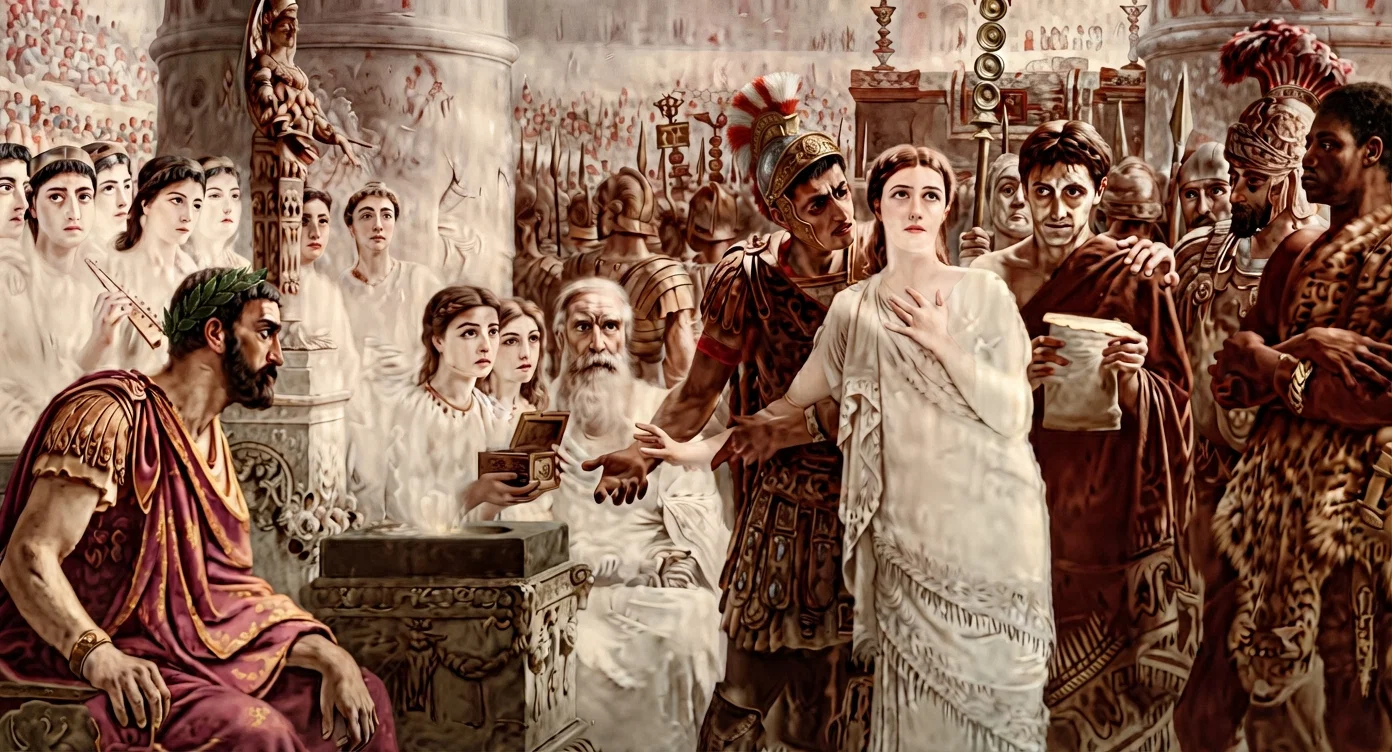
CHRIST OR DIANA.

Our beautiful engraving from Edwin Long's great picture propounds a question ages old—Shall we choose Christ or Diana?
Diana stands for nature worship: for the pleasures of earth, which at the best are only "for a season;" for the ambitions which wither and kill; for the lusts of the flesh which rot and disintegrate; for the self-love and self-indulgence which embitter and belittle the soul; for the ease of the present which dwarfs; for the passions which bestialize; for the greed of gain and power which tyrannize, enslave, and crush; for all that the human heart naturally loves and cherishes; for death as the result of all.
Christ stands for the very opposite of all the things for which Diana stands: for the eternal and ever-increasing pleasure of doing right; for the affections which bind together and save; for the ambitions which seek the good of others and make living, mighty men; for the righteousness of God which brings peace and rest; for the warfare which brings eternal triumph over wrong; for the liberty vouchsafed to every man, which, when received, makes men fearless and free; for the life which denies the baser lusts and passions, and gives power and purity to the ever upward growing character; for all of all good in righteousness and life and love, Christ stands.
Which shall we choose? To-day the Good Shepherd may seem near and we may see no want of needed things. To-day the pathway is cool and shaded beside the sweet, still waters; and we love its ease and peace. To-day the pastures are green and sweet; we love to feed upon the luxuriant grass. How good it is to follow Him! But to-morrow—our next to-day—the path may be rugged, and rough, and thorn-bordered. It has left the green meadows for the barren desert wastes. It has diverged from the still waters to the wild, roaring torrents of the mountains. The feet become weary and worn and bleeding. Earthly friends are calling us back to the lowlands of ease. The dulcet voice of the Dianas of nature woo us to eternal slumber, or call us back to an easier path. Christ, the Good Shepherd, goes on before; Diana invites to present ease and indulgence.
Which shall it be, God or nature? Christ or Diana?
Diana stands for force and compulsion in religion. Thus has every perversion of the true religion stood. When the apostle Paul went to the great city of Ephesus to preach, God wrought mightily thru him. A multitude turned to God. The devil did all he could to nullify the apostle's work by endeavoring to associate with him vagabondJews of no repute; but the Spirit of God wrought above them, and the name of Christ was magnified. Many of the most depraved turned to God. They showed the sincerity of their repentance by burning their evil books to the value of 50,000 pieces of silver. Turning from their idolatry affected the business of the devotees of Diana, and Paul was brought before the magistrates as a troubler of the peace of the city, when the fact was that he was working for peace—a mightier, deeper, holier, more lasting peace than Ephesus knew.
But Paul's work or Paul's right was not recognized. What right had he to preach in that city which had the great image of Diana, whom all the world worshiped? Her temple will be despised, and her magnificence destroyed. Then for two hours they cried, "Great is Diana of the Ephesians." The town clerk was a sensible, just man. He believed in Diana, and felt that she could stand by herself; but if these complainers "have a matter against any man, the courts are open; . . . let them accuse one another." See Acts 19.
It was the right principle. Men, not institutions, should be matters of law. Not men as against institutions, but men in their relations with each other, each protected in his own right, equal to his neighbor, tho the neighbor number a thousand and he but one. But the devotees of Diana did not discern so clearly as their town clerk. Later on, the hatred of the worshipers of Diana grew more fierce toward the worshipers of Christ, and doubtless the struggle depicted in our picture was a type of many others of variant form in which the worship of "Christ or Diana" was the crucial question.
All thru the times of pagan persecution the picture was repeated. All thru the Dark Ages the struggle was multiplied in a hundred forms. In our own day is a revival of the same spirit. Men have so little faith in the dogmas of the creed they hold that they are not willing to let them stand or fall by their inherent worth or worthlessness. "Great is the American Sunday" is ringing thruout the land, and prosecution of those who question its authority is demanded. New laws to protect it are demanded, lest it "should be despised," and its magnificence should be destroyed." Sensible town clerks and magistrates and legislators, and leaders of all classes are needed now. If Sunday be sacred, no human law can add to its sacredness. The truth and majesty of God within it will protect it. It will not give it a place in hearts to enforce it; and tho it be a thousand times Christian, it is a thousandfold un-Christian to seek to enforce it by law. If it be not able to stand in its own merits, let it perish. "Every plant, which My heavenly Father hath not planted, shall be rooted up," are the words of Jesus. "If it be of God, ye can not overthrow it," is equally true. Test all rival sabbaths by the word of God, but never do the un-Christian thing to seek to enforce by law even the true. We choose Diana when we choose the false. We choose the way of the heathen when we seek to enforce by law any religious dogma whatsoever. We stand with Christ when we grant liberty to others. We choose Christ when we choose the true.

OUR ALLEGIANCE TO THE STATE.

EVERY individual owes allegiance to the country in which he lives. Our own sense of right and wrong should teach us that such is the case. But that we may not be left in any doubt upon the subject the word of God states this fact plainly.
"Then went the Pharisees, and took counsel how they might entangle Him in His talk. And they sent out unto Him their disciples with the Herodians, saying, Master, we know that Thou art true, and teachest the way of God in truth, neither carest Thou for any man; for Thou regardest not the person of men. Tell us therefore, What thinkest Thou? Is it lawful to give tribute unto Cæsar, or not? But Jesus perceived their wickedness, and said, Why tempt ye Me, ye hypocrites? Show me the tribute money. And they brought unto Him a penny. And He saith unto them, Whose is this image and superscription? They say unto Him, Cæsar's. Then saith He unto them, Render therefore unto Cæsar the things which are Cæsar's; and unto God the things that are God's. When they had heard these words, they marveled, and left Him, and went their way." Matt. 22:15-22.
The foregoing scripture is definite in its teaching that there are certain things that are to be "rendered" "unto Cæsar." No place is left for the anarchist, or for any one else who would overthrow the right and the exercise of properly constituted civil authority. There are dealings between man and man that God has left to be regulated by man. God has ordained the civil authority. "The powers that be are ordained of God." Rom. 13:1.
It is perfectly clear that civil authority is not only a proper, but also a divine arrangement. Leaving out the few unbalanced anarchists, all the world recognizes this important truth. And hence, we see governments established in all parts of the world and right-minded men are sustaining and supporting these governments. Some of these governments are despotic and even tyrannical. But it is far better to be ruled by a despot than to have no government at all.
The foregoing principles are acknowledged, and should be defended and taught, by every lover of order and liberty.

A Vital Principle.

There is another and much more vital principle set forth in the text quoted from Matthew. It will be observed that the text says that we are to render "unto God the things that are God's" as well as to render to Cæsar (or the State) the things that are Cæsar's. What we render to God must be given to Him direct. We must not give it thru the State, or because the State demands it. Therefore a State religion is always wrong, or any interference of the State to enforce questions of religion is wrong.
It should be borne in mind that duties which we owe to God will not interfere with our fellow men, nor in any sense invade the rights or privileges of another. Let this point be illustrated by taking an extreme case, but one that illustrates the principle clearly. A few years ago a man in one of the Eastern States became possessed with the idea that he should offer one of his children as a human sacrifice. This would be recognized by any right-minded person as a rank piece of fanaticism, yet it was in the field of religion; and altho this is true, nevertheless, the State should interfere to keep such a person from carrying out purposes of this kind, because the right of another is involved.
But, you are ready to ask, would not such interference be stepping between this man and God, and keeping him from exercising a religious right. Most certainly not. The State would be simply stepping between that man and his child and preserving the child's right to live. The exercise of religion can not rightfully invade the rights of a fellow being, even tho that being is our own child. And when an attempt is made in that direction, the very purpose for which the State is formed is to step in and protect the rights of the individual. The foregoing is plain enough to be readily seen and understood by any one.

An Inalienable Right.

Every man has the inalienable right of perfect freedom. And in order for every man to enjoy this right each one must respect the rights of others. One man can not trample upon another, and claim in doing so that he is exercising the principles of freedom. For while he may be free himself, yet he is acting the part of a tyrant in trampling upon a fellow man, and there can be no freedom where there is tyranny. The tyrant of to-day may be overthrown and trampled upon himself to-morrow, thus showing that there is in reality no real freedom in a land where the individual is not taught to be just as careful to respect the rights of another as he is to exercise his own rights.
In harmony with the foregoing principles, it is a self-evident truth that so far as the law of the land is concerned, every man has a perfect right to choose his own religion, or, if he sees fit to do so, to have no religion at all. We are to render to God the things that are God's, and not to render to Cæsar the things that are God's. God Himself does not force His worship upon the individual. "Whosoever will," is the Gospel invitation. The appearance of worship may be demanded by force, but our heavenly Father would have us recognize from His dealings with mankind that real worship must be free and voluntary.
A failure to recognize the foregoing plain principles has been at the foundation of all the persecutions of all the past ages. And all the blood that has been shed in all the religiouswars that have been fought has been due to the fact that man has attempted to force his fellow man to do some act of worship, or observe some religious dogma.
Our grandfathers came to this country to work out the principles of religious and civil freedom. We have inherited from them some most priceless institutions. They took us on their knees in our childhood and told us again and again of the value of maintaining our freedom to worship God according to our own enlightened consciences. They told us to guard this sacred institution of freedom more devotedly than we would guard either our lives or our property.
There is great danger of being deluded into the thought that because we have freedom to-day, therefore we will always be free. But there was never a more pernicious error. Principles must be frequently reviewed, and constantly and faithfully taught to the rising generation if we would keep them alive and enjoy their benefits.
It is everlastingly true that "eternal vigilance is the price of liberty." T.

Persecution’s Consequences

It is incumbent on the authors of persecution previously to reflect whether they are determined to support it in the last extreme. They excite the flame which they strive to extinguish, and it soon becomes necessary to chastise the contumacy, as well as the crime, of the offender. The fine which he is unable or unwilling to discharge, exposes his person to the severities of the law, and his contempt of lighter penalties suggests the use and propriety of capital punishment.— Gibbon, “Decline and Fall of the Roman Empire,” chapter 37.

1984.—The “Added” Law. Eze. 20:24, 25; Gal. 3:19.

Does not Eze. 20:24, 25 show that the ceremonial law was added (Gal. 3:19) because of transgression of the moral law? If the added law was the moral law, and the coming of the Seed refers to the second advent, does not “added until the Seed should come” not only imply, but expressly demand, the abrogation of the moral law at the second advent?
If our querist will read the context he will see that the “statutes that were not good” and the judgments by which they should not live were not Gospel ordinances, of which the ceremonial law was an expression, but were perversions of the law, heathen laws and customs that came in among Israel. God “gave them up” to those very things. See Ps. 81:11, 12: “But My people would not harken to My voice; and Israel would none of Me. So I gave them up unto their own hearts’ lust; and they walked in their own counsels.” Eze. 20:39: “As for you, O house of Israel, thus saith the Lord God; Go ye, serve ye every one his idols.” See also verse 26. We read that the time God spoke the Ten Commandments “in the mount out of the midst of the fire, of the cloud, and of the thick darkness, with a great voice,” “He added no more; and He wrote them in two tables of stone, and delivered them unto me.” Deut. 5:22; “Which voice they that heard intreated that the word should not be spoken to them any more;” literally, “added to them any more.” Heb. 12:19. Now that law was not a new law, but it was given in a new form. Why it was given in that form is expressly stated in both Romans and Galatians. Rom. 5:20 declares, “Moreover, the law entered that the OFFENSE MIGHT ABOUND.” Man had so departed from God that he needed the written law to show to him what sin was, “that sin by the commandment might become exceeding sinful.” Rom. 7:13. Gal. 3:19 gives the same thought: “Wherefore then the law? It was added BECAUSE OF TRANSGRESSIONS, till the Seed should come to whom the promise was made;” in order that man might see and know what sin was; show him his misery that he might lay hold of God’s mercy; show him his sin that he might lay hold of God’s righteousness; the schoolmaster—pedagog—to drive him to Christ; and when Christ comes, the law will no longer be a reprover of sin. Then all shall know the Lord, and the law will be written in the hearts of all. As a negative code, a reprover of sin, a threatener of wrath, it will be no more. As a positive force of love in God’s children, it will and must exist, in the very nature of the case to all eternity, because it is the simple expression of God’s character.

1985.—The First-Fruits of the Spirit. Rom. 8:23.

What do you understand the first-fruits of the Spirit to be, as spoken of in Rom. 8:23?
The “first-fruits” of the Spirit of Rom. 8:23, is identical with “the earnest of the Spirit” in 2 Cor. 1:22; 5:5, “the earnest of our inheritance” in Eph. 1:14, and the sealing of the Spirit in Eph. 4:30. When the child of sin fully yields himself to God and accepts of Christ Jesus, God bestows upon that child His Spirit. “If any man have not the Spirit of Christ, he is none of His,” but when a man believes, he receives the Spirit of God; a new life, a new power, comes into his being and enables him to do what he could not before do, love God and be obedient to His law. That is the first-fruits of the Spirit; that is God’s pledge to him that He will abide with him all the way thru his life, even to the glorious consummation when that same Spirit will quicken his mortal body and fit him for eternal glory.

1986.—The Former Estate.

Will you please explain Eze. 16:55, 56? Is there any shadow of proof in the text for probation to come? What is the “former estate”?
The text and the context are a comparison of character between Judah and Israel on one hand, and Sodom on the other. The Lord points out that according to the light that they had had, they had done worse than Sodom; and in the great day of judgment, when they should come before God, this will be clearly seen. All that can be indicated by a former estate is that they will be raised from the dead, and, of course, raised in their sins, and then punished as indicated in Revelation 20. Then it will be seen that those who have sinned against great light are more guilty than those who had less light. The same thought is expressed by our Saviour in Matt. 11:21, 22: “Wo unto thee, Chorazin! wo unto thee, Bethsaida! for if the mighty works had been done in Tyre and Sidon which were done in you, they would have repented long ago in sackcloth and ashes. But I say unto you, it shall be more tolerable for Tyre and Sidon in the day of judgment, than for you.” The next two verses draw the comparison between Capernaum and Sodom, and say in regard to Capernaum that “it shall be more tolerable for the land of Sodom in the day of judgment, than for thee.” The text gives no ground whatever for probation in the age to come. Every man shall give account of himself to God for the deeds done in the body, and the resurrection is the returning to that estate.

1987.—The Righteousness of the Law or of Faith. Rom. 10:5, 6.

Please explain what Paul means in Rom. 10:5, 6.
Read the context and note the contrast between Israel as they ought to be and what Israel were seeking after. They had a “zeal for God, but not according to knowledge;” they were ignorant of God’s righteousness and hoped to establish their own righteousness; consequently they had not submitted themselves to the righteousness of God. They had failed to see the end, or object, of God in giving the law; that it was to lead them to the righteousness which is of God by faith, showing them that they had no righteousness of their own; that all their righteousness must be of Him. The law demands that absolute and perfect obedience of a perfect man, and, of course, the man that would do those things would live by them; but the apostle has pointed out, as other Scriptures do abundantly, that “there is none that doeth good, no not one,” for “all have sinned and come short of the glory of God.” Rom. 3:23. Therefore, the only righteousness which can be acceptable to God is the righteousness which is by faith in Jesus Christ, unto and upon all them that believe. See Rom. 3:20-22. The righteousness of the law looks to one’s actions for justification, and consequently gives glory to one’s self for a seeming righteousness which always comes short, and puts Christ far away; but righteousness which is of faith lays hold of the Lord Jesus Christ and brings Him down into our own hearts so that Christ shall dwell in our hearts by faith. Eph. 3:17. This is the “faith which worketh by love” (Gal. 5:6), and the love which keeps all the commandments of God (1 John 5:3).

1988.—Let Every Man Be Persuaded in His Own Mind.

What is to be understood, in the editor’s judgment, by the expression in Rom. 14:5: “Let every man be fully persuaded in his own mind”?
Just this, that God wants us to live by our own faith, our own convictions, our own judgment. We can not live by rules which others lay down with no convictions on our own part. “One man esteemeth one day above another; another esteemeth every day alike. Let each man be fully assured in his own mind.” Connect that with verses 22 and 23, “The faith which thou hast, have thou to thyself before God. Happy is he that judgeth not himself in that which he approveth. But he that doubteth is condemned if he eat, because he eateth not of faith; and whatsoever is not of faith is sin.” Now it seems very clear to us, and may be also clearly shown, that the apostle was talking to Christians, and not speaking of the Sabbath day which God has set apart to Himself separate from all the other days. There were those among the Romans who kept the Passover and Pentecost and Day of Atonement and other holy days of the Jews. To some these amounted to nothing, to others they ought to be kept faithfully. No man is governed by another man’s conscience in this respect; let every one be fully assured in his own mind. This principle is just as true in regard to the Sabbath or any duty which God asks of His children. He wants no one to do His will unless he has faith in Him; but faith is based on His word. Let us be careful to follow our own convictions; let us be careful to know that our convictions are based on the eternal truth of God.

Civil Government and Religious Conscience

The only proper objects of civil government are the happiness and protection of men in the present state of existence; the security of the life, liberty, and property of the citizen; and to restrain and encourage the virtuous by wholesome laws equally extended to every individual; but the duty that we owe to our Creator, and the manner of discharging it, can only be directed by reason and conviction, and is nowhere cognizable but at the tribunal of the universal Judge. To judge for ourselves, and to engage in the exercise of religion agreeably to THE DICTATES OF OUR OWN CONSCIENCE, is an inalienable right, which, upon the principles on which the Gospel was first propagated, and the Reformation from popery carried on, can never be transferred to another.—Presbytery of Hanover, Virginia, Declaration of 1776.

THE GREAT SALVATION

By GEO. W. REASER.

THE FINAL WORK OF THE ANGELS IN THE PLAN OF SALVATION.

"And then shall He send His angels, and shall gather together His elect from the four winds, from the uttermost part of the earth to the uttermost part of heaven."
WHEN the Lord would deliver His people from Egyptian bondage, He sent His Angel, who appeared to Moses in the bush which was all aflame, but unconsumed by the fire. The angel spake—as in other instances—as tho God was there in person; for he came there to represent and speak for God.
Moses was commissioned to lead God's people from the "iron furnace" of Egyptian bondage to "a land flowing with milk and honey." When the people—after the plagues which demonstrated the Lord's power and secured the consent of Pharaoh—formed in marching column for the journey to Canaan, the angel of the Lord went before until they were hotly pursued by their enemies, and until the progress of the advancing hosts of Israel was prevented by the waters of the Red Sea, when the heavenly messenger changed his position and stood between the children of Israel and the legions of Pharaoh. The sea opened and formed a pathway for the feet of the former, but a death-trap for their enemies. God's people marched safely thru the sea, with the walls of water on either side as protection against their being surrounded by the Egyptian army. Pharaoh's hosts assayed to follow after, but they were treading a pathway not made for their wayward feet, and when they were well into the sea, angels removed their chariot wheels, thus throwing them into confusion and disorder. Then the walls of water—no longer held for the protection of God's people—collapsed, and horse and rider perished in the flood. Then sang they a song of deliverance from their enemies and praised the God of their salvation.
When Israel, by the leadership and protection of angels, had passed thru the wilderness and crossed safely over the swelling tide of Jordan, Christ, the Captain of the Lord's host, was on the battle-field, and with His angels, gave Joshua the victory and the people possession of the city of Jericho, and, gradually, according to their faith, the promised land.

A Type of Final Deliverance.

This deliverance was a type of the final deliverance of God's people from the earth at the second appearing of Christ. The Lord now commissions mighty angels to lead His people safely to the heavenly Canaan. When the last plagues are poured upon a guilty but unrepentant world, the angels will have charge of God's people, and will keep them in perfect safety.
The final, joyful work of the angels in connection with the plan of salvation, will be to gather the redeemed to meet the Lord in the air. The Saviour comes with all of His holy angels. His voice wakes the slumbering saints, their graves can no longer hold them fast. They come forth immortal, and at the same moment the living saints are immortalized. The heavenly "watchers" have marked the spot where each one who sleeps in Jesus is resting. Angels that excel in strength bear aloft the saints of God to meet their Redeemer in the air, to accompany Him to glory, and to enjoy His presence and loving favor forevermore. When this long-looked-for event occurs, how the arches of heaven will reecho with the song of victory sung by the redeemed upon the sea of glass before the throne, and every heart will overflow with ecstasy, knowing that the plan of salvation is finally made complete, and that all sorrow is forever ended.
It may be well to settle in our minds one fact relative to angels, and that is, that the two classes, elect angels and fallen angels (demons), brought to our notice in the word, were never members of our human family, but were created beings of higher order than men,—existing before men. Nor will unfallen angels ever personate deceased men, and assume to be departed members of Adam's race. This deceptive work is practised wholly by fallen angels, and reveals the secret of the mysterious manifestations and personifications of Spiritualism. Relative to this delusion, the word says, "I would not that ye should worship demons."
So far as the Scripture record reveals the future state of the human family, even the redeemed will never become angels; but to "be made equal unto the angels," and to be made exempt from the ravages of death is quite sufficient ground for all of our holy ambitions. This constitutes an essential part of "the blessed hope."
Continue reading: TIME'S NOBLEST OFFSPRING