Your ShelfYour Projects

Signs of the Times, Vol. 24, No. 8.

THE GENTLENESS OF GREATNESS

Signs of the Times

Feb 24, 1898

Pacific Press Publishing Company · Oakland, California · Feb 24, 1898

THE GENTLENESS OF GREATNESS.

One thousand years before the great and gentle Jesus walked the earth, the royal psalmist had sung:
“Thy right hand hath holden me up, And Thy gentleness hath made me great.”
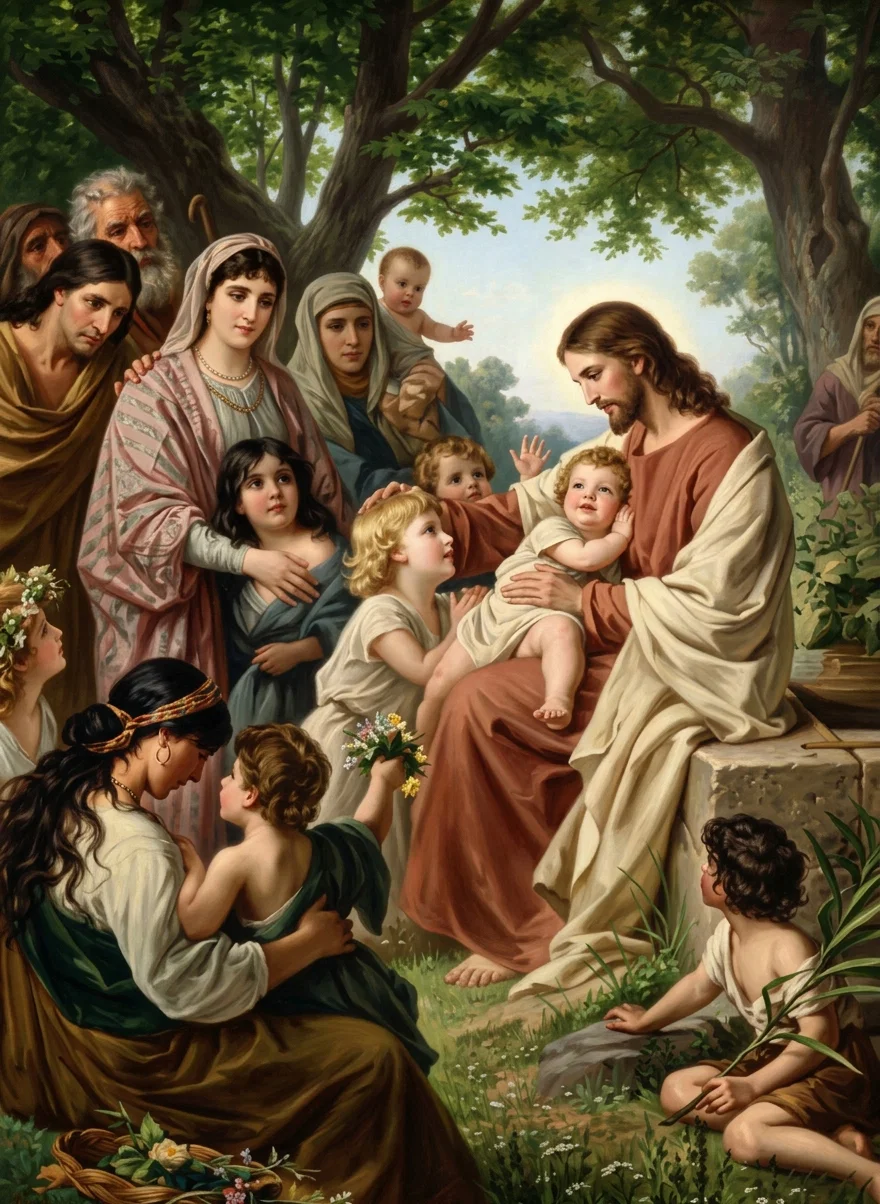
“And they brought young children to Him, that He should touch them; and His disciples rebuked those that brought them. But when Jesus saw it, He was much displeased, and said unto them, Suffer the little children to come unto Me, and forbid them not; for of such is the kingdom of God. . . . And He took them up in His arms, put His hands upon them, and blessed them.” Mark 10:13-16.
David learned the need and worth and beauty of gentleness in dealing with the tender lambs and the weak and sickly of the flock. True greatness in character must include gentleness.

What Is Greatness?

—It is often considered as synonymous with massiveness, volume, strength, power. We speak of great rivers, great mountains, great empires, great multitudes, great oceans, thinking alone of their extent and magnitude. But the greatness also includes the littleness. The great rivers are made up from the little rills, the many feeders all along its way; the great mountains are composed of tiny grains of sand; the great empires are made up of states and cities and towns and farms; the great multitudes are but the aggregate of many little units; and the great oceans are made up of “little drops of water, little grains of sand.” Greatness means not only length and breadth and height, but comprehensiveness. So must character be great in its grasp of both minima and maxima, the small as well as the large; for “he that is faithful in that which is least is faithful also in much; and he that is unjust in the least is unjust also in much.” Luke 16:10. God’s greatness not only created the mighty suns and constellations, and upholds and ballasts them in their course, but it numbers the hairs of our heads, and notes the fall of a sparrow. His greatness comprehends the infinitely large as well as the infinitesimally small. The great Master is equally at home in all parts of His universe, in all phases of His creation. Surely He is the Being whom alone we can implicitly trust.
What Is Gentleness?—Gentleness is mildness in disposition and manner; kindness; graciousness; it is being considerate of others’ feelings. It is that quality of mind or heart which will lead one to treat others as he would desire to be treated. It is the Golden Rule in manner. It never overrides the poor, the weak, the timid, the outcast. Rather it invites and inspires their confidence, and leads them to hope and strive for the better. Only the truly great can be truly gentle; for only the great mind can comprehend the great, broad need of gentleness.
The Greatness of the Son of God before He came to this world is fully revealed in the Word. He was, with the Father, Creator and Upholder of all things. When upon earth, He wrought mightier miracles than earth had ever seen. He taught truths so wonderful, vast, and sublime that the plummet of mortal minds has never fathomed their depths, nor exhausted their sublimity. He lived a life which has been the admiration of even those who would not yield to its power.
The Gentleness of the Son of God equals His greatness. Only those avoided Him who hated the purity of His teaching and the blamelessness of His life. All others sought Him, and were received by Him with divine gentleness. “The common people,” cursed and cowed by priest and ruler, “heard Him gladly.” The poor, vile sinner, anxious for cleansing, came to Him and was not condemned. The poor, the leprous, the blind, the halt, the lame, the down-trodden and oppressed, considered as under the curse by proud Pharisee and hypocritical priest, came to Him and found riches, and cleansing, and sight, and healing, and liberty, and blessing. Woman, considered as of little worth by Pharisaical tradition, could come to Christ and find a friend. Mothers, poor, worn, weary, and well-nighhopeless, could come to Jesus with the heaviest, and yet most precious burdens, their children, and find a gentle sympathizer yet mighty helper.
The Little Children.—The little children found a place in His heart and life. The instinctive purity and acute intuition of innocent childhood saw in Him one whose love surpassed that of both father and mother. Small-hearted disciples rebuked the parents for bringing them, even as small-hearted men and women, and sometimes faithless fathers and mothers, hold them back from coming to the Lord and following in His footsteps now, but the gentle Master answered, “Suffer little children, and forbid them not, to come unto Me.” The children do not need urging; all they need is to be shown the Master; and then suffer them to come, let them come; “for of such is the kingdom of heaven.” Matt. 19:13–15. Their open, trusting hearts receive its teachings without doubt. And even as they came, “He took them up in His arms, put His hands upon them, and blessed them.” Mark 10:16. And not infrequently may we believe were such scenes enacted as are shown in our beautiful accompanying illustration.
Lessons.—There are three important lessons that we may draw from the simple record, and carry them with us all through life.
1. The Great Gentleness of Jesus.—Never was there a greater character; never was there greater gentleness. He has left every one of His children here as His witnesses, His representatives, to witness by their life His character, to represent Him in their character. Truly in this harsh, unfeeling, grating age there is sufficient need. Yet it is possible to live as did the Master. His heart was attuned by the Spirit of God, its chords unswept by the fierce and ungracious discords of earth. His heart-strings were ever breathing out their heaven-born melody of gentleness, purity, and truth to the trivial, fearful, needy ones on every side. Not rudeness, not roughness, not harshness, not loudness, make us great, but the greatness of Christ’s indwelling presence. “Thy gentleness hath made me great.”
2. Receiving as a Little Child.—So must we come to God; the little child becomes our teacher; or God teaches through the child. Just as the little ones come with trusting confidence to the true and tender mother or father, so let us go to Him whose love is stronger than that of a father, and tenderer and more devoted and more lasting than that of a mother. Of the mothers the Lord says, “Yea, they may forget, yet will I not forget thee.” O soul, poor and oppressed, timid and friendless and orphaned, there is one Heart ready to receive you; the arms of One are open to embrace you; and He says to all those who, by rebuke or suggestion, would hinder your coming, “Suffer them to come unto Me, and forbid them not.” Come as a little child. No trust or confidence in God can ever be exercised in vain or be betrayed by Him who welcomes you.
3. Receiving Children.—There is yet another lesson impliedly taught here, and directly elsewhere. The Master received the little ones. He says to His children, to all fathers and mothers, to every servant of God, “Whoso shall receive one such little child in My name receiveth Me.” Father, mother, have you so welcomed the children which you have begotten and born? Did you receive each one in the name of the Master, seeing beyond the little bundle of innocent, undeveloped humanity the image, the great character, of the blessed Christ, which you by divine grace were to be so largely instrumental in developing? If you have not done this, and it is not now too late, let us beseech you to receive them now in Christ’s name, consecrate them to Him, train them for Him for all eternity. Teachers, receive the children intrusted to your care in Christ’s name. Never break the sweet child confidence by harsh, unholy reproof or base untruth. Let the threads of wool which you weave into the warp of his character be those of Christ’s righteousness, which will endure for all eternity. And, minister of God, “whoso receiveth one such little child in My name,” says the Master, “receiveth Me.” Let your whole life breathe out such fragrance and confidence that the timid, trusting ones will come even as they came to Christ, and know that they will not be repulsed.
May God forgive us for our rudeness and harshness and ungraciousness, and may our hearts be so responsive to His gentleness that every chord of our nature shall come into perfect harmony with the greatest, the gentlest, and the best Master in the universe, whose gentleness will make truly great every soul which is yielded to Him. He is the same today as in the past. He is “Jesus Christ, the same yesterday, and to-day, and forever.”
X.

CHRIST AND THE PHARISEES. No. 3.

The Jewish leaders felt complete in themselves. They felt no need of a physician. They would not humble their hearts to accept Christ. He presented before them their hypocrisy, pride, and formalism. In their hands the pure gold had become dim. God’s law, pure, far-reaching, and comprehensive, was adulterated with laws of human invention. And the farther the priests separated from right principles, the heavier the law of God was by them loaded with exactions.
This is the danger to-day. As men fail to practise obedience in its simplicity, they depart from God. Plans and methods that bear the marks of man’s natural attributes, are brought in to be obeyed, while the principles of truth, love to God and to man, are left out of the life. Kindness, love, and mercy, are not seen in the character.
Christ says: “Take My yoke upon you, and learn of Me; for I am meek and lowly in heart; and ye shall find rest unto your souls. For My yoke is easy, and My burden is light.” His yoke is not painful and galling. He does not require His followers to pass through the ceremonies often enjoined by men. But because of their unlikeness to Christ, and their false pretensions to obedience, men bring in a yoke that is galling to the neck that wears it. They take the power into their own hands, while acting themselves like undisciplined children. Thus in the minds of men God’s ways and works are mingled with the perversity and disobedience of men.
When Adam and Eve were placed in the garden of Eden, everything contributed to their enjoyment. They were simply instructed to dress the garden and keep it. No noxious weeds sprang up, demanding patient toil. How different from this was the work of Christ! The seeds of the Gospel were to be sown on soil in which the enemy had already sowed tares. The rubbish of error had long been accumulating. As the people separated from God, false ideas were accepted, and the leaders of the people taught for doctrine the commandments of men.
Christ came to this world to live the law and represent the character of God, that the delusions which Satan had brought upon the world might be dispelled. In the sermon on the mount, He who gave the law became an expositor of the law. That sermon, so full of what it means to love and obey God, is the unfolding of His character. The law is shown to be a representation of God’s character, that man may see that he must render obedience to the law if he would become a member of the royal family, a child of the heavenly King. This law requires nothing short of perfect spiritual obedience.
Bible religion does not allow a life of inactivity and idleness. One can not believe for another, or depend upon another’s evidence. The individuality of one can not be submerged in another. God’s work is a personal work. No one can be saved without earnest faith, earnest work, and faithful improvement of every God-given ability. Idleness is sin. While Christ, our Mediator, is presenting in our behalf His atoning sacrifice, we are to work in His vineyard. The Old and New Testaments declare without reservation that those who would enter into life must keep the commandments. The Lord Jesus holds out none of His precious promises as a premium for disobedience. Disobedience is sin, and in the Word of God the terrible consequences of sin are faithfully portrayed.
A certain lawyer stood up before Christ, and tempted Him, saying, “Master, what shall I do to inherit eternal life? He said unto him, What is written in the law? how readest thou? And he answering said, Thou shalt love the Lord thy God with all thy heart, and with all thy soul, and with all thy strength, and with all thy mind; and thy neighbor as thyself. And He said unto him, Thou hast answered right; this do, and thou shalt live.”
The question asked by the lawyer is an important one for every son and daughter of Adam. It concerns all, fathers and mothers, brothers and sisters, relatives and friends.
Those who profess to love God with heart and mind and strength, will be severely tempted to justify self in neglecting to love their neighbor as they love themselves. In the parable of the good Samaritan Christ showed the lawyer who his neighbor was. The priests and Levites who listened to His illustration knew that the picture was true to life.
To us as to the lawyer, Christ says, “Go, and do thou likewise.” Many say, “I go;” but they go not. In their inmost soul they do not desire to render obedience to God’s requirements. They justify disobedience. They make a reservation. They allow the rules and commandments of their own invention to supersede the holy commands of God.
The term “neighbor” includes all who have need of the grace and patience that Christ has promised to supply. Those to whom God would have you minister may be unconverted, uncourteous, and uncouth. They may have disagreeable qualities. By these your kindly deeds may be unappreciated, and totally unrequited. But because of this, you must not forget that they are still your neighbors, whom you are to love as you love yourself. All need to pray much, and watch unto prayer, that their faith fail not. No one can keep the commandments of God who does not cherish love in his heart; for without love there is no true obedience. Supreme love to God is required, and when this is an abiding principle in the soul, our love to those around us will be seen in our deeds and words.
Thousands are inventing a gospel to take the place of the Gospel of God. They are substituting the commandments of men for the commandments of God. But in the Gospel of Christ honor and dignity are given to the law of God. I have kept my Father’s commandments, Christ said, in all their purity and holiness.“I have taught from house to house,” Paul said, “repentance toward God, and faith toward our Lord Jesus Christ.” Repentance toward God is the first requirement, because His law has been broken. The sinner must be converted and led to Christ as the only remedy for sin. He must have faith in Christ as his personal Saviour. Christ came not to lessen the guilt of sin, that man may have liberty to be disloyal. He came to live the law of God, leaving man no excuse for violating one precept. He did not come to retract from the dignity of the law. By taking the sin of the world upon His soul, He exalted the law, and made it honorable. His death is an unanswerable argument in favor of the immutability of the moral law, and forever settles the question that its character is changeless, and will stand forever, through time and eternity.
Christ came to exalt the law, which had been trampled in the dust, that we might acknowledge its beauty and loveliness, and before angels and men advocate its supreme authority. By keeping the law in humanity, He made it possible for man to keep it. He imputed to us His righteousness, that we might become partakers of the divine nature. He came to this earth that we might be loyal sons and daughters of the heavenly King. God’s children never claim to be perfect, because they are often weakened by temptation, but they honestly strive for the victory. Satan tempts them to throw away their hope, because they fall under temptation; but they may be reassured by the words of Christ, “I came not to call the righteous, but sinners to repentance.” “Him that cometh to Me, I will in nowise cast out.” He came not to save men in sin, but from sin. And all who feel their need of a Saviour, and come to Him believing in His power, will gain the victory over sin. “As many as received Him, to them gave He power to become the sons of God.”
MRS. E. G. WHITE.

LIVING BY FAITH.

“THE just shall live by faith.” This is the utterance of Inspiration, in both the Old and New Testaments—by the prophet Habakkuk (chapter 2:4) and by the apostle Paul (Rom. 1:17; Gal. 3:11). A just or justified person is one whose sins are forgiven; “for all have sinned, and come short of the glory of God.” Rom. 3:23. Then to be just, or justified, a man must have been forgiven of sin. But how may this be done? The answer is, “By the faith of Jesus Christ.” Gal. 2:16; Rom. 5:1.
Then it requires the same power to remain just that it does to be made just. And this power must come from God. Says Christ, “Without Me ye can do nothing.” John 15:5. And this is just as true of the justified man as it is of the sinner. It requires power for any being to do right, and “there is no power but of God.” Rom. 13:1; Matt. 28:18. An angel of heaven could no more live right without the continued power of God than can the vilest sinner.
This power to do right can only come by faith; it never was and never will be imparted to any being who does not implicitly believe and trust in the Word of God. When our first parents were placed in the Garden of Eden they were just, pure, sinless. God pronounced them “very good.” They were beings with whom he could familiarly associate. He could walk and talk with them. This continued as long as the man believed God. But just as soon as he chose to believe the enemy of God he lost his power to do good. It was the same with the angels of heaven who participated in the defection of Satan. They were cast out, and are powerless to do good. Thus it is demonstrated that those beings who had not sinned were dependent upon faith in the Word of God to continue loyal.
The apostle Paul says, “We walk by faith, and not by sight.” 2 Cor. 5:7. There is not and never will be any way to serve God but by faith. No one ever will know the future only as he learns of it from God. Whatever we shall know more than we now know will be by the knowledge and power of God. Whatever we shall see, even in the heavenly kingdom, more than we now see will be through the power of God; and no one will ever see the time when he can see and know and do the will of God independently. Of all the spiritual gifts there are three that must abide—“faith, hope, charity.” 1 Cor. 13:13. The creature, however high, who attempts to walk by sight—a sight not lighted by the light of God’s Word—will be sure to run counter to His will. If we expect to abide in the kingdom of God, we must learn to “have faith in God,” for we will need to exercise that faith forever if we are to live forever. It will always be true that “the just shall live by faith.” W. N. G.

WHAT IS ATONEMENT?

THE generally received idea of an atonement is that of “satisfaction by equivalent.” That is to say, when one has wronged another, the one to whom the injury is done settles the matter by receiving an equivalent in the form of some offering. The logical conclusion is that the wrong has in this way been atoned for, since the one doing the wrong has sacrificed something in order to satisfy the feelings of the other whom he has wronged. But such a theory can not apply in the atonement work for sin, for several reasons. First, God receives no injury in any way by man’s sin, and therefore asks no satisfaction for wounded feelings. Second, the only one injured by sin is the person committing the sin, inasmuch as he forfeits life by it, hence it is not possible for him to render satisfaction to God for an injury done to himself.
Again, God did not give His Son to die in man’s stead simply to satisfy justice, since it is not strictly just to cancel sin in the guilty because one not guilty has suffered for the sin, inasmuch as such an act of itself can not change the life or character of the guilty one. Sin atonement is, therefore, not accomplished by the act, alone, of one dying in the place of another. True, the wages of sin is death (Rom. 6:23), and, consequently, every sin committed demands the death of the transgressor, not simply because he has injured another, and justice therefore demands satisfaction, but because, in the very nature of things, sin is the seed of death, and when once planted in the human heart, produces death, unless some remedy is applied by which the terrible germ can be eradicated. But such a work, to be successful, requires co-operation on the part of the one in whom is lodged the gruesome seed; otherwise nothing can relieve him.
The plan to relieve man from such a state was deeply laid in love, and such a love that God freely gave His “only-begotten” Son, that “whosoever believeth in Him should not perish, but have everlasting life.” John 3:16. The atonement of Christ for man is, therefore, to take from him that which would cause him to perish, and put in its place the seed of life everlasting. As stated by the apostle, Christ “abolished death, and brought life and immortality to light through the Gospel.” 2 Tim. 1:10.
As already seen, sin produces death, but not to satisfy God’s wounded feelings. Sin being entirely foreign to the holy nature and pure character of Jehovah, He can in no way associate with it, or with whatever is contaminated by it. Man, being a sinner, is opposed to God’s nature, and naturally has no desire to be associated with Him. In thus separating himself from God, who is the source of all life, man is cut off from life, and so perishes. To bring man back to God is, therefore, to return him to the “fountain of life,” from whence he has been separated.
This means a reconciliation, or an agreement, “a setting at one.” It is really an at-one-ment with God. But on whose part comes the change of standing? We read that with God “is no variableness, neither shadow of turning.” James 1:17. This being true, He could not alter His purpose or attitude, and therefore could not love the sinner less because he has sinned, nor desire his eternal happiness less after he has sinned than before. His everlasting, unchangeable love does not permit God to become unreconciled to the one who has sinned, however much He may be opposed to the sin itself; otherwise He could not, while man was still in sin, have “freely” and of “His own will,” sacrificed His own and only-begotten Son, to bring man back to His embrace. All of the pleading invitations from God plainly reveal that man is the one who is unreconciled, and therefore needs to change in order to bring about friendly relations between himself and his Maker.
It was to make man dissatisfied with God, and so alienate his affections from divine things, that the great enemy of heaven appeared to the first pair in Eden. His first effort and only object there was to make the woman feel unreconciled to God for placing restrictions about the tree of knowledge of good and evil. To gain this end, God was represented as being overbearing and unjust in denying her free access to that which would open to her the avenue to know evil along with the good she already understood. In following the counsel of her evil adviser, the woman transferred herallegiance from God to His inveterate enemy, and so separated herself and posterity from the Author of their existence.
Man’s life was thus hopelessly cut off, unless the love of God might provide a plan of relief. He can not change His attitude in relation to sin, but could open a way by which man might voluntarily drop his enmity to heaven’s law, and so renew friendly relations with the court of heaven. But while love seeks to unite man to God, that he may again have abiding life, it can do nothing to compromise the eternal character of God. Being infinitely just and right Himself, God can not uphold man in cherishing sin, or justify the least departure from holiness, which is the nature of His own character; for in so doing He would become a partner with sin, and thus destroy the holiness of His own being.
Then just how God can maintain His infinite attributes of purity and holiness, and yet receive fallen man into His confidence, is the problem which the atonement of Christ seeks to solve. To thus bring the sinner into harmonious relation with God involves an acquaintance, not on the part of God for man; for He knows him well from of old; but on man’s part, who, because of listening to Satan’s misrepresentations, has not known God. To acquire this, however, is beyond man’s unaided ability for when he at first permitted himself to become unreconciled to God, a pall of darkness came over his mind in consequence of the loss of that life which alone could empower it to comprehend God’s attributes. Eph. 4:18. It was of no avail that God’s perfect will was afterward expressed in His law, or that His attributes of mercy, graciousness, long-suffering, goodness, and willingness to forgive sin, were proclaimed in the holy mount. Ex. 34:4-7. These were ideas too high for a decayed and darkened mind to grasp. The heavens might “declare the glory of God,” and the firmament display “His handiwork” (Ps. 19:1), but even these could discover to feeble human minds only “parts of His ways” (Job 26:7–14).
It was therefore necessary for God to reveal Himself to man in a way that all His tender mercies, and unchangeable love for the sinner, might be fully appreciated. The right doing of God was embodied in His law, which is the transcript of His mind—the holiness of His character—expressed in words. Ps. 119:172. But the mind darkened by sin has no power to discover these qualities there; neither can the law impart the needed light by which its hidden truth may be fully known to the carnal mind. So what the law could not do for man because of the weakness of the flesh (Rom. 8:3), God attempts to do by sending His own Son, who is the express image of Himself (Heb. 1:3), to dwell among men, that in His life might be seen God’s attributes and requirements, which are the end, or design, of the law for righteousness (Rom. 10:4).
But this was not all to be accomplished by the mission of Christ. While His life was to reveal the holiness of God’s character, the love of Jehovah for fallen humanity was to be made manifest by the death of the sinless One, who freely gave up His own life in behalf of God’s enemies. This alone could touch hard hearts, and reconcile them to God. Thus “God was in Christ, reconciling the world unto Himself.” 2 Cor. 5:19.
A mysterious combination indeed. God was in Christ, yet Christ was in the likeness of sinful flesh. Rom. 8:3. It was necessary for this to be, however, for in no other way could the holiness of God touch polluted sinners without becoming corrupted, but by coming to them in a body like theirs, and through that flesh, kept pure by his indwelling presence, reach out toward, and heal the malady of sin, which, as an incubus of death, was not only holding man away from God, but was fast bearing him on to final destruction.
Not only this, but by Christ’s appearance in human flesh, to meet all the temptations to which flesh is subject, and by suffering to the depth of human anguish, under these temptations, He put Himself in man’s place, and thereby gained an experience by which He could sympathize with the weakest, to the extent of providing them the fullest amount of power to walk with God. So, while the work of atonement covers every necessity of man, in restoring him to the life and fellowship of God, it is plain also that such work is not accomplished without man’s co-operation. The nature of that co-operation is a point which must wait to be treated in future papers.
JOHN ORR.

OUR HOPE IN THE RESURRECTION.

Tho our outward man may perish, Tho our flesh and bones decay, There’s a constant hope we cherish, ’Tis the resurrection day;
Glorious day, when Christ shall call us, Call the righteous, from the grave; Death can then no more appal us; Christ has conquered, Christ can save.
Standing on a sure foundation, Naught have we from man to fear; ’Tis our greatest consolation, Our redemption draweth near.
Near, yes, everywhere we read it— In the earth, stars, sun, and moon. He is coming, will you heed it? He is coming, coming soon.
We are trusting in the merit Of the loving, risen Lord, Drinking in the Holy Spirit, Daily feeding on His Word;
Waiting for the golden morning, When the Lord shall come again; Waiting for our soul’s adorning; Waiting Christ’s eternal reign.
T. MORGENSSEN.
Tygh Valley, Oregon.

LOSING LIFE AND FINDING IT.

“For whosoever will save his life shall lose it, and whosoever will lose his life for My sake shall find it.” The rhetoric is abrupt, but there is nothing truer in literature.
Whatever airs science puts on about religion, it is modest enough in the presence of Jesus, and He has stated here the fundamental rule of life—not spiritual life; the same principle holds, from a microscopic particle of protoplasm up to the most glorious manhood: give and grow, save and starve.
The very first demonstrated fact of biology is that a cell gets its increase by its losses. Take, for instance, a bird’s egg; it is a single cell or spark of life, with some raw materials, and rations for three weeks, walled up in a solid, seamless, irrefragable masonry of limestone. Out of the silence and hopelessness of that imprisonment the infinitesimal fragment yearns to its Author, aye, and is heard or felt. Yearns for what?—Life, more life, liberty, enlargement. And from “the secret place of the Most High” a spirit flies, raps on the doorless sphere, and begins a dialog like this:—
“I have come that ye might have life and have it more abundantly.”
“How?”
“Give away what you have!”
“What!”
“Lose your life, to find it later on!”
“How long?”
“Times and seasons are in My hands!”
“Can I not hold onto the little that I have?”
“Yes, and lose all!”
“Wo is me! I can not understand; what shall I do?”
“Believe on Me, and thou shalt not perish, but have life.”
“I believe.”
And the cell divides and gives itself away—half or so; and then again and again it does the like with what is left; and each part that it gives off likewise divides in its turn, and strange, wasteful, foolish doings go on in that cramped little world. But at the close of the third week, crash! goes the shell, and the amoeba of three weeks ago stands amidst the ruins of its prison-house—a golden eagle, with wings and claws and a brain and a nervous system, heart, lungs, alimentary machinery. It “lost” itself in giving, but it has “found” itself—not one cell now, but a billion. The tight, dark shell has gone, and instead of it the circle of the heavens hems it in.
Science calls the operation karyo-kinesis—karyon, “a nucleus,” and kineo, “I move.” In what we call spiritual life the same thing is called “Christianity.”
The principle is universal.
Would you be rich?—Be a giver. Misery is misery.
Would you be strong?—Put out your strength.
Would you be a thinker?—Publish the thought you have.
Society is not a flock but an organism. You are a cell shut in a shell of environment—all but helpless. You can remain as you are—an addle. Hell is addledom. There is a way out, one only. Give, divide, lose your life for Jesus’ sake, for man’s sake, and by and by in a glorified humanity you “shall find it.”—John G. Woolley, in the Voice.
Continue reading: THE UNCOMPROMISING NATURE OF TRUTH