Your ShelfYour Projects

Signs of the Times, Vol. 36, No. 17.

PSALM CXI

Signs of the Times

Apr 28, 1909

Pacific Press Publishing Association · Mountain View, California · Apr 28, 1909

PSALM CXI

Spurrell's Translation
Hallelujah! I will laud Jehovah with my whole heart, In the private assembly of the upright, and in the congregation. Magnificent are Jehovah's works, Earnestly investigated by all who delight themselves therein; Majestic and glorious is His work; And His righteousness abideth forever. He has made His marvelous works to be remembered. Gracious and lovingly tender is Jehovah. He provideth meat for those who fear Him; He will remember His covenant forever. The mightiness of His works declared He to His people, That He would give them the heritage of the nations. The achievements of His hands are truth and justice; All His commandments are sure: They are established forever and ever; Having been made in truth and equity. He hath sent redemption unto His people; He commanded His covenant forever: Holy and reverend is His Name. The summits of wisdom consist in revering Jehovah: Admirably wise are all who arrive at them. His praise abideth forever.

2826.—Whatsoever Thy Soul Desireth.

Please explain Deut. 14:26, “Thou shalt bestow the money for whatsoever thy soul desireth, for oxen, or for sheep, or for wine, or for strong drink, or for whatsoever thy soul ask thee. Thou shalt eat there before Jehovah thy God; thou shalt rejoice, thou and thy household.” R. J. B.
We are sure that no candid reader would understand this text to mean that God’s children could go into all sorts of license regarding moral conduct, or indulging in all sorts of diet. In fact the first part of the fourteenth chapter forbids this. “Ye are the children of Jehovah your God.” “Thou art a holy people unto Jehovah thy God.” In the light of this they were to make discrimination between the clean and the unclean, and so were to come before the Lord for worship. Surely, we can not believe that their soul would desire, standing in the light of that text, anything that would be contrary to God and to His worship. That very thing is implied in all the context; but when they came up to that place which Jehovah had chosen, and when they went up there to obtain His blessing, they certainly would not choose, if they were
truly acting in harmony with His word, anything that would drag them downward. It would be perfectly safe to tell a good Christian man, and place money in his hand in order that he might do it, to go to a certain city and eat whatsoever his soul desired in the worship of God. We may be sure that the Christian principles which he had would hold him from doing anything that was contrary to God and to His word; and so with Israel anciently when they were standing in the light. But when they departed from God, these gatherings which the Lord ordained were utterly neglected. There may have been those then who would take advantage of such expressions as “whatsoever thy soul lusteth after,” and would do all sorts of wickedness; just as there are professed Christians at the present time who will take advantage of such expressions. It is well to remember that there was no such wine or strong drink in those days as we have now. The ancients knew nothing of distilled liquors, and their strong drink anciently was a mild cordial compared with the fiery intoxicants of the present time.

2828.— Temperance and the Sabbath.

Is not the temperance question as important to discuss as the Sabbath question? F. F. F.
The temperance question is always important; so also is the Sabbath question; but a man may be truly a temperance man and not be a Sabbath-keeper or a Christian. No man can truly be a Sabbath-keeper without being a temperance man. The latter reform always goes with the former. Why? Because the Sabbath is a memorial of God's creative power and loving Fatherhood. Had man always observed the Sabbath, He never would have been an idolater; nor would he ever have yielded himself to the abominable lusts that have carried away so many millions of the race. The Sabbath commandment is, "Remember the Sabbath day, to keep it holy." That implies the remembrance of it outside of the Sabbath day itself. Every day of the week was numbered with respect to the Sabbath. It was "One Day to the Sabbath," "Second Day to the Sabbath," "Third Day to the Sabbath," and so on, until the Sabbath itself came. Remembering that commandment in the letter and spirit of it, man could never forget God, nor his obligation to God. Having yielded himself to God he could never give himself up to the sins of gluttony or drunkenness. Every power of his being would be laid upon the altar of God. He could no more prostitute his mental and spiritual powers to the lust of appetite than he could yield himself to bow to the altars of Baal. Consequently whereever true Sabbath reform has obtained through the ages, there is connected with it true temperance.
Furthermore, it is God's time now for a Sabbath reform. Thus has every age ended. The patriarchal age ended with Sabbath reform, and connected with that was the true temperance question. As God led Israel out of Egypt, that temperance reform took hold of not simply wine and strong drink, but upon diet as well. There was true Sabbath reform in the closing of the Jewish age, when our Lord Jesus Christ showed what the Sabbath meant and should mean; and there was also true dietetic and temperance reform during which time was given that wonderfully comprehensive rule, "Whether therefore ye eat or drink, or whatsoever ye do, do all to the glory of God."
We are nearing the close of the Christian age. Our Lord is about to come. One of the mighty reforms which will sweep this earth, antagonizing all pure legal reforms which seek to embody in dead statute-law the living principles of the Gospel, is reform upon the Sabbath, the closing of the breach that has been made in God's law; and inseparably connected with that is true temperance reform; a reform message which takes in the whole man, spirit, and soul, and body.
The Sabbath question is not the mere question of the day of twenty-four hours. There is connected with it the very question of divine authority and full allegiance to God in worship, and all that is highest and best in the life of the Christian.

To Our Inquirers

[To Our Inquirers.— (1) The name and address of all who ask questions must accompany questions, not necessarily for publication, in token of good faith, and that we may reply by letter if thought best. All communications will be considered confidential if so desired, and no name will be published unless requested. But we have no time to give to anonymous or unsigned epistles or articles. (2) Let the questions be to the point. Do not say, "Explain Josh. 7:1-8," but state the thing upon which help is desired. (3) Questions can not be answered immediately in this department. Sometimes it will mean a month or more of waiting: We can not reply to the same question frequently. Read answers to other questions; you may find reply to yours. (4) Members of the Bible Band will kindly enclose stamp if answer is desired by letter. Others will please enclose ten cents. This does not begin to meet expenses oftentimes. (5) "Foolish . . . questions avoid."]

2825.—The Character of Moses.

I was recently asked what kind of a man Moses was, and I answered he was a very godly man and faithful in all his house. I was referred to Num. 31:13-17 and to 2 Kings 10.
A READER OF THE SIGNS.
2 Kings 10 has really nothing to do with Moses; that simply records the utterly rash acts of Jehu. Some of his work was certainly in harmony with the Lord's plan concerning Israel; namely, the wiping out of the worship of Baal, that which was corrupting and destroying the whole nation, but there was certainly altogether too much of Jehu in it, as was shown in his after life. The Lord permits us to learn some of these things of ourselves. The order given by Moses in Numbers 31, considered in the light of conditions at that time, puts a different face upon the matter. Midian deliberately planned through lewd women to destroy the nation of Israel and bring God's wrath upon them. They so deliberately plotted to do this that the leaders among them were willing to commit the worst of sins right in the open. See Numbers 25. When a nation had come to that condition it was the greatest kind of divine mercy to destroy it. It would only bring thousands of others into the world to follow in the same course. Certainly it would be mercy to save future generations from such a training as that. If we will look upon it in this light that the order of Moses was not of his seeking, but one which was directed by the Lord Himself, not only to save unborn generations from punishment, but to save His whole nation of Israel from destruction, the matter will look altogether different.
There are those who make no pretensions to religion at all that can see the grandeur and greatness of Moses. This is illustrated in the list of names which have been given at different times by secular papers noting the great characters of the ages. Almost invariably you will find Moses placed as one of the greatest. All the thinkers of the world know this to be the case. Israel was not perfect by any means; God has impartially revealed the sins of the great and the small; but Israel and its laws were a thousand times better than the nations and the laws of the nations around them. God was doing the best He could with poor, fallen humanity. It is not for us to question His means when we know so little of the circumstances.

2827.—Borrowing of the Egyptians.

In Ex. 12:35 it is stated that the children of Israel "borrowed" various things of the Egyptians. As they never gave it back was this right?
Read as in the Revised Version: The "asked," they demanded. They had been serving long years, centuries in fact, in Egypt. They had really enriched Egypt by their labor; they simply asked what belonged to them. So the word is rendered elsewhere "ask," "demand." The original word "sha'el" is rendered "ask," "beg," "demand," "request," "require," and several other terms. See 2 Sam. 11:7, "David demanded." Also Dan. 2:27, "The secret which the king hath demanded." "Asked," as in the Revised Version, is the best translation, not "borrowed."

2829.—Pentecost.

A minister tells me that Pentecost was on the first day of the week. Lev. 23:15. Of course he is trying to prove that Christ changed the Sabbath at His resurrection. N. C. N.
Sometimes Pentecost came on the first day of the week. It was like any other annual day which came sometimes on one day of the week, and sometimes on another; just as our Fourth of July comes on different days of the week according to the year. It was reckoned so many days after the Passover. Sometimes the Passover came on one day of the week, sometimes on another. Pentecost in Acts 2:1 may have fallen on the first day of the week. There are some authorities which think it did. There are others which think it fell on the seventh day. Absolutely it had nothing to do with the Sabbath in any way, shape, or manner. It was not typical of either Sabbath or Sunday, even tho it had always come on the first day of the week. God would have told us, "When the day of Pentecost was fully come on the first day of the week," if it were in His mind to honor the first day, but He did nothing of the kind. After the Ascension, forty days from the Passover, there remained ten days till Pentecost. One first day was passed over in entire silence; no mention is made of it, nor of the second either; but when the Day of Pentecost came, it is explicitly called the Day of Pentecost.

2830.—In Heaven and on Earth.

Please explain John 3:13, the last clause. Can the Son of Man be on earth and in heaven at the same time? P. L. D.
The text reads: "And no one hath ascended into heaven, but He that descended out of heaven, even the Son of Man, who is in heaven." The margin of the Revised Version tells us that many ancient authorities omit "who is in heaven." It may not be in the oldest Greek text, but is it not true? The Lord counts us where our hearts and our affections are. As in Matt. 6:20, 21: "Lay up for yourselves treasures in heaven, . . . for where thy treasure is, there will thy heart be also." Or in Phil. 3:20; "For our citizenship is in heaven, whence also we wait for a Saviour, the Lord Jesus Christ;" and so it is that we are counted as being where we are not, because our hearts are there. Take also that expression found in Eph. 2:6, "And raised us up with Him, and made us to sit with Him in the heavenly places in Christ Jesus." Now Christ is our Head and the Head over all things to the church, and we are His body, "members of His body, of His flesh, and of His bones." In Him, our Head, we also are sitting in the heavenly places, and in Him we have a right to count ourselves there, and yet we are still here as "pilgrims and strangers" in the earth. Therefore while our Lord Jesus Christ was here upon the earth to save men, His character, His thoughts, His life, and all His abundant blessings which He brought to earth, were heavenly, and He was indissolubly linked by living faith to the throne of God.

Ask, Seek, Knock

By Mrs. E. G. White
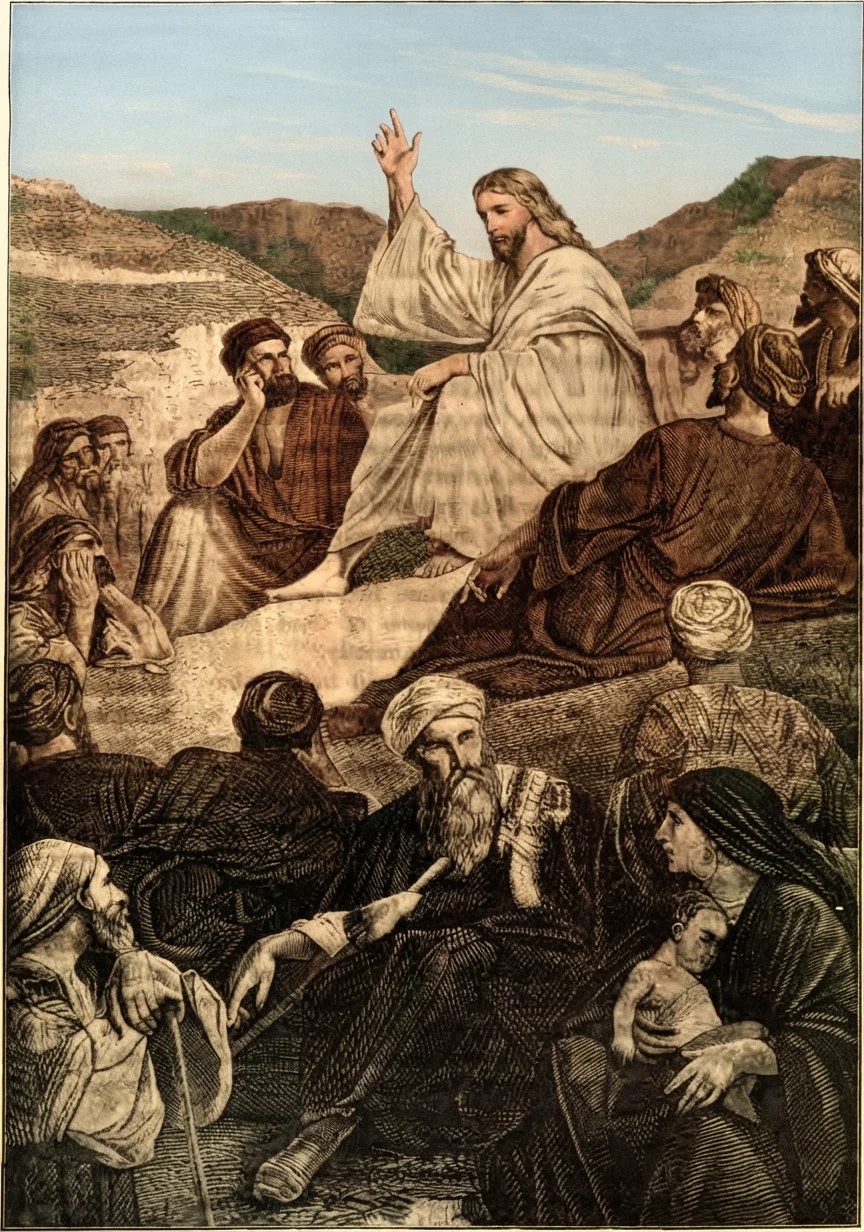
THE SERMON ON THE MOUNT
"Ask, and it shall be given you; seek, and ye shall find; knock, and it shall be opened unto you."
To leave no chance for unbelief, misunderstanding, or misinterpretation of His words, the Lord repeats the thrice-given promise. He longs to have those who would seek after God, believe in Him who is able to do all things. Therefore He adds, "For every one that asketh receiveth; and he that seeketh findeth; and to him that knocketh it shall be opened."

Our Great Argument

The Lord specifies no conditions except that you will hunger for His mercy, desire His counsel, and long for His love. "Ask." The asking makes it manifest that you realize your necessity; and if you ask in faith, you will receive. The Lord has pledged His word, and it can not fail. If you come with true contrition, you need not feel that you are presumptuous in asking for what the Lord has promised. When you ask for the blessings you need, that you may perfect a character after Christ's likeness, the Lord assures you that you are asking according to a promise that will be verified. That you feel and know you are a sinner is sufficient ground for asking for His mercy and compassion. The condition upon which you may come to God is not that you shall be holy, but that you desire Him to cleanse you from all sin, and purify you from all iniquity. The argument that we may plead now and ever is our great need, our utterly helpless state, that makes Him and His redeeming power a necessity.
"Seek." Desire not merely His blessing, but Himself. "Acquaint now thyself with Him, and be at peace." Seek, and you shall find. God is seeking you, and the very desire you feel to come to Him, is but the drawing of His Spirit. Yield to that drawing. Christ is pleading the cause of the tempted, the erring, and the faithless. He is seeking to lift them into companionship with Himself. "If thou seek Him, He will be found of thee."

He Waits to Welcome

"Knock." We come to God by special invitation, and He waits to welcome us to His audience-chamber. The first disciples who followed Jesus were not satisfied with a hurried conversation with Him by the way; they said, "Rabbi, where dwellest Thou? . . . They came and saw where He dwelt, and abode with Him that day." So we may be admitted to closest intimacy and communion with God. "He that dwelleth in the secret place of the Most High shall abide under the shadow of the Almighty." Let those who desire the blessing of God, knock and wait at the door of mercy with firm assurance, saying, For Thou, O Lord, hast said, "Every one that asketh receiveth; and he that seeketh findeth, and to him that knocketh it shall be opened."
Jesus looked upon those who were assembled to hear His words, and earnestly desired that the great multitude might appreciate the mercy and loving-kindness of God. As an illustration of their need, and of God's willingness to give, He presents before them a hungry child asking his earthly parent for bread. "What man is there of you," He said, "whom if his son ask bread, will he give him a stone?" He appeals to the tender, natural affection of a parent for his child, and then says, "If ye then, being evil, know how to give good gifts unto your children; how much more shall your Father which is in heaven give good things to them that ask Him?" No man with a father's heart would turn from his son who is hungry and is asking for bread. Would they think him capable of trifling with his child, of tantalizing him by raising his expectations only to disappoint him? Would he promise to give him good and nourishing food, and then give him a stone? And should any one dishonor God by imagining that He would not respond to the appeals of His children?

The Greatest of All Gifts

If ye, then, being human and evil, "know how to give good gifts unto your children, how much more shall your heavenly Father give the Holy Spirit to them that ask Him?" The Holy Spirit, the representative of Himself, is the greatest of all gifts. All "good things" are comprised in this.Nothing greater, nothing better. When we beseech the Lord to pity us in our distress, and to guide us by His Holy Spirit, He will never turn away our prayer. It is possible even for a parent to turn away from his hungry child, but God can never reject the cry of the needy and longing heart. With what wonderful tenderness He has described His love! To those who in days of darkness feel that God is unmindful of them, this is the message from the Father's heart: "Zion said, The Lord hath forsaken me, and my Lord hath forgotten me. Can a woman forget her sucking child, that she should not have compassion on the son of her womb? yea, they may forget, yet will I not forget thee. Behold, I have graven thee upon the palms of My hands."
Every promise in the word of God furnishes us with subject-matter for prayer, presenting the pledged word of Jehovah as our assurance. Whatever spiritual blessing we need, it is our privilege to claim through Jesus. We may tell the Lord, with the simplicity of a child, exactly what we need. We may state to Him our temporal matters, asking Him for bread and raiment as well as for the Bread of Life and the robe of Christ's righteousness. Your heavenly Father knows that you have need of all these things, and you are invited to ask Him concerning them. It is through the name of Jesus that every favor is received. God will honor that name, and will supply your necessities from the riches of His liberality.
But do not forget that in coming to God as a father, you acknowledge your relation to Him as a child. You not only trust His goodness, but in all things yield to His will, knowing that His love is changeless. You give yourself to do His work. It was to those whom He had bidden to seek first the kingdom of God and His righteousness that Jesus gave the promise, "Ask, and ye shall receive."
The gifts of Him who has all power in heaven and earth are in store for the children of God. Gifts so precious that they come to us through the costly sacrifice of the Redeemer's blood; gifts that will satisfy the deepest craving of the heart; gifts lasting as eternity, will be received and enjoyed by all who will come to God as little children. Take God's promises as your own, plead them before Him as His own words, and you will receive fulness of joy.

The Spirit World and a Future Life

III. Development of Modern Spiritualism and Its Diverse Modes of Manifestation

WHAT is known as modern Spiritualism had its public beginning, as all well-informed persons know, in Hydesville, a small town in New York State, in 1848. In March of that year, Kate Fox, a nine-year-old girl in the family of a farmer at Hydesville, made the astounding assertion that she was in communion with the spirits of the dead. Considerable time elapsed before her skeptical, matter-of-fact parents were convinced that the mysterious rappings with which the household were annoyed, were directed by any intelligence. The signals, however, were soon construed into a spirit message to the effect that "a murdered man was buried in the cellar of the house, and indicated the exact spot in the cellar under which the body lay; and upon digging there, at a depth of six or seven feet, considerable portions of a human skeleton were found. Yet more, the name of the murdered man was given, and it was ascertained that such a person had visited that very house five years before, and had never been heard of since." The message further declared that the murdered man was the signaler; and as all the witnesses satisfied themselves that the signals were not made by any living person or by any assignable agency, they logically concluded that it was the spirit of the murdered man, "however improbable and absurd that might seem."

Its Rapid Development

Margaret Fox, Kate's sister, soon developed the same occult power. The fame of the two sisters was rapidly noised abroad. Skeptical neighbors came, saw, and were convinced. Soon after, the sisters visited Rochester. The report of their marvelous doings had preceded them. Sneering accusations of imposture were quietly answered with a readiness to undergo the most rigid tests that the skeptics could devise. Three successive committees, consisting of intelligent, hard-headed citizens, were appointed; they thoroly examined the phenomena, and arrived at the unanimous conclusion that the phenomena were supernormal. Respecting the third of these committees, Alfred Russell Wallace writes: "The last and most skeptical committee reported that they had heard sounds, and failed utterly to discover their origin. They had proved that neither machinery nor imposture had been used; and their questions, many of them being mental, were answered correctly."
This cryptic power proved to be infectious. It was imparted spontaneously to many of those with whom the sisters came in contact. A married sister of the Fox girls, Mrs. Fish, was the first to acquire the new gift. A large number of incipient psychics was developed at Auburn, as a result of a visit to that city by Kate Fox. The movement spread like a prairie fire.
In the course of a few years these mystic rappings were propagated throughout the greater part of the Eastern section of the United States. In 1851, a correspondent of the Spiritual World estimated that there were fifty or sixty "private circles" in Philadelphia and not fewer than a hundred mediums in New York City.
Skeptics as to the genuineness of spiritistic phenomena frequently refer to the fact that Kate Fox once made what purported

Contemptuous Opposition of Scientists

Of course these esoteric marvels soon appealed to the cupidity of shrewd rascals, who possessed the diabolic penetration that enabled them to descry a potential Eldorado. Hence a multitude of charlatans—swindling clairvoyants, thievish fortune-tellers, and shabby boarding-house "mediums"—began to imitate these mysterious phenomena, seeking to wheedle away the money and brains of countless easily duped men and women. As a consequence, Spiritualism soon became so malodorous that for many years scientists ignored it with contempt and scorn; much less would they consent to investigate its pretensions.
To afford some idea of the virulence of this opposition of the science world of the middle-nineteenth century, I shall adduce a few statements from some of the most eminent scientists of that time. Thus Darwin exclaimed: "The Lord have mercy upon us all if we have to believe in such rubbish! It is all imposture." Faraday declared: "The system of education that could leave the mental condition of the public body in the state in which this subject [Spiritualism] has found it must have been greatly deficient in some very important principle. This wide-spread superstition, at this day of boasted progress, is a disgrace to the age and affords astonishing proofs of the vast flood of ignorance overflowing and desolating the higher places." He felt convinced "that these reputed spiritualistic phenomena were only worthy of the scorn or pity of all intelligent persons." Tyndall summed up his opinion of believers in Spiritualism in these words: "The drugged soul is beyond the reach of reason; surely no baser delusion ever gained dominance over the mind of man." Goldwin Smith, who is still living, in a letter to the New York Sun wrote: "There is no place for the supernatural. . . . To ghosts and apparitions of all kinds, Spiritualism included, we bid a longfarewell." Even in our day President G. Stanley Hall, of Clark University, writes: "Every one who has had a hard bump on his head may see sparks, but this would not make the sparks real. . . . Spiritism in its cruder forms is the very sewage of all the superstition of the ages." As we shall see in a later article, many of these vitriolic strictures on spiritistic phenomena are true, but not always in the sense in which these noted thinkers deemed them true.
But it was not only the hideous imposture and the rank rascality that attached themselves to the spiritualistic movement, which repelled scientists. They saw clearly that science had no explanation for these alleged supernormal wonders. So they conveniently denied that they ever occurred.

The Reaction, and the Society for Psychical Research
"Yet the more thoughtful, as the century drew near its close," says Fremont Rider, "argued that where so much smoke was there must be a little fire." Multitudes of people were insisting that they had seen tables and other ponderable objects, and even human beings, levitated, and float in the air; that they had heard closed pianos which were six feet or more beyond the reach of any living person, played skilfully; and that they were continually receiving messages from friends who had died. Not a few respectable men and women, contrary to their expectation and practical judgment, declared that they had received telepathic messages. These were facts that science, in the opinion of many of its leaders, could no longer taboo and ignore.
Accordingly, the now famous Society for Psychical Research was organized in England in 1882. The first president of the Society was Prof. Henry Sedgwick, of Cambridge University, one of the greatest writers on ethics of the past century. Among the vice-presidents were Prof. Balfour Stewart, eminent in science; Mr. R. H. Hutton, editor of the London Spectator; Mr. Edmund Gurney, who died in the thick of his work; Dr. F. W. H. Myers, whose name became famous the world over, as a student of, and writer on, spiritistic phenomena. Two other original vice-presidents still occupy their position—these are the Hon. A. J. Balfour, one of the famous names in English political life; and Prof. W. F. Barrett, of Dublin University.
An American branch of the same Society was organized in 1885. The American Society comprised such learned men as Prof. William James, and Professor Royce, of Harvard University; Prof. J. H. Hyslop, of Columbia University; the Rev. Dr. M. J. Savage, and so on. Soon after, the Society extended its organization into England and Italy. The Hon. W. E. Gladstone was made an honorary member of the Society. Concerning the work of the Society, Mr. Gladstone said: "It is the most important work that is being done in the world—by far the most important." Other men of renown, who threw themselves enthusiastically into the work of "psychical research," are Sir Oliver Lodge, one of the greatest of English physicists; Sir William Crookes, F.R.S., president of the British Association for the Advancement of Science; Alfred Russell Wallace, famous as a writer on diverse scientific subjects; William T. Stead, one of the greatest of living journalists; Archdeacon Colley, a leading intellectual light of the Anglican church; Camille Flammarion, the most celebrated living astronomer in France; Victorien Sardou, the noted French dramatist; Dr. Charles Richet, the greatest authority on medicine in France; Dr. Pio Foa, Professor of Pathological Anatomy at the University of Turin; Cesare Lombroso, Professor of Psychiatry at the University of Turin; and Dr. V. Maxwell, another distinguished French scientist.
England's Veteran Editor, Wm. T. Stead
Only yesterday the scientific world was contemptuously skeptical of everything that smacked of mysticism, spiritism, and the like. To-day, it can be truly said that never before was the world of science so ghost-ridden. Never before did it turn so wistfully to the occult. Never before did it listen so painfully at the sealed door of the tomb, behind which mysterious silences reign. Mr. Vance Thompson not long since said piquantly: "The ghosts that haunt the societies for psychical research have taken on a scientific air. They walk no more in windy corridors, clanking spectral chains; but in a practical, modern way they exhibit themselves to scientific congresses." Yes, the world over, psychical phenomena are being studied by thoroly trained scientists. Science, then, has reached the point where it no longer ignores the supersensible, spiritistic world. It no longer denies the apparition of "spirits," it seeks to account for them. Their labors range from the study of hysteria, of hypnosis, and the transmission of psychic forces, to the world-old mysteries of enchantment and apparitions.
With very few exceptions, these scholars and scientists began their psychical researches as confirmed skeptics, firmly believing the alleged phenomena to be the result either of fraud or of hallucination or of involuntary muscular action. They believed that they could swiftly prove to a demonstration that one or more of these hypotheses constituted the explanation of the phenomena. But they soon discovered their mistake. The uncanny wonders refused to be explained away. They were realities which the trained investigators could in no honest way deny.
Many of them, after protracted investigation, made the following admission: "It was only by irresistible evidence, under conditions that precluded the possibility of either of the above-named solutions, and after trial and test many times repeated, that we were slowly and reluctantly convinced that the phenomena exhibited in the course of our inquiry were veritable facts." Again: "After trials often repeated we were compelled to confess that imposture was out of the question."

Some of the Actual Results

After more than a quarter-century of painstaking, scientific investigation of all sorts of occult phenomena, the Society unanimously reports that the reality of the following supersensible phenomena has been definitely proved:
  1. Telepathy, the power to communicate thought across either limited or infinite space, independently of the physical senses; sometimes called mind-reading.
  2. Clairvoyance, the ability to see independently of the eye or physical organ of vision; the power that reads the sealed letter or the document hidden in the black heart of an iron safe.
  3. Clairaudience, the corresponding ability to hear subjectively, or independently, of the physical organ of hearing.
  4. Telekinesis, the power to move material objects without visible or tangible contact; as, for example, moving or levitating chairs, tables, or other objects, when at a distance from them. (Levitation in its strictest meaning signifies the raising or otherwise moving human bodies by supersensible agencies.)
  5. Materialization, the appearance of spirits in objective form, visible not only to the psychic, but also to the non-psychic.
  6. Prevision, the power mentally to penetrate time either in the direction of the past or more rarely in that of the future. In former case it is the power supernormally to know what has happened in the past; in the latter, to foretell future happenings.
  7. Automatic writing and automatic speaking.
As to the present conviction of these learned investigators respecting the bearing of their researches upon the question of the survival of human personality after death, must be told in a future article.

What Brings Revivals?

A REVIVAL of religion may be expected when Christians begin to confess their sins to one another. At other times they confess in a general manner, as if they were only half in earnest. They may do it in eloquent language, but it does not mean anything. But when there is an ingenuous breaking down, and a pouring out of the heart in making confession of their sins, the floodgates will soon burst open, and salvation will flow over the place.—Charles G. Finney.
Continue reading: The Great Threefold Message