Even now the leaven of evil is working in confederations and trusts.
Liberty
“ALL men are created equal,” reads the great American Declaration of Independence. It is not designed to convey the idea that all are of equal weight or size or strength or mental capacity. Its meaning is that all are created equal as regards the rights God has given, and entitled to the free exercise and enjoyment of those rights. “They are endowed by their Creator,” reads the great document, “with certain inalienable rights; that among these are life, liberty, and the pursuit of happiness.” In respect to these inalienable, or natural, rights, men are equal. Man can not be justly deprived of them, nor has he any right to barter them away. They are his from God, and all just government will protect him in their proper exercise. Upon this foundation principle the glories and blessings of this government were founded.
The truth of human equality is not new. Nor was it new a century and a third ago, tho then first for a long time definitely stated. It is a divine truth as old as Deity, and is always due when there are men among whom it should be operative. Yet how little has the world known concerning it! Man has lorded it over his fellows. The people have been divided between the nobility and serfs, the classes and masses, the masters and servants. The same domineering spirit has been manifest in all world religions. There have been lords many and gods many, with a constituted hierarchy graded all the way down to the “common people.” But this is not God’s plan. This tyrannical system has been manifest among God’s professed people, but it is not of the Gospel of Jesus Christ.
“Proclaim Liberty”
It was a strange voice to Jew and Gentile, that trumpet-toned proclamation sounded out in Judea three and one-half millenniums ago, every half century, “Proclaim liberty throughout all the land unto all the inhabitants thereof.” Lev. 25:10. It was not a declaration of independence on the part of the people; it was God’s proclamation in their behalf in an age when men were ground between the upper and nether millstones of civil tyranny and lordly hierarchies, and it was even thought right to enslave one’s own kindred. Yet the Lord had said: “For the Lord your God regardeth not persons, nor taketh reward; He . . . loveth the stranger.” Deut. 10:17, 18. “For there is no iniquity with the Lord our God, nor respect of persons.” 2 Chron. 19:7. And the Idumean emir, speaking of those who served him, said, “Did not He that made me in the womb make him? and did not One fashion us?”
Freedom was unknown among the nations, either religiously or civilly. Religion was a state affair, subject to the civil power. God’s own people were not prepared for the fullest freedom, yet the laws among them regarding human rights and freedom were greatly superior to the best of the nations around them. God was giving them every measure of freedom possible and consistent with their condition. They knew but little of the liberty vouchsafed them through the centuries following, because of their bondage to sin and transgression. He who is in the bondage of sin makes often the worst tyrant if he has the power. But whether the people knew it or not, God gave them the principles of the greatest freedom.
After centuries of dry, dead formalism, the Lord Jesus Christ uttered again the same blessed principle in this form: “If any man hear My words, and believe not, I judge him not; for I came not to judge the world, but to save the world.” John 12:47.
Man was given the right to believe or disbelieve, to receive or reject. Surely Christ’s followers must grant the same liberty to all who reject their ministrations. He said that all judgment, all condemnation, was to be left to “the last day.” Verse 48. Have His followers the right to judge now?
God and Cæsar
More than this: Jesus Christ laid down a principle which draws a distinct line between the duty which we owe to civil government and the duty which we owe to God. When asked whether it was lawful or not to pay tribute to Cæsar, He said: “Show Me the tribute money. And they brought unto Him a penny [a Roman denarius]. And He said unto them, Whose is this image and superscription? They say unto Him, Cæsar’s. Then saith He unto them, Render therefore unto Cæsar the things which are Cæsar’s, and unto God the things that are God’s.”Matt. 22:16-22.
Here is divine guidance for all concerning all requirements. Whose image? what stamp has it? Whose is the superscription? Is it God’s?—Then it belongs to Him. Is it Cæsar’s?—Then it belongs to him.
Take, for instance, the question of the Sabbath, over which legislators have been troubled for years. Whose superscription has the Sabbath? It is not a hard question as revealed by the Sabbath law, “Remember the Sabbath day to keep it holy. . . . The seventh day is the Sabbath of Jehovah thy God.” See Ex. 20:8-11. The Sabbath bears the superscription of the great Jehovah, the Creator of heaven and earth; render it to Him, Cæsar has naught to do with it. And God gives to man the free choice of observing the day or not; the Judge of all leaves to the last day the sentence. Surely He has given no commission to His servants to condemn men or to execute sentence before that great day of assize shall come.
Of Our Blood
The reason of the equality of man lies in the fact that all are creatures of the same God, on the same general plan. “The rich and poor meet together,” says the wise man, “the Lord is the Maker of them all.” “Did not One fashion us?” says Job. But the New Testament puts it stronger still; “God that made the world . . . hath made of one blood all nations of men for to dwell on all the face of the earth.” Acts 17:24-26. And the Son of God says, “One is your Master, even Christ; and all ye are brethren.” Matt. 23:8. Thus in express terms the Gospel of God affirms the absolute equality of man as regards his rights to life, liberty, and the pursuit of happiness. This does not mean that government is to be despised, or authority of rulers ignored; not at all. In a just government every natural right of man is protected and conserved, not because the individual is stronger but because the rights of one are the rights of each and all; and the just government will protect the rights of the weakest; in fact, it is that purpose for which it is ordained.
The equality of man, proclaimed in the Gospel of the Lord Jesus Christ, came as a boon of life and hope. “The poor have the Gospel preached unto them,” was the joyful6cry. Priest-ridden and oppressed, thousands took heart. The spiritual slave of superstitious rites, galled by the iron chains of priestly tyranny, bowed by the heavy burden of human traditions, lifted his head, and with gladdened heart rejoiced that God recognized him and his rights. True, the supercilious wise men, the tyrannous priesthood, and the self-constituted masters in religion, spurned the glad message which broke their galling yoke and severed their chains, but the poor rejoiced and went free in the blessed freedom of the Gospel.
The freedom of the Gospel took hold upon the hearts and minds of men in civil government, notably as the times of the Reformation broke upon the world. In Switzerland, in Germany, but more especially in England, the centuries-old wails of tyranny broke into battle-cries for freedom. Spiritual tyranny was broken. A man became better than a sheep. Men could speak for freedom without waiting expectant for the yawning prison, the ready headsman, the creaking rack, or the burning pyre. The fruitage of the years of travail was the great Republic of the West; American freedom was the result of the liberty of Christ’s Gospel upon Anglo-Saxon hearts.
A Fact of Prophecy
The Christian religion of all religions embraced in its principles the absolute equality of man. The American Republic alone, among all governments, embraced in its principles the same—the equality of man in the exercise of inalienable rights; the free and individual choice of man respecting religion. This great fact is set forth in the symbolical prophecy of the Book as a beast having two horns like a lamb, the lamb being the symbol of Christ Jesus. See Rev. 13:11; 5:6. Blessed, beneficent, freedom-bestowing and life-giving have been those principles in exercise. Blessed it would be if they continued forever. But the same “sure word of prophecy” declares that the lamb-horned beast shall develop a dragon voice and follow in the pathway of its predecessors in the persecution of men for conscience’ sake. Even now the leaven of evil is working in confederations, societies, trusts, formed ostensibly for bettering the condition of men, but which will result in binding the consciences of men.
The Theocracy of Israel
By George E. Langdon
Is It a Model for Modern Governments?
By George E. Langdon
The Theocracy of Israel
THE word “Theocracy” is derived from two Greek words, Theos, God, and krateo, rule; meaning a government of God; a true example of which is found in the early history of Israel.
There are religious bodies who are very arduous in their efforts to influence our legislators to enact laws enforcing religious observances under heavy penalties by the stern arm of civil law. When remonstrated with, that enforcement of religion is not in the purview of civil government, these religio-political reformers immediately fly to the Theocracy of Israel, thinking that to be an example and proof for enforcing religion by law to-day. It will be interesting to investigate the subject for help in deciding whether the position is sound or not.
A true theocracy is a government in which God alone frames the laws, interprets the same, and pronounces the penalties. He is the sole legislator. Thus, and only thus, can there be a government combining under one head, or rule, both moral and civil enactments.
The constitution of Israel was summarily contained in the Ten Commandments, written and spoken by Jehovah, and pronounced “the whole duty of man.” The specific moral and civil statutes growing out of this law, with the penalties for violations, were revealed to Moses from heaven, and chronicled by him in the “book of the law.” This book contained the divine interpretations of the law. That was truly a government of God. In no case in a theocracy is it in the province of man to enact laws, interpret them, or to attach penalties thereto. The province of the Hebrew rulers was only to enforce the laws God had given. One writer has truly said:
“The government of Israel was administered in the name and by the authority of God. The work of Moses, of the seventy elders, of the rulers and judges, was simply to enforce the laws that God had given; they had no authority to legislate for the nation. This was, and continued to be, the condition of Israel’s existence as a nation. From age to age, men inspired by God were sent to instruct the people, and to direct the enforcement of the laws.”—“Patriarchs and Prophets,” chap. 59, par. 1.
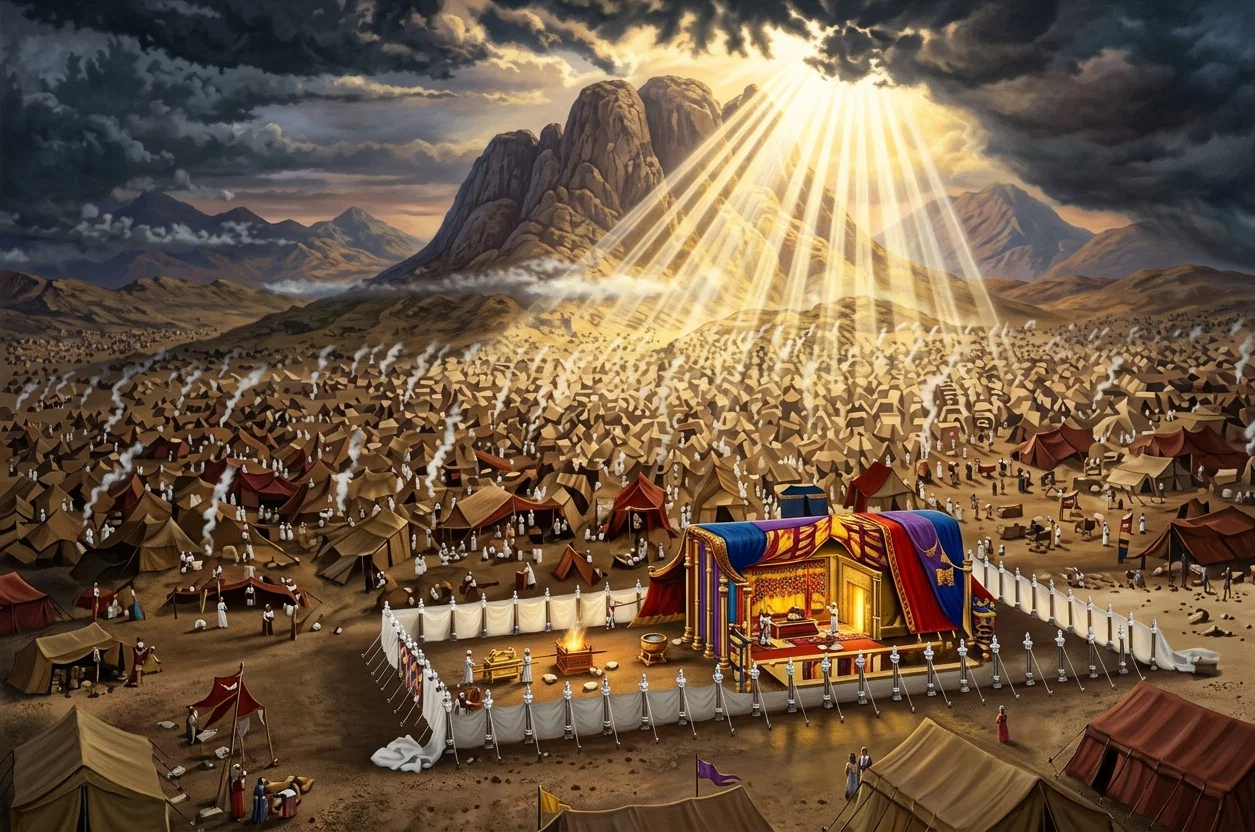
This government was completed with Israel in the compact, or covenant, of Jehovah and recorded in Ex. 19:5-9. Being under the immediate supervision of the Lord, in any case of doubt in its administration, the judges would put the offender in ward and the Lord would reveal the true situation, either by His prophets or by Urim and Thummim in the breastplate of the high priest. Lev. 24:11, 12; Num. 15:32-35. In this, no innocent person might suffer nor any unjust penalty be administered. This infallible precision in administration can not be found in any earthly government to-day.
The Coming in of the Kingdom
Israel desired a kingdom,—a kingdom like the nations about them,—but this did not change the principles of the Theocracy. The people still allowed the Lord to choose their kings. Altho it was contrary to the will of God, He permitted it. “The Lord foresaw that Israel would desire a king, but He did not consent to a change in the principles upon which the state was founded.” As full proof that the Theocracy did not end at this time, we read: “Solomon sat on the throne of the Lord, as king, instead of David his father.” 1 Chron. 29:23.
The succession to the throne descended in David’s line to Zedekiah who was made subject to Babylon in 588 B.C. Contrary to many writers, however, the Theocracy could not have ended with this overthrow of the kings. The Theocracy continued, but with many interruptions, till the time of Christ’s crucifixion. At that time Israel rejected the Messiah, their King and only hope, and delivered Him into the hands of Rome and declared —
“We Have No King but Cæsar.”
“Away with Him, crucify Him.” In this, Israel, as a nation, rejected the government of God, and He allowed the Romans to destroy their city and kingdom, and to scatter them to the four quarters of the earth. Jesus said, “Your house is left unto you desolate.” Since they had denied their King, He said: “But now is My kingdom not from hence.” “My kingdom is not of this world.” John 18:36. As another proof that the Theocracy did not cease until Christ’s time, we hear Him acknowledge Nicodemus as a ruler in Israel.
A Prophecy of Its Perversion
That the Theocracy continued until Christ’s time, is clearly shown in the words7of the Lord to Zedekiah (Eze. 21:25-27), when he was taken by the king of Babylon: “Thou profane and wicked prince of Israel, . . . remove the diadem and take off the crown.” This was done by Babylon in 588 B.C. The Lord continues: “I will overturn, overturn, overturn it.” This was fulfilled first by Medo-Persia, again by Grecia, and lastly by Rome to the finish, as an earthly kingdom, in A.D. 70 under Titus.
The word “overturn” is from the Hebrew aváh, literally, to crook; metaphorically, to bow down, trouble, or pervert (see margin), as a tree bowed down to the ground. The word does not have the meaning of destroy. It is very evident that a government to be three times overturned, or bowed down, must have had an existence during all that time. This is conclusive evidence that the Theocracy of Israel continued, in a varied existence, until Christ came and announced the principles of His kingdom which they rejected.
Zerubbabel and Nehemiah were selected by the Lord as governors who rebuilt and restored Jerusalem and governed under the theocracy of Israel. Another writer expresses the existence of the Theocracy in these words:
“Thus by choosing a heathen ruler, the Jewish nation had withdrawn from the Theocracy. They had rejected God as their king. Henceforth they had no deliverer. They had no king but Cæsar. To this the priests and teachers had led the people. For this, with the fearful results that followed, they were responsible. A nation’s sin and a nation’s ruin were due to the religious leaders.”
The text concludes, “It shall be no more, until He come whose right it is; and I will give it Him.” The One “whose right it is,” is Jesus. “The Lord shall give unto Him the throne of His father David; and He shall reign over the house of Jacob forever. Of His kingdom there shall be no end.” Luke 1:31-33. His kingdom is spiritual, and “not of this world.” Thus “the throne of the Lord,” or the true Theocracy, has been removed from the national world, and will be no more until Christ’s second coming, when all earthly kingdoms shall have an end and He shall set up His everlasting kingdom and rule forever.
Therefore, while this world stands, a true theocracy can never be erected in it again, therefore, every theory of an earthly theocracy is false, every pretension to it is false; and wherever any such theory is advocated, whether in Rome, New England or elsewhere, it puts man in the place of God and certainly can not be a model for modern governments.
Moral and Civil Government
Moral government and civil government are separate and distinct, the one from the other.
Moral government has to do with the conscience—the spiritual and moral rights of man. God has reserved this rule to Himself and can and does forgive the repentant offender; but He will punish the unrepentant offender in the last day. Matters of faith relate wholly to man and his Maker. He is the only One who can really read the convictions and motives of the heart.
Civil government has to do with natural rights between man and man, such as the protection of life, property, and chastity and reputation, which is necessary to the “pursuit of happiness.” The protection of natural rights between man and man, God has ordained as the rightful rule of man in civil government (Rom. 13:1-10), with which our own nation’s most beneficent Constitution accords.
When civil government steps beyond God’s ordination and seeks to grasp the prerogative to rule which He has reserved to Himself, and attempts to bind the consciences of men by legislating in matters of faith, it thereby places man above God, which The Word instructs us is antichrist. Further it is a union of church and state, and entirely obliterates the dividing line between moral and civil law so clearly defined by our divine Master, “Render therefore unto Cæsar [civil government] the things that are Cæsar’s, and unto God the things that are God’s.”
Result of Perversion
The matter of worship is due alone to God: “Thou shalt worship the Lord thy God and Him only shalt thou serve.” The Sabbath is the Lord’s,—I am “Lord of the Sabbath;” and is spiritual—“My holy day.” Therefore, any attempt to legislate upon a rest day in any form, or upon baptism, or any other forms of religion, tho in themselves right and just, would be wicked, unchristian, and uncivil. In the case of the exaltation of a false institution, which is always the case in religious legislation, immediate persecution would follow those who remained loyal to God and dared to say, “We ought to obey God rather than man.”
The protection of life, property, character, and liberty, both civil and religious, belongs to civil government. It should protect man in matters of faith, but not compel therein. Civil government is a compact between man and man to compel men to be civil who do not regard the equal rights of their fellow men, but it can not compel them to be religious.
And so, friends and countrymen, let our prayers ever ascend to the Father of life and liberty on behalf of our civil rulers, that they may remember the principles of our divine Master, to “keep the church and the state forever separate” in matters of religion, and not to confound morality—our duty to God—with civility—our duty to our fellow men.
Education Begins at Home
EDUCATION begins with a mother's look, with a father's nod of approbation or a sign of reproof; with a sister's gentle pressure of the hand, or a brother's noble act of forbearance; with handfuls of flowers in green dells, or hills and daisy meadows; with birds' nests admired, but not touched; with creeping ants and almost imperceptible emmets; with humming bees and glass beehives; with pleasant walks, with shady lanes, and with thoughts directed in sweet and kindly tones and words to nature, to beauty, to acts of benevolence, to deeds of kindness, and to the source of all good — to God Himself.— Selected.
Liberty—Choice
1. What is the Gospel invitation?
“If any man would come after Me, let him deny himself, and take up his cross, and follow Me.” Matt. 16:24.
2. How is this received by many?
“Ye will not come to Me, that ye may have life.” John 5:40.
3. How is this rejection treated by Christ?
“Think not that I will accuse you to the Father.” John 5:45.
“If any man hear My sayings, and keep them not, I judge him not: for I am not come to judge the world, but to save the world.” John 12:47.
4. How does God Himself treat the offender?
“As they refused to have God in their knowledge, God gave them up to a reprobate mind, to do those things which are not fitting.” Rom. 1:28.
5. What can be said of the man who pronounces judgment upon a sinner?
“Wherefore thou art without excuse, O man, whosoever thou art that judgest.” Rom. 2:1.
6. By what is every man judged?
“There is one that accuseth you, even Moses”—through the law. John 5:45.
“He that rejecteth Me, and receiveth not My sayings, hath one that judgeth him: the word that I spake [the law, through Moses], the same shall judge him in the last day.” John 12:48.
NOTE.—The fact that God never uses compulsion in His dealings with man has been demonstrated through all ages. Man in the Garden chose his own course of his own free will, knowing the command of God and the result of both courses. Noah preached a message of salvation to the antediluvians; all who accepted were saved; all who rejected the message were lost; not one was forced to enter the ark. When Moses led the children of Israel out of Egypt, every one was free to go or stay as he chose; of those who did start to the promised land, thousands through unbelief died by the way—God would not lead them into Canaan against their own wills. The message of the prophets was always of invitation and never of compulsion. Christ’s own way was the same—Come, come, come—“whosoever will, let him come.”
7. Has man any right to judge of one’s relation with his God, or to legislate upon it?
None whatever; the Creator of all is Judge of all; He alone is able to execute judgment. Jesus said, “He that rejecteth Me rejecteth Him that sent Me.” It is not man’s right or duty to interfere.
8. What is the test as to man’s duty to God and to the state?
“Jesus said unto them, Render unto Cæsar the things that are Cæsar’s, and unto God the things that are God’s.” Mark 12:17.
Shine To-day
By Max Hill
TO-MORROW I shall be prepared
To work at tasks too hard to-day;
The burdens other souls have shared
I then shall bravely bear away.
But let me not put off till then
The cheering word that I can say;
I shall not pass this way again,
So let me truly shine to-day.
Just where I am to shine and glow,
To cheer some pilgrim on the way;
To make some brother here below
A braver soldier for the fray.
It is not much that I can do,
It is not much that I can say;
But I can be a helper true
If I but truly shine to-day.
MAX HILL.
A Little Child’s Lesson
By Metcalfe
A LITTLE child came into our lives to teach us the way to love, to show us the way to live, and to tell us the way to die.— Metcalfe.
What Would the Authorities Do?
In various parts of the United States and Canada men have been prosecuted, generally at the instigation of professed Christians, for working on Sunday and observing the Sabbath of the Lord. When Jesus Christ was upon earth, He did the same thing. He rested the seventh day; He wrought the first day. If He were here now, He would do the same; for He is “the same yesterday, to-day, and forever.” What would the authorities do?—Logically, they would be forced to prosecute Him. But are they not doing that very thing now when they prosecute even the least disciple who follows Him? These are important questions. “Inasmuch,” He says, “as ye have done it unto one of the least of these My brethren, ye have done it unto Me.”
From the Consent of the Governed
By T.
THE Declaration of Independence speaks of certain “truths” that are “self-evident.” The two great truths that are thus mentioned are “that all men are created equal” and “that they are endowed by their Creator with certain inalienable rights.”
Following this utterance concerning “self-evident” “truths” is the brief but clear and comprehensive statement of the view held by the fathers of the Republic concerning the duties and powers of governments. They tell us “that to secure these rights, governments are instituted among men, deriving their just powers from the consent of the governed.”
When that wonderful declaration was made, saying that governments derive “their just powers from the consent of the governed,” it was in the face of darkest difficulties. A few men in the Old World had begun to see some of the glimmerings of the light of this great truth; but they hardly dared to breathe it in a whisper. The doctrine that kings ruled by divine right, had been so stoutly taught that the people dared not express the thought that the powers of rulers must be prescribed by those over whom they rule.
But the desire for liberty, so divinely planted, had become so strong in the breasts of the fathers of the Republic that they could no longer suppress the great principles that had set their souls on fire. They believed in their hearts that their Creator had endowed them with certain inalienable rights, and so they boldly proclaimed to the combined monarchies of the Old World that governments derive “their just powers from the consent of the governed.” They did not disavow the fact that “the powers that be are ordained of God;” but rather did they rise to the great demands of the time and affirm the “self-evident” truth that these powers are ordained to inhere in the people, and not to be held by a despot whose absolute powers fill him with all the evils of an unbridled tyranny.
The foregoing statement that this new doctrine of independence—the doctrine that the governed are to give their consent to the governing power—was made advisedly. Not only among the people of England, but among the peoples of continental Europe as well, was the doctrine of freedom spreading. Men here and there for several generations, had stood in the face of death while they showed the bitter and distressing effects of tyranny, and the fallacy of the doctrine of the divine appointment of hereditary and aristocratic rulers. It is true that God has frequently wrought through kings who were despotic and even tyrannical. But it was on the principle expressed in His word, “Surely the wrath of man shall praise Thee; the remainder of wrath shalt Thou restrain.” Ps. 76:10. It has been eternally true that “He shall cut off the spirit of princes; He is terrible to the kings of the earth.” Verse 12.
The tyranny that was in the state, and that called forth that immortal and splendidly glorious declaration of the fathers of the Republic on that never-to-be-forgotten Fourth of July in 1776, was built up and fostered by the crueler and more bigoted tyranny that was in the apostatized church. The ideas that God has ordained bishops and priests to lord it over the church, and kings and nobles, over the state, go hand in hand, and both owe their origin to the prince of the spirits of evil. The famous protest of the Reformation at Spires sounded the death-knell of this tyranny in the church, and the Declaration of Independence proclaimed its doom in the state. Protestantism laid the foundation for freedom, not only in the church, but also in the state. T.
A Rock of Offense
By R.
CHRIST is called a “Stone of stumbling and a Rock of offense.” This is because the acceptance of Christ requires the denial of everything that is pleasing to the natural heart. But this same Stone is the Foundation-rock of Ages. There is no other foundation on which life can be built to endure. The stone cut out of the mountain without hands is represented as destroying all the nations that are antagonistic to the kingdom of God. One must either fall upon that Rock and be broken, he must accept Christ and build his life’s structure upon this Rock, or the word is that the Rock will fall and grind him to powder.9
The kingdom of God will be established, but it can be established only by the destruction of every particle of opposition, and that it will fully destroy all sin and evil is well represented by the expression: “It shall grind him to powder.” In the vision of the prophet Daniel the particles of the image representing the nations were broken in pieces by the stone that smote the image upon the feet, and in the destruction of this image it became as “the chaff of the summer thrashing-floor; and the wind carried them away, that no place was found for them.”
While Christ is a Rock of offense to those who choose the evil way, yet it is most unfortunate for any one to take this view of the case. “Blessed is he,” says Christ, “whosoever is not offended in Me.” The only real blessedness or happiness or success comes in finding Christ’s way our way, and there never can be any real happiness, true blessedness, in a course or determination which makes Christ an offender. There is no reason for offense. The offense, if any, is due to the unreasonable attitude of humanity, for great peace have they that love God’s law, and nothing shall offend them.
Judgment may be convinced. We may see that the claims of Christ are proper, but with the revelation of the Christ comes always the revelation of our sin. We can not keep our sin and obtain Him also. We can not follow His way and our own sinful way. And so the final decision in all cases as to whether we shall accept the way of Christ or not depends merely upon whether we are willing to give up our sin or not. We may reason and argue and explain, but the kingdom of God and the great plans of God will go on to work out their destined and blessed results for all those who accept, and their strange and inexorable effects upon those who oppose.
R.
Legalism
It comes with an ill grace for those who believe in keeping a day for a sabbath not enjoined in the Bible, and are asking for human law to enforce it, to accuse those who observe the Sabbath of the Bible, the Sabbath kept by Jesus Christ, of “legalism,” or of being “sticklers for a day.” If Bible Sabbath-keepers had their choice of a day apart from Revelation, they would doubtless go with the majority; but the Lord has in His word, in the example of Jesus Christ, left them no option. The law is not theirs; it is God’s law. The Sabbath commandment is not theirs; it is God’s commandment. And “this is the love of God, that we keep His commandments; and His commandments are not grievous.” Is this “legalism”? If so, it is of the Gospel. But what does clinging to Sunday mean? And what should demanding a human Sunday law be called? Is it not akin to “legalism”?
Receiving and Giving
It is a law of spiritual growth that the receiver must be a giver. He who accepts God’s gifts in order to retain them must dispense them. He who attempts to get without giving will grow poor. He who hopes to gather without scattering will find poverty awaiting him. God blesses that we may bless. He gives of His own radiance, His own riches, His own life, that we may be lights to those in darkness, riches of grace to those in poverty, and may carry the bread and water of life to dying souls.
God imparts to us life, that we may live and grow and shed beauty, fragrance, and fruitage on other lives. He makes us righteous that we may do righteousness. And he who long lives contrary to the law of his spiritual being, constantly receiving and never giving, will become a spiritual dyspeptic, to die with spiritual heart disease. There should be many precious seasons of waiting on Christ, of drinking from the fountain, of feeding on the heavenly manna, but these seasons must be followed by active labor for Christ, by patient, faithful living, by godly words and deeds, by winning souls for Christ, if we would grow up into Christ, our living Head. “Give, and it shall be given unto you; good measure, pressed down, shaken together, running over, shall they give into your bosom. For with what measure ye mete, it shall be measured to you again.” This is God’s law of the abundant life for the Christian.
What Ought to Be
THE Constitution of the United States declares that “the powers not delegated to the United States by the Constitution, nor prohibited by it to the states, are reserved to the states respectively, or to the people.”
The same Federal Constitution declares of the Federal Government that “Congress shall make no law respecting an establishment of religion, or prohibiting the free exercise thereof.” It is, therefore, evident that the power to establish religion is reserved to the states and to the people; but as religion is a personal matter between the individual and God, the matter of its establishment or prohibition ought forever to be prohibited to the states by the people, and be reserved forever to the people as individuals. We wish it could be, for it is a right which ought to be recognized. But will the people do this? Will the people have sufficient regard for their own rights, for others’ rights, to demand this recognition?