Your ShelfYour Projects

Signs of the Times, Vol. 39, No. 7.

Above and Below
Earlier text: The Sweetness of Giving

Every Man His Work

By George O. States
I must work the works of Him that sent Me, while it is day: the night cometh, when no man can work. John 9:4.
THESE verses show that Christ came to do His work, that He had a special work to do, and had a limited time in which to do His work.
That is true of every one of us. "For the Son of Man is as a man taking a far journey, who left his house, and gave authority to his servants, and to every man his work." Mark 13:34. None are excused. Every person who accepts the Gospel of Christ must have some part, some place to fill, in the Gospel work.
By carefully studying the work of the disciples, we see that that was their experience also. "He first findeth his own brother Simon, and saith unto him, We have found the Messias, which is, being interpreted, the Christ. And he brought him to Jesus." John 1:41, 42. The very first thing Andrew did was to bring his brother to Christ. The real spirit of Christ is the spirit of labor; and as we become more and more imbued with the spirit of Christ, we are filled with a desire to labor for the salvation of others. All have some part to act; for if we desire to labor, we shall find some place, some niche to fill.
There is only an allotted time in which to work. Our days and opportunities are fast passing. Soon the time to help our fellow men will be over. Our chance for doing good to others is fast closing.
It is not the great things we do, but the object with which we labor. It is not worldly honor, the applause of men, but to save souls. Just a word spoken at the right time in the right way may change the course of a life.
During the first series of tent meetings I ever held, over twenty-seven years ago, as I was speaking one night on the near coming of Christ, I noticed a young lady with whom I was slightly acquainted, much impressed. After the meeting, as I shook hands with her, I said, "Don't you think you ought to be a Christian, and prepare for the coming of Christ?" Tears came to her eyes, and she replied, "I wish I knew just how to take hold and live a Christian life." Not many months after, as we organized a church in that place, I had the privilege of burying her with others in baptism, and I believe I shall meet her in the kingdom when God's people are gathered.
In laboring for the salvation of souls, our motives may not be understood, our work may not be appreciated. We may meet with rebuffs that will be very discouraging. Christ was not appreciated. "He was in the world, and the world was made by Him, and the world knew Him not." John 1:10. "If ye were of the world, the world would love his own: but because ye are not of the world, but I have chosen you out of the world, therefore the world hateth you." John 15:19. We must not expect any easier time in laboring for souls than Christ had.
I believe that in this work, the Lord gives us all the success that is for our good. If we have any success in affecting the minds of those for whom we labor, we should be conscious that it is not what we say or do, but is the result of being connected with Christ. If we realize this, there will be no danger of our becoming self-sufficient.
The question with all who labor in Gospel work is how to succeed, how to win souls to Christ. The first and most important consideration is our example, our home life. Do our family, those with whom we daily associate, have confidence in us? In Paul's charge to Timothy he said, "Be thou an example of the believers, in word, in conversation, in charity, in spirit, in faith, in purity." 1 Tim. 4:12. Thus we see that laborers in Gospel work must have a good influence. Having this we shall be "ready always to give an answer to every man that asketh you a reason of the hope that is in you with meekness and fear." 1 Peter 3:15.
In laboring in Gospel work, there will be no use of attempting to do anything unless God's truth is in the heart. Having this we shall follow the instruction given: "And the servant of the Lord must not strive; but be gentle unto all men, apt to teach, patient, in meekness instructing those that oppose themselves; if God peradventure will give them repentance to the acknowledging of the truth." 2 Tim. 2:24, 25. In laboring in that manner, there will be no danger of driving souls from Christ, for we shall realize that the man or woman who is out of Christ is under "the snare of Satan," and will instruct them in meekness, so as to recover them from his power.
In doing this, O, how much patience we need! In order to labor in this manner, we must have the spirit of Christ. I believe we could all profitably read Paul's counsel given to the elders of the church of Ephesus, as recorded in Acts 20:17-37.
It needs wisdom to labor acceptably in God's cause. "And they that be wise shall shine as the brightness of the firmament; and they that turn many to righteousness as the stars forever and ever." Dan. 12:3. "He shall see of the travail of His soul, and shall be satisfied." Isa. 53:11. The joy of Christ was in seeing souls saved, and His joy will not be complete until the work of redemption is finished.
It will be the same with every one of us. "His Lord said unto him, Well done, thou good and faithful servant: thou hast been faithful over a few things, I will make thee ruler over many things: enter thou into the joy of thy Lord." Matt. 25:21.

Power Divine

By John Francis Olmsted
Those blazing orbs in yonder sky Proclaim in silent speech The Mighty One who made them all, Who bears them up lest they should fall, And sways the course of each While, soaring on through boundless space, They onward swing each in its place, And wondrous wisdom teach.
Some men may doubt the mighty power Of Him who sees and knows, each hour, The many things we need; But He who guides each shining sun, Is able here to help the one Who would for pardon plead!
Columbus, Ohio.

Man a Prism of Divine Love

“God is love.” Godliness is God-likeness, to be like God. Godliness is the most profitable thing to obtain in this world. It is great gain, having promise of the life that now is, and also of that never-ending life which is to come.
Supreme love to God, and equal love to our fellow men, is godliness. God’s love shed abroad in the heart by the Holy Spirit, illuminating the mind, and the path of life, will constitute us prisms of divine love. All of the beautiful and blessed characteristics of divine love will be reflected by us upon all around us.
This is the light, coming to us from the Christ, the Sun of Righteousness, that will lighten the whole earth, before Jesus comes. This light of love is the light of righteousness, shining in and through His people, with which the Lord will cut short His work in the earth.
Sunlight is possessed of all the colors of the rainbow, and all the colors, tints, or hues of all the beautiful flowers of earth. More than thirty thousand different hues of color have been discovered. Likewise the sunlight of God’s love admits of reflection in all the versatile conditions of Christian life. Some of these most prominent characteristics we will consider.
1. PATIENCE.—Patience may be defined and recognized as love waiting to begin. When love is waiting to begin, it is always patient.
2. KINDNESS.—Kindness may be recognized and defined as love in action. When love is busily occupied in doing, it is always kind.
3. GENEROSITY.—Generosity is love in competition. In the works of love among men, the Christian is often brought into competition with others occupied in like manner, in a like work, and then true love will reveal generosity. It “envieth not.”
4. HUMILITY.—Humility is love hiding—not seeking, but rather shrinking from, praise. It “vaunteth not itself, is not puffed up.”
5. COURTESY.—Courtesy is love in etiquette. It does to others as it wishes to be done by.
6. UNSELFISHNESS.—It “seeketh not her own.” In doing business, love sacredly regards the rights of others, even at the sacrifice of convenience.
7. GOOD TEMPER.—“Not easily provoked,” says the apostle. It is love on trial.
8. FAITH.—“Believeth all things”—sincerity, love ever drinking and learning from the Holy Word, the fountain of truth, thus ever sitting at the feet of Jesus, learning of Him. H. A. St. John.

Our Bible Reading

A Literal, Visible Coming

1. Did Christ ascend bodily to heaven? And when He had spoken these things, while THEY BEHELD, He was taken up; and a cloud received HIM OUT OF THEIR SIGHT. Acts 1:9.
2. Will His return be literal, visible, personal? Why stand ye gazing up into heaven? this same Jesus, which is taken up from you into heaven, shall so come in like manner as ye have seen Him go into heaven. Acts 1:11.
3. Will all men of every nation and clime behold Him come? Behold, He cometh with clouds; AND EVERY EYE SHALL SEE HIM, and they also which pierced Him: and all kindreds of the earth shall wail because of Him. Rev. 1:7.
4. Did the ancients look forward to Christ's second literal coming? For I know that my Redeemer liveth, and that HE SHALL STAND at the latter day UPON THE EARTH: and tho after my skin worms destroy this body, yet in my flesh shall I see God: whom I shall SEE FOR MYSELF, AND MINE EYES SHALL BEHOLD, and not another. Job 19:25-27.
5. Will His coming be as visible as the lightning? Wherefore if they shall say unto you, Behold, He is in the desert; go not forth: behold, He is in the secret chambers; believe it not. For as the LIGHTNING cometh out of the east, and shineth even unto the west; so shall also the COMING of the SON of Man be. Matt. 24:26, 27.
NOTE.—The spiritual presence of the Lord at the conversion of a sinner, or at the death of a saint, does not meet the specifications He has given of His second coming. Christ's second coming will be as literal as was His departure.
6. Will He be accompanied by a visible cloud? And then shall they see the SON of Man COMING IN A CLOUD with power and great glory. Luke 21:27.
7. Will those who have died in Christ hear His voice at His coming? For the LORD HIMSELF shall descend from heaven with a SHOUT, with the VOICE of the ARCHANGEL, and with the TRUMP OF GOD: and the dead in Christ shall rise first: then we which are alive and remain shall be caught up together with them in the clouds, to meet the Lord in the air: and so shall we ever be with the Lord. 1 Thess. 4:16, 17.
H. W. COTTRELL.

The Bible

It is an armory of heavenly weapons, a laboratory of infallible medicines, a mine of exhaustless wealth. It is a guide-book for every road, a chart for every sea, a medicine for every malady, a balm for every wound. Rob us of our Bible, and our sky has lost its sun, and in the best of other books we have naught but the glimmer of twinkling stars. It is the wealth of the poor, blessing poverty with the contentment which makes it rich. It is the shield of wealth, protecting the few that are rich against the many that are poor. It may be compared to the skies, which hold at once the most blessed and the most baneful elements — soft dews to bathe the opening rose, and bolts to rend the oak asunder.— Guthrie.

Fourteen Mistakes

It is a great mistake to set up our own standard of right and wrong, and judge people accordingly.
To measure the enjoyment of others by our own.
To expect uniformity of opinion in this world.
To look for judgment and experience in youth.
To endeavor to mold all dispositions alike.
Not to yield to immaterial trifles.
To look for perfection in our action.
To worry ourselves and others with what can not be remedied.
Not to alleviate all that needs alleviation, as far as lies in our power.
Not to make allowances for the infirmities of others.
To consider everything impossible that we can not perform.
To believe only what our finite minds can grasp.
To expect to be able to understand everything.
The greatest mistake is to live for time alone, when any moment may launch us into eternity.— Anon.

Wanton Extravagance and Its Results

CAUSES are sure to bring their results. To say this is merely to state one of the commonplace things of nature.
There are soon to be some results in this nation, and for that matter throughout the world, as the direct outgrowth of the great amassing of wealth in the hands of a few individuals, and the wanton extravagance and unwise display of those who are so wealthy.
An instance was chronicled in the despatches a few days ago. Mr. Edward E. Stotesbury, partner of J. P. Morgan, was married. His bride's trousseau was said to be the most costly and fine of anything that had ever appeared amid the fashionable circles of Washington, D. C. She had "eighty gorgeous Parisian gowns, sixty equally gorgeous domestic gowns, a hat to match each costume, and trunk after trunk of wonderful lingerie." And the despatches say further that these were only a part of the prominent articles in this most wonderful and costly bridal outfit; for there was a full quart of gems of the rarest kind. There were pearls, diamonds, rubies, and emeralds bestowed upon the bride by her groom-elect and his millionaire friends. "A conservative estimate" places the value of these jewels alone at $1,500,000.
One of the gifts that attracted much attention was the necklace of two hundred diamonds bestowed upon the bride-elect by Mr. J. P. Morgan himself. From this necklace "depends an enormous pear-shaped stone of rarest water," "stated to be even larger than the famous Hope diamond."
The papers told all about this remarkable affair. Columns were given up to it. It was one of the greatest of "society events." Thousands, yes, even millions of the common people doubtless read these reports. And a great many of these selfsame common people do not have even the actual necessities of life, much less its luxuries. If the men and women who are thus wantonly, extravagantly, and recklessly flaunting their expenditures in the face of the poor could only hear the voices that are commenting upon this squandering of means; if they could be enabled to hear the vast multitude who are saying, "I wish I had some of this means to buy food and clothing for my hungry and well-nigh naked children;" in a word, if all these suppressed murmurs of discontent could be combined into one vast chorus and poured into the ears of the ones who are waving their senseless expenditure in the face of the populace, it would cause their hearts to stand still with terror.
It is needless to say that the poorer people are not taking note of these things. If you will mingle among those in the common walks of life and listen to the topics of their conversation, you will find that they are both reading and taking careful note of what is occurring. As an instance that will serve to illustrate this fact, the writer was listening a short time ago to the conversation of a group of section men. They were commenting on the woman who several months ago hired a special train to hasten her aged dog across the continent to some noted dog doctor in New York to see if the old animal could not have his already long sojourn upon earth prolonged for a few days more. Common sense would have directed that a humane officer give the old canine chloroform or some other anesthetic and put him out of the way as easily as possible and bury him in the manner that any truly sane person would bury a mere dog. But the woman who owned the old dog in question took with her a corps of "trained nurses," and spent $50,000 in getting him as quickly as possible to the doctor in New York. If the owner of the dog could have excused herself from her cares and sorrow long enough to hear what these men said, she might have found something that would take her mind to more practical things in life.
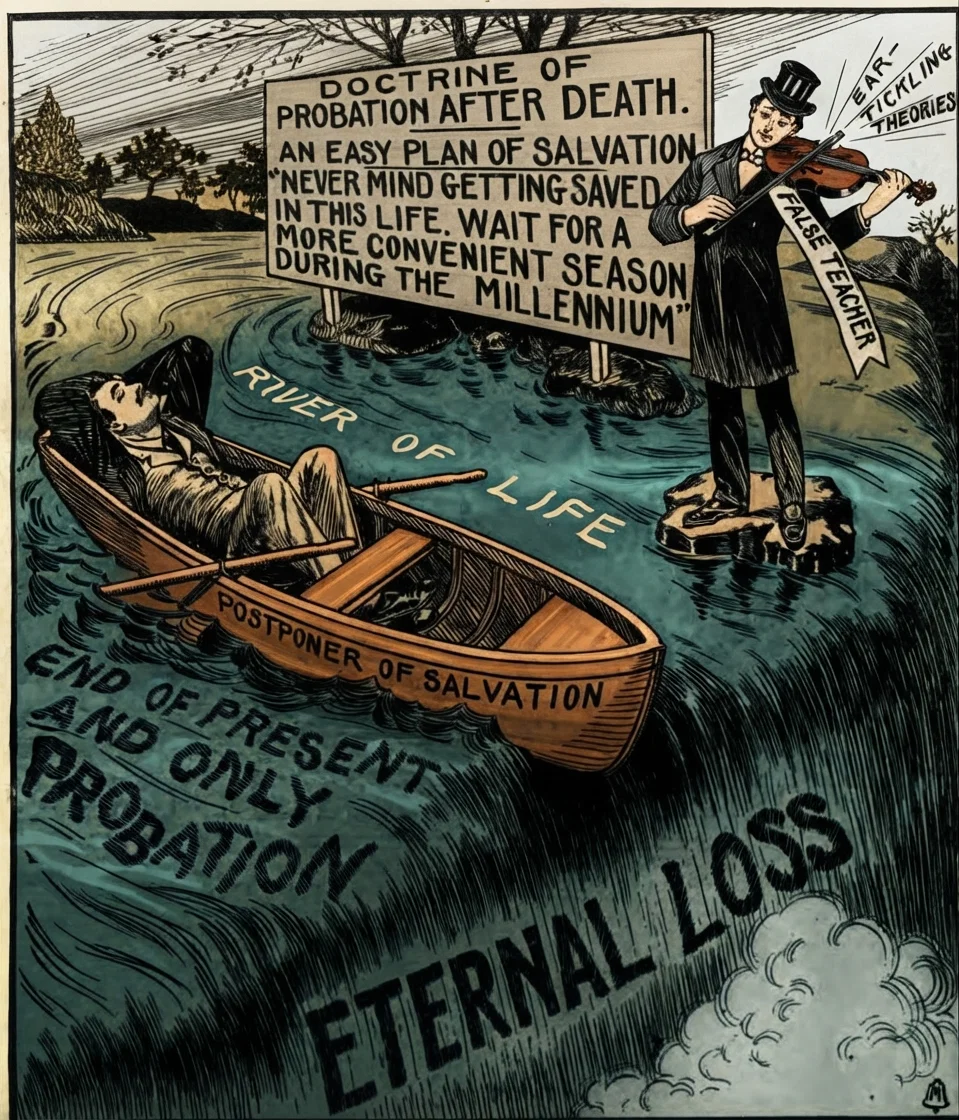
The music drowns the roar of the cataract. "Behold, now is the accepted time; behold, now is the day of salvation." 2 Cor. 6:2.
The men who work hard from seven in the morning until six at night for a dollar and a quarter to two dollars a day are not pleased that there are conditions in the country to permit a few people to spend vast fortunes in a single day without feeling it at all. They spend on the mere whims and vanities of life sums that would provide homes for a vast community of the common people. The common men and women are thinking of these things, and the struggle between capital and labor is doomed to be more and more fierce, until society will all be broken up into the chaos of anarchy and violence. We have the cause before us, and the effect can not help but follow.
We are made the more sure of this because of the following graphic and prophetic words:
"Come now, ye rich, weep and howl for your miseries that are coming upon you. Your riches are corrupted, and your garments are moth-eaten. Your gold and your silver are rusted; and their rust shall be for a testimony against you, and shall eat your flesh as fire. Ye have laid up your treasure in the last days. Behold, the hire of the laborers who mowed your fields, which is of you kept back by fraud, crieth out: and the cries of them that reaped have entered into the ears of the Lord of Sabaoth. Ye have lived delicately on the earth, and taken your pleasure; ye have nourished your hearts in a day of slaughter. Ye have condemned, ye have killed the righteous one; he doth not resist you."
"Be patient therefore, brethren, until the coming of the Lord. Behold, the husbandman waiteth for the precious fruit of the earth, being patient over it, until it receive the early and latter rain. Be ye also patient; establish your hearts: for the coming of the Lord is at hand. Murmur not, brethren, one against another, that ye be not judged: behold, the Judge standeth before the doors. Take, brethren, for an example of suffering and of patience, the prophets who spake in the name of the Lord." James 5:1-10.
A little study of the foregoing scripture will lead one to see that it utters a prophecy as well as states some great principles. Its startling warning is for the rich who have laid up their treasure "in the last days," and who have kept back the hire of the laborer, and who have not failed to nourish their own hearts even tho in a day of slaughter. And because of these conditions the rich are bidden to "weep and howl" for the miseries that are coming upon them—miseries that they are bringing upon themselves by their own conduct.
There are developing three distinct classes. There are the very rich who are oppressing the poor, and the poor who are fighting them by every means that they can invent. And then there is a third class who are students of the prophetic word, who are not a party to the strife on either side. The foregoing quotation calls this latter class the "brethren" who are patiently waiting amid all this strife for "the coming of the Lord." Those who thus confide their cases to the Master will have no terrors in that day. Now is the time for us to decide where we will then stand. T.

"Deluded Divines"

By Melbourne P. Boynton, D.D.
Pastor Lexington Ave. Baptist Church, Chicago, Ill.
ONE of the most discouraging features of any reform work is the difficulty of securing unity of opinion among good people concerning the evil attacked, as for instance, in the question of the segregation of vice.
Heretofore this difference of opinion has been due to a lack of exact knowledge gained in patient, thorough investigation of existing conditions.
However, we have now come into possession of very reliable information on these lines. Recent years have brought forward such works as:
1. The Committee of Fifteen in New York and its startling report as to the conditions in that city.
2. The Immigration Commission, spending nearly one million dollars in its work, and producing a report which waked the nation, and which was so startling in its revelation as to cause a Chicago congressman to oppose its publication for general distribution.
3. The Rockefeller Grand Jury of New York, and the clear proof of a white slave traffic in that city.
4. The Chicago Vice Commission and its monumental work.
5. The Federal White Slave Traffic Act, and new laws in some thirty States, of which Illinois was the leader, and whose laws are modeled on the Illinois Pander Act of 1908 and 1909.
6. A new library on this theme is growing, of which one Chicago book has gone into over three hundred thousand libraries and homes.
In all the above, notably the Chicago Vice Commission report, the segregation policy as applied to the social evil is condemned.
Our own Vice Commission begins its report with the following sentence, printing it in black type at the very head of the book:
Constant and persistent repression of prostitution the immediate method, absolute annihilation the ultimate ideal.
The moment a community consents to the segregation policy, they have commercialized this miserable business. There is absolutely no escape from this conclusion. Our Vice Commission has this further word upon this phase of the problem:
Furthermore, the overwhelming majority of the citizens of Chicago and the fathers and mothers of its children never will countenance the recognition or legalization of a commercial business which spells only ruin to the race. It is therefore incumbent upon us to take a bold stand against this curse of society. It behooves us to raise social life to the highest possible standard of righteousness—to teach the youth of our land loyalty and honor to womanhood.
Minneapolis followed Chicago's example and appointed a Vice Commission. Judge Daniel Fish, the city's legal adviser, says:
The illegal setting apart of a district in which the law may openly be violated is even more vicious than the vice proscribed.
During this last week one of our municipal judges, Judge William N. Gemmil, is quoted as saying, in refuting a report that he had criticized the Vice Commission report:
Instead of being opposed to the report, I most heartily approve its conclusion. I am unalterably opposed to the system of segregation, a system which is operated in defiance of the law and of common decency, and which is the underlying cause of the demoralization of the police force.
I think, however, it is much to be regretted that the Vice Commission concealed from the public the names of the criminals, high and low, whom it claims to have discovered to be the owners of property leased for vicious purposes, the givers and receivers of bribes, etc.
These names should have been turned over at once to the State's attorney of this county. Had this been done, the report of the commission would have had vital force.
America is not alone in its abhorrence of segregated vice.
Norway has pursued the policy of extermination since 1886.
Sweden has appointed a Parliamentary Committee, which reported recommending abolition of State regulation of vice and the inauguration of a policy of extermination.
Even in France, where the whole system of regulation originated with Napoleon I about one hundred years ago, the Extra Parliamentary Commission has reported against the system, and the most earnest minds of France are demanding an abandoning of the Napoleonic delusion.
An eminent Frenchman, Merle D'Aubigné, son of the famous church historian, himself a director of religious and social work in Paris, said recently with much feeling:
The system of regulation is tottering. It does not come to us from old France, but was introduced by Napoleon and his aids, who supposed that thereby they could preserve the health and military efficiency of the French army. Their belief in this respect was an utter delusion. The morning is dawning toward the supremacy of the moral law in France.
In England the destruction of segregated districts began in 1889, in Liverpool, formerly the "black spot on the Mersey," a very great seaport, where it was supposed the morals of the people were protected by the operation of vile resorts, kept open for supposed protection of good women. In one district of that city there were 443 tolerated houses quite immune from prosecution, tho the criminal code of Great Britain demanded their destruction. Under the leadership of Mr. Alexander Guthrie, a son of the famous Scotch preacher, himself an eminent business man in Liverpool, the honest people of that great city united, and left out of office politicians who thought the law could not be enforced, and in a new régime, exterminated the vice districts of Liverpool.
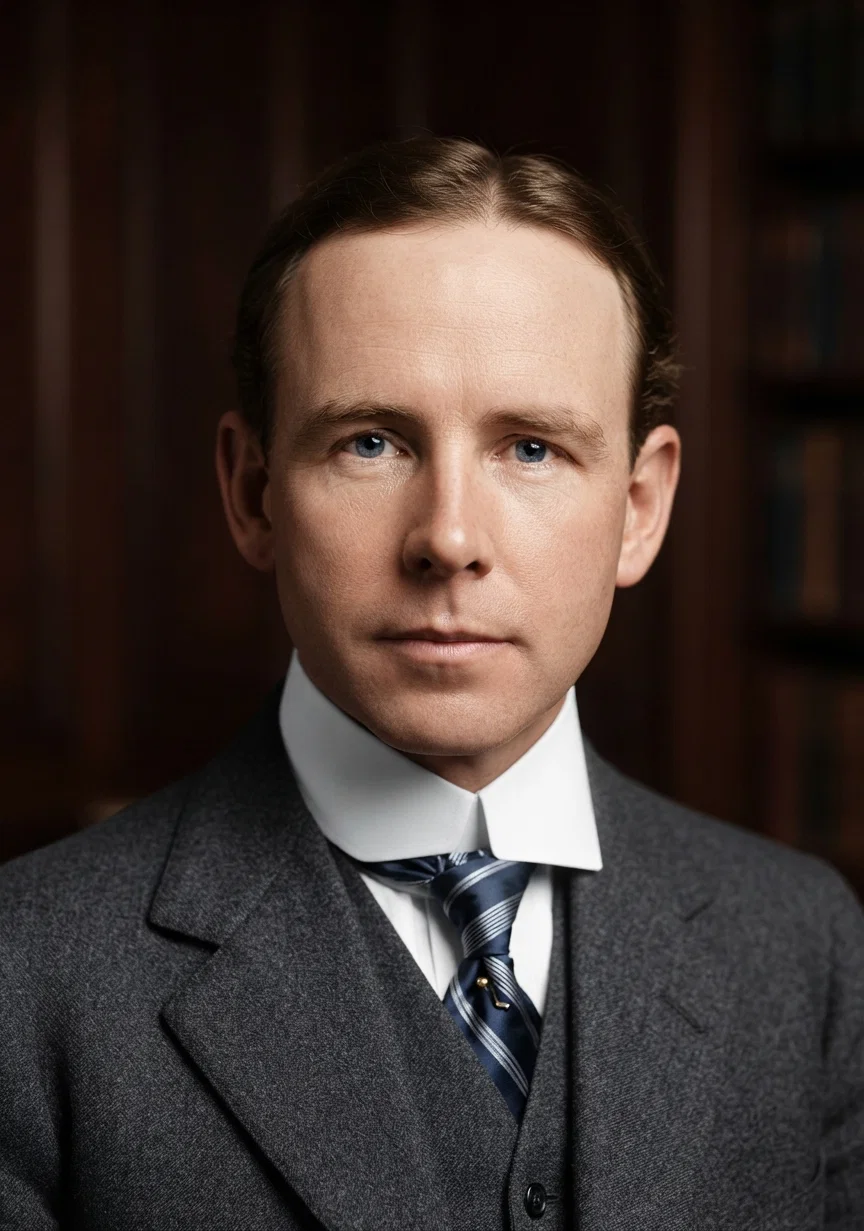
Thomas W. Lamont, partner of J. Pierpont Morgan, succeeding Mr. Perkins. Morgan considers him one of the brightest minds in the financial world—(Clinedinst).
In London, under the leadership largely of the bishop of London, the extermination of the vice districts began a few years after Liverpool had set the bright example. The vice districts and the protected resorts in London are now facts of an evil past, which no Londoner dreams of recalling.
In Holland and Denmark the policy of extermination has been in effect for some years.
In Berlin tolerated houses are not permitted. All Teutonic Europe seems ready to reassert its ancient character of chastity attested by the Roman historian Tacitus.
In our own country our cities are beginning to wake to the deadly peril of the segregation policy. Philadelphia has recently shown a deep resentment against the imputation that her clergy were in favor of this damnable heresy, and the Philadelphia clergy have unitedly professed their abhorrence of any such doctrine.
Seattle, Los Angeles, Salt Lake City, Des Moines, and the entire State of Iowa are now clear of recognized open dens of infamy.
Even the Orient is changing its attitude toward this policy.
In Japan this question is receiving wide-awake attention. When the Yoshiwara (the vice districts) of Osaka and Tokyo were burned, they were not allowed to rebuild in the midst of the city, but were driven to the outskirts, and indeed some of the districts have not yet been rebuilt. Public conscience is awakened, led by the great Count Okuma. The men of power in Japan are the Satsuma men, from the southern island, Kiushi,—men who in the days of old Japan stood firm against social corruption and would not allow vice districts in the cities of the southern islands. This chaste Satsuma clan made, and is still powerful in, new Japan.
In China segregation has always been abhorred by society at large. The dissolute characters were always driven beyond the walls of the city, and in many instances were compelled to dwell on boats in the rivers.
There is an ancient law in China by which, if a man proves that property was used for impure purposes, he acquires title to that property by means of such prosecution.
It has sometimes been earnestly protested that to rid a city of the tolerated houses would jeopardize the residence districts and make the streets unsafe. No lie of Satan's has ever been hurled back into his teeth with greater force than this one.
Take the experience of London for instance, the greatest city in the world. So far from the abolition of the vice districts and protected houses, increasing street-walking, the midnight meetings held for many years at the expense of Sir George Williams and others for the women of the street are now no longer possible for the lack of women to attend them, and these midnight meetings are now considering the question of discontinuing, and the whole movement is about to be disbanded.
In the face of all this evidence, in the presence of a world awakening such as the world has never experienced before on moral issues, it is indeed a sorry sight to see a clergyman come forward supporting this discredited, infamous policy of the segregation of vice; especially so when some of these clergymen are boastful in their declarations that they have never visited the districts, have never investigated the houses and will not do so, and yet do not hesitate to pose as the high priests of the segregation policy.
It were better that the clergymen listen to the words of the great Huxley, who shortly before his death, in addressing a company of clergymen, said that men of science, in their search for the truth, may find themselves obliged to return to the guardians of divine revelation, the ministers of God; that if they did so return, he hoped the clergy would not have betrayed the gates.
There is no more perilous delusion in the social mind to-day than this of the segregation of vice. This more than any other thing in the city of Chicago has debauched and disintegrated her police force and has brought about the present wholesale dismissal of commanding officers. What a pity that a Christian community should complacently endure a situation that spells inevitable disgrace and dismissal of the policemen, betraying them into a betrayal of their sacred trust! While I have no excuse for the corrupt policeman, yet, we must not forget that if we tolerate this ungodly, unrighteous situation in our cities, we are not free from our share of the responsibility, and no one is more immediately responsible for the perpetuation of the deplorable vice districts than the "deluded divines" who unblushingly proclaim their faith in this discredited and now rapidly being discarded method of handling the social evil.
There are three classes of "deluded divines" in this matter:
First, those who, without thoro investigation or personal knowledge of existing conditions, proclaim faith in the policy of segregation.
Second, those who are fearful of their standing, and fearing the conventions of society, refuse to take an interest in the situation, and remain silent in these hours of peril.
Third, those who, knowing the facts and realizing the situation, but fearful of possible notoriety or opposition of influential members, remain silent.
God grant to the clergy keen seeing eyes, flaming tongues, and a splendid unity of opinion and purpose in the work of morally cleansing our cities. The clergy must never "betray the gates."
Continue reading: India