Your ShelfYour Projects

Signs of the Times, Vol. 39, No. 7.

Above and Below

Signs of the Times

Feb 13, 1912

Pacific Press Publishing Association · Mountain View, California · Feb 13, 1912

Above and Below

O dwellers in the valley land, Who in deep twilight grope and cower, Till the slow mountain's dial hand Shorten to noon's triumphal hour, While ye sit idle, do ye think The Lord's great work sits idle too? That light dare not o'erleap the brink Of morn, because 'tis dark with you?
Tho yet your valleys skulk in night, In God's ripe fields the day is cried, And reapers, with their sickles bright, Troop, singing, down the mountainside. Come up, and feel what health there is In the frank Dawn's delighted eyes, As, bending with a pitying kiss, The night-shed tears of Earth she dries!
The Lord wants reapers. O, mount up, Before night comes, and says, "Too late!" Stay not for taking scrip or cup; The Master hungers while ye wait. 'Tis from these heights alone your eyes The advancing spears of day can see, That o'er the eastern hilltops rise, To break your long captivity.
  • James Russell Lowell.

Sowing Seed Morning and Evening

In the morning sow thy seed, and in the evening with- hold not thine hand: for thou knowest not whether shall prosper, either this or that, or whether they both shall be alike good. Eccl. 11:6.

Fields White to Harvest

Say not ye, There are yet four months, and then cometh harvest? behold, I say unto you, Lift up your eyes, and look on the fields; for they are white already to harvest.

Question Corner

"IF YE WILL INQUIRE, INQUIRE YE."

This Inquirers' Department is conducted for the purpose of helping those who are studying the Bible. The answers are oftentimes only suggestive. They are never to be considered infallible, only as they agree with the infallible Word. The writer who may answer them does not consider that his opinion is infallible. He will simply give the best that he has, and plead with the inquirer to search the Word. Such questions only will be answered as, to the editors, seem to minister to the good of the readers and to the mission of the paper. We can not answer repeatedly in the same volume questions upon the same scripture. The name and address must accompany question, not for publication, but as an evidence of good faith, and that answer may be made by letter if deemed advisable. No letters are answered which do not contain the name of the writer. It is well always to enclose stamp for reply.

3064 — Which Day of the Week Was It?

In Acts 27:11 we find that the disciples had a night meeting. We believe that it was Saturday night, the night of the first day of the week. In verse 7 it says that he departed "on the morrow." The opposers say that Paul departed not on the first day, but on the morrow after the first day. Please explain. T. W. F.
Evidently a mistake is made in the reference above. It should be Acts 20, verses 7-11. The Bible manner of reckoning time was from sunset to sunset, and therefore the evening of the first day was the evening preceding the light part, beginning with what is our Saturday night. That is generally conceded by scholars. The meeting was what would be called a Saturday night meeting. There can be no question over this at all, if we decide it from the Bible manner of reckoning the days. That meeting lasted all that night; and the next day—that is, the light day—Paul departed. If any one should say that there was a day between his departure and the time of that all-night meeting, of what worth would it be? The Scripture is absolutely silent regarding it. But no one looks upon it in that way, so far as we know. See Conybeare and Howson. They without any question make Paul take his journey across the isthmus to Assos on the first day of the week. Dean Alford counts the breaking of bread the "agape, or the love-feast, which Paul had not even tasted, that is the bread which he had broken." Again, "The time indicated by the break of day must have been before, or about five A.M., which would allow about four hours since the miracle. We have here a minute but interesting touch of truth in the miracle. Paul, we learn afterwards, intended to go afoot. And accordingly, here we have it simply related that he started away from Troas before his companions, not remaining for the reintroduction of the now recovered Eutychus, in verse 12." Wesley, on verse 11, says, "So departed, without taking any rest at all;" and on verse 13, "Being himself desirous to go on foot that he might enjoy the company of his Christian brethren a little longer, altho he had passed the night without sleep," showing clearly that Wesley understood him to have journeyed on the first day of the week, as the record clearly indicates. It seems to us that to deny the apostle’s journey on the first day of the week is a mere arbitrary statement against very obvious facts.

3065 — Change of the Law, Heb. 7:12

I have found some fine lessons in your paper, but I see a statement in the issue of November 28, 1911, to the effect that God has never changed His law. Now it seems to me as tho God has changed His law, as stated in Heb. 7:12. "For the priesthood being changed, there is made of necessity a change also of the law." Now was the law changed? What is meant by Col. 2:14,—the handwriting that was against us, and nailed to the cross? and the enmity abolished in His flesh, in Eph. 2:15? Was it not the law which was abolished, as stated in 2 Cor. 3:7? P. S.
Our correspondent has asked questions upon which a volume might be written, but we will answer very briefly. The writer in the paper to which he refers had reference to God's moral law, God's law of character, the reflection of His own character. Any one who will stop to think upon that earnestly and devoutly will see, in the very nature of the case, that as God is unchangeable (Mal. 3:6; James 1:17), so His great law of character must be unchangeable, and that as He requires that all His children shall be like Him, holy as He is holy, perfect as He is perfect (1 Peter 1:15, 16; Matt. 5:48), they must have the same character as is indicated by His law (Ps. 19:7-10); furthermore, that while His law must be the law of righteousness, for it could be no other, its transgression must be sin, as He declares over and over again (1 John 3:4; Rom. 7:7). And for God to change His law—that great moral law—would be to say to the world that He made a mistake in giving it, and that what was sin in one age was not sin in another age, and what was righteousness in one age was not righteousness in another age. And how, then, would it be when God's children of all ages are brought together in the last great day of judgment, one having a character molded after one standard, and another a character molded after another? God has the one great standard—His holy law, and that law was exemplified in the life of our Lord Jesus Christ. He was the law wrought out in living character, and He Himself tells us that it is easier for heaven and earth to pass than for one tittle of the law to fail, that is, a small point of a letter. See Matt. 5:17-20; Luke 16:17. And thus the psalmist by inspiration sings that God's commandments stand forever and ever. Ps. 111:7, 8. There are many other scriptures to the same intent.
Now what is the meaning of Heb. 7:12? You will notice the context. The question is not a question of character, but of priesthood; and there is nothing in God's great law of Ten Commandments which makes any reference to priesthood at all; but the priesthood being changed, there must also of necessity be a change of the law regulating the priesthood. The ceremonial law regulated the priesthood anciently, and by that the priesthood came of the tribe of Levi, and of the house of Aaron; but our Lord sprang from Judah. Consequently, when the Aaronic or Levitical priesthood passed away and our Lord Jesus Christ became Priest, there must be a change in the law regulating the priesthood. It was a matter no longer of sacrifices and offerings of the blood of beasts, but Christ came, and the priesthood is now that of Melchizedek, and not that of man. That is all the law that is spoken of there. In Colossians 2, and also in Ephesians 2, the matter which was nailed to the cross and which our Lord Himself abolished was the enmity, the sinful heart (Rom. 8:7), and the offerings for sin, and the various types which pointed forward to our Lord Jesus Christ; those were taken away with the sin. And so the sabbath days, and the new moons, and the feast-days pertain to these types of the Levitical law, and not to the eternal law of God, which existed before sin and will exist after sin is passed away. There were various yearly sabbaths, all having a typical aspect (read Leviticus 23), and these sabbaths were "beside the Sabbaths of the Lord" (see verse 38). Consequently those scriptures, instead of indicating a change in God's law, show its exceeding strength and character and absolute unchangeableness.
It is just as true concerning 2 Cor. 3:7. The thing which the apostle declares there is abolished is the glory of condemnation. The thing that condemns is God's law, and God's law written and engraved in stone—the Ten Commandments. But God does not want His children to stay under condemnation; He wants to take away the condemnation by justification; and so Paul tells us that those who have accepted the Lord Jesus Christ have the condemnation taken away, but have that which is better, the glory of justification. Condemnation comes when we hold the law outside and the sin inside; justification is when the sin is placed outside and God's law is written in the heart,—the same law. See the tract, "What Is 'Done Away' in Christ?" "Bible Students' Library," No. 149. Price 2 cents.

3663 — Has Christ Creative Power?

Did our Lord exercise creative power in the feeding of the multitude, or was all that He did done through angelic ministration? What caused the fall of Jericho's walls? A. K.
There are repeated evidences that our Lord exercised creative power. There were doubtless times when angels did work for Him, but the only power they received was in the command that was given to them. Said the Roman centurion, "I am not worthy that Thou shouldest come under my roof: but speak the word only, and my servant shall be healed." Jesus sent His word and healed him. The poor, decaying, corrupt leper said, "Lord, if Thou wilt, Thou canst make me clean." The cleansing of that leper meant creative power, the absolute renewing of his entire being; and Jesus touched him, and said, "I will; be thou clean." There came to Jesus at another time one sick of the palsy, and Jesus said, "Son, thy sins be forgiven thee." And the multitude murmured, saying that only God could forgive sins; but in order that He might demonstrate that He had the power of God to forgive sins, He said to the sick of the palsy, "Arise, and take up thy bed, and go thy way into thine house." And creative power restored the incurable of the palsy. It was not angels that said, "Thy sins be forgiven thee," but Christ; and it was not angels that healed the sick of the palsy, but Christ. It was so when the multitude was fed. As the bread left the hands of the Master, it multiplied, and it multiplied in the hands of His disciples, through His own power. The only hope that the poor, sinful soul has is in the creative power of the Lord Jesus Christ, in the reception of His Word. This does not mean that He did not use, at different times and on various occasions — and most occasions, in all probability — the help of angels. He does not do this because angels are necessary, but in order that there may be that blessed and divine coöperation which will make other hearts glad as well as His own. Even so He uses human beings. He could have said to Paul: "Thy sins are forgiven thee. Arise and be baptized." But He wanted Ananias to have a part in it, and He wanted His angel to have a part in it, and so He sends an angel to Ananias, and Ananias tells Paul, and both of them are blessed in Christ in the work which they do, but the power is of Christ.
God's army was with Joshua. We learn that by reading the context, when he stood before Jericho. And it was God's army, doubtless, that threw down the walls of Jericho; but the power was of God still. "If any man be in Christ, he is a new creature," — literally, a new creation.

3666 — Providence and Lightning-Rods

Is it right, or wrong, to put lightning-rods on buildings? Some persons seem to believe that it is defiance against God to do so.
It is not defiance against God to use the judgment and reason and good sense which He has given us in properly caring for ourselves, and properly protecting our property. When God gives us of His abounding grace, He does not design to take away common sense or good judgment. It is not defiance of God to place a roof upon our house, or give our stock shelter. And if currents of electricity in the warring elements, which occur because sin has blasted this earth, can be conducted away by natural channels, we see no reason in the world why that should not be done. Of the necessity or futility of lightning-rods, we are not writing, but it is certainly not defiance of God to use real good sense in the protection of life and property.
Schedule for Week Ending February 24, 1912

Sunday February 18 Exodus 29

Sunday February 18 Exodus 29
Monday " 19 " 30, 31
Tuesday " 20 " 32, 33
Wednesday " 21 " 34; 40:17-38
Thursday " 22 Leviticus 9, 10
Friday " 23 " 11, 16
Sabbath " 24 Psalm 105

Bible Readings

We begin our readings with Exodus 29, continuing through to chapter 34, giving the completion of the Lord's directions concerning the building of the sanctuary. We omit chapters 35-39, and a part of 40. In these chapters we have the statement made that the Lord's directions were explicitly carried out, and in the last part of the 40th chapter we have the dedication of the sanctuary itself, and the filling of that sanctuary with God's ineffable glory.
We pass over the first eight chapters of Leviticus. They are interesting, and we would advise those of our band who have time, to read them. They are not long; one sitting of from a half hour to an hour will read all that is omitted. They describe the different kinds of sacrifices, every one of which has something in type concerning the work of our Lord Jesus Christ. Chapters 9 and 10 are of peculiar interest,—9, the dedication of the sanctuary and of the sons of Aaron and of the people themselves. When all had been laid before the Lord, then the Lord shows how He accepts their gifts, pardons their sin, and reveals His glory. They stand sinless before Him, forgiven in full. But the next chapter records a no less important but opposite lesson. Nadab and Abihu identify themselves with sin, or the transgression of God's Word, and they perish with the sin. Chapter 11 contains instruction concerning clean and unclean beasts, which may be of interest. They are not named so arbitrarily, but from their nature. 12 to 15 are omitted. They are worthy of reading if we have time; 16 should be read, as it contains the description of the ceremonies concerning the cleansing of the sanctuary.
The week closes with the reading of the 105th Psalm, showing God's dealings with His children, reviewing in song God's wonderful works for them. It will call to mind many of the things over which we have passed, and throw new light upon the narrative of the children of Israel.

Christ the Life-Giver

By Mrs. E. G. White
In the beginning was the Word, and the Word was with God, and the Word was God. The same was in the beginning with God. All things were made by Him; and without Him was not anything made that was made. In Him was life; and the life was the light of men. And the light shineth in darkness; and the darkness comprehended it not. John 1:1-5.
THE world did not see divinity in the humble Man of Nazareth. The only-begotten Son of the infinite God was in the world, and men knew Him not in His true character.
"In Him was life; and the life was the light of men." It is not physical life that is here specified, but eternal life, the life which is exclusively the property of God. The Word, who was with God, and who was God, had this life. Physical life is something which each individual received. It is not eternal or immortal; for God, the Life-giver, takes it again. Man has no control over his life. But the life of Christ was unborrowed. No one can take this life from Him. "I lay it down of Myself," He said. In Him was life, original, unborrowed, underived. This life is not inherent in man. He can possess it only through Christ. He can not earn it; it is given him as a free gift if he will believe in Christ as his personal Saviour. "This is life eternal, that they might know Thee the only true God, and Jesus Christ, whom Thou hast sent." John 17:3. This is the open fountain of life for the world.

"Who Only Hath Immortality"

Giving his charge to Timothy, Paul says: "But thou, O man of God, flee these things; and follow after righteousness, godliness, faith, love, patience, meekness. Fight the good fight of faith, lay hold on eternal life, whereunto thou art also called, and hast professed a good profession before many witnesses. I give thee charge in the sight of God, who quickeneth all things, and before Christ Jesus, who before Pontius Pilate witnessed a good confession; that thou keep this commandment without spot, unrebukable, until the appearing of our Lord Jesus Christ: which in His times He shall show, who is the blessed and only Potentate, the King of Kings, the Lord of Lords; who only hath immortality, dwelling in the light which no man can approach unto; whom no man hath seen, nor can see: to whom be honor and power everlasting." 1 Tim. 6:11-16.
Writing again, Paul says: "This is a faithful saying, and worthy of all acceptation, that Christ Jesus came into the world to save sinners; of whom I am chief. Howbeit for this cause I obtained mercy, that in me first Jesus Christ might show forth all long-suffering, for a pattern to them which should hereafter believe on Him to life everlasting. Now unto the King eternal, immortal, invisible, the only wise God, be honor and glory forever and ever." 1 Tim. 1:15-17.

Immortality Brought to Light

Christ "brought life and immortality to light through the Gospel." 2 Tim. 1:10. No man can have an independent spiritual life apart from Him. The sinner is not immortal; for God has said, "The soul that sinneth, it shall die." Eze. 18:4. This means all that it expresses. It reaches farther than the death which is common to all; it means the second death. Men start back at this, saying, Would you make man no more than a beast? This is thought to be degrading. But what is it that elevates man in the sight of God? Is it his accumulation of money?—No; for God declares, "The gold and the silver are Mine." If man abuses his entrusted treasures, God can scatter faster than man can gather. Man may have brilliant intellect; he may be rich in the possession of natural endowments. But these are all given him by God, his Maker. God can remove the gift of reason, and in a moment man will become as Nebuchadnezzar, degraded to the level of the beasts of the field. This God does because man acts as though his wisdom and power had been gotten independently of Him.
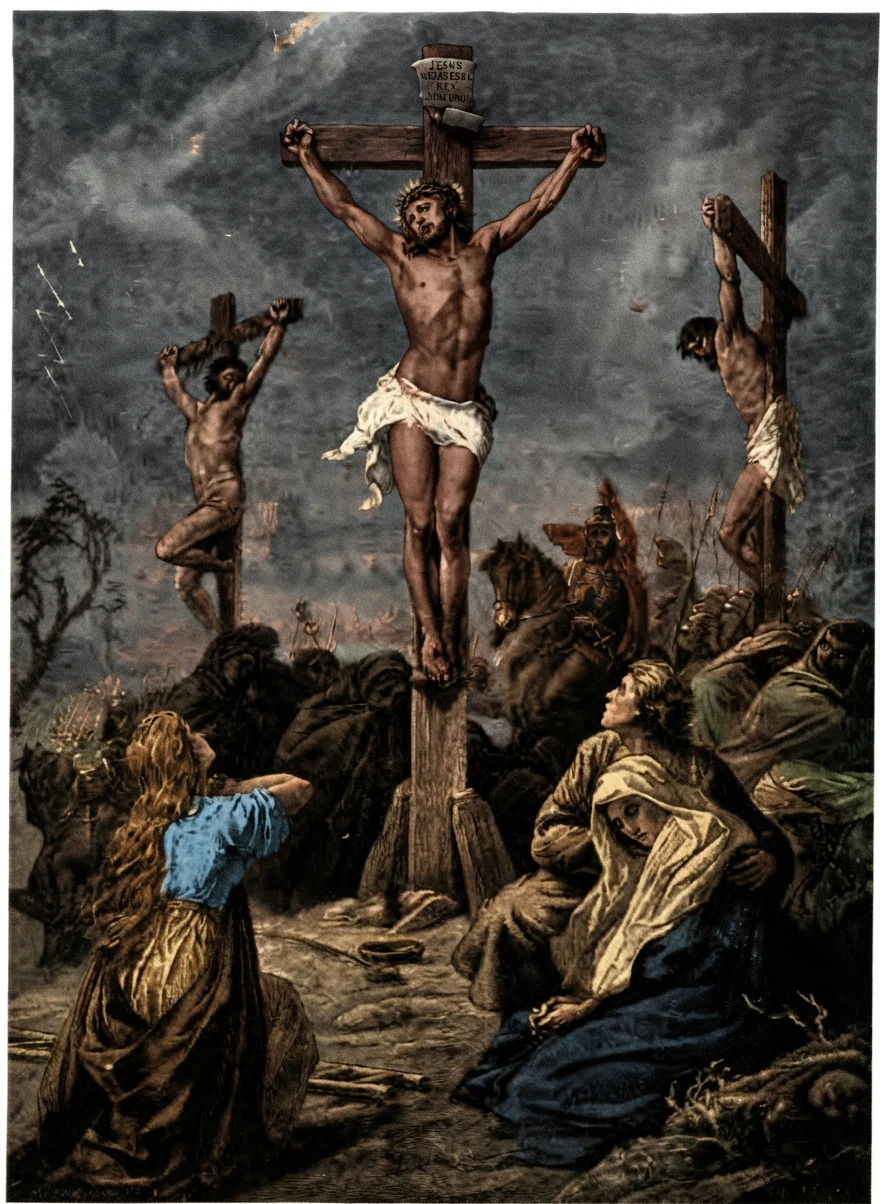
After Adam and Eve brought death into the world by their disobedience, a costly Sacrifice was provided for the human race
Man is only mortal, and while he feels himself too wise to accept Jesus, he will remain only mortal. Men have done wonderful things in the intellectual world; but who gave them power to do this?—The Lord God of Hosts. If in their fancied efficiency men triumph because of their own power, and glorify themselves, following the example of the antediluvian world, they will perish. The imagination of that long-lived race was only evil, and that continually. They were wise to do evil, and the earth was corrupted under the inhabitants thereof. Had they connected themselves with the One who is infinite in wisdom, they could have done marvelous things with their God-given ability and talents. But turning from God, they chose to follow Satan's lead, as many to-day are doing, and the Lord swept them from the earth, with all their boasted knowledge.

Whom God Honors

Humanity may be exalted by the world for what it has done. But man can lower himself very fast in God's sight by misapplying and misappropriating his entrusted talents, which, if rightly used, would elevate him. While the Lord is long-suffering, and not willing that any shall perish, He will by no means clear the guilty. Let all take heed to the words of the Lord: "Wherefore kick ye at My sacrifice and at Mine offering, which I have commanded in My habitation; and honorest thy sons above Me, to make yourselves fat with the chiefest of all the offerings of Israel My people? Wherefore the Lord God of Israel saith, I said indeed that thy house, and the house of thy father, should walk before Me forever: but now the Lord saith, Be it far from Me; for them that honor Me I will honor, and they that despise Me shall be lightly esteemed." 1 Sam. 2:29, 30.
God honors those who obey Him. "The Lord rewarded me according to my righteousness," said David; "according to the cleanness of my hands hath He recompensed me. For I have kept the ways of the Lord, and have not wickedly departed from my God. For all His judgments were before me, and I did not put away His statutes from me." Ps. 18:20-22.
Only the believer in Christ can receive life everlasting. Only by continually feeding on Christ's flesh and blood can we have the assurance that we are partakers of the divine nature. No one should be indifferent on this subject, saying, If we are honest, it is no matter what we believe. You can not with safety surrender any seed of vital truth in order to please yourself or anybody else. Do not seek to avoid the cross. If we receive no light from the Sun of Righteousness, we have noconnection with the Source of all light; and if this life and light do not abide in us, we can never be saved.

Every Provision Has Been Made

God has made every provision that His purpose in the creation of man shall not be frustrated by Satan. After Adam and Eve brought death into the world by their disobedience, a costly Sacrifice was provided for the human race. A higher value than that they originally possessed was placed upon them. By giving Christ, His only-begotten Son, as a ransom for the world, God gave all heaven.
The acceptance of Christ gives value to the human being. His sacrifice carries life and light to all who take Christ as their personal Saviour. The love of God through Jesus Christ is shed abroad in the heart of every member of His body, carrying with it the vitality of the law of God the Father. Thus God may dwell with man, and man may dwell with God. Paul declared, "I am crucified with Christ: nevertheless I live; yet not I, but Christ liveth in me: and the life which I now live in the flesh I live by the faith of the Son of God, who loved me, and gave Himself for me." Gal. 2:20.

Life Everlasting May Be Had

If through faith man becomes one with Christ, he can win life everlasting. God loves those who are redeemed through Christ, even as He loves His Son. What a thought! Can God love the sinner as He loves His own Son? — Yes; Christ has said it, and He means just what He says. He will honor all our drafts if we will grasp His promise by living faith, and put our trust in Him. Look to Him, and live. All who obey God are embraced in the prayer which Christ offered to His Father, "I have declared unto them Thy name, and will declare it: that the love wherewith Thou hast loved Me may be in them, and I in them." John 17:26. Wonderful truth, too difficult for humanity to comprehend!
Christ declares: "I am the bread of life: he that cometh to Me shall never hunger; and he that believeth on Me shall never thirst." "And this is the will of Him that sent Me, that every one which seeth the Son, and believeth on Him, may have everlasting life: and I will raise him up at the last day." "Verily, verily, I say unto you, He that believeth on Me hath everlasting life." "Except ye eat the flesh of the Son of Man, and drink His blood, ye have no life in you. Whoso eateth My flesh, and drinketh My blood, hath eternal life; and I will raise him up at the last day. For My flesh is meat indeed, and My blood is drink indeed. He that eateth My flesh, and drinketh My blood, dwelleth in Me, and I in him. As the living Father hath sent Me, and I live by the Father: so he that eateth Me, even he shall live by Me. This is that bread which came down from heaven: not as your fathers did eat manna, and are dead: he that eateth of this bread shall live forever." "It is the Spirit that quickeneth; the flesh profiteth nothing: the words that I speak unto you, they are spirit, and they are life." John 6:35, 40, 47, 53-58, 63.

The Testimony of Jesus

By George W. Reaser

VI—Marked Examples of Fulfilled Prophecy

HE following incidents will serve to illustrate the efficiency of fulfilled prophecy in disproving skepticism and in substantiating the truthfulness of the Bible.

Dr. Hamlin's Experience with a Turkish Colonel

When Dr. Cyrus Hamlin visited Constantinople, soon after the Crimean War, a colonel in the Turkish army called to see him, and during their conversation said, "What proof can you give that the Bible is what you claim it to be, the Word of God?"
Dr. Hamlin evaded the question, and drew the officer into conversation, during which he learned that he had traveled a great deal, especially in the East, in the region of the Euphrates.
"Were you ever in Babylon?" asked the doctor.
"Yes; and that reminds me of a curious experience I had there," replied the visitor. He then related the following account of his visit to the ancient capital of the world:
"I was very fond of sport, and having heard that the ruins of Babylon abounded in game, I determined to go there for a week's shooting. Knowing that it was not considered safe for a man to be there except in the company of several others, and money being no object to me, I engaged a sheik with his followers to accompany me, for a large sum.
"We reached Babylon, and pitched our tents. A little before sundown I took my gun and strolled out to have a look around. The holes and caverns among the mounds that cover the ruins are infested with game, which, however, is rarely seen except at night. I caught sight of one or two animals in the distance, and then turned my steps toward our encampment, intending to begin my sport as soon as the sun had set.
"It was my surprise to find the men striking the tents. I went to the sheik and protested most strongly. I had engaged him for a week, and was paying him most handsomely, and here he was starting off when our contract had scarcely begun. Nothing I could say, however, would induce him to remain.
"It isn't safe,' he said. 'No mortal flesh dare stay here after sunset. In the dark, ghosts, goblins, ghouls, and all sorts of things come out of the holes and caverns, and whoever is found here is taken off by them, and becomes one of themselves.'"
"Finding I could not persuade him, I said, 'Well, as it is, I'm paying you more than I ought; but if you'll stay, I'll double it.'"
" 'No,' he said; 'I couldn't stay for all the money in the world. No mortal flesh has ever seen the sun go down on Babylon and lived to tell the tale. But I want to do what is right by you. We'll go off to a place about an hour distant, and come back at daybreak.'"
"And go they did, and my sport had to be given up."
"As soon as he had finished," said Dr. Hamlin, "I took my Bible and read from the 13th chapter of Isaiah:
" 'And Babylon, the glory of kingdoms, the beauty of the Chaldees' excellency, shall be as when God overthrew Sodom and Gomorrah. It shall never be inhabited, neither shall it be dwelt in from generation to generation: neither shall the Arabian pitch tent there; neither shall the shepherds make their fold there. But wild beasts of the desert shall lie there; and their houses shall be full of doleful creatures; and owls shall dwell there, and satyrs shall dance there. And the wild beasts of the islands shall cry in their desolate houses, and dragons in their pleasant palaces: and her time is near to come, and her days shall not be prolonged.'"
" 'That's it exactly,' said the Turk, when I had finished; 'but that's history you have been reading.'"
" 'No, it's prophecy. Come, you're an educated man, you know that the Old Testament was translated into Greek about three hundred years before Christ.' He acknowledged that it was.
" 'And the Hebrew was given at least 200 years before that?'"
" 'Yes.'"
" 'Well, wasn't this written when Babylon was in its glory? and isn't it prophecy?'"
" 'I'm not prepared to give you an answer now,' he replied; 'I must have time to think it over.'"
" 'Very well, do so, and come back when you're ready, and give me your answer.'"
"From that day to this I have never seen him," continued the doctor, "but what an unexpected testimony to the truth of the Bible in regard to the fulfilment of prophecy did that Turkish officer give!"—Record of Christian Work.
What caused the silence of this pronounced skeptic who a few moments before had boldly challenged the faith of Dr. Hamlin in God and in His Word? Answer, "The testimony of Jesus," which "is the spirit of prophecy." "The testimony of Jesus" is ever the most effectual weapon to hurl against skepticism and to cause it either to blush with shame or to scamper away into the shadows.

A Remarkable Prophecy Concerning Cyrus

A most remarkable prediction was made concerning Cyrus, king of Persia, more than 100 years prior to his birth, and 174 years before the prediction made was fulfilled. The prophecy had to do with the release of God's people from captivity, and their return to the land of Palestine to rebuild Jerusalem and the central temple therein.
The Lord had declared through Jeremiah that He would cause Nebuchadnezzar, king of Babylon, to carry His people into captivity, because of their iniquity, and that Jerusalem would lie desolate seventy years (Jer. 25: 8-12). This period of seventy years began in 606 B.C. (Dan. 1: 2, margin), and would therefore terminate in B.C. 536.
The prophecy above mentioned reads as follows: "Thus saith the Lord . . . of Cyrus, He is My shepherd, and shall perform all My pleasure: even saying to Jerusalem, Thou shalt be built; and to the temple, Thy foundation shall be laid." Isa. 44: 24-28.
Two years before the time came for the fulfilment of the prophecy, or in 538 B.C., Babylon, where God's people were held in captivity, had been overthrown by Medo-Persia. The prophecy must be immediately fulfilled, or God's prophetic word would fail. Marvelous as it may seem, immediately Cyrus had come to the throne, a supernatural desire seized him, and he issued the decree that Jerusalem should at once be rebuilt by the people of God. This decree could not be delayed till the second year of his reign, because the God of heaven had spoken, His honor was at stake, the effectiveness of prophecy as a witness to God's existence must not go by default, and so it is written: "Now in the first year of Cyrus king of Persia, that the word of the Lord by the mouth of Jeremiah might be fulfilled, the Lord stirred up the spirit of Cyrus king of Persia, that he made a proclamation throughout all his kingdom, and put it also in writing, saying, Thus saith Cyrus king of Persia, The Lord God of heaven hath given me all the kingdoms of the earth; and He hath charged me to build Him an house at Jerusalem, which is in Judah. Who is there among you of all His people! his Godbe with him, and let him go up to Jerusalem, which is in Judah, and build the house of the Lord God of Israel, (He is the God,) which is in Jerusalem." Ezra 1: 1-3.

Alexander's Effort to Rebuild Babylon

Some of the mightiest military leaders in the history of the world, spurred on by their ambition for power and glory, have bent their herculean energies and set their indomitable will-power, doubtless unconsciously, to thwart some of the prophecies of God's Word, but in their futile efforts have themselves been brought to shame, ignominy, and utter ruin.
One of the marked instances of this was in the experience of Alexander the Great. Having conquered the world at the early age of thirty-three, he determined in his heart to restore the once golden city, Babylon, then in ruins, to some degree of its ancient splendor. God's prophet had spoken some 200 years before, declaring the utter destruction of the city, and that it should "never be inhabited" (Isa. 13: 19-22). In a few short months after Alexander had begun the restoration of Babylon, he suddenly died from yielding to his appetite for strong drink, the would-be restoration of the city ceased, and Babylon is still "heaps of ruins," without a single inhabitant. God's Word stood, and it will "stand fast forever and ever."
If Alexander could have rebuilt Babylon, "the testimony of Jesus" would have been broken. But his signal failure to rebuild Babylon, after conquering the world in a manner little short of miraculous, proves that "the testimony of Jesus" can not be broken. It will stand fast tho earth and hell combine to break it.
In conquering the world, Alexander was coöperating with "the testimony of Jesus;" in trying to resurrect Babylon from its "heaps of ruins," he was fighting against it. While fighting in harmony with what Jesus had spoken by the spirit of prophecy (Daniel 8), he could easily conquer the world; but in fighting against it, he could not build a single city.
And thus it will ever be. He who fights against God's prophetic word, must fight a losing strife. He who battles in harmony with it, will always win.

Napoleon Bonaparte Defeated by Prophecy

Napoleon Bonaparte, than whom probably no greater or more ambitious military genius was ever born to our race, set his heart to conquer all Europe, and to bind its divided kingdoms into one, with himself as absolute monarch, which would have placed in his own hands, eager for power, the balance of power in all the earth.
God's prophet had made a simple statement, to the effect that these kingdoms could not be thus united by human power or tact, but that "in the days of these kings [or kingdoms] shall the God of heaven set up a kingdom, which shall never be destroyed." Dan. 2: 43, 44. Napoleon went down in ignominious defeat at Waterloo, was taken captive, and transported on a British man-of-war far from the scenes of his overweening and unholy ambition, to the isle of St. Helena, where he spent the remainder of his days, a miserable, dejected exile, bitterly lamenting his own folly.
If Napoleon, by his mighty genius, could have welded all Europe together in one nation, he would thus have broken "the testimony of Jesus;" but the sounding of the retreat from Moscow, the corpses of thousands of loyal soldiers left lying upon the frozen ground during the retreat, the defeat at Waterloo, the exile and pining away on the far-off lonely isle,—all of these calamities which befell the one who unconsciously tried to break God's prophetic word, furnish tragic proof that "the testimony of Jesus" can not be broken.
O friends, one line of God's prophetic word far excels in strength the combined force of all the mighty generals and armies of earth, arrayed in unholy war to break that word!

Absolute Certainty of Prophecy

Nearly a quarter of a century after he had safely led Israel into the promised land, Joshua assured the people in these words, that Jehovah had faithfully performed everything He had promised: "And, behold, this day I am going the way of all the earth: and ye know in all your hearts and in all your souls, that not one thing hath failed of all the good things which the Lord your God spake concerning you; all are come to pass unto you, and not one thing hath failed thereof." Joshua 23: 14. And in declaring the certainty of the fulfilment of His prophetic word, Jesus said, "Heaven and earth shall pass away: but My words shall not pass away." Luke 21: 33.

The Position of Prophets

True prophets are greater, in the estimation of Heaven, than kings. They were commissioned of God in the olden times to select kings, to anoint them for their office, to reprove them when in error, and when kings were finally found to be derelict to their trust, God's prophets were sent to them betimes to convey the message that they were "weighed in the balance and found wanting," and they were deposed from their kingly majesty. The only two men in the history of the world who have been translated were not kings, but prophets. A truthful appeal to prophecy is based on certainty. Nearly all else is uncertainty. Prophecy, rightly understood, is the surest thing in the world.
— —
THERE are ways in which even silent people can belong to God and be a blessing in the world. A star doesn't talk, but its calm, steady beam shines down continually out of the sky, and is a benediction to many. Be like a star in your peaceful shining, and many will thank God for your life.—J. R. Miller.
Continue reading: The Sweetness of Giving