The Story of the People for the People—Origin of the United States—English Oppression—Restriction of Commerce and Manufacture—Smuggling Induced—Diverse Views on Taxation—Separation of the Colonies—Congress at Albany—Franklin's Plan of Federation—Its Fate—Anecdote Told by Franklin.
THE United States of America came into existence on the Fourth of July, 1776. On that memorable day, with the signing of the Declaration of Independence, this great country began. With that day its history as a nation begins. But the full history of the United States takes us back to an earlier day. The Declaration had its causes, and we must always deal with causes before we can deal with results. In 1766, ten years before, there was not, so far as we know, a man in the American colonies who had dreamed of independence. Yet the causes from which independence were to come were then in full play, and ten years later thousands of men in arms were bravely fighting for liberty.
What had brought about this great change? Nothing but the folly of the government of Great Britain, which was blind to the indications in the air, and contemned alike the advice of wise counsellors at home and the complaints of angry colonists abroad.8The history of the United States begins with the story of these preceding events, for these were the seeds from which the great republic grew. In fact, before 1776 there was not only no United States, there was no American country; only a series of colonies, thirteen in all, existed, each a distinct commonwealth, with its own government and history. These colonies had only one strong connecting link; they were all under the control of an island beyond the seas, and all writhed under the heavy hand of this distant realm.
The mother country—as England was called—looked upon the colonies as sheep to be shorn, not as children to be fostered. England was a manufacturing land; America must not make anything for itself. England was a commercial nation; America must trade only with its marts. All raw material must be shipped to English ports, all finished goods brought from there, and the sound of hammer or rattle of loom on American shores was deemed little less than a crime.
No American ship dared sail, except at its own peril, to any port of the continent of Europe. No goods could be brought from these ports with the exception of the wines of Madeira and Portugal, which England could not supply to the lovers of these then favorite beverages. New England had made much money in trade with the West Indies, sending hither fish and lumber, and bringing thence sugar, rum, and molasses. This trade was long loaded with heavy duties, and was finally suppressed by order of George the Third.
These checks to freedom of commerce were not the whole restrictions on colonial industries. Manufacture in America, while not wholly forbidden, was closely circumscribed. In the great pine forests of Maine every tree tall enough and straight enough to serve as mast for a king's ship was held as the property of the Crown. No American ax must, on peril, touch those monarchs of the American forests. In Carolina, where also were vast forests of pine, the people were forbidden to make tar from the wood, or tar and turpentine from the sap, of those abundant trees.
Wool was then the great English staple, and woolen goods the leading English product. Therefore the colonists must make no woolen goods for themselves beyond such coarse homespun as they could weave in their homes. Even this slight privilege was deemed too much, and attempts were made to stop the humble spinning-wheel and cottage loom. As for home trade in such goods, it was strictly ordered that no woolen fabrics should be carried from one province to another. Every flock of sheep, spindle, and loom in America was looked upon as a direct injury to English industry, and no sailor from the mother land in want of clothing was permitted to buy more than forty shillings' worth of woolen goods in an American port. Even this small privilege seemed too much, and was finally taken away.
America was the home of the beaver, from whose fur were made the hats of that day, but England claimed the right to make these hats. There were American hatters, but none of these were allowed to take more than two apprentices, and those must be kept for seven years. No negro was permitted to make hats, and no hat could be taken for sale from one plantation to another.
The manufacture of iron was also against the law. Abundant as the raw material was, the colonists were forbidden, in great measure, to work their own iron in furnace and forge. To make a hobnail or a horseshoe was a breach of privilege. William Pitt himself, the friend of America, remarked: "America has no right to make a nail or a horseshoe without England's permission." We are further told that "to print an English Bible would have been an act of piracy."
While labor was thus restricted, foreign labor was forcibly brought in to compete with that of Americans. Thousands of slaves were annually forced upon the colonists against their wills. About all the privilege left to the colonists by English law was to live and breathe, farm and hunt, to produce raw material for English manufacture, and to consume English wares.
Yet it was not from these causes that the Revolution arose. The restrictions named caused irritation, but not rebellion. In fact, they were by no means as effective as England hoped to make them. In spite of edicts against manufacture, much of it went on, and trade between the provinces was not stopped in full by prohibitive edicts. As for foreign commerce, American ships sailed to ports prohibited by "orders in council," and brought goods home from foreign realms. To Europe and the West Indies sailed these ships, taking and bringing wares. Smuggling it was called; strong efforts were made to stop it, but it went on still; the colonial agents complained of their helplessness. In New Hampshire, we are told, the illicit traders "laughed at the orders of the Board of Trade." England had not ships nor customs officers enough to guard the thousands of miles of American coast.
The oppressive edicts of the English Government therefore failed largely in their effect, and it was not this indirect, but an effort at more direct, bleeding of the American people that brought on the Revolutionary War. So far only the merchants and manufacturers of England had been benefited. The government craved a share in this benefit, and proposed to obtain it by taxation. In their efforts to do so they caused the irritation that led to the Revolution.
The trouble did not lie in the mere fact of taxation. The Americans recognized their obligations to the mother country, and would not have objected to meet those obligations in cash. Their objection was not to the fact, but to the mode. England proposed to levy money from the colonies in one way; America proposed to furnish it in another, and the two ways did not agree. The colonists were ready to vote a supply of money to England in their own assemblies. The English Government claimed the right to fix the supply through act of Parliament. They would not even give the colonists a voice in the vote by admitting their representatives to Parliament. No colonial rights in the matter were admitted, and George III. and his advisors posed as arbitrary rulers of the Americans and sole judges of the question at issue.
It was from the controversy on this subject that rebellion arose. But the consideration of it belongs to a later date in our story, and must wait its time. In the present chapter we have still another phase of the American question with which to deal.
The colonies, as we have said, were separate and distinct, with few interests in common, each pursuing its own course and making its own history. Each had grown from a root of its own, New England from Puritanism, New York from Knickerbockerism, Pennsylvania from Quakerism, Maryland from Catholicism, Virginia from paternalism, etc. They had developed in special lines, were diverse in laws, customs, and beliefs, and differed considerably in degree of freedom. The New England colonies were the most independent, the southern colonies the least so. Some were governed largely from abroad; some mainly at home. The New England colonies had united into a federation, a sort of inchoate federal republic; but each of the others stood alone.
For a federation to arise, a community of interests must exist. There was one such common interest, that of resistance to the oppressive edicts of the English Government. And about the middle of the century there arose another, that of defense against the encroachments of the French and their Indian allies. For years, at intervals, they had been at war with the English colonies, and were now vigorously pushing their way south and west. It was this that brought about the first step towards a general colonial federation.
In June, 1754, a congress of all the colonies north of the Potomac met at Albany, N. Y., called together by the representatives of the Crown, to confer with the chiefs of the Six Nations of Indians and to consider means of defense against the French. There were here twenty-five of the leading men of the colonies and a considerable group of Indian chiefs.
Among the latter, Hendricks, the famous Mohawk chief, gave his opinion freely and shrewdly as to the status of affairs.
"Look at the French," he said; "they are men; they are fortifying everywhere. But, we are ashamed to say it, you are like women, without any fortification. It is but one step from Canada here, and the French may easily come and turn you out-of-doors."
This was wise advice, and had its weight. But there were men there who saw deeper than the Indian sachem, and among these was a delegate from Pennsylvania, by name Benjamin Franklin. "We must unite or be overcome," he said. Before leaving home he wrote an article to this effect for his newspaper, the Gazette, and put over it the picture of a snake cut into thirteen pieces, the first letter of the name of a colony on each piece, and under it the motto, in large capitals, JOIN OR DIE. On his way to Albany he drew a plan for the union of the colonies, and on reaching Albany offered it to the consideration of the congress.
He found that others had come with the same idea. Other plans besides his were offered, but his was preferred, and, after twelve days' debate, was unanimously approved.
Franklin's plan was strikingly like that which afterwards made an American nation. It proposed a federal government, with Philadelphia, the largest and most central city, for its capital. The law-making body was to be a grand council, sitting annually, but elected every three years. The executive was to be governor-general, appointed by the Crown, and with the power of veto over the acts of the council. Each colony was to preserve its home government, but the central government was to have control of general affairs, and the power to make laws, levy taxes, enlist soldiers, make treaties, and the like general duties.
The plan was a good one, but it was in advance of its time. It took too much power from the colonies—so they thought. It gave too much power to the colonies—so England thought. Adopted unanimously by the congress, it was criticized out of existence when it reached the home tribunals.
"Its fate was singular," says Franklin; "the assemblies did not adopt it, as they all thought there was too much prerogative in it; and in England it was thought to have too much of the democratic."
And so it fell dead, and the colonies remained uncombined. But the time was to come when an expansion of this idea would be the law of the land, and Franklin, with whom it was born, was to live to aid its growth and help ably and wisely in its fruition.
Franklin made other propositions to the congress: One of these was to plant one or more powerful colonies in the west, beyond the Alleghanies, which, he thought, would form an effectual barrier to the advance of the French. That winter Franklin spent much time in Boston, where he talked his plan over with Governor Shirley. The governor showed him in return the English plan, which was that the governors of all the colonies should meet and take the necessary measures for defense, and draw on the British treasury for the whole expense; the treasury9to be repaid by a tax laid on the colonies by an act of Parliament. This proposition was vigorously objected to by Franklin. His objections may be summed up in the phrase which afterwards became the war note of the colonies: "No taxation without representation."
This chapter may fitly close with a story told by Franklin himself, in regard to the hostile relations existing between the colonial lawmakers and their governors. Governor Morris, who represented the proprietors in Pennsylvania, found the Quakers of the assembly anything but the quiet and demure body which their code of ethics led him to expect. The governor was arbitrary, the members resolute, controversies were endless, and in them Franklin and the governor came often into conflict.
But outside the assembly they were good friends, and the governor showed his friendly feeling by inviting his vigorous opponent to dinner, when Governor Morris said, in jest, that he much admired the idea of Sancho Panza, who, when it was proposed to give him an island, asked that it might be a settlement of blacks, as then, if he could not agree with his people, he might end the difficulty by selling them.
"Franklin," said a friend of the governor, "why do you continue to side with those rascally Quakers? Had you not better sell them? The governor would give you a good price."
"The governor," answered Franklin, with quiet satire, "has not blacked them enough yet."
CRITICISING SUPREME COURT DECISIONS.
THE American people have shown no hesitancy in criticising two of the branches of the general government, the executive and the legislative. Congress is made a target for slings and arrows and sharp shafts of ridicule and unmodified invective. And even political conventions in their platforms "denounce" the executive in the most unsparing terms. But there has always been some question in regard to criticism of the Supreme Court. As early as Jefferson's day the question was raised as to how sacred this branch of the government should be considered. The great author of the Declaration of Independence disposed of it by the rather tart remark that "Judges are as honest as other men, not more so," and Lincoln quotes him as substantially saying, "that whenever a free people shall give up in absolute submission to any department of their government their liberties are gone."
President Jackson wrestled with the question during the struggle over the United States Bank, and showed a very marked disposition not to consider the third branch of the government absolutely infallible.
But the most intense agitation of the question occurred after the Dred Scott decision. To say that a vast number of people did not believe that decision correct or righteous, or that it ought to stand, would be putting it very mildly. "That decision," said Mr. Lincoln, in his memorable debate with Douglas at Galesburg, "declares that the right of property in a slave is distinctly and expressly affirmed in the Constitution. I believe that the right of property in a slave is not distinctly and expressly affirmed in the Constitution." Here then was the after-emancipator setting his opinion squarely against the opinion of the Supreme Court of the United States. Perhaps Douglas exaggerated a
little when he said, "My opponent is going to appeal from the Supreme Court of the United States to every town meeting," but certainly the appeal of Lincoln and his party was from the Supreme Court to the conscience of the north and to the "higher law." The debate between the two political giants turned largely on this very question of absolute submission to the decisions of the Supreme Court. The famous question which Lincoln put to the astute and wily senator at Freeport, the question which it has been said saved Douglas in the senatorial race but defeated him at the Charleston convention two years later, was as follows: "If the Supreme Court of the United States shall decide that states can not exclude slavery from their limits, are you in favor of acquiescing in, adopting and following, such decision as a rule of political action?" It was Lincoln's contention that the Supreme Court was getting ready to make such a decision and that Douglas dare not tell an Illinois audience that he would acquiesce in it. But to sum it all up, the election of Lincoln to the Presidency two years later was largely due to the feeling aroused by the decision of the Supreme Court.
Another decision which caused much criticism was that in which Chief Justice Chase pronounced against his own greenbacks. The sentiment against this decision was so strong that when President Grant appointed a justice to fill a vacancy the judgment of the court was reversed. The opinion was freely expressed at the time that this appointment was made with this end in view, but such a view of the matter has been considered rather severe.
The history of the country shows, therefore, that while there has been considerable reserve in the expression of opinion concerning the action of the supreme judicial body of the land, yet its judgments have not been regarded as above question, and have been tested at the bar of the public conscience. Where they have failed to satisfy the sentiment of the nation they have sooner or later suffered reversal.—The Advance.
ROME AND THE UNITED STATES.
By Editor
The Kölnische Zeitung, Cologne, in a long article, endeavors to demonstrate that the greatest danger that threatens the United States is the growing power and influence of the Roman Catholic Church. The writer deplores that many Americans regard their nation and country as altogether exceptional and therefore free from the influences which make themselves felt in other parts of the world. The article is so full of interesting details that we condense it rather than give verbal quotations. The article runs as follows:—
'Lafayette, the champion of personal freedom and Washington's companion in arms, said: 'If ever the freedom of the American people is destroyed, it will be at the hands of the Roman priesthood.' This priesthood of course denies the accusation that it wishes to influence the government; but it is well-known that the Papacy, from the date of its origin, has continually aimed to extend its influence at the expense of the secular authorities. The Papacy is ill-pleased if it has to share the rule over humanity with another power, and Catholics are everywhere taught that the commands of Rome must be obeyed before the laws of the country in which the Catholic lives. The United States is no exception to the rule.
'A canonic law issued in Baltimore in 1886 says: 'An oath need not be kept if it is pointed against the interests of the Roman Catholic Church. A promise of this kind is not to be considered as an oath.' Bishop Gilmour, of Cleveland, wrote in March, 1873: 'The nations must learn to subject themselves to the dictates of religion. We must learn to be Catholics first and citizens next.'
'Pius IX., in his syllabus of December 8, 1864, declares: 'It is a mistake to believe that, in a conflict between church and state, the decision can be given according to civil law.'
'Leo XIII., in his pastoral letter of January 10, 1890, addresses the American Catholics as follows: 'It is wrong to break the commandments of the church in order to obey the laws of the state. If there is a conflict between the rules of the state and those of the church, if the interests of the church are hurt or the authority of the Pope doubted, it is a duty to oppose the laws of the state, and sinful to submit to them.'
'Pope Leo also denies that the church is separate from politics, and the General-Vicar Preston said in 1888: 'American Catholics often think that the supremacy of the church is restricted to matters of faith. This is untrue and disloyal. You have no right to think as you please, you must think like Catholics. Whoever says: 'I will take my faith from St. Peter, but not my politics,' is not a true Catholic.'
'In a pastoral letter from Pope Leo, dated November 7, 1885, the American Catholics are urged 'to do everything in their power to change the constitution of these states in accordance with the principles of the true church.'
'Let us now examine into the means by which the church hopes to attain its cherished hopes, and what progress has been made. The machine at the command of the Pope is very formidable. No other machine can compare in organization with the Catholic hierarchy. The army of Rome in the United States consisted in 1895 of 16 archbishops, 70 bishops, 9,686 priests, and 2,122 theological students, which army attends to the spiritual wants of 9,410,790 Catholics. The church has 8,512 churches, 2,795 chapels, 1 university, 37 seminaries, 116 high schools, 637 academies, and 3,610 parochial schools with 768,498 pupils. At the head of this formidable array stands the Apostolic Ambassador, with the rank of a cardinal, whose power is set forth in the following papal decree: 'We command all whom this may concern to acknowledge you, our Apostolic Ambassador, as the supreme power. We command them to render you help, assistance, and obedience in all things, and to receive with due reverence your commands. Whatever sentence you may pronounce, whatever punishment you may inflict upon those who oppose your authority, will be confirmed by us according to the power God has conferred upon us, and we will use our authority to obtain obedience and satisfaction, tho it may cause a conflict with the constitutions, with apostolic precept, or any other rules.'
'In the face of this well-ordered and well-disciplined army the Protestants, divided into countless sects, are powerless, and must be swept away. Yet the non-Catholic American can not see this. He believes that the United States Constitution can not be overthrown, and thinks that his country is an exception to the general rule that religious freedom and a sovereign priesthood can not exist side by side.
'The writer endeavors to prove by figures that the time is not far distant when the Roman Catholic Church will make demands in America similar to those made by the Uitlanders in the Transvaal. The wealth in the possession of the church was over $1,000,000,000 in 1872. What must it be now? The Catholic editors are influenced entirely by the bishops, in accordance with Pope Leo's order of January, 1895. As for the non-sectarian public schools, they are as much an object of aversion to the Pope, tho they are in America, as elsewhere. As long ago as Feb. 13, 1873, Bishop McQuaid said in Boston that 'the state has no right to carry on the work of education; that right falls into the province of the church.' And the lower clergy continually describe the public schools as devilish, scandalous, sinful, godless, unlucky, damnable places, whence the most untrammeled immorality emanates, so that the blood of every Catholic boils.'
Regarding the part played by the church in politics the writer says (we quote directly):—
'In many of the larger cities the Catholics already decide the elections, as in New York, where Tammany Hall is the gathering ground for the Catholic Irish. Claudio Jannet, Professor of Social Economy at the Catholic Institute of Paris, declares that the church has made itself felt as the balance of power to the American politician. He predicts that the church will be called to lead in the administration of the country during the twentieth century, at the instance of the people themselves. Those who doubt this need only glance at South America, where the United States of Colombia presents a case in point. Under the influence of his strictly Catholic wife President Urmez turned over all the schools, seminaries, all the charity organizations, hospitals, museums, and libraries of the country to the Catholic hierarchy. The liberals fought for their rights, but were beaten during the civil war, which lasted four years.
'The United States, too, will have to face the question whether Rome or Liberalism should rule. Who will be the victor it is impossible to determine. Thus much, however, is certain: the struggle will cost tremendous sacrifices and it will endanger the existence of the United States.'—Literary Digest, Sept. 5, 1896.
Armenian Trials in Constantinople
SEPTEMBER 29 the extraordinary tribunal of Constantinople convicted the first Mussulmans for the murder of Armenians, and sentenced them to fifteen years' imprisonment. At the same time, however, a long list of Armenians suspected of being implicated in the outbreak, were condemned to death. The mission of Artin Pasha to reconcile the Armenians is not making any progress.
DON'T DRIFT INTO THE CRITICAL HABIT.
"Do NOT drift into the critical habit," writes Ruth Ashmore in the Ladies' Home Journal. "Have an opinion, and a sensible one, about everything, but when you come to judge people remember that you see very little of what they really are, unless you winter and summer with them. Find the kindly, loveable nature of the man who knows little of books. Look for the beautiful self-sacrifice made daily by some woman who knows nothing about pictures, and teach yourself day in and day out to look for the best in everything."
"It is the every-day joys and sorrows, my dear girl, that go to make up life. It is not the one great sorrow, nor the one intense joy, it is the accumulation of the little ones that constitutes living; so do not be critical of the little faults, and do be quick to find the little virtues and to praise them. So much that is good in people dies for want of encouragement. As I said before, have an opinion, and a well-thought-out one, about everything that comes into your life, but do not have too many opinions about people. Their hearts are not open books, and as you must be judged yourself some day, give them the kindest judgment now."
DISCOVERED THROUGH A CHILD.
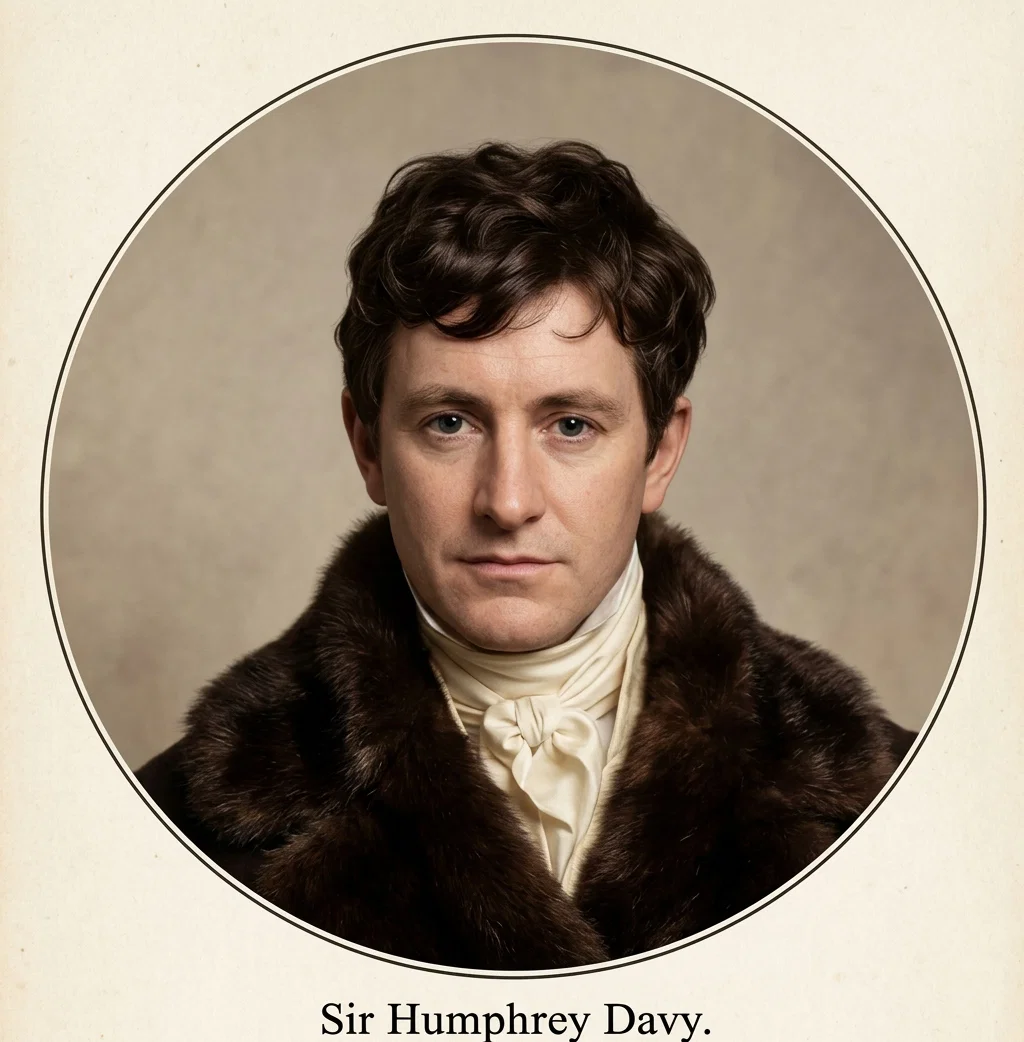
WHEN Sir Humphrey Davy was a boy about sixteen, a little girl came to him in great excitement.
"Humphrey, do tell me why these two pieces of cane make a tiny spark of light when I rub them together."
Humphrey was a studious boy, who spent hours in thinking out scientific problems. He patted the child's curly head, and said:—
"I do not know, dear. Let us see if they really do make a light, and then we will try to find out why."
Humphrey soon found that the little girl was right; the pieces of cane, if rubbed together quickly, did give a tiny light. Then he set to work to find out the reason; and after some time—thanks to the observing powers of his little friend, and his own kindness to her in not impatiently telling her not to "worry," as so many might have done—Humphrey Davy made the first of his interesting discoveries. Every reed, cane, and grass has an outer skin of flinty stuff which protects the inside from insects, and also helps the frail-looking leaves to stand upright.
Talking about children helping in discoveries reminds us of another pretty tale: In 1867 some children were playing near the Orange River, in Africa. They picked up a stone which they thought was only a very pretty pebble, far prettier than any they had found before. A neighbor, seeing this stone, offered to buy it for a mere trifle. He, in turn, sold it to some one else; and so the pebble changed hands, till at last it reached the governor of the colony, who paid $2,000 for it. This stone which the children had found was the first of the African diamonds.—Selected.
Sir Humphrey Davy.
A DUEL WITH POTATOES.
FIFTY years ago the practice of settling "an affair of honor" by means of the duel, was much more common in this country than it is now, or, let us hope, ever will be again. The feeling was even then, however, gaining ground that the practice is both foolish and immoral, and that to stand up with an adversary, pistol or sword in hand, each seeking the other's life, may be one way of testing the marksmanship or physical prowess of the combatants, but no more settles a dispute or vindicates one's "honor" than a foot-race would.
The reaction of public sentiment against the duel was due in large measure to the duel between Alexander Hamilton and Aaron Burr, and the powerful sermon preached at the former's funeral by Dr. Eliphalet Nott, president of Union College. He denounced dueling as "a crime, the very idea of which almost freezes one with horror." But it is one thing to preach against such a custom, and another thing to make it ridiculous, and the latter was happily done half a century ago by another preacher named Bowman. The story is told by J. Cuthbert Hadden in an English magazine.
Bowman was a strong, muscular man preaching in Kentucky. A well-known desperado, being rebuked by him for repeatedly disturbing the religious services, sent a challenge to the preacher. Bowman accepted, and having, as the person challenged, the choice of weapons, he selected a half bushel of Irish potatoes, and insisted on fighting with these at a distance of fifteen paces. The desperado had to consent to these strange conditions or be posted as a coward.
"The encounter took place on the outskirts of the town. Almost everybody in the place was present to see the fun. The seconds arranged the two men in position, by the side of each being a half-bushel measure filled with large hard Irish potatoes. Bowman threw the first tuber; it struck his opponent, and flew into pieces. A yell of delight went up from the crowd, which flurried the desperado, and his potato flew wide of the mark. Bowman watched his chance, and every time his opponent stooped for a potato, another hit him in the side. The desperado was struck about five times, and then the sixth potato took him in the short ribs, knocking the wind completely out of him, and doubling him up on the grass. The people were almost crazy with laughter, but Bowman looked as sober as if he had just been preaching a funeral sermon. The desperado was taken home and put to bed, and there he stayed for more than a week before he recovered from the effects of his Irish potato duel. That was the end of dueling in the Kentucky region."—The Voice.
RULES FOR LETTER WRITING.
By Pansy
HAVE you any unkind thoughts?
Do not write them down.
Write no word that giveth pain;
Written words may long remain.
Have you heard some idle tale?
Do not write it down.
Gossips may repeat it o'er,
Adding to its bitter store.
Have you any careless jest?
Bury it, and let it rest;
It may wound some loving breast.
Words of love and tenderness,
Words of truth and kindliness,
Words of comfort for the sad,
Words of gladness for the glad,
Words of counsel for the bad—
Wisely write them down.
Words, though small, are mighty things,
Pause before you write them;
Little words may grow and bloom
With bitter breath or sweet perfume,
Pray before you write them.
—Pansy.
COLTON'S ADVICE.
THE other day, as I was clinging to the strap of a Lexington Avenue car, says a writer in the Christian Advocate, two ladies sat near me, and as one opened her porte-monnaie to pay her fare a scrap of paper pasted to the leather was disclosed.
"Is that your shopping list?" asked the other; "it doesn't look like a long one."
"No," was the reply; "it is not the list, but it is what keeps the list from being a long one," and she read:—
"He who buys what he does not need, will soon need what he can not buy."
"What a capital guardian of your capital! You must let me copy that for my leaky purse. Who wrote it?"
"I don't know, but I wish I did, for he has saved many a dollar from lightly rolling from my hands since I put it here."
She referred to what Colton wrote:—
"We are ruined, not by what we really want, but by what we think we do; therefore, never go abroad in search of your wants. If they be real wants, they will come home in search of you; for he who buys what he does not want, will soon want what he can not buy."
PASTE THAT WILL KEEP A YEAR.
DISSOLVE a teaspoonful of alum in a quart of warm water. When cold, stir in flour enough to give the consistency of thick cream, being careful to beat up all the lumps. Throw in half a dozen cloves, and stir in as much powdered resin as will stand on a penny. Pour into the flour mixture a teaspoonful of boiling water, stirring well all the time. Let it remain on the stove a few minutes, and it will be of the consistency of mush. Pour it into an earthen or china vessel; let it cool, cover it, and put it in a cool place. When needed for use, soften a portion with warm water. It will last a year, and is better than gum, as it does not gloss the paper and can be written upon.—Selected.
The Lord’s Prayer: A Gate
"ALL the things that you need for yourself, or for your children, traced back, are found, in their initial forms, in the Lord's prayer. This is a birthright prayer, belonging to every man. A gate it is, through which every living soul may pass. Each petition is a separate gate. And beyond is an infinite variety of blessed things. This gate opens, as it were, into a garden where are growing fruits and flowers in wonderful profusion. Endless diversities of things are there; and all of them are appropriate to the utterance of this prayer."
JEWISH POPULATION OF PALESTINE.
By A. Ben Oliel
BY A. BEN OLIEL.
THE Turkish Government, like that of other lands, has its statistical "bureau" office; but whatever may be its success in the European provinces of the empire, here in Asia its computations are believed to be imperfect, unreliable, and mainly guesswork. The conscription and consequent tax for exemption from military service operate against it. The heads of the several religious communities—Turkish or Moslem, Jewish, Latin, Greek; Armenian, Copt, Maronite, Melchite, etc.—who coöperate in the census, have powerful motives to frustrate exactitude; for it means a larger annual taxation, for which they are made responsible. And apart from this, the inhabitants have strong prejudices against being numbered. Therefore, all estimates of population are merely approximate, and nothing more.
A young Jew of the highest family in this city, who is employed in offices of trust in the pasha's court, and has access to official records, tells me that in official circles the population of Jerusalem, including its suburbs—Bethlehem, Bethany, Mount of Olives, etc.—is now computed at 100,000, of which 60,000 are believed to be Jews. He is custodian of the roll of the Sephardim poor—widows, orphans, blind and decrepit old men and their families—amounting to 7,000 souls, that have to be provided for regularly. Yet the Ashkenazim constitute the majority of the Jewish inhabitants of Jerusalem now, and they have a roll of poor as large proportionately. He says the Sephardim pay £1,000 annually for exemption from military service, and the Ashkenazim £1,250, which, at the rate of two medjidis per head, represents 5,625 men of the age liable to service.
Jewish families are prolific, and must therefore be calculated at seven, rather than five, per family; and if one in each family is liable to service, the result is 39,375 souls. But this has reference to the Jewish rayahs—Turkish subjects; whereas there is a large admixture of those under Russian, Austrian, German, etc., protection who are free from military or other taxation. By such a process of reasoning, his estimate of 60,000 Jews for Jerusalem is almost proved mathematically.
I have before me Lunez’s first Hebrew almanac for the Jewish year 1895-96—an interesting compilation, astronomic, statistic, historic, etc. It gives the population of Jerusalem thus: "Number of inhabitants, 45,420, of which: Jews 28,112, viz., Ashkenazim 15,074, Sephardim 7,900, Mughrabim 2,420, Gurgis 670, Bucharis 530, Tamanites 1,288, Persian 230; Moslems 8,560; Christians 8,748, viz., Armenians 695, Greeks 4,625, Abyssinians 105, Syrians 23, Protestants 645, Catholics or Latins 2,530, Copts 125." He does not say so, but he can only mean the population inside the walls.
How far Jerusalem is now practically a Jewish city becomes strikingly evident on Saturdays and Jewish feast-days, for then but very few shops are open, and business is at a standstill; while the streets are full of groups of Jews, men and women, in holiday attire, on visiting rounds or lounging about.