Your ShelfYour Projects

Signs of the Times, Vol. 22, No. 40.

God's Love to You

Signs of the Times

Oct 8, 1896

Pacific Press Publishing Company · Oakland, California · Oct 8, 1896

God's Love to You.

This is the evidence of God's love to you, sinner, whoever you are: "For God so loved the world, that he gave his only-begotten Son, that whosoever believeth in him should not perish, but have everlasting life." You may believe; you may therefore be saved. And notice, and let the thought give you hope, you are not saved because of your love to him, but of his love to you. Plead his eternal, boundless love.

All the Way.

"But," says some doubtful soul, "if I begin to serve him, I will not hold out to the end, I will not prove faithful." And why? If you prove false, it will be because you prefer the false way. If you fail, it will be because you choose to fail. God "abideth faithful; he can not deny himself." So he speaks to every trusting soul: "He that spared not his own Son, but delivered him up for us all, how shall he not with him also freely give us all things?" Having given the greatest gift to save a race of rebels, think you that he will withhold a lesser to uphold his child? No, a thousand times, no. He is the beginning of the way that he may be its end. He will save now and save ultimately every soul that trusts in him.

It Is for All.

The love of God is not a monopoly. It is not a characteristic of the Father and not the Son; nor is it the reverse of this. It is the essential nature of both Father and Son; and they desire to make it the essential nature of every responsible intelligence in the universe. God loved, and "he gave his only-begotten Son." Christ loved, and he "gave himself for us, that he might redeem us from all iniquity." Both are our Friends, both our Redeemers; for Christ and the Father are One. (John 10:30.) Both are pledged in our behalf. None others can condemn us if God is on our side, and he will not if we trust him. "Who shall lay any thing to the charge of God's elect? It is God,"—but the apostle does not stop there,—"It is God that justifieth." (Rom. 8:33, 34.) He only who can make out a good case against us is the One who justifies. "Who is he that condemneth? It is Christ,"—but not there does he pause. Truly the blameless life and spotless perfection of Christ condemn all, but this is not the thought. Tho he only can condemn, "It is Christ that died, yea rather, that is risen again, . . . who also maketh intercession for us." O soul, there is all help in God! Come to him just as you are; cast yourself all broken upon his measureless love, and trust him. He will cleanse away the sin, and clothe you in his own royal robes of righteousness; he makes you his child, partaker and heir to the exceeding riches of his grace.
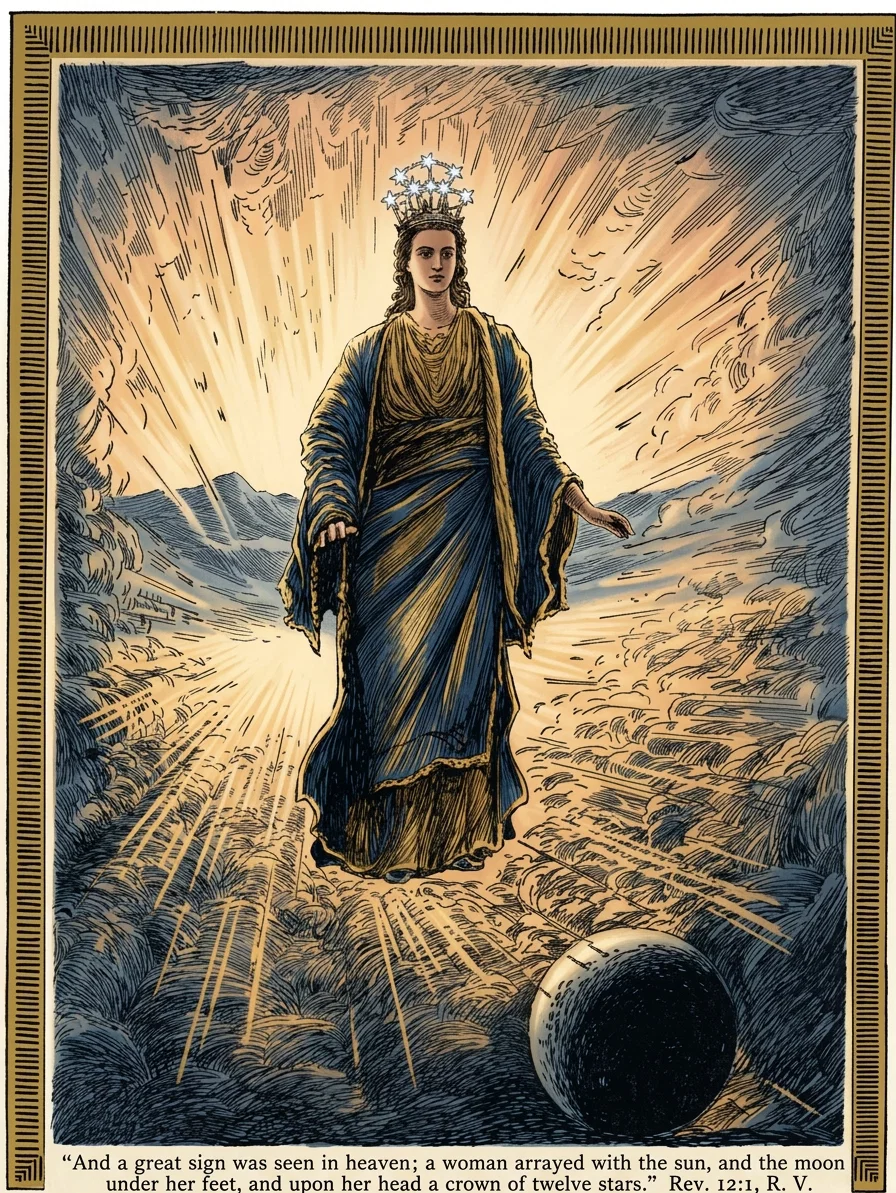
"And a great sign was seen in heaven; a woman arrayed with the sun, and the moon under her feet, and upon her head a crown of twelve stars." Rev. 12:1, R. V.

THE CONTROVERSY OF THE AGES.

Some Primary Considerations.

THERE are two books of the Bible which hold a preëminent place in the prophetic field, especially in symbolic prophecy. These are the books of Daniel and the Revelation. By successive symbols, and in brief the wonderfully comprehensive discourse, is spanned the entire history of this world, including the rise and fall of empires, and their relations to the people of God.
In all these prophecies is shown God's overruling power, restraining evil to his glory (Ps. 76:10), teaching the world the evil and the end of sin and the glorious fruits of righteousness. God's sovereign majesty, omnipotent will, and omnipresent love exercised always for the good of those who honor him, are the lessons he sought to impress upon the actors in the scenes, that they might "know that the Most High ruleth in the kingdom of men, and giveth it to whomsoever he will, and setteth up over it the basest of men;" that they might know that his "dominion is an everlasting dominion, and his kingdom is from generation to generation; and all the inhabitants of the earth are reputed as nothing; and he doeth according to his will in the army of heaven, and among the inhabitants of the earth; and none can stay his hand, or say unto him, What doest thou?" (Dan. 4:17, 34, 35.) This is the lesson God would teach those who lived when the prophecy was given and began to be fulfilled. This is the lesson that he would teach us by the record of these things; "for whatsoever things were written aforetime were written for our learning, that we through patience and comfort of the Scriptures might have hope." (Rom. 15:4.)

The Book of Daniel.

The alphabet of all these symbolic prophecies is found in the second chapter of Daniel, under the symbol of a great metallic image. It begins with the history of the great world empires and reaches to the everlasting and universal reign of Christ. Other lines of prophecy in the book of Daniel, recorded in chapters 7 to 12, expand and fill out in detail what is not told in chapter 2, bringing outmany new and characteristic features. And yet the book of Daniel is not complete. In later times, this side the coming of the Messiah, whom Daniel predicted, God has given us a supplement to the prophecies of Daniel—rather a complement, filling up what was then left incomplete. The especial part of Revelation similar to the chapters of Daniel above referred to, includes chapters 12 to 22, but the symbols are largely found in chapters 12, 13, 17, and 18.
It will be the object of these articles to develop some of the wonderful truths found in the above symbolic prophecies, taking for our mount of observation and alphabet of study the twelfth chapter of the Revelation.

The Benefits and Scope of Prophecy.

Previous to entering upon this study, however, we wish to note a few things which may be of help to us.
1. God has given his word, prophetic, didactic, devotional, as a lamp to the feet and a light to the path (Ps. 119:105) of all those who are willing to be taught and guided by him; for "the secret of the Lord is with them that fear him; and he will show them his covenant;" for "the meek will he guide in judgment; and the meek will he teach his way" (Ps. 25:14, 9). He therefore who would understand God's word must come with a meek heart and humble spirit, in the fear of God, with a desire that he may know not man's way, but God's truth, in order that he may do the truth. To such it is that God will reveal his prophetic word, and verify what he has said through prophet and apostle:—
"Surely the Lord God will do nothing, but he revealeth his secret unto his servants the prophets." Amos 3:7.
"We have also a more sure word of prophecy; whereunto ye do well that ye take heed, as unto a light that shineth in a dark place, until the day dawn, and the day-star arise in your hearts." 2 Peter 1:19.
"Blessed is he that readeth, and they that hear the words of this prophecy, and keep those things which are written therein, for the time is at hand." Rev. 1:3.
These are promises of God concerning those things which he has revealed through his prophets for the benefit of his people. May the reader ever come to the study of his word in such a spirit that he may indeed receive the blessing promised.
2. The prophetic word deals with those kingdoms which have had connection with God's people in the world and through which the molding influence upon the world came. For instance, China is a great country and the Chinese are a numerous people, and yet as a nation it has never had great connection with the people or cause of God, and never exerted a molding influence upon the world, and, hence, is rarely mentioned in prophecy, and but little in history, while Babylon and Rome are frequently referred to in the prophetic word, and history concerning them abounds.
3. In these prophecies, notably in the Revelation, we have three classes of powers symbolized and their working and spirit revealed: (a) The spiritual or supernatural forces, both good and evil, invisible to mortal eyes, but working through visible, tangible agencies; (b) ecclesiastical organizations, churches both pure and corrupt, through which the greater supernatural or spiritual forces work and influence for good or evil the minds and hearts of mankind; (c) the civil governments of earth, under limited control of Satan, but over which is the restraining hand of God. All this will be manifest as we proceed with our study.

Revelation XII.

In this chapter we have three important symbols: The woman, the dragon, and the man child. The opening verses read as follows:—
"And a great sign was seen in heaven; a woman arrayed with the sun, and the moon under her feet, and upon her head a crown of twelve stars; and she was with child; and she crieth out, travailing in birth, and in pain to be delivered." Verses 1, 2, R. V.
A pure woman in prophecy represents the true church or the body of God's people. Says the prophet, "I have likened the daughter of Zion to a comely and delicate woman." (Jer. 6:2.) "I have espoused you to one husband," says an apostle to a church, "that I may present you as a chaste virgin to Christ." (2 Cor. 11:2.) The woman seen in heaven, upheld by the power of God, is, therefore, the symbol of the people or church of God.
The expression "in heaven" would naturally show that the things symbolized were above the earth and earthly things in nature and in importance. It is in the spiritual realms that these things take place, seen only in the light of God's word by the eye of faith.
The view-point of the prophet was the opening of what is called the Christian dispensation, at the time when the church, flooded by the clearer light that shone out from the Messiah and his forerunner as compared with the light of centuries previous, is fitly represented by a woman arrayed in the sun, and with the moon under her feet, as a cast-off garment.
Previous to our Lord's first coming, the light of truth shone more dimly, represented by the light of the moon. The shadows were deeper and darker. Truth was revealed in symbolic sacrifices, offerings, and ceremonies, which in themselves had no virtue, but whose virtue lay in the One typified, Jesus Christ, even as the moon shines by light which it receives from the sun. The increased spiritual light which came at Christ's first coming as compared with the dimmer light before existing, is clearly set forth in the scriptures following. Said Zacharias of John the Baptist:—
"And thou, child, shalt be called the prophet of the Highest; for thou shalt go before the face of the Lord to prepare his ways; to give knowledge of salvation unto his people by the remission of their sins, through the tender mercy of our God; whereby the dayspring from on high hath visited us, to give light to them that sit in darkness and in the shadow of death, to guide our feet into the way of peace." Luke 1:76-79.
"The people which sat in darkness saw great light; and to them which sat in the region and shadow of death light is sprung up." Matt. 4:16.
"For verily I say unto you, That many prophets and righteous men have desired to see those things which ye see, and have not seen them; and to hear those things which ye hear, and have not heard them." Matt. 13:16.
"How that by revelation was made known unto me the mystery [the Gospel]; . . . which in other generations was not made known unto the sons of men, as it is now revealed unto his holy apostles and prophets in the Spirit; . . . unto me . . . was this grace given, to preach unto the gentiles the unsearchable riches of Christ; and to make all men see what is the stewardship of the mystery, which from all ages hath been hid in God, who created all things; to the intent that now unto the principalities and the powers in the heavenly places might be made known through the church the manifold wisdom of God, according to the purpose of the ages which he purposed in Christ Jesus our Lord." Eph. 3:3-11, R. V., margin.
The same increase of light is shown in Rev. 5:1-9, where the opening of the book of the Gospel, the revealing of the saving truth of God, was accomplished by the overcoming and death of Christ.
There is another significance to the expression "arrayed with the sun." Jesus Christ is called "the Sun of righteousness." (Mal. 4:2.) When transfigured, "his raiment became shining, exceeding white." (Mark 9:2.) The church is espoused to him. (Rom. 7:4; 2 Cor. 11:2.) He clothes her in his own royal robes, invests her in his own apparel; bestows upon her his own name. (See Isa. 61:10; Rev. 19:8; Ps. 45:13.) The glorious dress of the church eighteen centuries ago was but the outshining of the glory—Christ's righteousness—within.
That the church had conquered in some great struggle is represented by the crown, the twelve stars representing both the twelve tribes and the twelve apostles, who in the glorious restitution will rule over the twelve tribes (Matt. 19:28), the names of whom are in the foundations of the eternal city.

The Travailing in Birth.

The second verse of the prophecy reads: "And she was with child; and she crieth out, travailing in birth, and in pain to be delivered." This represents a condition previous to her victory, to her crowning and being clothed with the sun. She was with child, and during this time she was in pain to be delivered. The figure is a forcible one and known to all. Some minds may be shocked with the simile which the prophet uses, but it will be only those wrongly educated or whose minds have become basely corrupt, who look upon marriage as a license to gratify lust, and the begetting and bringing forth of children as libidinous and shameful, instead of the important and blessed and holy thing which God designed it should be. "Unto the pure all things are pure; but unto them that are defiled and unbelieving is nothing pure;but even their mind and conscience is defiled." In early times it was considered by holy women a disgrace to be without offspring,—offspring legitimate, begotten of their own lawful husbands, developing unselfishness in their own lives, strengthening love for each other, and enlarging the heart with almost infinitely tender and strong outreachings for blessing and power to bestow upon the lives of their lives. There are no longings so great as those in the heart of the true mother before her child is born. Her pain, her anguish at the time of its birth is not alone for herself, but for him in whom she is to be glorified.
So the church, with a hundredfold intensity, is represented as longing with pain and anguish for her Child. Not only is he to be her glory, but her Deliverer.

When Did It Begin?

The church of God as an organized body came into existence when God delivered his people out of Egypt and adopted them for his own, in order that they might serve him by revealing him to the world and so save others. For that purpose he bestowed upon them "the adoption, and the glory, and the covenants [old and new], and the giving of the law, and the service of God, and the promises." But he did it all that his people might reveal his glory, his law, his covenants, his service, to others, that others also might receive his adoption. And so the Lord said: "I was an husband unto them."
As long as God's people were faithful to him they prospered; this prosperity reached its earthly climax under the reigns of David and Solomon, each of whom were types of Christ. From that time the glory began to decline. The ten-tribe kingdom was subverted; only the tribe of Judah, to whom the promise of the Shiloh was made, remaining independent, having her own king, and preserving the true worship of God. In her backsliding the Lord chastened her, and in returning to him he prospered her, till at last her wickedness grew so great that the Lord removed from her his protecting arm, and the daughter of Zion was carried to Babylon. (See 2 Chron. 36:14-21.)
In the Babylonian humiliation began the travailing of the church, the anguish, the crying, the longing for the Deliverer. Her condition in captivity is thus set forth:—
"By the rivers of Babylon, there we sat down, yea, we wept, when we remembered Zion. We hanged our harps upon the willows in the midst thereof. For there they that carried us away captive required of us a song; and they that wasted us required of us mirth, saying, Sing us one of the songs of Zion. How shall we sing the Lord's song in a strange land?" Ps. 137:1-4.
In Jerusalem, obedient to God, she could sing his praise in the joy and prosperity of his presence. In captivity she mourned for the things she had lost, and longed for the Deliverer: "O that the salvation of Israel were come out of Zion!" (Ps. 14:7.) She waited with anxiety for the coming of "the Desire of all nations."
The prophet Micah, contemporary with Isaiah, after referring to the wickedness in Judah among priest and prophet, as it existed in the time just preceding her captivity, as shown by Jeremiah, predicts the destruction of Jerusalem and the captivity of the people, as well as the restoration. Thus he speaks of the church as she was going into the captivity, and was surrounded by her foes:—
"Now why dost thou cry out aloud? is there no king in thee? is thy counsellor perished? for pangs have taken thee as a woman in travail. Be in pain, and labor to bring forth, O daughter of Zion, like a woman in travail; for now shalt thou go forth out of the city, and thou shalt dwell in the field, and thou shalt go even to Babylon." Micah 4:9, 10.
A little farther along in his prophecy, after referring to the birth of Jesus in Bethlehem (Micah 5:2), the prophet again refers to the time this anguish, pain, longing, and travailing are to continue, in these words:—
"Therefore will he give them up, until the time that she which travaileth hath brought forth; then the remnant of his brethren shall return unto the children of Israel." Verse 3.
The anguish and travail began, therefore, at the time the people of God—the daughter of Zion—went into captivity, about six hundred years before Christ, and terminated when Jesus was born in Bethlehem. Then was manifest the Shiloh of the tribe of Judah, to whom the gathering of the nations should be, and not to a literal king at Jerusalem on earth.
We have learned thus far that the woman of Rev. 12:1, 2 symbolizes the church of God in her triumph after having passed through her anguish, pain, and longing of six centuries of captivity. In our next we will trace the other predictions of the prophecy.

Christ’s Coming and Reward

"Behold, I come quickly; and My reward is with Me, to give every man according as his work shall be." Rev. 22:12.

POPE LEO XIII. AND ANGLICAN ORDERS.

For years many of the clergy and members of the Church of England, who have repudiated the name Protestant, and designated themselves as Anglican Catholics, have been longing, planning, hoping, for a union with the Church of Rome. Certain Roman Catholic priests, among them Cardinal Vaughan, of England, Father Duchesne, of France, with such noted laymen as Lord Halifax and Mr. W. E. Gladstone, have favored such union. It has been hoped that Pope Leo would declare the ordinations of the English clergy valid; that is, that he would say that there was no break in their ordination from St. Peter down; that their orders of prelates were in direct line of true apostolic succession.
The real question is about this: Was the ordination of Parker, the chaplain to Anne Boleyn, who was consecrated Archbishop under the reign of Elizabeth, valid, and in true succession from Peter?
Upon this question the pope appointed a commission to make full and authentic inquiry into the facts of the matter, composed of the following, according to the Catholic Mirror of September 26:—
The commission was a remarkable one; it comprised Cardinal Rampolla, who presided; Father Di Augustinis, a Jesuit of great learning, favorable to the Anglican orders; Father Duchesne, a leading liturgical authority of France, also favorable; Father Gaspari, a professor of canon law in the University of Paris; Canon Moyes, of England; Father Gasquet, of England; Father Scannell, and Father David. In addition to these, two English clergymen were present in Rome, who took an informal part, Rev. Mr. Puller, one of the Cowley Fathers, and Rev. Mr. Lacey.
It is said that “the sympathies of the Holy Father” were warm toward the Anglicans. Notwithstanding this he declared against them. They have not “power over the real Body of Christ.” This press despatch tells the story:—
RoME, September 18.—The pope has issued an apostolic letter, in which he says: “After long study I must confirm the decrees of my predecessors, that all ordinations made under the Anglican rite are absolutely invalid.” His Holiness also entreats the Anglican clergy to return to the Catholic Church.
The Catholic Mirror thus concludes its editorial:—
Rome has spoken, and the question is settled; and it is well that it is so. There can not fail to be good results; many conversions will undoubtedly follow, especially among those who have been waiting. It is determined now that the Anglican Church is not a part of the Catholic Church. On this point there is no longer room for misunderstanding.
And to us it seems a logical course, and the decision is what might have been expected. It will doubtless result in many flocking to the Church of Rome, where logically they should have gone long ago. And the Anglicans will not be the last.

WHAT A SUNDAY LAW MEANS.

IN the Pacific Christian’s Sunday-law symposium, Mrs. A. C. Smithers falls into a very common error, which we wish to notice. While she denounces as a “fallacy” the claim that a Sunday law “would be an interference with religious liberty, and thus would be unconstitutional,” she declares that, “in harmony with the spirit of the Constitution, it is the imperative duty of the state to protect every individual in the exercise of his religious freedom, and how can this be done more effectually than for the state to enact such measures as shall require every one to so deport himself as not to interfere with those who wish to make it a day of worship?”
Our sister falls into the common error of those who do not know for what purposes human governments are ordained, of thinking that a law which protects a day, or an institution, protects men. Never was there a greater fallacy. A law to protect the sanctity of the Roman Catholic “Host” is not a law “to protect every individual in the exercise of his religious freedom.” A law to protect baptism, the Lord’s supper, a certain attitude in worship, a certain shrine of a saint, or a creed of a church, is not a law to protect men in his religious rights. The matter of preventing interference in others’ worship is not what Sunday-law people demand. Such laws exist in every state, applicable and sufficient for Sunday and all days alike. If a man disturbs that worship he is as liable to arrest in California, where no Sunday law exists, as in other states where Sunday laws do exist. If it is necessary to have a Sunday law to protect the rights of those who wish to make Sunday a day of worship, justice demands that there shall be a Sabbath law to protect the rightsof the Sabbath-keeping Christian and Jew, who wish to make the seventh day a day of worship. But this is not what Sunday-law people want, nor would they for a moment consent to it. They wish to use the seventh day in business, and would not vote away their rights to thus use it if they so elect. So it is with the Jew or the Sabbatarian. Numbers are of no account where human rights are at stake. The fact is that Sunday-law people desire a Sunday law, not to protect men, but an institution. And such a law, according to the invincible logic of facts, has always resulted in discrimination and persecution of one class and the exaltation of another.

During the Dark Ages

THE SABBATH AND THE SUNDAY. NO. 5.

IN our last compilation of historical facts we traced the Sabbath and Sunday question down to the middle of the fifth century, the writings of the historians, Socrates and Sozomen, who flourished about the year 450. It is their testimony that, except in Rome and Alexandria, the two chief seats of apostasy, the Sabbath was generally observed throughout the Christian world. In this time of apostasy, Sunday was, however, gradually crushing it out. It had already appropriated to itself so much of the livery of heaven as to call itself the Lord's day, but it was not yet known as the Sabbath. The two days were called "sister days" in the church, as witness Gregory of Nyssa, two weeks ago. But one, the Sabbath, was made a fast day, and Sunday, a festival. Both of these customs were pagan in origin. Sunday was "the wild solar holiday of all pagan times," a day of feasting and pleasure, and "Harper's Standard Latin Lexicon" says of Sabbatum: "In general, the day of rest among the Jews, the Sabbath; considered by the Romans to have been ordained as a fast day," and cites in proof of it, Pliny, Justin, and others. Both this feasting and fasting came from the pagans.

During the Dark Ages.

55. Thus the third council of Orleans (29th canon): "The opinion is spreading amongst the people that it is wrong to ride or drive, or cook food, or do anything to the house or the person on the Sunday. But since such opinions are more Jewish than Christian, that shall be lawful in future which has been so to the present time. On the other hand, agricultural labor ought to be laid aside [note the reason], in order that the people may not be prevented from attending church."
56. A council was held by King Gunthrum in Mascon, Burgundy, and this council warned Christians to "keep, then, the Lord's day."—Morer's Dialogues on the Lord's Day, p. 265.
57. Another council was held at Narbon, which threatened confiscation and banishment to those who would not keep the Lord's day.—Id., pp. 265, 266.
58. Like many other frauds, bogus miracles were brought forward to support it, (Dialogues on the Lord's Day, p. 68, and Francis West's Historical and Practical Discourse on the Lord's Day, p. 174), as for instance, a man went into his field to plow, and as he scraped the earth from his plow, the iron he used stuck to his hand, and for two years he was forced to carry it about.
59. At this time another foe arose to the Sabbath of the Lord, the Mohammedan sixth day. The Sabbath, like its Lord, was crucified between two thieves, the Mohammedan sixth day, and the Roman Sunday.
60. A provincial synod of Burgundy at Chalons, according to Morer (Dialogues on the Lord's Day, p. 267), pronounced as penalties to those who would not keep Sunday, beating, confiscation, and slavery.
61. The twelfth council of Toledo, Spain, says the same author, forbade the Jews to keep their own festivals and to do work on Sunday.
62. The same writer (p. 283) tells us that Ina, the king of the West Saxons, by the advice of his father and bishops, fined a master thirty shillings if his slave worked; if a freeman worked, sixty shillings; but if a priest, one hundred and twenty shillings.
63. The same work tells us that laws were made from time to time in England, Bavaria, and Italy to suppress Sunday labor.
64. From the last date forward was a succession of decrees, penalties, councils, fines, "miracles," "divine judgments," and efforts of all sorts to induce the people to observe Sunday better. Popes, kings, bishops, and rulers (civil and ecclesiastic) were appealed to, and thundered their decrees and anathemas, with little effect, down to the year 1000.
65. Dr. Francis White (Treatise of the Sabbath Day, London, 1635, p. 202) says: "When the ancient "fathers" distinguish and give proper names to the particular days of the week, they always style the Saturday Sabbatum, the Sabbath; and the Sunday, or first day of the week, Dominicum, the Lord's day." And Dr. Peter Heylyn testifies (Hist. of the Sab., part 2, chap. 2, sec. 12): "That whenever for a thousand years and upwards, we meet with Sabbatum in any writer of what name soever, it must be understood of no day but Saturday."
66. "The first who ever used it [the name "Christian Sabbath"] to denote the Lord's day," says Heylyn (Hist. of the Sab., part 2, chap. 5, sec. 13), . . . is one Petrus Alfonsus, . . . who calls the Lord's day by the name Christian sabbath." This is the precedent for that term as applied to Sunday. Alfonsus wrote about 1100.
67. Henry II. of England had a vision of St. Peter at Cardiff, Wales, and the apparition "charged him," Morer (Dialogues on the Lord's Day, p. 288) tells us, "that upon Sundays, throughout his dominions, there should be no buying or selling, and no servile work done."
68. In the year 1200 Eustace, the abbot of Flaye, Normandy, went into England to preach. He found open markets and all sorts of sports on Sunday, and he began to preach against them, with but little effect. Returning to Normandy, he went back to England the next year, and took with him "The Holy Commandment as to the Lord's Day," said to have come down "from heaven to Jerusalem, and was found upon the altar of St. Simeon, in Golgotha." In this wretched falsehood the Lord is represented as commanding Sunday to be kept from 9 o'clock Saturday until sunrise Monday. If his people will not do it, he swears by his seat and throne and cherubim that he will reign from heaven upon them "stones, and wood, and hot water in the night," so the people could not dodge them, and that he would send beasts with the heads of lions, hair of women and tails of camels, which would devour them. This was in 1201.
So says Hoveden's Annals (Bohn's ed., vol. 2, pp. 526-528). See also Matthew Paris (Historia Major, pp. 200, 201, ed. 1640). The command was worthy of the day it sought to promote.
The fact of there being such a commandment, which doubtless came from the pope himself, is unquestioned. The pontificate of Innocent III., then pope, was said to have been "the period of the highest power of the Roman See." This was marked by a bogus commandment "from heaven" in behalf of Sunday. This command was supported by all sorts of miracles. Blood came from bread baked on Sunday. Blood flowed instead of flower from mills which ground on Sunday, some hot ovens would not bake on that day, while dough set one side on that day was baked without fire!
All these things show the reader that down to the year 1200 the Sunday was not known or kept as a sacred day by the church generally. It is no more sacred now than it was then.
(To be continued.)

Question Corner.

"Enquire, and make search, and ask diligently."

No. 431. What People? The Observance of the Sabbath.

(1) In St. Matt. 5:21, 27, etc., what people did Christ refer to by "them of old time"? (2) Were there any other people besides the children of Israel at the time the Ten Commandments were given on Mount Sinai? (3) Can a person keep the Sabbath—the fourth commandment of the Decalogue—and carry his milk, or cause or allow his milk, which is manufactured into cheese or butter on the Sabbath, to be taken to the factory on that day?
1. "Them of old time" was the children of Israel. See the references from Matt. 5:21, 27, to the commandments in Exodus 20. The margin gives the better reading. It was not said "by them of old time," but "to them of old time." But God required more than the outward observance of the law; it can only be observed by having the heart right.
2. Yes, there were the "mixed multitude" from Egypt, and the relatives of Moses' wife, some Midianites. See Ex. 18:5-27 and Num. 10:30-32. The departing may not have taken place until after the law was spoken. However, it was given to all the world through the Hebrews, even as all revealed truth came to the world through them. See Rom. 9:4, 5.
3. To the third question we can not reply dogmatically. Circumstances of this kind are so varied, motives are so different, that it is impossible to decide for others. These questions of motives and morals must be decided between the actor and God. Many farmers think that it makes less work to have their milk go to the factory than it would be to keep it at home. Others keep it at home that day. Let every brother be sure that his course is right with God, and let us all be careful not to judge one another any more. See Rom. 14:12, 13. Yet, only so much Sabbath work of our own should be done as is necessary. "Remember the Sabbath day, to keep it holy," is a command for all the week.
Continue reading: WITNESSING FOR GOD