Your ShelfYour Projects

Signs of the Times, Vol. 22, No. 40.

God's Love to You
Earlier text: God's Love to You
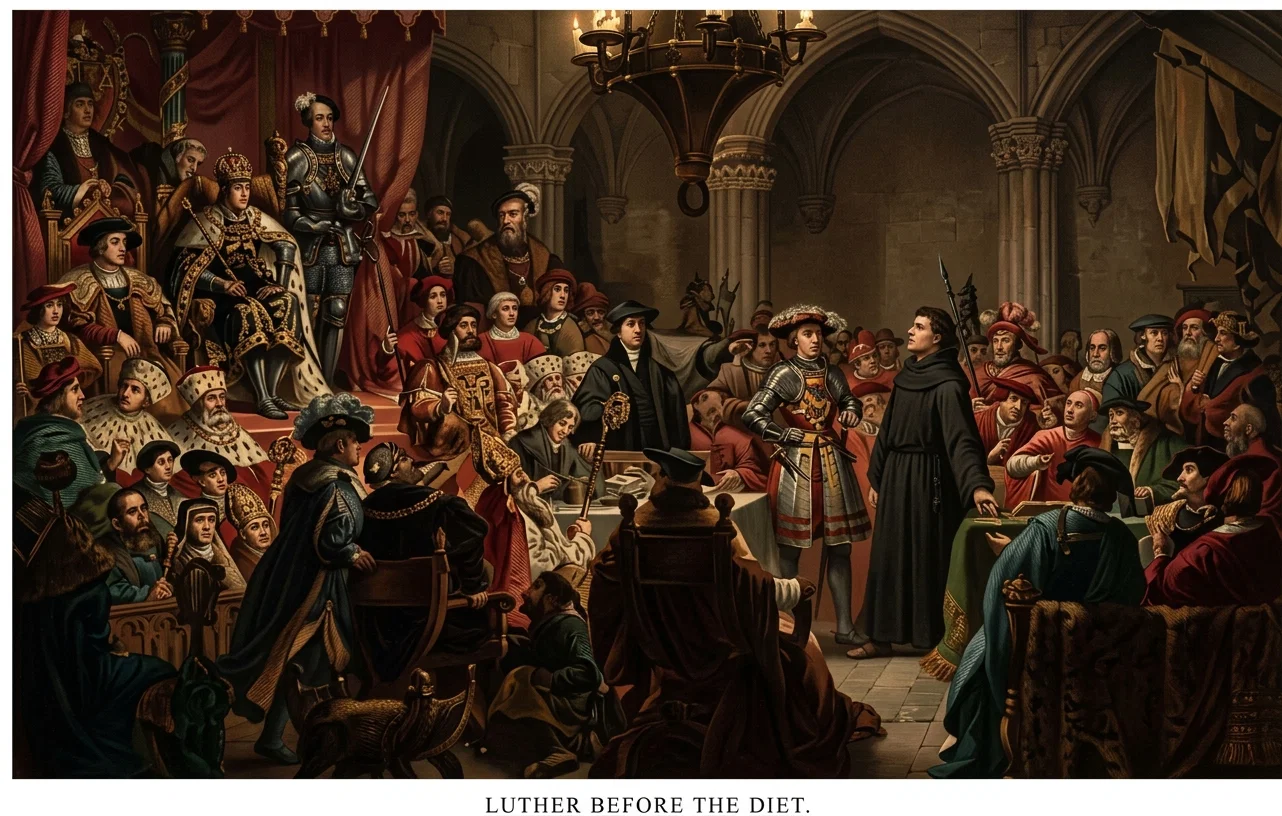
LUTHER BEFORE THE DIET.

WITNESSING FOR GOD.

BY MRS. E. G. WHITE.
"Ye are a chosen generation, a royal priesthood, an holy nation, a peculiar people, that ye should show forth the praises of him who hath called you out of darkness into his marvelous light."
All who advocate truth in distinction from error, have a special work to do in vindicating the law of God. Men inspired by a power from beneath, have regarded it their duty to uphold, as the sabbath of the Lord, the first day of the week. By disregarding the claims of God, ministers, who claim to preach the Gospel, are echoing the words told to Adam and Eve in Eden, that if they transgressed the law, they would not die, but would be as gods, knowing good and evil. The influence and example of these men have caused a lie to be received as truth. With persevering energy they have labored to establish a spurious sabbath, and this man-made institution has received the homage of the greater part of the world. But this does not make a day holy which God has given us as a common working day. Though this error is hoary with age, though the world is bowing in reverence to it, it still remains an error and a delusion; for God says, "To the law and to the testimony; if they speak not according to this word, it is because there is no light in them."
Well-nigh universal contempt is shown to the law of God, and all who are loyal to him have a sacred and solemn work to do in magnifying the law, and making it honorable. God placed his sanctity upon the seventh day, and gave it to man to keep holy; and he says, "My covenant will I not break, nor alter the thing that is gone out of my lips." By rendering obedience to his commandments, we uphold the honor of God in the earth.
Satan works against the law with untiring energy, and God calls upon his people to be witnesses for him by pressing the battle to the gates. This work must advance, or it will go backward. In this war there is no release. Those who take part in it must put on the whole armor of God, that they may fight manfully in the warfare against evil.
Often God's soldiers will find themselves brought into difficult places, they know not why. But are they to relax their hold because difficulties arise? Is their faith to diminish because they can not see their way through the darkness? God forbid. They are to cherish an abiding sense of God's power to uphold them in their work. They can not perish, neither can they lose their way, if they will follow his guidance, and strive to uphold his law.
The experience of the children of Israel in the wilderness should guide us in our work. The word of the Lord declares, "All these things happened unto them for ensamples; and they are written for our admonition, upon whom the ends of the world are come." In their journeyings the Lord brought the children of Israel into hard places, to test their faith and their fidelity to him. He had pledged himself to bring them into the promised land, and if they had waited patiently for the Lord, reviving their faith in him by recounting his great goodness and his wonderful works in their behalf, he would have shortened their test. But they forgot their heavenly Leader. Murmuring and complaining, they vented their wrath and bitterness upon Moses, forgetting that their emergency was God's opportunity.
To-day God says to his people, Do not imitate the children of Israel by showing unbelief when brought into difficulties. For "there hath no temptation taken you but such as is common to man; but God is faithful, who will not suffer you to be tempted above that ye are able; but will with the temptation also make a way to escape, that ye may be able to bear it."
"Dearly beloved," says the apostle Peter, speaking by the Holy Spirit, "I beseech you as strangers and pilgrims, abstain from fleshly lusts, which war against the soul; having your conversation honest among the Gentiles; that, whereas they speak against you as evildoers, they may by your good works, which they shall behold, glorify God in the day of visitation." God has led us out to stand in defense of his law, and he calls upon us to let our light so shine that others, seeing our good works, may be led to glorify our heavenly Father. We have no time to waste in thinking of our individual difficulties. When we bemoan the hardness of the way, we turn from the path of faith. God can make us fully able to go up and possess the promised land. He says, "Blessed are they that do his commandments, that they may have right to the tree of life, and may enter in through the gates into the city."
If our path is not always made plain and easy, if we are not always so well favored as we think we should be, let us look to God, and say in faith, By the mighty cleaver of truth God has separated us from the world, from its customs and maxims, and has chosen us as his peculiar people, and he is able to work for us. Let us go forward in the strength of the Lord God Almighty, striving to uplift his law in the earth. So shall we testify to his truth. "Ye are my witnesses, saith the Lord, and my servant whom I have chosen; that ye may know and believe me, and understand that I am he; before me there was no God formed, neither shall there be any after me." "I have declared, and have saved, and I have showed, when there was no strange god among you; therefore ye are my witnesses, saith the Lord." "That they may know from the rising of the sun, and from the west, that there is none besides me."

WHAT IS THY LIFE?

BY CATHARINE Y. GLEN.
WHAT is thy life, that thou shouldst toil and plan, And struggle with the "moth and rust," For a poor handful of earth's dust, O heart of man? A spark that glimmereth an instant in the dark— A breath that quivereth ere it is lost in death— A power that reigneth for an hour— Is this thy life?
Wilt thou find comfort in the name of Destiny? Or say that Fate's unceasing wheel Hath whirled thee into being, and will still bear thee along? One, and One only, standeth on the verge Of the eternal silence—One Who doth ever whisper to thy doubting soul, "Trust and be strong!"
—N. Y. Observer.

Sound Living and True Thinking

We must live more soundly in order to think more truly. From the heart of God we read the deep secret of his eternal purpose.

The Church Is a Force

I HAVE ceased to look upon my church as my field. It is more than my field—it is my force.—C. H. Parkhurst.

The Free Salvation of God

CATHOLICISM vs. CHRISTIANITY. NO. 2.

The Free Salvation of God.

THE article on the Catholic doctrine of penance, which makes every man his own saviour, closed two weeks ago with the statement: "Thus by her own showing, the god of the Papacy is of such a disposition and character that it is necessary for men, wicked men, to do 'good acts' in order to move him; and then, after they have thus moved him, it is still essential that they shall pay 'a debt of temporal punishment' in order to induce him to allow them the justification which they have so hardly earned."
But such is not the God of the Bible. Such is not the God and Father of our Lord Jesus Christ. Such is not his way of justifying men. Such is not his way of salvation. Here is his own announcement of his name, which is simply the proclamation of his character and his disposition toward all mankind: "I will make all my goodness pass before thee, and I will proclaim the name of the Lord before thee. . . . And the Lord passed by before him and proclaimed: The Lord, the Lord God, merciful and gracious, long-suffering, and abundant in goodness and truth, keeping mercy for thousands, forgiving iniquity and transgression and sin." This is the true God.
"Merciful"—full of the disposition to treat people better than they deserve. Mercy is not to treat people as they deserve. It is not merely to treat people better than they deserve, in an outward way. It is not to wait till one is "moved" by good deeds and punishments to grant what has been thus already earned. No, no. It is the disposition, the very heart's core of the being, to treat all persons better than they deserve. This is the Lord, the true God. "He doth not afflict from the heart, nor grieve the children of men." Lam. 3:33, margin. "He hath not dealt with us after our sins; nor rewarded us according to our iniquities. For as the heaven is high above the earth, so great is his mercy toward them that fear him. As far as the east is from the west, so far hath he removed our transgressions from us. Like as a father pitieth his children, so the Lord pitieth them that fear him. For he knoweth our frame; he remembereth that we are dust." Ps. 103:10-14. His mercy is great above the greatness of the heavens. Ps. 118:4.
"Gracious"—extending favor. And that without measure; for it is written: "Unto every one of us is given grace according to the measure of the gift of Christ." Eph. 4:7. And the measure of the gift of Christ is but the measure of "all the fulness of the Godhead bodily." And this is the measure of the full and free favor that God has extended to every soul on this earth, just where he is, and just as he is. And this boundless grace to every one, brings salvation to every one in the same measure as is given the grace, which is the measure of the gift of Christ. For again it is written: "The grace of God which bringeth salvation, hath appeared to all men." Titus 2:11. As the grace, the favor, of God is full and free to every one; and as this grace brings salvation; so the salvation of God is a full and free gift to every one. Tho it is freely given, he will compel no one to take it. As it is freely given, it must be freely received. And the receiving of the free gift of God is the exercise of the faith which he has also freely given to every man. "For by grace are ye saved, through faith, and that not of yourselves, it is the gift of God." Eph. 2:8. "Therefore it is of faith, that it might be by grace, to the end the promise might be sure to all the seed." Rom. 4:16.
This is God's way of justification; by grace, through faith; and of faith, that it might be by grace. "Being justified freely by his grace, through the redemption that is in Christ Jesus, whom God hath set forth to be a propitiation through faith in his blood, to declare his righteousness for the remission of sins that are past, through the forbearance of God." Rom. 3:24, 25. Justification is the free gift of God through the righteousness of Jesus Christ, who is altogether the free gift of God. For "as by the offence of one, judgment came upon all men to condemnation; even so by the righteousness of one the free gift came upon all men to justification of life." Rom. 5:18. And the receiving of this gift of justification, this gift of righteousness, as the free gift of God which it is, this is the exercise of the faith which God has given. And this is justification, this is righteousness, by faith: "Even the righteousness of God which is by faith of Jesus Christ unto all and upon all them that believe; for there is no difference." Rom. 3:22. The faith being the gift of God, the righteousness which it brings and which is wrought by it is the righteousness of God. And this is righteousness, justification, by faith alone, of which by her own boast the Catholic Church knows nothing; and in so boasting advertises her utter lack of Christianity.
True, men are to repent, and they will repent when they find God as he is in truth, as he is revealed in Jesus Christ. For "it is the goodness of God" that leads men to repentance; and repentance itself is the gift of God. Rom. 2:4; Acts 5:31. True repentance being the gift of God, is perfect in itself, and needs no punishing of ourselves to compensate for the imperfection in it. But when the repentance is of ourselves, it has no merit that can bring to us any good, and all the punishment of ourselves that could ever be inflicted by ourselves or in ten thousand purgatories never could compensate for the imperfection of it. For it is simply impossible for any man to save himself by punishment or in any other way.
The salvation, the justification, offered to mankind by Christianity, is altogether of God by faith. The salvation, the justification, offered to mankind by the Papacy, is altogether of self by penance. The salvation offered by Christianity saves to the uttermost all who will receive it. The salvation offered by the Papacy brings to utter destruction all who follow after it. And yet the professed Protestantism of to-day recognizes "Christianity" in the Papacy! Than this, nothing could possibly show more plainly how completely apostate such Protestantism is, not only from true Protestantism, but also from true Christianity.

"GOD IN THE CONSTITUTION."

BY W. N. GLENN.

THE advocates of the proposed religious amendment to the United States Constitution persistently use the argument that, after God had given victory to the Revolutionary army, it was the height of ingratitude to omit formal mention of his name or recognition of his sovereignty in the Constitution of the government which was brought into existence as a result of the great struggle for liberty. But those who bring forward this argument as persistently ignore the fact that God is more highly honored in the practical recognition of the right of every man to worship God according to the dictates of his own conscience. The adoption of the Saviour's own principle of the separation of church and state, in the organization of the government, was far more in harmony with his own enunciations regarding civil government than would have been the implanting of a nominal honor calculated to form a pretext for legislation that would soon overthrow all the good results of the God-given victory.As long as the government continued in its legitimate sphere, and no laws were made or court decisions handed down in any way designed to fasten religious tenets upon the people, Christianity flourished in the United States as it never did in any country after the first century. In later years, however, since Congress, Legislatures, and Courts have been taking cognizance of religious matters, the dragon head of religious tyranny is showing itself in every quarter of the Union. Professed Protestantism is following in the wake of Roman Catholic precedent, and professed Christianity is seeking the puny support of the civil government rather than relying upon the strong arm of the Lord. As a further consequence, the nominal church has joined hands with the world. With a great flourish of trumpets she would formally place the name of God in the Constitution, while her heart has turned from the doctrine of Him who said, "My kingdom is not of this world."
A precedent is kept conspicuously before the people, namely, the chaplains in Congress, as an argument that while God is daily invoked in the halls of legislation, consistency demands that he be formally recognized in the fundamental law of the land. Referring to the men who formulated our government, the Christian Statesman quotes approvingly from the American Tyler, organ of the Freemasons, the following expression:—
While we revere the memory of the men of that hour, we are not blind to the crudities and omissions that marked the foundations they laid when beginning the building up of a nation. The most glaring of these was the total ignoring of the Power that had led them from the nucleus of dependent colonies to finally become one of the greatest nations on earth. It is therefore time that this long-deferred recognition of "Our Father who art in heaven" took place here on earth. Even if it be but a mere form, it is a form bearing the shadow of gratitude from a people exceptionally favored, directed, and honored above all others in the great family of men. Therefore say we, let three more letters in the alphabet be added to the American Constitution, and let these three letters spell GOD!
Inasmuch as a Masonic journal can not recognize Christ, the Statesman must needs help it out with a little National Reform "logic," in order to be itself consistent in the indorsement; for it is Christ whom the Reform combination is trying to "take by force to make him a king" of this worldly government. So it adds the following:—
This argument is for the acknowledgment of God, and not for the acknowledgment of Christ and the Bible. And yet the logic of it can not stop short of the Christian's God, in whose name Christian chaplains open Congress with prayer, nor of the Bible, in which we have the revelation of this God and the moral law which he has given for nations. This Masonic journal will either have to advance to the distinctively Christian ground, or else it will be constrained to abandon the positions it has already so strongly taken. We shall look with more than ordinary interest for its further utterances on the subject.
As to the Christianity of the Congressional chaplaincy, or the honor which is likely to come of it to the name of the Lord, we submit a report of the election of the present chaplain of the lower House of Congress at the session of last winter. The report is from the New York World's Washington correspondent, and gives a fair idea of what is to be expected of political religion:—
"WASHINGTON, Dec. 1, 1895.—Eight men of God wrestled together Saturday for one of the fleshpots of Egypt, and prolonged the contest far into the Sabbath [Sunday]. The struggle over the chaplaincy of the House between the ministers who hunger for honor and pelf was the only excitement of the Republican caucus. The office is one of great dignity; it is a holy office, but it is also a salaried office at $900 a year. Therefore were dignity and holiness forgot and the scramble made so undignified as to excite the ridicule of the members of the House to whose souls the rival preachers sought to minister.
The candidates were Revs. O. A. Brown, W. E. Parsons, W. H. Gottwald, C. B. Ramsdell, W. H. Brooks, and H. D. Smith, of this city; H. D. Fisher, of Kansas, and H. U. Couden, of Michigan. Rev. Fisher and Rev. Couden based their claims on their war records, and one or two of the candidates based theirs on their color and the Republican obligations to the negro race. Parson Couden, who proved successful, had sentiment as an ally, for he is blind, and his eyesight was lost in battle, and moreover he waved the ensign of the G. A. R. Parson Fisher had only one war-cry: 'I am the fighting parson of Kansas, and Jim Lane said in the Senate I saved his brigade by my gallantry.' With these recommendations for the office of intercessor between offended Heaven and a sinning Congress, the battle began.
Long before the caucus met last night the parsons were at work in the crowds which filled the house lobby and the committee rooms. They flitted in and out of the rooms, and were here, there, and everywhere, and they buttonholed without mercy. They were the envy of the little politicians who had flocked to the capitol to witness the election of men from whose hands they hope to receive the crumbs of patronage. The most active of all was Fisher. He justified his title of 'the fighting parson of Kansas.' He wore a heavy, soiled, and ancient ulster. The nap of his silk hat bore the marks of battle. His thin, brown face was seamed with age and want, but his eye glowed with the light of warfare from under bushy gray brows. To everybody he was introduced with the old tale about Jim Lane's commendation, and as his gallantry was mentioned he would cast a sidelong glance downward and give a deprecatory assent to the recital. He had the advantage of being on the 'combine' ticket, but as some of the Kansas men did not support the other combine candidates, he knew that the strength of the coalition would not be his.
"But we know this," he said, "that we'll either lick or be licked," and then he would make a charge upon another foeman. Another very active parson, who was sleek, white-necktied and clerical, soon found that he was not in the fight. He had scrambled with the best until then. When he realized his fate, he recalled dignity and holiness and said, sadly: "O, if I had only known what a disgraceful scramble it was to be, I should never have become a candidate."
In the caucus the friends of the candidates took up the scramble. It required three ballots to nominate. On the first two the "fighting parson" led. The second stood 109 for Fisher, 104 for Couden, and 6 scattering. One more vote would elect Fisher, and Couden's men were frightened. It was then Sunday morning, but that was of no consequence in this strife of parsons. The Couden men got up on desks. They howled and shouted. You could hear them cry, "Mr. Chairman," through the closed doors of the chamber. Through the door windows you could see men waving their hands over their heads to attract attention. The purpose was to force a third roll call before any one could change to Fisher. They succeeded, and Couden was nominated.
Some one asked the fighting and licked parson why he wanted to make such a fight for a petty $900 place.
"If you had preached all your life out in Kansas for $700 a year, you wouldn't ask," he replied mournfully.
Such scenes are only what could be expected to result from even a limited alliance between the state and religion. To add, if it were possible, to the absurdity of the position, it is only necessary to say that the prayers of these legislative chaplains are often mere political utterances favorable to some party policy. For instance the published initial prayer of the successful candidate mentioned in the foregoing report, was simply a tirade of censure against the party opposed to the one to which the chaplain adheres, and his invocation was merely for the continued success of his party's domination. Yet the existence of such a system is continually held up as one of the evidences that this is a "Christian nation," and that the Constitution ought so to declare.

FACTS CONCERNING THE SABBATH QUESTION.

A "FREE-LANCE" writer, D. T. Baxter, in the Morning Herald, of Lexington, Kentucky, of August 31, has the following to say with reference to Sunday and the Sabbath, which it would be well for all to ponder:—
Since I have been away I notice Sunday baseball has become quite a fad in Lexington and I understand that nearly two thousand people attended the game yesterday afternoon, played by the Lexingtons and Paris. I also learned that Brother McGarvey preached against Sunday baseball last night. The Young People's Christian Endeavor Society of the Central Christian Church and several other societies also took action yesterday on what is considered the desecration of the sabbath. I know I will have all the preachers in Lexington down on me when I say that there is absolutely no authority in either the Old or the New Testament for observing Sunday as the sabbath.
Sunday is a man-made sabbath, and man did not keep it as the sabbath until several centuries after the crucifixion of Jesus. The Jewish Sabbath (the seventh day) is the only day set apart by God as the Sabbath. Nor did God impart this command in a second-hand way. He wrote it twice on tablets of stone. The first time he wrote it Moses, upon seeing the children of Israel worshiping the golden calf after he had come down from Mt. Sinai, got mad and threw the stones on the stones on the ground, breaking them in pieces. Again did God write the Ten Commandments on tablets of stone, and this time Moses did not break them. In order that some of my doubting friends may think that man can designate any day in the week and keep it as the sabbath, I will quote the commandment as twice written by the Great Jehovah, the God of Abraham, Isaac and Jacob, the great I AM, the God of the Christian world, the Father of Jesus the Christ, and the One alone who is all-powerful, all-knowing, omniscient, and who has existed for all time, and who will continue to exist forever:—
"Remember the Sabbath day, to keep it holy. Six days shalt thou labor, and do all thy work; but the seventh day is the Sabbath of the Lord thy God; in it thou shalt not do any work, thou, nor thy son, nor thy daughter, thy manservant, nor thy maidservant, nor thy cattle, nor thy stranger that is within thy gates; for in six days the Lord made heaven and earth, the sea, and all that in them is, and rested the seventh day; wherefore the Lord blessed the Sabbath day, and hallowed it."
It seems to me that is very plain English, and how anybody can substitute the first day of the week for the Sabbath and at the same time say they believe what God himself wrote, is more than I can understand. The Ten Commandments, of which this is one, comprise all that the Great Jehovah ever wrote, so far as we have any record. It is true that Moses saw him face to face in the burning bush before the thunders of Sinai announced to the great Israelite that he was ready to write with his own fingers that code of moral law which is to-day the basis of all our laws, except Sunday laws. It will be observed that God gives a specific reason for observing the seventh day as the Sabbath, and our modern Christians, by insisting on the observance of Sunday, indirectly say that God didn't know what he was talking about when he made the seventh day the Sabbath, and that any other day will do just as well. To carry this reasoning to its logical sequence, one might add to several of the commandments. For instance: "Thou shalt not kill any of thine own household." "Thou shalt not steal from citizens of thine own country," etc.
While this Sunday question is up, I would like for some of the learned divines to tell me who first designated Sunday as the sabbath, and how it was observed, and what penalties were inflicted for its non-observance, and what provisos were made for seed-time and harvest, and in fact all the information regarding the changing of the will of God on this subject into the will of man. It would make interesting reading, and would give the people information which thousands of them do not now possess.
Continue reading: CHAPTERS IN OUR NATION'S HISTORY.