AMONG the chief characteristics of the worldling and the Christian are these: the first lives, plans, and labors for today; the second lives, plans, and labors for eternity. The ambitions of the one center entirely about self. Every purpose and enterprise engaging his attention is to a greater or less extent considered from the viewpoint of the influence it will have upon his personal interests. It could not be otherwise, for he walks after, or according to, the flesh, and his enjoyments and benefits are bounded by his present life; and, at the best, the ultimate of his ambitions when attained, are as a fleeting shadow or a fading flower. “For all flesh is as grass, and all the glory of man as the flower of grass. The grass withereth, and the flower thereof falleth away.” The ambitions of the other center in Christ, whom he serves, and the ultimate of his ambitions is the everlasting kingdom of God, the interests of which he is ever seeking to advance, which with its glory and greatness under the whole heaven shall be given finally to the people of the saints of the Most High.
Naturally, these distinguishing characteristics will mold the lives of these two classes; and, notwithstanding many of the first class may and do by profession identify themselves with the second class, so that the dividing line cannot always be clearly discerned, yet eventually by these distinguishing characteristics the entire human family will be separated into two well-defined divisions, the servants of self and the servants of Christ; for “no man can serve two masters: for either he will hate the one, and love the other; or else he will hold to the one, and despise the other. Ye cannot serve God and mammon.”
The service of mammon, or the world, is but another name for the service of self, and James tells us that “the friendship of the world is enmity with God. Whosoever therefore will be a friend of the world is the enemy of God.” The service of God calls for the best and all there is of a man. There is no room for a division of our affections or interests; for on one occasion, when a lawyer questioned as to which is the great commandment of the law, the Saviour made known the secret of acceptable service by answering: “Thou shalt love the Lord thy God with all thy heart, and with all thy soul, and with all thy mind. This is the first and great commandment, And the second is like unto it, Thou shalt love thy neighbor as thyself. On these two commandments hang all the law and the prophets.”
On another occasion he stated it in this manner: “If any man come to me, and hate not his father, and mother, and wife, and children, and brethren, and sisters, yea, and his own life also, he cannot be my disciple. And whosoever doth not bear his cross, and come after me, cannot be my disciple.”
It is not always the love of gold and silver and worldly glory that entices man from the single-hearted service to God that is required, but he is many times unduly influenced by those who are near and dear to him. But God can receive no divided allegiance. So by the mouth of Moses God instructed his people in olden times that “if thy brother, the son of thy mother, or thy son, or thy daughter, or the wife of thy bosom, or thy friend, which is as thine own soul, entice thee secretly, . . . thou shalt not consent unto him, nor hearken unto him.”
The Lord is gathering a people from every nation under the sun, who are to be the citizens of a heavenly land, the glory and riches of which defy portrayal by human language; but we are told that its metropolis has its foundations laid in all manner of precious stones, and its streets are of pure gold. The only entrance to this kingdom of glory is through his kingdom of grace, the kingdom established in infinite love and founded upon an infinite sacrifice. “For God so loved the world, that he gave his only begotten Son, that whosoever believeth in him should not perish, but have everlasting life.”
In every age the propagation of the truths of this kingdom has been accomplished only by the devotion and sacrifice of its believers. Abraham, in order that he might make its blessings possible to the inhabitants of Canaan and Egypt, forsook friends, relatives, and home, sojourning in a strange country, dwelling in tabernacles with Isaac and Jacob. Moses turned his back on the throne of Egypt, “choosing rather to suffer affliction with the people of God, than to enjoy the pleasures of sin for a season; esteeming the reproach of Christ greater riches than the treasures in Egypt: for he had respect unto the recompense of the reward.” Paul gladly suffered the loss of all things, and counted all his worldly prospects as the refuse of the earth, that he might win Christ and enter into his labor and sufferings.
And so, too, it has been with the early workers in this message, the early history of the denomination having been created through the untiring toil and self-denial of the men and women to whom God had sent a knowledge of this last message of mercy. Today we begin to see some of the results of their self-denial. A strong work has been well established in all parts of the world. Thousands of converts have been re-claimed from the darkness of heathenism, gladly taking upon themselves the responsibilities attendant upon their new experience, fully entering with us into this service of Christ.
But while the believers willingly give of their labor and means, the work in many of these lands is rendered very difficult on account of the great poverty prevailing among the masses, and the scarcity of laborers to properly care for the constantly increasing interests. Upon those living under more favorable conditions must therefore continue to rest the chief responsibility of providing the necessary funds to care for these fields. The rapidly closing work, with its increasing demands; the magnitude of the task before us; and the character that must be developed in all before the end shall come, call for that complete self-sacrifice that has made the plan of salvation possible, and has characterized the lives and labors of God’s servants in early days.
The situation and need for today were set forth in clear terms by Sister White, as follows:—
“The progress of our foreign missions depends not alone upon a few laborers, nor even upon many, but upon all who have received the light of truth. Every one can do something for the advancement of the work in distant lands. Our people are not half awake to the demands of the times. The voice of Providence is calling upon all who have the love of God in their hearts, to arouse to this great emergency. Never was there a time when there was so much at stake as today. Never was there a period in which greater energy and self-sacrifice were demanded.
“Every dollar and every dime that we can spare is needed now to aid in carrying the message of truth to other lands. At the holiday season much is spent by our own people upon gifts and various gratifications which are not only useless, but often hurtful. Appetite is indulged, pride and self-love are fostered, and Christ is forgotten. If the money usually devoted to these objects were all brought into the mission treasury, our foreign missions would be lifted above17embarrassment. Shall we not this year consecrate to God not merely a part but all our holiday gifts for the relief of his cause, which is in so great need? How can we more appropriately celebrate the coming Christmas, how better express our gratitude to God for the gift of his dear Son, than by offerings to send to all the world the tidings of his soon coming?
“For what shall we hoard up treasures? To be swept away by the flames of the last day? Shall we lay up gold and silver, to be a witness against us in the judgment,—to eat our flesh as it were fire? Shall we cling to our possessions till they fall into the hands of our enemies? The time is coming when commandment keepers can neither buy nor sell. Of what use will houses and lands, bank stock and merchandise, be to us then? Now is the time to place our treasures where they will be eternally secure. It is time for those who have large possessions to cut down the principal, that God’s work may be extended in foreign lands. ‘Sell that ye have, and give alms; provide yourselves bags which wax not old, a treasure in the heavens that faileth not, where no thief approacheth, neither moth corrupteth.’ That which we give to the cause of God becomes our own forever. Says Christ, ‘Lay up for yourselves treasures in heaven.’ These alone, of all that we possess, are really ours. All that we lay up on earth, we must leave at last. It is only what we give for Christ that we can take with us into the eternal world. Jesus bids us, ‘Make to yourselves friends of the mammon of unrighteousness; that, when ye fail, they may receive you into everlasting habitations.’
“The Lord does not need our offerings. We cannot enrich him by our gifts. Says the psalmist, ‘All things come of thee, and of thine own have we given thee.’ Yet God permits us to show our appreciation of his mercies by self-sacrificing efforts to extend the same to others. This is the only way in which it is possible for us to manifest our gratitude and love to God. He has provided no other.
“Every offering, however humble, bestowed in his name and from love to him, is precious in his sight. Parents value their children’s gifts, not because they are rich and costly, but for what they express of loving self-denial, of tender thoughtfulness, and grateful appreciation. So does our Heavenly Father regard the gifts of his children. He sees in them a spirit of devotion and sacrifice, the expression of a grateful, loving heart; and such offerings are as fragrant incense before him.
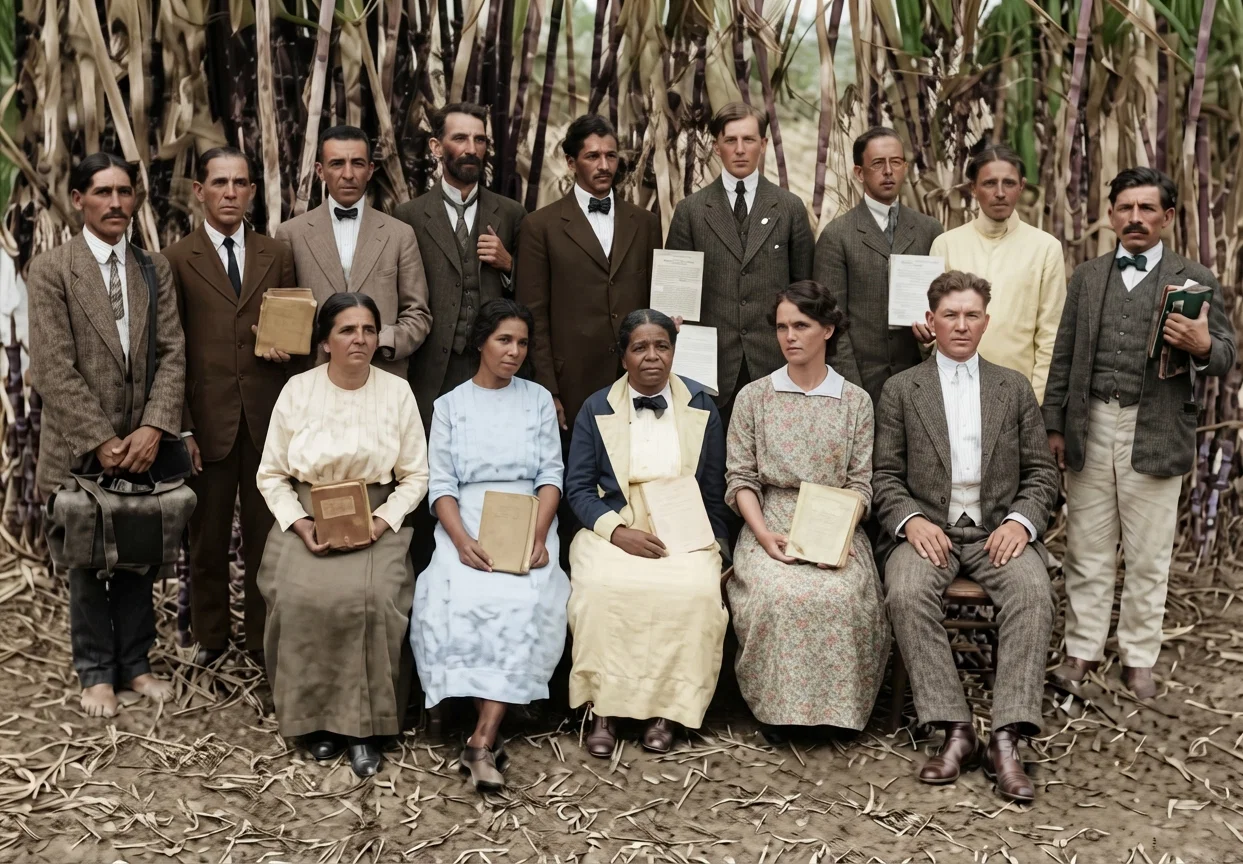
These people were first interested in the truth by two colporteurs going into their neighborhood selling books. R. N. Carter and the brother working with him, then held some meetings with them, instructing them how to sell literature, also, and this picture shows them ready to go out with the books that guided them into the truth. This took place in Brazil, South America.
“In every effort to benefit others, we benefit ourselves. When we invest our means in the different missions, we enlist our interest and our prayers for these missions; we draw the different nationalities nearer to ourselves; our affections go out to them, and we are stimulated to greater devotion and stricter obedience to God, that we may be enabled to do others the greatest good. If we desire to have our affections set upon heavenly things, we must place our treasure in heaven. Where the treasure is, there the heart will be. What has cost us little, we have no special interest in; but that in which we invest our means claims our interest and attention, and we labor to make it a success.
“God is a source of life and light and joy to the universe. Like rays of light from the sun, blessings flow out from him to all the creatures he has made. In his infinite love he has granted men the privilege of becoming partakers of the divine nature, and, in their turn, of diffusing blessings to their fellow men. This is the highest honor, the greatest joy, that it is possible for God to bestow upon men. Those are brought nearest to their Creator who thus become participants in labors of love. He who refuses to become a laborer together with God,—the man who for the sake of selfish indulgence ignores the wants of his fellow men, the miser who heaps up his treasures here,—is withholding from himself the richest blessing that God can give him.
“Brethren, ye know the grace of our Lord Jesus Christ, that, though he was rich, yet for your sakes he became poor, that ye through his poverty might be rich.” “As every man hath received the gift, even so minister the same one to another, as good stewards of the manifold grace of God.” As we recount the numberless mercies of our God, and meditate upon his matchless love; as we behold the wonderful sacrifice of the Redeemer, may gratitude awaken in our hearts, till it shall kindle a flame of sacred love that shall flow out to souls.”
—Mrs. E. G. White, in Review and Herald, Dec. 6, 1887.
As the Lord has promised his remnant people in the closing days of the gospel that they shall receive the outpouring of his Spirit with as great or greater manifestation of his power than that enjoyed by his people in the days of the apostles, so also we must expect that in his people today will be found the same devotion and self-sacrificing spirit as that which characterized the believers in the early days.
Of them it is recorded that they had one common interest—the success of the mission intrusted to them. Their love for Christ was far greater than their love for money. They acted out their faith and by their works testified that they accounted the souls of men of more worth than any earthly treasure. Have we not even greater reason to sacrifice than had they? Have we not far less time than they in which to accomplish our work?
Let Him Deny Himself
Lesson for the Children — No. 5
“Let Him Deny Himself”
MEMORY TEXT: “If any man will come after me, let him deny himself, and take up his cross daily, and follow me.” Luke 9:23.
Tell how soldiers obey and follow their leader. Jesus is the Christian’s captain. He does not ask us to go anywhere that he has not gone before us. He is our example. 1 Peter 2:21. We are to walk in his steps.
Jesus denied himself: (1) Gave up his home and friends; (2) became poor for our sakes; (3) worked for others instead of for himself; (4) glorified not himself; (5) even gave his life. 1 Peter 2:24; Phil. 2:7, 8.
What shall we do if we walk in his steps? Give examples of those who have followed the example of Jesus in denying themselves riches, friends, and fame as did Moses. The martyrs are examples of self-denial and suffering. Heb. 11:36-38.
Tell how people in Europe are denying themselves, living sparingly, that they18may win in war. They give money, relatives, homes, themselves, all, as proof of their patriotism. We, too, are engaged in warfare. We are trying to rescue Satan’s captives. What shall we give that people in other lands may be warned of their danger and saved at Jesus’ coming? How can we deny self that we may help finish the work? Speak of things we naturally love—expensive food, clothing, pleasure, etc. We can and should do without these for Jesus’ sake, and so follow in his steps.
We are to bring an offering to the Lord for his work this week. It will be of value according to the love and self-denial that go with it. Tell how Mary brought a precious and costly gift to Jesus. The ointment was worth much money. She thought nothing was too good for Jesus. She might have used the ointment herself and enjoyed its fragrance, but she poured it all out on Jesus.
There was also a poor woman who brought as an offering all the money she had. It would take eight mites to make a penny. She had nothing left to buy food or clothing. Jesus measures our gifts by what we have left after they are given.
The leader may tell a story of some who were very poor giving to the Lord, to illustrate self-denial in giving.
In this meeting let all pray to overcome selfishness—the disposition to please ourselves, and to use the best and most for self instead of giving to Jesus. We should also pray that the Lord will help those who have money to give it to finish his work. We have now reached the place in the third angel’s message where it is like a beautiful building on which much labor and money have been spent, but now funds and workers are greatly needed to finish it.
On the Way to the Holy City
By W. A. SPICER
Reading for Thursday, December 16
On the Way to the Holy City
W. A. SPICER
In the little book “Early Writings,” by Sister E. G. White, a view is given us of the journeyings of the Adventist people to the city of God. This was the first message to the Adventist believers by the spirit of prophecy; and in words that can never die it points now to the end of the pathway, and cheers us on in the little journey that we have yet to make.
The thought that we—of many peoples and nations and tongues—are pressing along together in this pathway, soon to meet at Jesus’ coming, is a precious one to the believers in all the lands. We are more than a denomination of Christians. This is a movement that we have come into. We are a people on the march—going somewhere; and as we pass along the road, the waymarks multiply that show that we are nearing the journey’s end.
How those in one part rejoice at every word of progress in every other part of the one world-wide work! And a blessing showered in one place, seems, by the very hearing of it, to bring showers of similar blessing and revival over all the fields.
This week our prayers, ascending from widely separated homes and companies, unite our hearts at the throne of grace. All are rejoicing in the same “blessed hope,” praying for one another and loving one another. The Adventist people do love one another. No storms that scourge the world can break the tie that binds together the family of believers in this bright hope of Christ’s soon coming. This week of prayer, in a troubled world, we thank God for this anew.
“There is a scene where spirits blend,
Where friend holds fellowship with friend.
Though sundered far, by faith we meet
Around one common mercy seat.”
And this year at the mercy seat we meet multitudes of new fellow believers—of many nations and tongues. What good cheer in that record of baptisms last year. It is a shining column of figures in the statistical report. Fifteen thousand persons—lacking but one soul—were baptized into the faith of the Lord Jesus. That means an average of over forty souls every twenty-four hours, coming into the ranks, and helping to swell the cry of the message. They have found the path.
Let us read again that story that never grows old, of the journey of the Adventist people as revealed to the little band of believers at the beginning of the way. May the reality of it all be impressed anew upon our hearts. It was out of a wonderful experience of fulfilling prophecy and providential guiding that this movement rose in the days of 1844, to spread through all the world. May God keep our hearts in the simplicity and joy of the Adventist faith, and give us grace to follow all the way. If any have not stepped into this path by full surrender to the Lord Jesus, now is the accepted time.
This is the view that was sent to cheer our hearts:—
“As God has shown me the travels of the advent people to the holy city, and the rich reward to be given those who wait the return of their Lord from the wedding, it may be my duty to give you a short sketch of what God has revealed to me. The dear saints have many trials to pass through. But our light afflictions, which are but for a moment, will work for us a far more exceeding and eternal weight of glory—while we look not at the things which are seen, for the things which are seen are temporal, but the things which are not seen are eternal. I have tried to bring back a good report and a few grapes from the heavenly Canaan. . . . I declare to you, my brethren and sisters in the Lord, it is a goodly land, and we are well able to go up and possess it.
“While I was praying at the family altar, the Holy Ghost fell upon me, and I seemed to be rising higher and higher, far above the dark world. I turned to look for the advent people in the world, but could not find them, when a voice said to me, ‘Look again, and look a little higher.’ At this I raised my eyes, and saw a straight and narrow path, cast up high above the world. On this path the advent people were traveling to the city, which was at the farther end of the path. They had a bright light set up behind them at the beginning of the path, which an angel told me was the midnight cry. This light shone all along the path, and gave light for their feet so that they might not stumble. If they kept their eyes fixed on Jesus, who was just before them, leading them to the city, they were safe. But soon some grew weary, and said the city was a great way off, and they expected to have entered it before. Then Jesus would encourage them by raising his glorious right arm, and from his arm came a light which waved over the advent band, and they shouted, ‘Alleluia!’ Others rashly denied the light behind them, and said that it was not God that had led them out so far. The light behind them went out, leaving their feet in perfect darkness, and they stumbled and lost sight of the mark and of Jesus, and fell off the path down into the dark and wicked world below. Soon we heard the voice of God like many waters, which gave us the day and hour of Jesus’ coming. . . .
“Soon our eyes were drawn to the east, for a small black cloud had appeared, about half as large as a man’s hand, which we all knew was the sign of the Son of man. We all in solemn silence gazed on the cloud as it drew nearer, and became lighter, glorious, and still more glorious, till it was a great white cloud. The bottom appeared like fire; a rainbow was over the cloud, while around it were ten thousand angels, singing a most lovely song; and upon it sat the Son of man. His hair was white and curly and lay on his shoulders; and upon his head were many crowns. His feet had the appearance of fire; in his right hand was a sharp sickle; in his left a silver trumpet. His eyes were as a flame of fire, which searched his children through and through. Then all faces gathered paleness, and those that God had rejected gathered blackness. Then we all cried out, Who shall be able to stand? Is my robe spotless? Then the angels ceased to sing, and there was some time of awful silence, when Jesus spoke: ‘Those who have clean hands and pure hearts shall be able to stand; my grace is sufficient for you.’ At this, our faces lighted up, and joy filled every heart. And the angels struck a note higher and sang again, while the cloud drew still nearer the earth.
“Then Jesus’ silver trumpet sounded, as he descended on the cloud, wrapped in flames of fire. He gazed on the graves of the sleeping saints, then raised his eyes and hands to heaven, and cried, ‘Awake! awake! awake! ye that sleep in the dust, and arise.’ Then there was a mighty earthquake. The graves opened, and the dead came up clothed with immortality. The 144,000 shouted, ‘Alleluia!’ as they recognized their friends who had been torn from them by death, and in the same moment we were19changed and caught up together with them to meet the Lord in the air. . . .
“Angels were all about us as we marched over the sea of glass to the gate of the city. Jesus raised his mighty, glorious arm, laid hold of the pearly gate, swung it back on its glittering hinges, and said to us, ‘You have washed your robes in my blood, stood stiffly for my truth, enter in.’ We all marched in and felt that we had a perfect right in the city. . . .
“We tried to call up our greatest trials, but they looked so small compared with the far more exceeding and eternal weight of glory that surrounded us, that we could not speak them out, and we all cried out ‘Alleluia, heaven is cheap enough!’ and we touched our glorious harps and made heaven’s arches ring.”
Here we close the quotation from that first view given us in “Early Writings.” By the ear of faith we can hear those harps of the ransomed making heaven’s arches ring. By the grace of God we must be there. Our voices must join in that grand “Alleluia” to the Lamb. And what a solemn thought that this path we are walking in actually leads on into experiences and scenes such as these described.
We cannot walk this path in our own strength,—
“I must have the Saviour with me,
For I dare not walk alone.”
And, thank God, he promises to go with us all the way; and his power can keep us and make even our poor hearts clean and pure and strong, and take us through to the city. We will let him do it; and we will plead with others to come and walk in this glorious way with him.
How Do We Know?
Lesson for the Children — No. 6
How Do We Know?
MEMORY TEXT: “And he causeth all, both small and great, rich and poor, free and bond, to receive a mark in their right hand, or in their foreheads.” Rev. 13:16.
Show a tag or label and explain its use. It shows to whom a parcel or any article belongs, and where it is to go. A lady once sent her little boy a long way on the train with simply a tag fastened to his clothes, showing that his fare was paid and telling where he was going.
A poor man in Europe came to America to make a home for his wife and boy. The wife died, and so the father worked hard to send money for his little boy, only four years old, to come to him.
A ticket was bought and tied round his neck, containing his father’s address. A few words were added, asking Christian people to give the child food and drink and to care for him. He was placed on a long train with his little bundle of clothes beside him. The conductor found him all alone, and was first to feed him. When he cried for home, some women rocked him to sleep and cared for him. After days of travel, he was placed on a large ship. Still there was some one always ready to care for him and wash and mend his clothes. When he reached New York, a telegram was sent to his father, and the little boy was placed on a Pennsylvania Railroad train. At a certain station his father found him and carried him home. He was tagged, or marked, so he reached his destination safely.
The time will come when every one will be marked as servants of God or servants of Satan. Speak of some of the signs by which we know that that time is near. Signs in heaven, earth, sea, and sky have been fulfilled.
Jesus wants all his children to come home. He says, “Father, I will that they also, whom thou hast given me, be with me where I am.” It matters not where they have lived in this world, their home city is the New Jerusalem. Their Father and Elder Brother are waiting for them. They will be marked with God’s name and their destination, and every one who is truly his will reach heaven safely. Rev. 3:12.
Satan also has a mark. Those who serve him will reach their destination, which is the lake of fire, where they will be destroyed. Satan’s mark will be placed either on their foreheads or in their hands, and it can be plainly seen to whom they belong.
(The leader may explain the seal of God and the mark of the beast in a way suited to the ages of the children taught. Help may be obtained from “Early Writings,” in the chapters on “My First Vision” and “The Mark of the Beast.”)
In this, as in other meetings, let time be given for prayer and testimony. The subject of special prayer should be that we may have God’s mark, and refuse to let Satan brand us as his subjects. Also pray that we may become earnest workers, and so help others to choose the right mark.