Your ShelfYour Projects

Review and Herald, Vol. 92, No. 56.

The Inca Work in Peru

Review and Herald

Nov 11, 1915

Review and Herald Publishing Association · Takoma Park Station, Washington, D. C. · Nov 11, 1915

The Inca Work in Peru
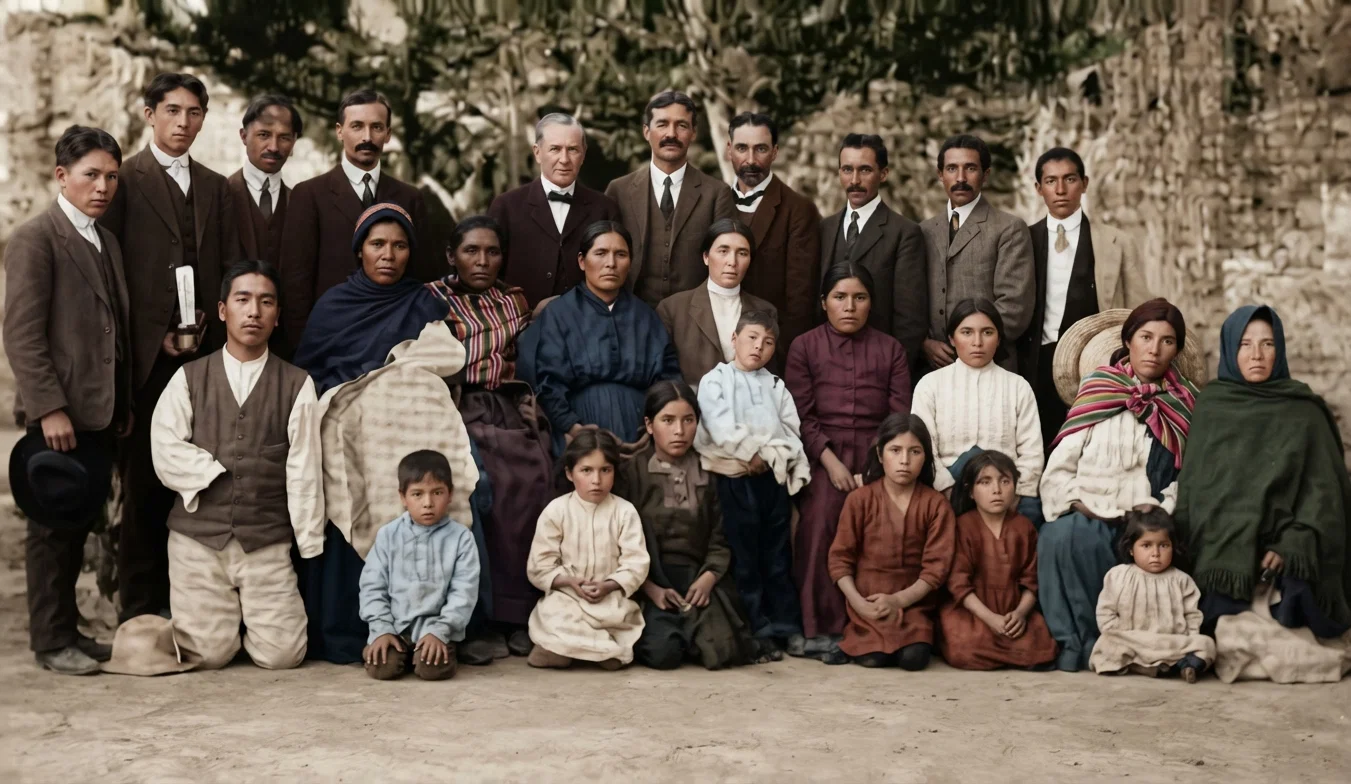
GROUP OF BELIEVERS IN AREQUIPA, PERU
AREQUIPA is located on a plateau in Peru less than halfway up the Andes range on the direct route from the coast to Lake Titicaca. About this lake at one time the powerful Inca Indian tribe had its headquarters. It is here, up among the clouds in the high altitudes of this same lake, that our Indian work among the Incas is now being carried forward. Here we have over three hundred loyal Indian brethren and sisters. From our Puno mission the sound of this message has gone out into the regions round about until it is impossible to answer the many calls coming in for teaching evangelists.
Two families of recruits are now pressing their way up the mountains, stopping at Arequipa to study the language en route, to relieve our overworked missionaries in this our highest mission station in the world. (See article on page 5)

War to Last Eighteen Months Longer

EDWARD SHEARSON, head of Shearson, Hammill & Co., bankers, who recently returned from England, speaking of the duration of the European war, says:—
By officials in the government service and men of affairs in England I was told that the war certainly would last another eighteen months. Taking this as a basis for a rough estimate, formed from the expenditure up to date, it will cost the belligerent nations about $45,000,000,000 for the destruction of property, waste, and labor in this war.—New York Times, Oct. 25, 1915.
It is to be hoped that these officials are mistaken in their estimate of the length of the war; for it is truly awful to contemplate the continuance of the present conflict for a year and a half more. We should pray God to restrain the wrath of men, that his work in the earth may go forward unhindered.

Note and Comment

China May Become a Monarchy

A CITIZENS’ convention is to be held in China this month, which may decide on a change in the form of the Chinese government. Should the Chinese Republic be overthrown, there is fear among many diplomatics that a revolution might break out in China. This would seriously hinder the work of the Protestant missionary in that country.

New Catholic Building in New York

CARDINAL FARLEY has approved the plans for a new $500,000 Catholic headquarters building in New York. His letter of approval, written to William Myhan, of the Knights of Columbus, has a statement which we reprint from the New York Times of October 21:—
“The Catholics of New York need just such a building as you propose to erect,” Cardinal Farley writes. “The educational advantages and gymnasium facilities offered by various sectarian or, at least, non-Catholic institutions in this city are endangering the faith of many young people, and I think a Catholic center under the intelligent direction and control of a body like yours can most effectually counteract this bad influence.”

Japan Excludes Christians From Coronation Ceremonies

JAPAN is turning against Christianity. Another indication of this tendency is seen in an Associated Press dispatch sent from Tokio, October 28:—
Japan has decided to adhere to her original intention not to invite a representative of the Christian religion to the coronation ceremonies of Emperor Yoshito, to be held in Kioto early next month. Japanese Christians tried to induce the court and government to change the original plans, on the ground that Christianity is now one of the prominent religions in the empire, but the authorities decided that only representatives of the Buddhist and Shinto religions would attend the ceremonies. The explanation given is that Buddhist and Shinto priests have a court rank in Japan which entitled them to an invitation.

Estimate of the Cost of the War

The Washington Post of October 29 published an estimate of the cost of the war, which may be of interest, even though it is not official. The figures are so large that the human mind really cannot sense them. Though no estimate is available, it seems probable that the total amount spent during the Christian era in carrying the gospel to the heathen is less than what has been spent already in the present war.
It is estimated that the European war has cost the belligerent powers $24,801,000,000 up to October 20, although these figures are not official.
The cost is divided as follows:— England, $6,163,000,000. France, $4,128,000,000. Russia, $3,724,000,000. Italy, $643,000,000. Germany, $7,380,000,000. Austria, $2,763,000,000.

A Remarkable Feat

THIS is an age of wonderful accomplishments. One of the greatest engineering feats ever performed in war time was completed in September:—
When Russia faced the prospect of again being closed to the world through the freezing of the harbor at Archangel, it was quickly decided to build a line to Ekaterina, an open port within the arctic circle, which, because of a twist in the Gulf Stream, is ice-free the year round. The American engineers called to the work confronted the problem of building a standard-gauge, double-track railway for six hundred miles across a terrain composed chiefly of swamps. Owing to the short summer, the time of the work was brief, and progress had to be made at the rate of one hundred miles of new track per month, and the contract demanded completion by the first of October.
But the American engineers began their battle with characteristic energy, and excavating and grading machinery was exported from the United States. An order for scores of heavy locomotives was also filled in this country, being delivered at Vladivostok.
According to report, the Russian wilderness has given way before the onslaught of the engineers, and the road was completed three weeks before the time set. Thus a new record has been established in speed and obstacles overcome.— Cincinnati Times-Star.
Let us remember that every railroad built and every development in the line of ease of intercommunication is intended by God to serve as a means of spreading more rapidly the knowledge of Christ’s coming kingdom.

Episcopal Split on Fighting Pope

IN a report on the first page of the New York Times of October 27, under the heading “Episcopal Split on Fighting Pope,” it is stated that—
five High Church dignitaries resigned yesterday from the Protestant Episcopal Board of Missions after a heated debate, in which they had tried vainly to stop that body from sending delegates to the Pan-Protestant Congress at Panama, on the ground that such action would be an affront to the Roman Catholics.
Bishop Weller, of Wisconsin, is quoted in the same article as saying:—
I say here that we will not join in fighting against another part of Christendom. We will rather walk on the other side of the line. It is true that with certain difficulties we have kept the fellowship for four centuries. I want to say to you candidly that when it comes to joining with Protestantism against Roman Catholicism, there are some of us here, if you make us, who would take our place on the other side.
We are glad, however, that the spirit of real Protestantism still prevails in the Episcopal Board of Missions, and that delegates are to be sent to the Panama Protestant Congress even if plans to carry the gospel of Christ to the people of Latin America are displeasing to the Papacy.

Notes From the Field — No. 1

The thought of going home brings a thrill of joy to every traveler. The hope of again mingling with the friends of yore, of gazing upon familiar scenes, and of getting back, even for a little time, in old, congenial environment, affords joy, as does also the realization.
It was with something of this feeling that we visited again for a few days, recently, our old field of labor in Colorado. It was to this health-giving climate that we were driven years ago in quest of health; it was here that health and strength returned. In the thirteen years which we spent in Colorado, we formed many associations which have developed into lasting friendships. Returning, after seven years of absence, we inquired with interest concerning the welfare of those we had known in the past. Some, we found, had moved to other places, for Colorado, like all the great West, knows the spirit of change; some had been called to lay down their burdens and rest for a little season; while others we found here at their posts, with their faces still set Zionward; and although their heads are gray with long waiting for the realization of their hopes, their hearts are still aflame with the spirit of this message and this work.
Never have we found a more loyal people than here in this conference, and we were glad to find the same earnest spirit of missionary endeavor that exists in every part of the great field. God has made the hearts of his people in every land one in purpose for the advancement of the work he has committed to their hands; and sectional lines are growing less and less distinct. We are coming to recognize that we are engaged in a world-wide movement; that our interest cannot be confined within State boundaries or within the confines of union or division conferences, but that we are debtors to all men.
In every part of the field we find homes from which have gone out to earth's remotest bounds some worker for Christ. Such a home we found near Boulder,—the home of Brother and Sister R. E. Hay, the parents of our dear Brother Hay in the Philippine Islands. These parents do not regret their sacrifice in sending their son out into the regions beyond, but rejoice, as many other parents who have sent sons and daughters to the front. They have not been able to go themselves, but they have given up their loved ones, and sent them forth with prayers to do valiant service for the Master; and the sacrifice of these devoted parents will not be unrecognized by the Lord of the harvest. Indeed, we shall find that those who have stayed by the stuff, who have remained at home, there to labor and toil to supply means to send others, have borne as truly a missionary part as those who have gone forth to battle.
At Boulder we spent several days at the sanitarium. Here we found an excellent and devoted company of men and women who realize, we believe, that they are a part of this great movement that is giving the last message to the world.
Many changes have been made in the personnel of the sanitarium family during the last few years. Notwithstanding this, the work has moved forward. We believe, however, it is coming to be recognized more and more in connection with all our sanitariums, that the fewer changes among physicians and managers, the better it is for the work.
At the sanitarium, on the occasion of our visit, we found guests who were here eight or nine years ago. Naturally, as they return, they look for familiar faces. The guests are attracted to the institution, not alone by the general character that it bears, but by the personality of its workers. They repose in these workers a confidence which grows through the years. They come to regard them as personal friends, as those in whom they can confide, and from whom they can receive help in every crisis of life.
The sanitarium at the present time possesses an excellent faculty. Dr. H. A. Green, the medical superintendent, has brought to the work a wide and extensive experience gained in other fields, both as a general physician and as a surgeon, and the Lord has certainly blessed his earnest labors as he has endeavored to build up the work on a strong and solid foundation. With Dr. Green there are associated at the present time Dr. Kate Lindsay and Dr. F. H. Weber. Dr. Anna B. Durrie, who has been connected with the work for several years, was absent on an extended vacation. Of Dr. Lindsay's long experience in connection with our denominational work, we need not speak. Thousands of young men and young women have received at her hands a training as nurses which they will appreciate and value while time lasts. Dr. Weber is rendering excellent service in the institution.
We were particularly impressed with the kindly and cordial Christian spirit of the business manager. Brother E. J. Baker, who has been associated with the institution for several years, demonstrates that it is possible to combine the exercise of Christian principles and integrity with business ability. The Lord is truly blessing his work.
During the summer months Elder A. C. Anderson has done very acceptable service as chaplain of the sanitarium and as pastor of the Boulder church. Sister Anderson, who completed her medical course in the spring, has rendered valuable assistance in the medical department during the summer months.
Faithful through the long years of efficient service she has rendered the institution, Sister J. W. Collie is still doing the work of matron.
We were pleased to note many improvements that have been made since we separated from the institution, seven years ago. At the present time the institution consists of one large main building of five stories, two fourteen-room cottages, and seventeen other cottages of varying size. The institution operates its own power plant for generating steam and electricity. It manufactures an excellent variety of foods to supply its own tables and also to meet the demands of the general trade. Brother E. L. Austin, the manager of the food department, tells us that this year has witnessed the largest output of foods since the plant was established. The institution also has a well-equipped laundry.
One very pleasing feature was the excellent dairy of a dozen sleek, well-kept cows, which supplies the sanitarium tables with milk and cream. A liberal supply of fresh eggs is also furnished by fowls belonging to the institution.
The treatment rooms for both men and women have been enlarged, which adds greatly to the convenience of the patients of these departments.
An air of general thrift pervades the institution. The grounds have been materially improved. New walks have been constructed, some of the old cottages enlarged, and much added in the way of new equipment and general furnishings. It is certainly necessary that our sanitariums be kept in good repair. We cannot allow our institutions to run down in appearance or equipment. We cannot permit our furnishings to become old or threadbare. When this is done, we shall find there will be a corresponding decrease in the patronage, and a lowering of the character of that patronage. Our sanitariums, in order properly to represent the movement with which they are connected, must be maintained in a neat, sanitary, creditable condition. This does not necessarily involve extravagance, but it does require constant care and painstaking effort on the part of those connected with them.
At the time of our visit, the sanitarium was enjoying, for this season of the year, an excellent patronage. The great problem which this institution has always had to confront is how to build up its winter trade. Its summer guests come in overflowing numbers; there is no need to advertise for them. And if the sick in various parts of the country could realize what a delightful winter climate Colorado possesses, the institution would have many more applicants than it could accommodate during the winter months. If many who seek congenial winter climate in the West, or in the South, or on the islands of the sea, could know the enjoyable winter climate of Colorado and the advantages which they could secure at our institution in Boulder, they might be turned this way. We believe that our brethren and sisters should constantly bear in mind the opportunities afforded by our sanitariums, and should direct to them their friends and neighbors who are in need of medical help.
We were pleased to meet here in Boulder some of our brethren from the East who are here seeking health. For years Elder C. E. Peckover has been making a great fight against a disease which has threatened his life. We found him of good courage, and in better physical condition than he was a year ago.
We also found here in Colorado Elder T. B. Westbrook, who, on account of his wife's health, was compelled to resign the presidency of the Northern New England Conference and come to this field. Sister Westbrook is making a brave and courageous fight, and the Lord is adding his blessing to her efforts. Brother Westbrook during the winter months will connect with the work in Boulder, as chaplain of the sanitarium and as pastor of the church.
Here also we found Brother Legg, at one time an employee of our General Conference. While still unable to return to his work in the East, Brother Legg has made marked improvement, and is finding a fruitful field of labor in connection with the sanitarium.
While in Boulder, we met Elder A. R. Sanborn visiting his son, who, with his wife, was compelled to leave New Jersey to seek relief in this climate.
We were pleased also to greet in Boulder Brother F. E. Stafford, who has spent six years of earnest labor in China. We were surprised to find him so greatly improved in health, and we sincerely hope that the Lord will give him complete restoration, and enable him to return to the field to which his heart and interest continually go out. Brother Stafford reported that he had recently visited Brother and Sister Benson and Sister Erickson, in Cañon City. Sister Erickson was greatly improved in health, and well on the road to complete recovery. Brother Benson had not availed himself sufficiently long of the mountain climate to obtain marked benefit, but his courage in the Lord was good, and he expected results from his stay in Colorado.
Sister L. L. McCamly, who spent several years in the India mission field, is doing much in local missionary labor to advance the interests of the cause of Christ. Elder W. D. Emery, forced to retire from active work, is also doing all that his strength will permit to strengthen the work of God.
Elder A. T. Robinson, president of the Colorado Conference, reports that the Lord is greatly blessing the work in his field. Good success has attended the efforts of the conference laborers.
Campion Academy is doing excellent service in preparing young men and young women for a part in this closing work. Surely, there is need for these additional workers. The fields are white unto harvest. Open doors are waiting on every hand. The great aim and desire of every young man and young woman connected with this movement should be to have a part in this closing work. May God inspire all our hearts with this spirit and this purpose. F. M. W. Boulder, Colo.

A Long Time Coming

“WHY did you not come before?” Often in the story of missions this question has been asked. Over in the eastern Transvaal, Elder W. S. Hyatt met a man whose heart was much stirred at the first glimpse that he had caught of this wonderful message.
“I notice this is the eighteenth volume,” the man said, holding out a copy of the South African paper; “how is it that I have never seen a copy of this paper before?”
Our brethren in South Africa are trying to remedy this situation by sending sample copies of the Dutch and the English paper to every name appearing in the directory of farms and remote country establishments, where possibly a man’s next-door neighbor may live ten to twenty miles away. W. A. S.

The Week of Prayer

A YEAR has rolled around, and another week of prayer gives us as a denomination a new privilege of uniting to ask God to accomplish speedily his work throughout all lands. Yet our prayer should first of all be that the divine work of grace be completed in our own hearts; for it is only as this work is done for us that God can use us in extending the knowledge of his love to others. Our own experience must be such that we can say with the apostle John:—
“That which was from the beginning, which we have heard, which we have seen with our eyes, which we have looked upon, and our hands have handled, of the Word of life; (for the life was manifested, and we have seen it, and bear witness, and show unto you that eternal life, which was with the Father, and was manifested unto us;) that which we have seen and heard declare we unto you, that ye also may have fellowship with us: and truly our fellowship is with the Father, and with his Son Jesus Christ.” 1 John 1:1-3.
The past year has been a very remarkable one. God has greatly blessed the work of carrying the message, even though circumstances have seemed in many ways unfavorable. The European war has brought hardships to many of our brethren; but the Lord will still make even the wrath of man to praise God, and the remainder of wrath will restrain. See Ps. 76:10. If in our own personal experience, as we review the year that has gone, we do not see the advancement in Christian character which we should like to see, let us not be discouraged, but, renewing our consecration to the Lord, let us press forward to the victories which God will give us in the year just before us. As the apostle Paul said, we may say:—
“Brethren, I count not myself to have apprehended: but this one thing I do, forgetting those things which are behind, and reaching forth unto those things which are before, I press toward the mark for the prize of the high calling of God in Christ Jesus.” Phil. 3:13, 14.
L. L. C.

A Sincere Heart

“A SINCERE heart does not need to be advertised by a solemn face.”

The Inca Union Mission

E. L. MAXWELL
ON making up my mid-year summary the other day, some facts presented themselves that I thought would be of interest to the brethren “back home.” I will pass on a few.
Most of the work in the territory of the Inca Union Mission has been done in Peru. Therefore the greatest results are here. Up to the time of my arrival, Sept. 22, 1913, there were 187 members enrolled on the church books of the four local missions. This, of course, was the net active membership at that time. The seed sowing had been going on for ten or twelve years. Thousands of dollars’ worth of literature had been sold, and the foundations well laid for a substantial work. God, who watches over his work, has certainly given us a good harvest.
Between Sept. 22, 1913, and Aug. 1, 1915, a period of twenty-two months, there have been added by baptism in the various fields, principally in Peru, 238 members, making to date, with the 187 that we had when I came, 425. According to the reports I now have, there are at least fifty persons ready and waiting for baptism at various places in the interior and along the coast, and at Puno some also in Ecuador and Bolivia.
We are glad to report the arrival of Brother C. V. Achenback and wife, who will work in Puno and Plateria, among the Indians, and of Sister Millie Sauerwein, who will join the force in Bolivia. We need more help for Ecuador, and one or two more workers for Peru. We could use a number in the Indian work.
Just a few days ago we had our first baptism in Arequipa, a Catholic stronghold. Six were baptized. A father and his two daughters went forward after many months of study and prayer. The wife and mother, who is still a Roman Catholic, wept bitterly at the time of the ceremony, and opposed the step, so much so that it was feared the police would prevent it. But it seems the policeman became so absorbed in the novel ceremony that he forgot his authority, and everything passed off pleasantly, except for the crying and sobbing of the poor woman, who no doubt thought that her loved ones were sealing their perdition.
So many interests have sprung up in the central table-land section of Peru, that it was thought best to locate some one up there to look after them. We have asked Brother R. B. Stauffer to accept this place, and he will go there at once. Land has been offered us for a mission center, such as the one we have at Puno; but we have no one to take charge of it. This land is three days’ journey from the railroad, and it is not possible for Brother Stauffer to live so far from the railroad and attend to the colporteur work. A man and his wife, nurses preferred, able to teach the truth as well as care for the sick, and having a burning desire to devote their lives to this work, are needed for this section, which is so far from the ordinary channel of communication with the world.
One of our workers, Brother Bartolome Rojas, has been very sick for some time. Although he is better now, he is not yet out of danger. Otherwise we are all enjoying reasonably good health, and are of good courage in the work.

Patagonia

A. G. NELSON
The work is onward in Patagonia. There are no extraordinary experiences to report, but there is a steady advance. We have put out considerable literature, and are studying with a number of interested persons. Our Sabbath school has a membership of twelve. Some of those who have accepted the message are doing good service in the canvassing work. One good, substantial man is doing successful work canvassing for Videntes and “Daniel and the Revelation.” We have four boys between nine and thirteen who are real little missionaries. Every opportunity they are out distributing and selling papers. They are making good progress in the study of the Bible. They often offer prayer in the meetings, and their circumspect and obedient lives reveal a living Christian experience. They are strict in tithe paying, and very liberal in their donations, which they earn themselves by the sale of literature. The mother said of one of the boys, “Stanley would give all his money for missionary work if we would let him.”
We are waiting now for word from Brother Westphal to know if money was voted for a cart and a horse. We want to start a colporteur wagon to the camps among the shepherds. I am planning to go to the Falklands this summer to see if an interest can be started there. [He wrote August 31.]
It has been mud, slush, rain, ice, or snow continually for five months, but the spring winds and the thaw are beginning, so we shall soon have better roads. [It is winter in Patagonia when it is summer in the United States.] Our courage is good, and we are thankful for God's continual blessings. We want to be faithful until the work is finished, and then with you have a home in his kingdom.

Malaysia

F. A. DETAMORE
WE are ordering more than one thousand copies of the Ingathering Signs. This year we shall have them all sent to Java, and then I shall bring them to Singapore when I return from Java, as I shall probably be there about the time they come. I think this will make us more sure of receiving them. [Last year their supplies did not reach them.] We are also to have a special number of the Chinese Signs for the Ingathering work, and shall use many of them, I suppose. I trust that God will bless in this work, and that we shall be able to raise a large sum of money in this effort.
Good interests are springing up in various parts of the field, and there are many more calls than we can possibly answer. I am glad to report that some are taking their stand for the truth, and the future seems encouraging. In all the missions there are converts accepting the message, and this is the joy of our workers. We shall baptize several here soon.
In Borneo we found several families near our mission at Jesselton who are calling for our message. Six families have decided that they want to be Seventh-day Adventists, and we have arranged to go to teach them the truth. Many others in that place are dissatisfied with their present teachings, and we believe that there will be a strong work done there.
One of our colporteurs went to Sarawak some time ago, and two men accepted the truth while he was there. Since then I have had letters from these two men, and they are begging us to send them help. In one letter they stated that there were about forty persons who wish to unite with us. The same worker has just returned from Medan, Sumatra, and reports fifteen or twenty in one place who wish to unite with us. In another city near by several others are calling for the truth. In a third place a young man has accepted the message, and is coming toour school to prepare for the work. I could mention other interesting experiences, but space forbids. Our field seems ready for the truth, and I trust that we shall soon have a number of recruits from home.

Be Strong!

BE strong! We are not here to play, to dream, to drift; We have hard work to do, and loads to lift. Shun not the struggle; face it. ’Tis the God’s gift.
Be strong! Say not the days are evil—who’s to blame? And fold the hands and acquiesce—O, shame! Stand up, speak out, and bravely, in God’s name.
Be strong! It matters not how deep intrenched the wrong, How hard the battle goes, the day how long, Faint not, fight on! Tomorrow comes the song.
—Maltbie Davenport Babcock.

Relief From the Heat of India's Plains

(Concluded)
MRS. MYRTLE LEECH
It was a pretty little boat, nicely furnished, the sitting room cozy with its rugs, couches, chairs, and settee. It seemed a pity to disturb the room, but we found it necessary to use it for a bedroom. We got nicely settled and had good hot baths before the Sabbath, and were very comfortable. We spent the evening out on the terrace, enjoying the glorious night and the beauty of the water.
After laying in our supplies for our mountain trip, we started down the river. While the men pulled and poled us along, we spent most of the time on the terrace reading and talking and enjoying the peace and quiet. The next Friday morning found us in camp at the head of the beautiful Sind River, an ideal place to spend the Sabbath, with its great, spreading maple trees.
Here we made all arrangements for our trip up to the snow line, engaging ponies, and getting together the things we should need. Sunday morning, bright and early, we were off. O, such a morning! It doesn't seem to me there ever could have been a more perfect. All nature seemed at her best as our horses galloped up the valley. The road led through fields of waving grain, then through great groves of maple and walnut, and now and then we would come upon pretty little villages nestled in the valley.
Soon we left the valley, and our road grew more narrow and rugged. All day we met great flocks of sheep and goats, with the shepherds and their families, coming down from the mountains, as the snow was beginning to fall. What a picturesque sight these people made, with their camels, yaks; donkeys, cows, sheep, and goats! It made us think of Bible times.
We made camp that night in a little grove near a stream. Oh, it was cold! We were glad to hover over the fire. We slept well, and were up and off the next morning while the frost was still on the ground. My little pony pricked up her ears, and away we went. Such a fine gallop as we had! She was a good little riding pony, very sure-footed, and I grew quite fond of her. How I wished I could bring her home with me, for a good saddle pony would be such a help in my work here, as I could go right across field and through wood, and save much time.
Well, I just can't describe the road, one must see it to appreciate it. It is so wild and rugged, just a bridle path cut out of the mountain, following the blue Sind River. I never saw water so blue, save in the washtub at home when mother was bluing the clothes. And those pines and firs! I felt just as one does when he has found some long-lost friend. Part of the way our path led through a cañon, with the river hundreds of feet below us and the solid walls of rock rising high on both sides, so we had to look straight up to see the sky. Then when we met big flocks of goats, our ponies would go so close to the edge to let them by that it made me dizzy to look down so far; but, my pony being so sure-footed, there was really no danger, though sometimes I was afraid I'd go over her head, or slide off behind. That evening about four o'clock we reached the summit, and camped within three miles of perpetual snow. It was very cold, but there was plenty of wood, and we made big fires and heated stones to put to our feet. Brother Pettit cut a lot of fir boughs for our beds, and we were very cozy.
The next morning we started out for the snows. We rode our ponies as far as we could, then left them and went on foot. It was a long, hard climb, but we were well repaid for the trip. We gathered a lot of Alpine flowers and mosses on our way up. We girls went to and around the glaciers, but did not try to go on them, as it was a hard climb, and dangerous. Roy and Brother Pettit went onto the glaciers, while we worked our way back with the help of the boys. It was very steep and hard going down; and when we had gone about halfway, a thunderstorm came on, and how we wished the men were with us! It grew very dark, and soon began to snow and hail. Then, as a climax, just up the valley a big avalanche came roaring and thundering down. We were well out of its path, and a grander and more awful sight I never saw. I wouldn't have missed it for anything. Soon we were down the steepest part, and how we did race down that mountain side, for it was getting dark, and we were frightened, and the hail cut our faces and hands. First one of us would slip and fall, and then another, for the snow made the rocks very slippery. Sister Pettit slipped into the creek and got both feet wet. The road seemed long, and we were glad when we came to our ponies. It didn't take us long to gallop from there to camp. The men came about half an hour later; and how tired and hungry and cold we all were! Sukhi had a good, hot dinner ready for us, and we ate by the light of the camp fire.
The next morning we pulled camp and started down the mountain again. We should have enjoyed staying a day longer, but our time was limited, and there were other places we wished to visit. At sunrise Sister Pettit and I went up on the hill to take a last look at the big eagles. They had taken their baths, and some were circling around over our heads, while others were on the rocks sunning themselves. I know we went within ten feet of one, but it did not seem at all afraid. We reached the house boat Thursday, a little after noon, and early Friday were again on our way down the river to the Wulur Lakes. As we were traveling downstream, our progress was quite fast, and by two o'clock we had reached the first lake. We camped here over Sabbath and Sunday. It was a pretty little body of water, clear as crystal, and though very deep, still we could see the bottom. I cannot tell you of the many delightful boat rides we had in our rowboat, and of the little side trips we took. Monday we went down to the big lake, and, after spending as much time as we could spare, we hastened back to Srinagar for the Sabbath.
It was with a great deal of regret that we turned our backs on Kashmir and started home. If only we could have had two more weeks there, it would have been fine, but our work demanded our immediate return. Oh, I haven't told you how we feasted on apples, pears, plums, and figs! We had apple sauce for breakfast, and apple pie or apple dumplings for dinner every day; and how we enjoyed them! They were so cheap, too; such great big apples for two annas a dozen (two annas are about four cents); how I wish we could get them down here!
We had a very pleasant trip back, although it rained for two days and nights, and we all got a good soaking. We enjoyed every bit of it, though. We spent Sabbath at Murree, on the divide, and how it hailed! We reached Rawalpindi at four o'clock on Sunday, and went for a drive over the city. It is one of the prettiest and best-kept of the cities I have seen in India. We boarded the train that night and went as far as Delhi together. Here Brother and Sister Pettit left us for Bombay, while we came home. On the way back the train was crowded with soldiers. We reached home at four o'clock Wednesday afternoon, a three days' and three nights' run on the train. Our whole trip took us over three thousand miles, yet traveling is so cheap in India that it was not an expensive one.
The girls and workers were all so glad to have us home again. They had the house cleaned, and everything nice, and flowers everywhere, even on the gate-post—and garlands over it. The girls hardly left me for a few days. They would come and throw their arms around me and beg me not to leave them again. We have been very busy since our return. Roy has been in camp, and will be most of the cool season, so I'm alone with the girls. He is working the outlying villages, and sends in every few days for the mail and supplies.
Love to all of you. Write often to your friend and cousin away out in India.

Make Somebody Happy

“LET us get up in the morning resolved that we will make a truer life than we did yesterday; make somebody happy, keep our temper, and do something to make the lives of those around us richer and better.”
Continue reading: To Church Officers and Workers