THREE WEEKS ago we published in full the proposed Sunday Enforcement Law for the District of Columbia, now before Congress. From a document sent out by the Religious Liberty Bureau, we take these significant comments:
This bill is the same as the one (H. R. 4859) that died in the House, March 4, 1905, at the close of the Fifty-eighth Congress, with the exception that this one has a preamble,—a rather remarkable and unusual thing in ordinary legislation,—setting forth certain reasons why the proposed law should be enacted. As now prepared, it sounds more like some conference resolution or Sunday-school petition, than a bill to be enacted into law by Congress.
The religious character of the bill is apparent. According to its title, its object is, "to protect the first day of the week as a day of rest," or sabbath. Sabbath means rest, or cessation from labor.
Upon its own showing, the bill is designed to protect the day, not the people. It is the "peace and quiet of the day" with which it is concerned. Work which upon any other day would be considered perfectly proper, is by it declared to be a "great offense" to "Christian and humane citizens."
Works of "charity or necessity" it graciously permits. But what are works of charity and necessity? Who is to decide? A Sunday excursion for the poor might, by some, be considered a charity; and harvesting to save crops, or labor to provide for a family, by others, a necessity.
Twice, it says, the District commissioners have approved of the measure, and, in a very adroit manner, represents the President as favoring such legislation,—that he has "regretfully said" there was no law enabling him to suppress Sunday toil in the District.
It makes honest labor and trade on Sunday a penal offense, but permits the sale of tobacco, cigars, and malt and spirituous liquors under limitations, on that day. A strange inconsistency!
Such legislation has been urged as necessary because certain dealers are "compelled to keep open their places of business on Sunday to compete with those dealers who do not respect that holy day."—(Washington Evening Star, April 14, 1904.) This at once shows the character and object of the desired legislation. It is religious, and is designed to stop all Sunday competition by compelling non-Sunday-observing dealers to respect the "holy day."
Must the right of men to choose their own religion and their own time to rest and labor be treated as a crime, in order that those who observe Sunday shall have no Sunday competition? It should never be forgotten that a religious monopoly is the most dangerous, the most unreasonable, and the most oppressive of all monopolies.
No one in the District of Columbia is compelled now to labor or keep open any place of business on Sunday. All are free to rest and observe Sunday as a "holy day" if they desire to do so. But if this bill becomes a law, freedom is gone. Then all embraced in its provisions will be compelled to cease from business and trade on Sunday, and to observe the day, whether they desire to do so or not, or be subjected to heavy and repeated fines.
If a man is religious from principle, he will do that which he believes to be right, even tho he loses financially by so doing. The religion which is a matter of so little conscience that it needs a governmental prop to support it, can not benefit its possessor, and would certainly be a dangerous thing to embody into civil law.
Moreover, if those who observe Sunday need a law compelling others to observe the day, then, by parity of reasoning, those who observe any other day need a law requiring others to observe that day.7And the state can not grant such a law to one class and deny it to another, without enacting class legislation, taking sides in a religious controversy,—the question of which day is the Sabbath,—and making an unjust distinction between its citizens.
WHAT THE EXEMPTION IMPLIES.
THE District of Columbia Sunday bill, now before Congress, proposes to exempt those who keep "another day," providing they keep it "uniformly," and do not by their labor "interrupt or disturb" those who observe Sunday.
Such an exemption implies that the state has a right to compel all to observe some day; if not one, then another.
It implies that the state has a right to say when men may labor, as well as when they must rest.
It is, moreover, of the nature of toleration. The state selects, establishes, and requires the observance of, the first day of the week as the day of rest; but, upon certain conditions, it permits men to labor on that day, and to keep another day, the seventh, the one enjoined in the law of God—instead. Think of the state permitting men to obey God! Think of it saying to a certain class: "You may worship God according to the dictates of your conscience!"
This is simply toleration; and toleration implies an established religion; and an established religion forebodes persecution. From tolerance to intolerance is but a step. The right to permit implies the right to prohibit. The permission may be withdrawn.
In this is seen the inherent evil involved in this proposed legislation. It is religious. It invades the realm of conscience, and treats the right to worship God according to the dictates of conscience as concession or privilege granted as a kindness or mercy. It assumes that the state has a right to dictate to men in matters of religion—to say when and how they shall worship. It is the first step in the making of a religious establishment.
If it is right to exempt one class who do not believe in keeping Sunday, why is it not right to exempt all classes who do not respect the day? This, of course, would nullify the law.
But why is the exemption introduced? Sixteen years ago the first District Sunday bill was introduced into Congress. This likewise contained an exemption for observers of another day. The reason was clearly stated by a representative of the Woman's Christian Temperance Union—Mrs. Catlin. The observers of the seventh day had opposed, as unconstitutional, unchristian, and contrary to the law of God, the Blair Sunday-Rest bill introduced two years before. That contained no exemption. So when the Breckinridge District Sunday bill was introduced, the lady referred to, said: "We have given them an exemption clause, and that, we think, will take the wind out of their sails." It was hoped by this means to check their opposition to Sunday legislation until Congress was committed to it. Foolish indeed would they or any one else be to be deceived as to the real nature of such legislation by such a clause. The founders of this nation held that "the free exercise of religion, according to the dictates of conscience, is something which every man may demand as a right, not something for which he must ask as a privilege. To grant to the state the power of toleration is implicitly to grant to it the power of prohibiting;" whereas they denied to it any jurisdiction whatever in the matter of religion.
The wording of the exemption would seem to imply that only observers of the first day were entitled, during their devotions, to protection against interference and disturbance.
Lastly, the exemption is of little value in itself; for it takes very little to "disturb" some people. A few years ago a woman in New York complained of being disturbed all day one Sunday because her nephew was setting type in a back room up-stairs ten blocks away.
From all this it is evident, therefore, that the passage of this bill would be needless and unjust legislation.—Religious Liberty Bureau Leaflet.
"A SILLY BILL IN OHIO."
By Editor
THIS is what our esteemed contemporary, the Medical Record, calls the measure now before the Ohio Legislature, to kill a person who is suffering; and it is just about what we would expect the Record to say:
An old man with a stomach ache will be in a perilous state in Ohio if Miss Anna S. Hall and Representative Hunt of Cincinnati have their way. The latter, presumably at the instance of the former, has introduced a bill into the Ohio House of Representatives, making it lawful "to kill a person suffering from intense pain and for whose recovery there is no hope." Every one who has experienced it will fully admit that the pain of a stomach ache may be intense, and no one will deny that there is no hope of recovery from old age. It is true, the bill provides an imaginary safeguard in that the patient's consent must first be obtained by some one who is not a relative or a presumptive heir; but a man, or a woman, with a pain legally defined as intense, may temporarily be non compos and weakly answer in the affirmative—and then the game is up. It is hardly possible to treat this question seriously; for it is too hideous to be regarded as anything but a grim joke.
It is within the knowledge of almost every one that some relative or friend, now living, has been believed, and even declared by the physician in attendance, to be beyond the hope of recovery. Consumptives, who once were gasping for breath and were momentarily expected to yield up their last sigh, are to-day leading an active and useful life; persons suffering from a tumor, pronounced cancerous and incurable by a council of physicians, have recovered and are carrying on their work with comfort to themselves and cheer to their families; the same is true of innumerable others who have been condemned to speedy dissolution and are yet alive to shame their doctors and rejoice their loved ones. "While there is life there is hope" is a saying so true that to deny it is an absurdity. There is a power in therapeutics, and a still greater power in the recuperative forces of nature, which is inane to ignore.
The Ohio legislators failed to reject this bill, when a motion to that effect was made, by a vote of 79 to 23, but we refuse to believe that this is a measure of the intelligence of this body of Solons. The seventy-nine may have thought it would be well to have some discussion on the subject before the final rejection of this criminal suggestion, in order to instruct fool legislators in other states who might be contemplating a similar move, or they may have had some other motive; but that seventy-nine out of 102 men in any assembly outside of a lunatic asylum can seriously support this bill, which one sane member called "an insult to the intelligence of the House," passes the bounds of credulity. The thing is a silly joke, and we are unable to regard it as anything else.
A NEW LAW OF ATTRACTION.
AMONG the reasons now being urged in behalf of Sunday legislation is the following, by Rev. S. V. Leech, D.D.:
Give us good Sunday laws, well enforced by men in local authority, and our churches will be full of worshipers, and our young men and women will be attracted to the divine service. A mighty combination of the churches of the United States could win from Congress, the state Legislatures, and municipal councils, all legislation essential to this splendid result.
This idea of attracting young men and women to the churches is a tacit acknowledgment that the churches have lost their power to attract through the Gospel. Jesus says, "I, if I be lifted up from the earth, will draw all men unto Me." Has Christ, or His Gospel, lost the drawing power? or is the weakness not rather in the professed representatives of the Gospel? The turning from the power of Christ through His Word and Spirit, and resorting to compulsory human law for attraction to the churches, indicates that the Gospel is so weakened by perversion, and by a loss of confidence on the part of its nominal adherents, that it can not longer work through the medium of the professed ministry of the Gospel. As Paul says of the law, the Gospel has become "weak through the flesh;" and the only effectual remedy must come through a return to "the commandments of God, and the faith of Jesus," rather than to the power of human law. To attract "young men and women" to church by a compulsory Sunday law is a new exposition of the law of attraction. Christ did not use any compulsory law to draw men to Him. John 12:47, 48. Attracting people to church by a Sunday law can only produce hypocrites, through a perversion of true Gospel principle. The Gospel is an invitation (Matt. 11: 28-30; Rev. 22:16, 17) from the merciful Saviour, and not the mandate of a presumptive human government (Matt. 22:21; Acts 5:17-32).
Sunday Closing Is a Religious Question
The Chicago "Record-Herald" accredits the pastor of Millard Avenue Baptist church with the statement that "it is a humane, and not a religious, sabbath that is covered by the civil law which provides that saloons shall be closed on Sunday." But why is it more "humane" to close saloons on Sunday than on any other day? That these Sunday-closing agitators have no suggestion of the humanity of shutting up the vile demon any other one day in the week, shows that there must be some pretext for this strange discrimination. What is this pretext?—Clearly it is because of the assumed religious character of the day. Then it is just as clear to assume that operating a saloon on Sunday is more inhuman than the same act would be on Monday, is solely a religious, and not a humane, question. When we consider the closing of saloons from the standpoint of humanity, we can not legitimately make any discrimination between days. To do so, is to give the saloon the credit of being legitimate on all other days of the week. Surely there is nothing "humane" about that. Despite all disclaimers, the Sunday-closing issue is a decidedly-religious question.
WHAT PROTESTANTS SAY.
BELOW will be found the declarations of many of the large Protestant denominations. We are Protestants. We stand on the same ground, the Bible and the Bible alone.
The thirty-nine articles of the Protestant Episcopal Church declare:
“Holy Scripture containeth all things necessary to salvation; so that whatsoever is not read therein, nor may be proved thereby, is not to be required of any man, that it should be believed as an article of faith, or be thought requisite or necessary to salvation.”—Article 6.
“No Christian man whatsoever is free from the obedience of the commandments which are called moral.”—Article 7.
“It is not lawful for the church to ordain anything that is contrary to God’s Word written.”—Article 20.
The Methodist Episcopal Catechism No. 2 reads:
“86. What is the rule of our obedience?
“The moral law, ‘If thou wilt enter into life, keep the commandments.’ Matt. 19:17.
“87. Where is the moral law given?
“In the Ten Commandments. Ex. 20:1-17.”
“It was not the design of Christ to revoke any part of the law. It can not be broken. Every part of it remains in force upon all men in all ages. Neither time, place, nor circumstances make it liable to change.”
Our Baptist brethren declare:
“We believe the Holy Bible was written by men divinely inspired, and is a perfect treasure of heavenly instruction; that it has God for its Author, salvation for its end, and truth, without any mixture of error, for its matter; that it reveals the principles by which God will judge us, and therefore is, and shall remain to the end of the world, the true center of Christian union, and the supreme standard by which all human conduct, creeds, and opinions should be tried.”—Baptist Convention of New Hampshire.
From “The Advance Almanac for 1894 and Manual of Congregationalism,” we take the following:
“V. We believe that the Scriptures of the Old and New Testaments are the record of God’s revelation of Himself in the work of redemption; that they were written by men under the special guidance of the Holy Spirit; that they are able to make wise unto salvation; and that they constitute the authoritative standard by which religious teaching and human conduct are to be regulated and judged.”—Page 56, Creed of 1883.
The “Presbyterian Confession of Faith” thus speaks:
“The Bible contains the whole counsel of God concerning all things necessary for His own glory, or man’s salvation, faith, and life.”
“The moral law doth forever bind all, as well justified persons as others, to the obedience thereof; and that not only in regard to the matter contained in it, but also in respect of the authority of God, the Creator who gave it. Neither doth Christ in the Gospel any way dissolve, but much strengthen, this obligation.”—Article 5.
“Neither are the afore-mentioned uses of the law contrary to the grace of the Gospel, but do sweetly comply with it, the Spirit of Christ subduing, and enabling the will of man to do that freely and cheerfully which the will of God, revealed in the law, requireth to be done.”—Article 7.
On Matt. 5:17-20 Dr. Albert Barnes, the noted Presbyterian, says:
“We learn hence, (1) that all the law of God is binding on Christians (compare James 2:10); (2) that all the commands of God should be preached, in their proper place, by Christian ministers; (3) that they who pretend that there are any laws of God so small that they need not obey them, are unworthy of His kingdom; and (4) that true piety has respect to all the commandments of God and keeps them (compare Ps. 119:6).”
The Essential Principles of Protestantism.
The principles contained in this celebrated Protest opposes two abuses of man in matters of faith; the first is the intrusion of the civil magistrate, and the second, the arbitrary authority of the church. Instead of these abuses, Protestantism sets the power of conscience above the magistrate, and the authority of the Word of God above the visible church. In the first place, it rejects the civil power in divine things, and says, with the prophets and apostles, “We must obey God rather than man.” In presence of the crown of Charles the Fifth, it uplifts the crown of Jesus Christ. But it goes farther: it lays down the principle that all human teaching should be subordinate to the oracles of God.—D’Aubigne’s “History of the Reformation,” Book 13, Chap. 6, Pars. 19, 20.
NO INDEMNITY TO LIGHTEN THIS BURDEN.
COUNT OKUMA, formerly Prime Minister of Japan, and now in opposition, has been discussing the finances of the empire before the associated Chambers of Commerce of Tokyo. He declared that after the disbandment of the army the national debt would be $1,250,000,000, the interest on which would amount to $75,000,000 annually, or nearly twice the revenues of the government ten years ago. Before the war the per capita share of the national debt was $6.00. This has now been increased fourfold. —Christian Advocate.
THE NATION'S INVESTMENTS IN RAILWAY PROPERTY.
RECENTLY-published tables place the commercial value of the steam railways of the United States at 11,245,000,000, exclusive of Pullman and private cars. Pennsylvania leads among the states, with New York, Illinois, Ohio, Minnesota, Indiana, Kansas, California, Iowa, and New Jersey following in the order named. There are eight states which rank below Indian Territory in the value of their railroad property.
A Three Days' Trance.
A St. Paul, Minn., despatch of February 22 says: "James Mulligan of Iowa, Wis., narrowly escaped being buried alive today. The funeral procession was slowly wending its way to the church when the driver of the hearse heard groans from within, followed by smashing of glass, which plainly indicated that Mulligan had objection to being buried alive. The casket was opened and Mulligan, fully restored to consciousness sat up and began to inquire where he was. He had lain three days in a trance."
A Sad Loss
A Sad Loss.—The American College at Aintab, Asia Minor, has been destroyed by fire. So says a despatch from Constantinople, dated February 21. No lives were lost. The institution was devoted to the general education of native women to become teachers and homekeepers.
Heavy Fire Loss
Heavy Fire Loss.—The San Francisco Gas and Electric Light Company’s power station on Stevenson Street was destroyed by fire on the 22nd ult., leaving a large portion of the city in darkness. The loss to the company is estimated at $400,000.
Let Not Americans Be Deceived.
There are many American Protestants or non-religionists who feel that Roman Catholicism is changing; that it is not now what it was in medieval ages; that it is not here what it is in the Old World; and that America is really setting the standard for the Roman Catholic world, so that by America we may measure Roman Catholicism. Be not deceived. The standard of Roman Catholicism to-day is the Old World Catholicism. This is what the Rev. D. S. Phelan, the stirring editor of the St. Louis Western Watchman, one of the leading Catholic journals of the country, says in its issue of February 1:
There are those who would Americanize our religious orders and communities. We have more than once expressed ourselves on this subject. When it comes to a show-down between American and French Catholicity; or between American and Spanish Catholicity; or American and Italian Catholicity; or between American and German Catholicity; give us the French, or Spanish, or Italian, or German article every time. We have in this country done many things, well; we have built churches and filled them with devout worshipers; we have defended the pope and the church against the virulent ignorance of heretics. But we have yet much to learn from the older Catholic lands. We must tarry longer at their knee, and learn obedience and reverence.
A Sanguine Prospect.
It was with reference to the contemplated work of the Inter-church Conference on Federation, recently organized in New York, that Dr. Power (Disciple) of Washington, D. C., said:
The same results may be attained in three years to-day that were attained in the three centuries that brought Christianity to the headship of the Roman Empire and of the world.
Well, the result of that consummation was the headship of the Papacy over the world. We have for years been showing from the prophetic Word that Rome would, in the very near future, be restored to more than her pristine power; that the "deadly wound" inflicted by the influence of the Reformation was in process of healing very rapidly. And now that the federation of so many "Protestant" churches has started on a line that must hasten such a condition, and enters upon the work in such a sanguine spirit, we confidently expect wonderful progress in "three years." The avowed aim of the federation to exercise a controlling influence in the government is evidence that it is in the same line that brought about the union of church and state in the former instance. Therefore when it shall have consummated its purpose, what will we have but an "image" to the former disastrous union? and will it not most certainly have that power's co-operation and do its work?
Senate Opposition to Algeciras Delegates
Decided dissent has been expressed in the United States Senate from the President's action in sending delegates to the convention of European powers at Algeciras, Spain, to consider the political and commercial conditions in Morocco; that is, to settle the dispute for control which has arisen between Germany and France. It is said that the president favors the "open door" to all nations alike, which is Germany's alleged position, as against France's claim for continued supremacy, which is said to be backed by Great Britain. Many senators resent the President's action in such matters without consent of the Senate. They express confidence in the present Executive, but do not want to set a precedent for future presidents, especially in view of "the war spirit in this country." Truly the war spirit—even in a professed "Christian nation"—is not a factor to be trusted with opportunity to make pretext for war.
TEMPORAL POWER OF THE PAPACY
By C. E. Milton
BY ONE ON THE GROUND
Its Origin and Development.
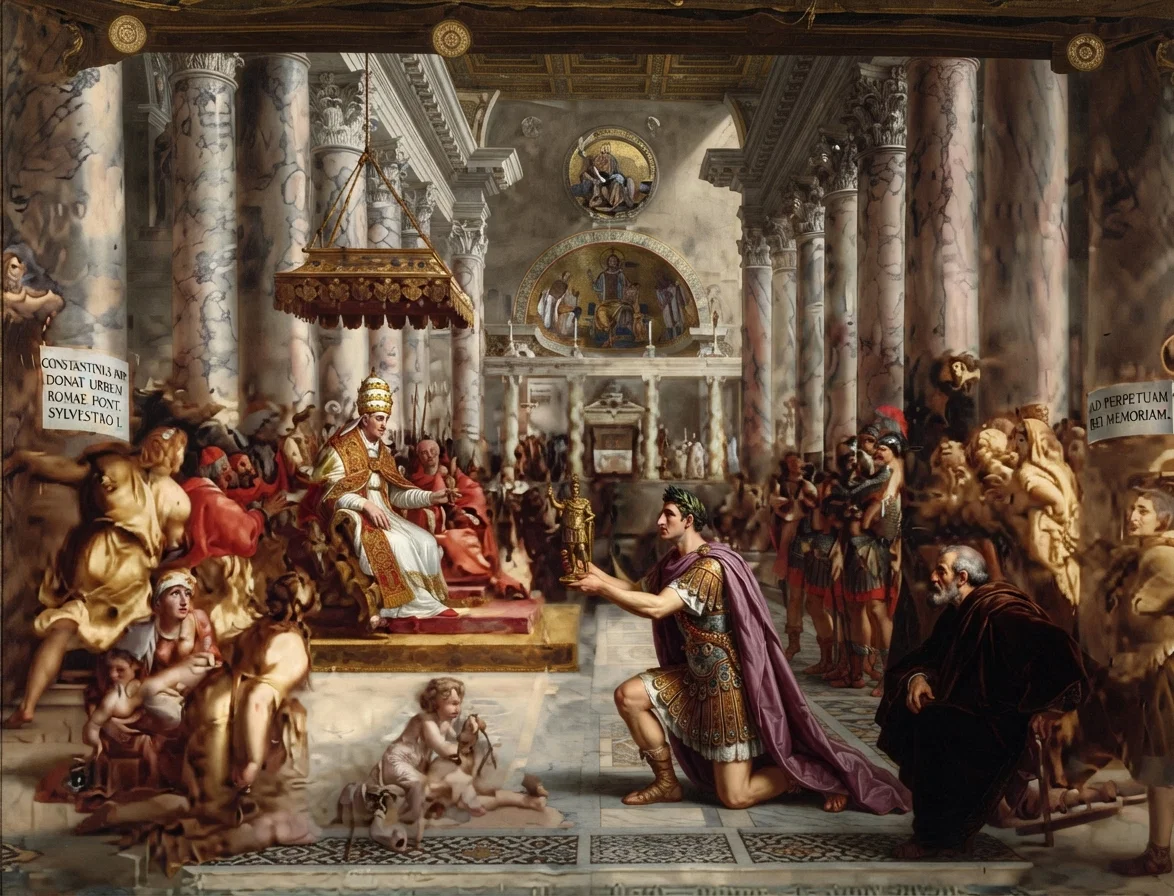
THE first glimmerings of the dawn of the temporal power of the Papacy are certainly to be found in the days of Constantine the Great. The tradition and teaching of the Catholic Church are to the effect that Constantine formally presented the city of Rome to Sylvester I., bishop of Rome, as a gift, and thence departed to found his new capital at Constantinople. This view of the matter has, until recently, been accepted as true by all with but few exceptions.
Dante, the great Italian poet, in his Divine Comedy sums up the general teaching on this point as follows:
O, Constantine, of how much evil wert thou the origin, not your conversion to the Christian faith, but that gift of Rome, which the first rich pontiff received from thee.—Inferno 115.
Rome Presented by Constantine to Sylvester I.
And in fact in the Vatican picture-gallery can be seen to-day an immense painting which represents Constantine in the act of giving Rome to Sylvester, under the symbol of an image of a warrior. (See illustration.)
But even if we should doubt the formal donation of the city of Rome to Sylvester, still the very fact of the departure of Constantine left the city practically in the hands of the bishop of Rome. As says Mr. La Banca, Professor of History in the University of Rome:
The mere fact of the abandoning of Rome on the part of Constantine was sufficient to afford an opportunity to the head of the Catholic Church to gain a great independence. It is true that there remained still in Rome the senate and the prefect, who represented the emperor; but it is also true that with the emperor at a distance, the church could better develop itself and enjoy great liberty of exercising its functions. That this was really the case we see clearly from many acts that were put in operation by the following bishops of Rome: Liberius (352-365), Damascus (366-384), Siricius (385-395).
Leo the Great (440-461) in one of his famous sermons pronounced the following words:
The sacred seat of Peter places you [Rome] at the head of the world to win with the power of religion a greater authority than the worldly dominion ever procured.
One historian in harmony with this says:
There did not lack in Rome tendencies to an absolute monarchy, but Leo, for reasons of prudence toward the Roman Empire and the Patriarch of Constantinople, did not manifest them openly. . . . But the Papacy, through the writings and acts of Leo the Great, raised itself to a marvelous greatness.
The Papacy had therefore already reached an elevated position before the fall of the Roman Empire in 476. And, as we have already noticed, the departure of Constantine left the city of Rome practically in the hands of the pope, because from that time no other throne than the papal was ever set up in "the eternal city" until 1870, when Victor Emmanuel II. made it the capital of united Italy; for the immediate successors of Constantine continued to reign with Constantinople as the capital of the Roman Empire. To be sure, at the death of Constantine the empire was divided in three parts, but this division lasted but a few years; for Constantius soon subdued the entire empire and ruled as sole emperor at Constantinople. Then after Julian and Jovian had reigned as sole emperors, the empire was divided with Valens as emperor of the East, while Valentinian I. established the capital of the Western Empire, not at Rome, but at Milan.
The capital of the Western Empire remained at Milan during the reign of Gratian and Valentinian II., and then Theodosius became sole emperor with the capital at Constantinople. At his death the empire was again divided, Arcadius taking the throne of Constantinople, while Honorius moved the capital of the Western Empire to Ravenna, where it remained till the fall of the Western Empire in 476.
After the fall of the Western Empire the capital still continued at Ravenna, as the following quotation from Gibbons shows:
The example of Honorius was imitated by his feeble successors, the Gothic kings, and afterwards the Exarchs, who occupied the throne and palace of the emperors; and, till the middle of the eighth century, Ravenna was considered as the seat of government and capital of Italy.
So we see that until the eighth century no throne had been established in Rome but the papal. And from that period onward we know that the power of the Papacy was so supreme in Italy that the pope reigned at Rome without a rival till 1870. And incidently I might remark that in this fact we see how wonderfully the prophecy of Revelation 13 has been fulfilled which says that the dragon gave to "the beast"—the Papacy—"his power, and his seat, and great authority."
However, while the city of Rome remained practically in the hands of the bishop of Rome from the departure of Constantine, yet some centuries passed before the Papacy formally and independently took the reins of government with all its responsibilities. As we have already noticed, before the fall of the Roman Empire the pope was already exercising a certain governing power in the city of Rome. And the fall of the Roman Empire "prepared a new and extraordinary future for Papal Rome." "And it is certain that with the fall of the empire to the succession of the emperors crept in that of the popes in Rome which resulted in a great material advantage to the Papacy." And again we are reminded that the death of Paganism meant life to the Papacy, as the following quotation from Professor La Banca will show:
If the lingering death of the Eastern Empire was injurious to the interests of the Patriarch of Constantinople, the sudden death of the Western Empire was a great advantage to the interests of the Papacy.
The power of the Papacy, from the fall of the Roman Empire until the famous decree of Justinian took effect in 538, might be well summed up in the following citation:
If the popes did not have in this epoch a sovereignty legally recognized, yet great was their spiritual power, and exceeding great their authority, over the affairs of Rome and Italy.—Galeotti, "History of the Sovereignty of the Popes."
C. E. MILTON.
(To be continued.)
WELLS SPRINGING UP.
By H. A. St. John
"BUT whosoever drinketh of the water that I shall give him shall never thirst; but the water that I shall give him shall be in him a well of water springing up into everlasting life." John 4:14. Beautiful representation of a living Christian. Many wells supply good, cool water; but if you would get the water, you must needs draw, with a pump or otherwise. Then there are some wells, not so numerous, however, that spring up to the surface and overflow continually, freely giving, with but little effort on the part of the receiver. Such wells are the truest representatives of a whole-souled Christian life.153On my father's farm we had a well at the door. In this well was a pump. This was the rule among all the neighbors—wells with pumps for getting the water. When we wanted water, we went to the pump, worked the pump handle, and caught the water from the pump spout. Sometimes, oftentimes indeed, our pumps would get to leaking and go dry soon after the handle was still. It was necessary then to pour in some water, and work the handle vigorously, in order to get water out. Sometimes, however, this plan would not suffice to bring water from the well. With squeaks, groans, and a gurgle, the water poured in immediately went out, and the pump became dry and useless. Then it must needs be thrown aside, or repaired.
I remember going with my father one day on a journey into a neighboring community. On the way I beheld something that riveted my attention, and interested me immensely. At once I exclaimed, "O papa, see that pump! the water is pouring out of the spout, and there is nobody pumping; the pump has no handle!" I had many questions to ask. Nearly sixty years have passed since that day, but the impressions are seemingly as vivid as if it were but yesterday. My father told me that was an artesian well, that it flowed all the time just like that. It flowed wherever the owner wanted water, and neighbors also were refreshed by the life-giving stream.
Seldom, if ever, do I read the words of our Saviour, about the water that He would give us, being in us a well of water springing up unto everlasting life, without thinking of that incident in my early life. Many church members are like pumps with handles. If you want to see their faith revealed by their works, you must first work the handle with a good sermon, an exhortation, or earnest appeal; then good works will follow for a season. Then comes a cessation, to be followed by another stirring-up by human agency.
Other members are like the pump that has run dry. First you must pour in, provoke with love and good works, then you may get something out while your effort continues, but no longer. Others still are like the pump that can not be started. There is a squeak, a groan, a gurgle, a murmur, and all is over. All you have poured in is like the words that go into one ear and out of the other.
Then there is another class of church members, in the minority, we are sorry to say, who are like the artesian well. They are constantly drinking at the flowing fountain of living water that Jesus gives, and this water is ever in them as a well of water, springing up unto everlasting life. Like Jesus, they are ever doing good unto all men, as they have opportunity, especially to the household of faith. They are not only watered themselves, but are ever watering others also with the gushing overflow of love and good works. Such are the ones, who by patient continuance in well doing are seeking for glory, honor, and eternal life.
From the rock smitten by the rod of Moses in the wilderness came forth a stream of living water which continued to flow and follow the children of Israel all the way through a dry and thirsty land. So Christ, as the rock, smitten by the rod of divine Love, continues to flow and follow the Israel of God through all their pilgrimage in this wilderness world; and all may be so constantly filled, that they will constantly flow out to a thirsty, dying world, disseminating the life and light of God to all around.
When the members of the remnant church of Christ shall have in them the water that Christ gives, as a well springing up into everlasting life, the world will soon know it, and see it, and many will come, drink, and thirst no more. Jesus still invites, "And let him that is athirst come. And whosoever will, let him take the water of life freely." Rev. 22:17.