Your ShelfYour Projects

Signs of the Times, Vol. 32, No. 10.

Declaration of Independence

Signs of the Times

Mar 7, 1906

Pacific Press Publishing Company · Mountain View, California · Mar 7, 1906

Declaration of Independence

FUNDAMENTAL PRINCIPLES. No. 4.

"We hold these truths to be self-evident: that all men are created equal; that they are endowed BY THEIR CREATOR with certain unalienable rights; that among these are life, liberty, and the pursuit of happiness. That to secure these rights, governments are instituted among men, deriving their just powers from the consent of the governed."

Declaration of Independence

"Congress shall make no law respecting an establishment of religion, or prohibiting the FREE EXERCISE thereof; or abridging the freedom of speech or of the press; or the right of the people peaceably to assemble, and to petition the government for a redress of grievances."
Amendment 1, passed Sept. 25, 1789.
"No state shall make or enforce any law which shall abridge the privileges or immunities of citizens of the United States; nor shall any state deprive any person of life, liberty, or property, without due process of law, nor deny to any person within its jurisdiction the EQUAL PROTECTION of the laws."
Amendment 14, passed June 16, 1866.

C. L. HORNUNG

"I sold one set of the special numbers bound together to one person, and later, as I was passing by, they called me in and said: 'We are so interested in the SIGNS; we want the paper for a year.'"
"I think the SIGNS should be in every home. May the Lord help us to work while it is day."

C. L. HORNUNG

INTERESTING EXPERIENCES.

Those who desire openings for Bible-reading work will find an excellent suggestion here:
One earnest, faithful missionary writes thus of the results obtained from work with the SIGNS:
It opens the way for many interesting Bible explanations which make the people more friendly to the paper, and ultimately lead to securing their subscription. This, in turn, opens the way for everything we have to do, in book-selling, Bible-reading, preaching, etc., and I have all or more than I can get along with as a result of the use I am making of the SIGNS. People of every denomination tell me that the SIGNS is the best religious paper they ever read.
A boy of eleven years, who is taking a club of five SIGNS regularly to sell, says: "I sold quite a number of the Specials, and the people seemed to like them very much."
This boy will soon find that he can sell many more than five copies a week; and tho "only a boy," he is doing a work which many grown people might wish were theirs when they see its results.

PACIFIC PRESS PUBLISHING CO.

MOUNTAIN VIEW, CAL.
1109 E. 12th St., Kansas City, Mo. 285 Salmon St., Portland, Ore

TO OUR PATRONS.

Please be careful to write all names of persons and places plainly.
Send money by Post-office Money Order, Express Order, or Bank Draft on New York, Chicago, or San Francisco.
Orders and Drafts should be made payable to the Pacific Press Publishing Co.
Paper money or silver should be sent in a registered letter.
Registered mail is safe. Unregistered mail is at the risk of the sender.
Postage-stamps in five or ten cent denominations will be accepted for small amounts.
The address label on your paper will indicate the time to which your subscription is paid. In case of non-receipt of papers, or any other irregularity, please notify us immediately.
When subscriptions expire, no more papers are sent to the party except by special arrangement.
You are requested to watch the date on your label, and renew early, and save the loss of papers. We can not always furnish missing numbers.
When requesting change of address, be sure to give both old and new addresses.
Important.—If you order SIGNS, Our Little Friend, books, etc., at the same time, use a separate sheet of paper for each. If this request is complied with, it will materially assist in the prompt and accurate despatch of the business.
When writing to the editor, be sure to use a separate sheet of paper.

OUR PUBLICATIONS

THAT our friends may become more familiar with our general line of books, tracts, etc., we are giving each week in this column a review of the items as they appear in our catalog. You will be instructed as well as interested by perusing this page carefully each week.

DIAGRAM OF PARLIAMENTARY RULES

By Uriah Smith. A lucid and interesting treatise on parliamentary usage. By a simple map, with converging lines, it shows the relation of any one motion to every other motion, and at a glance answers over 500 questions in regard to parliamentary matters. A very ingenious and useful arrangement. Breast pocket size, 32 pages, cloth - - - - - - - - - - - - - - - - - - - - - - - - - - - - - - - - - - - - - - - - - - - - - - - - - - - - - - - - - - - - - - - - - - - - - - - - - - - - - - - - - - - - - - - $0 50

EDUCATION

The object of true education and how it may be realized by the youth, the parent, the teacher, the writer, the tiller of the soil, and the business man, is the great theme of this book.
Its first chapter is devoted to First Principles; following that are illustrations, taken from the history of Israel. The Master Teacher, Nature Teaching, The Bible as an Educator, Physical Culture, Character Building, The Under Teacher and the Higher Course, are titles of other chapters. 321 pages, cloth - - - $1 25

EMPIRES OF THE BIBLE

By A. T. Jones. This book gives the history of the times of the Bible, from the Flood to the captivity in Babylon. The history in the Bible and out of the Bible woven together in one connected story. Bound in cloth, net - - - $1 50

EMPIRES OF PROPHECY

From Babylon to the fall of Rome. A companion of the prophecies concerning Babylon, Medo-Persia, Grecia, and Rome, together with the profane history of these countries. 696 pages and 22 maps. Cloth - - - - - $2 00

ECCLESIASTICAL EMPIRE

By Alonzo T. Jones. It embraces the leading events of history from the fall of Rome to the present day. The latter part of the book deals with national apostasy as it is, and what its end is to be, as revealed in the sure Word of prophecy. It contains, in a condensed way, all the essential points of history necessary to a good understanding of the great question of to-day—the relation of church and state. 874 pages. Bound in cloth, net - - - - - - - - - - - - - - - - - - - - - - - - - - - - - - - - - - - - - - - - - - - - - - - - - - - - - - - - - - - - - - - - - - - - - - - - - - - - - - - - - - - - - - - $2 50

ESSENTIALS OF OUR LANGUAGE

By G. W. Rine, B. L. Accuracy in the Use of Words is the title of the opening chapter, while others are, Slips in Syntax, Punctuation and Capitals, Art of Correspondence, Art of Sentence-Building, Practical Synonyms Discriminated, Learning by Doing.
It has been prepared especially for those who are unable to attend school but want to become accurate in the use of English. Most practical volume for home study we have ever seen. Price, net - - - - - - - - - - - - - - - - - - - - - - - - - - - - - - - - - - - - - - - - - - - - - - - - - - - - - - - - - - - - - - - - - - - - - - - - - - - - - - - - - - - - - - - $0 75

THE CRISIS OF THE WORLD.

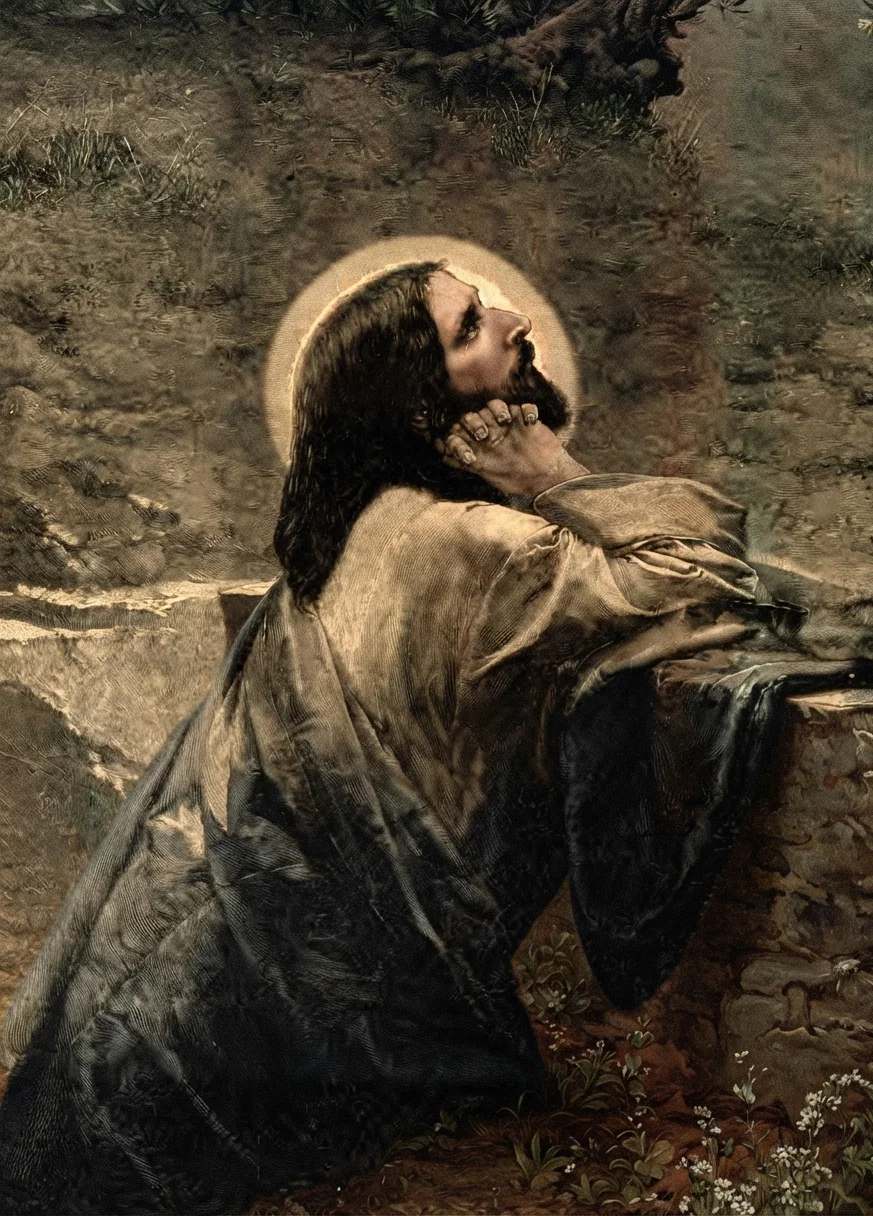
Gethsemane.

THE supreme crisis of the world was not at the Cross. It was not where Roman soldiers mocked and hating priests ridiculed and blasphemed, and the excruciating pains of the Crucifixion were endured by a sensitive human soul to the utmost. It was not where even the Father's face was hidden and the awful darkness of sin wrung from the lips of the dying Victim, "My God, My God, why hast Thou forsaken Me?" No, it was not here where the crisis of the world—nay, more, the crisis of the universe—was met.
THE crisis was met in the low, still garden, where like sentinels stood the ancient olive trees with down-bending boughs, swaying before the gentle spring breeze; where the mild paschal moon shed its soft radiance o'er the scene, filtered through the branches, and flecked the still earth "with leafy light and shadow," here it was that the critical hour, the crisis of the universe, came. It came not to the Man of Nazareth amid jubilant crowds or acclaiming multitudes, but all alone, with the most stalwart of His followers sleeping, knowing naught of the struggle through which was passing their beloved Master.
THERE had been other crises. When He "gave Himself," "a Lamb slain from the foundation of the world," a crisis was passed. When He took upon Himself "the form of a servant," and became an Angel among the angels, a crisis was passed. When He was "made in the likeness of man," a crisis was passed. When He met the mighty temptations of the adversary at the beginning of His ministry, and conquered by faith in the Word of God, a crisis was passed. And there doubtless were other times. But the supreme crisis was met in the Garden of Gethsemane, when alone with God, Jesus Christ yielded Himself again, with renewed consecration, facing all the suffering, to become the supreme and everlasting Sacrifice for humanity. The crucifixion and the resurrection were but the demonstration in life of the submission of Gethsemane.
In Gethsemane.
In Gethsemane.
THEN there came before the Christ of God the awful specter of sin, in all its ugliness and its fearful consequences, separation from God, eternal death. It came to Him weakened in humanity, feeble, worn, weary, old, humanly speaking, before His time, with the awful burden of a sinful world upon Him. Must He bear it still? Should He endure it to the end? Must its crushing load press Him to death, separate from Him His Father's face, and His soul pass out into darkness? Therefore His words to His disciples who went with Him into the garden, "My soul is exceeding sorrowful, even unto death."
WHILE the climax was reached in the garden, Jesus saw the coming crisis for Himself and His people, and began the awful struggle hours before. Listen to His words: "The hour is come, that the Son of Man should be glorified. Verily, verily, I say unto you, Except a grain of wheat fall into the earth and die, it abideth by itself alone; but if it die, it beareth much fruit. He that loveth His life loseth it; and He that hateth his life in this world shall keep it unto life eternal. If any man serve Me, let him follow Me; and where I am, there shall also My servant be; if any man serve Me, him will the Father honor. Now is my soul troubled; and what shall I say? Father, save Me from this hour? But for this cause came I unto this hour. Father, glorify Thy name. There came therefore a voice out of heaven, saying, I have both glorified it, and will glorify it again." John 12:23-28.
DO WE get the import of the words? The Son of God, the Lifegiver, must die. Death is sin full ripe. James 1:15. He who in all His righteous soul hated sin, must bear it for the sake of others to its ultimate. He who had ministered only life, must bear the load of death. He must lie down in death's darkness as the sinner must lie down. His human soul shrank from the awful nadir of the primal purpose. "What shall I say?" He asks. Shall I say, "Father save Me from this hour?" or shall I hold My life to Myself? Shall I go back on the sacrifice purposed from the beginning? No, a thousand times, no; for this very cause I came to this hour, to die that others might live. If He had refused to die, the race would have been forever lost. The Spirit of God gave the thought to Elihu of old: "Who hath laid upon Him the whole world? If He set His heart upon Himself ["if He cause His heart to return unto Himself," margin]; if He gatherunto Himself His Spirit and His breath; all flesh shall perish together, and man shall turn again unto dust." Job 34:13-15. He had taken all upon Him. He could not go back. Infinite Love could not be selfish. Therefore He would not pray, "Father, save Me from this hour," but "Father, glorify Thy name."
BUT the burden heavier rolls. He must meet the struggle, not surrounded with loyal disciples, not with souls seeking His teaching and presence; but alone must He meet the trial, with His nearest human helpers indifferent to His struggle. He evidently hoped for their aid, comfort, and encouragement. He takes them all to the Garden of Gethsemane; but for the struggle He selects Peter and James and John, and says to them, "My soul is exceeding sorrowful, even unto death; abide ye here, and watch with Me." But in His soul-struggle with the flesh and the powers of darkness, they fall asleep, even ardent Peter failing to watch "for one hour."
THE crisis of the universe is expressed in the agonized prayer of Jesus: "And He went forward a little, and fell on His face, and prayed, saying, My Father, if it be possible, let this cup pass away from Me; nevertheless, not as I will, but as Thou wilt." Matt. 26:39. Then He returns to His disciples, finds them sleeping, greatly reproves the ardent Peter for his sleeping, excuses the weakness of His disciples, and then returns to pray. "My Father, if this can not pass away, except I drink it, Thy will be done." Again, He returns and finds His disciples sleeping. He finds no human help, no human comfort, and He staggers back to the fearfully-agonized struggle, so fearful in its strain that He was sweating great drops of blood, and once more prays: "Abba, Father, all things are possible unto Thee; remove this cup from Me; howbeit not what I will, but what Thou wilt."
In this last agonizing prayer the struggle is over, the victory is won in submission, absolute submission to the will of God. Note the confidence on which the submission is based. First, confidence in God's love, expressed in "Abba, Father," "My Father," "My own Father." Only the true child can say it. Rom. 8:14; Gal. 4:5. It is not the term indicating mere fatherhood; it is the term showing the life relation between the child and his parent. "Thou lovest Me; therefore I can leave my case with Thy love."
Secondly, confidence in God's power and wisdom. "All things are possible unto Thee." He has all power, all knowledge, all wisdom, else to Him all things are not possible. Jesus could therefore leave His case in the hands of His loving, omnipotent, omniscient Father.
But, thirdly, the human petition still abides in the final prayer, "Remove this cup from Me." This ordeal His human nature shrunk from. This desire His human heart longed for. God did not rebuke it; and He could not rebuke it, because there was another petition in the heart of Jesus paramount—"Howbeit not what I will, but what Thou wilt." "Shall I say, Father, save Me from this hour? [No, but] Father, glorify Thy name." And it was to the glory of God's name that He should so love fallen humanity as to give His only-begotten Son to die that man might be saved. That was His will, and to that Jesus yielded; more than this, for that He prayed, and forth to the cross He went unwaveringly, and died, forgiving His enemies and committing to His Father His Spirit. But from that death came the salvation of the world and His eternal exaltation.
THE prayer of Christ Jesus must be our prayer. Before Pentecost lies Calvary. Before Calvary lies Gethsemane.
THE will must be yielded to God, the struggle must be alone with Him. Whatever the desire, whatever the ambition, whatever the idol, whatever the heart wish, all, all, all, must be laid upon God's altar. We may pray, if we wish, that God may give us that desire, but paramount to this must be, "Nevertheless not my will, but Thine, be done." Settling that with God, and settling it forever, and all other things, the mock trial and the cross may follow; they will not move us. We are in harmony with the will which moves the universe, and all is well. Wrestle it out with God, let self be crucified, and just beyond lies the glorious resurrection to a new life, and beyond, the ascension to the right hand of God. All other ways end in defeat. The way of Gethsemane is the blood-stained path of victory.

EXPRESSIONS OF FAITH.

SOME people think there was no faith connected with the typical ordinances of the Mosaic dispensation. But that is a mistake. The idea is akin to that other mistaken notion, that Gospel work in the earth did not begin until the advent of Christ in the flesh. The typical sacrifices and ceremonial feasts were just as significant object-lessons in pointing forward to Christ as are the present ordinances of the church as memorials of His humility, His death, and His resurrection. Those Levitical ordinances were of great benefit, as teaching the Gospel of Christ by object-lesson.
But those ordinances were of value to those who observed them only as they did so by faith in Him whom they prefigured. God especially ordained all those ceremonials for the people to observe, just as He appointed the ordinances now observed by the church. But "without faith it is impossible to please Him." This was just as true in all ages before the advent of Christ as in the so-called Christian dispensation. God was displeased with the mere formality of service in former days (1 Sam. 2: 27-30; Prov. 15:8), just as the perversion of His ordinances displeases Him to-day (1 Cor. 12:17-30). "The word preached to them did not profit them, not being mixed with faith in them that heard it," and the same cause will produce a like effect to-day. But there were some who did believe, and they are set forth as examples of faith to us. See Hebrews 11.
G.

"I DON'T UNDERSTAND THIS."

A Parable.

THERE was once a rough white stone found near a rude cabin in a thinly-settled portion of the country.
The children played with it by day, and left it lying by the doorstep at night. Stones of any kind were scarce there, or the children might have tossed this one into the weeds, or thrown it at some distant object and left it where it fell.
One day a stranger came to the cabin. He was weary and in need of food. While waiting for an answer to his knock, he noticed the white stone and picked it up. He made known his errand to the one who answered his knock, and, while waiting for food, examined the stone closely.
The children wondered at the interest he took in their plaything; the parents wondered that a man of so much seeming intelligence should spend so much time looking at a rough stone.
When the stranger was ready to depart, he asked what value they placed upon the stone. "None whatever; you may take it if you wish." "No," said he, "I will not take it for nothing. I will give all I have for the stone." So saying, and in spite of their protests, he emptied his purse into the good man's hands, and took his departure.
We will give the stone a tongue and let it talk through its experiences.
"Why does he take me from my surroundings, from the hands of the little children who delighted to play with me? Why is he putting me in his dark wallet and carrying me so far? I don't understand this."
The stranger finally reached a large city, and found a lapidary. "Polish this stone for me," he said; "make its facets many. It must be made fit to adorn the crown of the king."
The lapidary went at the work. He drew various designs, and made many close and exact measurements of the rough stone. "What is all this handling for? I don't understand it at all," exclaimed the stone.
The outer surface was first ground away until all the little checkings, abrasions, or corrosions of time and the elements disappeared. It was a trying process. The raspings of the emery flour, sharpened by oil, tore away the tiny particles of the stone with no seeming regard for the feelings of the stone itself. When the lapidary ceased to turn the mill, the stone said, "Now I hope this ends it. Surely I have borne enough. Never was stone afflicted and tormented as I have been."
But the lapidary had his orders, and he had only begun with the stone. It was merely a smooth clear pebble now, and emitted no brilliancy whatever.The stone was fastened to a plate, and the workman went over its entire surface with a diamond point, tracing deep the outline of the design he had drawn on paper. "Now, what is all this for?" the stone cried out. "There is no enjoyment in it. It is agony. I don't understand it at all."
When the drawing was complete, the stone said, "Now I shall have peace, I hope. Surely I have suffered enough." The stone did not know that all that had so far been done was merely preliminary to the real work that the lapidary had in mind to do.
The workman cemented the smooth stone to the end of a rod, and placed it in an apparatus so adjustable as to permit of the stone being held on the swiftly-revolving polishing disk at any desired angle.
"I wonder what is coming now," said the stone. "Surely my afflictions have been enough. I have been ground out of all semblance to my former self. I don't understand this. I believe that an enemy is at the bottom of it all."
Now the real business on the stone begins. It is held down upon the polishing disk till it would seem that the stone must burst into a thousand fragments. Then it is lifted and ground in another place, almost beyond its endurance. After the entire stone has been ground down to the engraved design of the lapidary, and it looks utterly unlike what it was when it was used for a child's plaything, another polishing disk is put on the spindle, and every separate facet of the cut stone is now burnished till the beautiful light-rays sparkle and dance over its entire surface. It has taken tedious days to do the work; but now it is finished, and the owner of the stone is called in to view the result.
"It is all I could ask," he said. "I gave all for it, and it was worth the price."
The beautiful stone was carefully wrapped, and sealed in a box to await the pleasure of the owner. "The first eyes that look upon it must be the eyes of my king."
"I don't understand this," said the stone. "Why should I be shut away from the light when it is the light that makes me beautiful?"
But the stone was left under the owner's seal until one day the owner of the gem came into the king's presence, broke the seal that had held the gem in the darkness so long, and let its luster shine forth. The king was delighted. "I will give it an honorable place in my royal crown," he said. "It is indeed fit for the brow of a king."
"I did not understand this," said the gem. "I was a mere stone—a plaything for a child; I am a jewel now, with a most honored place in the crown of a king. I understand it now. My experiences were trials indeed; but they made me what I am. I suffered afflictions; they are past now, and O how small they seem! Other stones have rebelled under the grinding and the polishing, and have broken down into very inferior fragments, or have been powdered into dust to use in polishing others. I had nearly rebelled myself; but how glad I am that I allowed the process to go on till the designer's work was complete in me. Now I shall enjoy forever the presence of the king, and be a joy forever to my king and his retinue."
Reader, are you permitting God to work out His design in you by the trials He permits for your polishing? He is now preparing jewels for His crown of rejoicing. Are you submitting to His process and becoming one of His jewels? or rebelling under every affliction, and so becoming of less and less worth to Him?
The polisher will not permit needless affliction, for that would undo His design. Every trial, temptation, affliction, persecution, faithfully borne, will make us brighter jewels. They are the emery wheels that burnish the facets of our character that they may reflect the glorious brightness of the character of God. Every affliction or trial borne makes us more like Him, and better able to help others to bear the trials that come to them. "Rejoicing in hope; patient in tribulation; continuing steadfastly in prayer." "In everything commending ourselves, as ministers of God, in much patience, in afflictions, in necessities, in distresses, in stripes, in imprisonments, in tumults, in labors, in watchings, in fastings; . . . as chastened, and not killed; as sorrowful, yet always rejoicing." 2 Cor. 6:4-10. "They shall be Mine, saith the Lord of hosts, in that day when I make up My jewels; and I will spare them, as a man spareth his own son that serveth him." Mal. 3:17.
Then let us not, as children of God, say that we "don't understand this," when God permits afflictions to come upon us. He understands; and if faithful, some day we also shall understand. S.

All Paths Through Gethsemane

"Down shadowed lanes, across strange streams Bridged over by our broken dreams, The garden lies. Strive as we may, We can not miss it on our way. All paths that have been or shall be Pass somewhere through Gethsemane.
"And we, each one of us, Must kneel alone in darkness there And battle with some fierce despair. God pity those who can not say, 'Not mine, but Thine,' who only pray, 'Let this cup pass,' who can not see The purpose in Gethsemane."

"THE CURSE OF THE LAW."

PROFESSED Christians who are anxious to rid themselves of obligation to observe the law of God, which the Spirit tells us is "holy, and just, and good" (Rom. 7 : 12), should be impressed with the fact that it is the "carnal mind"—the natural heart—that is "not subject to the law of God, neither indeed can be." Rom. 8 : 7. "The law is spiritual," therefore only a spiritual mind can be brought into subjection to it. For "they that are in the flesh [subject to the inclinations of the flesh] can not please God." Verse 8. "For to be carnally minded is death; but to be spiritually minded is life and peace." Verse 6.
The class of professed Christians above noted are wont to confound the "curse of the law" with the law itself. By this means they utterly pervert the sense of Gal. 3 : 13, which says, "Christ hath redeemed us from the curse of the law, being made a curse for us; for it is written, Cursed is every one that hangeth on a tree." Now what the unrepentant sinner will suffer will be the penalty of the law, and it is from this penalty that Christ redeems those who accept the substitution of His death, and yield allegiance to Him. The "curse of the law" is simply the penalty of the law. So the suffering of the penalty of a law does not affect the law in any way only to honor it.
Suppose a criminal is sentenced to life imprisonment, or to death on the gallows; that punishment is the penalty of the law. His remedy lies in being pardoned by the chief executive of the state the law of which is violated. But the pardon only relieves him of the penalty of the law; it does not take away the law. Should this pardoned criminal again trespass, he will find that the law is still in force.
The transgression of the law of God is sin, and "the wages of sin is death." Jesus Christ "tasted death for every man," so that every one who confesses and forsakes his sin may have life. It is death that is the curse of the law; and Christ redeems the penitent sinner from the curse. But He does not redeem him from the law. "Do we then make void the law through faith? God forbid; yea, we establish the law." The law is not a curse, for it was "ordained unto life." God never ordained a curse. The curse is the consequence of sin; violation of the law brings it on as a natural result. "The law of the wise is a fountain of life, to depart from the snares of death."
It was prophesied of Christ that He would "magnify the law, and make it honorable" (Isa. 42 : 21), and this He did both in His life and in His death. The highest honor He could bestow upon the law—that which more than anything else emphasized its perfect immutability—was His self-sacrifice in taking upon Himself the penalty in behalf of sinners. If it were possible to ignore the law's claims, or to set aside the law itself, sinners could have been set free without His death. The simple repeal of the law would have accomplished that object. But God's government is an eternal institution, and His law is the standard of its administration. All His commandments are righteousness (Ps. 119 : 172), and His declaration is, "My salvation shall be forever, and My righteousness shall not be abolished." Isa. 51 : 6. "Fear God, and keep His commandments; for this is the whole duty of man." Eccl. 12 : 13.
G.

The Evidence of Christ’s Resurrection

Amply proved is the fact that "Christ died for our sins according to the Scriptures; and that He was buried, and that He rose again the third day according to the Scriptures; and that He was seen of Cephas, then of the twelve after that, He was seen of above five hundred brethren at once. . . . After that, He was seen of James; then of all the apostles. And last of all He was seen of me [Paul]." No fact in history is substantiated by a better array of reliable witnesses. Why not believe it?

The Prophecy of a Changed Sabbath

The only mention in the Bible of a change of the Sabbath of the Lord is a prophecy to the effect that a certain antagonistic power would “think to change times and the law.” Dan. 7:23-25, R. V. This power, whatever it should be, would be one that would “speak words against the Most High,” and would “wear out the saints of the Most High.” So it is clear that if to think to change God’s law is deemed antagonistic to God and His people, then to think to change His Sabbath would be also against the Most High. And to claim that His Sabbath law has been changed is an acknowledgment that some power antagonistic to God and His true people has been at work. It is also an admission that whoever made the change was an enemy of God and His people. Therefore to give assent to the assumed change and adhere to it, is to endorse the power that speaks against God, and to approve of the persecution of His saints who adhere to His law. Let this point be emphasized, that the prophecy puts the thought to change the law as enmity against God; and the prophecy applies as far down in history as the judgment, according to verse 26. Those who take their stand on the theory of a changed law, and therefore a changed sabbath, would do well to reflect as to where their position places them in the light of God’s Word. G.
Continue reading: THAT DISTRICT OF COLUMBIA SUNDAY BILL