1 “Now there was a certain man in Cæsarea, Cornelius by name, a centurion of the band called the Italian band, a devout man, and one that feared God with all his house, who gave much alms to the people, and prayed to God alway. 3 He saw in a vision openly, as it were about the ninth hour of the day, an angel of God coming in unto him, and saying to him, Cornelius. And he, fastening his eyes upon him, and being affrighted, said, What is it, Lord? And he said unto him, Thy prayers and thine alms are gone up for a memorial before God. 5 And now send men to Joppa, and fetch one Simon, 6 who is surnamed Peter; he lodgeth with one Simon a tanner, whose house is by the seaside. 7 And when the angel that spake unto him was departed, he called two of his household servants, and a devout soldier of them that waited on him continually; 8 and having rehearsed all things unto them, he sent them to Joppa. 9 “Now on the morrow, as they were on their journey, and drew nigh unto the city, Peter went up upon the housetop to pray, about the sixth hour; and he became hungry, and desired to eat; but while they made ready, he fell into a trance; 11 and he beholdeth the heaven opened, and a certain vessel descending, as it were a great sheet, let down by four corners 12 upon the earth; wherein were all manner of four-footed beasts and creeping things of the earth and fowls of the heaven. 13 And there came a voice to him, Rise, Peter; kill and eat. 14 But Peter said, Not so, Lord; for I have never eaten anything that is common or unclean. 15 And a voice came unto him again the second time, What God hath cleansed, make not thou common. 16 And this was done thrice; and straightway the vessel was received up into heaven.
17 “Now while Peter was much perplexed in himself what the vision which he had seen might mean, behold, the men that were sent by Cornelius, having made inquiry for Simon’s house, stood before the gate, and 18 called and asked whether Simon, which was surnamed Peter, were lodging there. And while Peter thought on the vision, the Spirit said unto him, Behold, three men seek thee. 20 But arise, and get thee down, and go with them, nothing doubting; for I have sent them. 21 And Peter went down to the men, and said, Behold, I am he whom ye seek; what is the cause wherefore ye are come? 22 And they said, Cornelius a centurion, a righteous man and one that feareth God, and well reported of by all the nation of the Jews, was warned of God by a holy angel to send for thee into his house, and to hear words from thee. 23 So he called them in and lodged them. “And on the morrow he arose and went forth with them, and certain of the brethren from Joppa accompanied him.”
QUESTIONS.
Who was Cornelius? Where did he live?
What was his character?
As he was praying one day, who appeared to him?
How did the sight affect him? What did he ask? What comforting assurance did he receive?
What was he told to do?
What was he told that he would then learn?
As soon as the angel departed, what did Cornelius do?
What took place as these men approached Joppa the next day? What time of day was it?
Describe Peter’s condition when he fell into the trance.
Tell what he saw.
What did he hear?
What was Peter’s reply?
* What instruction did the voice then give him?
How was this made more impressive?
Did Peter at first understand the vision? What took place while he was still thinking about it?
What did the Spirit say to him?
What did Peter then do? What did he say to the men?
Give the words in which they told their errand.
When did he go with them? Who accompanied him?
SUGGESTIVE QUESTIONS.
What was a centurion?
“He saw in a vision, evidently;” in the revision we have “openly.” It was a plain sight.
Why did not the angel, while he was present, preach the Gospel to Cornelius?
To whom alone is the preaching of the Gospel committed? Cite texts. Can you tell why from the Scriptures?
What is the work of the angels?
In this lesson we have an illustration of how God works at both ends of the line to shape events.
Did Peter suppose that this vision was meant to teach him that he should eat all sorts of beasts and creeping things? How do you know?
The Sunday School
International Series.
LESSON V.—SUNDAY, OCTOBER 31, 1897.
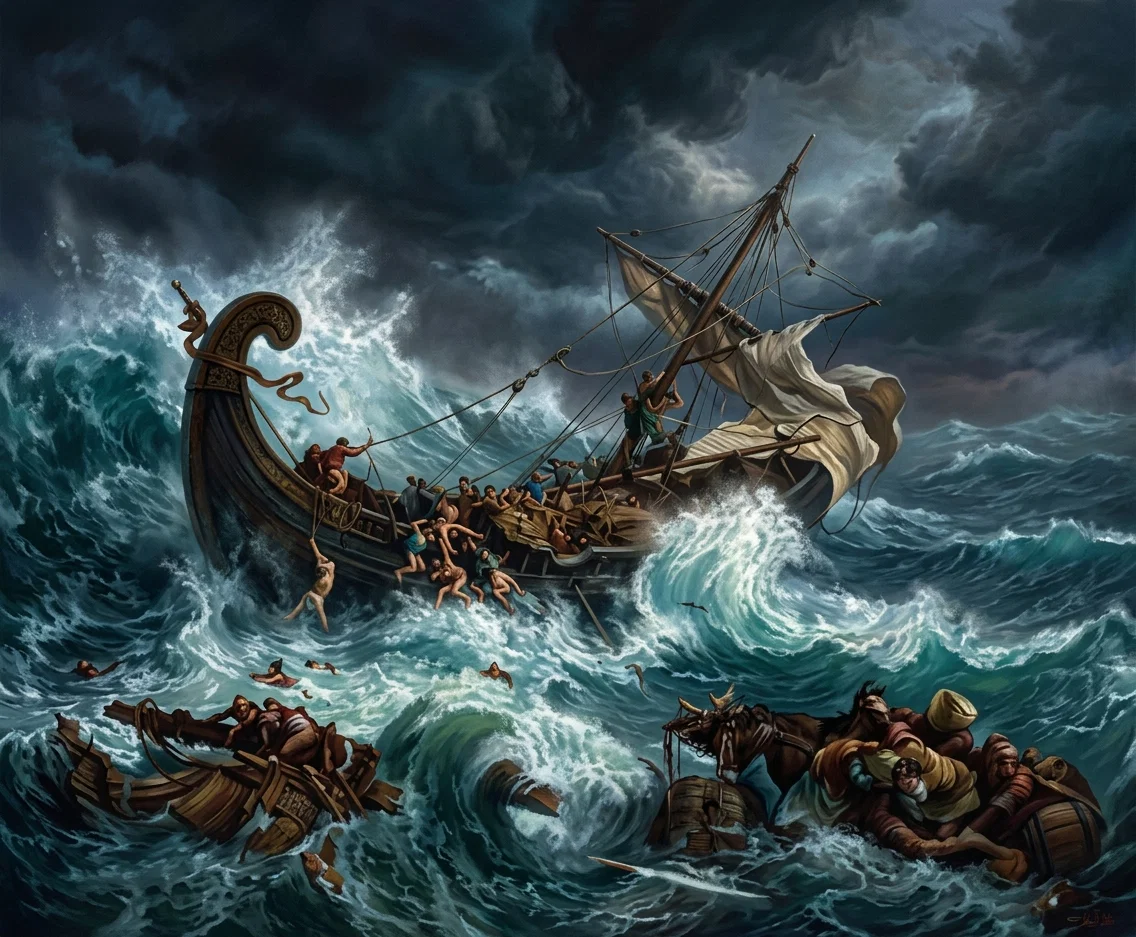
PAUL'S VOYAGE AND SHIPWRECK.
Note.—The present lesson section includes the whole of chapter 27. Interest will be added to the narrative by tracing the voyage on the map. According to Lewin the voyage began August 21, A.D. 60, and the wreck on the coast of Malta occurred about November 1. “The events described [in this lesson] were not only a part of God's providence guiding him to Rome, but they prepared the way for his better treatment at Rome and his release from prison.”—Peloubet.
13 “And when the south wind blew softly, supposing that they had obtained their purpose, they weighed anchor and sailed 14 along Crete, close in shore. But after no long time there beat down from it a tempestuous wind, which is called Euraquilo; 15 and when the ship was caught, and could not face the wind, 16 we gave way to it, and were driven. And running under the lee of a small island called Cauda, we were able, with difficulty, 17 to secure the boat; and when they had hoisted it up, they used helps, under-girding the ship; and, fearing lest they should be cast upon the Syrtis, they lowered the gear, and so were driven. 18 And as we labored exceedingly with the storm, the 19 next day they began to throw the freight overboard; and the third day they cast out with their own hands the tackling of 20 the ship. And when neither sun nor stars shone upon us for many days, and no small tempest lay on us, all hope that we 21 should be saved was now taken away. And when they had been long without food, then Paul stood forth in the midst of them, and said, Sirs, ye should have hearkened unto me, and not have set sail from Crete, and have gotten this injury and 22 loss. And now I exhort you to be of good cheer; for there 23 shall be no loss of life among you, but only of the ship. For there stood by me this night an angel of the God whose I am, 24 whom also I serve, saying, Fear not, Paul; thou must stand before Caesar; and, lo, God hath granted thee all them that sail 25 with thee. Wherefore, sirs, be of good cheer; for I believe God, that it shall be even so as it was told me. 26 Howbeit we must be cast upon a certain island.
PAUL’S VOYAGE AND SHIPWRECK.
Golden Text: “Be of good cheer; for I believe God, that it shall be even so as it hath been spoken unto me.” Acts 27:25
SUGGESTIVE QUESTIONS.
(1) What action of the wind did the sailors take as a favorable omen for sailing? Verse 13. Note 1. (2) Where did they sail? Same verse. (3) What change did they soon experience? Verse 14. (4) What was the result? Verse 15. (5) As they ran before the wind, what island did they reach? Verse 16. (6) What difficulty did they experience here? Same verse. Note 2. (7) What did they do to keep the vessel afloat? Verse 17. Note 3. (8) What serious danger threatened them at this time? Same verse. (9) As the tempest continued, what measures did they take for their own safety? Verse 18. (10) In what work did the apostles themselves engage on the third day of the storm? Verse 19. (11) What led them to conclude that they would not be saved? Verse 20. Note 4. (12) What did Paul tell the officers of the ship in regard to his former advice? Verse 21. Note 5. (13) Notwithstanding their present condition what cheering words did Paul speak to them? Verse 22. (14) What did his words show in regard to the fate of the vessel? Same verse. (15) How had Paul received this knowledge of what should happen to them? Verse 23. (16) How did Paul in this speech “show his colors”? Same verse. (17) What message did the angel have for Paul personally? Verse 24. Note 6. (18) What message did he bring in regard to the officers and crew? Same verse. (19) What reason did he give why they should be of good cheer? Verse 25. (20) What prophecy did he give of that which should happen to them? Verse 26.
NOTES.
1. When the south wind blew softly.—They were desirous of leaving the harbor in which they were now anchored, for it was not a good one to winter in, hoping for sufficient good weather to enable them to reach Phenice. The gentle south wind was taken to be indicative of favorable weather, and against the advice of Paul, they set sail, “thinking they had obtained their purpose” in waiting. The gentle south wind was no doubt the work of the “prince of the power of the air,” who designed to engulf the ship and thus cut short the work of Paul. It is in keeping with all his devices for entrapping and destroying souls. It is a gentle current that first urges the boat into the fearful rapids and falls of Niagara. It is a pleasant, tempting glass that draws the young into the rapids and over the brink of strong drink. It is the “little” sins that deaden the conscience and make it possible for the person to wantonly break the law of God and lose eternal life. “Be not deceived,” however pleasant the agent of deception. Know God's will and yield to it.
2. To secure the boat.—To bring the boat which was usually towed astern up out of the hold and upon deck, to be ready in case the vessel sank or had to be abandoned.
3. Undergirding the ship.—They passed chains or ropes under the vessel and over the deck, and then made them taut. This made the vessel better able to stand the strain of the tall mast with its great sail, and would also decrease her leaking. This expedient has been successfully resorted to by sailors since the day of Paul.
4. Neither sun nor stars . . . for many days.—In the days of Paul the compass was unknown, and sailors were guided by the stars and the sun. Not having seen either for many days they had no means of knowing where they were or even in which direction they were sailing. They might be driving directly upon a rocky coast.
5. Ye should have hearkened unto me.—Paul here refers to the advice which he had given them before leaving the harbor, not to find fault, but to impress upon his hearers the real value of that advice and the importance of heeding his encouragement, and the counsel which he was to give them later. That they did give heed to his words is seen by reference to verses 31 and 32.
6. Thou must stand before Caesar.—There is considerable similarity between this announcement of the angel and the words of the Lord as expressed in chapter 23, verse 11: “Be of good cheer, Paul; for as thou hast testified of me in Jerusalem, so must thou bear witness also at Rome.” The angel repeats the announcement that Paul may not forget God's unchanging purpose towards him in his work, notwithstanding the terrors of the gale, the dangers of the sea, or the apparent impossibility of being spared a watery grave.
THE ATONEMENT.
AN EXAMINATION OF
A REMEDIAL SYSTEM, IN THE LIGHT OF NATURE AND OF REVELATION.
BY ELD. J. H. WAGGONER.
THIRD EDITION, REVISED AND GREATLY ENLARGED.
THIS work is a critical and exhaustive treatise on the plan of salvation as revealed in the Scriptures, showing its harmony with the principles of justice and mercy, its consistency with reason, and its final results as affecting the destiny of the human race. 368 pp.; cloth, $1.00.
Address. PACIFIC PRESS, Oakland, Cal.
“Angels of God.” (Spanish.) A collection of five Bible readings on the following subjects: 1. The Angels of God. 2. Satan and His Work. 3. Christ the Resurrection and the Life. 4. The Second Chapter of Daniel. 5. Signs of the Coming of Christ. Two illustrations; paper; price, 6 cents. Address, PACIFIC PRESS PUBLISHING CO., Oakland, Cal.
News and Notes
FOREIGN.
—It is reported that the Greek cabinet has officially ratified the treaty of peace drawn up by the ambassadors of the powers.
—A new Grecian cabinet has been formed under the leadership of M. Zaimis, and the members took the oath of office before King George on October 3.
—On September 12 a bloody riot took place at Santo Domingo, Costa Rica, between the supporters of the president and his political antagonists, in which five were killed and over thirty wounded.
—Japan has purchased two new war vessels in England, which were being built for the Chilian Government. These vessels are 9,000-ton armored cruisers of the first class, capable of sailing twenty-one knots.
—Indian health statistics show that the bubonic plague is again active in India. The withdrawal of the medical officers to serve with the soldiers on the frontier is regarded as responsible for the increase of the disease.
—A plot to overthrow the government of Salvador has been nipped in the bud, and prominent politicians implicated have been placed under arrest. President Gutierrez is said to have the sympathy of natives and foreigners alike.
—The retiring minister for the Spanish colonies has called upon the bank of Spain to furnish 50,000,000 pesetas for the Cuban campaign; but the committee of the bank has declined to advance the funds, and has been asked to resign.
—The war between the Conselheiro fanatics and the Government of Brazil has come to an end, and Conselheiro is a captive. Canudos, the stronghold of the rebels, was captured by the government troops after a desperate engagement.
—Pope Leo has issued another encyclical, the burden of which is the spread and assiduous maintenance of the worship of the Virgin Mary,—a form of idolatry known as Mariolatry and forbidden by the first and second commandments.
—The English exploring expedition under Cavendish, which was reported some time ago to have been massacred by natives in East Africa, has reached civilization in safety, having discovered a number of lakes and two active volcanoes.
—A British sailing captain, arriving at Halifax on October 2, reports the sinking of an unknown vessel with all on board during a furious gale on September 8. He estimated the crew of the unfortunate vessel at between forty-five and fifty.
—Late reports from Guatemala indicate that the rebels under Morales are being defeated. Quetzaltenango has been retaken by the government forces, and one of Morales’ generals has been captured with a considerable store of arms and ammunition.
—English officials have communicated to United States Ambassador Hay the final decision of England not to join in a sealing conference to which Russia and Japan were to be admitted, but she is willing to join in a conference between the United States and Canada.
—In view of the preparations made by the British forces in India to complete the punishment of the rebellious Afridis and Orakzais, the latter, it is reported, have decided to offer terms of submission, instead of attempting to oppose the advance of the punitive expedition.
—A terrible prairie fire raged through certain portions of Manitoba on October 2, destroying live stock, farm products and implements, and entailing a considerable loss of life. There were many narrow escapes, and a number of families are homeless and utterly destitute.
—The National Congress of Miners, in session at Liege, Belgium, on October 3, has decided to make a demand for an increase of 15 per cent in miners’ wages throughout the kingdom; and if this demand is not granted by the middle of November, a general strike is to be declared.
—A Havana despatch states that it is estimated that 150,000 native Cubans have disappeared from various causes since the beginning of the war, and that in certain towns whole families have been wiped out. The highest estimate placed upon the number of massacred Armenians is 100,000.
—Insanity is said to be greatly on the increase in Prussia, where the lunatic asylums find great difficulty in accommodating the crowds of applicants for admission. The completed census of 1896 shows a total of 82,850 of these unfortunates in the kingdom. The condition of affairs in this respect in England is said to be but little better.
—The latest reports from Dawson City indicate that famine and disease will work havoc among the miners during the coming winter. The city itself is situated on a flat, with no drainage, and furnishes a first-class breeding ground for deadly bacilli. Vessels conveying provisions up the river have been stalled at different places, unable to proceed on account of the shallow water, and it is estimated that the stock of supplies now on hand at Dawson, can not possibly support all those who look to that place for the necessaries of life.
—Certain persecuted refugees from Galicia, Austria, who are now in the United States and Brazil, have asked to be taken into the Russian Church; but the Russian Government holds aloof from granting the request, on the ground that such an action may give offense to Austria; which is another of the inconsistencies of a union of Church and State.
—A report from the Orient states that Russia is preparing for aggressive movements in the far east. It is said that 100,000 Russian soldiers are now massed on the Russian frontier near Vladivostock. Her purpose in the move is not clear to outsiders, but it is thought to be a menace to Japan, inasmuch as Russia has offered to drill Chinese soldiers free of expense.
—The interests of England and France in western Africa are beginning to clash. France is laying claim to territory that for some time has been considered under the sphere of British influence, and British troops are being moved toward the seat of difficulty. It is stated that unless the Anglo-French frontier is speedily designated, there is bound to be trouble.
—Additional excavations made in the district of Tiraspol, Russia, have resulted in the finding of the bodies of six more of the fanatics who had themselves buried alive. The search continues, and it is expected that about thirty more bodies will be discovered. This peculiar sect was known as the Raskolniki, and burial alive was considered by them a passport to heaven.
—The English and Germans have decided to abandon the practise of carrying conspicuous battle-flags into action. Lord Wolseley says: “In future it would be madness and a crime to order any man to carry colors into action. You might as well order him to be assassinated. The Germans carry the poles on which the colors used to be, so that they attract no notice in action.”
—A New York Herald despatch from Panama gives the following report of affairs in Colombia: “The disturbed political situation continues, and is causing considerable excitement throughout the republic. Commercial interests are suffering greatly.” Both parties have hopes of settling the present critical condition without conflict, should the proper man be placed at the head of the government.
—Considerable excitement has been aroused in England over the epidemic of typhoid fever which has recently broken out in Maidstone, Kent County. There have been 1,300 cases of the fever in that town and vicinity, and about 50 deaths have occurred. The epidemic is spreading at the rate of 120 cases daily. Hospital accommodations have been found inadequate, and the school buildings have been turned into sick wards.
—The Spanish columns at Rosario, Havana province, were attacked on October 1 by the insurgents. After a desperate fight the Spanish were routed, and all connection on the Western Railway, joining Havana with Pinar del Rio, has been cut off. General Weyler has cabled to Madrid another promise to pacify Havana province. The volunteers threaten to throw down their arms if Weyler is recalled. The excitement against the United States is so intense in Havana that it is feared attacks upon the United States consulate and Americans will occur if Weyler is recalled.
—Señor Sagasta has accepted the position of premier of Spain, and selected his cabinet. General Correa will be minister of war, Señor Gullon, minister of foreign affairs, and Señor Moret, minister for the colonies. Señor Sagasta has announced a liberal policy for Cuba, which will amount to home rule under the suzerainty of Spain, and the recall of General Weyler. On the announcement of the change in the cabinet, General Weyler cabled the government, tendering his services, and stating that he would not resign. Through his influence and that of his immediate associates a great demonstration was made in Havana on October 6 by the loyal Spaniards protesting against Weyler’s recall. In a speech made by Weyler on that occasion he declared he should neither resign nor accept a recall. It is said that according to the laws of Spain he can not be compelled to obey the recall of the government. The queen regent, in appointing Señor Sagasta, expressed her dissatisfaction with the cruelties practised under the leadership of Canovas, both in Spain and Cuba.
DOMESTIC.
—General Neal Dow, the father of prohibition in the State of Maine, died at Portland on October 2. He was ninety-three years old.
—The Southern Pacific Railroad Company has closed its Gulf route to all freight traffic on account of the yellow fever quarantine.
—The lumbering town of Austin, Potter Co., N. Y., was nearly destroyed by fire on October 4. The amount of the loss is placed at over $165,000.
—Seven girls were burned to death at Plankinton, S. D., on October 6 by the burning of the girls’ dormitory of the State Industrial School at that place.
—The schooner Hueneme, of San Francisco, was wrecked on Unamak Island, Alaska, on September 7. Her crew was saved, but her entire cargo was lost.
—It is said that the bacilli of cholera can not resist the powerful citric acid of the lemon, and that one grain will destroy all the microbes in a quart of water.
—A tent in which the First-day Adventists were holding meetings near Pittsfield, Mass., was set on fire on September 7, and a considerable portion of it destroyed.
—The State Fish Commissioner of Washington reports that the Pacific Coast salmon catch for the present year will break all past records. The entire catch will amount to nearly 3,000,000 cases.
—Five bandits held up the Rock Island passenger train at a lonely siding near Chickasa, I. T., on October 1, robbed the passengers, crew, and the mail pouches, and escaped to the Wichita Mountains.
—Prof. Elmer Gates, of Washington, D. C., has invented a microscope, or an improvement on the microscope, by which the power of magnifying an object can be increased 300 times above what it is now.
—On September 30 two masked robbers held up and robbed three stages between Angels and Milton, Cal., killed two of the horses, and wounded two of the passengers, all inside of thirty-five minutes. They have not been apprehended.
—An express train was held up eight miles from Kansas City, Mo., on October 6 by a band of eight highwaymen. Their attempt to blow up the safes of the express company failed, the robbers securing only a few dollars from the trainmen.
—One hundred and thirteen naval officers and seamen passed through Omaha, Neb., on October 6 on a special train to join the United States cruiser Baltimore at San Francisco. The run is being made as a sort of test of the facilities of sending sailors across the continent.
—The government is rushing work on the harbor defenses of San Diego Bay, which will consist of heavy gun emplacements and additional submarine torpedoes, and these defenses are to be completed in half the time specified when the contracts for the work were signed.
—Four young women were drowned in Buttahatchie River, near Hamilton, Ala., on October 1. Their escorts, two young men, who caused the boat in which they were sailing to capsize by rocking it, saved their own lives, but have been compelled to leave town on account of the bitter feeling against them.
—The United States Commissioner to the Paris Exposition of 1900 has succeeded in securing the desired space for the American exhibits. The space set apart for the Americans was considerably smaller than that granted to the other big nations, and the commissioner had decided to withdraw from the exhibition.
—Certain Catholic leaders are making complaint to the public because Catholic authors are not recognized in the text-books of the country, and propose to establish a Catholic authors’ club in New York, and to boycott all text-books issued by non-Catholic publishers and authors “in which Catholic genius is ignored.”
—The wily Chinese coolies who desire to come to America in spite of the exclusion law, are shrewdly taking advantage of a treaty fifteen years old, by the provisions of which they are allowed to land. By that act they are simply required to make oath that they are either merchants or students, and have their certificates signed at the port of departure. It is believed that the act will be revised.
—The editor of the Interior declares that the Presbyterian Church is lagging behind other denominations in its progressive work, and attributes this to the “weights of austere and forbidding philosophies” that hamper it. He advises the different churches of the denomination to stop bickering over creed nonessentials, and suggests that a new, short creed be adopted.
—During the present year, 6,913 schoolchildren of the city of New York have been refused admission to the public schools on account of lack of room. In view of this certain officials of the city are negotiating with the superintendents of the parochial schools to bring about such an arrangement that the schoolchildren now denied a place in the public schools may be admitted to the parochial schools to receive instruction there under Catholic teachers.
Fountain Syringes
Best Rubber Holds 3 Quarts
Complete with 5 Hard Rubber Tubes
In a Nice Oak Box
PRICE, POSTPAID, $1.00
AddressPacific Press, Oakland, Cal.
The Testimony of History to the Truth of Scripture.
By Rev. George Rawlinson, M.A., author of “Seven Great Monarchies.” This is a pamphlet of 240 pages, takes up the most recent archaeological discoveries, and shows how thoroughly they agree with the Bible record. “The religion of the Bible, unlike almost all other religions, has its roots in the region of facts,” are his opening words in this valuable work, and the whole book is just as forcible and to the point as this opening sentence. We say again, it is a valuable aid to those who wish to briefly study the subject. Price, paper covers, 35 cents.
PACIFIC PRESS PUBLISHING CO., Oakland, Cal.
To New and Old Subscribers
By Editor
SIGNS OF THE TIMES for one year and our
New Teachers’ Bible
To New Subscribers for $3.00. Last winter we gave a Bible with the SIGNS to new subscribers only, but we received so many requests from old subscribers for a Bible that we have decided to include them also in our offer for the next few months. We will therefore send this Bible to Old Subscribers Who Renew for One Year, for the same price as to new, and if your present subscription does not expire for several months, and you wish to obtain the Bible, renew during the time of the offer, sending us $3.00, and we will extend your subscription one year from the present date of expiration.
Extravagant words are really unnecessary in describing this book, as we make no representations not in accordance with the facts. Those competent to judge, who have examined this Bible, say that we are making a
REMARKABLE OFFER
and that subscribers who get this book will get a splendid Bible for the money. If you are not satisfied we will refund your money; but we have no fears. We are positive that you will wonder that we can give such a good book and the paper for the price. The Bible is an
S. S. TEACHERS’ EDITION
minion type (the style most used), with references, divinity circuit, round corners, red under gold edges, size of page 5½ × 8 inches, cover leather lined to edges—an important adjunct to the substantial nature of the binding. It contains over
650 Pages of Valuable Bible Helps
Including the immense
New Illustrated Bible Treasury
Containing sections on the Old and New Testaments, History and Chronology of the Bible; Geography and Astronomy of the Bible; Birds, Animals, Plants, Fishes, Calendars, Weights, Measures, etc., in short, a
Specimen Page of the Illustrated Bible Treasury
Copyrighted by Thomas Nelson & Sons
THE NEW TESTAMENT.
complete and exhaustive collation, but most of them deserve a more careful study than they have hitherto received. It is also readily to be admitted that they are, relatively to the Uncial MSS. and the versions, of much less value in the determination of the text. But we must bear in mind that the texts of Cursive MSS. are merely the descendants of lost Uncial MSS., and that the maxim that “all various readings are early” applies to them as well as to the more imposing Uncial MSS. Where a number of Cursive MSS. can be proved to come from a common lost original, it is often possible to restore the lost (Uncial) ancestor by a critical comparison of the texts that are descended from it.
LECTIONARIES.—A word must be said in passing of Lectionaries, or copies of the Gospels, or the Acts and Epistles, arranged for reading in churches. They are very numerous, and almost unknown as to text; but enough is known to enable us to affirm with certainty that they often contain fragments of very early texts. When the lectionary is made up out of lessons from the Gospels, it is commonly called an Evangelistarium; when the lessons are taken from the Acts and Epistles, it is known as an Apostolos or Praxapostolos.
VERSIONS.—We come now to versions, a class of witnesses to which greater weight is continually being assigned in the determination of the text. The great value of the versions lies in the evidence which they furnish as to the state of the New Testament text at the time when it was translated. Many of the versions are of the highest antiquity—in fact, three of them are commonly credited to the second century—and this means that, if their evidence had come down to us unchanged from the time of the first translation, we should have the equivalent of three Greek MSS. which would be at least 150 years older than any existing copies. Unfortunately versions are only copies in a different language, and are subject to the same tendencies to revision and textual change as are ordinary Greek MSS. It becomes, therefore, of the first importance to edit the versions as nearly as possible in the forms in which they stood when first made. A polished Vulgate must be carried back to the rough and probably barbaric ancestor from which it is derived, and the evidence of the ancestral translation will be of the highest value. It is, for textual purposes, the evidence of the version.
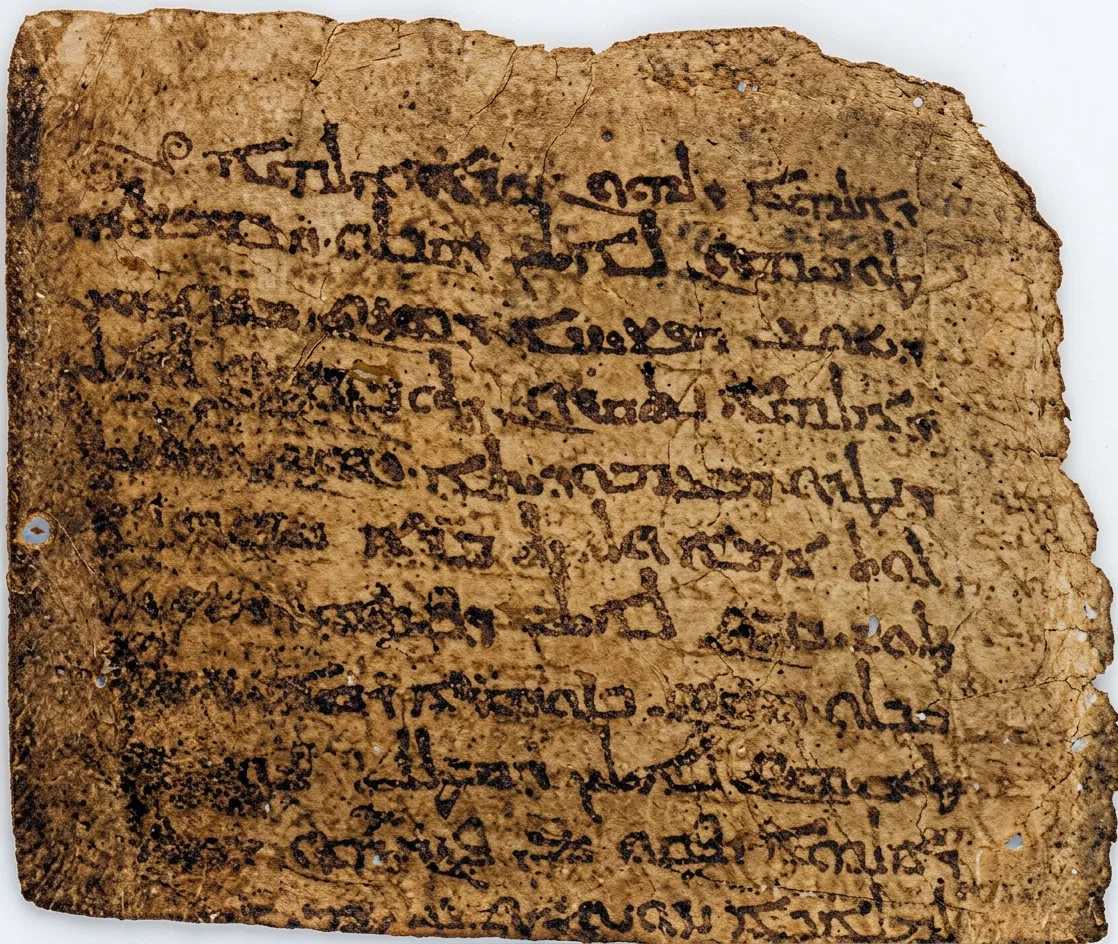
PORTION OF MANUSCRIPT IN SYRIAC (Luke 7. 44-47).
(From a Photograph taken by Mrs. LEWIS.)
We may divide the earliest versions into the following groups:—
SYRIAC VERSIONS.
LATIN VERSIONS.
EGYPTIAN VERSIONS.
Each of these versions is believed to go back in some form to the second century; and this may be taken as proved for the first two groups. The third group has not yet been adequately studied.
1. SYRIAC VERSIONS.—The Syriac New Testament is known to us in the following forms:—
(1.) Old Syriac (Lewis Syriac) from Mount Sinai, discovered in palimpsest in 1892 by Mrs. Lewis. The washed-out text which has been covered by legenda sanctorum (or rather sanctarum, for the stories are tales of good women), was probably written in the fifth century. The text is a very remarkable one, and is often in close agreement with that of the Codex Bezae and Old Latin versions. It often, by a slight change of order of the words or sentences, adds greatly to the meaning (e.g., Mark 16. 3, “And they said one to another, ‘Who shall roll us away the stone from the door of the sepulchre?’ for it was very great;” an arrangement which is also found in the Apocryphal Gospel of Peter in the second century; John 16. 30, “And needest not that thou shouldest ask any one,” &c.).
The following account of the history of this MS. has been furnished by Mrs. Lewis:—
BIBLE DICTIONARY
with over 350 Illustrations, the larger part being fine half-tones, clearly and beautifully printed. An entirely new and exceedingly fine feature of this Bible is the
COMBINED BIBLE CONCORDANCE
which includes, in one alphabetical list, a Concordance, Subject Index, and Dictionary of Proper Names. This must be seen to be appreciated. Besides the above is a set of
TWELVE COLORED MAPS
with complete index. All told, this is a rare chance to get the SIGNS’ and a fine, substantial Bible at an exceedingly low figure.
OUR OFFER
The SIGNS OF THE TIMES one year and the BIBLE to a new name, postpaid,
The Same Price to Old Subscribers who Renew for One Year
$3.00
FREE
By securing for us a few subscribers to the SIGNS you can get the Bible FREE as follows:—
We will send a Bible free, postpaid, to any one sending us Seven New Subscriptions at one time, for one year each, and $7.00.
You can get the Bible at a merely nominal cost, as follows:—
1. We will send the Bible postpaid to any one sending us $3.75 for two new subscribers to the SIGNS, or for one new name and one renewal, for one year each, all sent at one time.
2. We will send the Bible postpaid to any one sending us $4.50 for three new subscribers to the SIGNS, or for two new names and one renewal, for one year each, all sent at one time.
3. We will send the Bible postpaid to any one sending us $5.00 for four new subscribers to the SIGNS, or for three new names and one renewal, for one year each, all sent at one time.
If any subscribers under any of these offers desire Bibles, add $2.00 for each one wishing a Bible.
Note.—The Bibles and papers will be sent to different addresses if desired.
Note.—We can not sell the Bible separate from the above offers.
Address,
Signs of the Times
Oakland, Gal.
(We will stamp your name in neat gilt letters on Bible Cover for 25 cents extra, if desired.)