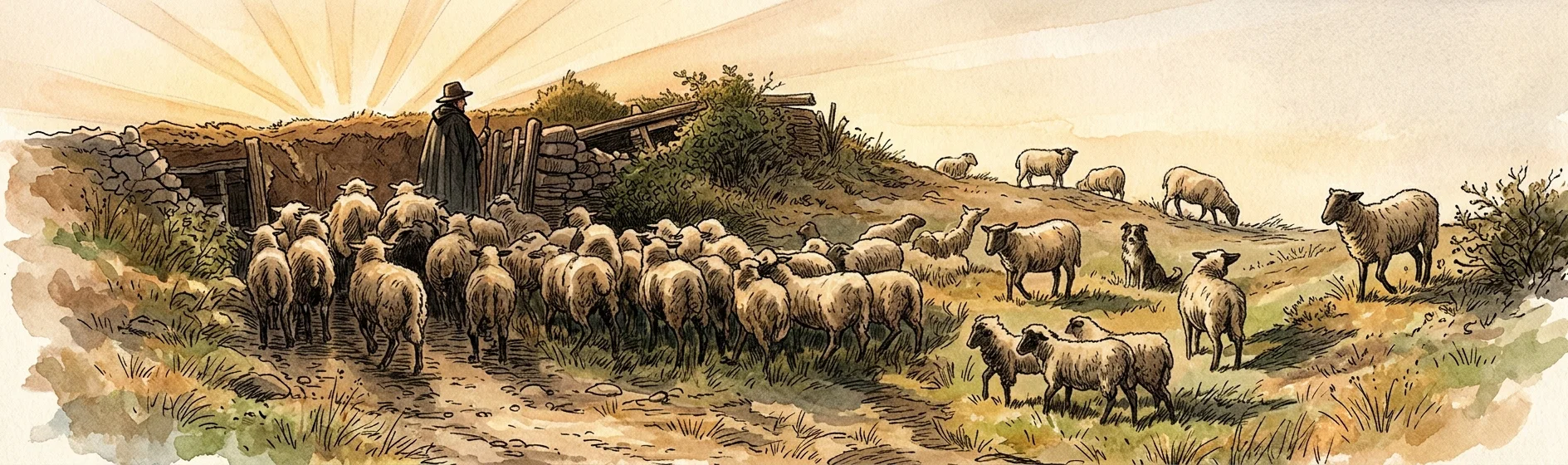
In the beautiful word picture of the sheep and shepherd, contained in the tenth chapter of John, representing the closeness of the relationship existing between God and his children, our Saviour says, “I am the Good Shepherd, and know my sheep, and am known of mine.”
There is so much embraced in this idea. There is comfort and strength in the thought that God knows us. He knows our trials, our difficulties, our temptations, our weaknesses. He knows our power of endurance. He knows just how hot to make the furnace, just how deep to send the arrow of affliction, just how heavy to make the load.
A gentleman passing along the street saw a little boy with a hod of brick on his shoulder, in which his father was placing a load for him to carry to the building above. The little boy was asked, “Are you not afraid your load will be too heavy?” The little fellow replied, “Father knows how heavy to make the load.” And our heavenly Father knows. His knowledge is infinite, his power is infinite; and the infinitude of his love and tenderness for us equal the greatness of his power and wisdom. He is too wise to err, too good to be unkind. Knowing that he knows, we may safely trust the leadings of his providence. To us the way may seem dark; no star of hope may light the sky of our experience; but if we do not understand, God does, and with perfect confidence we may place our hands in his and resign ourselves to his leadership and guidance, trusting him to give us that experience that will be for our highest good.
“He calleth His own sheep by name, and leadeth them out. When He hath put forth all His own, He goeth before them. And the sheep follow Him; for they know His voice.” John 10:4, 5, R. V.
Yes, God knows us, and, O blessed thought, we also may come to know him! “I know my sheep, and am known of mine.” We may know God as we know our dearest, closest friend, and with even a deeper knowledge than we can know any earthly friend may we come to understand him. There is a vast difference between knowing of God, knowing about God, and knowing God. I have a dear, kind friend, who, by his constancy in many experiences and trials, has proved the strength of his friendship. With him I have come to commune as with a brother. There is no secret between us. He knows my virtues and failings, and I know his. Before I met that friend I knew of him. I knew something about him, but now I know him. I know his habits of life, his disposition, his likes, his dislikes, his tastes. I know him as he actually is in all his characteristics and attributes; but, O, I may know God with even a deeper knowledge than this! I may read about him in his Word; I may hear of him through others’ experience; I may hear him represented as a compassionate Saviour, as a merciful Redeemer, as a comforting Friend, but deeper and broader than all this I may know him in my actual experience as a loving Father, as a Comforter, as a Sympathizer in all my trials, as “a Friend that sticketh closer than a brother.” And when one comes to know God in this closeness and tenderness of relationship, then it is, and not before, that he can enjoy loving communion with him. Then can he come to the Lord Jesus in fulness of confidence in every great trial and in every small trial, knowing that God is equally interested in both causes of concern to one of his own.
And in knowing God, and in knowing that he knows us, the independence of our relationship to him is strengthened. Our faith will not rest upon the experience of others, but upon the individual experience which God has given to us. Others may prove disloyal, we will prove true; others may falter, we will stand firm; indifference and coldness may possess those around us, but the love of God shed abroad in our hearts will keep aglow the fervor of our devotion and piety. Factions may split the church, false doctrines may be presented, and in the midst of the jargon of strife and confusion it may seem to us, viewing the matter from a human standpoint, that the work of God is coming to ruin. At such times this personal relationship, this knowledge of God, will save us from rout and disaster. Friends may prove false, and the finger of scorn may point us out to the mocking, jeering multitude, but none of these things will move us, because we have come to know in whom we have believed, and we have come to know not only in whom we have believed, but we have come to know him in whom we have believed. And this knowledge of him is the knowledge of power, enabling us to prove loyal to One ever so loyal to us.
May we, as the sheep of the heavenly fold, know the voice of the True Shepherd; and knowing that voice, may we follow where it leads. F. M. WILCOX.
THE APOSTLES AND THE SABBATH.
By W. L. Iles
(Continued.)*
Meeting on the First Day.
SOME persons claim it was the custom of the disciples to meet on the first day of the week, after the resurrection of Christ, to commemorate that event. If it were true, as some claim, it would still be a fact that it is the “first day of the week,” and not the Sabbath. It was not their custom to meet on that day, or at least we have no record that it was. We have record of one meeting being held on that day, and then it is called the first day of the week, not the Sabbath.
“And upon the first day of the week, when the disciples came together to break bread, Paul preached unto them, ready to depart on the morrow; and continued his speech until midnight.” Acts 20:7.
This meeting was held upon the first of the week, or first day of the week, or Sunday. The Sabbath always comes on the last of the week, and not on the first of it. How could the first day of the week become the Sabbath without divine appointment? Where is such an appointment? Does a religious meeting, held on that day, make the day the Sabbath? Those who keep the seventh day very often meet upon the first day of the week for religious services, and to “break bread.” Does that make it the Sabbath? If the disciples had met upon the second day of the week, and broken bread, would that make Monday the Sabbath? We ask the reader to consider the following facts concerning this meeting:—
1. If the day was reckoned from midnight to midnight, then they broke bread Monday morning. Paul preached until midnight, and, after healing the young man who fell out of the window, they returned to the room in the third story and broke bread. The breaking of bread was after midnight, and, if the meeting was Sunday night, the breaking of bread was Monday morning. Acts 20:7-14.
2. According to the Bible, the day begins at6even, or sunset, and lasts until the next evening at sunset. “The evening and the morning were the first day.” “From even unto even shall ye celebrate your Sabbaths.” The Jews did not believe in healing on the Sabbath, but after the Sabbath was over, then they would bring the sick to Christ. “And at even, when the sun did set, they brought unto him all that were diseased, and them that were possessed with devils.” Mark 1:32. “And it came to pass, that when the gates of Jerusalem began to be dark before the Sabbath, I commanded that the gates should be shut, and charged that they should not be opened till after the Sabbath.” Neh. 13:19.
The “first day of the week,” upon which the disciples held their meeting, began Saturday evening, and closed Sunday evening. The sun rules the day, and at the going down of the sun, one day closes and another begins. As this meeting was upon the “first day of the week,” and in the evening (for there were many lights burning), and the evening is the first part of the day, we conclude it was held upon what we now call Saturday evening. Seventh-day Adventists quite often meet upon the evening of the first day to “break bread,” but who ever thought of referring to an Adventist meeting on that day to prove that that day was the Sabbath? If the Adventists could keep the Sabbath, and yet “break bread” on the “first day of the week,” could not the early disciples do the same? He who keeps Sunday should have better authority than is found in this text.
3. This was the last meeting Paul could enjoy with this company. Acts 20:22, 38. Paul’s brethren were sailing while he was enjoying this farewell meeting with his brethren. Sunday morning Paul started on his journey afoot, expecting to meet his companions in travel at Assos, a distance of nearly twenty miles. It is therefore evident that he did not consider it a sacred and holy day. How will you consider it? Even tho he had a direct command to meet on the first day of the week, to break bread, that would not affect the fourth commandment or the observance of the Sabbath.
Many Christians suppose that the church is commanded to meet on the first day of the week, and take up a collection. That thought is based on a wrong understanding of the following text:—
“Upon the first day of the week let every one of you lay by him in store, as God hath prospered him, that there be no gatherings when I come.” 1 Cor. 16:2.
This is called “a collection for the saints.” There are many ways of taking up collections. It may be done by passing the collection box or plate to those assembled together, or by sending men from house to house to gather up the money. In the time of Paul the churches donated means to support the needy poor in the church. “Only they would that we should remember the poor; the same which I also was forward to do.” Gal. 2:10. Again he says: “But now I go unto Jerusalem to minister unto the saints. For it hath pleased them of Macedonia and Achaia to make a certain contribution for the poor saints which are at Jerusalem.” Rom. 15:25, 26. We now inquire, How was this contribution money gathered together, and how did it get to the saints at Jerusalem? Here is the reply: “Upon the first day of the week let every one of you lay by him in store, as God hath prospered him.” How can any one “lay by him in store” by putting it in the collection box? In putting it in the collection box, instead of laying by himself, he has given it to another. He does not have it by himself in store. If he should take from his means a certain portion each week, and lay it by itself, “by him” in his own home, and not at the church, he would be fulfilling the text. Again the apostle exhorts them:—
“For as touching the ministering to the saints, it is superfluous for me to write to you; for I know the forwardness of your mind, for which I boast of you to them of Macedonia, that Achaia was ready a year ago; and your zeal hath provoked very many. Yet have I sent the brethren, lest our boasting of you should be in vain in this behalf; that, as I said, Ye may be ready; lest haply if they of Macedonia come with me, and find you unprepared, we (that we say not, ye) should be ashamed in this same confident boasting. Therefore I thought it necessary to exhort the brethren, that they would go before unto you, and make up beforehand your bounty, whereof ye had notice before, that the same might be ready, as a matter of bounty, and not of covetousness.” 2 Cor. 9:1-5.
Paul had boasted of Achaia for their liberality, and in their forwardness in supplying means for the poor saints. He had told the brethren of Macedonia that Achaia was ready a year ago. Paul expected soon to make a trip through Achaia, and he did not know but some of the brethren of Macedonia would go with him. Lest Paul’s boasting should be in vain, and he be ashamed, he sent some brethren before him to make up their bounty. If the brethren of Achaia had met every Sunday and had passed the collection box, and the money was in the hands of the treasurer, why did Paul need to fear lest the bounty might not be ready? How could it be possible for Paul to come and “find them unprepared” if from week to week they had been putting it in the collection box? How could the brethren “make up” the bounty, if they had been making it up every Sunday by putting it in the collection box? If the brethren had obeyed Paul, and laid by itself that which they could give to the poor, it would be but a natural thing to have the brethren make up the bounty. When the bounty was made up, it was then taken to Jerusalem. “And when I come, whomsoever ye shall approve by your letters, them will I send to bring your liberality unto Jerusalem.” 1 Cor. 16:3.
If Sunday has no stronger foundation for its divine appointment than the unwarranted inferences drawn from such texts as Acts 20:7 and 1 Cor. 16:2, it certainly is built upon the sinking sand. W. L. ILES.
Phœnix, Ariz.
Christ Is Living and Presses His Claims
By Christopher G. Hazard
CHRIST is no mere historical character; he is not dead and gone; he lives, and presses his tremendous claims upon the soul.—Christopher G. Hazard.
THE KINGDOM OF GOD NOT POLITICAL.
By W. N. G.
According to the doctrine advanced by the W. C. T. U. of Alameda County, Cal., “our national life” and the “coming of Christ’s kingdom on the earth” are co-ordinate interests, the one depending upon the other. According to the Word of God, however, the setting up of the kingdom of God will break in pieces and consume every earthly nation in existence, and it will fill the whole earth and stand forever. See Daniel 2. But we could hardly expect anything but confusion when the effort is squarely made to convert the kingdom of Christ into a kingdom of this world in the face of his plain declaration that it is “not of this world.” John 18:36. About the most motley declaration of principles yet published is set forth in the following preamble and resolution:—
“WHEREAS, We believe that the perpetuity of our national life depends upon obedience to the divine command, ‘to keep holy the Sabbath day,’ and recognizing, as we do, that the labor question and the temperance question go hand in hand in sustaining the vital issues of a day of rest and closing the saloon, as a necessary protection to our young people and safeguard to the community; and,
“WHEREAS, The multiform evils resulting from the desecration of the sabbath in California require that a legal enactment making its observance mandatory is the ultimatum toward which the Christian churches of this State should direct their efforts; and,
“WHEREAS, Public sentiment has not reached the point which demands such legislation; therefore,
“Resolved, That we welcome into our midst the presence of so powerful an organization as the United Society of Christian Endeavor, which has for one of its objects the promotion of a better sentiment on this important question; and knowing that in ‘union is strength,’ we desire to co-operate with them in every effort which they are making to hasten the coming of Christ’s kingdom on the earth, which is ‘righteousness, peace, and joy in the Holy Ghost.’”
In the first place, what has the “divine command to keep holy the Sabbath day” to do with a human command to observe a day which no competent power ever has made holy? Again, all the “multiform evils” that have resulted from the so-called “desecration” of Sunday in California, have arisen from the custom of being idle on that day; and not only is this true, but the W. C. T. U. and other organizations are desirous of extending this custom and making it obligatory upon all. Men who follow their ordinary legitimate occupations on Sunday are no more disorderly than on other days. Yet we are told in the foregoing declaration that to enforce idleness on Sunday, and consequently an excess of mischief, “is the ultimatum toward which the Christian churches of this State should direct their efforts.” With what we see of the effects of voluntary idle Sunday observance, what may we expect of “a legal enactment making its observance mandatory”?
On the supposition that a legal enforcement of Sunday observance is “the ultimatum toward which the churches of this State should direct their efforts,” we are forced to the conclusion that such an “ultimatum” is a very low aim. The apostle’s ultimatum of effort, below which the church of to-day can not afford to fall, was this: “I press toward the mark for the prize of the high calling of God in Christ Jesus.” Phil. 3:14. This was Paul’s aim, the goal to which he pressed forward; yet in all the record we have of his life we find no reference to working up public sentiment to the pitch of demanding a legal recognition or a religious observance of Sunday.
The last item of the preamble and the resolution itself admit that one of the objects of holding the International Christian Endeavor Convention in San Francisco was the promotion of a sentiment favorable to a Sunday law. Inasmuch as the enactments of any State law is a political action, this resolution admits that the holding of said convention in California was a political movement; and such an admission is practically an avowal of the doctrine that hastening the coming of Christ’s kingdom on earth is a political work. It is practically a lowering of Christ’s righteousness, and “peace and joy in the Holy Ghost,” to the level of political wire-pulling.
But it is pertinent to illustrate this idea that a Sunday law for California should be the ultimatum of church effort to the extent of calling an international convention for the promotion of sentiment to that end. According to the sentiment expressed by the Alameda County W. C. T. U., such an achievement would be an effort to hasten the coming of Christ’s kingdom. Over fifteen hundred years ago a Sunday law was enacted by a government that controlled the world. A few years later it was so far indorsed by the church which that government recognized and supported, that all dissenters were anathematized. Was the kingdom of Christ on earth hastened as a consequence?—No, the period known as the Dark Ages followed in a very short time; and many countries where Christianity had been previously recognized7as a power for good are yet in the darkness of heathenism.
But we will come to our own country for an illustration. No State has been more scurrilized or berated by the churches and reform societies than Nevada, because of its legalizing of prize-fights. Yet Nevada has its Sunday law. Did the great prize-fight, which Nevada’s legislature especially invited by a special law, particularly “hasten the coming of Christ’s kingdom”? It ought to have had such an effect, rather it could not have been passed at all, if the previous Sunday enactment had been so efficacious in ushering in the coming kingdom of Christ as is claimed by our W. C. T. U. sisters and their adherents for a California Sunday law.
“The ultimatum toward which the Christian churches of this State should direct their efforts” should be reached through the Word of God, guided by the “Spirit of truth,” and not through the fallible laws of political powers. The erection of human foundations on which to establish the kingdom of Christ is sheer presumption. The God of heaven will set up that kingdom in his own time and in his own way; and the legitimate aim of the churches should be to preach the Gospel of the kingdom to every nation, kindred, tongue, and people, that whosoever will may come and take of the water of life freely. There is no legal compulsion in the plan of salvation, nor is there any human politics in it. W. N. G.
CHRIST IN THE PSALMS.
By J. E. Evans
The supposed higher education of the present day is opposed to the Word of God. Criticism of that Word is becoming more and more common every day. Skepticism and actual infidelity are the result, while the ignorance of many religious teachers results in undermining the faith and confidence of those who look to them for help. As long as men feel free to criticise the Word of God, saying that this utterance is inspired and that is not, how can they minister to the wants of those who are longing for something less capricious than the human mind? Even ministers of the Gospel are troubled over the records of incidents in the lives of patriarchs and prophets, and style certain of the psalms of David as imprecatory.
May 31, 1897, a discussion arose in the Ministerial Union of Baltimore concerning the divine and human utterances in the Bible. After a paper had been read by Bishop James A. Latane, on “The Inspiration of the Bible,” Dr. Grammer said:—
The infidel is making capital out of his attacks on the supernatural, and we must meet them. How best shall we account for what he insists are inaccuracies, inconsistencies, and anachronisms? . . . How must we account for the blessings showered upon Jael, after her bloody deed, and for many events that occurred in the history of Elijah?
The imprecatory utterances of the psalms were then taken up. The report continues:—
Several ministers suggested that there were both divine and human utterances in the Bible, and that certain fierce denunciations, and prayers for the destruction of others, were simply manifestations of the human side.
Rev. Samuel A. Wilson then read the 109th Psalm. “I regard the objections raised by many to the Bible as largely due to the imprecatory psalms. We have been bothered by them. The hard places in the Bible had better be passed over by preachers in the pulpit.”
Another speaker, Rev. Dr. Joseph E. Smith, said:—
I do not sympathize with men who are always finding fault with the Bible. We do not attach enough importance to the human side of it, and human imperfections must crop out. Look at the old patriarchs mentioned in the eleventh chapter of Hebrews. They were the most imperfect set of men, and few of them would now be admitted into the Methodist Episcopal Church, even on probation. . . . The human element comes to the surface, or else how can you square some of David’s utterances with the Sermon on the Mount?
Rev. Dr. Grammer, in making his closing remarks, said:—
David caught the spirit of holy indignation against the wrongdoing of his time, and expressed it sometimes in a human way. We can understand that. The great purpose of Protestant ministers must be to uphold the inspiration of the Scriptures.
Thus we see that these ministers of the Gospel, in attempting to clear up the matter in their own minds, could see only the human side of it all; and the subject became all the more bewildering to those who accepted them as guides in spiritual things. The reason for this lies in the fact that many study the Scriptures as they would a book on some common topic, the author of which was not even supposed to be inspired. While there are more than twenty different Psalms which unmistakably refer to Christ, I will notice only a few of them, and a few other scriptures, to show that our Lord is not only referred to in the Psalms, but is often represented as the speaker.
First, did David speak by inspiration? He says of himself, “The Spirit of the Lord spake by me, and his Word was in my tongue.” 2 Sam. 23:2. Again, “Which the Holy Ghost by the mouth of David spake.” Acts 1:16. And Christ, in speaking of David, says, “For David himself said by the Holy Ghost,” etc. Mark 12:36. Other scriptures might be cited, but these are sufficient to show that the Saviour acknowledged David as speaking by inspiration.
Coming to the subject direct, I first turn to Ps. 2:7: “I will declare the decree: the Lord hath said unto me, Thou art my Son; this day have I begotten thee.” We find the same words in Acts 13:33: “As it is also written in the second psalm, Thou art my Son, this day have I begotten thee.”
“For thou wilt not leave my soul in hell; neither wilt thou suffer thine Holy One to see corruption.” Ps. 16:10. Peter, speaking upon the day of Pentecost, says of this, “For David speaketh concerning him. . . . Because thou wilt not leave my soul in hell, neither wilt thou suffer thine Holy One to see corruption.” Acts 2:25–27. Compare also Ps. 22:1; with Matt. 27:46; Ps. 40:7, 8; with Heb. 10:5–10; Ps. 41:9; with John 13:18.
Now I turn to one of the alleged imprecatory psalms—the eighty-ninth. Beginning with the twentieth verse it reads thus:—
“I have found David my servant; with my holy oil have I anointed him. . . . I will beat down his foes before his face, and plague them that hate him. . . . Also I will make him my first-born, higher than the kings of the earth. . . . Once have I sworn by my holiness that I will not lie unto David. His seed shall endure forever, and his throne as the sun before me.”
David was not the first-born, nor does his throne still exist. Therefore this language must apply to some one else, and that is Christ, the Son of David.
We will next consider that psalm which bothered Rev. Samuel A. Wilson so much. It is the 109th. A few words from it will show that Christ, and not David, is the speaker in this particular instance. Verse 8: “Let his days be few; and let another take his office.” Verse 25: “I became also a reproach unto them; when they looked upon me they shaked their heads.” Acts 1:20 gives us an inspired interpretation of the first of these verses, in the following words: “For it is written in the book of Psalms, Let his habitation be desolate, . . . and, his bishopric let another take.” By referring to Matt. 27:39, the other is made equally clear: “And they that passed by reviled him, wagging their heads.” The twenty-second psalm, already referred to, gives the same in nearly the same words.
The above is sufficient to show that Christ is the central figure in the Psalms, as well as all other scriptures. But let me also ask you to read and carefully compare the following texts: Ps. 102:24–28; Heb. 1:10–12; Ps. 110:1; Matt. 22:41–46 and Acts 2:34, 35; Ps. 118:10–24; Matt. 21:42; Ps. 68:18; Eph. 4:8. Then since Christ is so plainly the thought of these scriptures, is it wise to condemn any of these sayings as “the human side”? Rather should we not say of them as did our Lord, in quoting Ps. 82:2, “The Scripture can not be broken”? J. E. EVANS.
New Orleans, La.
The Work of Spiritualism.
The following is from the Pacific Baptist of June 17, 1897:—
‘Spiritualism has done nothing for the world in its half century of history which entitles it to anything other than the contempt and scorn of intelligent Christian people. It has fathered an amount of humbuggery not to be found outside of heathendom. It has ruined thousands of men and women by its wicked teachings concerning spiritual affinities, and its contempt for the marriage ties. It has given the world no knowledge of any value, either as concerns this world or the world to come. Not a fact of science has been revealed in the stupid gibberish of all its army of priests and prophets. No truth of revelation has been made more plain than it is made in Scripture. On the contrary, thousands have been led to be incredulous of the Word of God and profoundly credulous of everything else. Missionaries of high standing have shown that Spiritualism is through and through a heathen system, permeated with the evil spirit of idolatry and ungodliness, and proven by its fruits to be the offspring of the wicked one.
It is little less than wicked for young people, or any people who profess the name of Christ, to touch this nasty superstition. The Bible is thoroughly against witchcraft, of which Spiritualism is the legitimate and characteristic child. There is not a word in the Bible to support the contention that the spirits of the dead are granted to have communication with the living. The story of the witch of Endor, so often used in defense of Spiritualism, is a true exhibit of its lying character and its unhallowed place. There is nothing to prove that the witch of Endor saw Samuel. She simply lied about it. It is incredible that after God had refused to speak to Saul he would make the medium of his communication with him an outlawed witch, who ought not to have been living if Saul had kept the Word of God. The story may be easily explained without such a violation of the probabilities of divine communication. And the fact that this solitary instance of seeming communication, through a medium, with the spirits of the dead, is associated with the wicked end of a disobedient and half-crazy king, indicates pretty plainly what is God’s opinion of Spiritualism. Saul was a fit subject to be humbugged by it, and a fair indication of the sort of people to whom this religion of right belongs.
By their fruits ye shall know them. Go through the encyclopedias and sift out, if you can, knowledge contained therein which has come to us through Spiritualism. What have the spirits told us as to the vexed questions of history except a pack of irreconcilable lies? What have they added to our knowledge of the unexplored domains of earth? What laws have they revealed to us, by which our moral or material civilization has been advanced? Where are the discoveries which have come to us through their communications? What good of any kind have they done? And what evil is there they have not taught? Read this testimony:—
Dr. B. F. Hatch, husband of the notorious Mrs. Cora V. Hatch, makes the following statement: “I have known many whose integrity of character and uprightness of purpose rendered them worthy examples to all around, who, on becoming mediums, and giving up their individuality, also gave up every sense of decency and honor. . . . Iniquities8which have justly received the condemnation of centuries are openly upheld; vices which would destroy every wholesome regulation of society are crowned as virtues; prostitution is believed to be fidelity to self; marriage, an outrage on freedom; love, evanescent, and, like the bee, should sip the sweets wherever found, and bastards are claimed to be spiritually begotten.” And he continues: “I do most solemnly affirm that I do not believe that there has, during the last 500 years, arisen any class of people who were guilty of so great a variety of crimes and indecencies as the Spiritualists of America.” This testimony is strong, but we believe that it is none too strong. The best and brightest Spiritualist whom we ever knew was a man who was ruined by it, and at length took his own life. We have examined its fruit in many instances, and to us the whole system is so foul and loathsome that we shrink from the slightest contact with it. If other testimony is needed, we can give it in plenty, but we have only this word to add at present: Touch not the unclean thing. Let it utterly and resolutely alone.
The truth of the above we will not question. The system is evil and only evil. It is all based on the first falsehood in Eden, “Thou shalt not surely die.” And that very falsehood is indorsed and fostered by “orthodoxy” to-day in its immortal soul and consciousness-in-death theory. Many honest souls are led to build on the false foundation laid by Satan, and garnished by so-called “orthodoxy.”
IN ARIZONA, ALSO.
By W. N. G.
The principle of Church and State union, at least its pioneer feature comprised in Sunday laws, has been so far encouraged in the past decade that we need not be surprised to see little scions springing up anywhere in the United States. There is no State Sunday law in California, and the constitution of the United States, which directly prohibits the establishment of religion and guarantees the free exercise thereof, is by the State constitution made the supreme law of the State. Yet there are several counties and municipalities where Sunday closing ordinances are in force. Compelling men to close business on Sunday is enforced religion; it is to that extent an establishment of religion for the people by the civil authorities.
But it is not only in California that this species of9religious tyranny is showing itself in the civil ordinances of small localities, contrary to the spirit and even the letter of the fundamental law. We find the same thing in Arizona, altho as yet it has appeared in but one locality. The little city of Yuma is the one place in that territory where the principle of Church and State government is in force. The territory has no general Sunday law, but Yuma has a municipal Sunday law; and we learn from the Phoenix Press that a prominent merchant “has been fined $50 for not complying with the town religion.” Thus we see the boldness of that professed Christianity which dares to judge and condemn men in the realm where Christ himself said, “I judge no man.” The imposing of penalties by the civil magistrate for non-compliance with any religious dogma is just the opposite of Christianity; and its being done in the name of Christianity is all the more deceptive. Neither by precept nor example has Christ ever given such authority to man. It was against such action that Protestantism arose three centuries ago, and against it true Protestantism must stand to-day.
W. N. G.
CHRIST’S COMING NEAR.
By Lena E. Howe
MATT. 24 : 3: “And as he sat upon the Mount of Olives, the disciples came unto him privately, saying, Tell us, when shall these things be? and what shall be the sign of thy coming, and of the end of the world?”
Matt. 24 : 4–14. Jesus tells them something of the condition of the world preceding his coming.
Matt. 24 : 23–26. He warns his followers against being deceived by the signs and wonders done by the false Christs.
Matt. 24 : 27. No one who understands the nature of Christ’s coming need be deceived, because he tells us in Luke 9 : 26. He comes in his own glory and in his Father’s and in the glory of the holy angels.
Matt. 24 : 29. As special signs of his coming, he gave the darkening of the sun and moon and falling of the stars.
NOTE.—“Those days” of tribulation refer to the 1,260 years of papal persecution, beginning A.D. 538 and ending A.D. 1798. Matthew says, “Immediately after the tribulation of those days,” and in Mark 13 : 24 we read, “In those days, after that tribulation, the sun shall be darkened, and the moon shall not give her light.” The persecution almost entirely ceased about twenty years before the expiration of the days. Then, in order to be signs of Christ’s coming, the darkening of the sun and moon must come between the years 1778 and 1798. On May 19, 1780, the sun was “supernaturally darkened,” and the following evening the moon, tho in the full, gave no light. See Webster’s Dictionary, Art. “Dark Day.”
REV. 6 : 13 describes the falling of the stars, which was also to be a sign of his coming.
Matt. 24 : 30; Mark 13 : 26. The next event brought to view is the coming of the Son of man in the clouds of heaven.
Matt. 24 : 32, 33. Jesus says that when these signs have been given, we may know that he is near, just as we know that summer is near when the trees put forth their leaves.
Matt. 24 : 36. No man knoweth the day or the hour of his coming.
Matt. 24 : 37, 39. The world will be taken unawares just as they were at the time of the flood.
Luke 21 : 34. Christ warns his people against being so engaged with the things of this life that they have no time in which to learn of his coming. LENA E. HOWE.
Binding and Loosing: The Keys of the Kingdom
No. 639. Binding and Loosing.
“I WILL give unto thee the keys of the kingdom of heaven; and whatsoever thou shalt bind on earth shall be bound in heaven; and whatsoever thou shalt loose on earth shall be loosed in heaven.” Matt. 16:19. What does this signify? W. W.
It does not signify that the power of binding and loosing was conferred on Peter alone; for the same power was conferred upon all the disciples (John 20:23), and upon the church (Matt. 18:18). The keys of the kingdom is that which opened the door of the kingdom. This was the Gospel which Peter first preached on the day of Pentecost (Acts 2:14), and to the Gentiles (Acts 10:34). Referring to this, Peter said, “Men and brethren, ye know how that a good while ago God made choice among us, that the Gentiles by my mouth should hear the word of the Gospel, and believe.” See Acts 15:7–9. The proclamation of the Gospel is a savor either of life unto life or of death unto death. He who accepts it enters the kingdom; he who rejects it is barred out. So Jeremiah by the word which he uttered was set “over the nations and over the kingdoms, to root out, and to pull down, and to destroy, and to build, and to plant.” Those who complied with the condition were planted. Those who did not were rooted out and destroyed. See Jer. 18:7–10. It is thus that God’s servants bind and loose, remit and retain.
HOW LONG did Noah preach before the flood?
No. 640. Time When Noah Preached.
HOW LONG did Noah preach before the flood?
Evidently for 120 years he gave the Gospel message of warning the world of a coming flood, and pointing out the only sure refuge. Rabbi Leeser’s Jewish translation of Gen. 6: 3 reads: “My Spirit shall not always strive for the sake of man, for that he is but flesh; yet his days (of grace) shall be a hundred and twenty years.” The Lord revealed the coming flood to Noah (Amos 3: 7), that Noah might tell others. Noah was a “preacher of righteousness” (2 Peter 2: 5), by faith (Heb. 11: 7). He evidently began to tell people as soon as the Lord revealed to him the present truth for that day, and 120 years was all he had to do it in.
WERE there three Adams or not?
No. 641. How Many Adams?
WERE there three Adams or not?
There have been many men named Adam. There have been two in the sense of being the head of a race. The creation of the first Adam is recorded in Gen. 1 : 26, 27 and 2 : 7. He is called the first Adam in 1 Cor. 15 : 45. And Jesus, the head of the spiritual race of man, is called the last Adam. The first male and female of Gen. 1 : 26, 27 were Adam and Eve. The first chapter gives a brief general account. Gen. 2 : 7, 18–25 is a specific and detailed account of the same thing.
Daniel's Last Prophecies
No. 642. Daniel’s Last Prophecies.
How many years were there between Daniel’s last two prophecies?
The vision of chapter 9 came in the first year of Darius (Dan. 9:1), and the vision or prophecy of chapter 11 begins with a similar statement. The time was evidently less than a year. This was the year B.C. 538.