PLEASE explain how the beast and false prophet are cast into the lake of fire (Rev. 19:19, 20) a thousand years before the utter destruction of the wicked, and before the devil is cast in, as stated in Rev. 20:10 and 2 Peter 3:10. Where is this lake of fire at that time? SEARCHER OF TRUTH.
The beast and false prophet represent systems and governments. These systems or governments will be destroyed when Christ shall come, when his presence will set on fire the earth. See Isa. 30:33; Ps. 50:3; 2 Thess. 2:8. At the end of the 1,000 years the whole earth will be converted into a lake of fire, and in it Satan and all the wicked, not as systems or governments, but as individuals, will be consumed. This is shown in 2 Peter 3:10, and other scriptures.
THE RETURN OF THE JEWS.
MANY enthusiastic persons have seen in Dr. Herzl’s plan of purchasing Palestine from the sultan and colonizing it with Jews, a fulfilment of their interpretations of prophecy that there will be a literal return of the Jews to Palestine and a reinstatement of their worship there. It is worth while to learn how the Jews regard it. The Independent tells us that Dr. Grünhut, “the enthusiastic and self-denying head of the technical school for Jewish children in Jerusalem,” “has no faith in the proposition, as appears from an interview with him published in a Buda-Pesth journal. He says the rich Jews will not live in Palestine, and of the paupers they have quite enough there already. Of the 50,000 population of Jerusalem 30,000 are Jews, all living on alms except 700 families. The Germans and the Russians have the monopoly of settlements in Palestine, and we may be sure that Russia, at least, would never allow the establishment of a Jewish State in a land which she expects to occupy, and where she claims the special right to protect the Holy Sepulcher. The leading Jews of Vienna look on the proposition with little less than anger. They have won their civil rights too lately to begin to talk of leaving their native land and go to one which is to them foreign. The attempt to excite their enthusiasm is like that which Bishop Turner makes to induce our American negroes to emigrate to Africa, and it is likely to be equally opposed by the sentiment of patriotism and the consideration of comfort where they are.”
THE CATARACT OF CRIME.
For more than twelve years the Christian Advocate has lugubriously prophesied an increase of crime and lynchings in this country, and the prophecy has been fulfilled to the horror of many communities and the disgrace and shame of the nation.
Among the causes are the maudlin sentimentality with which crimes are treated, the ease with which an expert can be procured to swear a criminal insane, or the crank expert who believes every one insane, the influence of detailed discussions of crime and murders in the newspapers, the law’s delays, the increasing depravity and recklessness of youth, the great decline in the conduct and order of judicial proceedings, the want of reverence for religion, and the flippancy of juries, the frequency of pardons, the denial of a place to retributive justice, and the unnatural and debilitating doctrine that the sole purpose of punishment is reformation.
Such lynchings as have taken place in Ohio and Maryland, where in the first case the prisoner was in jail, sentenced to prison for twenty years, and in the second was sentenced to death, are a shock and a frightful damage to civilization. They demonstrate what every student of history and observer of panics knows to be true, that the brutal mob-like instincts are very near the surface of our civilization, and nothing that ever has taken place is so terrible that it has not been paralleled in this country, and may not be yet again.—Christian Advocate.
INFLUENCE OF DRESS.
By Ida M. Poch
Our first parents in their holy, happy state, were clothed with shining innocence. They needed no other garment, until Satan beguiled them into yielding that to him. Then God himself made for them garments of skins and clothed them. The first idea of clothing, then, was to cover the nakedness of the body. Later, as the human family scattered over the earth and encountered varieties of climates and conditions, protection from the extremes of temperature modified the dress. Still the guiding idea was the need of the race.
By and by, as men still more lost sight of the real purpose of existence, an entirely new idea began to influence the human family in this particular—the idea of ornamentation. We believe it always has been true and always will be true that the dress is an index of the character of an individual or a nation. “It is astonishing how much people judge by dress. Of those, many go mainly by appearances in any case, and many more have in your own case only appearances to go by. The eyes and ears open the heart, and a hundred people will see for one who knows you,” says Lubbock.
It seems almost as if mankind sought to supply or perhaps cover up the lack of the true beauty which has been lost through sin by bedecking the body with ornaments of various sorts. It certainly is a fact that as sin developed and its evil effects began to be spread abroad, more and more adornment rather than protection became the central governing idea in dress. When men had so far strayed from the truth that we call them the “early savages,” we see them decking themselves with paints, feathers, bits of metal, colored stones, etc. So fixed was the idea of adorning the body that they sought to “improve” upon the construction of the human frame to make places for this senseless decoration regardless of the suffering and inconvenience necessary to produce the fashionable deformity and the hideousness of the result. (We certainly must call any modification of the original form, from whatever cause, deformity; and no deformity is truly beautiful or desirable except to a perverted taste.) Ears, nose, wrists, ankles, in fact, almost every part of the body has been utilized to display the wealth or vanity of the individual.
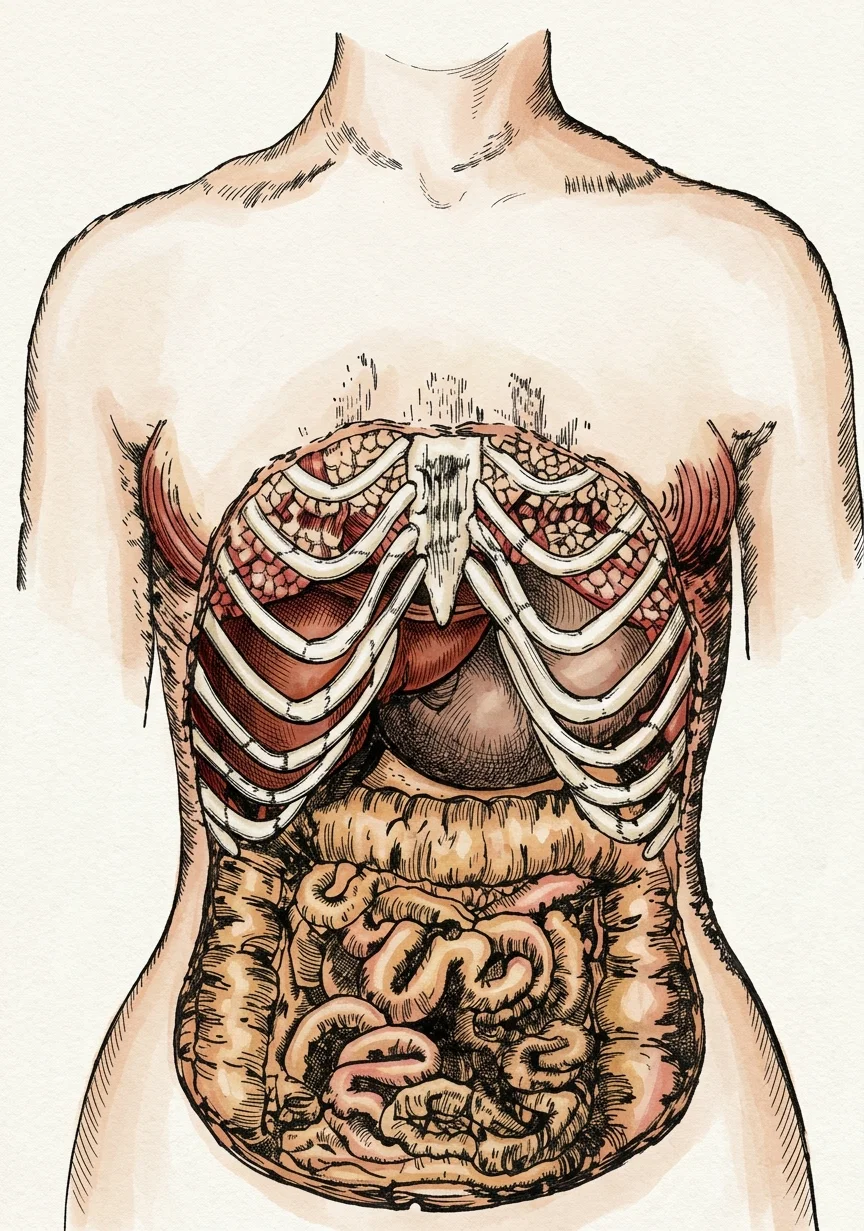
A natural waist, as God made it.
As a result of civilization, the first idea of protection once more began to take rank with ornamentation and display in developing the style of dress. But the practise of modifying the form of some portion of the body to suit the individual taste or the prevailing fashion still obtains among all classes of people, civilized and uncivilized, the idea among them all being to enhance the beauty and attractiveness of the person.
With what a superior, pitying air we regard those poor creatures who think to add to their beauty by inserting a fish-bone in the lip, and what a painful and inconvenient delusion is the idea of squeezing the feet into a shapeless mass, thus to impress the world with the distinction between such and common clay. But what shall we say of the extremely civilized custom of compressing the body into a shape resembling a wasp, but not at all adapted to the needs of the human animal.
We were impressed by the statement somewhere that the habit of deforming the body by tight lacing and the conventional mode of dress is responsible for as great loss of life and happiness as that other evil of this age—alcoholism. That is a broad statement, but is it not true? The first evil effects that portion of the human race to which God entrusted the responsibility of rearing helpless infants, of nurturing the race. In such a special way the tiny one is flesh of her flesh and bone of her bone. And while it is folded so close to her very life, through her alone its life and nature are shaped for good or ill, for strength or weakness. While some of the weeds and flowers have their roots far beyond her power, yet much is in her hands, morally, mentally, and physically. And for long years mother is the ideal toward which the daughters strive; and of the sons it is said, If a boy has a good mother he is worth knowing, no matter who may be his father.
This is woman’s special work which can not be passed on to another. We might write lengthily of the glories of this mysterious motherhood, but you will find that elsewhere—only a hint here. Your girls will be the women and mothers of the next generation; then rob them of nothing that shall help them on the way of attaining the perfection of their possibilities.
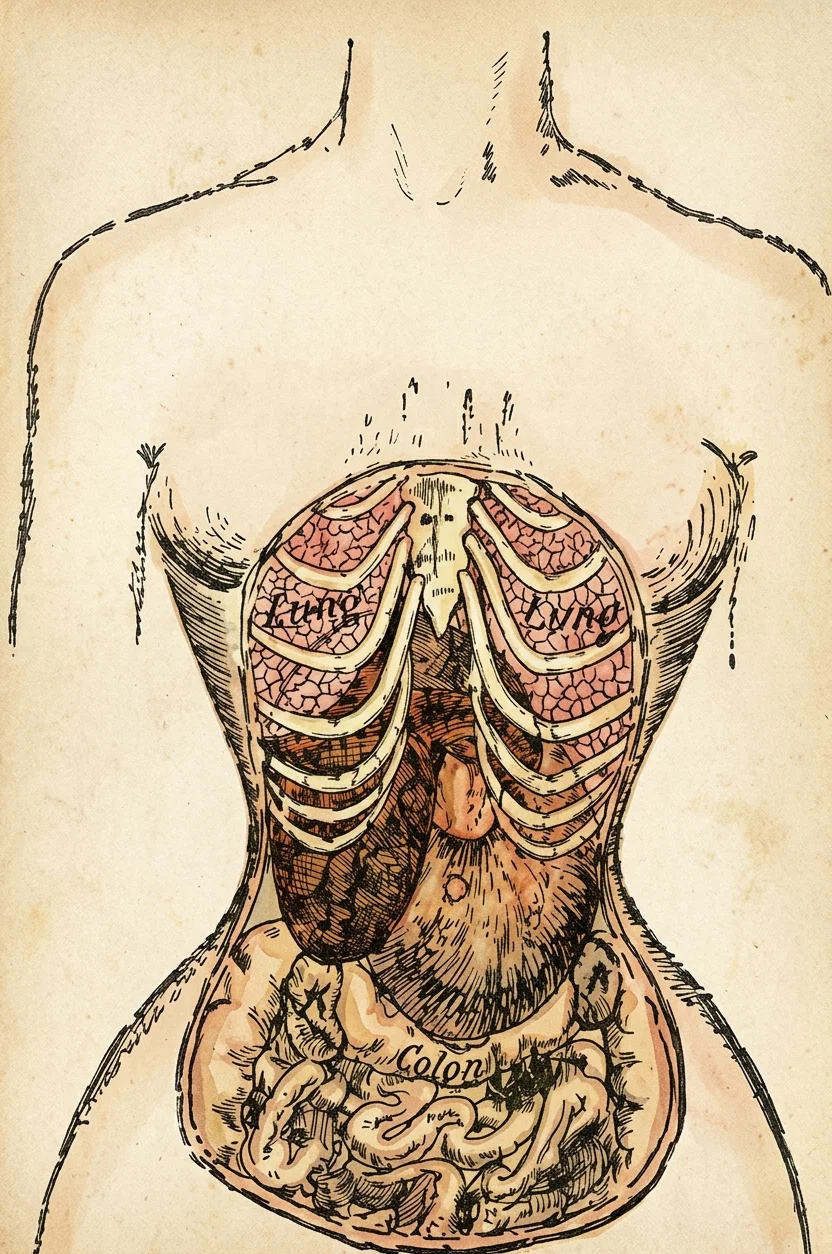
A human waist distorted by fashion.
We so often hear mothers speak of the difference between themselves and their daughters. “When I was a girl, I was worth two of my girls. They have no endurance nowadays.” And then with evident pride, they begin to name over the various uses and abuses to which they subjected their bodies. My good sisters, out of your own mouths you stand convicted. By these very abuses you wasted the substance which should have come as a heritage of strength to your frail, suffering daughters; and too often with this legacy, a dangerous ignorance of the laws of their being, is their portion. So they go forth to the battle not only with unknown foes of health and happiness within themselves, but with no knowledge of what is necessary to protect themselves from the known pitfalls prepared for their feet. Is it10strange that girls to-day are so often poor, puny, bundles of aching nerves?
Then again, see the little schoolgirl, just at that age when she is growing, developing into larger life; so laced that it makes one ache, and involuntarily you take a breath for her. In that inflexible case the organs strive and struggle and crowd one another in their efforts to keep pace with the demands the growing body makes upon them. Is it strange that the powers of endurance are far below par? And these are the mothers of the next generation. Her brothers during this formative period are running and jumping and howling like young savages, developing muscles and lungs and storing away nervous energy. (The foundation is better, tho the superstructure may contain much rotten timber.)
But this is not all. A large portion of the world’s work is called “woman’s work,” and the thing which, more than all else, hinders in its performance is slavery to fashion. “Satan has invented fashion to keep the minds of women from higher and better things. One of the weak spots in the armor of every woman is the desire to please. The desire to be beautiful is not in itself wrong—the wrong comes in a wrong standard and motives; but of this later. When once the first step is taken, Fashion lures on and yet on until every precious thing is laid upon her altar. And this is the atmosphere which surrounds the growing boys and girls. They are by precept possibly taught to regard life as the supreme thing, but by practise, an artificial standard is constantly kept before them. We need hardly be surprised that it is hard to break the power of the tyrant.
What shall be done about all this? Is it really something which must be recognized and met? If woman has a part to play in the drama, or, perhaps, tragedy, of the world, it is surely necessary that she have some sort of an equipment fitting for her part. Is it an easy part?—Nay, verily, it is taxing to both mind and muscle, for she has not been content with her Heaven-allotted work. She has stepped into the ranks with her brother, and in the race for fame and fortune, even for just standing room, she must strive shoulder to shoulder. She has yielded the right for consideration because she is a woman, and claims equal rights with her brothers. It is not hard to see that the race is unequal, for woman is the weaker vessel and the heavier laden. We can not better picture it than by noting the suggestion of an experiment on a North American Indian, proposed by a lady physician, which we fear would subject the one who put it into practise to prosecution by the Society for the Prevention of Cruelty to Animals.
Put him into the garb of a woman—feeble, delicate, gossamer woman (who by the way, has greater powers of endurance than any other animal on earth)—into tight corsets, which would jam his elastic ribs into his pendulous liver; his writhing stomach up against his wobbling heart and gasping lung, his whole nutritive apparatus upward, downward, sidewise, anywhere, so that nineteen inches of steel and whalebone would compass his twenty-five inch middle; add the dozen or more articles, with their aggregation of bands, strings, buttons, hooks, loops, clasps, and pins; place about him zone after zone of tight bandages, from which are suspended dozens and dozens of yards of gathered, puckered, plaited, and festooned material; tilt his body all out of plumb by fastening under his heels a wooden peg two inches high, and crush his toes into the space of a good-sized thimble. Weigh him down with a long, heavy, outside wrap, perch a bonnet upon his head and stretch a dotted veil over his eyes, put his hands into tight kid gloves, and into these a pocket-book and an umbrella; then send him out for business or for pleasure on a moderately wet morning or afternoon; let him keep his long, flopping skirts, his shoes and ankles, dry and clean, his feathers and bangs in curl, and his temper unruffled. Then ask him when he gets back to you—if he lives to do so —which he would rather be, a lovely civilized woman or a howling savage, and see what he will say.
And yet we send missionaries to such to civilize them.
IDA M. POCH.
Oakland, Cal.
HUMBLE PHILOSOPHY.
By Edith Perry Estes
Two laborers talked on their homeward way / Of the evils that poverty bore; / One cried—as some haughty millionaire / Drove by with his coach and four— / “See, the dust from the rich man’s carriage wheels / Falls on the toiling poor!”
But his mate replied, with a cheery laugh, / As they trudged on that dusty road: / “’Twould be just the same if our carts went by, / And you’d get more dust from the load.”
And they passed—nor dreamed of the helpful words / On a listening heart bestowed. / —Edith Perry Estes
Critique of the "National Sabbath" Concept
How little of the true Sabbath idea is manifest in the appointment of a “mid-week sabbath,” a “national sabbath,” an “American” and a “European” and an “Australian” sabbath! Such expressions originate in superstition and tradition rather than in the Bible idea of the Sabbath. The calling of the Fourth of July “Our National Sabbath,” as does William G. Haeselbarth, in the Christian Work of July 1, is a good example of this. In the first place, the Fourth of July has not one single element of the Bible Sabbath idea in it, and in the second place, the people will never use it as a sabbath, and in the third place, only God can make a Sabbath acceptable to him. Notwithstanding all this, men go on planting their ordinances and observances; but said Jesus, “Every plant which my heavenly Father hath not planted shall be rooted up.”
Bells, Rockets, and Mass Against Yellow Fever in Brazil
WHEN plague rages in heathen lands there is a beating of drums and demonstrations to attract the attention of the Deity, and to scare away the evil spirits. One of our missionaries in Brazil says that while stopping in one town recently he noticed that the bells of the Catholic Church would each evening set up a clanging, and then at the same time a number of rockets would be fired. I asked what was the meaning of this, and the answer was, “They are saying mass every evening so that the yellow fever will stop in Itu.” It seemed a strange way to call upon God; but these poor people have no other than the heathen idea of God, supposing that he can be appeased or persuaded to do a certain thing by saying mass, and offering him fireworks as an entertainment.—London, Eng., Present Truth.
A GROWING TENDENCY.
By Editor
THE idea that the Gospel ministry is commissioned to interfere in the matter of conducting governmental affairs on Sunday seems to be growing. This conclusion is once more impressed upon us by the following Chicago despatch, dated September 21:—
“Presbyterian ministers of Chicago are indignant over the fact that the work of excavating and putting in the foundation for the new Federal building at Clark and Jackson streets is being prosecuted on Sunday. At the weekly meeting of the Presbyterian Ministers’ Association, resolutions were passed and copies forwarded to President McKinley and Secretary of the Treasury Lyman T. Gage, expressing regret that the Christian sabbath is being violated by the building of the new post-office and custom-house, and requesting that officers having the building in charge order that the law of God be obeyed and all labor on or connected with the construction of said post-office be suspended on the Christian sabbath. The ministers are confident that the Federal authorities will act favorably in the matter.”
Any minister or association of ministers ought to know that government officials have no business to “order that the law of God be obeyed.” The Lord himself has commanded that, and there is no authority above his. It is the duty of every man, whether official or employe, to obey the law of God; but no human authority,—officer, or professed Gospel minister, or any aggregation of men,—has any authority to compel men to obey that law. So far as Sabbath observance or any other religious duty is concerned, “every one of us shall give account of himself to God.” Rom. 14 : 12.
THE BIRTH OF AN ICEBERG.
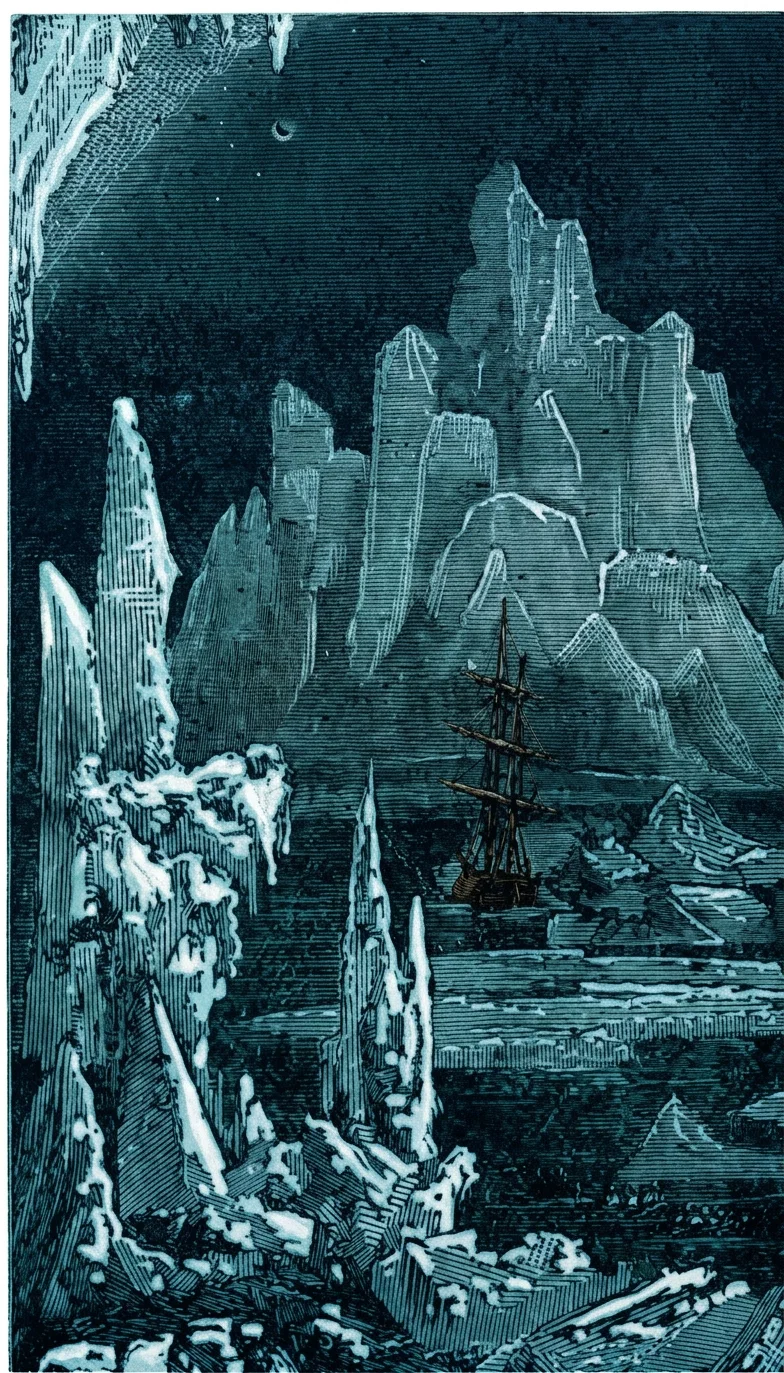
A VERY stirring and graphic description of how icebergs are formed and projected from glaciers is given by Mr. John Muir in the Century. Of the glacier that bears his name, Mr. Muir says: “The number of bergs given off varies somewhat with the weather and the tides. For twelve consecutive hours I counted the number discharged that were large enough to make themselves heard like thunder at a distance of a mile or two, and found the average rate to be one in five or six minutes. The thunder of the largest may be heard, under favorable circumstances, ten miles or more. When a large mass sinks from the upper fissured portion of the wall, there is first a keen, piercing crash, then a deep, deliberate, long-drawn-out, thundering roar, which slowly subsides into a comparatively low, far-reaching, muttering growl; then come a crowd of grating, clashing sounds from the agitated bergs that dance in the waves about the newcomer as if in welcome; and these, again, are followed by the swash and roar of the berg-waves as they reach the shore and break among the boulders.
“But the largest and most beautiful of the bergs, instead of falling from the exposed weathered portion of the wall, rise from the submerged portion with a still grander commotion, heaving aloft nearly to the top of the wall, with awful roaring, tons of water streaming like hair down their sides, while they heave and plunge again and again before they settle in poise and sail away as blue crystal islands, free at last after being held fast as part of a slow crawling glacier for centuries. And how wonderful it seems that ice formed from pressed snow on the mountains two or three hundred years ago should, after all its toil and travel in grinding down and fashioning the face of the landscape, still remain pure and fresh and lovely in color! When the sunshine is pouring and sifting in iris colors through the midst of all this wilderness of angular crystal ice, and through the grand, flame-shaped jets and sheets of radiant spray ever rising from the blows of the falling bergs, the effect is indescribably glorious.”
GIVE AND IT SHALL BE GIVEN.
By Edith V. Brandt
If I should see
A brother languishing in sore distress,
And I should turn and leave him comfortless,
When I might be
A messenger of hope and happiness—
How could I ask to have what I denied
In my own hour of bitterness supplied?
If I might share
A brother’s load along the dusty way,
And I should turn and walk alone that day,
How could I dare—
When in the evening watch I knelt to pray—
To ask for help to bear my pain and loss,
If I had heeded not my brother’s cross?
If I might sing
A little song to cheer a fainting heart—
And I should seal my lips and sit apart,
When I might bring
A bit of sunshine for life’s ache and smart—
How could I hope to have my grief relieved
If I kept silent when my brother grieved?
And so I know
That day is lost wherein I fail to lend
A helping hand to some wayfaring friend;
But if it show
A burden lightened by the cheer I sent,
Then do I hold the golden hours well spent,
And lay me down to sleep in sweet content,
—Edith V. Brandt.
PERSIA AND ASIATIC TURKEY.
PERSIA has a population of about nine millions, over eight millions of whom are Mohammedans, chiefly of the Shiah faith. The rest are Parsees, Jews, Nestorians, Armenians, and Kurds. The country is under an absolute monarchy, and the present ruler is Shah Mazefer-ed-Din, who ascended the throne last year. The laws are based on the precepts of the Koran. The Persian priests are called mullahs, and Friday is the Mohammedan sabbath.
The missionary Henry Martyn said of the Persians, “They are clever and intelligent and more calculated to become great and powerful than any other of the nations of the east.” S. G. Wilson, for fifteen years a missionary in Persia, writes: “The Persians have alert, active minds, untrained and unscientific, but naturally intelligent, subtile in argument, sharp in business, skilled in imitation, artistic in execution, socially entertaining, fond of humor, poetry, and music, and well informed for their opportunities. Persian art and civilization gave birth to Arabian culture in Bagdad and Spain, with its philosophy, mathematics, and architecture. Persian poets have sung in immortal verse.” There are among the Persians about three thousand Protestant converts.
Asiatic Turkey includes Asia Minor, Syria, Palestine, Arabia, Mesopotamia, Armenia, and Kurdistan, and has a population of nearly twenty-two millions, about twelve millions of whom are Turks and about eighteen millions (including Turks, Arabs, and Kurds) are Mohammedans. The Jews number over a hundred thousand.
The country has been ruled over since 1876 by Sultan Abdul-Hamid II., who is an absolute monarch and is about fifty-five years old. The laws are according to the Koran.
Arabia, containing about five million Arabs, is the birthplace of Mohammedanism. Mecca is there, and each of the 200,000,000 Mohammedans hope to visit it at least once before they die.—Selected.
SKETCHES FROM THE ORIENT.
By H. P. H.
III.
One of the most interesting features to the visitor in Turkey is the dress of the inhabitants. In striking contrast to the general sameness in apparel of Europeans is the almost endless variety in an oriental town. In the dress of woman as she appears on the streets, there is little of interest, but that of the men presents an entertaining display. Thus, the order is reversed, the man in Turkey occupying in this respect the same relative position as the woman in America.
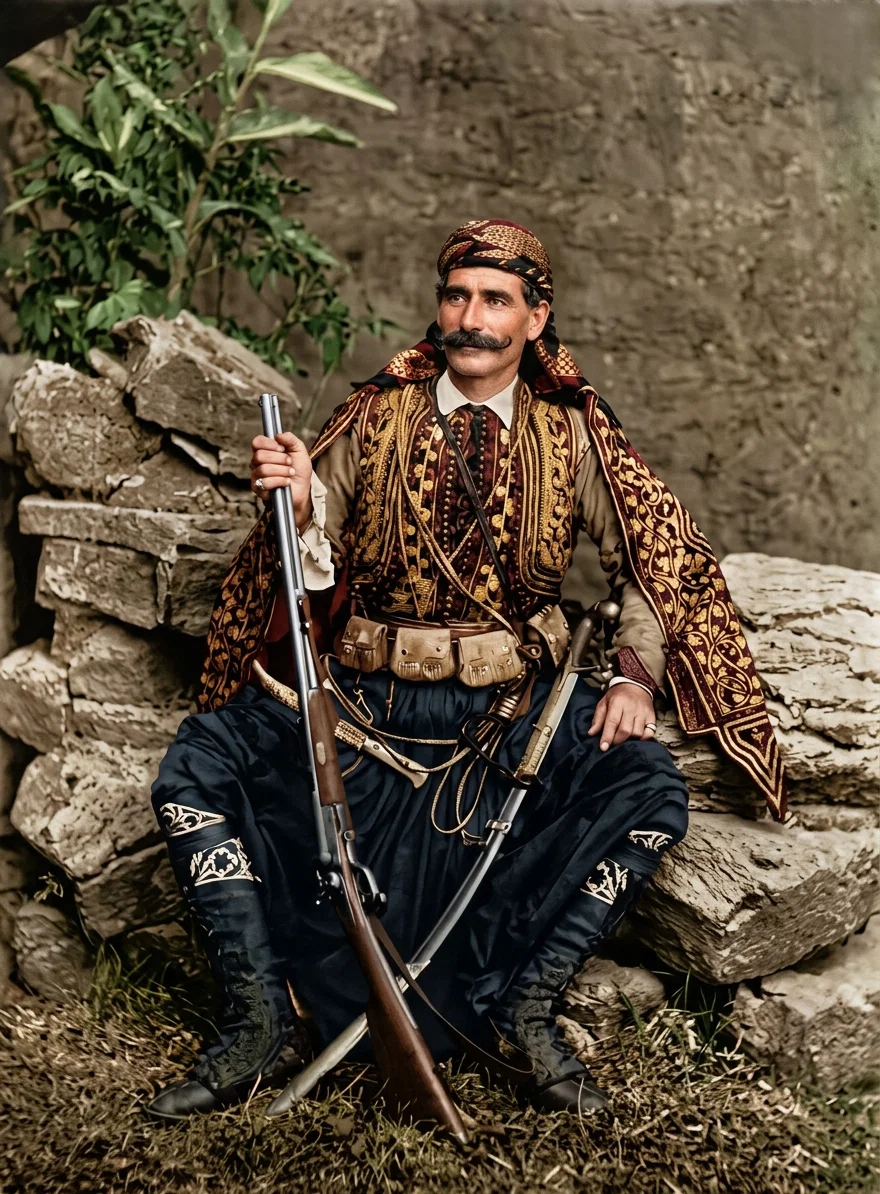
Our illustration presents a dragoman (guide and interpreter) in full dress. He furnishes a splendid illustration of the tastes in dress which prevail in the east. The dragoman is usually well paid and hence can more fully than others gratify his desires in dress. This contributes to some extent to the fact that he is a man of authority among the common people. As a rule, the dragoman is intelligent and entertaining.
A TURKISH DRAGOMAN OR GUIDE.
The trousers of the dress shown in the illustration give a correct idea of those worn by the Turks in general. They were doubtless evolved from the long robes worn by men in patriarchal times. Instead of girding up his loins to facilitate marching as did the ancients, the Turk divides his skirt, tying it fast to the lower limbs, sometimes at the ankles only, sometimes from the ankles to the knees, as represented in the cut. It will be observed that the dragoman is quite as conspicuous for his weapons as for his gaudy apparel. Besides gun, sword, and dagger, he carries in his belt, pistol and revolver. The pouches suspended from his belt are for carrying ammunition. The wandering Arab, prowling about the deserts and making the country unsafe for the traveler and the caravan, is armed very much as this dragoman.
While the dress of the Turk has some sanitary points which our style lacks, it also has some most objectionable features. The heavy belt, loaded with arms and ammunition, is prejudicial to the vital organs on account of its great weight, its restriction, and the heat which it produces in summer. Also the turban, and still more the Turkish fes, often worn with the turban, as seen in our illustration, by causing undue heat and preventing the circulation of air, are the frequent cause of baldness; this fact, however, is of less importance than with the Franks, for the Turk never lifts his hat in salutation nor removes it in the home or in his place of business.
The style of dress of the Turk is closely related to his religion. Among the Mohammedans are many sects, most of which are indicated by some variation in dress. Thus, like the Pharisee, they bear outward signs of their religion. The greatest variation in this respect is seen in the turban, both in color and form. The softas (wise men) or religious teachers, who were the most active in killing Armenians in the massacres, are distinguished by their white turban; the dancing dervishes are distinguished by their tall, gray cylinder without rim at the top or bottom; and the Arab is marked by his black turban, with his heavy black horse-tail switch hanging down the back.
If the Mussulman adopts the infidel or European style of dress, he is regarded as untrue to the faith. Some divisions of the army which are dressed in the European style of uniform are looked upon with suspicion by the faithful, while the religious troops, so called because they wear the Mohammedan style of dress, are looked upon as the most reliable.
But these ideas of a particular style of dress as expressive of the faith are not all confined to the Mohammedan. The Armenian and Greek priests of the eastern churches, as well as the priests and various orders of monks of the Roman Catholic Church, are distinguished by their style of dress. How much better it is to manifest our faith in our lives and not simply our clothes! The east has ever been noted for its ceremonialism; but there is a vast difference between mere forms of dress and worship and vital godliness; and the marked difference on this point will constitute one of the signs of the times in the last days. While some will be prominent and zealous in form but lacking in power, another class will be simple in form but so great in power and true godliness that it will be said of them, “Here are they that keep the commandments of God and the faith of Jesus.”
H. P. H.
OUR WORK AND WORKERS.
Elder W. H. Thurston says of the cause in Brazil: “We now have five churches and four companies, with a total membership of 251, and sixteen Sabbath-schools, with a membership of nearly 500.”
At Villisca, Iowa, Brethren B. E. Nicola and E. E. Gardner recently closed a series of meetings with twelve additions to the “little flock” who adhere to the keeping of the “commandments of God and the faith of Jesus.”
Elder W. T. Knox, president of California Conference, has located his family in Oakland, which will hereafter be his headquarters, altho he aims to visit every church in California and Nevada during the conference year. His permanent P. O. address is 1059 Castro Street.
At Wakopa, Manitoba, August 21, Elder A. C. Bourdeau baptized nine persons, and as many more were to be baptized in a short time afterward.
Elder B. F. Purdham reports that ten have been convinced that the seventh day is the Sabbath of the Lord, in connection with meetings held at Norwood, N. C.
At Artichoke, Minn., twenty persons were baptized recently in the lake near that place, by Elder Stone, in the presence of a very large concourse of people.
Elder Geo. H. Smith reports the organization of three new churches in his district in Nebraska,—at Milburn, Mason, and Arcadia,—total membership about sixty.
At the recent camp-meeting held at Colorado Springs, Colo., Brethren W. W. Hills, B. W. Marsh, E. H. Curtis, and Jacob Kraft were ordained to the Gospel ministry.
The Maine Tract Society has been making a good record. The annual report in 1894 showed an indebtedness of $1,185.82. The report presented at the meeting a few weeks ago showed that this debt had been reduced to $314.89.
Elder J. M. Huguley reports the addition of twenty-four members to the church at Dallas, Texas. In his meetings there he was favored by the Dallas News with liberal reports of his discourses.
The following named persons have been chosen as officers of the Illinois Conference: President, N. H. Lane; vice-president, W. D. Curtis; secretary, Walter Foreman; treasurer, Illinois Tract Society.
A Sabbath-school of thirty members has been organized at Bolivar, N. Y., with the design of organizing a church at an early date. These were mostly Sabbath-keepers who were living within reach of that place, but unorganized.
The following named officers of the Missouri Conference were elected at the recent session held in connection with the camp-meeting at Clinton: President, W. A. Henning; secretary, James Cochran; treasurer, W. V. Tovey.
At a meeting of the Texas Tract Society in August, the following resolution was passed: “Resolved, That we encourage our people everywhere judiciously to engage in the work of distributing our literature; first, by systematically canvassing for our books; second, by canvassing for the SIGNS OF THE TIMES, and, third, by selling, loaning, and giving away tracts.”
At the late session of the West Virginia Conference it was resolved to request all in the conference to manifest their interest in the circulation of the SIGNS OF THE TIMES. The Monitor says that “Elder Underwood related interesting experiences of our sisters working in the saloons in Pittsburgh on Saturday nights selling the SIGNS. All our cities need such work.” The principal conference officers are: President, Geo. B. Thompson; secretary, T. E. Bowen; treasurer, B. B. Johnson.
From the report of Elder E. W. Farnsworth, president of the New Zealand Conference, in the Review, we learn of the vast importance of our periodicals, and the great good that may be done with them by men, women, and children. At Dunedin, a city in the South Island, “one sister, with the assistance of a young girl, is selling each week 575 copies of the Bible Echo, our Australian paper. As a result a deep interest is springing up.” He also states that “two sisters in Wellington are selling 430 copies of the Echo weekly, and quite an extended interest is springing up as the result of this work.” Wellington is in the North Island. A further statement is: “In the city of Westport, situated on the west coast of this [South] Island, some families secured some of our publications, and began keeping the Sabbath. Ten persons embraced the truth in this way. Brother W. M. Crothers then visited them, when eight more embraced the truth and were baptized.” Mention is also made of ten converts under the labors of Elder David Steed.