What kept the moss a-growing
Through January's snowing?
It knew—oh! never doubt it—
The blasted tree without it
Would bleaker seem and older
To summer's new beholder.
What was the water saying
Beneath the ice roof playing,
Whereon the sunshine glistened,
While underneath it listened?—
“O kingly sun, arisen
To loose me from my prison,
I murmur not from grieving—
I sing, in thee believing!”
What brought the peach buds swelling
From out their birchen dwelling?—
The song of bluebirds won them;
Fresh music poured upon them
In bloom is overflowing,
The blush and perfume showing
That life is richer, better,
Joy's never-pardoned debtor.
O loving, soul-fresh faces,
Moss of deserted places!
O voices of the chosen,
Through deadliest cold unfrozen!
O lives with beauty, brimming,
Glad in the heaven's near hymning!
Ye know the hidden glory.
Who else may tell that story?
Grow, sing, and bloom undaunted;
A world so shadow haunted
Needs all your bursting splendor,
Soft lights, and murmurs tender.
The human want is pressing;
O'ershadow it with blessing,
Your triumph sure believing,
Till hearts shall hush their grieving.
— Lucy Larcom
A Wise Prescription
Some years ago a lady, who tells the story herself, went to consult a famous physician about her health. She was a woman of nervous temperament, whose troubles—and she had had many—had worried and excited her to such a pitch that the strain threatened her physical strength, and even her reason. She gave the doctor a list of her symptoms, and answered his questions, only to be astonished at his brief prescription at the end: “Madam, what you need is to read your Bible more.”
“But, doctor,” began the bewildered patient.
“Go home and read your Bible an hour a day,” the great man reiterated, with kindly authority. “Then come back to me a month from to-day,” and he bowed her out without a possibility of further protest.
At first his patient was inclined to be angry. Then she reflected that, at least, the prescription was not an expensive one. Besides, it certainly had been a long time since she had read the Bible regularly, she reflected, with a pang of conscience. Worldly cares had crowded out prayer and Bible study for years, and, though she would have resented being called an irreligious woman, she had undoubtedly become a most careless Christian. She went home and set herself conscientiously to try the physician’s remedy.
In one month she went back to his office. “Well,” he said, smiling as he looked at her face, “I see you are an obedient patient, and have taken my prescription faithfully. Do you feel as if you needed any other medicine now?”
“No, doctor, I don’t,” she said, honestly. “I feel like a different person—I hope I am a different person. But how did you know that was just what I needed?”
For answer the famous physician turned to his desk. There, worn and marked, lay an open Bible.
“Madam,” he said, with deep earnestness, “if I were to omit my daily reading of this book, I should lose my greatest source of strength and skill. I never go to an operation without reading my Bible. I never attend a distressing case without finding help in its pages. Your case called not for medicine, but for sources of peace and strength outside your own mind, and I believed if I showed you my own prescription, and I knew it would cure.”
“Yet I confess, doctor,” said his patient, “that I came very near not taking it.”
“Very few are willing to try it, I find,” said the physician, smiling again. “But there are many, many cases in my practice where it would work wonders if they only would take it.”
This is a true story. The doctor died only a little while ago, but his prescription remains. It will do no one any harm to try it.—Selected.
Practical Hydrotherapy
By GEO. THOMASON, M. D.
Lesson 9—Diphtheria and Its Treatment
GEO. THOMASON, M. D.
DIPHTHERIA is an acute disease, and in the process of its development the chief seat of the disease is localized in the throat. The specific cause of the disease is a germ. From the various manifestations of the disease processes, it was known for many years that it was directly produced by germs, but it was not until 1880 that the specific microbe causing the disease was discovered. The access of the germ to the throat does not always condemn one to the disease, since this germ, as is the case with many others, is frequently found in the throat of healthy persons. It is necessary that conditions shall be favorable within the body for the growth and development of the germ in order that the disease may be produced. In other words, the vital resistance must be lowered, or the natural defenses of the body weakened, before the germ can gain a foothold. Children are most frequently affected with the disease, although it may occur at any age. The liability to contract the disease diminishes as a person advances in age.
Many of the lower animals are also subject to the disease. Dogs, pigs, sheep, fowls, cows, and other animals frequently suffer from it. Milk may be one of the means of communicating the disease. The milk of a cow suffering from diphtheria, being set aside in a warm place, will develop diphtheria germs in great numbers; and milk thus contaminated, when given to another animal, will give rise to the disease. There seems abundant evidence for believing that true diphtheria may be transmitted from cats to children, and even to adults.
Diphtheria is a highly contagious disease. The closer the contact with the patient, the greater is the danger of contracting the disease. Unhygienic surroundings favor the spread of the disease, as, for example, living in damp, dark, poorly ventilated houses. Foul cesspools, deficient drainage, and living where one is obliged to breathe air vitiated by decomposing vegetable or animal matter, or by barnyards or other sources of contamination, lower the vital resistance, and increase the susceptibility to the disease.
One principal manifestation of diphtheria is the formation of a grayish-colored membrane in the throat. When the disease is prevalent, it is well, as soon as the child appears to be ailing, to take the temperature regularly, and systematically to examine the throat, as diphtheria frequently develops rather insidiously, and it is possible for the disease to become considerably advanced before the child complains of throat symptoms. The disease sometimes reaches a stage where it may prove fatal within a few hours, before the real situation is appreciated. The extent of the false membrane is quite an index as to the severity of the disease. It is sometimes12very small, not larger than a dime, or it may become very extensive, covering the inner surface of the mouth and cheeks, reaching out upon the lips, also extending from the throat upward into the nose, or downward into the esophagus, and reaching even to the stomach. It frequently enters the air passages, when it is often the cause of death by suffocation.
Symptoms
At the beginning of the disease, the child usually complains of being tired; there will be headache and loss of appetite, and vomiting frequently occurs. After a few hours the patient complains of dryness or soreness in the throat. Looking into the throat, there will often be observed a marked redness, and perhaps one or two small grayish spots on or near the tonsils. The child's temperature will rise, frequently reaching 104° or 105°, although at times the thermometer may not show a temperature of more than 102°. The height to which the temperature rises, however, cannot be taken as a true index to the severity of the disease, as in many cases the body is so overwhelmed with poisons generated by the microbes that there is a marked tendency to collapse, and to a fall in the temperature. When the air passages are involved, the child frequently has spells of coughing, and portions of the membrane may be raised. The pulse increases greatly in frequency, and is often irregular and feeble. The duration of the disease is usually from ten days to two weeks. Very severe cases may extend over several weeks or even months. The germs frequently lurk in the throat for some time after the membrane has entirely disappeared.
Treatment
In treating the disease, careful attention should be given to the local processes in the throat. Treatment should consist of carefully spraying the throat every hour with an antiseptic solution of some sort, such as a ten-to-fifteen-per-cent solution of peroxide of hydrogen, or a solution consisting of a dram of carbolic acid to an ounce of listerine, diluted in a third of a glass of water. In addition, external applications should be made in the form of fomentations, or very hot compresses, to the throat for ten or fifteen minutes every hour or two, with an ice bag applied to the throat continuously during the interval between the fomentations, during the first days of the disease. Later, the fomentations may be applied to the throat every three or four hours, a compress being worn during the interval, consisting of from four to six thicknesses of cheese cloth wrung slightly from very cold water, and covered with at least three or four thicknesses of flannel.
To control the fever, the patient may be given a short, hot, full immersion bath at a temperature of from 100° to 105° for five minutes, or a hot-blanket pack for fifteen minutes, either of which could be followed by a neutral full immersion bath at from 93° to 96° for twenty or thirty minutes, or more, or by friction of the body with cold water. A copious enema at 80°, repeated several times, is a very successful means of lowering the temperature, and in any case the enema should be administered twice daily. The child should be given water to drink copiously, at least from two to four pints daily, and more if possible.
Fomentations, or flannels wrung from very hot water, should be applied to the spine, renewed every four or five minutes, and continued for fifteen or twenty minutes two times a day, to be followed by some form of cold friction. It is often gratifying to the patient to be allowed bits of ice to hold in the mouth. The carbolic acid and listerine solution in very hot water, in the strength of a teaspoonful to half a glass of water, is of great service as a gargle, if the child is old enough to understand the method of gargling. As the disease progresses, if there is a tendency to collapse, as indicated by chill, paleness of the skin, rapid, weak pulse, and cold perspiration, a short hot immersion bath or a hot enema should be administered, followed by surrounding the patient with dry blankets, with hot-water bags placed at the feet and sides, to promote activity of the circulation in the skin.
If there is indication of suffocation, the child should be placed in a hot bath, and cold water poured upon the chest and spine to aid in the effort to clear the throat of portions of the false membrane. Frequent inhalations of steam will assist in loosening the membrane.
To prevent the spread of contagion, the patient should be completely isolated from other members of the family. The room in which the patient is kept should be largely divested of its superfluous furniture, such as rugs, curtains, etc., retaining only the essentials. The room should be thoroughly ventilated. All discharges from the patient should be carefully disinfected with quicklime or with a two-per-cent carbolic-acid solution. The patient should use cheese cloth in place of handkerchiefs, and these should be promptly burned. Attendants upon the patient should wear a linen gown or sheet, entirely covering the clothing, which should be removed upon leaving the room. As a precautionary measure the attendants should also gargle or spray the throat every two or three hours with the solution of peroxide of hydrogen or carbolic acid and listerine, as mentioned above.
After Recovery
After the patient has recovered, the body should be cleansed with a hot soap-and-water bath, and the scalp should be thoroughly shampooed. All the clothing which has been worn in the sick room should be disinfected by boiling, and also by soaking at least five or six hours in a 1/2000 solution of bichloride of mercury, or for twenty-four hours in a two-per-cent solution of carbolic acid. The walls and floor of the room should be carefully washed and scrubbed with either the bichloride or the carbolic-acid solution. As an additional measure, the room should be completely closed, stopping up cracks in doors and windows with paper, and placing on the floor a pan of water in which is placed two bricks, and upon these a vessel containing sulphur and charcoal in equal quantities, and in amount equivalent to two pounds for every one thousand cubic feet of space. This should be allowed to burn and the room kept tightly closed for at least from twenty-four to thirty-six hours, when it may be thoroughly aired. It will then be safe to occupy.
How to Be Healthy
THE rules of health have been summed up as follows:—
Drink less; breathe more.
Eat less; chew more.
Clothe less; bathe more.
Ride less; walk more.
Sit less; dig more.
Worry less; work more.
Waste less; give more.
Read less; write more.
Preach less; practice more.
A Practical Knowledge of Human Life
By Ellen G. White
A PRACTICAL knowledge of the science of human life is necessary in order to glorify God in our bodies.—Mrs. E. G. White.
The Return
By John Burroughs
HE sought the old scenes with eager feet,—
The scenes he had known as a boy;
“O for a draft of those fountains sweet,
And a taste of that vanished joy!”
He roamed the fields, he mused by the streams,
He threaded the paths and lanes;
On the hills he sought his youthful dreams,
In the woods to forget his pains.
O sad, sad hills! O cold, cold hearth!
In sorrow he learned thy truth,—
One may go back to the place of his birth;
He cannot go back to his youth.
— John Burroughs, in The Independent.
The Swan and the Crane
By Moody
There is an old legend of a swan and a crane. A beautiful swan alighted by the banks of the water in which a crane was wading about, seeking snails. For a moment the crane viewed the swan in stupid wonder, and then inquired, “Where do you come from?”
“I came from heaven!” replied the swan.
“And where is heaven?” asked the crane.
“Heaven!” said the swan; “heaven! have you never heard of heaven?” And the beautiful bird went on to describe the grandeur of the eternal city. She told of the streets of gold, and the gates and walls made of precious stones; of the river of life, pure as crystal, upon whose banks is the tree whose leaves shall be the healing of all nations. In eloquent terms the swan sought to describe the hosts who live in the other world, but without arousing the slightest interest on the part of the crane.
Finally the crane asked, “Are there any snails there?”
“Snails!” repeated the swan; “no! of course there are not.”
“Then,” said the crane, as it continued its search along the slimy banks of the pools, “you can have your heaven. I want snails!”
How many a young person to whom God has granted the advantages of a Christian home, has turned his back upon it, and searched for snails. How many a man will sacrifice his wife, his family, his all, for the snails of sin! How many a girl has deliberately turned from the love of parents and home to learn too late that heaven has been forfeited for snails.—Moody.
— D. B. Mackie
By D. B. Mackie
Ministry
Your needs are many, and your heart cries out
For sweet relief from all your burning care;
You look to heaven, and ask your God to spare
Your soul from further pain and anxious doubt.
And at your side you do not see the cure
You might so quickly find had you the will;
Seek but your neighbor’s life with love to fill,
And you’ll forget the miseries you endure.
E’en as the Master at the well forgot
His own sore thirst in off’ring living drink,
So into naught your numerous needs shall shrink
In giving good to those who have it not.
The mystery of ministry is this:
Who gives most blessing gains the greatest bliss.
— D. B. Mackie
South Sea Islands
By Mrs. Carrie Stringer
MRS. CARRIE STRINGER
A STREET IN PAPEETE, TAHITI
DURING our pilgrimage in the isles of the sea, in working for the Master, we have met with varied experiences, associates, and circumstances; but the promise, “Lo, I am with you alway, from even unto the end of the world,” has forever been ours. In times of perplexity, which in loneliness and trials, it has been our comforter. Christ is a rock and a fortress to his people. The privations, inconveniences, and trials one may meet among a people of strange and heathenish customs and beliefs only strengthen his desire for the future and better world,—the home with one language and one God,—the home where changes never come.
Traveling across the broad waves of the mighty deep, as one approaches these dots of land dispersed in the great Pacific, one might imagine himself entering a land of Edenic beauty. Nature is continually clothed in her garment of green. The waving palms and climbing vines, interspersed with fragrant flowers; the fertile valleys, producing a variety of foods with little or no cultivation; the rushing rivers and babbling brooks, with the broad, blue ocean surrounding all, afford a beautiful scene of the handiwork of God.
Lot, when viewing the fertile and beautiful plains of the Jordan, beheld in them a location for an ideal home. These islands are likewise very attractive; and like Sodom, Lot’s chosen home, pride, fullness of bread, and abundance of idleness are here. The sins of Sodom reached unto heaven, and God, who is a consuming fire, could bear with her no longer. These islands are fast becoming Sodoms, but there are a few honest souls scattered through them. As Lot was torn from his home of ease and luxury, so the few honest here must be sought out, and as “a brand plucked from the fire,” they must be rescued before the great and final destruction, which is near at hand.
The messengers sent to warn Lot did not have a pleasant and easy time. In the darkness and wickedness of that great city, their lives were in jeopardy. God is able to save to the utmost, and he changes not—“the same yesterday, and to-day, and forever.” He had a tender watchcare over his messengers. He protected them from the wicked throng that compassed the door of Lot’s house; and, as we are delivering a message in a dark and wicked land, the same tender watchcare is ours.
The work is being cut short in righteousness. Self-denial, love for souls, diligence, and perseverance are essential. “Every trial brings us more patience, and patience brings experience.”
The dark earth is being lighted by the angel of light. Satan also will transform himself into an angel of light. He who would assist others to distinguish between these two lights must himself be guided by wisdom from above, and this comes by prayer. While false light is being scattered broadcast by Satan’s devices and deceptive schemes, the true light from above is also penetrating these dark corners, and a few are being separated and tried.
Our numbers are small, but the Lord is not slack concerning his promises, and during the week of prayer here in Papeete, we enjoyed much of the good Spirit in our midst. The workers are all being blessed with good health and courage. New Year’s day several of us went around the island to Paca, to meet with the brethren and sisters there. As we assembled to worship the Lord, a collection was taken up for the benefit of the new church which they expect to erect soon. This little company numbers about fifteen. They are not blessed with much of this world’s goods, and the week previous a severe wind and rain storm passed through the island causing much destruction to their crops and to some of their homes, but they brought an acceptable offering of fifty-two dollars, Chilian coin. During the storm in that vicinity the Protestant church was completely ruined. On New Year’s day a large concourse of people assembled at their place of gathering, to raise money to erect a new church. There were about five hundred present, and they raised only seventy-two dollars, Chilian money. It is the love of God that constrains us, and makes us cheerful givers.
During the last month we have had with us Brother McCoy, of Pitcairn Island. We were indeed glad to hear once more from the brethren and sisters of that lonely isle. During the past year, only one of our many periodicals, a copy of the Signs of the Times, found a landing there. It was a welcome friend. Those living in the continents, and especially those near the heart of the work, know not what it is to thirst for a knowledge of the progress of the work and of the welfare of those who are proclaiming this last solemn message. “As cold waters to a thirsty soul, so is good news from a far country.” Nearly two years have been a blank to the Pitcairn Islanders as far as a knowledge of the work is concerned, but we are glad to hear a report that there are honest ones14there who are progressing in the faith, and earnestly striving for the victory, hoping soon to be united with God’s people in a home where there are no separations.
The work is onward in the islands. While some are being tried and sifted out, others are coming in. The aim and desire of our life is to let our light shine more and more unto the perfect day.
British West Indies
By W. A. Sweany
W. A. SWEANY
BARBADOS.—This is the most eastern island of the West Indies group. It is wedge-shaped, tapering to a point at the northern end. Its greatest length is twenty-two miles, its greatest width fourteen miles, and its area one hundred and sixty-six square miles. The population at the last census was 182,867. (It is now said to be nearly or quite 200,000.) Of this number, 15,613 are white, 44,537 mixed, and 122,717 black. Religiously, they are divided as follows: Church of England, 156,539; Wesleyan, 14,485; Moravian, 6,801; Catholics, 816; Jews, 21; other sects, 1,560; not stated, 2,645.
It will be noticed that almost the entire population belongs to the various churches; but nowhere else is the fall of Babylon more marked, or the need of the third angel’s message greater, than here. Seven per cent of all births are illegitimate, and the whole social fabric seems to be fairly reeking with moral rottenness. However, there are, amidst all this pollution, many pure, honest, upright persons. But it must also be said that many in the high circles of society are not entirely above reproach in matters of morality.
In extenuation of the terrible percentage of illegitimacy, it must be said that very many who live together as husband and wife, raising large families, do so with no consciousness of sin, this manner of living being their heritage from the days of slavery. So far as I can learn, there are absolutely no laws, and very little sentiment, against such things. But as soon as the commandments of God and the faith of Jesus are heard, all these evil habits and associations end, and the life is purified. Our people here will compare favorably with our people anywhere, and many of them have come up from, and out of, the life already described.
The cause of God in Barbados has been fortunate in being represented by laborers whose means, as well as their time, have been faithfully consecrated to the Lord’s service; and as a result we have a beautiful and substantial white stone church, with iron roof, and a seating capacity of three hundred, standing on our own ground, and all paid for. Owing to the deep poverty of the people, this could never have been realized but for the faithfulness and liberality of the laborers who developed the work here. It was the need of humanity that touched the heart of God, and brought Christ to earth; and a consciousness and realization of the needs of the work throughout the great field will touch hearts and open pocketbooks to do more as nothing else can do. No consecrated servant of God can labor in such a needy field as this without finding himself moved to give to the very limit of his time and means.
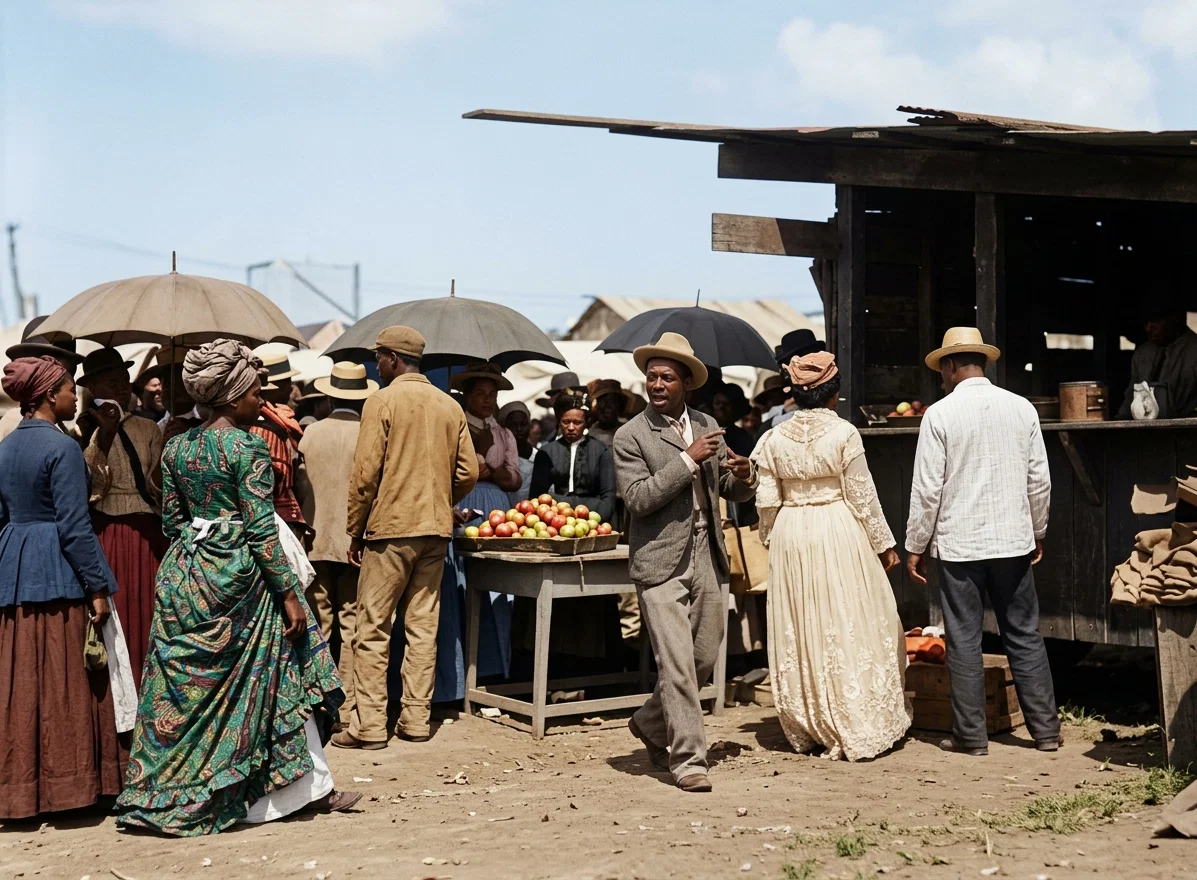
MARKET SCENE IN BARBADOS
The membership of the Bridgetown church is about one hundred and twenty-five, and there are three unorganized companies that hold regular services in the country. Including isolated believers, there are probably nearly one hundred and fifty Sabbath-keepers in the island. Urgent calls come from every direction, and could we but respond to these, companies might speedily be raised up in all parts of the island. Conditions here are such that a large church, in a large city like this, requires the constant presence and attention of a pastor, not for the sake of the members alone, but to look after newcomers and those who may become interested. This makes it almost impossible for me to accomplish much evangelistic work in the country, although I have done something in that direction. If we had one more laborer here, we could speedily sweep the island with the message, and gather a harvest of souls; then go on to some of the other unentered, needy islands that are waiting for the message, many of them being ripe for the harvest.
The regular services of the Bridgetown church are as follows: Preaching, Sunday night, largely attended by those not of our faith, many of whom are deeply interested; missionary meeting; Wednesday night, which is intensely interesting and profitable, because nearly all, old and young, are doing something—selling, loaning, and giving away literature, holding Bible readings, visiting the sick, etc.; prayer and testimony meeting, Friday night, which is a season of such quiet, sweet, soul-refreshing communion with God that all love to be there. Then, of course, we have a regular Sabbath service,—Sabbath school, and preaching, or Bible study. Just now, on Sabbath we are studying the Holy Spirit, and seeking God for righteousness and power, which will enable us to do better service. And truly we are receiving some droppings of the latter rain; but we need, and must have, the showers. Sins are being confessed, and wrongs of long standing are being made right, and as a result there is rejoicing.
We are trying to keep abreast with the Forward Movement; so some phase of the gospel of health is dwelt upon at each of our missionary meetings, and nearly all are putting into practice the truths learned.
The canvassing work is rising again, and the church school is prospering. We are of good courage to press on to continual victory, and to eternal triumph.
Its Productions, Industries, and History
By Chas. Grim
Belgium
Its Productions, Industries, and History
CHAS. GRIM
BELGIUM is situated on the coast of the North Sea, between France and Holland. While it has an area of about 11,373 square miles, it has a population of 6,500,000 inhabitants, which makes an average of more than 570 to the square mile. In proportion to its extent, it is one of the most densely populated countries on the globe.
Two principal languages are spoken here; the French, or rather the Walloon, in the south, and the Flemish in the north. In addition, German is spoken in some towns near the border of Germany.
The natural resources of the country are abundant. In the north spread out fertile plains, where are cultivated the cereals, the sugar beet, flax, and hemp. Through the center runs a rich basin of oil. This is passed out to the world through the great cities of Liège, Charleroi, and Mons. There are also mines of iron, zinc, and lead.
These last products give rise to metal industries, which are very flourishing. The country is filled with blast furnaces, steel works, and rolling mills, which send out their products to all parts of the world. Crystal glassworks have made great strides in recent years,15and there are many glass factories of all kinds, especially for window glass. We must also mention the weaving works and the cloth factory, which are also of central importance.
The southern part of the country is more hilly, where woods and forests abound. Elsewhere there are prairies dotted with farms, busy in cattle raising and butter making, butter being an article of large consumption in the country.
After enduring the Roman yoke, Belgium, like all the other countries of Western Europe, passed under the rule of the French kings, when Rome as an empire split up into the ten kingdoms. And The city of Liège lays claim to the honor of being the birthplace of the Emperor Charlemagne, to whom the city has raised a statue, and also of the most celebrated French kings.
At the time of the Reformation, Belgium formed a part of the empire of Charles V, the rabid enemy of Protestantism. So the reform movement, which had made great development in that country, was stifled by the violence of the persecutions. It passed some time under the dominion of Austria, after which it was reunited to Holland, when Napoleon was defeated at Waterloo.
Being obliged to complain much of the new ruler, the Belgians revolted in 1830, and after a furious struggle of a few months, the Hollanders (Dutch) were driven from Belgium, and independence was proclaimed. In 1831 the new constitution was adopted, which is still recognized by the country. It is one of the most liberal of Europe. It gives entire liberty of conscience, and permits each one to teach and to propagate his views by speech and press. Thus the Lord has prepared the way for the last message to be proclaimed in a country where the darkness is great.
Every Noble Deed
By Sarah K. Bolton
He built a house, time laid it in the dust;
He wrote a book—its title now forgot:
He ruled a city, but his name is not
On any tablet graven, or where rust
Can gather from disuse, or marble bust.
He took a child from out a wretched cot,
Who on the state dishonor might have brought,
And reared him to the Christian’s hope and trust.
The boy, to manhood grown, became a light
To many souls, preaching for human need
The wondrous love of the Omnipotent.
The work has multiplied like stars at night,
When darkness deepens. Every noble deed
Lasts longer than a granite monument.
—Sarah K. Bolton.
British Guiana
By D. C. Babcock
FRIDAY morning, February 7, I left Aurora to attend a meeting at Leguan, Sabbath and Sunday. Here I met W. T. Downer, who had been with the company a few days; and after prayer and careful consideration, we thought best to organize a church at this place. We found many difficulties in the way; but as the meeting proceeded, the Lord came in with his power, confessions were made, and all were united.
The church was organized with a membership of twenty-three. Two elders and a deacon were elected. The Lord manifested his Spirit in the ordination of these brethren. It is evident that God is working with his people. We hope that other precious souls will soon be added to this company.
The following Sabbath and Sunday I spent with the church at Georgetown. We had a good season in seeking the Lord together. Brother and Sister Morrow have labored in this city for six months. They have had many difficulties to contend with, and trials to meet, but the Lord has surely blessed their labors. It has been necessary to withdraw the hand of fellowship from several of the members on account of direct violation of the law of God; but while some are leaving our ranks, others are taking their places. Thus the Lord is gathering out a people for his name in this part of the field.
On Tuesday morning, February 18, I left Georgetown by steamer for Bootooba. Nearly one year ago arrangements were made for a school to be started at this place, conducted by Brother Browne, from Barbados; but owing to the financial condition of the brethren and sisters, and those from the outside whom we expected to patronize the school, it has seemed necessary to close it for a time. Brother Browne will labor in Georgetown for some time. We had a fair attendance at the meeting in Bootooba, and the Lord worked for all present, revealing his presence according to his promise.
There are many difficulties with which our people have to contend in these rural districts. The men who control the timber interests in the country, do all in their power to make our people labor upon the Sabbath; and, in addition to this, food that they cannot eat is placed before them. Thus distress is brought upon those who have cast in their lot with the remnant people in these last days. If some of our brethren in the States who have had experience in the timber work, could come to this country, and engage in that work, they could become self-supporting missionaries, and be a great help to our churches. It does not need much capital to begin the work, and returns are quickly made. Here is a good opportunity for those who have longed to be missionaries, and yet are not prepared to preach the word directly, but who have good business qualities, and good solid muscles to take hold and carry forward the work of God, and be a blessing to those around them. Surely the Lord has opened the way for all classes of people to labor for him; and I trust that, erelong, some will consecrate themselves to the work in British Guiana.
Georgetown is in great need of a new place of worship. The brethren and sisters are doing what they can by small donations to raise means with which to begin this work; but it will be necessary for us to have means from other sources before the work can be completed.
OUR CHURCH AT BOOTOОBA
We appeal to those of our people who have means to spare, to give us even the smallest donations to assist in this worthy enterprise.
The Lord is blessing the efforts of the laborers who are in the field. About fifty have accepted the truth within the last year. For this we praise our Heavenly Father.
The work in Dutch Guiana has been almost at a standstill during the past year, owing to our need of a Holland worker for this field. We long for some one to carry the truth to perishing souls in that colony. A few books have been sold, and a few individuals have accepted the truth, but there is yet much to do. They are calling for help, but we can do nothing for them at present. May the Lord open the way for his truth to reach these people.
D. C. BABCOCK.
Missionary Facts
CHRIST said, “Go ye into all the world.” “Go” does not mean stay; “all” does not mean a part.
There are 300,000,000 souls in India, and only 1,700 missionaries.
India has 23,000,000 widows; 14,000 are baby widows under five years old.
Allowing one letter of the Bible to represent one person in India, it would take seventeen Bibles to represent them all.
The Christian population of India could be represented by the letters in the book of Isaiah.
In China there is one ordained minister to every 1,000,000.
Every year 12,000,000 perish in China from the effects of opium.
The population of Japan is about 40,000,000, and the average parish of each missionary is about 100,000.—Christian Worker.
Christianity Rejects Selfishness
“It is treason to humanity to propose to work out your own salvation in a way that should secure your salvation and nothing else.” There can be no selfishness in Christianity.