Your ShelfYour Projects

Review and Herald, Vol. 79, No. 15.

Luther at the Wartburg
Earlier text: Luther at the Wartburg

Another Good Meeting

THE fourth union conference session to be held in this country has just closed. This was the Lake Union Conference, held in Chicago. The meeting convened in our Forty-Sixth Street church, March 27, and closed April 2.
To me, this conference was in all respects equal to either of the preceding conferences, and in some features it seemed better than any of the former meetings. It was truly enjoyable, inspiring, and profitable to those who were present. The delegates went from this meeting with new love, courage, and determination to work for God.
The attendance was good. Ninety-four delegates were present from the five States composing the union; six General Conference representatives were in attendance, and quite a number of brethren and sisters were present from the different States. Besides these, our workers in the various missions in Chicago, and the members of the city churches turned out in strong force. This gave us large, appreciative audiences.
As the business proceedings and some of the most stirring talks are to appear in the REVIEW from week to week, this report will deal with only a few prominent features of the conference. One of these was the beautiful harmony that prevailed from first to last. This was so marked that it was a subject of general comment. It was not a forced and regulated union; it was created by the Spirit of the Lord. It was the result of enlightened, Spirit-led minds.
Presidents of conferences, heads of schools, and medical and publishing institutions, strong-minded committeemen, business managers, editors, canvassing leaders, and business men worked side by side, day after day, helping to advance the particular lines of work in which each was engaged, without friction or discord. Never have I seen a greater and more charming manifestation of unselfishness in any meeting. This means something; it is a token to the people of God of reformation and revival. It was when the disciples became of one accord, that the early rain fell upon them.

Religion and Business

Another especially impressive feature of this meeting was the natural blending of the spiritual and the business phases. I have many times deplored the gulf that has seemed to separate what we have been pleased to call the spiritual and the business meetings in our conferences. I have felt that this gulf should not exist. True spiritual experiences are real, practical, common-sense experiences; true gospel business is sacred and spiritual. Why should they not blend? Why should not God's people experience rich spiritual blessings in what is called a business meeting? Why is it necessary to set apart one hour in the day to tell how much we love the Lord and his cause, and another hour for long, tedious, conflicting discussions about the business of the Lord's cause, which we love? Why not have practical, businesslike spirituality and spiritual business combined? The Lord gave us some experience in this at the Chicago conference, and it did us all good. Some of our best social meetings came unplanned, while considering recommendations in what we called the business meetings. Hearts were made tender, and tears flowed. The spiritual part was not made frigid, nor was the business transacted made weak and superficial. Each was made better by their perfect blending.
The other feature of the meeting deserving special notice was the earnest, ever-present inquiry, “Lord, what wilt thou have me to do?” In the early part of the meeting the trumpet call to service was sounded and responded to, and all through the meeting there was manifested a solemn inquiry regarding present duty. In response to this desire, some great responsibilities were revealed to some of the delegates while the meeting was in session. In some cases these duties were so pressed upon their hearts that their sleep brake from them. But they did not swerve from the plain path of duty. With confidence in God's leading, they resolutely placed their feet in the paths marked out. In doing this they received signal tokens of God's approval. Dear Brother Gowell and his brother workers from Michigan were given a most blessed experience.
Their victory brought light and victory to the whole conference. From the hour this victory was gained, there was one strong, grand move forward to the close of the meeting.

The Relief of the Schools

From the efforts that had been made in behalf of the sale of “Christ's Object Lessons” during a few weeks previous to this meeting, this line of work naturally held a prominent place in the conference. The ministers, church officers, and brethren and sisters were given an opportunity to state their personal experiences in selling this book, and also to give their impressions regarding the benefits that will follow. Many very thrilling and heart-cheering experiences were related.
Those who related their experiences did not need to tell their hearers that they had been blessed in their work. This was revealed in their countenances, and by the light and life expressed in their testimonies. One striking feature of this witness bearing for this good work was that not a person uttered a complaint. Those who had been most earnest and hopeful regarding this work had not been disappointed. On the other hand, those who were not at first in harmony with the movement, but had taken hold of the work, had received signal blessings, and had experienced an entire change in their views. No discouraging or evil testimony could be borne by those who had complied with the conditions upon which the blessings of this work are promised. Naturally, of course, there was a strong feeling that the work should be pressed forward with greater vigor than ever. Each State conference committee openly and resolutely announced that it was their intention to continue this work until the last book is sold, and the last dollar of indebtedness on the school is paid. This I most confidently expect will be carried out.
One of the most stirring days of the conference was that devoted to the medical missionary work. The earnest workers connected with the Chicago Branch Sanitarium, Life Boat Mission, Life Boat Rest, Workingmen's Home, University Hygienic Café, and other missionary enterprises, made a very deep impression upon the minds of the delegates by their reports of labor. More than once the brethren and sisters were in tears as the workers told, in simple, humble, but touching language, their thrilling experiences.
But Elder A. T. Jones attended this meeting, and gave most valuable instruction on our work of reorganization, Christian education, and the relation of the medical missionary and evangelical departments of the cause. Brother E. R. Palmer gave the conference good instruction regarding missionary work and the sale of our literature.Brethren Lane, Sutherland, Magan, and Paulson rendered much help in the meeting.
Much more of a truly encouraging character could be told, but space forbids. The experiences of the first session of the Lake Union Conference will long be held in pleasant memory by those who were present.
A. G. DANIELLS.

Papal Literature in Public Libraries

THE papacy is very busy these days in working to cover up from the view of the rising generation the record of her misdeeds which has come down to us in the literature of the nineteenth century. Her endeavor now is to bring before the public some of her own literature in which these records are declared to be false and slanderous, and a pleasing picture is drawn of papal virtues and benefits to mankind. Her agents are visiting all the large public libraries, and supplying them with Catholic literature of this sort. “We learn,” says the Catholic Mirror, “that a movement is being inaugurated among the local [Catholic] federations of several of the larger cities to petition the public libraries of those respective centers to place more books of Catholic writers on the shelves of the public library, and to keep on file copies of Catholic papers which shall be recommended to them. This petition has been presented, among other places, in Cincinnati, and the request of the federation has been cheerfully granted.”
This is one of many ways in which Catholic sentiment is being fostered and papal interests promoted in the United States.

The Coming Benevolent Feudalism

FORECASTING the social and political systems which are to be established in the United States as an outgrowth of present conditions, Mr. W. J. Ghent, who has acquired some reputation in connection with politics and movements for social reform, sees as “the next step” in the evolution of government in this country, the formation of “a benevolent feudalism.” He states his conclusions on the subject and his reasons therefor in an article contributed to the New York Independent of April 3. In the composition of this coming feudalism he enumerates twelve classes, comprising as many different grades of society, at the top of which are to be “the barons, graded on the basis of possessions,” the title being to be conferred by the mere possession of wealth. Next to these will come “the courtiers and court agents,” whose work will be to justify to the lower classes the ways and institutions of the nobility. Next will come “the workers in pure and applied science, artists and physicians;” after them “the managers of great industries;” then “the foremen and superintendents;” next the general mass of skilled workmen, and so on down to “the tramps, the occasionally employed, the unemployed—the wastrels of city and country.”
“Bondage to the land was the basis of villeinage in the old régime,” Mr. Ghent remarks; and he foresees that the basis of villeinage (or vassalage) in the new régime will be “bondage to the job.” “The secured job will become the laborer’s fortress, which he will hardly dare to evacuate.” Any temptation on the laborer’s part to agitate and devise means for securing better terms of employment from the barons, will be effectively restrained by the “black list,” with which workingmen in this country are already familiar. “He will be a hardy and reckless industrial villein indeed,” observes this writer, “who will dare incur the enmity of the Duke of the Oil Trust when he knows that his actions will be promptly communicated to the banded autocracy of dukes, earls, and marquises of the steel, coal, iron, window-glass, lumber, and traffic industries.”
With the establishment of this feudal government there will be developed, says this authority, a caste system under which “the sons of clerks and of mechanics and of day laborers will tend to accept their environment of birth and training and abide by it.” No more rail splitters or canal boys will become president—there will be no future Lincolns or Garfields rising from the obscurity of humble parentage. The important positions of public trust will be filled by the nobility or their lieutenants. The ambition to rise will dwindle down to correspond with the narrow possibility of bettering the heritage of one’s birth.
There is doubtless much truth in this forecast of coming American government; should time continue a few generations longer, there would certainly be, according to all present indications, a government by feudalism, with its barons and serfs, in the place of this republic, albeit not so “benevolent” a feudalism, doubtless, as this writer portrays. But this only shows how ripe is the world to-day for the coming of that kingdom which is to supplant all earthly systems of government, and establish in their place the divine system of government by love, the true republic, where all things are done with the sincere approval of every individual over which that government is erected. And that kingdom is now to come, for the prophetic time of its setting up has been reached. Jesus Christ is about to come in the clouds of heaven, to put an end forever to all schemes of those who would constitute themselves “benevolent” rulers over others. That coming is the paramount hope of the world to-day.

Note and Comment

IN certain arid districts of this country where the development of agriculture has made necessity the mother of invention, a machine has been devised for “harnessing sunshine” (the supply of this being always abundant), and by this means boiling water and generating steam power. The shape of the machine is that of a huge umbrella, its outer circumference having a diameter of thirty feet or more, and its inner surface being plated with about seventeen hundred small mirrors, so arranged as to reflect and focus the sun’s rays upon a boiler that occupies the position of a handle as to the umbrella. This machine is successfully used to pump water for irrigation in some parts of California and southern Kansas. Would that a corresponding energy might be developed by the rays of spiritual light in every individual upon whom those rays are focused through the third angel’s message.

The Pious Fund Case

PRESS dispatches dated April 5 tell us of the “first case” which is to come up for adjudication before The Hague Tribunal. It is a case in which the chief parties are the United States, Mexico, and the Catholic Church. “It is even what is known as ‘the Pious Fund’ matter,” says the New York Sun, “and is clearly based on a claim of the Roman Catholic diocese of California against the government of Mexico for a share in the interest of a fund established prior to the cession of the present State of California to the United States. This fund was established for the aid of the Catholic missions in California and Lower California, and was deposited in the Mexican Treasury.”
The accumulated interest on this fund, it is further stated, amounts now to about $1,000,000, and the United States government is acting for the Catholic diocese of California in the matter, through the United States ambassador to Mexico. A decision favorable to the Catholic Church is to be expected.

What We Really Are

IT is what we really are, and not what we profess to be, which is of value in God's sight. “For the Lord seeth not as man seeth; for man looketh on the outward appearance, but the Lord looketh on the heart.” We may be able to deceive men by a false reputation and an outward show of Christianity, but our very thoughts are known to God. “O Lord, thou hast searched me, and known me. Thou knowest my down-sitting and mine uprising, thou understandest my thought afar off.” And this ought to be a source of encouragement to us, for it is the purpose of him who knows us so thoroughly to make us just what we ought to be, rather than to accept us as we may seem to others, or even to ourselves, to be. If our purpose is to be conformed to the image of his dear Son, he will reveal to us our lack, when we may have been deceived into the idea that we were already like him, and he will put the reality of his life of love in the place of our sham experience. Then thank the Lord for such knowledge which is united with such love!

Attempt Great Things for God

Is this the time, O church of Christ, to sound Retreat? To arm with weapons cheap and blunt The men and women who have borne the brunt Of truth’s fierce strife; and nobly held their ground?— No! rather strengthen stakes and lengthen cords! Enlarge thy plans and gifts, O thou elect, And to thy kingdom come for such a time! The earth, with all its fullness, is the Lord’s: Great things attempt for him, great things expect, Whose love imperial is, whose power sublime. — Selected.

The Evidence of Apostleship

MRS. E. G. WHITE
“Do we begin again to commend ourselves? or need we, as some others, epistles of commendation to you, or letters of commendation from you?”
These words were written by the apostle Paul to the Corinthian church. Some had charged Paul with self-commendation in writing his former epistle. Paul refers to this by asking the members of the church if they thus judge his motives. Did he or his fellow laborers need any recommendation or testimony as to their Christian character? There were those who had come to Corinth with letters of commendation from other churches; but the leading workers, the founders of these churches, the apostles of Christ, had no need of such commendation. The Corinthians, who had been led from the worship of idols to the faith of the gospel, were themselves all the recommendation Paul needed. Their reception of the truth, and the reformation seen in their lives in response to the labors of the apostle, was a testimony that spoke to all nations, tongues, and peoples.
Paul regarded the Corinthian brethren as his testimonial. He loved them; for they were the fruit of his labor. The reformation wrought in them was sufficient evidence of his authority to counsel, reprove, exhort, and command as a minister of Christ. “Ye are our epistle,” he says, “written in our hearts, known and read of all men. Forasmuch as ye are manifestly declared to be the epistle of Christ ministered by us, written not with ink, but with the Spirit of the living God; not in tables of stone, but in the fleshy tables of the heart.”
The conversion of sinners and their sanctification through the truth, is the very best proof a minister can have that God has called him to the ministry. If these evidences attend his labors, he needs no other recommendation. The evidence of his apostleship is written upon the hearts of the ones converted, and is witnessed to by their reformed lives. Christ is formed within, the hope of glory. They are zealous for the truth they have received. They realize that their lives must harmonize with this truth.

True Measure of Usefulness

The usefulness of a minister of Christ is measured by the results of his labors. When men and women receive the truth, and in their lives adorn it, following the example of their Lord, they recommend the truth and the minister who presented it. The minister is greatly strengthened by these seals of his ministry.
In this age there are many preachers, but there is a great scarcity of able, holy ministers, men filled with the love that dwelt in the heart of Christ. To-day the ministers of Christ should have the same witness as that which the Corinthian church bore to Paul's ministry. But pride, self-confidence, love of the world, fault-finding, bitterness, envy, are the fruit borne by many who profess the religion of Christ. Their deportment is in sharp contrast to the character of Christ. Such an epistle, known and read of all men, is, alas, a sad testimony to the character of the ministerial labor under which these souls received their spiritual mold. With such conversions Christ had no connection. In some instances, it is true, men may dishonor God by their claim to be his followers, while the minister under whose labor they professed to receive the truth was faithful, sincere, and thorough in his work. But this is seldom the case.
There is no greater honor than to be accepted by God as an able minister of the gospel. But those whom the Lord blesses with power and success do not boast. They acknowledge their entire dependence on God, realizing that of themselves they have no power. With Paul they say, “Not that we are sufficient of ourselves to think anything as of ourselves; but our sufficiency is of God; who also hath made us able ministers of the new testament.”
There are many ministers who lose their efficiency because they do not make God their trust. They do not depend on his strength.
Many church members act unwisely toward the minister. Often when a teacher of truth has a measure of success in his labor, he is spoiled by those for whom he has worked. Petted and praised, he begins to cherish self-admiration. Thinking that he has superior qualifications, he grows careless in regard to asking God for help. He does not watch unto prayer; and Satan obtains an easy victory over him.
The true minister does the work of the Master. He feels the importance of his work as one who has charge of the flock of God, realizing that in a degree he sustains to the church and to the world the same relation that Christ sustained. He is interested in everything that concerns the salvation of souls. He works to lead sinners from a life of sin to a nobler, higher life, that they may obtain the reward of the overcomer.

The Minister Is God’s Watchman

Weighty is the responsibility resting on ministers of the gospel. The Lord calls them his watchmen. The watchmen anciently placed on the walls of the cities occupied a most important position. Upon their faithfulness depended the safety of all within the walls. When danger was apprehended, they were not to sleep day or night. Every few minutes they were required to call to one another, to see that all were awake, and that no harm had come to any. From one to another the cry of warning or good cheer was to be sounded, till it went the entire rounds of the city.
These watchmen represent the ministers of Christ, upon whose fidelity depends the salvation of souls. These ministers are to stand as watchmen on the walls of Zion, and if they see the sword coming, they are to sound the warning. “O son of man, I have set thee a watchman unto the house of Israel; therefore thou shalt hear the word at my mouth, and warn them from me.” The watchmen are to live very near to God, where they can hear his word and be impressed by his Spirit, that the people may not look to them in vain. “When I say unto the wicked, O wicked man, thou shalt surely die; if thou dost not speak to warn the wicked from his way, that wicked man shall die in his iniquity; but his blood will I require at thine hand. Nevertheless, if thou warn the wicked of his way to turn from it; if he do not turn from his way, he shall die in his iniquity; but thou hast delivered thy soul.”
If the man who feels that he is called of God to be a minister will humble himself and learn of Christ, he will become a true teacher. If his lips are touched with a live coal from the altar, he will lift up Jesus as the sinner’s only hope. When the heart of the speaker is sanctified through the truth, his words will be living realities to himself and to others. Those who hear him will know that he has been with God, and has drawn near to him in fervent, effectual prayer. The Holy Spirit has fallen upon him, his soul has felt the vital, heavenly fire, and he is able to compare spiritual things with spiritual. Power will be given him to tear down the strongholds of Satan. Hearts will be broken by his presentation of the love of God, and many will inquire, “What must I do to be saved?”

Patience and Complaining

IMPATIENT people water their miseries and hoe up their comforts; sorrows are visitors that come without invitation, but complaining minds send a wagon to bring their troubles home in. Many people are born crying, live complaining, and die disappointed; they chew the bitter pill which they would not even know to be bitter if they had the sense to swallow it whole in a cup of patience and water.— C. H. Spurgeon.

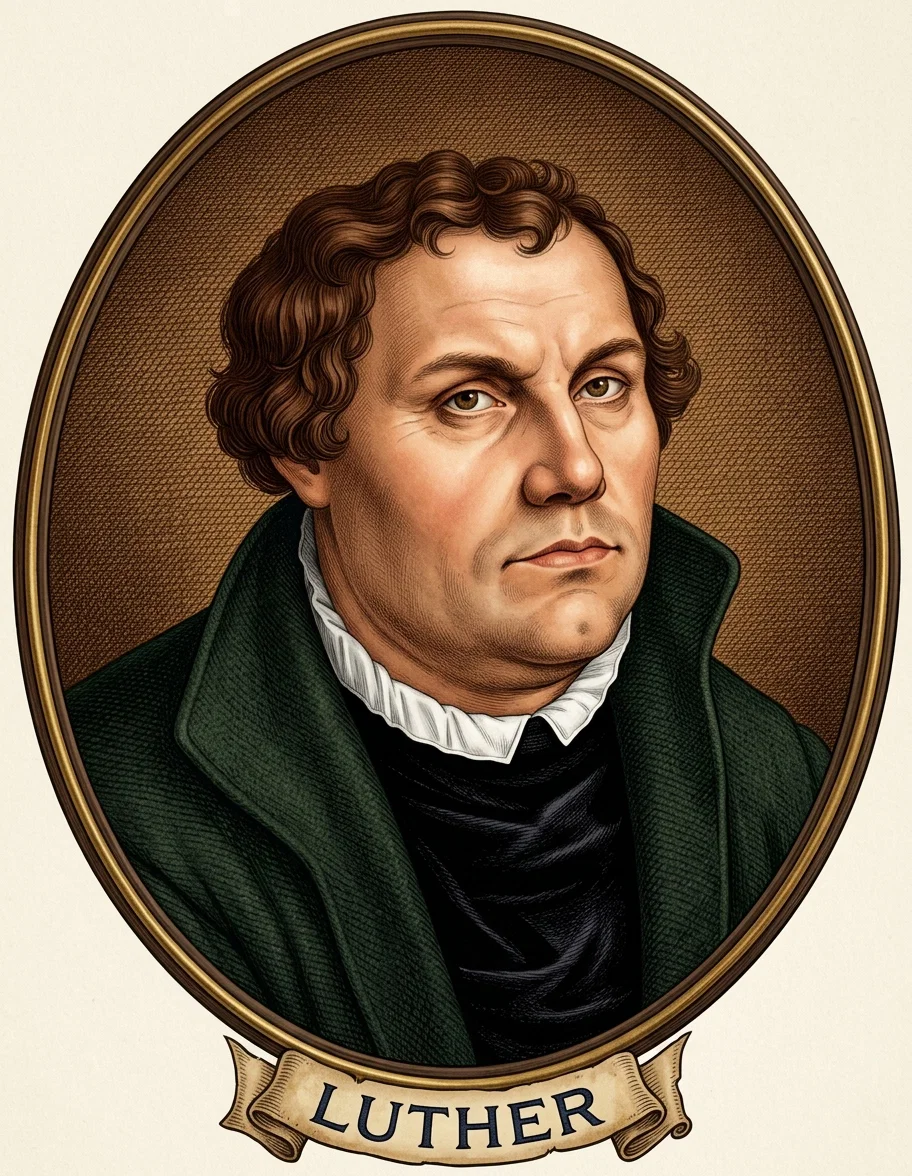
Martin Luther’s Hymn

ONE of the most historic and inspiring hymns of all time is Martin Luther’s famous song beginning, “Ein’ feste Burg ist unser Gott,”—“A mighty fortress is our God.” It is the battle hymn of the Protestant Reformation, and the national hymn of Germany. It is based on the forty-sixth psalm: “God is our refuge and strength, a very present help in trouble. Therefore will not we fear, though the earth be removed.” There are no less than sixty-five different translations of this hymn into English. The most faithful and forcible of all these translations is that by Thomas Carlyle.
The translation which is most popular in America is that of Rev. F. H. Hedge (1805–1890), a Unitarian minister and professor in Cambridge Divinity School. It was made in 1852, and is in part as follows:—
“A mighty fortress is our God, A bulwark never failing; Our helper he, amid the flood Of mortal ills prevailing, For still our ancient foe Doth seek to work us woe; His craft and power are great, And, armed with cruel hate, On earth is not his equal.
“Did we in our own strength confide, Our striving would be losing, Were not the right man on our side, The man of God’s own choosing. Dost ask who that may be? Christ Jesus, it is he; Lord Sabaoth is his name, From age to age the same, And he must win the battle.
“And though this world, with devils filled, Should threaten to undo us, We will not fear, for God hath willed His truth to triumph through us. The prince of darkness grim— We tremble not for him; His rage we can endure, For, lo, his doom is sure, One little word shall fell him.”
It is easy to see that the man who wrote this hymn had the faith and courage to lead the great Reformation to a glorious victory. Luther is really the father of modern Christian hymnology. In the early days of Christianity, the singing of psalms and hymns was a most popular and impressive part of public worship, but in the latter part of the fourth century (at the Council of Laodicea, 363 A. D.) the church prohibited laymen from taking any part in the singing; and from that time on, the priest did practically all the singing, and this was done mostly in an unknown tongue. It was Martin Luther who brought popular Christian song back again to worshiping congregations as their own divine right and precious privilege. His translation of the New Testament into the language of the people, and placing it in their hands, was a work which they appreciated and enjoyed only a little more than they did the privilege of singing bright and joyful Christian songs in their own language. It was Luther who made the singing of Christian hymns popular with the masses and with the common people. They heard him gladly as he preached, but still more gladly as he sang the blessed gospel, and taught them how to sing its songs of faith and hope and love. . . .
The inscription on Luther’s monument in Wittenberg is the first line of this hymn. This hymn was Luther’s solace in his times of greatest peril. When dangers gathered thickest about him, he would say to Melancthon: “Come, Philip, let us sing the forty-sixth psalm,” by which he meant his own “characteristic version.”
“Luther, full of faith,” says D’Aubigné in his “History of the Reformation,” “revived the courage of his friends by composing, and singing with his fine voice, that beautiful hymn, since become so famous: ‘Ein’ feste Burg ist unser Gott.’ Never did soul that knew its own weakness, but which, looking to God, despised every fear, find such noble accents.”—W. F. Tillett, in Sunday School Magazine.

J. S. WASHBURN

Boldness

J. S. WASHBURN

HE who truly fears God will fear no other, will never tremble in terror before tempest, fire, or flood, wild beasts, wicked men, or cruel demons. With Luther we may boldly say:—
“And though this world with devils filled Should threaten to undo us, We will not fear, for God hath willed His truth to triumph through us.”
We know that the Author of life is with us always, and therefore all power in heaven and earth is at our command. Isa. 45: 11. The fear of the Lord does not make a man uncertain and wavering, but calm and bold. “In the fear of the Lord is strong confidence.” Prov. 14: 26. It is God’s wish that we should “serve him without fear, in holiness and righteousness before him, all the days of our life.” He has overcome the world, and while we rest on his word, he is overcoming the world in us, and no one in the universe dare stay his hand, or say unto him, “What doest thou?”
Whatever your condition may be, even if you have sinned deeply, you may still come boldly to the throne of grace, that you may obtain mercy and find grace to help in time of need. God does not wish us to be cringing slaves, but his own dear children, coming with confidence to our Father, who delights to give, and who never upbraids us when we turn to him confessing our sin, who never reproaches nor taunts us with our weakness or failure. He wishes us to “have boldness in the day of judgment.” 1 John 4: 17.
It is when our love is made perfect that we have boldness. Perfect love casts out fear. Fear comes as a result of sin. God is love. In him is no sin. Where he is, where love is, sin cannot be. Love not only does no evil deed, speaks no evil word, but actually “thinketh no evil.”
Until Adam sinned, he had no thought of fear in the presence of his divine Father. But on that dark day when he fell into sin, he hid himself in terror from his best Friend. “Thus does a guilty conscience make cowards of us all.”
Sin is the only cause of fear. But all have sinned, and therefore all have reason to tremble at the “fearful looking for of judgment and fiery indignation, that shall devour the adversaries.” Then how is it possible for us to have boldness now or in the day of judgment? There is one true ground for boldness, and one only, and that is the forgiveness of sin, the absolute, complete destruction of sin in us. No one can be bold on the ground that he is better than any other man. Such hope is a snare. He who is nearest to God will count himself the chief of sinners. Paul, who thus counted himself, faced every deadly peril boldly from the time he was converted till the day on which he fearlessly died a martyr’s death. How could this man who had been a murderer, a blasphemer, meet death and the judgment joyously, without trembling?—Only on the ground that he had obtained mercy and been forgiven.
With quiet confidence, with perfect assurance, may the forgiven sinner face a frowning world, going on from victory to victory, conqueror over self, and treading underfoot serpents and scorpions, and possessing power over all the power of the enemy, yea, authority over all devils.
“Finally, my brethren, be strong in the Lord; and in the power of his might.” “Who shall lay anything to the charge of God’s elect? It is God that justifieth. Who is he that condemneth?” “Therefore have I set my face like a flint, and I know that I shall not be ashamed.”
May the following words be our experience not alone in the day of judgment, but now and for evermore:—
“Bold shall I stand in that great day, For who aught to my charge shall lay, While through the blood absolved I am From sin’s tremendous curse and shame?”

Joy in the Lord Is Strength

“Sorrow unduly prolonged causes weakness, but continual joy in the Lord is strength to the believer.”

Occupy, Occupy

IF you are a student of prophecy, I entreat you, never let it be said that prophetic study prevents practical diligence. If you do believe that the day is really approaching, then labor actively to provoke others unto love and good works. If you do believe that the night is far spent, be doubly diligent to cast off the works of darkness, and put on the armor of light. Never was there a greater mistake than to fancy that the doctrine of the personal return of Christ is calculated to paralyze Christian diligence. Surely there can be no greater spur to the servant’s activity than the expectation of his Master’s return.
This is the way to attain a healthy state of the soul. There is nothing like the exercise of our graces for promoting our spiritual vigor. Alas! there are not a few of God’s saints who complain that they want spiritual comfort in their religion, while the fault is altogether in themselves. “Occupy,” “occupy,” I would say to such persons. Lay yourselves out more heartily for the glory of God, and then uncomfortable feelings will soon vanish.
This is the way to do good to the children of the world. Nothing under God has such an effect upon unconverted people as the sight of a real, thoroughgoing Christian. There are thousands who will not come to hear the gospel, and do not know the meaning of justification by faith, who yet can understand an uncompromising, holy, consistent walk with God. “Occupy,” “occupy,” I say again, if you want to do good.
This is the way to promote meetness for the inheritance of the saints in light. There will be no illness in the kingdom of Christ. The saints and angels shall there wait on their Lord with unwearied activity, and serve him day and night. It is a fine saying of Bernard that Jacob in his vision saw some angels ascending and some descending, but none standing still. “Occupy,” “occupy,” I say again, if you would be thoroughly trained for your glorious home. O brethren believers, it would be well indeed if we did but see clearly how much it is for our interest and happiness to use every farthing of our Lord’s money to live very near to God.
So living, we shall find great joy in our work, great comfort in our trials, great doors of usefulness in the world, great consolation in our sicknesses, great hope in our death, leave great evidences behind us when we are buried, have great confidence in the day of Christ’s return, and receive a great crown in the day of reward.—Selected.

Christian Giving

Christian giving develops the Christian graces in the soul of the giver. We will not give our money without faith in the object to which we are giving, and with this giving comes a deepening interest, a desire for knowledge. Nothing so expands the heart, enlarges the sympathies, and elicits a generous charity, as the taking up of God's world-wide work for study and prayer. With it comes a corresponding increase of faith in God's ability to do even greater things than he has done.
Christian giving is one of the best means of making us unselfish. Some one has said, “All of the gospel, so far as principle is concerned, is contained in the one word ‘love;’ all of practice, in the word ‘give.’” Christ gave himself for us. Why?—Because he loved us. And what more natural than that we should grow into his likeness, if we follow in his footsteps? Christian giving leads us to think of all who sin and suffer. It carries us out of ourselves, and brings our thoughts and sympathies to embrace the whole world. Our hearts are filled with pity for the dwellers in far-off lands, who are without Christ, “having no hope, and without God in the world.” Then we look upon life, not from the standpoint of self-interest or self-love; but constrained by the love of Christ, we rise to the dignity of co-workers with God.
Christian giving develops in the giver the highest types of manhood and womanhood. It is not satisfied with giving money, but develops that consecration of character which holds nothing back, but lays it all—life and everything—upon the altar to be used in God's service. Such giving brings to the giver the joy of at least some measure of success; for where the means are given, and persistent effort is put forth, suffering and sin will be alleviated, and trophies will be won for Christ. The infinite resources of divine power are placed within our reach, and the testimony of all who have put them to the test, is that of Spurgeon, who said, “There is no joy outside of heaven like that of winning souls for Christ.”
Then, as the Master bears in remembrance and lovingly rewards, at the end, everything done in his name or for his cause, even though it be done “unto the least of these” his brethren, we may look forward to an eternal reward. Surely it cannot be anything but uplifting and ennobling to the character of an individual to be striving for, and looking forward to, the commendation of the Master: “Well done, good and faithful servant; thou hast been faithful over a few things, I will make thee ruler over many things: enter thou into the joy of thy Lord.”
Let us then remember,—
“Love divine will fill thy storehouse, Or thy handful still renew; Scanty fare for one will often Make a royal feast for two. For the heart grows rich in giving; All its wealth is living grain; Seeds which mildew in the garner, Scattered, fill with gold the plain.” —Selected.

The First Advent Includes the Second

THE span of Christ's manifestation in the flesh is from the manger to the cross. In weakness he came, and in weakness he ended his work. “He was crucified through weakness.” 2 Cor. 13:4. Nevertheless, “he liveth by the power of God,” and that is how we are to live. Christ is coming again; but his coming in the clouds of heaven, “with power and great glory,” will be only the manifestation of the power that lay in the manger and hung on the cross. The “hiding of his power,” is from his side, where once the spear pierced, but where the stream of glory issues. Hab. 3:4, margin. He is King of glory solely because of his humility. Phil. 2:8, 9. He is coming to save his people; but he will save at his second coming only those whom he has already saved at the cross. That manger in Bethlehem is capacious enough to contain all mankind: it contained divinity. The second coming will be only the complete manifestation of the first. In the manger Christ was the Son of God; but it was the resurrection from the dead with power according to the Spirit of holiness, that demonstrated the fact. When he comes again, it will be for the purpose of showing all men that he really lives.—Selected.

Kept

DAY by day, He leads me on, In the way he sees is best; Earthly joys pass, one by one, But he gives his peace and rest. Loving One!
Hour by hour I look to him, And his wondrous face to me Brighter grows as earth grows dim, And shadows fall upon the sea. Gracious One!
Earth and sea are all his own, Time and blest eternity; I can never walk alone, For his own hand is leading me. Mighty One!
— Caroline Willard Bixby.

Missions Mean Mind, Might, and Motive

M                     MISSIONS MM                  MEAN M M             MIND M M M         MIGHT M     M         MOTIVE of the M                     MASTER M                     MULTIPLIED by his M                     MESSENGERS.
Is it not an inspiring thought that thus through our missionary endeavor we are able to multiply the mind, might, and motive of our Master? And the more closely we accord with his mind and motive, the more of his might shall we possess. I fear that many of us have only a little of the Christ motive, else we should be more active in multiplying the message; for—
“While one soul of the sons of men Waits for the message from lips or pen, We who have heard it must tell it again.”—Selected.

The Soul Awakes

“I WATCHED the morning as God called: Cold gray, a touch of gold, then flame. So is it when the soul awakes: Surprise, a glow, then glad acclaim.”
Continue reading: — Lucy Larcom