Your ShelfYour Projects

Signs of the Times, Vol. 40, No. 28.

Signs of the Times

Signs of the Times

Jul 22, 1913

Pacific Press Publishing Association · Mountain View, California · Jul 22, 1913

Signs of the Times

Every branch in Me that beareth not fruit, He taketh it away: and every branch that beareth fruit, He cleanseth it, that it may bear more fruit. . . . Herein is My Father glorified, that ye bear much fruit; and so shall ye be My disciples.”—Jesus.

Fruit-Bearing

Question Corner

"IF YE WILL INQUIRE, INQUIRE YE."

This Inquirers' Department is conducted for the purpose of helping those who are studying the Bible. The answers are oftentimes only suggestive. They are never to be considered infallible, only as they agree with the infallible Word. The writer who may answer these questions does not consider that his opinion is infallible. He will simply give the best that he has, and plead with the inquirer to search the Word. Such questions only will be answered as, to the editors, seem to minister to the good of the readers and to the mission of the paper. We can not answer repeatedly in the same volume questions upon the same scripture. The name and address must accompany question, not for publication, but as an evidence of good faith, and that answer may be made by letter if deemed advisable. No letters are answered which do not contain the name of the writer. It is well always to enclose stamp for reply.

4132 — Two Works of Grace

Are there two works of grace, as justified and sanctified? and has one got to be wholly sanctified if he will ever see God? S.
Yes, there is one work of grace, and two works of grace, and three works of grace, and many other works of grace that God is doing for His children all the time. It all may be summed up in one great, continuous work of grace. The Lord does not set before us in His word a special work that He does for a soul, and then by and by another special work, and that that soul is to rest always in that work. First of all the child is born, and then it grows and develops into youth and strong manhood. It is so with the Christian. God does not want dwarfs, nor does He always want us to remain little children. When we believe in the forgiveness of sins through our Lord Jesus Christ we are justified. God forgives for Christ's sake. That is one work. That is what He does for us simply because we believe. Of course preceding this is repentance, or sorrow for sin and a turning from sin, and that is where the will of the individual must choose.
Sanctification means a separation from and a separating unto, and the soul that is justified gives himself to God for service. It does not mean that he is then perfect. It does not mean that he will not make mistakes. It does not mean that he can not sin. A sanctified person is a saint. That is what Paul calls the Romans, and calls the Corinthians, and he calls others saints; but by reading the epistles we will see that they are very faulty, defective saints nevertheless; but they have given themselves to God. They have separated themselves from the world, and yielded themselves to the Master, and God in His grace has been with them in this whole work, so that a wholly sanctified person is one who has given himself to God, and the working out of character follows.
Sanctification, therefore, may be said to be an instantaneous work, as relating to the decision, but a progressive life-work, as relating to the working out of that decision. Paul expresses both these in his own experience in Phil. 3:7-14. The first was the decision,—"What things were gain to me, those I counted loss for Christ. Yea doubtless, and I count all things but loss,"—all that he had seen, all that he would see in the future,—all were given up for Christ. And then he prays that he may know Christ, and the power of His resurrection, and the fellowship of His sufferings, being made conformable unto His death, if by any means he might attain unto the resurrection out from among the dead. And the 12th verse says: "Not as tho I had already attained, either were already perfect: but I follow after." He presses on toward the mark of the prize of the high calling of God in Christ Jesus. The man who boasts himself a saint does not know of what he is talking. The man who says that he is perfect and sinless, is sinning in the very declaration that he has made. It is a characteristic of the New Testament writers to call themselves "servants," not "saints." They may call others saints, and God may call them saints, but the sweetest name that the child of God who recognizes his obligation can use is "servant." Don't be worried over the ultra and unscriptural views of holiness which are taught. Our hope lies in Jesus Christ our Lord and in His word, not in any particular feeling or emotion that we may have.

4134 — The Earth Defiled, and Why?

Please explain Isa. 24:5. "The earth also is defiled under the inhabitants thereof; because they have transgressed the laws, changed the ordinance, and broken the everlasting covenant."
To our mind, it seems to be a general statement of universal transgression. If we wish to particularize, we could say that the laws had reference to God's moral law; the ordinance would certainly have reference to baptism; and the covenant, the new covenant in our Lord Jesus Christ. The American Revised Version, which is more uniform in its rendering, has, "The earth also is polluted under the inhabitants thereof; because they have transgressed the laws, violated the statutes, broken the everlasting covenant." Rotherham's emphatic translation renders, "They have set aside laws; gone beyond statute, broken an age-abiding covenant." Spurrell renders: "They have transgressed the law, they have changed the decree; they have broken the everlasting covenant." Bishop Lowth renders: "They have transgressed the law, they have changed the decree, they have broken the everlasting covenant," and declares in a note that "the law" should be singular. The Septuagint reads: "They have transgressed the law, and changed the ordinances, from the everlasting covenant." That is, the ordinance connected with the covenant, which would include not only the matter of baptism, but also that of the Lord's supper. Boothroyd also has, "They have transgressed the law, they have changed the ordinances, they have broken the everlasting covenant."
Let the reader get the picture of the prophet, and he will get a better idea of what he means. Let him read the context, and he sees a whole world in transgression of everything that is good and sacred.—'The earth mourneth and fadeth away, the world languisheth and fadeth away, the haughty people of the earth do languish. The earth also is defiled under the inhabitants thereof; because they have transgressed the laws, changed the ordinance, broken the everlasting covenant. Therefore hath the curse devoured the earth, and they that dwell therein are desolate.'
The same picture is presented in Isa. 59:13, 14: 'In transgressing and lying against the Lord, and departing away from our God, speaking oppression and revolt, conceiving and uttering from the heart words of falsehood. And judgment is turned away backward, and justice standeth afar off: for truth is fallen in the street, and equity can not enter.'
There is not a law of God but that is transgressed, not an ordinance of God but that apostasy has sought to change, and every phase of His great, new everlasting covenant has been broken. Those who try to make technical applications of these great, broad, general statements, merely confuse and do not help.

4131 — Knowing

Is there such a thing as a person being saved and not knowing it? or will you know when you are converted and saved, so you can testify of it and know it?
Not always. Experiences come to some altogether differently than to others. The natural disposition in some minds is to be decided and positive, in others to be questioning, and yet the timid, almost doubting, one (who doubts no one but himself) may be just as near the Lord as the confident one. To some conversion comes suddenly, at an instant, and they know the very time when God spoke peace to their souls. To others it is a gradual work.
In the pathway of some they know when they pass from the valley to the hill,—the demarcation is clear and distinct; but with some the way is so gradual that they hardly know that they are ascending, and yet in a little time they can look back and know that God has lifted them from the slough of sin and of despond and placed their feet upon the highway of holiness. He gives to every soul His twofold witness; that is more than all feeling and all emotional experience. Is our heart in harmony with His word? Does the voice in our heart speak in harmony with the voice in His word? We may know then that we are His. Do we meet the little, daily tests gladly? Are we submissive under reproof, willing to be admonished, anxious to be corrected, so that our feet may be kept in the right way? We may know that we are His. All imperfect as we are, He accepts us in the name of the Beloved. Have we confessed our sins? Then we may know from His own word that "He is faithful and just to forgive us our sins, and to cleanse us from all unrighteousness." These are the evidences which we need to keep before us, and the evidences upon which we may depend and know that we are saved; but we may well be in doubt if our hearts are rebellious against His will, and we are careless and indifferent regarding duty.

4133 — Spiritual Gifts

Please explain 1 Cor. 12:30. E. Y.
The passage consists of two questions asked by the apostle, similar to the verse before, which we quote with it: "Are all apostles? are all prophets? are all teachers? are all workers of miracles? have all the gifts of healing? do all speak with tongues? do all interpret?" The very form of the question demands a negative answer. The whole chapter is taken up with spiritual gifts, the gifts which God places in His church, the gifts that are necessary to make that church what it ought to be.
In verse 28 he tells us the relative importance at least of the first gifts,—"first apostles, secondarily prophets, thirdly teachers,"—after that various gifts. The least important of all is tongues, which would be demanded only where it is necessary to speak to people in other tongues, altho it might be manifested other times. Now the question rises, Does every one of God's children have all these gifts? And of course the answer is, No; all are not apostles, all are not prophets, all are not teachers; just as all the members of our body are not hands, or eyes, or feet. That is all that is meant by it. These gifts are distributed among God's children according to the ability to use them, and always according, not to the wish of the individual, but to the will of God. See 1 Cor. 12:11.

4135 — The Keys

Please explain Matt. 16:19. What are the keys He was to give Peter?
A Brother.
Of the conditions of salvation, the gospel of the Lord Jesus Christ, Peter himself, referring to this, says: "Men and brethren, ye know how that a good while ago God made choice among us, that the Gentiles by my mouth should hear the word of the gospel, and believe." Now Peter preached first to the Jews on Pentecost (Acts 2) the word of the gospel, and many of the Jews believed; and then, according to the 10th chapter of Acts, he preached to the Gentiles; and the Gentiles believed. The key that opened their heart was the key of the gospel of Christ. Every minister has that, but Peter used it first. That is, God showed by Peter just what effect the gospel would have if it were preached. And the binding and the loosing is also by the word. It was not Peter as a man that did that; Peter as a man was a poor, fallible fellow. He was one who denied his Lord, and he was one who dissembled before the Jews. But the mighty message which Peter had and proclaimed was the power that did the cleansing and the loosing, or the binding and the condemning. And God approved it because it was by His word. Even so Jeremiah wrought by the message which God sent through him. Jer. 1:10.
Schedule for the Week Ending July 26, 1913

Sabbath School Lesson Readings

Sunday July 20 Jeremiah 7, 8
Monday " 21 " 9, 10
Tuesday " 22 " 11, 12, 13
Wednesday " 23 " 14, 15, 16
Thursday " 24 " 17, 18
Friday " 25 " 19, 20
Sabbath " 26 Psalms 49, 50
Our readings cover Jeremiah, chapters 7 to 20, and Psalms 49 and 50. These chapters of Jeremiah point out the idolatry of Israel, showing them that their form of temple worship is of no avail to the ungodly; denounce their idolatry, their abominations of Topheth, their treachery and shamelessness; and declare that their wilfulness will soon be punished by the swift avenger Babylon. The prophet weeps over their desperate state of sin, and seems at times almost utterly discouraged because of the utter lack of response on the part of the people to the messages which God sends through him. Yet he pleads with God for the people, beseeches Him not to disgrace the throne of His glory, especially points out their sins regarding the Sabbath, shows to us that if they had heeded the Sabbath, with all the Sabbath meant, Jerusalem would have stood forever, and the nation would have been preserved; for in a true recognition of the Sabbath there is always a true recognition of God, Creator and Redeemer. In chapter 18, verses 5 to 10, are laid down the conditions upon which the blessing or curse came upon Israel, and upon all other nations as well. If the reader will but fix them in his mind, they will help him to solve many problems of Scripture in the future.
Psalm 50 is a striking song of our Lord's second coming and the necessity of preparations for that coming.

The Way to Christ

By Mrs. E. G. White

THE commandments of God are comprehensive and far-reaching; in a few words they unfold the whole duty of man. "Thou shalt love the Lord thy God with all thy heart, and with all thy soul, and with all thy mind, and with all thy strength. . . . Thou shalt love thy neighbor as thyself." In these words the length and breadth, the depth and height, of the law of God is comprehended; for Paul declares, "Love is the fulfilling of the law."
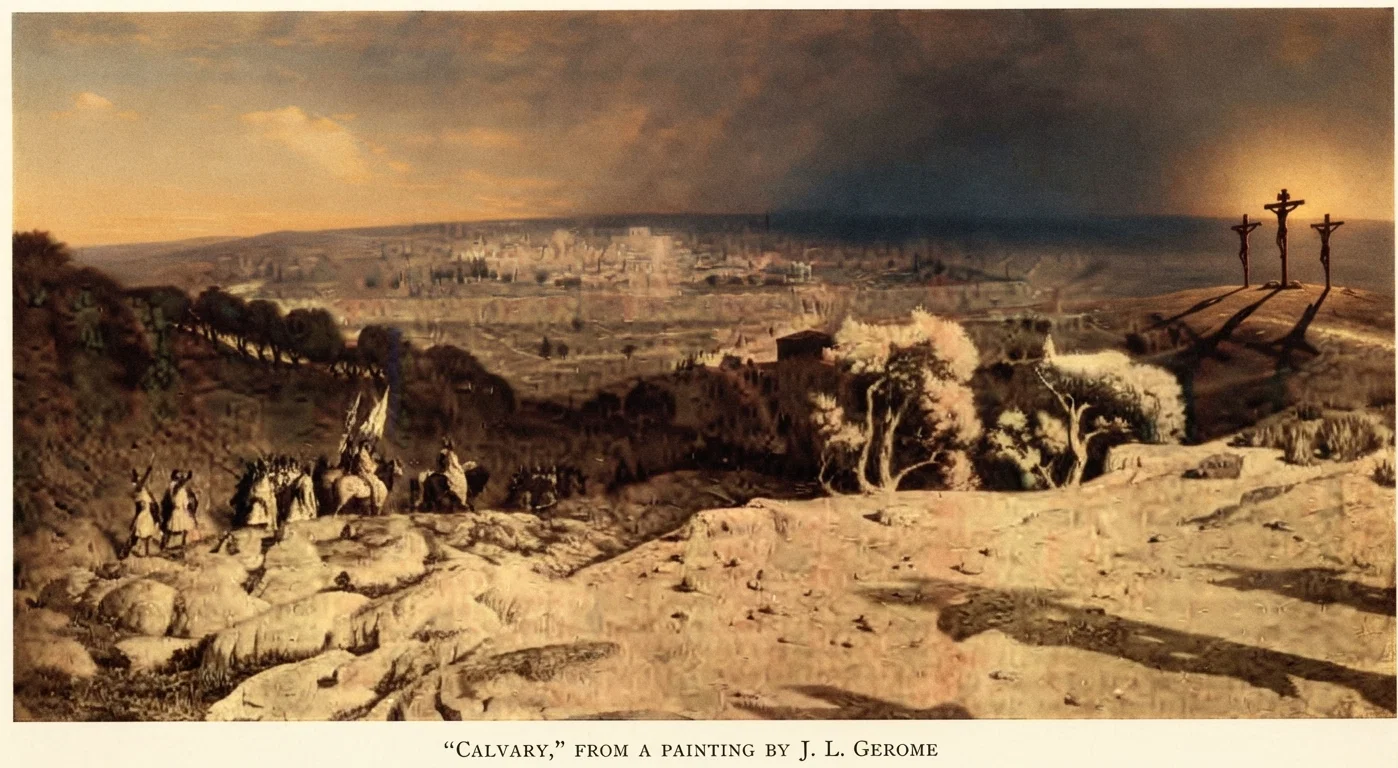
“CALVARY,” FROM A PAINTING BY J. L. GEROME
The only definition we find in the Bible for sin is that "sin is the transgression of the law." The word of God declares, "All have sinned, and come short of the glory of God." "There is none that doeth good, no, not one." Many are deceived concerning the condition of their hearts. They do not realize that the natural heart is deceitful above all things, and desperately wicked. They wrap themselves about with their own righteousness, and are satisfied in reaching their own human standard of character; but how fatally they fail when they do not reach the divine standard, and of themselves they can not meet the requirements of God.
We may measure ourselves by ourselves, we may compare ourselves among ourselves, we may say we do as well as this one or that one, but the question to which the judgment will call for an answer is, Do we meet the claims of high Heaven? Do we reach the divine standard? Are our hearts in harmony with the God of heaven?
The human family have all transgressed the law of God, and as a transgressor of the law, man is hopelessly ruined; for he is the enemy of God, without strength to do any good thing. "The carnal mind is enmity against God: for it is not subject to the law of God, neither indeed can be." Looking into the moral mirror,—God's holy law,—man sees himself a sinner, and is convicted of his state of evil, his hopeless doom under the just penalty of the law. But he has not been left in a state of hopeless distress in which sin has plunged him, for it was to save the transgressor from ruin that He who was equal with God offered up His life on Calvary. "God so loved the world, that He gave His only-begotten Son, that whosoever believeth in Him should not perish, but have everlasting life."
Jesus was the majesty of heaven, the beloved commander of the angels, who delighted to do His pleasure. He was one with God, "in the bosom of the Father," yet He thought it not a thing to be desired to be equal with God while man was lost in sin and misery. He stepped down from His throne, He left His crown and royal scepter, and clothed His divinity with humanity. He humbled Himself even to the death of the cross, that man might be exalted to a seat with Him upon His throne. In Him we have a complete offering, an infinite sacrifice, a mighty Saviour, who is able to save unto the uttermost all that come unto God by Him. In love He comes to reveal the Father, to reconcile man to God, to make him a new creature renewed after the image of Him who created him.
Jesus is our atoning sacrifice. We can make no atonement for ourselves; but by faith we can accept the atonement that has been made. "For Christ also hath once suffered for sins, the just for the unjust, that He might bring us to God." "Ye were not redeemed with corruptible things, . . . but with the precious blood of Christ, as of a lamb without blemish and without spot." It was through infinite sacrifice and inexpressible suffering that our Redeemer placed redemption within our reach. He was inthis world unhonored and unknown, that, through His wonderful condescension and humiliation, He might exalt man to receive eternal honors and immortal joys in the heavenly courts. During His thirty years of life on earth His heart was wrung with inconceivable anguish. The path from the manger to Calvary was shadowed by grief and sorrow. He was a man of sorrows, and acquainted with grief, enduring such heartache as no human language can portray. He could have said in truth, "Behold, and see if there be any sorrow like unto My sorrow."
Hating sin with a perfect hatred, He yet gathered to His soul the sins of the whole world. Guiltless, He bore the punishment of the guilty. Innocent, yet offering Himself as a substitute for the transgressor. The guilt of every sin pressed its weight upon the divine soul of the world's Redeemer. The evil thoughts, the evil words, the evil deeds of every son and daughter of Adam, called for retribution upon Himself; for He had become man's substitute. Tho the guilt of sin was not His, His spirit was torn and bruised by the transgressions of men, and He who knew no sin became sin for us, that we might be made the righteousness of God in Him.
Voluntarily our divine substitute bared His soul to the sword of justice, that we might not perish but have everlasting life. Said Christ: "I lay down My life, that I might take it again. No man taketh it from Me, but I lay it down of Myself. I have power to lay it down, and I have power to take it again." No man of earth or angel of heaven could have paid the penalty for sin. Jesus was the only one who could save rebellious man. In Him divinity and humanity were combined, and this was what gave efficiency to the offering on Calvary's cross. At the cross mercy and truth met together, righteousness and peace kissed each other.
— ★ ★ —

Christ Jesus the Rock

By T. E. Bowen
PETER was not the rock upon which Christ promised to build His church.
The gates of hell would have soon prevailed against the new church had it had so frail a foundation as that of Peter. It was the God-revealed truth voiced for all the disciples by Peter, that Jesus was the Son of the living God, upon which Christ founded His church. That living, divine truth, so little comprehended by the disciples and others at that time, that the Father had sent His Son into the world,—the divine Son by whom He made the worlds; that Son who was the express image of His Father's person, full of grace and truth; Him who was the Way, the Truth, the Life, and by whom alone salvation could be obtained,—all this was comprehended in the statement by the disciple Peter, when he said, "Thou art the Christ, the Son of the living God," in answer to the Lord's direct question, "But whom say ye that I am?" Upon this divine truth, which Jesus then said had been revealed to Peter not by flesh and blood, but by the Father Himself, the church has been built. The gates of hell have not yet succeeded in prevailing against this divine truth that the Son of the living God was manifested in the flesh, and still lives in the hearts of men by faith, thus bringing salvation within the reach of all.

Peter Not the Divine Rock

That Peter is not this divine rock is easily shown from the Scriptures. In one of his own epistles this point is made very clear. Speaking of Christ, he says, "To whom coming, as unto a living stone [rock], disallowed indeed of men, but chosen of God, and precious, ye also, as lively [living] stones, are built up a spiritual house, an holy priesthood, to offer up spiritual sacrifices, acceptable to God by Jesus Christ." "Unto you therefore which believe He is precious: but unto them which be disobedient, the stone which the builders disallowed, the same is made the head of the corner." 1 Peter 2: 4-7. All of which applies to Christ Jesus in plain language, and has no reference whatever to Peter.

Peter Makes a Grave Mistake

But before the conversation was completed when Christ called forth from the disciples their expression of belief in Him as the Son of God, it was revealed unmistakably that Peter was very fallible indeed. When Jesus began telling the disciples what was just before Him, what He must suffer at Jerusalem, Peter began to rebuke his Lord, saying, "This shall not be unto Thee." Whereupon Christ turned to him, saying, "Get thee behind Me, Satan: thou art an offense unto Me: for thou savorest not the things that be of God, but those that be of men."

Christ Jesus the Rock

If Peter was the rock upon which the church was built, then Satan thus early had taken possession, for Jesus recognized His deadly enemy speaking through Peter in opposing that which had been written concerning what must be endured by the Son of Man. It is the savor of men that was the offense to Christ. The man-made traditions have all through the history of the church been an offense to Christ, and have always brought weakness and disaster to the church. Here is where Satan steps in. It was here he held sway in the Jewish church. In the apostasy which soon followed the labors of the apostles, in the creeds, the traditions of men, that were exalted to take the place of Jesus' words and teaching, was the "savoring of men" introduced,—that point where the mystery of iniquity began its development, which wrought such havoc in the church during the dark ages of papal oppression.
But how about Peter further? A little later we find that he again gets into difficulty by telling the tax-gatherers for the temple that Jesus paid tribute,—a catch they had to show that Jesus was simply a common worshiper with all the rest at the temple—when in very fact He was its glory, the One whom every Israelite should have there devoutly worshiped, being the Son of the living God, manifested in their midst. So Jesus said to Peter, "What thinkest thou, Simon? of whom do the kings of the earth take custom or tribute? of their own children, or of strangers?" Peter saith unto Him, "Of strangers." Jesus saith unto him, "Then are the children free." Thus Peter was again wholly out of harmony with the purpose of Christ and the will of God.

Peter One of the Twelve, but No More

These instances were before the outpouring of the Spirit on the Day of Pentecost. Yet the Scriptures reveal that Peter was left to himself and made another great mistake even after this, so that no one need be misled as to his true position as simply being one of the twelve apostles through whom Christ wrought in establishing the church. See Matt. 19: 27, 28.
Peter was a Jew. Paul was a Jew also, and an apostle called by Jesus in a most remarkable manner. Paul was sent as an apostle to the Gentiles. Peter was likewise sent to them with the gospel. But at one time when Jewish brethren came down where he was laboring among the Gentiles, he changed his attitude toward the Gentiles, doing differently, and, as a result, the faith of the Gentile believers was shaken. Paul took Peter to task before them all, in this fashion: "When Peter was come to Antioch, I withstood him to the face, because he was to be blamed. For before that certain came from James, he did eat with the Gentiles: but when they were come, he withdrew and separated himself, fearing them which were of the circumcision. And the other Jews dissembled likewise with him; insomuch that Barnabas also was carried away with their dissimulation. But when I saw that they walked not uprightly according to the truth of the gospel, I said unto Peter before them all, If thou, being a Jew, livest after the manner of Gentiles, and not as do the Jews, why compellest thou the Gentiles to live as do the Jews?" Gal. 2: 11-14.
Can this be the immovable "rock" upon which the church was built? If so, again we find it in error, walking not "according to the truth of the gospel"—another instance of savoring of the things of men, rather than those things which be of God.

Who Was This Immovable Rock?

Let no one be deceived. Peter is not the rock to which Jesus referred. By the term "this rock," Jesus was speaking of Himself. It is Christ Jesus the Lord, the Rock that went with the children of Israel in their wanderings in the wilderness. 1 Cor. 10: 1-4. Again of Himself He says, "I am Alpha and Omega, the beginning and the end, the first and the last;" and again, "I am the root and the offspring of David, and the bright and morning star." Rev. 22: 13, 16. He is the rock upon whom the church is built, the Son of the Highest, God with us, the One who makes no mistakes, and against whom the gates of hell have not, neither ever can, prevail.
Every other god is a false god. All who seek to enter in some other way than by this Door, Heaven styles as thieves and robbers, and it is self-evident that such shall not inherit the kingdom of heaven.
From the cloud on the mount of transfiguration came the voice of the Father, corroborating all this testimony, saying, "This is My beloved Son, in whom I am well pleased; hear ye Him." Let us do it. The voice of the Lord Jesus never misleads. His sheep will recognize His voice, and follow Him. And to such the gates of the Paradise of God will be thrown open as the loving Shepherd welcomes them home, with these words: "Come, ye blessed of My Father, inherit the kingdom prepared for you from the foundation of the world."

Learning from Others’ Faults

"By others' faults, wise men correct their own."
Continue reading: THE WITNESSING OF GOD