X. His Twofold Witness Regarding Israel According to the Flesh
HIS infallible witness of God is not concerning a teaching, a city, a law, or a person, but a people,—a continuous people, among whom is found both prediction and fulfilment, but so far apart, so separate in time that there could be no human connivance or collusion between them.
It is manifestly impossible to treat at length the great mass of detail prediction and fulfilment. General statements concerning events conceded by all must suffice.
First, then, we note the promises and prophecies to the great father of the Hebrew people, namely, Abraham. (See Gen. 12: 1-3; 13: 14-17; 15: 5, 6, 13-21; 17: 1-8; 22: 16-18; et al.) God called Abram from all that was dear,—country, kindred, and home, to go to a strange land of which Abram was afterward to learn and to receive. There God promises to make of him a great nation, and to make his name great, and that in and through him should all the families of the earth be blessed. Abram went forward trusting God under various testings. God confirms him with a covenant, and changes his name from Abram to Abraham; tells him that no adopted son, but one of his own blood, should be his heir through whom the promised Seed was to come; that that seed should be numerous; that it was early to become afflicted; that four hundred years would pass before deliverance came (the first promise dating thirty years earlier); and that after that Abraham's descendants should receive the Land of Promise from the river Euphrates to the river of Egypt; that they should dispossess certain named nations, some of whom, if not all, were stronger than the Hebrews.
Time and Territory
All these were clear, distinct, specific promises and predictions concerning Abraham and his descendants. Both time and territory are named, the time when they should be delivered from Egypt, the territory they were to possess, tho they were to meet numerous foes.
The time passes. Abraham dies, Isaac dies, Jacob dies, the twelve patriarchs die. One of them, Joseph, exacts a promise that his body should be taken to the Promised Land when the time came, thus recording his faith. Gen. 50: 25.
Dynasties changed in Egypt. The Chosen People became a nation of ignorant, idolatrous slaves, but God does not forget His promise. 'And the sojourning of the children of Israel, while they sojourned in the land of Egypt and the land of Canaan, was four hundred and thirty years. And it came to pass after the four hundred and thirty years, all the forces of the Lord came forth out of the land of Egypt by night.' Ex. 12: 40, 41, Septuagint. The sojourning included both lands. In our common versions we are told in verse 41: 'And it came to pass at the end of the four hundred and thirty years, even the selfsame day it came to pass, that all the hosts of Jehovah went out from the land of Egypt.' Thus explicitly does God remember the time of the promise.438
The Land
The great God leads His people through a man-devouring wilderness for forty years,—a forty years' course in higher education. By miracle and wonderful manifestations of power He preserves them, until at the close of forty years they enter the Promised Land and begin to possess it. The transgressions of Israel restrained God's working until we reach the days of Solomon. Then the promise predicted as foretold in Genesis 15, is recorded, from 'the river Euphrates' 'unto the border of Egypt.' 1 Kings 4: 21.
Nay, more, the very nations whose lands were promised to Abraham are noted in the fulfilment. Tho the Hebrews by backsliding had utterly failed and were thrown into captivity, yet one of their number in the most solemn of discourses—earnest prayer—sets seal to the promise of God: 'Thou art Jehovah, the God who didst choose Abram, and broughtest him forth out of Ur of the Chaldees, and gavest him the name of Abraham, and foundest his heart faithful before Thee, and madest a covenant with him to give the land of the Canaanite, the Hittite, the Amorite, and the Perizzite, and the Jebusite, and the Girgashite, to give it unto his seed, and hast performed Thy words; for Thou art righteous.' Neh. 9: 7, 8.
Thus is definitely recorded hundreds of years after the promise was given, the fulfilment of the territory to be possessed by the literal seed of Abraham. But from the days of Solomon onward, that nation began to depart from God. They utterly refused to meet the conditions which the Lord laid down so explicitly in Deuteronomy 27 and 28. By every effort that Divinity could use to move upon their heart to accept Him, God sought to save His people. And so it is recorded: 'And Jehovah, the God of their fathers, sent to them by His messengers, rising up early and sending, because He had compassion on His people, and on His dwelling-place; but they mocked the messengers of God, and despised His words, and scoffed at His prophets, until the wrath of Jehovah arose against His people, till there was no remedy.' 2 Chron. 36: 15, 16. Then came the Babylonian captivity. All this is expressly foretold in the prophecies of Jeremiah and Ezekiel, even the very period of time that the Jews themselves should remain captive to Babylon,—seventy years. Jer. 25: 11, 12.
At this time there were two great powers in the earth in whom Israel, turning from God, had trusted at different times. The one was Chaldea on the north, and the other Egypt on the south. Nebuchadnezzar, the mighty general, had swept over the smaller nations, and was on his way toward Egypt. Nation after nation had yielded to his yoke. Israel vainly thought that Egypt would help them. Numerous false prophets rose up against Jeremiah, accused him of a lack of patriotism, told him that he was weakening the hands of the men of war, endeavored to make the people believe in every way they could that Egypt would come and rescue them; but steadfastly Jeremiah tells them that they must yield to Babylon, and altho Babylon should be so defeated that they had nothing but wounded men among them, yet the wounded men would take Jerusalem.
The Captivity and Restoration
The fulfilment came as the prophet declared, and also the restoration at the end of the seventy years, as we learn by the books of Ezra and Nehemiah. Then God stirred up Cyrus, the king of Persia, to relieve the Jews and restore them to their own land. Clearly, definitely, according to His promise in Isaiah 44 and 45, God fulfilled to that people just what He had declared.
The last captivity of all, foretold by Moses in Deuteronomy 28, was under the Romans. Its fearfulness is foretold with an exactitude that is amazing. Leviticus 26 covers practically the same ground. If they would obey the commandments of God, God would make them the head and not the tail, as they were in the days of Solomon; if they disobeyed, their enemies would rise up against them, and they would be smitten before them. They should come against them from one way, and should flee before them seven ways. Cursing and discomfiture and rebuke would be upon them. The pestilence would cleave to them. Consumption and fever and inflammation and sword and blasting and mildew should pursue them. Their dead bodies would be food for all the birds of heaven, and unto the beasts of the earth. There should be none to frighten them away. The diseases of Egypt from which He had saved them would again come upon them. Their wives and sons and daughters would be taken captive. They should become an astonishment, a proverb, and a byword among all the peoples whither Jehovah should lead them away. Their cities should be besieged in all their gates, and the high and fortified walls in which they had trusted would come down. Nay, more, they would be brought to that condition that they would eat their own offspring in the straitness of the siege. They would be scattered among all peoples, from one end of the earth to the other end of the earth, and there serve other gods. They should find no ease, and there should be no rest for the sole of their foot. All these are told with wonderful detail in Deuteronomy 28, and we need not mention the various ways in which it has been fulfilled. From the time that the Romans scattered the Jews into slavery, and put so many of them to death in 70 A.D., until the present time, the Jews have had fulfilled in their own experience the predictions of God's word.
Another strange thing about these predictions is this, that in all their apostasy they preserved the word of God. The testimony of the prophets was written among that people, held among that people, and yet their superstition was so great that while they perverted God's word by their traditions, they did not assume to change the word or destroy it. Consequently they themselves were the depositaries of the predictions which were fulfilled in their experience. Wherever one goes, wherever one meets the Hebrews to-day, they are an ineffaceable evidence of the truthfulness of God's word. They admit it to-day. The old wailing place by the wall of Jerusalem, where may be found every day Jews from various parts of the world mourning the destruction of Jerusalem, praying for a time of restoration — there is the fulfilment of God's word.
The first witness is scattered all through the prophets, from Moses down; the second witness has been demonstrated in the experience and history of the Jews from the days of Solomon to the present time. Why should we doubt God's word? In the face of all this evidence, what are the puny theories of men that would rise up to discount its marvelous truth? It is that upon which the devout soul can rest and not be afraid. For the same God that uttered the predictions against sin has also given the promises to those who are righteous. And that righteousness in our Lord Jesus Christ is freely offered to all.
Christ's Second Coming---A Part of the Gospel Plan
By A. R. Ogden
OUR Lord's coming has long been the hope of the righteous, a theme of hope and cheer to the people of God in all ages. Of the surety of the event, patriarchs, prophets, and apostles have all alike written and spoken in no uncertain terms. The culmination of the gospel centers in this event as the climax of God's work on earth for a sinful world. It is not a new doctrine, for "Enoch also, the seventh from Adam, prophesied of these, saying, Behold, the Lord cometh with ten thousands of His saints." Thus we see that it comes to us a doctrine from the earliest times of earth's history.
In the working out of the plan of human redemption, as revealed through Jesus Christ, God provided that when the fullness of time should come, Christ, His only-begotten Son, should leave the courts of glory, lay aside His divinity, take upon Himself humanity, and live a life among men, in due time giving His own life for the sins of the world. "For God so loved the world, that He gave His only-begotten Son, that whosoever believeth in Him should not perish, but have everlasting life." John 3:16. He died! The sacrifice has been made. Salvation is open and free, so that "whosoever will" may "take the water of life freely."
Shortly after His death, burial, and resurrection, which events are held dear in the heart and mind of every Christian by the sacred ordinances of the baptismal rite and the communion service, He ascended on high, leaving His disciples to finish His work on earth. Before His departure from this world, He gave to the apostles, and through them to us, the assuring promise, "I will come again." John 14:3. It is therefore clear that in the great plan of God, Christ will come again. Heb. 9:28. Through and by virtue of the first advent of Christ, we get redemption from sin through faith in His shed blood. But another and in many ways a more important event is the second coming of Christ. By His first coming it is possible for the inhabitants of earth to prepare for His second coming. When He comes the second time, all who are not prepared to meet Him will be eternally lost. How important, then, that all prepare; for prepared or unprepared, we will individually meet Him.
His Coming Literal
In this brief paper, I think it not necessary to enter into a prolonged argument proving the surety of the event. Just as surely as He was on earth once, so surely will He "come again." On the occasion of His ascension, the positive assurance was given, "This same Jesus, which is taken up from you into heaven, shall so come in like manner as ye have seen Him go into heaven." Acts 1:11. A personal coming, "this same Jesus," "in like manner"! He will therefore come not in secret nor in some mysterious manner, but will return just the same as He left. He left in a cloud. He will come with clouds. Rev. 1:7. It will be a visible coming. "For as the lightning cometh out of the east, and shineth even unto the west; so shall also the coming of the Son of Man be." Matt. 24:27.
Purpose of His Coming
"And My reward is with Me, to give every man according as his work shall be." Rev. 22:12. The same truth is taught in many texts of Scripture. We herewith give a few references without quoting the text: Matt. 25:31-46; Mark 8:38; Matt. 13:38-43; Isa. 25:9; etc. The subject of Christ's coming can not be too highly regarded, and is one worthy our most careful and unprejudiced consideration. The promise is "unto them that look for Him." Heb. 9:28. With Paul, we may expect our final reward at that time, with "all them also that love His appearing." 2 Tim. 4:8. It is therefore right and important that we "look for" and "love" His appearing.
Since it is a fact that Christ will come again sometime, there is a possibility that He might come in this our day. But would an event of that importance come upon the world unannounced? God has not so dealt with earth's inhabitants in the past. The antediluvians were warned for one hundred and twenty years that a flood was coming. Noah, a special messenger, faithfully proclaimed the message, and by so doing condemned the world. Heb. 11:7. It was a message of life and death — life to those who accepted, and death to those who rejected7it. The first advent of our Saviour was heralded by a chosen messenger, John Baptist by name.
Would it be reasonable to believe that the event of all events of earth's history would come upon the world suddenly and unexpectedly, without any note of warning? I believe not. The Scriptures plainly teach that even tho we may not know the day or the hour of the event, we are to know when it is near, even at the door. Matt. 24:29, 37. "But ye, brethren, are not in darkness, that that day should overtake you as a thief. Ye are all the children of light." 1 Thess. 5:4, 5. It is evident, therefore, that the Lord desires His people to know something about the proximity of that event.
Christ assures us that "there shall be signs." Luke 21:25. The question of the disciples (Matt. 24:3), "What shall be the sign of Thy coming, and of the end of the world?" seemed to elicit a very full and definite answer from the Saviour. He did not pass the question as one of little importance. He gave definite and specific as well as general signs that would show when that event would be near, "even at the door." Among the definite, specific signs, He said that the sun and moon should be darkened and the stars would fall from heaven. Verse 29. This darkening would not be an eclipse, for there have been many eclipses. It would necessarily be an unnatural darkening; and such a darkening of the sun and moon occurred May 19, 1780. The stars fell November 13, 1833. Hence these definite signs have been fulfilled. We are stating a fact but mildly when we say that every sign and prophecy of the Bible evidencing the soon coming of Christ has already been fulfilled or is to-day in the process of fulfillment. Signs in the social, the political, the religious, the sidereal, and the physical world all unite in proclaiming that we have come to the "last days" of earth's history, and that Christ's second coming is an event not far distant.
The above facts being true, we would naturally expect to see some movement in the world definitely announcing the event; for before the Lord comes, "this gospel of the kingdom shall be preached in all the world for a witness unto all nations; and then shall the end come." Prophecy shows (Dan. 8:14) that we have been living in the judgment hour period since 1844, for at that time terminated the last and longest period of time prophecy in all the Bible. No definite prophetic date reaches farther down the stream of time than the close of the 2,300 prophetic days, which terminated, as before stated, in 1844. Therefore the clock of time has struck the hour for the definite, world-wide message of Christ's soon coming. See Rev. 14:6-16.
It is a fact well known to all who are keeping abreast the conditions of the world, that during the last century, and especially the last half of the last century, unparalleled progress has been made in foreign mission activity. The Bible has been translated into hundreds of the languages and dialects of the world, until to-day the Book may be read by practically all of earth's inhabitants, in their own vernacular. This is truly remarkable when we consider that only about one hundred years ago the first Bible society was organized for a general publication and distribution of the word of God. Remarkable have been the providences of God in opening the doors of all the world for the proclamation of the gospel.
The definite message announcing the soon coming of Jesus is to-day by hundreds and thousands of voices being heralded in all lands. Soon — how soon, none can tell — the work will be finished in the earth, probation will close, and Jesus come. The supreme question to every individual is, Am I prepared for that event? The message of heaven to all earth's inhabitants is going. The call of heaven to each soul is, "Prepare to meet thy God."
Suggestions to a Godly Life
By J. W. Lowe
BLESSED is he who is turning sinners from their evil way; but cursed is he who stands in the way of their conversion.
Precious in God's sight is he who delights in mercy; but hateful is he who refuses to exercise mercy.
Happy is he who has learned the blessedness of self-denial; but miserable is he who has been living only to please self.
Fortunate is he who has learned that happiness does not depend upon earthly possessions, but rather in the performance of every known duty.
Wise is he whose greatest pleasure is found in doing the will of God; but foolish is he who considers only his own will.
Prosperous is he who is constantly making sure of eternal life; but failure is the portion of him who seeks only for that which the world can give. J. W. LOWE.
A Truly Noble Character
By Ellen G. White
A TRULY noble character will not stoop to resent the false accusations of enemies; every word spoken falls harmless; for it strengthens that which it can not overthrow.—E. G. W.
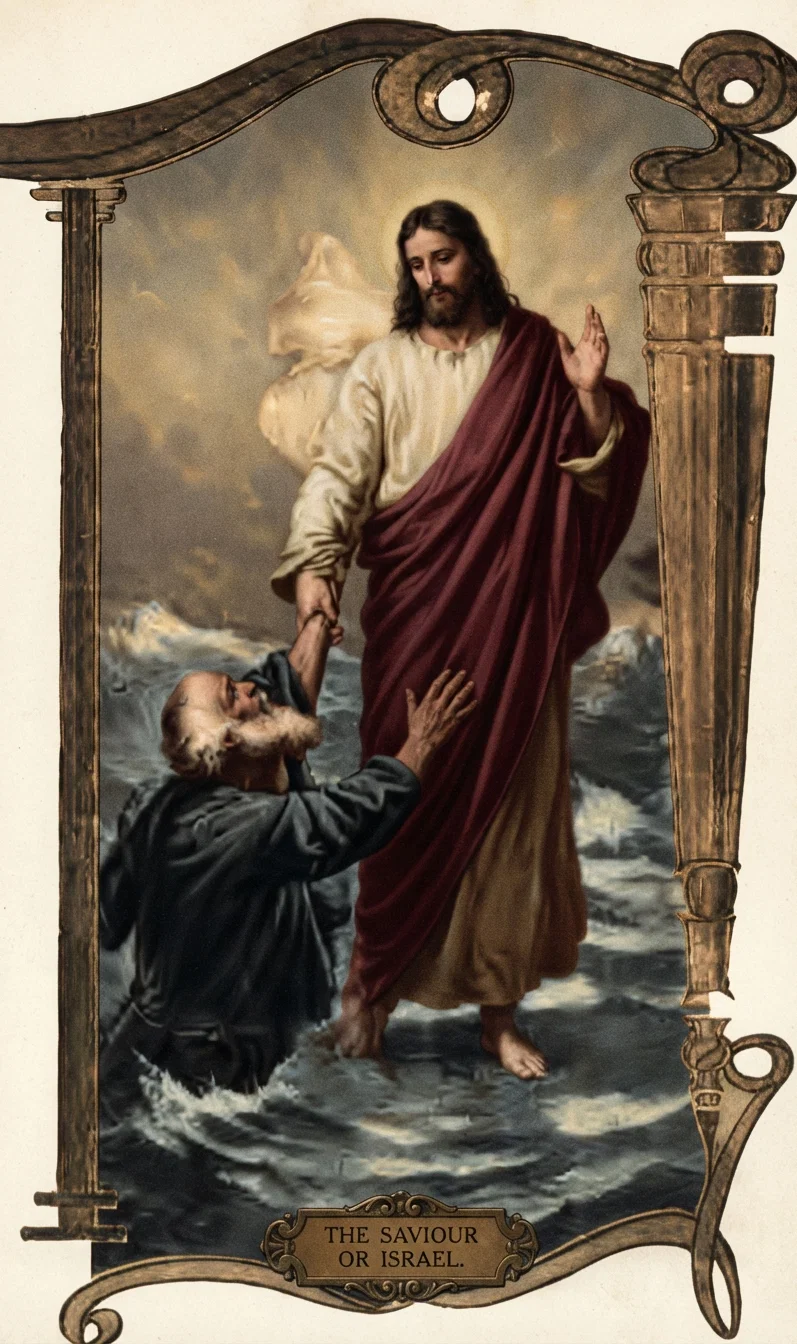
Impetuous Peter
By Delwin Rees Buckner
By Delwin Rees Buckner
Bold, hazardous, he leaps headlong into
The flood, 'tense to annihilate the space
Divorcing him from his divine Friend's face.
But, as he reels on writhing dunes of blue
Which counterfeit high heaven's azure hue,
Faith flees his breast, while Fear usurps her
place,
Yet vanishing in boggy billow lace,
The reckless one recalls his Lord anew.
That helping hand, outstretched across the wave,
Which snatched rash, sinking Simon from the
grave,
Well-nigh a victim of the tempest's greed,
Is not now lessened in its power to save
The creatures it created, when they crave
Assistance in their hapless hour of need.
The Great Forgiver
By Worthie Harris Holden
By Worthie Harris Holden
Far as the east is from the west
Hast Thou removed my sins from me;
Thy mercy is my ark of rest
Upborne upon Love's boundless sea.
Tho storms may rage, tho tempests blow,
Thy saving power can never fail;
While I Thy great redemption know
No force of evil can prevail.
So strong art Thou and I so weak,
My heart and mind in wonder bend
Till losing self, I long to seek
Thy glory, and Thy will attend.
Forever hath Thy blessing crowned
The souls who sought Thee oft in prayer;
Here let me, Saviour, e'er be found
Till home at last I see Thee there.
Courage
Because I hold it sinful to despond,
And will not let the bitterness of life
Blind me with burning tears, but look beyond
Its turmoil and its strife;
Because I lift my head above the mist,
Where the sun shines and the broad breezes
blow,
By every ray and every rain-drop kind
That God's love doth bestow;
Think you I find no bitterness at all;
No burden to be borne, like Christian's pack;
Think you there are no ready tears to fall,
Because I keep them back?
Why should I hug life's ills with cold reserve,
To curse myself and all who love me? Nay!
A thousand times more good than I deserve,
God gives me every day.
And in each one of these rebellious tears
Kept bravely back, He makes a rainbow shine;
Grateful I take His slightest gift, no plans
Nor any doubts are mine.
Dark skies must clear, and when the clouds are
past,
One golden day redeems a weary year;
Patient I listen, sure that sweet at last
Will sound His voice of cheer.
—Anon.
The Departed Blessing
"I wonder so that mothers ever fret
At little children clinging at their gown,
Or that the footsteps, when the days are wet,
Are ever black enough to make them frown.
If I could find a little muddy boot,
A cap, or jacket on my chamber floor;
If I could hear the sound of restless feet,
Or hear them patter in my home once more;
If I could mend a broken cart to-day,
To-morrow make a kite to reach the sky,
There is no woman on this earth could say
She was more blissfully content than I.
But, O, that little pillow soft and white
Is never rumpled by a shiny head,
My singing birdling from its nest has flown,
The little boy I used to love is dead.
But now it seems surpassing strange to me
That while I wore the badge of motherhood,
I did not kiss more oft and tenderly
The little child that brought me only good."
If We Only Understood
By Rudyard Kipling
If we knew the cares and trials,
Knew the effort all in vain,
And the bitter disappointment,
Understood the loss and gain,
Would the grim, external roughness
Seem, I wonder, just the same?
Should we help where now we hinder?
Should we pity where we blame?
Ah! we judge each other harshly,
Knowing not life's hidden force;
Knowing not the fount of action
Is less turbid at its source;
Seeing not, amid the evil,
All the golden grains of good;
And we'd love each other better
If we only understood.
Could we but draw back the curtains
That surround each other's lives,
See the naked heart and spirit,
Know what spur the action gives,
Often we would find it better,
Purer than we judge we should,
We should love each other better
If we only understood.
Could we judge all deeds by motives,
See the good and bad within,
Often we should love the sinner
All the while we loathe the sin,
Could we know the powers working
To o'erthrow integrity,
We should judge each other's errors
With more patient charity.
—Rudyard Kipling.
All Is Right in His Will
"Ill that He blesses is our good,
And unblessed good is ill;
And all is right that seems most wrong;
If it be His sweet will."
Pray
"Whate'er the care that breaks thy rest,
Whate'er the wish that swells thy breast,
Spread before God that wish, that care,
And change anxiety to prayer."
Pray
*
The Second Coming of Our Lord
His Coming Is Personal
1. What evidence had the disciples that our Lord ascended to heaven?
"And when He had spoken these things, while they beheld, He was taken up; and a cloud received Him out of their sight." Acts 1:9.
2. What message came to them as they watched His ascension?
"And while they looked steadfastly toward heaven as He went up, behold, two men stood by them in white apparel; which also said, Ye men of Galilee, why stand ye gazing up into heaven? this same Jesus, which is taken up from you into heaven, shall so come in like manner as ye have seen Him go into heaven." Acts 1:10, 11.
NOTE.—The disciples were not only looking at Christ when He ascended, but they "looked steadfastly"—they had their attention and their eyes fixed upon Him. In their literal, mortal bodies, with their natural eyes, they saw Him go. The One who is promised to return is "this same Jesus" that they knew and had been associating with in person. He was a personal, literal Saviour when He was here in His first advent; and when the promise is fulfilled He will return, the same personal, literal Jesus that He was then. This is the plain, obvious teaching of the text.
His Coming Is Literal
3. What promise had Christ made to His disciples while He was yet with them in His earthly ministry?
"Let not your heart be troubled: ye believe in God, believe also in Me. In My Father's house are many mansions: if it were not so, I would have told you. I go to prepare a place for you. And if I go and prepare a place for you, I will come again, and receive you unto Myself; that where I am, there ye may be also." John 14:1-3.
4. What statement does the apostle Paul make concerning the second coming of Christ?
"So Christ was once offered to bear the sins of many; and unto them that look for Him shall He appear the second time without sin unto salvation." Heb. 9:28.
5. Who will attend the Lord Jesus when He comes?
"For the Son of Man shall come in the glory of His Father with His angels; and then He shall reward every man according to his works." Matt. 16:27.
6. How many of the angels will attend the Lord when He returns?
"When the Son of Man shall come in His glory, and all the holy angels with Him, then shall He sit upon the throne of His glory." Matt. 25:31.
7. In what emphatic language does the apostle Paul speak of the second coming of Christ in his letter to the Thessalonians?
"For the Lord Himself shall descend from heaven with a shout, with the voice of the archangel, and with the trump of God." 1 Thess. 4:16.
NOTE.—The Lord HIMSELF is the one that is coming. Language could not be made more emphatic or clearer. And not only is the Lord HIMSELF coming, but He will bring with Him all the holy angels. The foregoing scriptures tell this story in simple, plain, correct language. It could not be made clearer than the language of Scripture puts it. The Lord HIMSELF could be none other than the Christ of God, and the Lord HIMSELF could not come without His coming being both PERSONAL and LITERAL.
His Coming Will Be Visible
8. How manifestly plain and visible will the coming of Christ be?
"For as the lightning cometh out of the east, and shineth even unto the west; so shall also the coming of the Son of Man be." Matt. 24:27.
9. How many will see Him when He comes?
"Behold, He cometh with clouds; and every eye shall see Him, and they also which pierced Him: and all kindreds of the earth shall wail because of Him." Rev. 1:7.
NOTE.—"Every eye shall see Him." And "they also which pierced Him" shall see Him, showing that the resurrection takes place at His second coming, and those who so cruelly put Him to death on the cross will be required to see the enormity of their awful deed. As the lightnings shine from east to west, illuminating with intense brightness the whole earth and sky, even so shall the coming of our Lord, in all His glory and with all the glory of His Father and with all the glory of His holy angels, illumine this old earth with a glory that has never before appeared upon it.
10. What warning does the Master give concerning those who will teach that His coming is secret or private?
"Behold, I have told you before. Wherefore if they shall say unto you, Behold, He is in the desert; go not forth: behold, He is in the secret chambers; believe it not." Matt. 24:25, 26.
11. What further warning emphasizes the fact that we must not look for the second coming of Christ in some private or local manner?
"Then if any man shall say unto you, Lo, here is Christ, or there; believe it not. For there shall arise false christs, and false prophets, and shall show great signs and wonders; insomuch that, if it were possible, they shall deceive the very elect." Matt. 24:23, 24.
NOTE.—These warnings against "false christs and false prophets" are also prophecies that such characters will arise. And it should be plain to any one that they will be most abundant and deceptive in the time just preceding the second coming of our Lord. Satan would especially exert himself to this end. But we have the comfort from the Scriptures that while these great deceptions are aimed especially against the "elect" of God, yet they will not be able to lead them astray. They are studying and heeding the warnings that the Master has given concerning the work of the arch-deceiver. "If any man willeth to do His will, he shall know of the teaching, whether it is of God, or whether I speak from Myself. He that speaketh from himself seeketh his own glory: but he that seeketh the glory of Him that sent him, the same is true, and no unrighteousness is in him." John 7:17, 18. A.R.V.
Man May Know When His Coming Is Near
12. What statement does the Master make in regard to the definite knowledge that we may have in regard to His second coming?
"Now learn a parable of the fig-tree; When his branch is yet tender, and putteth forth leaves, ye know that summer is nigh: so likewise ye, when ye shall see all these things, know that it is near, even at the doors." Matt. 24:32, 33.
NOTE.—There are certain things which the Lord has given us in His teaching that are to betoken the approaching day of His coming. And we are told to know, when we see "all these things," that His coming is so near that it is even at the doors. Observe this: His instruction is that we are not to say we know His coming is so imminent until we see "ALL" the things that He tells us in His word to look for.
13. What clear instruction does the apostle Paul give us concerning the definite knowledge we may have regarding the time when the great day of the Lord is near?
"But of the times and the seasons, brethren, ye have no need that I write unto you. For yourselves know perfectly that the day of the Lord so cometh as a thief in the night. For when they shall say, Peace and safety; then sudden destruction cometh upon them, as travail upon a woman with child; and they shall not escape. But ye, brethren, are not in darkness, that that day should overtake you as a thief. Ye are all the children of light, and the children of the day: we are not of the night, nor of darkness." 1 Thess. 5:1-5.
NOTE.—There are those whom the apostle speaks of in the third person as "they" who are in darkness, and so the day of the Lord steals in upon them as a "thief;" it will come to them as a great surprise and shock. But those whom Paul claims as his "brethren"—those who are with him, the followers of Christ—are not in darkness, and hence that great day does not come upon them as a thief. They have studied the prophetic word that reveals the "times and the seasons" when His coming is near, and so they are looking for Him and are ready for Him when He comes.
There Shall Be Signs
14. What plain statement does Christ make concerning the tokens that should mark the approach of the day of His coming?
"And there shall be signs in the sun, and in the moon, and in the stars; and upon the earth distress of nations, with perplexity; the sea and the waves roaring; men's hearts failing them for fear, and for looking after those things which are coming on the earth: for the powers of heaven shall be shaken. And then shall they see the Son of Man coming in a cloud with power and great glory. And when these things begin to come to pass, then look up, and lift up your heads; for your redemption draweth nigh." Luke 21:25-28.
15. What other statement does the Teacher make on the same subject?
"And great earthquakes shall be in divers places, and famines, and pestilences; and fearful sights and great signs shall there be from heaven." Luke 21:11.
16. What is the character of the prophecies that foretell the coming of the Lord?
"For we have not followed cunningly devised fables, when we made known unto you the power and coming of our Lord Jesus9Christ, but were eye-witnesses of His majesty. For He received from God the Father honor and glory, when there came such a voice to Him from the excellent glory, This is My beloved Son, in whom I am well pleased. And this voice which came from heaven we heard, when we were with Him in the holy mount. We have also a more sure word of prophecy; whereunto ye do well that ye take heed, as unto a light that shineth in a dark place, until the day dawn, and the day-star arise in your hearts; knowing this first, that no prophecy of the Scripture is of any private interpretation. For the prophecy came not in old time by the will of man; but holy men of God spake as they were moved by the Holy Ghost." 2 Peter 1:16-21.
NOTE.—The one who reverently, devotedly, and unselfishly follows the teaching of the word of the Lord concerning the second coming of Christ can not be led astray. For there will be signs so numerous and so completely out of the sphere of man’s power that the intelligent Christian will make no mistake. The mighty earthquake, the “fearful sights and great signs from heaven,” and all the rest of the mighty signs that we are to be guided by, are beyond the power of man. They are wholly under the control of Him who guides the universe. And then we have the “more sure word of prophecy” that can be depended on even beyond our natural senses, because no prophecy of God’s word ever came by the will of man; but men spoke from God, being moved by the Holy Spirit. The Lord has fixed things so plainly in His word that there is no chance for the sophistries and delusions of the last days to reach His children. They stand firmly and securely on the impregnable and eternal foundation of God’s word.