Your ShelfYour Projects

Signs of the Times, Vol. 40, No. 28.

Signs of the Times
Earlier text: THE WITNESSING OF GOD

Ezekiel and the Second Advent

By W. R. Uchtmann
THE most inspiring message in either Old or New Testament scripture, which is, and always has been, present truth, and on which hang all other lines of prophecy, is the second advent of Christ. As we are nearing this great and glorious scene, it seems that the word of God opens in a special manner its brightest and most fascinating gems of truth to those who ask, seek, and knock; for such only will receive, find, and enter.
Christ is coming soon with all the holy angels, a mighty and numberless host; yet with Jesus as the commander-in-chief, there will be such perfect order that it will amaze the entire universe, but the glory of it will consume all the wicked.
I once watched a German army at drill. Whenever the officer gave the command, the whole rank and file moved as one man. It was a fine sight. Every movement was under the control of the general. But what will all the armies of this whole world amount to, when the army of heaven falls into line, and every loyal angel, beautiful and glorious, advances under the direct leadership of Jesus, “the King of Kings, and Lord of Lords,” worshiped and adored by all?
All the prophets have given much light on this greatest of all subjects, but I like to ponder over the wonderful visions of Ezekiel, the mourning, exiled prophet. In chapter 1 he describes the cherubim (compare* chapter 10: 20-22), beneath which are the high and dreadful intersecting wheels, which at first to the prophet’s mind must have seemed complicated and confusing, but when they started to go, everything was in perfect harmony and beautiful exactness.
The hand of God was under the wings of the cherubim. What a beautiful demonstration of Matt. 28: 18, “All power is given unto Me in heaven and in earth”!
Reading Ps. 68: 17, R.V., we find that “the chariots of God are twenty thousand, even thousands upon thousands.” In the last clause of the same text, and also in Deut. 33: 2, we find that these chariots came down to Mount Sinai, no doubt at the proclaiming and giving of the law of God. The doubting servant of Elisha, in 2 Kings 6: 17, was much encouraged by a glimpse of these same chariots, made up of angels, ready to fight the battles of Israel at the request of the prophet. Daniel, in his vision of the judgment (Dan. 7: 9, 10), saw the angels and the throne of God like the fiery flame, and the wheels as burning fire. John, on the isle of Patmos, dwelt so much upon the heavenly scenes, of which he received new visions, one after another, that his exile to this desolate island was turned by the same hand of God into the greatest and richest blessing. It was the cross which brought the crown. These visions were recorded for our special benefit, to prepare us, like the seers of old, for the coming battle.
I believe that these great wheels, full of eyes, and guided by the Spirit of God, were like the chariots, made up of angels; because everything given in the description denotes intelligence. The great generals in this world seem to maneuver mostly in angles and squares, but our divine Commander uses that which indicates endless life and joy—unbroken circles. Above the wheels are the cherubim, and above these great leading angels is the firmament, likened to the terrible crystal (Eze. 1: 22), or, as John has it, the sea of glass, which is the foundation of God’s glorious throne. Here Christ the Lord is established, above all, as the mighty conqueror and ruler, and the beautiful rainbow encircles it round about.
Let me call your attention to something which seems to me worthy of considerable thought. After the vision in chapter 1, the prophet hears a voice, and he falls on his face, but was told to rise to his feet. In the next seven chapters, the Lord tells Ezekiel about the fearful and fatal backslidings of Israel, which extend until the time of the sealing and judgment, which is clearly shown in chapter nine. In the next chapter the entire heavenly host, including the throne of God, come down to the earth and return heavenward. Now, there is only one thing which brings our blessed Lord to this planet, directly after the sealing of the remnant in their foreheads, which is this: Jesus will first raise His sleeping subjects from their dusty beds to life and immortality, and then translate the living saints, who have been true to all His commandments, and place them beside Him, on the sea of glass. Rev. 15: 2, 3.
Next, we enter upon the most blessed journey to the mansions ready for those who were willing to be prepared by letting Jesus have His way in them, tho it took all to buy the pearl of great price. Let us run no risk by holding on to any one thing. Jesus must be all in all, or remain a stranger; “Jesus only.”

Welcoming the Advent

NO MAN rightly desires Christ’s coming, but he that hath assurance of benefit at His coming. To him the day of Christ is as the day of harvest to the husbandman; as the day of deliverance to the prisoner; as the day of coronation to the king; the day of wedlock to the bride; a day of triumph and exultation, a day of freedom and consolation, a day of rest and satisfaction. To them the Lord Jesus is all sweetness, as wine to the palate, and ointment to the nostrils, saith Solomon; honey in the mouth, saith St. Bernard; music in the ear, and a jubilee in the heart. Get assurance of Christ’s coming, as a ransomer to redeem you, as a conqueror to subdue all your enemies under you, as a friend to comfort you, as a bridegroom to marry you, and then shall you with boldness and confidence, with joy and gladness, with vehement and holy longings, say, “Come, Lord Jesus.”

The Second Advent

Did you ever hear the sound of the trumpets which are blown before the judges as they come into a city to open the assizes? Did you ever reflect how different are the feelings which those trumpets awaken in the minds of different men? The innocent man, who has no cause to be tried, hears them unmoved. They proclaim no terrors to him. He listens and looks on quietly, and is not afraid. But often there is some poor wretch waiting his trial, in a silent cell, to whom those trumpets are a knell of despair. They tell him that the day of trial is at hand. Yet a little time, and he will stand at the bar of justice, and hear witness after witness telling the story of his misdeeds. Yet a little time and all will be over,—the trial, the verdict, the sentence; and there will remain nothing for him but punishment and disgrace. No wonder the prisoner’s heart beats when he hears the trumpet’s sound! So shall the sound be of the archangel’s trump.—J. C. Ryle.

Faith in the Advent

I DIE in the faith of the speedy accomplishment of those glorious things which are spoken concerning the city of God and of the kingdom of Christ. “Amen. Even so, Lord Jesus! Come quickly!”—Increase Mather.

World's Christian Citizenship Conference
Editorial Correspondence
THE World's Christian Citizenship Congress, in session in Portland, Oregon, from June 29 to July 6, is really under the auspices and leadership of the National Reform Association that was organized in Xenia, Ohio, fifty years ago. One of the principal tenets of its faith, as set forth in its organ, the "Christian Statesman," has been to have God acknowledged in the Constitution of the United States, and to have "all of the Christian laws, institutions, and usages of our government placed on an undeniable legal basis in the fundamental law of our land."
This organization has also worked for the purpose of securing a national Sunday law that would be binding upon everybody, and, regardless of creed or no creed, would compel the observance of what they have been pleased to term the "American Sabbath."
A few years ago they enlarged the scope of their work by organizing an international or world's Christian citizenship movement. Their first international conference was held in Philadelphia, in 1910, and this meeting in Portland is their second.
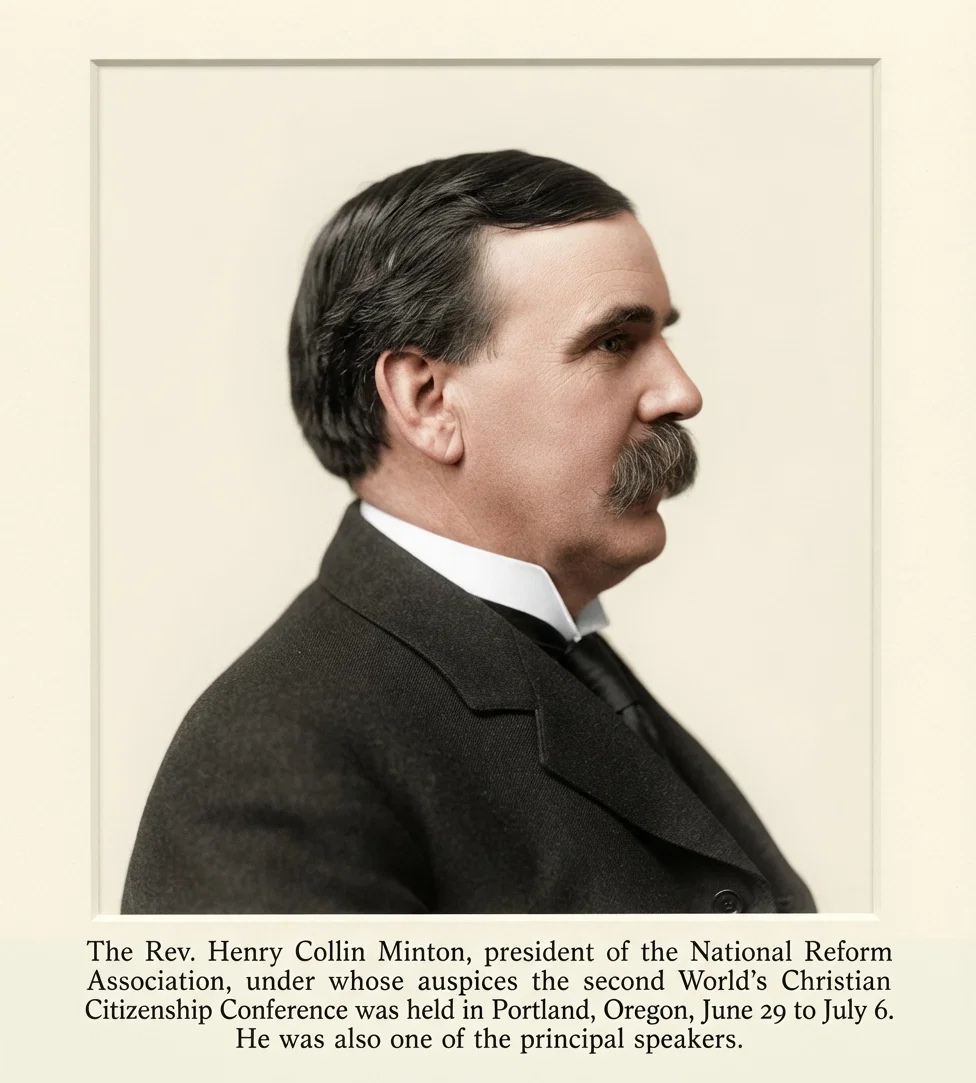
The president of the association, the Rev. Henry Collin Minton, reported at the opening of the meeting that he had traveled extensively throughout the world, visiting all the leading countries, in the interests of this meeting, with the endeavor of securing leading representative speakers on the various topics which they believe enter into their scheme of Christian citizenship.
This meeting has been extensively advertised for the last two years. They have had the hope that it would be an epoch maker in the way of crystallizing popular enthusiasm and popular sentiment. The meeting is quite largely attended — as many as 10,000 persons in attendance — very much larger than what has been seen at the regular National Reform meetings in bygone years.
Some of the opening addresses, particularly that of Dr. Samuel Zane Batten, general secretary of the social service department of the Baptists, have a very strong Socialistic flavor.
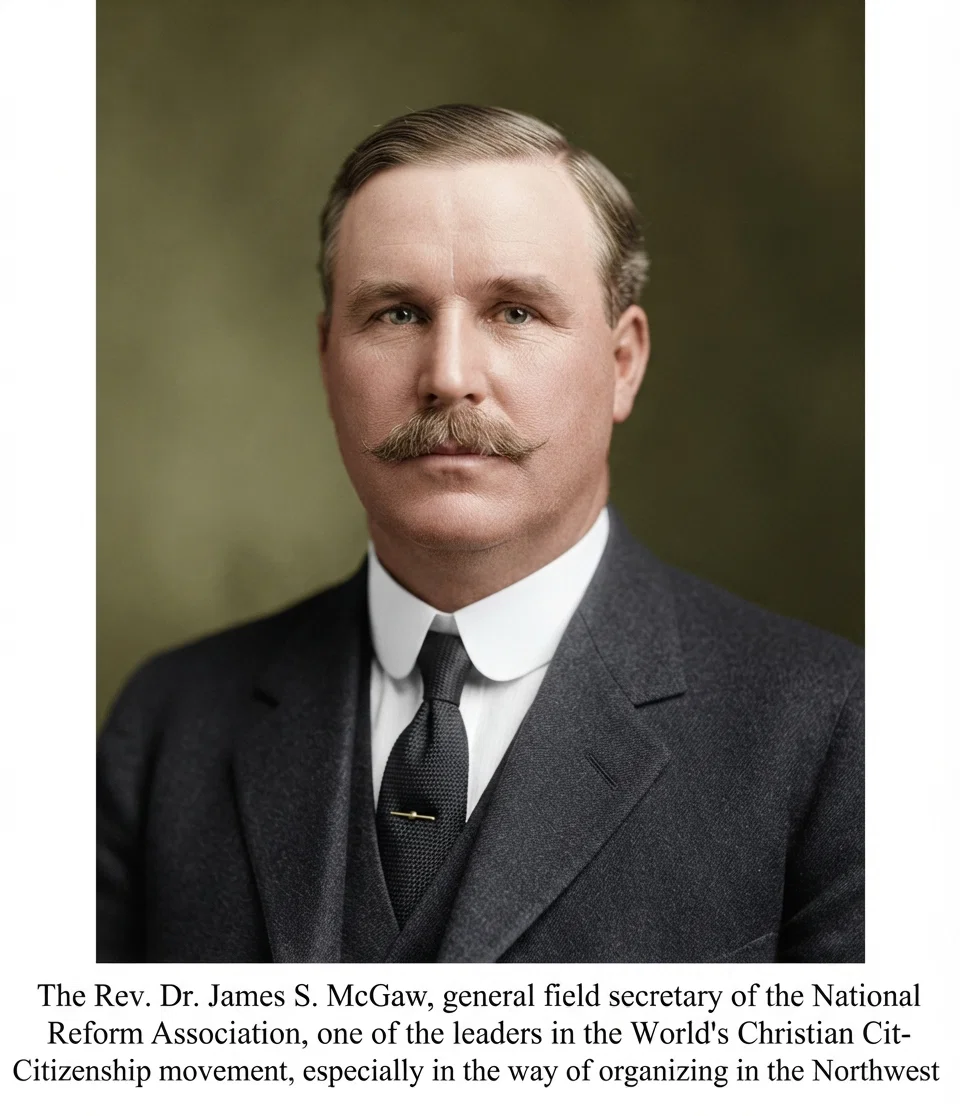
The Rev. Dr. James S. McGaw, general field secretary of the National Reform Association, one of the leaders in the World's Christian Citizenship movement, especially in the way of organizing in the Northwest
They see, and affirm with earnestness, that there are great "sociological problems" that are world-wide. Among these problems they mention that of the great accumulation of wealth, the problems of war, of vice, and of official and political dishonesty. They believe that in order to combat these great evils, it is necessary for the whole Christian world to combine in one great overtowering organization which will compel the respect of politicians and command the enforcement of the laws that they may see fit to enact.
There is no question in regard to these great international problems. The world is full of them. There can be no question in regard to the need of combating them in every proper way. But it is perfectly proper to call in question what will be the result of such a stupendous organization along ecclesiastical lines.
The conference throws open its doors to the widest range of discussion. It says it desires that there shall be absolute freedom of speech and of opposing ideas; but it does hope, out of its great plan, to establish on the earth "the fatherhood of God and the brotherhood of man."
The Rev. Henry Collin Minton, president of the National Reform Association, under whose auspices the second World's Christian Citizenship Conference was held in Portland, Oregon, June 29 to July 6. He was also one of the principal speakers.

The National Reform Association, as expressed in its world's conference here in Portland, is only one of the many similar organizations that are working at the present time to the same end. The plans that it proposes for world dominance are very similar to the plans proposed by the Federation of Churches, by the Men and Religion Forward Movement, by the Laymen's Movement, and similar organizations.
One thing noticeable in the speeches was the call for a world organization, with a world headquarters, that will establish the kingdom of Christ in world politics upon this earth.
Those who are regular readers of the "Signs of the Times" are more or less familiar with the prophecies that have been frequently presented through our columns, which inform us that one of the last acts of the peoples of this earth will be to establish a world-wide empire of religion that will demand world-wide obedience. Now, it is perfectly apparent that the men who are in this movement are sincere. Their hearts are stirred by the wickedness that they see in the world, and they are casting about for some remedy by which the social disease can be cured. But why is it they can not see from the word of God, and from the pages of undisputed history, that they are starting on the identical plan that was proposed in the early centuries, which finally resulted in the enthronement of the Papacy, and all the horrors of the persecutions of the Middle Ages, with its attendant religious bigotry, darkening of intellect, and wholesale degeneration? Religious despotism was established then under different circumstances and a different guise; but this one that is so enthusiastically proposed at the present time, is none the less identical in principle, and will produce the most direful results, even under the blazing splendors of the noonday civilization of the twentieth century.
The lower picture is the summer White House of President Wilson, up among the green White Mountains of New Hampshire, in a little hamlet on the Connecticut River. The name of the house, or the estate, is called Harlakendon.
These men hope to cure the evils of the world by their system of combined Christian politics, and yet the Christ of the Bible said explicitly, "My kingdom is not of this world." And, furthermore, as is clearly outlined in the prophecies of Daniel, which have been so often presented in these columns, the kingdom of Christ is to be established on the absolute destruction and everlasting overthrow of the wicked kingdoms of this world. We earnestly hope and sincerely believe that many of these men who are so earnest, and who seem to be imbued with such noble principles of justice and uprightness, will yet see from the clearness of the prophetic pages of God's word, that the only hope for the overthrow of wickedness in this world is the second coming of Christ with His own infinite power, and by His personal presence.
Some of the most important sayings of the leading speakers of the conference will be given in later issues, so that our readers may get the spirit of the conference in the words of the men themselves.
A. O. TAIT.

Electric Trepanning Machine

A surgeon in Chicago has invented a machine for cutting the skull so that a patient can be trepanned by this method in a fraction of the time required by the old chisel and hand-worked saw. The machine is something like a miniature buzz-saw, operated with an electric motor. Dr. Emil G. Hoglund is the inventor.

The Innocent Criminal.

In the editorial section of a recent Sunday issue of one of the great dailies there is an illustration that is supposed to represent the personification of crime. Then an editorial writer uses up two or three columns of space seeking to show that in reality there is no such thing as criminality, that the man we call a criminal is really a man who needs some kind of repair. It is stated that—
“he is simply a human machine out of order.” “Nobody speaks of such a thing as a criminal automobile, or a criminal flying-machine, or a criminal driving-wheel. Yet often the automobile, when the steering gear breaks, kills more than any criminal; and the flying-machine, when a rod snaps, or the engine gives out, kills its freight; and the big driving-wheel in the factory, when it bursts, may kill hundreds.”
The sophistry of comparing a human being, that has brains and will-power, to some part of a machine that may get out of order, ought to be apparent to most thinking people. There are very few criminals but that take the course of criminality from choice, or by the exercise of will. In some instances, as in the case of children that are taught criminality by their parents or guardians, the will may not be exercised at first by the child, and he is driven into those conditions by the force of wills older than his own. In such cases the older person is morally responsible for the crimes and sins that the child commits. But to say that all of the crimes that are committed are to be charged to a human machine’s simply getting out of order is nonsense. This editorial writer seeks to call upon our sympathies for the criminal, and to say that we should not learn to hate him, but should regard him with pity.
There may be truth in such sentiments as these, if they are expressed by an individual who is viewing matters from the correct standpoint. Truly no Christian man will ever hate anybody. Christ teaches us plainly that we should “love your enemies, bless them that curse you, do good to them that hate you, and pray for them which despitefully use you, and persecute you.” Matt. 5:44. So really there is no room for hatred in the heart of a person who stands upon the broad platform of Christianity. But on the other hand, this Christian individual will have the keenest sense of the fact that there are thousands of persons in this world who are wilfully choosing to go wrong. There is no use in trying to cover up the wrong-doings of men and women by sophistries. If such a doctrine were true, we should not have penitentiaries, or any other kind of punishments for criminalities. We should have hospitals in which these criminals would be placed for treatment.
A little while ago, there were a great many men who were claiming that surgical operations, by taking away certain portions of the brain, would relieve some of these who were criminally inclined, and make honest citizens out of them. But authoritative statements from great medical men are to the effect that they are not getting the results from this work that they had fondly hoped. The trouble with the people on this sin-cursed planet is that they have gone wrong, and they are seeking all kinds of make-shifts to get around the fact that we are wilful sinners. No doubt the one who penned those editorial paragraphs, and tried in the way he did to excuse criminality, can call to mind many things in his own life that he has done that are wrong, and he knows perfectly well that if he had chosen he could have gone in a different course. We should not be so carried away with speculation that we fail to recognize real fact.
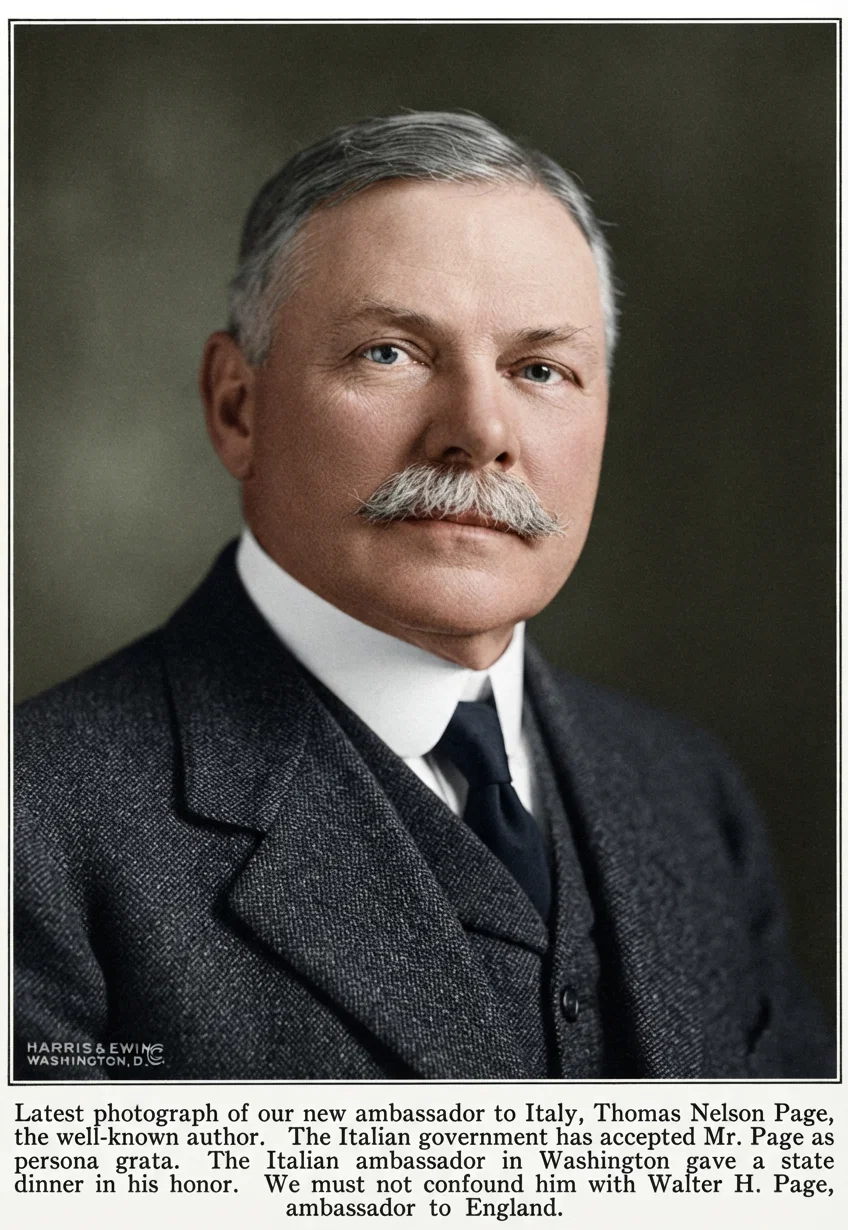
Latest photograph of our new ambassador to Italy, Thomas Nelson Page, the well-known author. The Italian government has accepted Mr. Page as persona grata. The Italian ambassador in Washington gave a state dinner in his honor. We must not confound him with Walter H. Page, ambassador to England.
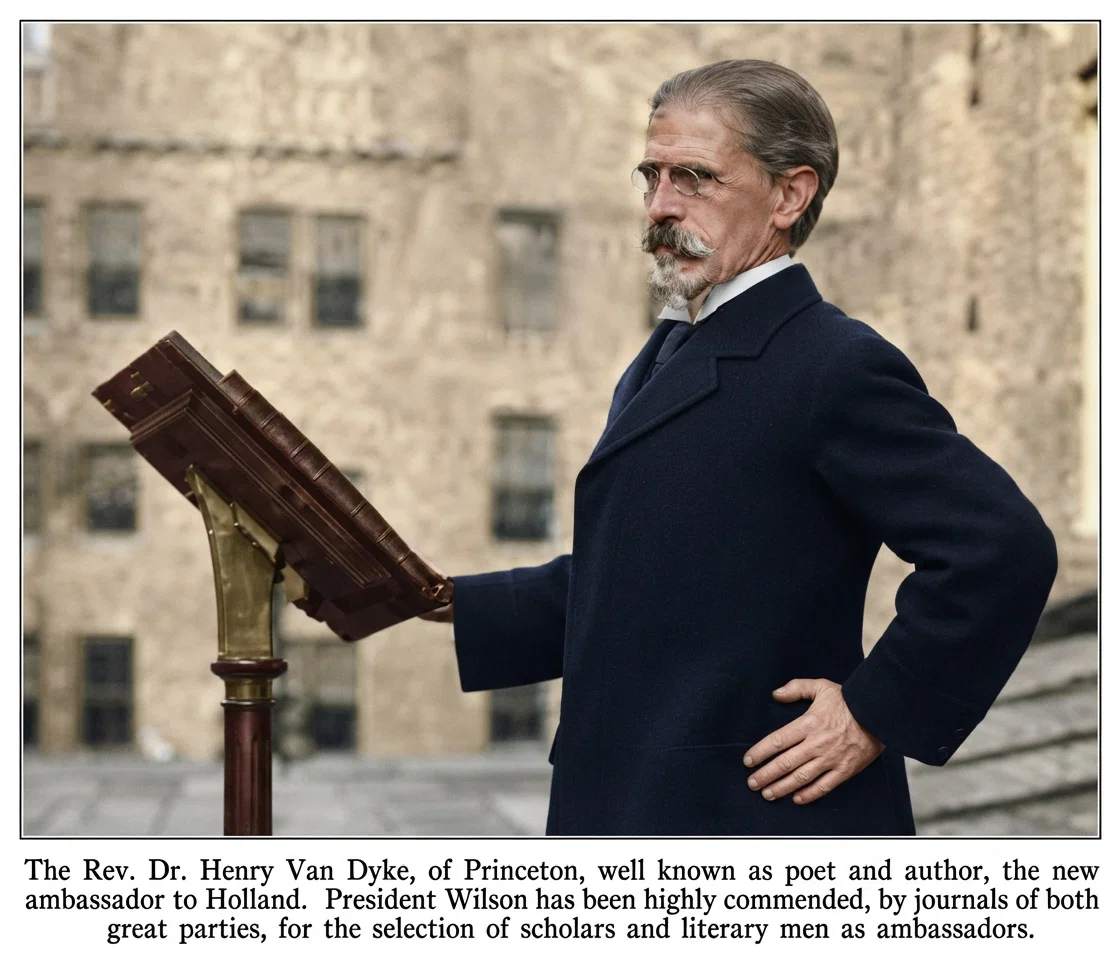
The Rev. Dr. Henry Van Dyke, of Princeton, well known as poet and author, the new ambassador to Holland. President Wilson has been highly commended, by journals of both great parties, for the selection of scholars and literary men as ambassadors.

The Great Ocean Steamship

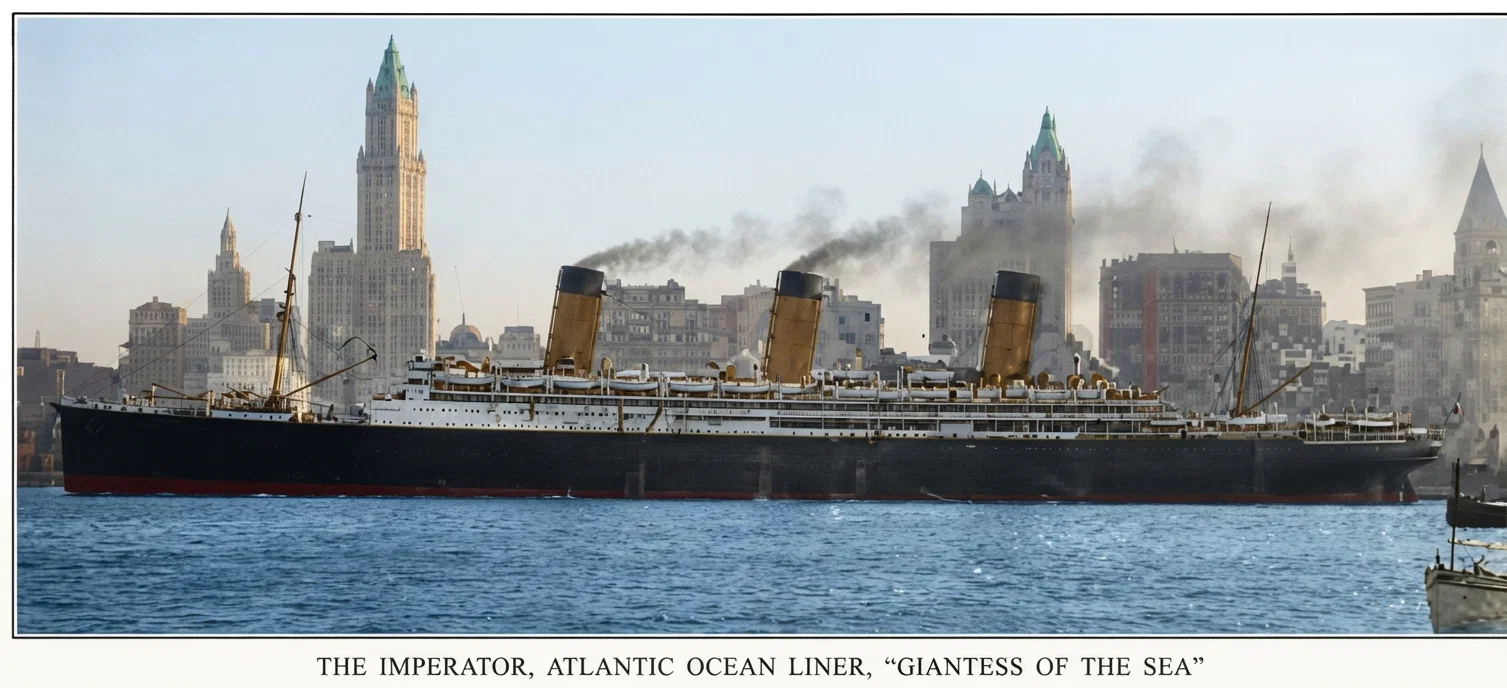
THE IMPERATOR, ATLANTIC OCEAN LINER, “GIANTESS OF THE SEA”
That we may get a better idea of this great ocean steamship, she is taken with the great sky-scrapers of New York in the background, and especially that of the Woolworth Building,—the two most gigantic structures built by man in this generation. This picture was taken June 19. The length of the ship is 919 ft., beam 98 ft., height of bridge above the water 90 ft., gross tonnage 50,000. Five captains are required to command her, with Hans Ruser in charge. She has three wireless operators, who work eight hours a day each. Has nine decks, seven of which are for first-class passengers. Has a battery of six elevators, life-boats enough to accommodate more than 4,000 persons, and power launches to tow the life-boats. She has a complete telephone system from stateroom to stateroom, through a regular “central;” an imperial suite of twelve rooms with a private glass-enclosed promenade deck of its own for the use of the kaiser if he ever comes here, or any one else who can pay $1,000 a day for a six-day trip. Has a Ritz-Carlton restaurant, a grill-room, three private dining-rooms, and a public saloon; a garden with growing flowers and shrubbery; a theater, and a ballroom as large as that of the average New York hotel; an automatic device for dropping a life-raft overboard; and a special station for a lookout in the eagle figurehead at the bow. Of her five anchors the heaviest weighs 26,445 lbs., the lightest 4,960. She carries a crew of 1,180. She brought on her first trip 3,450 passengers, making a total of 4,630 souls. Her first trip was made in six days, 5 hours, and 14 minutes, and she started with the following provisions: 48,000 eggs, 121,000 lbs. of potatoes, 9,000 lbs. fish, 10,950 lbs. game and fowl, 12,500 quarts of milk, 400 lbs. tea, 7,000 lbs. coffee; and other things in proportion,—a great floating town. And yet, let God withdraw His hand, and let the wrath of the ocean be manifest through marine earthquake or otherwise, and the great floating palace would go down in an instant.

San Francisco Population

San Francisco’s Directory for 1913 is estimated to give her a population of 505,652.

Sunday Laws and the Weather

Somehow or other the Sunday laws of Illinois, Indiana, Pennsylvania, Michigan, etc., do not prove a protection against the fearful and abnormal heat. California, which has no Sunday law, is enjoying delightful weather. We are drawing no comparisons. Moral conditions are about the same everywhere, and Sunday laws do not change hearts or motives.

Some Gentlemen

“Some Gentlemen.”—It is related of General Grant, during one of his military campaigns, that while he was seated in his headquarters with his aides around him in council, a young officer came in with a good story to tell. He began by looking around and making the inquiry, “Are there any ladies here?” General Grant’s prompt and stern reply was, “No, sir, there are no ladies here; but there are some gentlemen.” The young officer did not tell his story.

Japanese Instructor at Stanford

Dr. Yamato Ichihashi, a Japanese, has been appointed as instructor in Japanese history and government at Leland Stanford University. Dr. Ichihashi is a graduate of the university, having previously graduated from one of the public schools in San Francisco. He is very strongly attached to the people of this country—says that he considers himself a Californian, as he has spent so much of his time here. He furthermore thinks that we should cease this talk in regard to war between this country and Japan. He says these two nations can not afford to fight each other.

Does It Pay to Be Good?

("Dorothy Dix," a woman of the world, in the New York "Evening Journal")
A YOUNG girl, seventeen years old, looking at life with the clear, candid eyes of a child, asks me this question:
"Does it pay a girl to be good?"
This girl is pretty and poor. She has to work for her living. Her hours of labor are long and hard, and her earnings only enough to pay for the bare necessities of existence. She has few pleasures and no luxuries, and she sees the future stretching before her, an arid highway along which she must toil foot-sore and weary, cold and hungry, and discouraged.
Yet she has the natural impulses of her sex within her. She is no senseless and passionless machine. She is all quivering, throbbing girlhood. She longs for pretty clothes to set off her beauty, for amusement, for gaiety, for feasting and dancing and love-making.

What She Sees

At her side in the shop this girl sees women, flat-chested, anemic, withered, toil-worn, who have worked from youth to age in the treadmill. They are good women, models of impeccable virtue. But their lives have been as drab and featureless as the black gowns they wear. They have never had a frill or a furbelow. They have never had a frivolous gown, or a jewel, or eaten a meal in a smart restaurant.
This girl sees other women. She hears the clang of their automobiles as they roll up to the door of the shop, and she sells them embroidered silk stockings, or real lace, or swishy satin petticoats, or fifty-dollar hats. Her eyes are dazzled by the gorgeousness of their gowns, and the flash of their diamonds, and she listens enviously to their chatter about theaters, and suppers on roof-gardens, and gay parties of a kind she only reads about. She knows these are not good women, that a few years, or months, ago they were poor working girls, even as she is, and that they did not get their money by honest labor.
Nevertheless, as she looks at them, and at the worn and weary women who have trodden the hard and narrow road instead of the primrose path, it is no wonder that she said:
"Does it pay a girl to be good?"
Yes, it does pay a girl to be good, little sister, in spite of the fact that appearances are against it. It pays in many ways. One of these is your own conscience. Believe me, there is just one person whose respect is absolutely necessary to your happiness, and that is yourself. The day you lose the ability to look yourself in the face, something has gone from you that takes all peace and comfort with it.

Does It Pay?

You covet the pretty clothes these women wear; but you, who sell bargains in clothes, consider this proposition from a cold business standpoint — are a few willow plumes, a few yards of chiffon, a jewel or two, worth the price of a woman's soul? Does it pay to walk in silk attire when your silks cover a guilty heart and other women draw away their honest homespun skirts from your soiled finery?
Does it pay to mortgage your future for a little present pleasure? Make no mistake about this, little sister! When you take the wrong turn of the road, it leads you away from all the natural happiness that every good woman has a right to look forward to.
The kind of man you would like to marry will not be willing to marry the sort of woman that you have become. He won't want his children to have a mother who has got a past that won't bear inspection.
Men seldom marry the women with whom they have gone the pace, and when they do it brings no happiness to the women. Experience has taught the men that these women are weak, and foolish, and too fond of pleasure, and are to be suspected. Nor are men just or generous to women, and the very man who has led a woman into sin will never cease to reproach her with it.

Look in Their Faces

If you think that wrong-doing pays, look at the faces of the women who have bought ease and luxury at a price. Watch how soon the roses fade on their cheeks and are replaced by rouge. Note how soon the light of youth flickers out in their eyes, and they have to substitute belladonna for it. Watch how thin and hard their lips grow. Listen how loud, and noisy, and mirthless their laughter becomes.
Did you ever think why such women almost invariably take to drink or the use of drugs? It is to stimulate their flagging spirits, to force the laughter to their tired lips to which it no longer comes naturally, to simulate pleasure when their hearts are dead within them. Or else it is to forget, to deaden memory and remorse, to shut out from their own vision the picture of what they were, and the sorrow and shame they have brought on their families. Truly, little sister, there is nothing else in the world so little gay as what we call the gay life.
It pays to be good just in health and length of life, daughter. The wages of sin is death, literally as well as figuratively, for women. It takes only seven years to send a girl from the top to the bottom of the toboggan-slide of unlawful pleasure, and the bottom is in the grave, or worse.
It pays to be good because only good women get any decent treatment from men. There are no other human beings whose lives are so full of anxiety, who are so abused, insulted, and mistreated as the women who are the toys and playthings of men, and whose conduct gives men the right to treat them without reverence or respect.
It pays to be good, little sister, first and last and all the time, because only the good, who have clean hands and pure hearts, have any real happiness.

HOME AND FIRESIDE

The Cheerful Spirit

"THERE is enough in the world to complain about and find fault with, if you have the disposition. You often travel on a hard and uneven road; but with a cheerful spirit you may walk therein with great comfort, and come to the end of your journey in peace."

Trachoma

THIS disease of the eyes is becoming of greater importance as it becomes more widespread throughout our country. In 1897 the secretary of the treasury declared trachoma a dangerous contagious disease, and denied an immigrant afflicted with it entrance to this country, because of the discovery that the disease was being introduced and disseminated by immigrants. It seems to be undisputed that no country is free from the ravages of the disease, the history of which goes back to ancient times, and that no race is immune from it, and no age exempt, except the very young. The cause of trachoma is not yet known, as the specific germ has not yet been discovered. The disease occurs in groups, in localities, in houses, in factories, and in schools, and is spread by contact or by contamination with articles like common towels, which are handled by the afflicted patient and his fellows.
The seriousness of trachoma, its contagiousness, the knowledge that thousands of would-be immigrants are waiting to come to America if restriction of this disease is removed, the amount of it already in this country, and especially its concentration in certain localities, mean that measures for its prevention should be inaugurated by every state, city, and town where the disease has been discovered. Poverty, crowding, dirt, and articles used in common, tend to spread this infection rapidly. While the number of persons having trachoma may be diminishing in some of our larger cities where both the government and the local authorities are alert to the danger of the disease and to the segregation necessary, other cities and communities should pass such ordinances as would cause every case of trachoma to be reported. School children should be inspected for this disease. Factories should also be inspected; and where the disease is discovered, the owners should take measures to prevent its spread and to eliminate it if possible. A person with trachoma should be isolated and treated until he is well. A child who is discovered to have trachoma and is banished from school should be followed to its home by a visiting nurse or some inspector from the board of health, to insure that the child does not spread contagion in its own home. School wash rooms should have faucets for running water which are controlled by foot pressure, so that the hands need not touch the faucets. The common towel should be abolished with the common drinking cup. These rules for cleanliness apply also to factories, hotels, office buildings, and all public institutions.—Journal of the American Medical Association.

Right Makes Might

LET us have faith that right makes might, and in that faith let us to the end dare to do our duty as we understand it.—Abraham Lincoln.

Co-operation Corner

Helping Together

THERE are constantly coming to this office requests for this paper for those who are poor and unable to take the paper; (2) for mission work among prisoners and others otherwise confined or secluded; (3) for public reading-rooms; (4) for general missionary work in foreign fields by our missionaries; (5) for general missionary work in various phases. Sometimes there are calls for tracts in foreign languages as well as English. It is not possible for the publishing house to meet all these requests. Publications are sometimes published at a loss to the house. We felt sure that many more of our readers would be glad to help us in this work. Thus may we bring together those who have no time or opportunity to do missionary work, but who are able to help others, and those who have the time and opportunity, but not the means. Who will contribute to our Coöperation Fund?
As a brief work to assist in the study of any phase of Christ's prophecy relating to His second coming, we can recommend nothing more highly than the pamphlet "An Exposition of Matthew 24." You will appreciate its simple, thoro, direct manner of explanation. Contains 94 pages, and costs only ten cents, post-paid. This office.
Continue reading: Special "World's Christian Citizenship Conference" Number