Your ShelfYour Projects

Signs of the Times, Vol. 37, No. 15.

God's Purposes Can Not Be Frustrated

Signs of the Times

Apr 19, 1910

Pacific Press Publishing Association · Mountain View, California · Apr 19, 1910

God's Purposes Can Not Be Frustrated

The Reign of Jehovah's Anointed

Psalm II

Why do the nations rage, And the peoples meditate a vain thing? The kings of the earth set themselves, And the rulers take counsel together, Against Jehovah, and against His anointed, saying, Let us break Their bonds asunder, And cast away Their cords from us. He that sitteth in the heavens will laugh: The Lord will have them in derision. Then will He speak unto them in His wrath, And vex them in His sore displeasure: Yet I have set My king Upon My holy hill of Zion.
I will tell of the decree: Jehovah said unto Me, Thou art My Son; This day have I begotten Thee. Ask of Me, and I will give Thee the nations for Thine inheritance, And the uttermost parts of the earth for Thy possession. Thou shalt break them with a rod of iron; Thou shalt dash them in pieces like a potter's vessel.
Now therefore be wise, O ye kings: Be instructed, ye judges of the earth. Serve Jehovah with fear, And rejoice with trembling. Kiss the Son, lest He be angry, and ye perish in the way, For His wrath will soon be kindled. Blessed are all they that take refuge in Him.

"IF YE WILL INQUIRE, INQUIRE YE."

This Inquirers' Department is conducted for the purpose of helping those who are studying the Bible. The answers are oftentimes only suggestive. They are never to be considered infallible, only as they agree with the infallible Word. The writer who may answer them does not consider that his opinion is infallible. He will simply give the best that he has, and plead with the inquirer to search the Word. Such questions only will be answered as, to the editors, seem to minister to the good of the readers and to the mission of the paper. We can not answer repeatedly in the same volume questions upon the same scripture. The name and address must accompany question, not for publication, but as an evidence of good faith, and that answer may be made by letter if deemed advisable. No letters are answered which do not contain the name of the writer. It is well always to enclose stamp for reply.

3097.—Isaiah 65:20

Will you please explain Isa. 65:20?
The scripture reads, "For the child shall die an hundred years old; but the sinner being an hundred years old shall be accursed." The text and the context clearly refer to the end of sin and the entering upon the eternal inheritance. Note the
great day of God's wrath begins with the end of probation and the pouring out of the last plagues. For fuller account of this see the Bible Students' Library, "The Great Day of God."
After the pouring out of the seventh plague, Christ comes, and all the living wicked that are left perish in the presence of His awful glory. See Rev. 14 to 19.
During one thousand years—the "many days," Isa. 24:22—the earth is left desolate; the wicked are dead; the saints are in heaven with Christ. See Isa. 24:1-5; Jer. 4:23-27; John 14:1-3; Rev. 20:4-5.
At the close of the one thousand years, the "many days," the wicked are raised from the dead to vindicate God's infinite justice by giving themselves more to the deceptions of Satan, who reorganizes them again into armies, prepares them for war, and marshals them for the battle for the city of God. This is "the season," as compared with the thousand years of his existence, and it seems reasonable that it may be the one hundred years of Rev. 20:5-8; Isa. 54:15, 17.
There will be among these wicked ones those who have just passed the age of accountability, and have rejected God. There will also be the hardened sinner; and for that period of time they will, by yielding to Satan's control, demonstrate that God has justly rejected them.
Now in the light of these facts read Isa. 65:17-21. Verses 17 to 19 present before us the glorious new earth and its capital city, in which sorrow and crying will never enter. See also Rev. 21:1-4.
The next verse gives the reason; for before that time all the former conditions will have passed away, the premature old man, the abnormally old infant; for at the close of that little season the child of wickedness will die a hundred years old, and the sinner being a hundred years old shall be accursed. And when God's glory appears above that city, they shall all perish in His presence. Rev. 20:9. Beyond this lie the glorious new heavens and new earth.

3099.—How Raised from the Dead?

I think you teach that the resurrection will find us physically, mentally, morally, and spiritually where death leaves us. Am I correct?
That depends on what is meant by the resurrection finding us. We understand in the very nature of the case that there can be no change in character during death. "The dead know not anything." There certainly can be no change of character in those who sleep; nor can there be change of mentality, because there is no progress. "Morally and spiritually" have to do with character. When the wicked are raised at the end of the thousand years, they come up physically mortal. Not so with the righteous, however. They are not raised, and then judged, and then changed from mortality to immortality. In the courts of heaven their cases have already been passed upon before they are raised from the dead. In other words, they are "accounted worthy" to obtain that world, and, literally, the resurrection out from among the dead. Luke 20:35. Therefore of that time the apostle declares, "Behold, I shew you a mystery; We shall not all sleep, but we shall all be changed, in a moment, in the twinkling of an eye, at the last trump: for the trumpet shall sound, and the dead shall be raised incorruptible, and we [those who are living in Christ] shall be changed. For this corruptible must put on incorruption, and this mortal must put on immortality." 1 Cor. 15:51-53. Then when the child of God is changed in the resurrection, all the infirmities of mind and body are passed away forever. The physical being of the man will have been brought into such harmony with God that he will think the thoughts of God and be in perfect accord with his Maker. Divine illumination will flood his mind as he is endowed with the gift of immortality—God's stamp of a righteous character.

3096.—The Jews

Was Abraham a Jew? And if so, what made him a Jew? What is the meaning of "Jew"? B.
The term "Jew" presumably comes from the tribe of Judah. We have no one called Jews until after the tribe itself came into existence. The first instance in which the term in the singular occurs is Esther 2:5. In "the palace there was a certain Jew." That is after the tribe went into captivity. The first instance in which the plural occurs is 2 Kings 16:6, in which it still has reference to descendants of the tribe of Judah.
There are scholars who find the origin of the term, however, in another word. Sometimes the Lord's name is given as "Jahwes" instead of Jehovah; and the Jews, such contend, are servants of God, the people of Jahwes. But Abraham is not called a Jew. He is, however, called a Hebrew, Gen. 14:13. And so his descendants are called Hebrews. This comes from their ancestor Eber, or Heber. The term "Jew" is used, however, in a spiritual sense. Jesus was a Jew, and He tells us that "salvation is of the Jews." John 4:22. Then, too, according to the prophecy of Jacob, Gen. 49:10, to the tribe of Judah would the gathering of the peoples be, because Christ, the Shiloh of that tribe, would be the one through whom salvation comes to all. Consequently in later years the term "Jews" came to embrace all of God's children; and the apostle uses the term in a wholly spiritual sense in Rom. 2:28, 29: "For he is not a Jew, which is one outwardly; neither is that circumcision, which is outward in the flesh: but he is a Jew, which is one inwardly; and circumcision is that of the heart, in the spirit, and not in the letter; whose praise is not of men, but of God." It is therefore no reproach to be called a Jew, if one is truly such in a spiritual sense, for God condemns those "which say they are Jews, and are not, but do lie." Rev. 3:9. The true Jew in the spiritual sense, the only real and true sense, is a true believer in Christ Jesus our Lord.

3098.—The Soul

When one dies, does the soul die, or does it sleep? L. F. K.
Both. What is to us literal death is to the Lord only a sleep. Jesus said of Lazarus, "Our friend Lazarus sleepeth;" and the saints are spoken of as those who have fallen asleep; yet to us they are dead, and without the resurrection would never live again. The great trouble with many is that they have a wrong conception of what the soul is. If we would but get the true idea that soul is but our physical life, common both to man and to beast, we would have no trouble whatever in settling many of these questions. The idea that the soul is a conscious, intelligent entity capable of existing separate from the body, in and of itself alone, has no ground of existence in the Word at all. The conception is purely mythical and pagan. The soul is the life, and the word is so rendered again and again in the Scripture; and when that life is taken, man falls unconscious, and in God's plan sleeps till the resurrection. He dies literally as far as nature is concerned, and if he has persisted in rejecting God's overtures of life and mercy he will finally die the second death; and then will be fulfilled the declaration, "The soul that sinneth, it shall die;" but from the first death the Lord will awaken all who sleep. This is the argument of the whole chapter of 1 Corinthians 15. Without the resurrection they that are fallen asleep in Christ are utterly perished.

3100.—"Unending Torment"

Please explain Rev. 20:10. Does the text teach unending torment? Please answer for the satisfaction of a sincere person in doubt.
The text contains one of the very strongest expressions in all the Word of God concerning the awful doom of the wicked. This we can not answer in full here, but refer our querist to Bible Students' Library, No. 111, entitled "Tormented Forever and Ever," the cost of which is one cent. It is very clearly shown in that little publication that the word "tormented" in the original Scriptures means "testing." It is God's great final test brought to bear upon the wicked, and that great final test is the world itself set on fire by the very presence of God. See Isa. 30:33. We read in 1 Cor. 3:13 that "the fire shall try every man's work of what sort it is," and in Isa. 30:33, that the last great fire will be kindled by the presence of God's glory. Those who are in harmony with God will be unharmed in that fire, even as were the three Hebrew children in the fiery furnace, and even as the prophet declares in Isa. 33:14, 15. That fire shall purify the earth, will burn up all traces which sin has left upon it; and then from the ashes shall spring a new heavens and a new earth. And thenceforth will be heard in God's universe no more crying, nor blasphemy, nor sin, nor wickedness of any sort; but that very spot in God's universe which has felt the curse of sin the heaviest will know God's glory in its abundant fulness. See the chapters in Revelation which follow.

3101.—The Melchizedek Priesthood

Kindly give us all the light you can on Heb. 7:3.
It is utterly impossible for us to do this in this Question Corner or in this whole paper. We hope that there will be published a volume soon on the Melchizedek priesthood, by this or some other publishing house, which will give very clear and definite information upon that wonderful subject. This certainly is true, that the Melchizedek spoken of belonged to the same order of priesthood as our Lord Jesus Christ, and this is brought in here to reveal to us how truly great and how vitally important is the priesthood of Christ, beyond all that is indicated in the type of the Aaronic priesthood. Further than this mere hint, it is impossible for us to go at this time without taking too much space.

3102.—Tithing

My income this year was $300. I owe $600. How much tithe should I pay?
That depends. If nothing more was used in the securing of that income than one's daily labor, the tithe would be $30. The debt which we owe has nothing to do with our tithe, absolutely nothing. There are thousands of people who pay tithe whose income may be $500 a year for instance, but who owe several thousand dollars. The tithe is paid on the income. If in the securing of that income we have to hire others, of course their wages will be deducted from the receipts; but if the income is simply gotten without other labor, the whole income is tithed.

The Fruits of Bible Conversion

By Mrs. E. G. White
IT is the work of conversion and sanctification to reconcile men to God by bringing them into accord with the principles of His law. In the beginning, man was created in the image of God. He was in perfect harmony with the nature and the law of God; the principles of righteousness were written upon his heart. But sin alienated him from his Maker. He no longer reflected the divine image. His heart was at war with the principles of God's law. "The carnal mind is enmity against God: for it is not subject to the law of God, neither indeed can be." But "God so loved the world, that He gave His only-begotten Son," that man might be reconciled to God. Through the merits of Christ he can be restored to harmony with his Maker. His heart must be renewed by divine grace; he must have a new life from above. This change is the new birth, without which, says Jesus, "he can not see the kingdom of God."
The first step in reconciliation to God, is conviction of sin. "Sin is the transgression of the law." "By the law is the knowledge of sin." In order to see his guilt, the sinner must test his character by God's great standard of righteousness. It is the mirror that shows the perfection of a righteous character, and enables him to discern the defects in his own. The law reveals to man his sins, but it provides no remedy. While it promises life to the obedient, it declares that death is the portion of the transgressor. The Gospel of Christ alone can free him from the condemnation or the defilement of sin. He must exercise repentance toward God, whose law has been transgressed, and faith in Christ, his atoning sacrifice. Thus he obtains "remission of sins that are past," and becomes a partaker of the divine nature. He is a child of God, having received the spirit of adoption, whereby he cries, "Abba, Father."

Sanctification

True sanctification is a Bible doctrine. The apostle Paul, in his letter to the Thessalonian church, declares, "This is the will of God, even your sanctification." And he prays, "The very God of peace sanctify you wholly." The Bible clearly teaches what sanctification is, and how it is to be attained. The Saviour prayed for His disciples, "Sanctify them through Thy truth: Thy Word is truth." And Paul teaches that believers are to be "sanctified by the Holy Ghost."
What is the work of the Holy Spirit? Jesus told His disciples, "When He, the Spirit of truth, is come, He will guide you into all truth." And the psalmist says, "Thy law is the truth." By the Word and the Spirit of God are opened to men the great principles of righteousness embodied in His law. And since the law of God is "holy, and just, and good," a transcript of the divine perfection, it follows that a character formed by obedience to that law, will be holy. Christ is a perfect example of such a character. He says, "I have kept My Father's commandments," "I do always those things that please Him." The followers of Christ are to become like Him,—by the grace of God, to form characters in harmony with the principles of His holy law. This is Bible sanctification.
This work can be accomplished through faith in Christ, by the power of the indwelling Spirit of God. Paul admonishes believers, "Work out your own salvation with fear and trembling. For it is God which worketh in you both to will and to do of His good pleasure." The Christian will feel the promptings of sin, but he will maintain a constant warfare against it. Here is where Christ's help is needed. Human weakness becomes united to divine strength, and faith exclaims, "Thanks be to God, which giveth us the victory through our Lord Jesus Christ."

A Progressive Work

The Scriptures plainly show that the work of sanctification is progressive. When in conversion the sinner finds peace with God through the blood of the atonement, the Christian life has but just begun. Now he is to "go on unto perfection;" to grow up "unto the measure of the stature of the fulness of Christ." Says the apostle Paul,
"This one thing I do, forgetting those things which are behind, and reaching forth unto those things which are before, I press toward the mark for the prize of the high calling of God in Christ Jesus." And Peter sets before us the steps by which Bible sanctification is to be attained: "Giving all diligence, add to your faith virtue; and to virtue knowledge; and to knowledge temperance; and to temperance patience; and to patience godliness; and to godliness brotherly kindness; and to brotherly kindness charity. . . . If ye do these things, ye shall never fall."
The desire for an easy religion, that requires no striving, no self-denial, no divorce from the follies of the world, has made the doctrine of faith, and faith only, a popular doctrine; but what saith the Word of God? Says the apostle James: "What doth it profit, my brethren, tho a man say he hath faith, and have not works? can faith save him? . . . Wilt thou know, O vain man, that faith without works is dead? Was not Abraham our father justified by works, when he had offered Isaac his son upon the altar? Seest thou how faith wrought with his works, and by works was faith made perfect? . . . Ye see then how that by works a man is justified, and not by faith only."
The testimony of the Word of God is against this ensnaring doctrine of faith without works. It is not faith that claims the favor of Heaven without complying with the conditions upon which mercy is to be granted. It is presumption; for genuine faith has its foundation in the promises and provisions of the Scripture.

The Entire Man

The sanctification set forth in the Scriptures embraces the entire being,—spirit, soul, and body. Paul prayed for the Thessalonians, that their "whole spirit and soul and body be preserved blameless unto the coming of our Lord Jesus Christ." Again he writes to believers, "I beseech you therefore, brethren, by the mercies of God, that ye present your bodies a living sacrifice, holy, acceptable unto God." In the time of ancient Israel, every offering brought as a sacrifice to God was carefully examined. If any defect was discovered in the animal presented, it was refused; for God had commanded that the offering be "without blemish." So Christians are bidden to present their bodies "a living sacrifice, holy, acceptable unto God." In order to do this, all their powers must be preserved in the best possible condition. Every practise that weakens physical or mental strength, unfits man for the service of his Creator. And will God be pleased with anything less than the best we can offer?
Says Peter, "Abstain from fleshly lusts,which war against the soul." Every sinful gratification tends to benumb the faculties, and deaden the mental and spiritual perceptions; and the Word or the Spirit of God can make but a feeble impression upon the heart. Paul writes to the Corinthians, "Let us cleanse ourselves from all filthiness of the flesh and spirit, perfecting holiness in the fear of God." And with the fruits of the Spirit,—"love, joy, peace, long-suffering, gentleness, goodness, faith, meekness,"—he classes "temperance."
To those who comply with the conditions, "Come out from among them, and be ye separate, and touch not the unclean," God's promise is, "I will receive you, and will be a Father unto you, and ye shall be My sons and daughters, saith the Lord Almighty." It is the privilege and the duty of every Christian to have a rich and abundant experience in the things of God. "I am the light of the world," Jesus said; "he that followeth Me shall not walk in darkness, but shall have the light of life." "The path of the just is as the shining light, that shineth more and more unto the perfect day." Every step of faith and obedience brings the soul into closer connection with the Light of the World, in whom "there is no darkness at all."
Such are the fruits of Bible conversion and sanctification; and it is because the great principles of righteousness set forth in the law of God are so indifferently regarded by the Christian world, that these fruits are so rarely witnessed. This is why there is manifest so little of that deep, abiding work of the Spirit of God which marked revivals in former years. Saith the Lord, "They have forsaken Me the fountain of living waters, and hewed them out cisterns, broken cisterns, that can hold no water."
"Blessed is the man that walketh not in the counsel of the ungodly. . . . But his delight is in the law of the Lord; and in His law doth he meditate day and night. And he shall be like a tree planted by the rivers of water, that bringeth forth his fruit in his season; his leaf also shall not wither, and whatsoever he doeth shall prosper."

Love and Service

If in thy life on earth, In the chamber, or by the hearth, 'Mid the crowded city's tide, Or high on the lone hillside, Thou canst cause a thought of peace, Or an aching thought to cease, Or a gleam of joy to burst On a soul in sadness nursed; Spare not thy hand, my child, Tho the gladdened should never know The well-spring amid the wild Whence the waters of blessing flow. Find thy reward in the thing Which thou hast been blest to do; Let the joy of others cause joy to spring Up in thy bosom too. And if the love of a grateful heart As a rich reward be given, Lift thou the love of a grateful heart To the God of love in heaven. GEORGE MACDONALD.

The Holy Spirit

By John Orr Corliss

I. The Spirit in Creation

IT is a generally accepted theory among Christians that the Spirit of God is Heaven’s active agency in the conversion of men, and also the monitor of their religious conduct. But for all this there does not seem to be any well-defined idea as to how this heavenly deputy operates, or regarding its incipient action. The design of this article is not so much to discuss the personality of the Spirit, as to consider its potency of performance.
From a careful study of the Scriptures, we may learn that the Spirit’s action is said to be the operation of God’s Word. In the introduction to the book of Hebrews, we are told that God spoke to His early prophets at various times and in different ways, in making known His revelation to men. But in studying what another writer said of the matter, we gather that their uttered words were the expression of the Spirit of Christ which dwelt in them. 1 Peter 1:11. See also Eph. 3:5. Again, we hear David’s last words, in which he instructs his successors how to rule the kingdom successfully. In uttering these he says that the Spirit of the Lord spoke by him, and God’s Word was in his tongue. 2 Sam. 23:2-5.
From this it seems settled that, in David’s case at least, the Word of God in his tongue was the utterance of the Spirit of God. The fact also that the Hebrew word ruach, from whence comes “Spirit” in this case (as in most others in the Old Testament), carries the sense of the English words “wind,” “blast,” “tempest,” as well as “mind,” conveys the thought of an active principle, capable of controlling matter. It also corresponds with the account of the pentecostal endowment of the apostles (Acts 2:1-4), wherein we are told that the manifestation on that occasion was a “sound” from heaven like a “rushing mighty wind,” which sat on them as divided languages, while they spoke freely, to meet the needs of their auditors from many nations. The words spoken by the apostles at that time were therefore the expression of God’s mind, which appeared as a strong wind filling the enclosure where the disciples sat, and occupying their minds with a Spirit-filled message.
Jehovah’s power knows no limit; nothing is impossible with Him. He is “clothed”—covered—with majesty and strength, behind which His individuality is concealed. When we have considered His works in detail so far as the human mind can penetrate, we have then learned but a minute fraction of His trodden path; we have seen but the merest borders of His works, and heard but the faintest whisper of His voice. The sum of His thoughts is too great to be estimated; “they are more in number than the sand.” No knowledge can compare with His, whose “way is in the sea,” and His “path in the great waters,” while His footsteps are unknown. He “doeth great things past finding out; yea, and wonders without number.” With the apostle we may well exclaim: “O the depth of the riches both of the wisdom and knowledge of God! How unsearchable are His judgments, and His ways past finding out.” Rom. 11:33.
But the most wonderful part of God’s ways is the creation of material worlds. While the keenest logic can not make clear the method of such an operation, yet our senses reveal that sometime, and in some way, some one did bring into existence the world in which we live. From all that art or science has disclosed, we know that the earth’s presence is not like the mechanical products of men’s hands. In all the latter one may trace the origin of every part, and its antecedent value. No so, however, with earth’s structural elements. We know nothing of their formative originals, nor of their procreative powers. We only know that the soil does produce verdure for the sustenance of all living creatures, and must therefore have been endowed with a life principle by its Author.
How was this wonderful structure produced? we may ask. There is but one way to satisfy the mind on this point, since a logical analysis does not settle it; and that is, as stated by the apostle, “Through faith we understand that the worlds were framed by the word of God, so that things which are seen were not made of things which do appear.” Heb. 11:3. The worlds were “framed;” that is, according to the original, “made thoroly right, or fit.” There was, then, in the creation, both design and process. The world was formed “thoroly right,” and also made “fit” for man’s habitation. Isa. 45:18.
The psalmist tells us that this was all done by the breath [Hebrew, ruach] of God’s mouth. Ps. 33:6. The record of Genesis is more explicit. It tells us that God created—that is, prepared, formed, or fashioned—the earth; and then states that this was accomplished by the Spirit [ruach] of God, which moved upon the face of the waters. Gen. 1:2. The word “moved” as here used carries the same thought concerning the action of the Spirit as the Saviour expressed to Nicodemus, when showing him the operation of the Spirit in the new birth. He said: “The wind [pneuma] bloweth where it listeth, and thou hearest the sound thereof, but canst not tell whence it cometh, and whither it goeth: so is every one that is born of the Spirit.” John 3:8.
So in the creation of the earth. The breath of God moved, fluttered, or shook, above the waters, as the preparation of the earth for man’s residence went forward. Light came; the firmament appeared; grass and trees emerged. But this was not all. We are also told that by the Spirit He “garnished the heavens.” Job 26:13.
To garnish is to make splendid by adornment. This was also the work of the Spirit; and so the heavens were made to declare the glory and majesty of the Most High, through the exhibition of His infinite skill. His Spirit “moved;” and in token of its recognized utterance, the sun, moon, and stars were in evidence. Again its will was indicated, and the heavenly lights “stood fast;” that is, they remained steadfast in their several stations, as rulers over the day and night, constantly to point men to the power and glory of Jehovah, in whom they may trust. Surely our God is the Rock. “His work is perfect: for all His ways are judgment; a God of truth and without iniquity, just and right is He.” Deut. 32:4. “O come, let us worship and bow down; let us kneel before the Lord our Maker. For He is our God; and we are the people of His pasture, and the sheep of His hand.” Ps. 95:6, 7.

The Soul and God Stand Sure

“ALL that is outward changes and passes; thy soul and God stand sure.”

"Out of Babylon to Zion"

God's People in Babylon

THE prophecy of Zechariah is remarkable for the rich stores of truth it contains; and this, together with the fact that it seems to be very poorly understood by many, leads us to the belief that a series of studies of this portion of the Scriptures would be helpful. Considering the fact, too, that the prophecies of Zechariah were given in the time of the restoration, when Jerusalem was being prepared for the first advent, they will contain something of help in this second period of restoration, of spiritual temple-building, in preparation for the second advent of Christ. Beginning the prophecy we read:
"In the eighth month, in the second year of Darius [Darius the Persian, called the Great, B. C. 520], came the word of the Lord unto Zechariah, the son of Berechiah, the son of Iddo the prophet, saying." Zech. 1:1.
It is impossible for us to understand the force and beauty of God's Word to His people at that time unless we understand the historical setting of the whole book. The children of Israel had been taken captive from Jerusalem, had been in captivity in Babylon for seventy years. The captives had been treated as colonists, and had been given a large degree of freedom and opportunity in that country, and many of them had settled down, had established homes, and were content to remain in the land of Chaldea; but there were those who longed to return to Jerusalem. The desire of these to return to their native land is well expressed in the 137th Psalm:
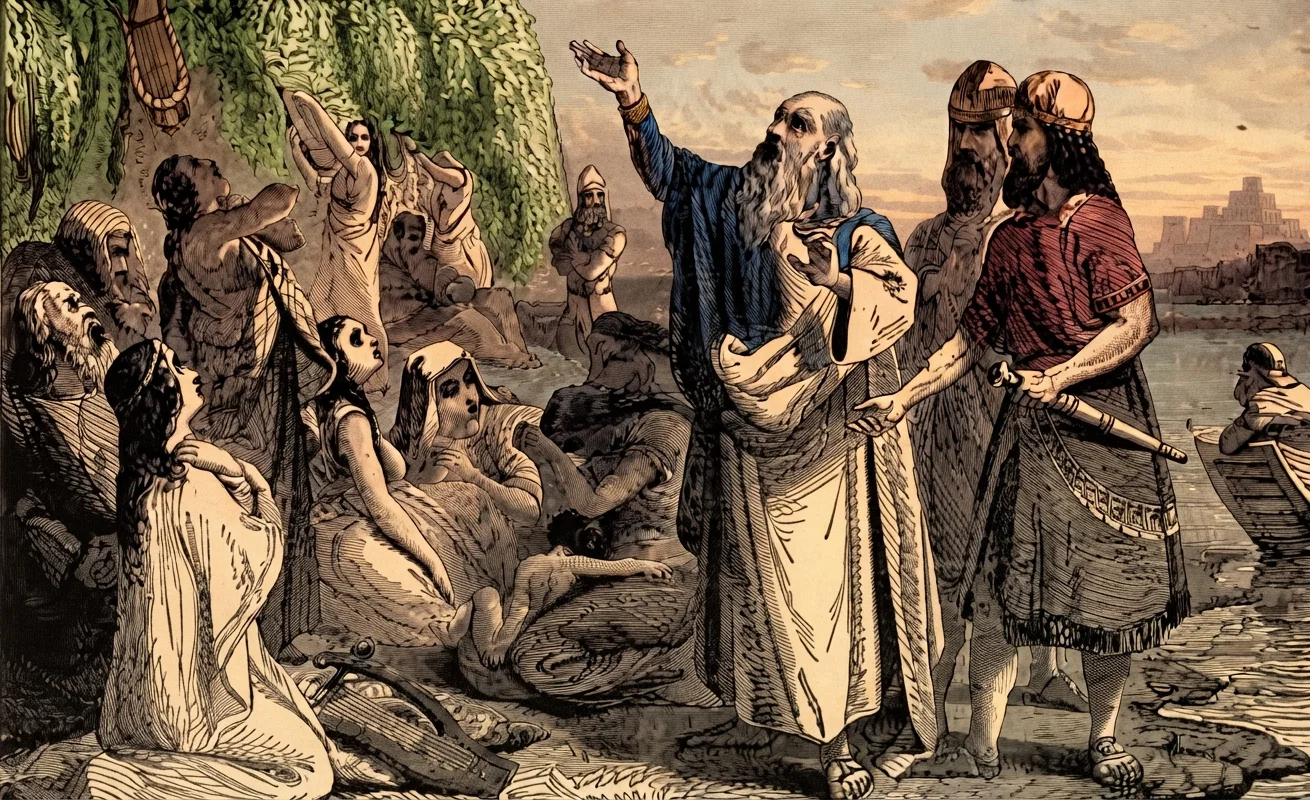
"By the rivers of Babylon, there we sat down, yea, we wept, when we remembered Zion. We hanged our harps upon the willows in the midst thereof. For there they that carried us away captive required of us a song; and they that wasted us required of us mirth, saying, Sing us one of the songs of Zion. How shall we sing the Lord's song in a strange land? If I forget thee, O Jerusalem, let my right hand forget her cunning. If I do not remember thee, let my tongue cleave to the roof of my mouth; if I prefer not Jerusalem above my chief joy. Remember, O Lord, the children of Edom in the day of Jerusalem; who said, Raze it, raze it, even to the foundation thereof. O daughter of Babylon, who art to be destroyed; happy shall he be, that rewardeth thee as thou hast served us. Happy shall he be, that taketh and dasheth thy little ones against the stones."

The Prophet Daniel

Among those who longed for the time to come when God's people might return and rebuild Jerusalem, was the faithful prophet of God, the beloved Daniel. In the ninth chapter of the book of Daniel we read that in the first year of Darius, who was the ruling king, Daniel understood through a study of the prophecy of Jeremiah that the seventy years appointed by God for the desolations of Jerusalem were about to expire. Then it was that this faithful servant of God set his face unto the Lord to seek Him by prayer and supplication, with fasting, sackcloth, and ashes. The wonderful confession of his sins and the sins of his people is given in Dan. 9:4-19. While he is in prayer, the angel Gabriel appears to him, and gives him understanding with reference to the time period that is set apart by God for the accomplishment of great events, and which runs forward into the future, covering thousands of years.
This vision was given to Daniel in the first year of Darius, who was ruling at that time in Babylon. It is under Darius that the conspiracy of the presidents and princes to get Daniel into trouble took place. Daniel had been highly honored during the Babylonian supremacy, and had occupied a position fairly equal to that of the prime minister of the kingdom. When the Babylonian rule was overthrown, and Darius the Median and Cyrus the Persian came to inquire into the affairs of Babylon with respect to the establishment of order and the reorganization of the government, they found Daniel in his royal robe and holding his high official position. His wisdom, his thoro information respecting the affairs of the kingdom, its revenues, etc.,—his supreme ability,—caused them to honor Daniel with a place in their new council, and to give him the very highest place in the council; for we read:
"It pleased Darius to set over the kingdom an hundred and twenty princes, which should be over the whole kingdom; and over these, three presidents; of whom Daniel was first; that the princes might give accounts unto them, and the king should have no damage. Then this Daniel was preferred above the presidents and princes, because an excellent spirit was in him; and the king thought to set him over the whole realm." Dan. 6:1-3.
The very fact that the king thought to set him over the whole realm, shows that there was some opposition to this plan, and yet that the king deliberately had it in mind to finally bring it about.

God's Revelation to the King

In the midst of these affairs, what seemed to be an opportune time for a conspiracy against Daniel had arrived, at least so the presidents and princes of the council argued among themselves. Envious that Daniel should be placed above them all, and seeing that he was to be advanced still higher and become prime minister, the whole company of them formed a conspiracy and diligently sought to find occasion against Daniel. How a law was obtained preventing a petition by anybody to any one save the king, how Daniel continued to pray with his window open toward Jerusalem as he had done ever before, and how by the law the king was compelled to cast Daniel into the den of lions, and how God shut the mouths of the lions and preserved His faithful servant, are facts that are thoroly familiar to all of us.
“Out of Babylon to Zion” By Prof Lucas A. Reed
The king was terribly troubled over the conspiracy, but had no way to break his word; but how deeply he sympathized with Daniel is well shown by the fact that the king arose very early in the morning, and hurried to the den of lions, and cried with a voice of lamentation, "O Daniel, servant of the living God, is thy God, whom thou servest continually, able to deliver thee from the lions?" The cry of this great king to the faithful servant of God is something almost pathetic. The condition of affairs had come to the place that practically demands that a test shall be made of the power of that God whom Daniel served. It is the only hope of the king, and it is the only salvation for Daniel; and as that pathetic cry of the king rings out in the early morning hours, "Is thy God able to deliver thee?" there come, to the delight of the king, the wonderful words of assurance on the part of Daniel: "O king, live forever. My God hath sent His angel, and hath shut the lions' mouths,that they have not hurt me: forasmuch as before Him innocency was found in me; and also before thee, O king, have I done no hurt."
This was the great revelation of God to Darius the king. He realized now who is really the God of heaven, who it is that rules in the kingdom of men; and he at once sent forth a wonderful proclamation, declaring that the God of Daniel is "the living God, and steadfast forever, and His kingdom that which shall not be destroyed, and His dominion shall be even unto the end. He delivereth and rescueth, and He worketh signs and wonders in heaven and in earth, who hath delivered Daniel from the power of the lions." All this had taken place in the short period of two years; namely, from the fall of Babylon in 538 B.C. to the death of Darius in 536.
JEWISH CAPTIVES IN BABYLONIA
Continue reading: Resurgo San Francisco