Your ShelfYour Projects

Signs of the Times, Vol. 32, No. 27

LOVE SUFFERS LONG

Signs of the Times

Jul 11, 1906

Pacific Press Publishing Company · Mountain View, California · Jul 11, 1906

LOVE SUFFERS LONG.

BY FLORA E. YERGIN.
Love suffers long. No pow'r of earth can quench The working of that living, burning flame That shines beyond the region where its worth Is known and seen and sung by angel tongue, To where they know Him not who bears its name.
Love suffers long. The slowly passing years Find Love's clear waters still more clear and sweet; And many hearts have gazed with hopes and fears At that cool fountain— once they passed with sneers, And found again—where love and longing meet.
Love suffers long; nor waits until the hand Is lifted up in sorrow or despair; A mighty arm from Canaan's glory-land Now reaches down to Egypt's desert sand, To gently lead His wand'ring children there.
Love suffers long! until the fevered lips Have tasted of Love's living, cooling cup; Until sin's prison-bars are opened wide; Till starving wand'rers find Love's bleeding side, Love lives and longs! and can not give them up.
Love suffers long. And what should mortal care For aught of else, that withers all to-day? Love lives,—in cooling streams and pastures fair; In gentle breeze, and angel voices where They follow even while Love leads the way.
Love suffers long? a year?—aye, tens of years! Long as the sons of earth shall need of love; Long as the ages where Hate laughs and jeers; Long as the heavy heart shall sigh in tears Shall the Eternal bear—who reigns above!
O weary soul, leave now with Him thy prayer, And go rejoicing in its answer true; Ah, self-sufficient, careless one, beware! He hates the sin that leads thee to despair,— But listen to His pleading love for you.
Onoway, Mich.

New Publications

Signs of the End

Near the close of the Civil War, Abraham Lincoln said, “I see in the near future a crisis approaching that unnerves me, and causes me to tremble for the safety of my country. As a result of the war, corporations have been enthroned, and an era of corruption in high places will follow, and the money power of the country will endeavor to prolong its reign by working upon the prejudices of the people until the wealth is concentrated in the hands of a few, and this Republic is destroyed. I feel at this moment more anxiety for the safety of my country than ever before, even in the midst of war.”
This crisis is upon us. Read its significance in “Signs of the End.”
Bible Students Library No. 194. Price $0.80 a 100.

The Bible or Tradition

A review of Dr. Torry’s booklet entitled “Ought Christians to Keep the Sabbath.” The reviewer’s purpose is to point out the contradictions with which the book abounds. For example:
“Each of the Ten Commandments is an expression of an eternal principle, and the eternal principle stands under the new dispensation as well as the old.”
“The one thing we have now settled is that the law written and engraved on stones, including the Sabbath law, has been done away.”
Bible Students Library No. 193. Six full-page illustrations. Price $1.60 a 100.

Sunday in a Nutshell

In these strenuous times you object to long drawn-out arguments, and appreciate those which are short and pointed. “Sunday in a Nutshell” is of this latter kind. Its sixteen pages are bristling with facts, references, and quotations, showing just how Sunday entered the Christian Church and how it came to be regarded as a sacred institution. The character of the quotations are such as will interest all denominations and classes.
Apples of Gold Library No. 88. Price $0.80 a 100.

Great Popular Evils

The Ethics of the Theater, The Card Table and the Dance, by Rev. E. E. Knapp, Pastor First Baptist Church, Fairport, N. Y., together with “The Question of Skating Rinks” by Milton C. Wilcox, editor of the SIGNS OF THE TIMES. A setting forth of the evil of these forms of amusement such as will cause even their devotees to pause and consider. Every young man and woman in the land should have a copy.
Apples of Gold Library No. 89. Price $0.80 a 100.

The Earthquake: Its Lessons

A message of comfort and cheer to the sorrowing and discouraged. Written by one who was in the midst of the shaken region, and who has carefully observed its effect upon the country and people; it presents these lessons in a manner that invites close consideration.
Here are some of its sub-headings:
Different Points of View The Ministry of Affliction The True Comforter A Touching Incident The Causes of Earthquakes A Foretaste of the End The Solidity of Eternal Things Bruised to Heal Lessons in Human Kindness The Earthquake’s Meaning to Us Another Great Earthquake Perfect Trust
This publication is issued as Bible Students Library No. 196.
Price $0.80 a 100.

The Great Earthquake

The whole world is, and will continue to be, interested in the terrible California Earthquake of April 18, 1906. In the United States particularly every family will want a series of views upon which they can depend as being accurate. Such a series, nearly fifty in all, is found in "The Great Earthquake" booklet. One leading feature of this series is, they cover not only San Francisco, but Healdsburg, Santa Rosa, Stanford University, Mountain View, San Jose, and Agnews Asylum where more than 100 people were killed.
Liberal discount to agents. Price $0.25 each.

Adventist Publishing House Addresses and Branch Offices

The PACIFIC PRESS PUBLISHING CO., Mountain View, California; Kansas City, Mo., 1109 E. 12th St.; Portland, Oregon, 285 Salmon St.
REVIEW AND HERALD PUBLISHING CO., Takoma Park Station, Washington, D. C.; Battle Creek, Michigan
SOUTHERN PUBLISHING ASSOCIATION, 24th Avenue North, Nashville, Tennessee; Fort Worth, Texas

Terms of Subscription.

Per Year, post-paid . . . . . . . . . . . . . . . . . . . . . . . . $1.50
Six Months, 75 cts. Three Months, 40 cts.
To Foreign Countries, per year, $1.75.

SPECIAL TERMS.

1. One new yearly subscription and one renewal, or two new yearly subscriptions, sent at one time, $2.50.
2. Two new yearly subscriptions and one renewal, or three new yearly subscriptions, sent at one time, $3.25.
3. Three new yearly subscriptions and one renewal, or four new yearly subscriptions, sent at one time, $4.00.
Sample copies sent on application.

TO OUR PATRONS.

Please be careful to write all names of persons and places plainly.
Send money by Post-office Money Order, Express Order, or Bank Draft on New York, Chicago, or San Francisco.
Orders and Drafts should be made payable to the Pacific Press Publishing Co.
Paper money or silver should be sent in a registered letter.
Registered mail is safe. Unregistered mail is at the risk of the sender.
The address label on your paper will indicate the time to which your subscription is paid. In case of non-receipt of papers, or any other irregularity, please notify us immediately.
When subscription expires, no more papers are sent to the party except by special arrangement.
You are requested to watch the date on your label, and renew early, and save the loss of papers. We can not always furnish missing numbers.
When requesting change of address, be sure to give both old and new addresses.
Important.—If you order SIGNS, Our Little Friend, books, etc., at the same time, use a separate sheet of paper for each. If this request is complied with, it will materially assist in the prompt and accurate despatch of the business.
When writing to the editor, be sure to use a separate sheet of paper.

A Sister Praises the Paper's Growing Quality

A sister in renewing says: “We think the paper is getting better all the time, and would like to see it in every home.”

Aged Missouri Sister Praises the Paper

Another, and aged, sister in Missouri writes: “I would not miss a single copy if I could help it. I give out the papers and try to interest all I can in the truth.”

Reader Praises the Papers in Perilous Times

From New York an interested reader writes: “I don't want to miss any of the papers, for they are just what we all need in these perilous times. I should miss them very much.”

Colporteur Sales of Signs of the Times in Texas

A brother who sells 150 copies a week in Texas writes: “Many are so interested in the SIGNS OF THE TIMES they have the five cents ready for me at the door. I wish I could handle ten hundred instead of one hundred SIGNS.”

A Sister's Success Selling Papers in San Francisco

A sister in San Francisco says: “I sold forty papers yesterday forenoon in two hours.”

Free Catalog Available by Postal Card Request

Our catalog for 1906 is free. Send us a postal card requesting one.

"AND AFTER THE EARTHQUAKE A FIRE."

THE above expression from the Scriptures has been twice placed in connection with a fire scene in previous numbers of this paper. There are those who have inquired as to its meaning or application. In reply to these and others, we would say that the text was so used as illustrative of the often close connection of these agencies of destruction, and to teach a lesson. The lesson is of vastly more importance than the mere aptness of the illustration.
THE passage is found in 1 Kings, chapter 19. The previous chapter reveals the utter discomfiture of the false prophets who were nourished by the corrupt queen Jezebel, and of the slaying of those prophets who had brought such a curse upon Israel. Then Elijah, the prophet of God, prays for rain upon the drouth-smitten land, and it comes in abundance. Ahab, the king, drives from Carmel to Jezreel in his chariot, but Elijah, the messenger of the Most High, the hardy mountain-dweller, runs ahead of the chariot for twenty-five miles, enters the city before the king, and lies down wearily by the city gate, discouraged at the spiritual apathy of Israel.
FROM his unrefreshing slumbers a messenger from the cruel Jezebel arouses him with this message: “So let the gods do to me, and more also, if I make not thy life as one of them [the false prophets] by to-morrow about this time.” Wearied, worn, and discouraged, fear took possession of the fearless prophet who had fearlessly faced the most dreaded dangers. He arose and fled for his life. Reaching the southern border of Judah, he leaves his servant, and presses on into the wilderness to die. At the end of a weary day's journey, he casts himself down under a scraggy broom tree of the desert, and moans in his utter discouragement: “It is enough now, O Jehovah, take away my life; for I am not better than my fathers,” and in sheer exhaustion he falls asleep.
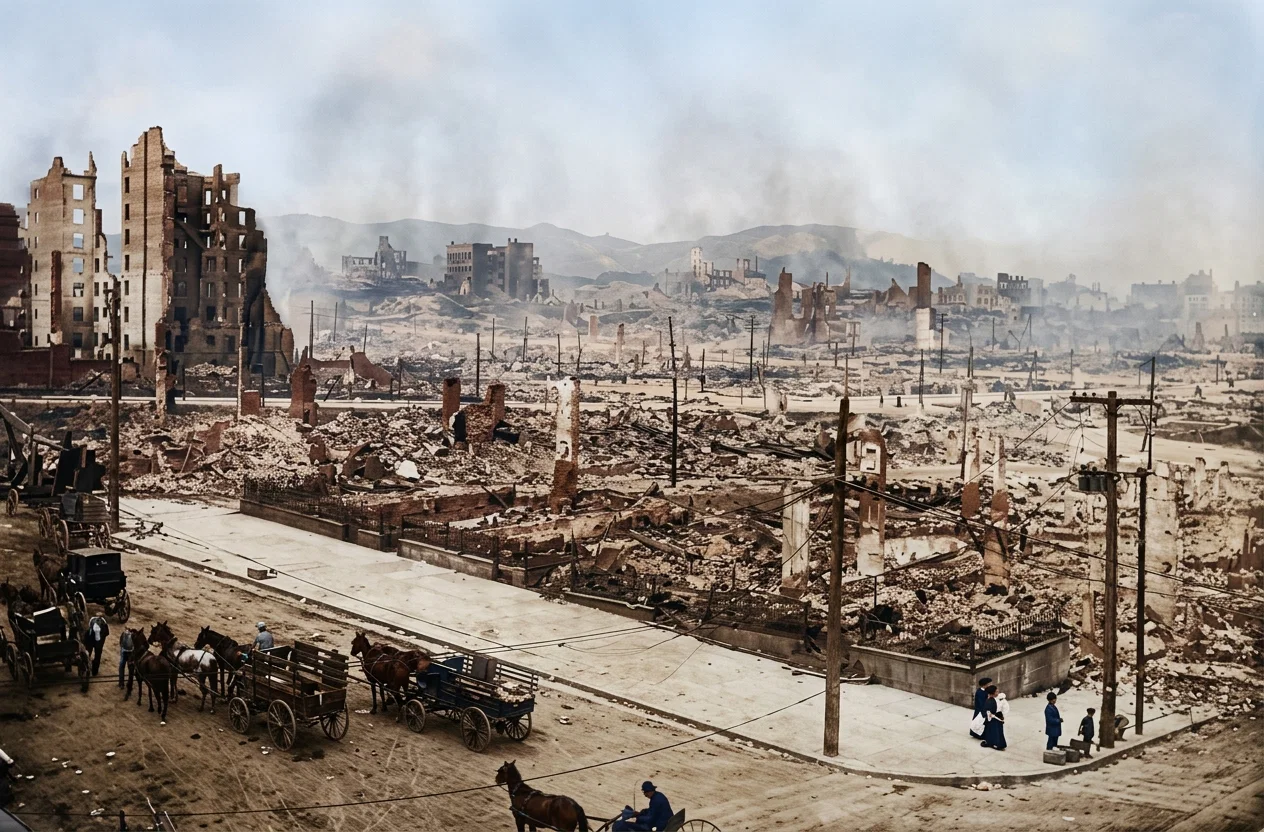
After the Fire in San Francisco. Looking northward toward the Fairmont Hotel. This was the appearance of square miles after the awful burning.
GOD pities him, sends His messenger, and twice in that night he is aroused to eat and drink of the food prepared by the angel; and in the strength of that food he presses on for forty days and nights unto Horeb the Mount of God. And the story continues:
“And he came thither unto a cave, and lodged there; and, behold, the word of Jehovah came to him, and He said unto him, What doest thou here, Elijah? And he said, I have been very jealous for Jehovah, the God of hosts; for the children of Israel have forsaken Thy covenant, thrown down Thine altars, and slain Thy prophets with the sword; and I, even I only, am left; and they seek my life, to take it away. And He said, Go forth, and stand upon the mount before Jehovah. And, behold, Jehovah passed by, and a great and strong wind rent the mountains, and brake in pieces the rocks before Jehovah; but Jehovah was not in the wind; and after the wind an earthquake; but Jehovah was not in the earthquake; and after the earthquake a fire; but Jehovah was not in the fire; and after the fire a still small voice. And it was so, when Elijah heard it, that he wrapped his face in his mantle, and went out, and stood in the entrance of the cave. And, behold, there came a voice unto him, and said, What doest thou here, Elijah? And he said, I have been very jealous for Jehovah, the God of hosts; for the children of Israel have forsaken Thy covenant, thrown down Thine altars, and slain Thy prophets with the sword; and I, even I only, am left, and they seek my life, to take it away. And Jehovah said unto him, Go, return on thy way.”
THE text and context clearly indicate that Elijah expected his zeal to accomplish Israel's reformation. He had been very zealous, he had wrought mighty things; but now, discouraged, all his work seems a thing of naught, and he stands alone. Then God gave him the lesson. A mighty wind rends the mountains and breaks the rocks, a mighty trembling follows which shakes the very earth; and then a devouring fire sweeps over the ruins; yet God is not in wind or earthquake or fire. He uses them. Before they came “Jehovah passed by.” But the prophet seemed not to know it. He shrunk back into the mountain cave, afraid.
YET Jehovah uses even these great destructive agencies. They come in consequence of sin, as the results of perverted law. God permits them, that man may learn how evil sin is, how destructive is its power, what an enemy to mankind it is. God would have man learn his own helplessness and nothingness; how pitifully weak he is before these great perverted forces of nature. He has grown him great crops; the wind, the storm, the tempest, the tornado, destroys them. He erects noble buildings; the earthquake shakes the foundation and the buildings are broken, and the fire sweeps over and licks up what is left. All earthly hopes are wrecked and in ashes, and upon the dreary ruins sits helpless humanity, discouraged, despairing, disconsolate, desperate, or determined.
TO ALL in these great calamities, which come in consequence of sin, God speaks. Again and again in that awful morning at San Francisco, conscience called men to judgment, conscience condemned them for their deeds, conscience aroused within them impulses to do better, and nobly many acted on those impulses; not alone in San Francisco the great heart of humanity was touched. It is ever so. In the great forest fires of Wisconsin and Michigan a few years ago, wild and savage beasts herded with the most timid, peaceful, and harmless. In the waters of a lake could be found bear and deer and dog and wolf and sheep and man. The fear of a great power had suppressed for a time the savagery born of sin, and peace reigned. The tornado, the earthquake, the fire, frighten and subdue for the time the sin-born savage in man, and good impulses rise to the surface and bear sway till the fear is gone, the love of self asserts its rule, and the impulse issues in death. Men—even the unregenerate—sorrow as the impulses die and the spirit of fellowship vanishes. Even so are they sorrowing to-day in the city by the Golden Gate.
AT such times as these comes ever the voice of God to every soul the sanctuary of which is not barred and bolted against righteousness. By some almost forgotten sermon, by some word of Scripture learned when a boy, by every and any means which can be used, God speaks to the soul, and bids it, “Come unto Me.” He offers forgiveness and cleansing, fellowship and counsel, comfort and strength; healing for every hurt, balm for every bruise; riches of grace and glory which tornado nor earthquake nor fire can destroy, a character which is priceless beyond all rubies, eternally young and expansive in the everlasting, unshakable, sinless kingdom of God.
TO HIS servants Jehovah would teach this lesson: “It is not by might, nor by power, but by My Spirit, saith Jehovah of hosts.” It is not the big things in which we pride ourselves that accomplish God's work; it is the uplifting, penetrating power of a life hid with Christ in God. We may not reach Israel by thunder tones or mighty displays of eloquence or force; we may reach them by prayer through the power of the Spirit. We may feel we are all alone; but God still has His own faithful ones who have not, and will not, compromise faith or righteousness on the altars of lust or greed. The still, small voice of God is more than all the might of mere power. The weakness of God is stronger than men. O soul, hide in Him.

THE LAW BEFORE MOSES.

It is passing strange that men who profess to love and serve God should be so anxious to evade His law, which is the expression of His divine will. Ps. 40:7, 8; Eccl. 12:13. In order to escape obedience, they persistently maintain that there was no law until it was delivered from Mount Sinai. But the Scriptures give ample testimony to the fact that all the principles of the Ten Commandments were in force and recognized before the formal deliverance on Sinai. We will briefly note the evidence as touching the several commandments in order:
1. “And God said unto Jacob, Arise, go up to Bethel, and dwell there; and make there an altar unto God, that appeared unto thee when thou fleddest from the face of Esau thy brother. Then Jacob said unto his household, and to all that were with him, Put away the strange gods that are among you, and be clean.” Gen. 35:1, 2. Why put away the “strange gods” if they were not forbidden? “Sin is not imputed when there is no law.” Rom. 5:13.
2. These “strange gods” were images (Gen. 31:19), and Jacob hid them from his people. Why?—Because Jacob had been taught the law of God. Abraham had obeyed it (Gen. 26:5), and had so taught his household (Gen. 18:17–19).
3. Among the sins for which the Canaanites were destroyed was their profaning the name of God. Lev. 18:3, 21, 27. If that was sin, there was law against it.
4. The Sabbath was established at Creation. Gen. 2:2, 3. Moses reminded the Israelites of the sanctity of the Sabbath day, and renewed its observance, one month before they came to Sinai. Ex. 16:1, 4, 5, 22–26. The Lord said this was a test, “that I may prove them, whether they will walk in My law, or no.” And it is a test for all ages.
5. A curse rested on Ham, son of Noah, because he dishonored his father. Gen. 9:20–25.
6. A curse was visited upon Cain because he killed his brother Abel. Gen. 4:8–12. Satan was “a murderer from the beginning” (John 8:44); therefore, if murder was a sin from thebeginning, the law forbidding murder must have existed, as “where no law is, there is no transgression.” Rom. 4:15.
7. Adultery was sin in Abraham’s time (Gen. 20:1–9); and would have brought dire punishment upon Abimelech, tho committed unwittingly. It was sin in Joseph’s time also, Gen. 39:7–9. The “sin” of Sodom and Gomorrah was “very grievous” (Gen. 18:20), and Peter ascribes to them “unlawful deeds” (2 Peter 2:8), while Jude specifies the sin of fornication (Jude 7).
8. God punished theft in Abraham’s day (Genesis 14), and it was deemed a heinous offense in the time of Jacob (Gen. 30:33; 31:26, 27) and of Joseph (Genesis 44).
9. False witnessing was a sin when Potiphar’s wife brought a false charge against Joseph. Gen. 39:7, 12–18. Christ charges Satan with being the father of lying. John 8:44. If that was sin, the law forbidding lying must have been in force when Satan told his first lie.
10. If Eve had not coveted the forbidden fruit, she would not have partaken of it. If Abimelech had not coveted Abraham’s wife, he would not have taken her for himself. If Jacob had not coveted Esau’s birthright and blessing, he would not have taken the unrighteous course he did to secure them. As covetousness is idolatry (Eph. 5:5) it was included in the acts of those who transgressed the first and second commandments.
Inasmuch as God is perfect (Matt. 5:48), and the law is perfect (Ps. 19:7); inasmuch as God is holy (Rev. 4:8), and the law is holy (Rom. 7:12); inasmuch as Christ is the truth (John 14:6) and the law is the truth (Ps. 119:142); and inasmuch as, under the everlasting covenant, the law is placed in the hearts of God’s people (Heb. 8:8–13), it follows that the principles of the law are suitable to the divine administration in all ages, under all circumstances. G.

THERE IS POWER IN HIS NAME.

THE name “Jesus” means “Saviour.” “Thou shalt call His name Jesus; for He shall save His people from their sins.” Matt. 1:21. He was also called Emmanuel, which means “God with us.” On the day of Pentecost, when many were convicted of sin by the power of the Holy Spirit, and cried out, “Men and brethren, what shall we do?” Peter replied, “Repent, and be baptized, every one of you in the name of Jesus Christ for the remission of sins, and ye shall receive the Holy Ghost.” Acts 2:37, 38.
Shortly afterward Peter and John were called before the council and questioned concerning the healing of a certain man who had been lame from his birth. Then Peter declared that “by the name of Jesus Christ of Nazareth” the man had been made whole. And to this testimony he added the further declaration that “neither is there salvation in any other; for there is none other name under heaven given among men, whereby we must be saved.” Acts 4:7-12.
Dr. Banks tells of an early missionary to Africa who, for over two years, was at a loss for some expression by which to make known the idea of a Saviour. At last he heard a native tell some others how his master had saved him from being killed by a lion. After listening to the adventure, he asked the man what he would call the one who had saved him from death, when, to his great joy, he found the long-desired and powerful word. At once he told the man about Jesus his Saviour in a way to make it clear to him; and the poor native, having caught the full meaning of the message, was surprised to learn what the missionary had been trying all that time to tell the people.
In telling of his joy because of the discovery and its result, the missionary said: “I spent four years in Africa. For fourteen months I never saw bread; for months I have lived on African beans and sour milk; I have eaten everything from ants to rhinoceri; thirty times I had fever; I have been attacked by native bands, three times I have been attacked by lions, and four times by rhinoceri; but I would go through it all again for the ineffable joy of that moment when I heard the word Saviour, and saw the light of that man’s face at the message it conveyed to him!”
The wonderful power of the name of Jesus, a power sufficient even to forgive sin, is available to every one who will believe in Him and implicitly trust Him. His assurance is: “Whatsoever ye shall ask in My name, that will I do, that the Father may be glorified in the Son. If ye shall ask anything in My name, I will do it.” John 14:13, 14. The only conditions are that we shall ask believing, (Mark 11:22-24), and in a spirit of obedience (1 John 3:21, 24). It is into this name that the true believer is baptized, thus becoming a recognized member of the heavenly family, with all its privileges and blessings and promises. See Gal. 3:26-29.
“Take the name of Jesus with you, Child of sorrow and of wo; It will joy and comfort give you, Take it, then, where’er you go.”

The Greater Dangers; The Greater Enemies.

San Jose was “hit hard” by the earthquake, but she was a long way from being killed. She was hardly stunned, as her noble call for thousands of San Francisco refugees demonstrated. Mountain View was “hit hard” so was Palo Alto, Redwood, San Mateo, San Francisco, and Santa Rosa first of all. And yet to-day we would as soon settle and build in Santa Rosa or San Jose as any other city in the world of equal advantage elsewise. We do not believe there is worse danger in these cities than there is in any two cities of equal size in the East. The worst foe of San Jose is not the earthquake or the man who tells of it, it is the saloon and the rum-sodden politics which surround it. The earthquakes and cyclones are incident to the ageing of the earth in consequence of the sin-perverted laws in her physical being, and go where we will we can not escape regions of disaster. Therefore as we have said from the beginning we do not consider California any more perilous than any other state or locality and in many respects the Golden State is generally to be preferred to many other sections of the world. The worst foe of any city is its unrighteousness. “By the blessing of the upright the city is exalted; but it is overthrown by the mouth of the wicked.” Prov. 11: 11.

Earthquake and Fire Special.

“Signs of the Times” Souvenir Edition.
This is our third and last and best edition on the great misfortune which befell the Pacific Coast. It is of much more than ordinary interest; it is the best thing yet gotten out. Let us tell you a few things it contains:

I. In Art and Illustrations.

  1. A fire picture of the burning of the city in colors.
  2. Two two-page panoramic views—one of the great fire and the other of the ruins, in colors.
  3. A portrait of the governor of California, Hon. Geo. C. Pardee.
  4. A whole page (seven views) of Stanford University buildings before and after the great temblor.
  5. A whole page (six views) of refugee scenes, camps, etc.
  6. A page on areas covered by earthquake and fire, including a relief map of San Francisco, with burned district in red.
  7. A fine page-view of fire and ruins, looking up California Street.
  8. Twenty-four other illustrations of graphic earthquake scenes, seismographic records, ruins of noted places, such as San Francisco City Hall, Palace and Fairmont hotels, eruption near Healdsburg, safe-opening scene, etc., etc., etc., with interesting stories of each. A total of forty-seven illustrations. The six seismographic records alone, including tracings taken in California, New York, and Austria, are worth the price of the paper, as are several of the other illustrations.

II. The Articles.

  1. “California: Her Condition and Resources,” contributed to this paper by Governor Geo. C. Pardee.
  2. An article on Why This Issue.
  3. “The Earthquake.”
  4. “The Queen City of the West in Sackcloth and Ashes.”
  5. “Oakland, Berkeley, and Alameda.” By A. J. S. Bourdeau.
  6. “Stanford University.” By President David Starr Jordan.
  7. “How San Jose Fared.” By C. M. Snow.
  8. “Mountain View’s Experience.” By W. N. Glenn.
  9. “What Do These Things Mean?” By J. O. Corliss.
  10. “Santa Rosa’s Sad Story.” Mostly from the pen of Mr. Geo. E. Peery.
  11. “Some Direct Causes of the Earthquake.” From “Patriarchs and Prophets.”
  12. “A Mighty Ruin—Sure Trust.” By C. M. Snow.
  13. “Divine Law—Normal and Abnormal.” By the Editor.
  14. “The Eruption in Alexander Valley.” By Prof. L. A. Reed.
  15. “Some Graphic Descriptions.” A few extracts from Hewitt’s and Hopper’s articles on the earthquake and fire.
  16. An official list of contributions to the Relief Funds up to June 16.
  17. Some Disasters of the present year.
  18. Increase of Earthquakes, a list of the most destructive.
  19. Destructive Fires in the United States.
  20. Fire Losses in the United States from 1875 to 1905.
This paper is an issue which you will wish to keep. Twenty-four pages; price 10 cents; in lots of 5 to 500, SIX cents each; 500 and upward, FIVE cents each. Mailed direct from this office to lists of names furnished in lots of five or more, six cents each. Orders are coming in splendidly. News agents are doing well in selling it. It will be a good seller till autumn. Address, SIGNS OF THE TIMES, Mountain View, Cal.

CONTAINED IN THIS NUMBER.

Poetry.
Love Suffers Long. FLORA E. VERGIN …… 7
A Hymn of Praise, L. D. SANTER …… 9
Be Patient …… 10
In Christ …… 12
Editorial.—“And After the Earthquake a Fire”—There Is Power in His Name—The Law Before Moses …… 3–5
Question Corner.—Nos. 1844–1852 …… 5
General.
The Royal Law, F. C. GILBERT …… 6
Our Great Treasure-House, MRS. E. G. WHITE …… 7
Acceptable Obedience, H. A. ST. JOHN …… 7
Temporal Power of the Papacy, C. E. MILTON …… 8
The One Way, M. S. BABCOCK …… 9
The Gospel Grain Field (Bible-reading) …… 9
The Home.—Influence and Responsibility of Parents, MRS. L. D. AVERY-STUTTLE—In the Home Laundry, M. H.—Mothers and Children …… 10, 11
Literary Notices. …… 11
Missions.—Railroads in Africa, A. C. SELMON, M. D.—Letter from Portugal, C. E. RENTFRO …… 12, 13
Outlook.—Morality Personal, Not Legislated, F. M. WILCOX—As It Should Be Everywhere—The Testimony of Presidents—Religion and the Constitution—Boston Methodists—The Seed Is the Word—Sunday Enforcement …… 14, 15
Publishers …… 2

Temblor: The Spanish Word for Earthquake

“Temblor.”—The word “temblor” is a Spanish word meaning earthquake. It is commonly used throughout the Pacific Coast region. Some of our Eastern exchanges get it “trembler,” “tremblor,” and elsewise; but the proper Spanish word is “temblor.”

Redeeming Power in Christ Only.

In speaking of the Shaw-White murder a daily paper says:
‘That this murder will have a great and redeeming effect on the morals of this great city was to-day’s positive development in the most sensational homicide which New York has known since the Fisk-Stokes case.’
Be not deceived. There is no redeeming power in crime or violence or brutality or war or sin or revelation of corruption of any kind or sort. Persons may be horrified, shocked, awakened; but there will be no true, lasting reform unless men sink out of self and into Christ Jesus. Redeeming power is creative power; and creative power comes to this world through Christ Jesus alone. As long as men hope for reform in the revelation of the need of reform they will be disappointed.

Another Earthquake Felt in Southern Wales

Another earthquake has strayed from the “belt” in which, according to “science,” such phenomena logically belong. This one found its way as far north as the British Isles. A press despatch says that violent shocks were felt throughout southern Wales in the forenoon of June 27. “Houses rocked and many of the cheaper were damaged. Hundreds of chimneys fell, occupants of dwellings were thrown to the ground, and people fled from their houses, shrieking in panic with visions of the San Francisco disturbance before them. Though there were many narrow escapes from falling chimneys and copings, there were no casualties, as far as known.” Earthquake shocks were also felt at Bristol, Ilfracombe, and elsewhere. They were accompanied by loud rumblings. The shocks were felt with particular severity in the collieries, where the men tell of terrific experiences. While underground they were thrown about in all directions like ninepins, and they all left the pits as speedily as possible.”

The Transitory Nature of Earthly Accomplishment

The transitory nature of mere earthly accomplishment is well illustrated in the recent death of George K. Fitch, who spent fifty-seven years in the work of building up the great city of San Francisco, and lived just long enough to see its most valuable improvements wiped out. He came to San Francisco in 1849 as a journeyman printer. It was a time when the best artisans of all trades came to California from every state in the Union. He made an enviable reputation as part owner of the Bulletin and the Call. Being a newspaper man of the old school, which was characterized for integrity of purpose and independence rather than the pursuit of political influence, he achieved a goodly share of that influence as a natural result of the confidence of the public. It is noticeable that the great fire covered the territory that was improved under the supervision and by the effort of the pioneers, and their labors in this line went down and out while many of them were yet alive. The new San Francisco will be built by other hands. And it is a fitting symbol of all the merely temporal works of man. Why not build for eternity?

Nine Shot.

A report having been published in an Indiana paper to the effect that a woman had been shot by a soldier in San Francisco because she insisted on building a fire in the park; the editor of Messiah’s Advocate called the attention of General Greely to the matter. That officer replied that there was no truth in the story, adding the following statement: “But nine people were shot during the earthquake and fire period. Of these, two were by the National Guard, two by citizens, the Denicke case which was a complication between marines and a citizen, and the sixth by a police officer, of a looter. As to the death of the three others, nothing is known definitely, but they were not in the localities covered by the regular army. They were all men; no woman was shot, and no man was shot in the park.”

Building in San Francisco Delayed by Strikes and Insurance

Building in San Francisco, while being very much retarded by the dilatory action of the insurance companies, must suffer also from other causes. Among these is the strike of union seamen, and the usual attempts to prevent others from taking their places. A conflict took place on the 16 ult., between strikers and a non-union crew in which one union man was killed and three wounded. The strikers were attempting to board the vessel from a launch.

Cloudburst Delays Trains Near Golconda, Nevada

A cloudburst, the second within a month, occurred June 27, in the mountains near Golconda, Nev. Altho the waters had spread so as to lose much of their force before reaching the railroad, the track was covered with three feet of debris for a quarter of a mile, delaying all trains until it could be cleared away.

RELIGION AND THE CONSTITUTION.

The Boston Globe of April 16 contains the following regarding the freedom of conscience in religious matters under the United States Constitution:
Keeping the Sabbath day is one of the free exercises of religion. Thus the United States Constitution does not prohibit the Christian keeping Sunday as the Sabbath; nor does it forbid the Jew keeping Saturday as such; nor does it stop the Greek observing Monday as a day of rest; nor does it interfere with the Mohammedans keeping Friday as their holy day. Thus, under the Constitution any person has any right to pursue his business on any day; practically there is no legal Sabbath day for all the United States according to this Constitution, because the Constitution wisely declined to make any religious laws interfering with any one; thus the United States, according to its Constitution, is without any religion, and without any religious laws, for the Constitution is . . . non-sectarian.
Undoubtedly the laws enforcing the observance of Sunday are all interferences with personal religious freedom of others who do not agree with these laws. The clause in the Massachusetts Sunday laws freeing a seventh-day person from the Sunday-law obligation is a piece of hypocritical interference, as the clause has no business, nor has the whole Sunday law any business, to be in the statutes of one commonwealth or of the United States.
Under this situation there can be no amendment to allow any religious laws to be in force in any states, so all that can be done is to leave these observations of all religious matters to the conscience of the people of the United States, which was . . . the intention of the framers of the Constitution.

THE SEED IS THE WORD.

THE ninetieth annual meeting of the American Bible Society, which was held on May 10, in the Bible House, New York City, presents some interesting features. The debt which was reported a year ago has been paid, and the new year opens with a balance of $27,477 in the treasury. The total cash receipts of the year were $842,488. The total issues of the year amount to 2,236,755, about two-fifths of these volumes being issued in New York, and three-fifths from the mission presses in China, Japan, Siam, Syria, and Turkey. The figures are by far the largest in the society’s history of ninety years. The circulation of the Bible in foreign countries during the past year, shows that China has received over 500,000 copies, and Japan half as many. More than 100,000 copies have gone to the Philippines, which before the American occupation were absolutely closed to the free circulation of the Scriptures. In Latin America more than 130,000 Bibles and parts of Bibles have been distributed in the past year. The work of the American Bible Society is supported by contributions from nearly all the American Protestant churches, including our own. Its production of cheap and uniform editions of the Scriptures is one of the most efficient factors in home missionary work, and it deserves the hearty support of all the churches.—Christian Advocate.

Catholic Church Adjusts Services to Allow Sunday Baseball

THAT Sunday laws are principally designed to cut off all pretext for not attending church, and everything that tends to a rivalry of church patronage, is frequently manifest in compromises with such rivalry. Such compromises are most frequently met in the action of Roman Catholic churches. It is said that an arrangement has been made between Priest Waring, of Dyersville, Iowa, and the management of the local baseball team, whereby the Sunday afternoon church services are to be held a half hour earlier and the ball game a half hour later than formerly, so that those who desire to attend both can have the opportunity. The Sunday holiday as a church institution originated in the Roman Church, and it is but logical to expect that authority to set the pace for its observance. It is said that Priest Waring “realizes that Sunday baseball has come to stay,” and evidently it is all right with him if it does not interfere with attendance at his church. This is an old-time principle of that church.
Continue reading: COMPROMISING WITH THE SALOONS