Your ShelfYour Projects

Signs of the Times, Vol. 29, No. 19.

WAR IN HEAVEN

Signs of the Times

May 13, 1903

Pacific Press Publishing Company · Oakland, California · May 13, 1903

WAR IN HEAVEN
Our first article on Revelation 12, two weeks ago, was a study of the woman, the church of God; in the light of the symbol used by the prophet, from the time of her captivity in Babylon to the glorious light she entered at the first advent.
“Since then the children are sharers in flesh and blood, He also Himself in like manner partook of the same; that through death He might bring to nought him that had the power of death, that is, the devil.” Heb. 2:14.
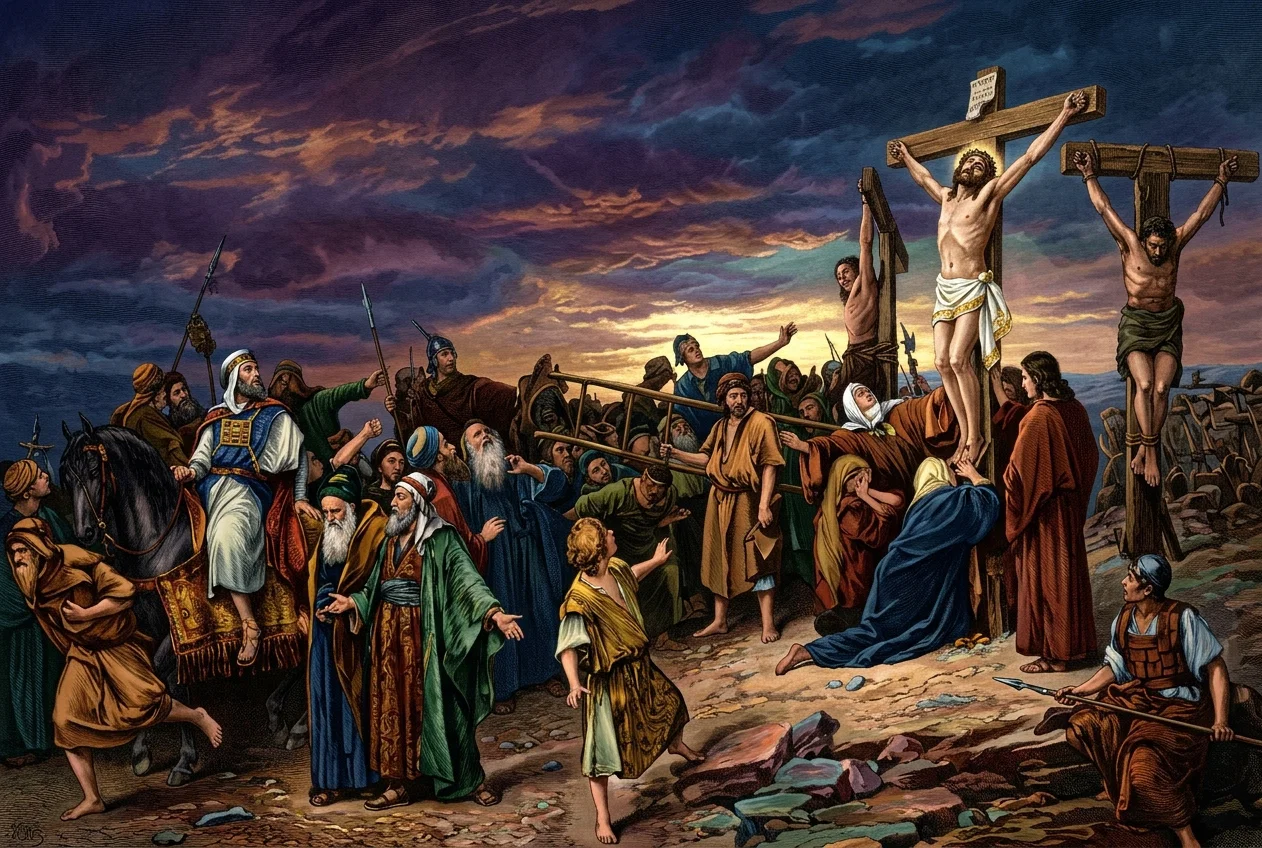
Last week we studied the dragon, that old serpent, called the devil and Satan, from the time he dwelt in heaven as Lucifer to the first advent of our Lord. A little more remains to be said on verses 5 and 6. Of the woman it is said:— “And she was delivered of a Son, a Man Child, who is to rule all nations with a rod of iron; and her Child was caught up unto God, and unto His throne. And the woman fled into the wilderness, where she hath a place prepared of God, that there they may nourish her a thousand two hundred and threescore days.” In our last study we learned how Satan watched for the birth of Christ Jesus; how he instigated Herod to destroy Him by destroying all the children under two years of age in that section. Jesus then escaped; but Satan followed Him. Mad mobs were stirred up against Him. The very sea was enraged that the deep might swallow Him. Pharisees, Sadducees, priests, lawyers, and scribes were aroused against Him; and finally the Roman power was prevailed to lift its strong arm to put Him to death. It did, and the sepulchre was closed and sealed; nevertheless the “Child was caught up unto God and unto His throne.”
No power can forever prevail against eternal right.
Verse 6 follows logically after verse 5, tho not closely chronologically. It is a prophetic declaration of the great persecution through which the church should pass, and God’s preserving power to keep her. It will be considered in connection with verse 14.

War in Heaven.

In this study we will consider verses 7–9, which carry us back to a period preceding verse 5. The scripture reads as follows:— “And there was war in heaven; Michael and His angels going forth to war with the dragon; and the dragon warred with his angels, and they prevailed not, neither was their place found any more in heaven. And the great dragon was cast down, the old serpent, he that is called the devil and Satan, the deceiver of the whole world; he was cast down to the earth, and his angels were cast down with him.”
Where was this war?—In heaven, in spiritual realms, “against the spiritual hosts of wickedness in the heavenly places.” Eph. 6:12.
Who went forth to war on the one side?—Michael and His angels.
Who were the foes against which they warred?—“And the dragon warred with his angels.”
How successful were the dragon and his angels?—“And they prevailed not.”
What was the final result?—“Neither was their place found any more in heaven.”
What occurred to the dragon?—“He was cast down to the earth, and his angels were cast down with him.”
These are mighty, momentous events. May we know what they are? Let us study the scripture.
Michael means “who is like God.” He is elsewhere called the Archangel, who has power over death (Jude 9; 1 Thess. 4:16), “the great Prince which standeth for the children of thy people” (Dan. 12:1). These facts, together with the meaning of the name Michael,would clearly indicate that Michael is the Son of God, the Chief over all the angels, the Lord of hosts, or armies, the Angel or Messenger, of whom Jehovah said, “My name is in Him.” Ex. 23:21.
The war in heaven, then, must be a war which occurred and continued between the Son of God and the good angels, and Satan and the angels who fell with him, from the time he sinned, culminating in his defeat and overthrow, an overthrow so marked, so clearly manifesting the weakness and wickedness of sin as compared with the inherent strength and vitality of love, as to forever set at rest among “the principalities and the powers in the heavenly places” the ultimate and all-comprehending authority of the God of love.

Satan Triumphant over Man.

When Lucifer fell he was not immediately cast down to hell (tartarus, 2 Peter 2:4, the regions encompassing and including this sin-cursed earth), but he was allowed a freedom in the universe of God not now known. This is evident from glimpses which the Word of God gives of his history and work. Adam was given dominion of this earth, subject to the Throne of Heaven. Over every other inhabited world God also had His sons to whom dominion was given. These, as well-regulated government and the highest enlightenment, unity, efficiency, and good of God’s creatures demanded, met from time to time before the Lord, and gave report of their respective domains. This earth was not represented by its rightful prince—Man—to whom it had been given. Man had yielded himself a slave, and yielding himself, he yielded his kingdom to Satan. So “when the sons of God came to present themselves before the Lord,” “Satan came also among them.” When asked from whence he came, he replied: “From going to and fro in the earth, and from walking up and down in it.” Job 1:6, 7.

Might versus Right.

While cast out from the immediate presence of God, he yet came among the other angels. He was there as a usurper, to justify which he became an accuser. He asserted that his way was right, his Maker’s wrong. Having in his very purpose the elements of corruption and death, he promised and yet promises liberty to his dupes. He claimed the earth as his by the power of might. “From going to and fro in the earth, and from walking up and down in it” showed that Satan felt that in the earth he was king—he did as he pleased. By the same power of fraud and force he was determined to conquer the universe, and exalt his throne “above the stars of God.” Isa. 14:13. Michael met him on the eternal principle of love—righteousness. With Satan, “might is right,” “the end justifies the means,” were moulding principles; with the Son of God, right is might, the righteous means will be justified by the eternal end, were the principles on which His warfare was conducted. Satan “can not brook delay,” but Michael and all the good “can well afford to wait.” Yea, tho longing for the universal reign of righteousness, the principle of righteousness may not be departed from in obtaining it. All must wait God’s time for the vindication of right.

Battles in the War.

We have two examples of evil undeveloped, and the course of the Son of God in meeting that evil, knowing it to be evil. First, when He came down with His shining hosts to raise Moses from the dead (see Jude 9), Satan was there to oppose Him. The devil claimed Moses as his lawful captive in his own prison-house, the grave. He contended that Jesus had no right there, that the earth was his own by conquest, and that every sinner, and all who died, were his lawful slaves and captives. Jesus does not argue the question. He could not stoop to this. He did not present His own claims or position as a reason why the doors of the grave should unlock and release the servant of God. He simply said to him who, in all his temptations and badgerings and Satanic devices of forty years, could get but one failure from the “man of God,” “The Lord rebuke thee,” leaving to the eternal future His right to “release the prisoners.”
Again, in the record of Zech. 3:1–5, we have a similar instance. The actors in this age-long drama are (1) the Angel of Jehovah, Michael; (2) Joshua the high priest clothed in filthy garments, representing Israel in their sins; and (3) Satan, the adversary, at Joshua’s right hand to resist him. This is a typical scene which is here opened before us. Joshua pleads with God before the Angel for acceptance and relief. Satan is there to accuse, and to declare that forgiveness of such vile sins can not be granted. He declares that Jehovah punished him for sins less vile—for Joshua and Jerusalem there is no hope. Again are heard the words, “The Lord rebuke thee, O Satan; even the Lord that hath chosen Jerusalem rebuke thee: is not this a brand plucked from the burning?” Even thus the conflict went on for the ages, Satan tempting to sin, accusing the sinner, and yet claiming his course to be justified by God’s arbitrary dealings with man, while Christ and good angels, ever instructing in righteousness and pleading in love, waited till such time as the final battle should be fought and the eternal principles of God’s character vindicated.

Stooping to Conquer.

This came when the Man Child was brought forth by the waiting church. Satan won the kingdom from Adam by becoming incarnate. Michael—“who is like God”—must win it back by becoming incarnate. When man yielded his heart to Satan, sin became incarnate, dominant over the flesh. When the Son of God, who, tho in God’s form, “counted not the being on an equality with God a thing to be grasped,” but humbled Himself to save man (Phil. 2:5–7, A. R. V.), He took the body of a flesh of sin prepared for Him of God (Heb. 10:5), that He might be both Brother and Saviour to man. And in this body of flesh, such as all men bear, righteousness became incarnate by Jesus Christ. But He does not lose His identity. Still is He Michael to all the angelic host, but how changed—a man, poor, weak from fasting, a seeming failure in all but character, in Himself helpless. He said: “I can of Myself do nothing.”
Thus He was when met by Satan during, and especially at the close of, the forty days’ fast. Eve was led by Satan to doubt God. “Hath God said, Ye shall not eat of every tree of the garden?” asked Satan with a sneer, in order to induce doubt. “If Thou be the Son of God,” he suggested to the Seed of the woman. From outward appearance, how suggestive the “if.” But the voluntarily weak Michael is strong in God’s Word and in the principle of right. “It is written” is His ever-ready and all-potent weapon. Twice He replies as tho Satan was what he claimed to be, an angel of light; but when the adversary demanded worship which belonged to God, he is answered in words which show to him that his true character is revealed: “Get thee hence, Satan; for it is written.”
Michael had conquered by the King’s weapons, and had withstood every assault by the armor of righteousness. Every power and device of the prince of darkness and evil had been used against Incarnate Righteousness; every assault had been completely met by the Prince of life and righteousness. It was the battle in the conflict of the ages between good and evil, and all the heavenly host witnessed the duel with interest that mortal never knew. It was eternal defeat to Satan; it was eternal victory for Christ and the faithful.

Results of Victory.

The demons acknowledged this defeat, and the disciples rejoiced in the results before they understood the struggle which made it possible. Shortly after, Jesus—the Michael of the angelic host—meets a poor sufferer, possessed or controlled by demons, angels of the dragon. They know His power, and cry out: “What have we to do with Thee, Thou Son of God? art Thou come hither to torment us before the time?” Matt. 8:29. They knew defeat had come; they knew that eventually punishment was certain; and reasoning from their own injustice, they feared it might be visited previous to the time appointed by the Judge. See also Luke 4:34.
On another occasion, the seventy disciples returned from a mission with joy, and declared, “Lord, even the demons are subject unto us through Thy name.” They had never known such things before. Poor lunatics! many were controlled by demons, but man could not before this, to their knowledge, cast them out. Jesus revealed the secret. “I beheld Satan fallen as lightning from heaven. Behold I have given you authority to tread upon serpents and scorpions, and over all the power of the enemy.” Luke 10:18, 19. The battle had been fought, the victory won. The dragon had fought and his angels, and Michael had fought and His angels, the great spiritual warfare, but Righteousness Incarnate triumphed.

Even unto Death.

But the dragon did not rest here. In some unguarded moment, doubtless, he reasoned, Jesus might fall, even as did Moses. He would follow Jesus still. He would stir up against Him a proud, self-righteous, ungrateful people. He would persecute and harass Him. He would flatter Him by a selfish and unthinking populace which wanted a king. He would get Jesus to take glory to Himself; He would discourage Him by turning against Him His own nation and even His own disciples. But none of these things led to even a compromise of one principle of right. Weakened and distressed humanity could sometimes sigh for deliverance, but above the sigh rose the prayer of the heart that God’s will might be wrought. As He nears the last fearful hour of agony the prayer arises: “Now is my soul troubled; and what shall I say, Father, save Me from this hour? but for this cause came I unto this hour. Father, glorify thy name.”
That hour is reached in its fulness in the agony of Gethsemane’s Garden. Again we hear the human wail of agony: “Abba, Father, all things are possible unto Thee; take away this cup from Me.” Humanity shrinks from the trying ordeal. But this is not the petition of the heart above all others. Paramount to that agonizing cry is what immediately follows:“Nevertheless, not what I will, but what Thou wilt.” Mark 14:36. The struggle is over in the heart of alike the Victim and Victor. God’s will—the cruel scourging; the humiliation; the mock honor; the crown of thorns; the cross of Calvary; the awful hiding of the Father’s face, because of a sense of the sins of the world which were upon Him; the darkness of death; the climax of the eternal sacrifice, with God’s righteous will and a redeemed race—is wholly preferable, with all it costs, to all other glory gotten by a single compromise of right, a single yielding to self. And so the spotless Victim became the eternal Victor.
“Jesus Christ died, but for others. He laid down His own life. He was buried. The portals of the grave shut Him in. A seal was set to the grave by the authority of one of the dragon heads—Pagan Rome—whose empire then filled the world. A Roman guard and demons of darkness were set to watch the sepulchre. Michael, He who was once like God in the shining courts above, He who had laid aside that glory for man and become Immanuel, was at last locked in the tomb, the prison-house of him who could not unbolt the prison door—Satan. His disciples mourned. Nature grew black at His death. The angels of light must have well-nigh despaired. But, altho under the power of death, “it was not possible that He should be holden of it.” Right is might. Righteousness is life. All the powers of darkness commanding all the powers of earth could not lock the tomb over Eternal Righteousness, incarnate tho it were. In God’s time He would come forth; and God’s time, according to the scripture, came on the third day. Angels of might and glory shine away the darkness, prostrate the strong Roman guard, and Michael, the triumphant and Eternal Conqueror, steps forth.
[The next article in the series on this part of the Revelation is “The Son of God.”]

God’s Preparation for Service, No. 6: Consequences

GOD’S PREPARATION FOR SERVICE. NO. 6.

Consequences.

While we have spoken of the last three lessons in order as next, that must not be considered as arbitrary in order of development, for one dear saint may learn them in a very different order from another. Neither can we say there is a certain order in their importance; for as we can not tell God’s rule of rank in these things, neither can we tell what may be of most importance to any individual, as each has his own distinctive disposition, surroundings, and so forth; and hence, his need. But one thing is certain, we must know them all before we can gain the victory of full deliverance; and our deliverance is in proportion to our experimental knowledge of these truths.
The moment the eye is upward—I thank God through Jesus Christ our Lord that He delivers me—that moment deliverance is found, just as our first gleam of salvation was found, not through self, but through Christ.
But before the Spirit unfolds fully the blessed portion of the “not I” but “Christ in you,” He gives us the warning with the promise enfolded in the last sentence of Rom. 7:25.
The enemy will never be a friend. Flesh is flesh and Christ is Christ, and knowing this, we learn to watch.
By accepting and holding this position, one of the first consequences you will note will be an actual freedom from sin. When temptation comes, you will recognize it, and reckoning yourself dead, it has no power over you. Continuing to do this again and again, each temptation loses its power, and we can sing:—
“Victory for me! Through the blood [life] of Christ my Saviour, Victory for me! Through His precious blood [life].”
Another consequence you will notice—you become dead to the law by the body of Christ, Rom. 7:4–6. That is, having Christ in you, you do not fear bondage to sin as forbidden by the law, but you delight in the law, and know, by faith, the Christ in you will keep His own law.
Another consequence is that you are delivered from the world, crucified unto it. Gal. 6:14. Its true character has been detected and exposed. Viewing its allurements in the light of the cross, we understand James 4:4, and we want none of it.
Another blessed consequence is that you lose the fear of man and his religious claims upon you. Once you and I owned it, we acknowledged it, we were alive to it; now, being dead with Christ, we lose sight of man entirely, being subject only to Him. Thus the employee works for his master, carpenter, cook, teacher or whatever his calling, serving the Lord Christ. So every enemy is conquered and Christ is Lord alone.
Beloved, let us enter in.
Augusta C. Bainbridge.

FOLLOWING CHRIST.

BY MRS. E. G. WHITE.
FOR each one of us there is a live, disordered self to master, or it will master us. Christians who live for self dishonor their Redeemer. They may apparently be very active in the service of the Lord, but they weave self into all that they do. Sowing the seed of selfishness, they must at last reap a harvest of corruption. It can not but be thus. Eternal life can not possibly be the result of their life-work, unless they see their mistake, and surrender all to God.
Service for self takes a variety of forms. Some of these forms seem harmless. Apparent goodness is regarded as genuine goodness. But they bring no glory to God. Christ says, “He that is not with Me is against Me; and he that gathereth not with Me scattereth abroad.”
The Lord does not accept the service of those who live an inefficient, do-nothing life. They exert an influence that leads away from Christ. Self-denial and nobility of purpose marked His life. From the beginning to the close of His earthly ministry He went about doing good. In His life no sin appeared. No selfishness marred word or act. “Which of you convinceth Me of sin?” He asked the Pharisees, knowing that they could find nothing of which to accuse Him. And at His trial Pilate declared emphatically, “I find in Him no fault at all.”
Christ declares that as He lived, so we are to live. “Whosoever will come after Me,” He says, “let him deny himself, and take up his cross, and follow Me.” His footsteps lead along the pathway of sacrifice.
As we pass through life, there come to us many opportunities for service. All around us there are open doors for ministry. By the right use of the talent of speech we may do much for the Master. Words are a power for good when they are weighted with the tenderness and sympathy of Christ. Money, influence, tact, time, and strength—all these are gifts entrusted to us to make us more helpful to those around us, and more of an honor to our Creator.
Many feel that it would be a privilege to visit the scenes of Christ’s life on earth, to walk where He trod, to look upon the lake where He loved to teach, and the valleys and hills on which His eyes so often rested; but we need not go to Palestine in order to walk in the steps of Jesus. We shall find His footprints beside the sick-bed, in the hovels of poverty, in the crowded alleys of the great city, and in every place where there are human hearts in need of consolation.
All may find something to do. “The poor always ye have with you,” Jesus said, and none need feel that there is no place where they can labor for Him. Millions upon millions of souls ready to perish, bound in chains of ignorance and sin, have never so much as heard of Christ’s love for them. Were our condition and theirs reversed, what would we desire them to do for us? All this, so far as lies in our power, we are under the most solemn obligation to do for them. Christ’s rule of life, by which every one must stand or fall in the judgment, is, “Whatsoever ye would that men should do to you, do ye even so to them.”
“If thou forbear to deliver them that are drawn unto death, and those that are ready to be slain; if thou sayest, Behold, we knew it not; doth not He that pondereth the heart consider it? and He that keepeth thy soul, doth not He know it? and shall not He render to every man according to his works?” In the great Judgment day, those who have not worked for Christ, who have drifted along thinking of themselves, caring for themselves, will be placed by the Judge of the whole earth with those who did evil. They will receive the same condemnation.
To every soul a trust is given. Of every one the Chief Shepherd will demand, “Where is the flock that was given thee, thy beautiful flock?” And “what wilt thou say when He shall punish thee?”

IN HIS HANDS.

“It must be done!”
I was watching the goldsmith fashion a beautiful bangle. Various manipulations were necessary, but at last it seemed to me that the splendid work was finished. But lo! the artisan put the tiny shining bit into the flame and burned it black.
“Why destroy its splendid luster,” I exclaimed, disappointed.
“Wait,” he said, as he held the bit against the polishing wheel. As by magic the dull black disappeared, and the rosy luster of the metal flashed in his fingers, rich, without a scratch, more perfect a dozen times than it had been before.
“You can’t tell,” said the workman at last, “you never can tell about the unfinished job in the workman’s hands. Wait. Leave it to him, and don’t worry.”
Only the Maker, He who sees the end of all from the first, knows the result of human life—your human life and mine. His thoughts concerning us are thoughts of improvement, progressand attainment. If we are in His hands His thoughts will be carried out. If we are not in His hands it is high time to get there.
EDISON DRIVER.

IN HIM ALONE.

“AND as the path of duty is made plain, May grace be given that I may walk therein, Not like the hireling, for his selfish gain, With backward glances and reluctant tread, Making a merit of his coward dread; But, cheerful, in the light around me thrown. Walking as one to pleasant service led; Doing God's will as if it were my own, Yet trusting not in mine, but in His strength alone!”

The Seventh Day—the Sabbath

THE GOSPEL IN CREATION. NO. 10.

The Seventh Day—the Sabbath.

WE now come to the close of that first week of time. The Sacred Record reads:—
“Thus the heavens and the earth were finished, and all the host of them. And on the seventh day God ended His work which He had made; and He rested on the seventh day from all His work which He had made. And God blessed the seventh day, and sanctified it; because that in it He had rested from all His work which God created and made.” Gen. 2:1-3.
In harmony with this is the Sabbath law, and the words of Christ:—
“Remember the Sabbath day, to keep it holy. Six days shalt thou labor, and do all thy work; but the seventh day is the Sabbath of the Lord thy God; in it thou shalt not do any work, thou, nor thy son, nor thy daughter, thy manservant, nor thy maidservant, nor thy cattle, nor thy stranger that is within thy gates; for in six days the Lord made heaven and earth, the sea, and all that in them is, and rested the seventh day; wherefore the Lord blessed the Sabbath day, and hallowed it.” Ex. 20:8-11.
“And He said unto them, The Sabbath was made for man, and not man for the Sabbath; therefore the Son of Man is Lord also of the Sabbath day.” Mark 2:27, 28.
These and related passages tell us how, when, and where, of what, by whom, for whom, and for what purpose, the Sabbath was made, just as Genesis 1 and related passages tell us all these things concerning the other works of God.
From the simple reading of the Record, some very interesting and important facts concerning the Sabbath become clearly apparent, and plainly evident:—
1. God in Christ, is its Maker. John 1:1-14; 1 Cor. 8:5, 6; Eph. 3:8, 9; Col. 1:14-17; Heb. 1:1-3.
2. It was made for man—not for the Jews only.
3. It was made on the seventh day of creation week, before the fall, and is, therefore, not a type or shadow of anything, but a blessed, living reality.
4. Specific actions on the part of God entered into its making as verily as in anything else that was made.
5. It was made out of the seventh day intermingled with the rest, blessing, and sanctification of God.
The acceptance and understanding of these and related facts will result in the revelation of some most precious truths, that are almost universally unknown, or blindly rejected as error.
It is interesting to note the successive acts by which God made the Sabbath. First of all, He worked six days for man, making and preparing the earth for his habitation. Ps. 115:16. Thus six days of labor is the foundation for proper Sabbath-keeping, and only those who have, during the six working days, faithfully done all their work can derive any benefit or blessing from Sabbath observance.

He Rested on the Day.

Next, He rested—not for Himself, nor from physical weariness, for “He fainteth not, neither is weary” (Isa. 40:28), but for man; “God is a Spirit; and they that worship Him must worship Him in spirit and in truth.” John 4:24. His rest is, therefore, spiritual rest.
O sin-burdened souls, longing to be free, accept “the gift of God,”—“the faith of Jesus” (Eph. 2:8-10), “which worketh by love” (Gal. 5:6); believe in Him, and thus “work the works of God” (John 6:28, 29). Cease from your own works as God from His, and enter into the rest that remains for the people of God, which is the seventh day,—the Sabbath or rest of the Lord thy God. Heb. 4:1-11. “Come unto Me,” says Jesus, “and ye shall find rest unto your souls.” Matt. 11:28-30. Soul rest comes only from Christ, but the Sabbath brings the presence of Christ to the believer, and so it is that the seventh day, the blessed holy Sabbath of the Lord, becomes the chief instrument or channel through which His rest flows into the souls of His people. And the rejection of this truth fills the world with unrest, strife, war, confusion, and commotion.
As the great Creator contemplated the finished, perfect work of His hands, He “was refreshed,”—delighted. Ex. 31:17. Just so, when we are “created anew in Christ Jesus” (Eph. 2:10; 2 Cor. 5:17), and all our works are wrought in Him (John 3:21), His “wonderful works to usward” (Ps. 40:5) will refresh and delight us as we contemplate them in the observance of the holy Sabbath day (Isa. 58:13, 14).

Blessed the Day.

After resting, He blessed the Sabbath, or rest-day, for man. God blesses men on every day for He “daily loadeth us with benefits” (Ps. 68:19); but He has placed one blessing for us in the Sabbath, which can only be obtained in the proper observance of the day, of which it is a part. The Sabbath thus becomes a channel or means of blessing. All blessings are in Christ. Eph. 1:3; Col. 2:1-3, 6-10. But the Sabbath contains special blessings, which demonstrates again the presence of Christ in the Sabbath that makes it a means of sanctification, for He is made unto us sanctification. 1 Cor. 1:30. “To sanctify” is defined to mean, “to set apart for a sacred, holy, or special use”. So the Sabbath was sanctified, or set apart by God for a sacred, holy, or special use on the part of man. This could only be done by giving him the proper instruction concerning its use. So we have the plain statement that the Sabbath was given to man in the beginning, altho it was not written until the law was reiterated on Mount Sinai. That the seventh-day Sabbath has a definite, peculiar, sanctifying “setting-apart” influence and effect upon those who observe it, is seen in the fact that they are cut out from the world, and are known as a peculiar people, separate and different from every one else.
The Sabbath is supposed by many to be some sort of an institution which the Lord made and placed on the seventh day, afterward removing it and placing it on the first day. But the Sabbath can no more be separated from the seventh day than the seventh day can be separated from the seventh day; for “the seventh day is the Sabbath,” and the Sabbath is the seventh day. The terms “Sabbath” and “seventh day” are but two forms of expression denoting exactly the same period of time. The “Sabbath” is not the combination of a day, and an institution; but an institution composed of the seventh day, intermingled with the rest, blessing and sanctification of God.
How idle, then, is all talk about the Sabbath being changed. The reason for which the Sabbath was made and enjoined upon man is plainly stated in the Fourth Commandment, viz., because “in six days the Lord made heaven and earth.” It is, therefore, a monumental memoir of the creative power of God, as verily as Washington’s monument, or February 22 commemorates the greatness of the “father of his country.” Notice that it is more than a memorial of creation which is only one manifestation of God’s power. Another mighty manifestation of His power is seen in redemption or re-creation. And the Sabbath is also a sign of this. “Moreover also I gave them My Sabbaths, to be a sign between Me and them, that they might know that I am the Lord that sanctify them.” Eze. 20:12, 20; Ex. 31:13. And so it is that the followers of Christ do not keep the Sabbath to get Him to save them, but in grateful acknowledgement of the blessed fact that He has saved them.
W. A. SWEANY.
(Concluded next week.)
Continue reading: BAPTISM FOR THE DEAD