Your ShelfYour Projects

Signs of the Times, Vol. 33, No. 51.

Signs of the Coming Son

Signs of the Times

Dec 18, 1907

Pacific Press Publishing Company · Mountain View, California · Dec 18, 1907

Signs of the Coming Son

AND there shall be signs in the sun, and in the moon, and in the stars; and upon the earth distress of nations, with perplexity; the sea and the waves roaring; men’s hearts failing them for fear, and for looking after those things which are coming on the earth: for the powers of heaven shall be shaken. And then shall they see the Son of Man coming in a cloud with power and great glory. And when these things begin to come to pass, then look up, and lift up your heads; for your redemption draweth nigh.”—Luke 21:25-28.

He Is Near, Even at the Doors

“When ye shall see all these things, know that He is near, even at the doors.” —Matt. 24 : 33.

Discerning the Times

“Ye can discern the face of the sky and of the earth; but how is it that ye do not discern this time?” —Luke 12 : 56.

No Text Provided

With Our Inquirers

"If ye will inquire, inquire ye."
[All questions to this department will be answered which to the editors will seem to minister to the good of the readers and to the mission of the paper. The same question can not be answered repeatedly in the same volume. The name and address must accompany question, not for publication, but as an evidence of good faith, and that answer may be made by letter if deemed advisable. It is well always to enclose a stamp for reply.]

2316.—The Sabbath in the Beginning.

Did God command Adam and Eve to keep the Sabbath? What Bible record have we that the Sabbath was kept by any people or persons before the time of Moses? W. S. K.
1. Genesis is not a book of law, being simply a very brief record of God's providential dealings with His people for twenty-five hundred years. We find no prohibitions, "Thou shalt not steal," "Thou shalt not kill," "Thou shalt not commit
adultery," and as to the matter of that, every other command of the Decalogue. On the other hand, we do find that the transgression of all these commandments was counted sin. The apostle Paul tells us, Rom. 3:20, "By the law is the knowledge of sin;" Rom. 4:15, "Where no law is there is no transgression." Therefore the law was in force during that time.
2. The record is that God rested, blessed, and sanctified the seventh day. Gen. 2:2, 3. "Sanctify" means to set apart. For whom was it set apart? Jesus said, "The Sabbath was made for man." Mark 2:27. Therefore when God set apart that day in the very beginning, He set it apart for man; so Lange, the great commentor, declares that God must have commanded it then. This, too, is shown by Gen. 4:3, "And in process of time it came to pass." The margin for "in process of time" is "at the end of days." The only cycle of days that is given us thus far is the weekly period. As God later commanded in the law, sacrifices on the Sabbath day, so Cain and Abel brought their offerings to worship on that day.
3. One of the very first things that Moses did when he went down into Egypt to that poor nation of slaves, who had almost utterly lost the knowledge of the true God in the surrounding idolatry, was to bring them back to a knowledge of the Sabbath. They began keeping the Sabbath, and therefore Pharaoh finds fault with them in these words: "Behold the people of the land now are many, and ye make them rest from their burdens." The root word for "rest" is sabbath. He made them sabbatize, keep the Sabbath. This was many days before the children of Israel came to Sinai; and even before they came to Sinai they began to keep the Sabbath as the Lord taught them, by the fall of the manna, as recorded in Exodus 16. Note what Moses says, that God gave the manna "a certain rate every day, that I may prove them, whether they will walk in My law, or no." Verse 4. In the instruction which Moses gives them he does not declare that He is giving them a new law at all, but mentions it as a fact already well established, "to-morrow is the rest of the holy Sabbath unto the Lord." Verse 23. The 26th verse, "the seventh day, which is the Sabbath;" it is a recognized, established institution. Some of the people did not keep it. The reproof comes from the Lord, verse 28, "How long refuse ye to keep My commandments and My laws?" All this before the law was spoken from Sinai. When God gave the law there, as recorded in Exodus 20, He gave the same reasons for the Sabbath as at the time when it was instituted, as recorded in Gen. 2:3, in the very beginning.
There are a hundred other considerations that have a bearing on the question which confirm the statements made in this note. Read the pamphlet, "The Lord's Day the Test of the Ages," and see how the Lord has guarded His Sabbath at the beginning and the close of every dispensation. One thought further: It does not make any difference to God whether any one ever keeps His commandment or not. It does not lessen the holiness of the command nor the necessity; the Lord does not do unnecessary things; all that He asks of His people is for their good.

2317.—The Passover of John 2: 13.

What do we understand by the first Passover of John 2:13, as mentioned in the SIGNS of October 27, relating to Christ's birth?
According to Dan. 9:24-27, Christ came at the end of the sixty-nine weeks. He was to confirm the covenant with His people for one week, but in the midst of that week He was to be cut off. That week began with His baptism and closed with the exclusive ministry of His disciples to the Jews. His baptism took place in A.D. 27. See the margin of Matt. 4:1. He is supposed to have attended four Passovers, John 2:13; 5:1; 6:4; and 13:1, the time that He was crucified. At the time of His baptism Jesus was about thirty years of age. After the baptism He went into the wilderness for forty days. He spent some time in His ministry and in choosing disciples previous to the first Passover, probably about six months. His ministry closed at the time of the last Passover, making three years between the Passovers, and six months previous to the first Passover. As He began His ministry when He was thirty years of age, according to the law of the Jewish priesthood, His birthday must have been about six months removed from the Passover, because He began His ministry six months before the Passover; the Passover occurred in the spring, in April. Six months from April would be October. As the time of the Passover varied between the last of March and the first of April, it may have been the last of September or the first of October. That is the best light that we have to indicate the time of Christ's birthday. It certainly was not in the month of December.

2315.—The Head of the Family.

Please explain Gen. 3:16, the last part, "He shall rule over thee." Also 1 Tim. 2:11, 12, and such expressions as "The husband is the head of the wife." Do such commands as these apply to a husband who is out of Christ? Do they apply only to the family relation? D.
The expression in Gen. 3:16 is a prediction, not a command. In the very nature of the case, man has become the stronger and woman the weaker vessel. From the physical standpoint, man is expected to be the protector and to a large extent the provider, the shielder, of the household. So far as the commands in the New Testament are concerned, those relating to the wife are not designed to be used by the husband; those relating to the husband are not designed to be used by the wife. When the Lord tells the husband to love his wife, even as Christ loved the church, that is a duty that rests upon him. It is not one that his wife has the right to arbitrarily demand, nor could she possibly secure it by arbitrarily demanding it. On the other hand, "Wives, be subject to your own husbands in the Lord," does not mean that the husband has the right to demand that of the wife, and it would be the poorest way in the world for him even to endeavor to secure it by demanding it. If the husband is anxious to do his part, to love his wife and care for her, as Christ loved the church and gave Himself for it, there will be little trouble in the wife's looking to her husband for the help and counsel which she needs; and on the other hand, a good, faithful, devoted wife may win her husband to the Lord by showing that meekness and sweetness of disposition and love which the Lord wants her to have toward her husband. Yet there are circumstances where husbands or wives are not professed Christians, nor do they feel bound by the word of God. In such cases as that it is impossible to give any kind of advice or counsel to the one who does believe in Christ, save this, to live a Christian life and exemplify the Master in all things. The apostle declares that God has called us to peace. If we can live peacefully without compromising with sin, do so; if we can not do it, separate. In some cases husbands have been inhuman and brutal toward their wives simply because their wives were Christians. The wives have borne it patiently for years and sometimes have won their husbands. Sometimes their lives have been cut short by the cruel brutality of their husbands, but they have borne it even to the end. Not all the martyrs or witnesses for Christ died at the stake by any means; there are many of them who are living with Christless husbands, who are doing everything in their power to exemplify Christ and win their husbands to Him, but who seemingly meet with no response, but rather with brutal abuse, sometimes in its most refined form, not in blows or physical roughness, but by words that sting harder than blows. To all such wives we would say, hope on, pray on, and live on, for Christ. Sometimes, tho rarely, husbands find themselves in some such circumstances. We appeal to them also to exemplify Christ. Learn by seeking God and studying His word just what your duty is and do it at all costs.

2318.—Grace Before Meals.

Do Adventists have grace before each meal? If so, give scripture. O. O.
Presumably most of them do thank God for the temporal blessings of food, and ask His blessing upon it. We know nothing in the Scriptures whatsoever against giving thanks to God "at all times," and asking His blessing at all times. He tells us, "Rejoice evermore," and "Pray without ceasing." The Bible is a great book of principles. God does not command us what to do every moment of time, but He does give us principles to guide us, and His Spirit impresses upon us the duties which grow out of those principles.

2319.—The Name Catholic.

I understand the Papacy and Catholics to be the same. How long have they gone by the name Catholic? O. O.
No, it can hardly be said that the Catholic Church is the Papacy, or the same. The Papacy is an outgrowth of Roman Catholicism, but if the pope should die to-day the Catholic Church would exist just the same. They would probably elect another pope and that pope would still clamor for temporal power. The word "catholic" means universal. The words Catholic Church mean the universal church. It is a term that one church has just as much right to as another. It probably dates from about the time of Constantine, when the Roman church assumed it. There is nothing against the term "catholic" itself. Now it is used simply as a part of a name without any regard to its meaning on the part of most people. That religious body of which the pope is the head is called the Catholic Church by others without any regard to the meaning of the name, just as the Presbyterian Church is so named without any thought of the meaning or origin of the term presbyterian.

2320.—As a Thief.

Is there any place in the Bible that reads to the effect that Christ’s coming will not be as a thief in the night to those that believe and obey His word? O. O.
The right understanding of the expression “Come as a thief,” can only be gotten by the study of the sanctuary question and the priesthood of Christ. The coming as a thief is the great coming of the day of the Lord when probation shall close, when Christ shall come out of the sanctuary as priest to execute judgment. That day will come upon the world as a thief; and yet the promise is to God’s children (1 Thess. 5:4), “But ye, brethren, are not in darkness, that that day should overtake you as a thief.” If you have the work “Christ Our Advocate,” you will find explanation in reading it; or the tract “Manner of His Coming.” It may be obtained from some of our tract societies; the Pacific Press has none of the latter in stock; it has not as yet been reprinted. These will explain the passages which speak of His coming as a thief.

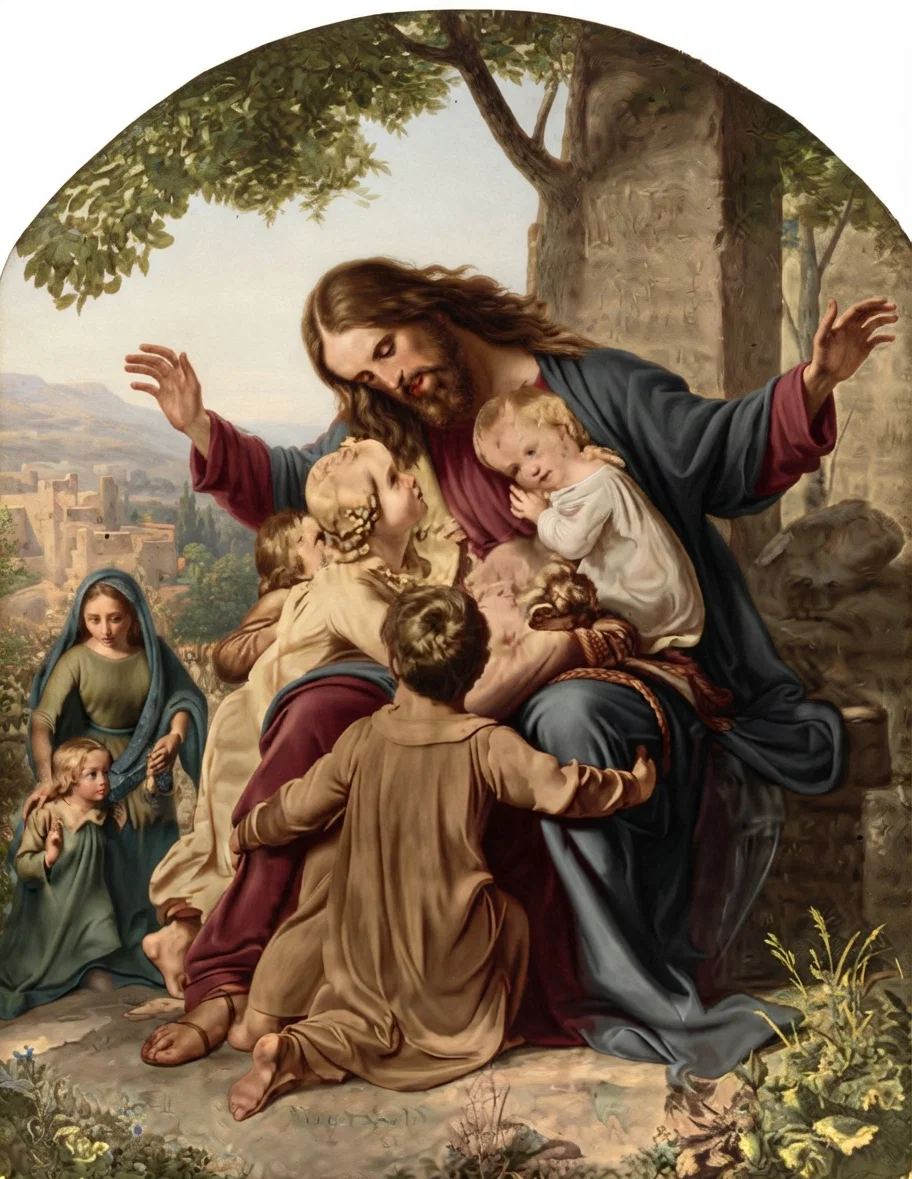
Calling the Children

By Mrs. E. G. White
As Jesus ministered in the streets of the cities of Judea and Galilee, mothers with their sick and dying little ones in their arms pressed thru the throng, seeking to come within reach of His notice.
Behold these mothers, pale, weary, almost despairing, yet determined and persevering. Bearing their burden of suffering, they seek the Saviour. As they are crowded back by the surging throng, Christ makes His way to them step by step, until He is close by their side. Hope springs up in their hearts. Their tears of gladness fall as they catch His attention, and look into the eyes expressing such pity and love.
Singling out one of the group, the Saviour invites her confidence, saying, "What shall I do for thee?" She sobs out her great want, "Master, that Thou wouldest heal my child." Christ takes the little one from her arms, and disease flees at His touch. The pallor of death is gone; the life-giving current flows thru the veins; the muscles receive strength. Words of comfort and peace are spoken to the mother; and then another case, just as urgent, is presented. Again Christ exercises His life-giving power, and all give praise and honor to Him who doeth wonderful things.
We dwell on the greatness of Christ's life. We speak of the wonderful things that He accomplished, of the miracles that He wrought. But His attention to things accounted small is even higher proof of His greatness.
Among the Jews it was customary for children to be brought to some rabbi, that he might lay his hands upon them in blessing; but the disciples thought the Saviour's work too important to be interrupted in this way. When the mothers came desiring Him to bless their little ones, the disciples looked on them with disfavor. They thought these children too young to be benefited by a visit to Jesus, and concluded that He would be displeased at their presence. But the Saviour understood the care and burden of the mothers who were seeking to train their children according to the word of God. He had heard their prayers. He Himself had drawn them into His own blessed presence.
Christ Blessing Little Children.
One mother with her child had left her home to find Jesus. On the way she told a neighbor her errand, and the neighbor wished to have Jesus bless her children. Thus several mothers came here together, with their little ones. Some of the children had passed beyond the years of infancy to childhood and youth. When the mothers made known their desire, Jesus heard with sympathy the timid, tearful request. But He waited to see how the disciples would treat them. When He saw the disciples reproving the mothers and sending them away, thinking to do Him a favor, He showed them their error, saying, "Suffer the little children to come unto Me, and forbid them not; for of such is the kingdom of God." He took the children in His arms, He laid His hands upon them, and gave them the blessings for which they came.
The mothers were comforted. They returned to their homes strengthened and blessed by the words of Christ. They were encouraged to take up their burdens with new cheerfulness, and to work hopefully for their children.
Could the after-life of that little group be opened before us, we should see the mothers recalling to the minds of their children the scene of that day, and repeating to them the loving words of the Saviour. We should see, too, how often, in after years, the memory of these words kept the children from straying from the path cast up for the ransomed of the Lord.
Christ is to-day the same compassionate Saviour as when He walked among men. He is as verily the Helper of mothers now as when He gathered the little ones to His arms in Judea. The children of our hearths are as much the purchase of His blood as were the children of long ago.
Jesus knows the burden of every mother's heart. He who had a mother that struggled with poverty and privation, sympathizes with every mother in her labors. He who made a long journey in order to relieve the anxious heart of a Canaanite woman will do as much for the mothers of to-day. He who gave back to the widow of Nain her only son, and in His agony upon the cross remembered His own mother, is touched to-day by the mother's sorrow. In every trouble, He will comfort and help.
Let mothers come to Jesus with their perplexities. They will find grace sufficient to aid them in the care of their children. The gates are open for every mother who would lay her burdens at the Saviour's feet. He who said, "Suffer the little children to come unto Me, and forbid them not," still invites mothers to bring their little ones to be blessed by Him.
In the children who were brought in contact with Him, Jesus saw the men and women who should be heirs of His grace and subjects of His kingdom, and some of whom would become martyrs for His sake. He knew that these children would listen to Him and accept Him as their Redeemer far more readily than would grown-up people, many of whom were the worldly-wise and hard-hearted. In teaching, He came down to their level. He, the Majesty of heaven, answered their questions and simplified His important lessons to meet their childish understanding. He planted in their minds the seeds of truth, which in after years would spring up and bear fruit unto eternal life.
When Jesus told the disciples not to forbid the children to come to Him, He was speaking to His followers in all ages—to officers of the church, ministers, helpers, and all Christians. Jesus is drawing the children, and He bids us, “Suffer them to come;” as if He would say, They will come, if you do not hinder them.
Let not your unchristlike character misrepresent Jesus. Do not keep the little ones away from Him by your coldness and harshness. Never give them cause to feel that heaven would not be a pleasant place to them if you were there. Do not speak of religion as something that children can not understand, or act as if they were not expected to accept Christ in their childhood. Do not give them the false impression that the religion of Christ is a religion of gloom, and that in coming to the Saviour they must give up all that makes life joyful.
As the Holy Spirit moves upon the hearts of the children, cooperate with His work. Teach them that the Saviour is calling them, that nothing can afford Him greater joy than for them to give themselves to Him in the bloom and freshness of their years.
The Saviour regards with infinite tenderness the souls whom He has purchased with His blood. They are the claim of His love. He looks upon them with unutterable longing. His heart is drawn out, not only to the best-trained and most attractive children, but to those who by inheritance and thru neglect have objectionable traits of character. Many parents do not understand how much they are responsible for these traits in their children. They have not the tenderness and wisdom to deal with the erring ones whom they have made what they are. But Jesus looks upon these children with pity. He traces from cause to effect.
The Christian worker may be Christ’s agent in drawing these faulty and erring ones to the Saviour. By wisdom and tact he may bind them to his heart, he may give courage and hope, and thru the grace of Christ may see them transformed in character, so that of them it may be said, “Of such is the kingdom of God.”
God can use every person just in proportion as He can put His Spirit into the soul-temple. The work that He will accept is the work that reflects His image.

The Sabbath on a Round World

THE All-Father, thru the divine Son, created the myriads of worlds: “By whom also He made the worlds.” Heb. 1:2. He made all things “that are in heaven, and that are in earth, visible and invisible, whether they be thrones, or dominions, or principalities, or powers: all things were created by Him, and for Him: and He is before all things, and by Him all things consist.”

Man Was Made.

The Father said to the Son, “Let Us make man in Our image, after Our likeness.” Gen. 1:26. Thus in counsel together, they made all things.

The Sabbath Was Made.

“The Sabbath was made for man,” said Jesus. Mark 2:27. It was made for the English, German, French, Italian, Swedish, and for whatsoever tongue or complexion, be they black, brown, red, or white—for “man,” uttered the Master, “for man.” Be it true then eternally, for the word, like its Author, changeth not. “I am the Lord, I change not;” “Jesus Christ the same yesterday [the eternity of the past], and today [present time], and forever [the eternal future].” Heb. 13:8.
Sabbath means rest. The Christian Sabbath means the rest of the Author of Christianity, who was also the Creator of all things—Jesus Christ.
As rest follows labor, so the rest of Christ, the Creator, followed His labor in creation; and this, the Lord’s day of rest,—“the Lord’s day,” “the Sabbath of the Lord thy God,”—followed the days of His labor in creation.

How the Sabbath Was Made.

Christ, as we have learned, made all things. “He spake, and it was done; He commanded, and it stood fast,” was spoken of the Lord in the creation of this world. Ps. 33:9.
After six days had been consumed in the creation of the host of the airy heavens and the earth, the work was accounted very good. Gen. 1:31; 2:1. The Creator then made choice of the only remaining day of that first cycle of seven days, upon which to rest. After resting upon the seventh day, He blessed it, then sanctified it. Thus the seventh day was made “the Sabbath of the Lord thy God,” and “made for man.”

Acts and Facts.

Fact 1.—He chose the seventh day upon which to rest—there was no other day in the cycle. Fact 2.—He rested upon the day He chose. Fact 3.—He blessed the day upon which He had rested. Fact 4.—He sanctified the day He blessed.
These four acts of the Creator are facts that can never be changed, and they made the seventh day the eternal Sabbath (Ex. 20:8-11) eternally the Lord’s day (Rev. 1:10), forever “the holy of the Lord” (Isa. 58:13), the Christian Sabbath as authorized by the Author of Christianity.
Jesus was a carpenter, but always observed the seventh-day Sabbath. Mark 6:2, 3; Luke 4:16. He said, “It is easier for heaven and earth to pass, than one tittle of the law to fail.” Luke 16:17. He placed both the Sabbath law and the Sabbath in the New Testament. “It is lawful to do well on the Sabbath days.” Matt. 12:12.
The disciples “rested the Sabbath day according to the commandment. Now upon the first day of the week, very early in the morning, they came unto the sepulcher, bringing the spices which they had prepared, and certain others with them.” Luke 23:56; 24:1. The Sabbath is herein said to be the day just before the first day of the week, and all this according to the commandment.
In the year A.D. 60, Paul declared himself to be a believer in the written law, so it must have been still in force; and in harmony with his faith as a true Christian, he observed the Christian Sabbath, the seventh day, commonly called Saturday, as a life-practise, in harmony with the example of the Master—the Author of the Sabbath and of Christianity. Acts 24:14; 17:2.
When the Bible proof has been presented that the seventh day (Saturday) is the Christian Sabbath, then we are informed that the seventh-day Sabbath can not be observed on a round world; for in going westward around the world we lose a day, and in going eastward around the world a day is gained; therefore it is useless to attempt to obey the Lord and observe the Sabbath on a round world. But can Sunday, the first day of the week, be observed any more easily on a round world?
The fact is, there is not one moment of time actually lost in going one way around the world, neither is there an actual gain of a moment in going the other direction. To illustrate this thought, let us take three children who are triplets. Let one go westward, and another eastward around the world, while the third remains at home. The one remaining at home will, without question, have all the time there is. And, if the theory is true, the one going westward will lose a day in his trip around the world; thus on his return he will be one day younger than the one remaining at home. The theory, if correct, will make the triplet who went eastward one day older than the triplet who remained at home, and two days older than his brother triplet who went westward. This would logically make the triplet who went westward two days younger than his brother triplet who went eastward, and one day younger than the brother triplet who remained at home. But such a condition could not exist, as they are triplets.
Again, if it be contended that there is a loss and gain of time in this journey, then, pray tell, where was the westward-bound triplet during the day he lost?
Take triplets at the moment of birth, place each in the cradle of time, and at that moment permit one to go westward with the velocity of time on the earth, and it would encircle the earth in just twenty-four hours(one day) to the second. Having taken one day to encircle the earth, if it lost a day, it would be compelled to lose the day it went in, and that would set the child back to the moment of his birth, thus having made his trip around the world in no time; the triplet child who was cradled at home would be, beyond question, one day old.
The child triplet going eastward would also make its journey in twenty-four hours (one day), and according to the theory, gain a day while making his journey. How could a child live forty-eight hours in twenty-four—two days in one—which it would be compelled to do if the theory were true?
If these triplets should continue the journey of life, until, in the natural course of events, the one remaining at home should become as old as Methuselah—nine hundred and sixty-nine years—the triplet going eastward, who each day gained a day, would be just twice as old as the one remaining at home, which would make it nineteen hundred and thirty-eight years of age; while the other triplet child going westward, making his circuit of the earth in a day, and each day losing the day in which he went, would ever at the completion of each trip be brought back to the moment of his birth, without age, and they triplets. Ah, it can not be. There can not one moment of time be lost on a round world. It is only an apparent loss or gain in traveling with or against time, and is corrected in the simple count of the mariner in crossing the dayline.
"The seventh day is the Sabbath of the Lord." It is "the Lord's day." It is the Christian Sabbath, and will be observed as such thru eternity. "For as the new heavens and the new earth, which I will make, shall remain before Me, saith the Lord, so shall your seed and your name remain. And it shall come to pass, that . . . from one Sabbath to another, shall all flesh come to worship before Me, saith the Lord." Isa. 66:22, 23.
H. W. COTTRELL.

Ability and Responsibility

ABILITY involves responsibility. Power to its last particle is duty.—Alexander Maclaren.

The Love of the Truth.

BY this scripture we know that the receiving of the love of the truth is salvation, and not receiving it is to perish. Because men are naturally so ignorant of the meaning of God's blessing of salvation they do not feel concerned for the love of the truth in order to obtain salvation; but their love for investigation and searching out things from beginning to end for their own purpose shows a perverted practise of this principle. The principle of the love of a thing is our only guide for right reasoning from cause to effect.
It is because the love of the truth has not been received that Satan can do all his work of unrighteousness in men. And now Satan is doing his work to the extent that it is one of many other signs that the last days are upon us, and proves also to what awful length this disregard of God's word leads.
The love of the truth leads to a knowledge of the truth, and to living it, as surely and naturally as the love of God leads us to keep His commandments. See 1 John 5:3.
Consider that the love of the truth is the principal thing taught in this text. It teaches that every soul of us must now, in this life, come into possession of love—the love which is of God, in order to learn the truth of His word. Love, our possession of it, its relation to truth, are all bound together in this text, but love stands out as the price of salvation. Love rewards with a knowledge of the truth, as hungering and thirsting after righteousness (Matt. 5:6) rewards with righteousness.
Let us then gladly and thankfully cast off all wrong motives, which are many, in reading and studying the Scriptures of truth. And let us solemnly consider the sum of this great matter; namely, those that receive the love of the truth are saved; those that do not, perish. There are only two issues, one glorious, the other awful; there is no middle ground. H. C. BALSBAUGH.

What Does He Hear?

TODAY I saw a little boy out in the barn-yard with a number of men. The little fellow stood in the circle, hands behind his back, eyes turned attentively up to the face of one of the men who was telling the others something—I hoped it was something that the little man might listen to safely. At the conclusion of the narrative, the men burst into a hearty laugh, the little man with the rest. Then I wondered more than ever about that story. It may have been pure. There are pure stories that are funny, exceedingly funny, but there are so many more that are not that it pays to be suspicious.
Is it safe for little boys to listen to all that is said in a promiscuous company of men? Is it safe for large boys? When you see a little fellow drinking in something that an older one is telling to an attentive crowd, or to him alone, be sure the story demands investigating. Impurities of thought and word and action are the stock in trade of more men and boys than it is pleasing to think of. They never tell them in the house in the company of ladies, nor do they tell them to self-respecting men; instead, they gather about them men and boys of another sort altogether, on the street, in the alley—in the saloon eventually—and pour into their ears unspeakable stories of soul-destroying filth.
It pays to know what the little folks hear, for there is far more understanding in the mind of a child than it is given credit for. An evil thought finds easy lodgment in an undeveloped mind, and from that little may grow a character as low and offensive as sin can make. It pays a thousandfold to know what the little ones hear.
MAX HILL.

Forgive Us as We Forgive.

"FORGIVE me, Lord, as I forgive." The grandest or most fearful prayer. If in my heart resentment lives To any soul, hopeless despair Is Thy just answer to that prayer. "Forgive me, Lord, as I forgive." Let every passion of my soul Each moment of the life I live Be under Thy supreme control, Thy love the fulness of the whole. The foes that smote my gracious Lord Received His prayer, "Father, forgive." If I can live His life and word, Then I shall be content to live, My life to cruel foes to give. J. A. POWERS.

Circumstances and Character

MAN is not altogether an imbecile. True, "circumstances do make the man;" but they make him only in the sense and degree that he permits them to make him.—G. D. Boardman.

Conditions in Answered Prayer.

1. What confidence do we have in asking for anything that is in accord with the will of God?
"This is the confidence that we have in Him, that, if we ask anything according to His will, He heareth us: and if we know that He hear us, whatsoever we ask, we know that we have the petitions that we desired of Him." 1 John 5:14, 15.
2. Are there other conditions, also?
"But let him ask in faith, nothing wavering. For he that wavereth is like a wave of the sea driven with the wind and tossed. Let not that man think that he shall receive anything of the Lord." James 1:6, 7.
"If any man will do His will, he shall know of the doctrine, whether it be of God, or whether I speak of Myself." John 7:17.
3. Having complied with the conditions, what may we with confidence say?
"Now we have received, not the spirit of the world, but the Spirit which is of God; that we might know the things that are freely given to us of God." 1 Cor. 2:12.

Men versus God.

4. May we not depend upon the learning of our wise men?
"It is written, I will destroy the wisdom of the wise, and will bring to nothing the understanding of the prudent." 1 Cor. 1:19.
5. What has the Lord said about trusting in man?
"Thus saith the Lord, Cursed be the man that trusteth in man, and maketh flesh his arm, and whose heart departeth from the Lord." Jer. 17:5.
6. But may we not depend upon the ministers?
"Her priests have violated My law, and have profaned Mine holy things; they have put no difference between the holy and profane, neither have they showed difference between the unclean and the clean, and have hid their eyes from My Sabbaths, and I am profaned among them." Eze. 22:26.
7. How long will God's word endure?
"The word of the Lord endureth forever." 1 Peter 1:25.
"The word of God, . . . liveth and abideth forever." 1 Peter 1:23.
8. What does the wise man say regarding anything that God does?
"I know that, whatsoever God doeth, it shall be forever: nothing can be put to it, nor anything taken from it; and God doeth it, that men should fear before Him." Eccl. 3:14.
9. Then when God speaks, is His word unalterable?
"Nothing can be put to it, nor anything taken from it."
10. What warning are we given against attempting to add to God's words?
"Add thou not unto His words, lest He reprove thee, and thou be found a liar." Prov. 30:6.
I. E. L.
Continue reading: Present-Day Conditions Minutely Foretold