"Let the Revelation speak and tell what is truth. . . . Uplift Jesus as the center of all hope."
A Challenge and the Victor
The Triumph of Sacrifice
THERE have been many crises in the affairs of men and nations, many challenges to overwhelming odds, many mighty results from the crises.
It was a mighty challenge to the world when Alexander the Great with an inferior force started on his Eastern campaign and met the Persian forces at the River Granicus. It was a challenge for the conquest of the world, a crisis in its affairs, and the young Macedonian warrior-king was victorious.
Napoleon challenged the world to combat when he began his career of conquest; but Waterloo was the crisis in his affairs and in the government of Europe, when the ambitious Corsican went down before the allied forces. History is full of such bold adventure and corresponding victory or failure.
God's work has had its challenges and crises. It was a challenge to faith and a crisis in God's work when Abraham heard God's call and met it. It was a challenge to all the powers of evil and a crisis in God's work when the shepherd from Midian, "Moses the man of God," stood before earth's mightiest monarch, and uttered the simple, single, reasonable message, "Thus saith Jehovah, Let My people go, that they may serve Me."
It was a crisis in Christendom when Luther found that climbing a stone staircase on his knees had no power to save, and his ear was open to hear that heavenly message, "The just shall live by faith." It was a challenge to his faith; its acceptance meant to him a battle for life, and his decision changed the face of the world.
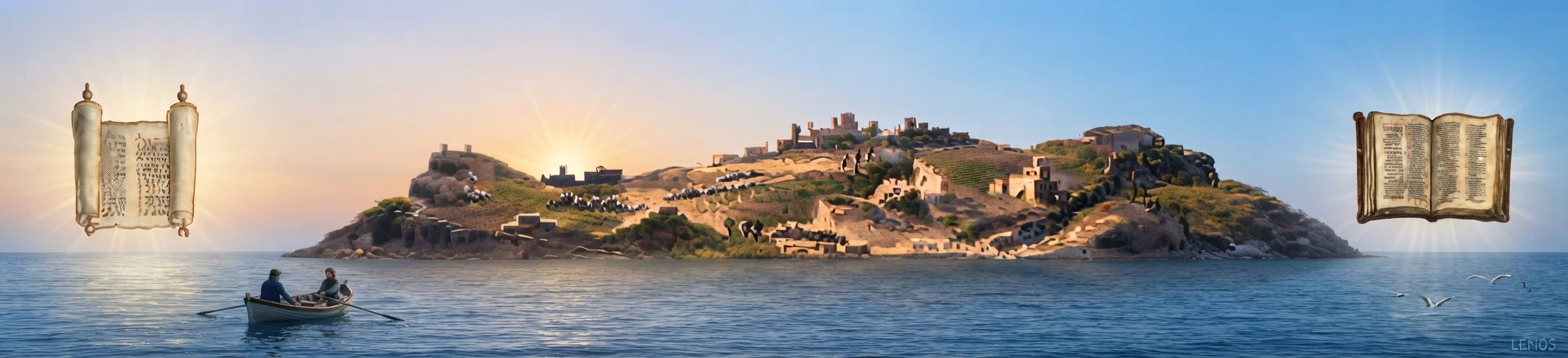
It was a greater challenge still to the prince of evil when the Son of God, clothed in mortal weakness, consented to fight on the same ground and in the same environments the battle of a thousand times the defeated one, groaning, dying, a captive in the dominion given him. It was the crisis of this world, of all humanity. This was among the things set forth in vision to the exiled disciple on Patmos. It is a continuation of the vision of our lesson study of last week.
PATMOS
The Answer of the Text
[The answers to the questions are from the American Revised Version. Omitting questions, and disregarding sometimes the capital at the beginning and the period at the close of an answer, the text may be read continuously. In notes and comments both versions are used without designation.]
1. What did John see after hearing the song of the holy ones?
And I saw in the right hand of Him that sat on the throne a book written within, and on the back, close sealed with seven seals.
2. What mighty challenge went forth?
And I saw a strong angel proclaiming with a great voice, Who is worthy to open the book, and to loose the seals thereof?
3. What was the result of the challenge?
And no one in the heaven, or on the earth, or under the earth, was able to open the book, or to look thereon.
4. How was John affected by this utter failure?
And I wept much, because no one was found worthy to open the book, or to look thereon.
5. How was he finally comforted?
And one of the elders saith unto me, Weep not; behold, the Lion that is of the tribe of Judah, the Root of David, hath overcome to open the book and the seven seals thereof.
6. What did the prophet then see?
And I saw in the midst of the throne and of the four living creatures, and in the midst of the elders, a Lamb standing, as tho it had been slain, having seven horns, and seven eyes, which are the seven Spirits of God, sent forth into all the earth.
7. What did the Lamb do?
And He came, and He taketh it [the book] out of the right hand of Him that sat on the throne.
8. What occurred when the Lamb took the book?
And when He had taken the book, the four living creatures and the four and twenty elders fell down before the Lamb, having each one a harp, and golden bowls full of incense, which are the prayers of the saints.
9. What do they sing?
And they sing a new song, saying,
Worthy art Thou to take the book,
And to open the seals thereof:
For Thou wast slain,
And didst purchase unto God with Thy blood
Men of every tribe, and tongue, and people, and nation,
And madest them to be unto our God
A kingdom and priests;
And they reign upon the earth.
10. What did the prophet then see?
And I saw, and I heard a voice of many angels round about the throne and the living creatures and the elders; and the number of them was ten thousand times ten thousand, and thousands of thousands.
11. What praise did they offer?
Saying with a great voice,
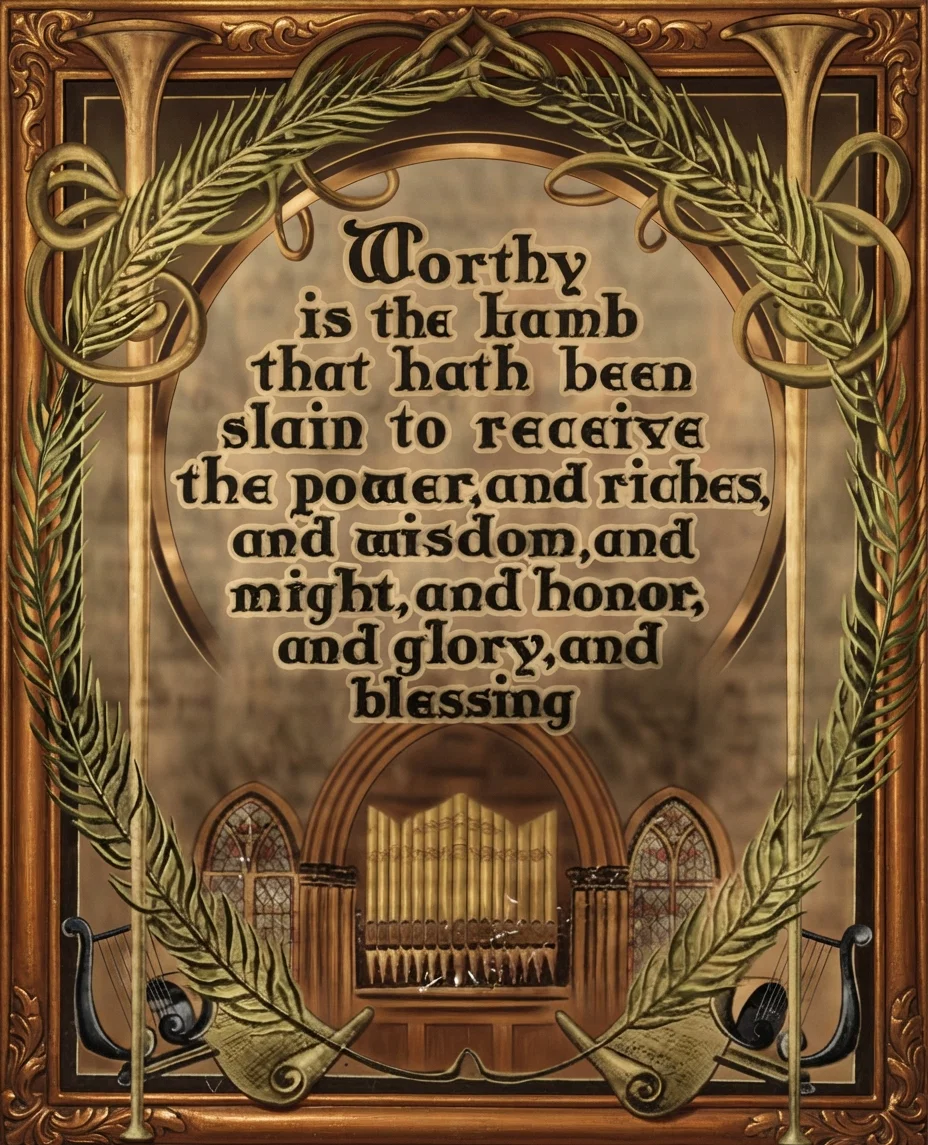
Worthy is the Lamb that hath been slain
To receive
the power,
and riches,
and wisdom,
and might,
and honor,
and glory,
and blessing.
12. How far did this song extend?
And every created thing which is in the heaven, and on the earth, and under the earth, and on the sea, and all things that are in them, heard I saying,
Unto Him that sitteth on the throne,
And unto the Lamb,
Be the blessing, and the honor, and the glory, and the dominion,
Forever and ever.
13. What was the response to this?
And the four living creatures said, Amen. And the elders fell down and worshiped.
Note and Comment
1. Him that sat on the throne.—The eternal Father, the Ruler, the Center of the universe. Right hand, the instrument of power and skill. Book, scroll. Some punctuate, "written within, and on the back close sealed with seven seals." If on the back there was writing, it was perhaps the titles of the contents within. Our illustration.
1. And I saw in the right hand of Him that sat on the throne a book written within and on the back side, sealed with seven seals.
2. And I saw a strong angel proclaiming with a loud voice, Who is worthy to open the book, and to loose the seals thereof?
3. And no man in heaven, nor in earth, neither under the earth, was able to open the book, neither to look thereon.
4. And I wept much, because no man was found worthy to open and to read the book, neither to look thereon.
5. And one of the elders saith unto me, Weep not: behold, the Lion of the tribe of Judah, the Root of David, hath prevailed to open the book, and to loose the seven seals thereof.
6. And I beheld, and, lo, in the midst of the throne and of the four beasts, and in the midst of the elders, stood a Lamb as it had been slain, having seven horns and seven eyes, which are the seven Spirits of God sent forth into all the earth.
7. And He came and took the book out of the right hand of Him that sat upon the throne.
8. And when He had taken the book, the four beasts and four and twenty elders fell down before the Lamb, having every one of them harps, and golden vials full of odors, which are the prayers of saints.
9. And they sang a new song, saying, Thou art worthy to take the book, and to open the seals thereof: for Thou wast slain, and hast redeemed us to God by Thy blood out of every kindred, and tongue, and people, and nation;
10. And hast made us unto our God kings and priests: and we shall reign on the earth.
11. And I beheld, and I heard the voice of many angels round about the throne and the beasts and the elders: and the number of them was ten thousand times ten thousand, and thousands of thousands;
12. Saying with a loud voice, Worthy is the Lamb that was slain to receive power, and riches, and wisdom, and strength, and honor, and glory, and blessing.
13. And every creature which is in heaven, and on the earth, and under the earth, and such as are in the sea, and all that are in them, heard I saying, Blessing, and honor, and glory, and power, be unto Him that sitteth upon the throne, and unto the Lamb forever and ever.
14. And the four beasts said, Amen. And the four and twenty elders fell down and worshiped Him that liveth forever and ever.
The Sealed Book and Its Worthy Opener
tion clearly shows how such a scroll could be sealed on the back, the breaking of each disclosing some new fact: Seven seals would indicate that it was fully, completely sealed. See Rom. 16:25; Eph. 3:9; Col. 1:26.
2. Who is worthy?—It is God's challenge to the universe, not for courage or strength or prowess, but for that which is more, and which includes all these—righteousness. In it is involved the eternal triumph of all struggles of the ages—the triumph of right. Worthiness the sealed book demanded. By worthiness only could its seals be broken.
3. No one.—No creature in God's universe was able, was worthy, even among the principalities and powers in the heavenly places, to open the book, nay, nor to look thereon. Learn hence the book's importance. It contains not a mere line of prophecy, not a portion of apocalyptic revelation duplicated elsewhere, not a chapter or so that we could spare with but little loss. In it was involved the salvation of the universe, the hidden mystery of the ages. Nor angel nor man could save from sin. Ps. 49:7.
4. Wept much.—Would God that more concerned themselves with the revelation of God's will. Moses turned aside to see the burning bush; Daniel considered the vision in detail which God gave him. John wept at the thought that that which was written for revelation to man should be withheld because no one was worthy to disclose it.
5. Weep not.—There is always a comforter from God to unselfish sorrow. This comforter, himself one who had struggled and longed for light and conquered, brought the message of cheer, the story of a Mighty One. The Lion of the tribe of Judah (Isa. 11:1), the Root of David, as also a Branch, had come to the rescue. The eternal Son of God had remembered the need of His children. Nay, more than that: He had stooped to sinful man's estate, had met the difficulties, obstacles, forces of evil, and had overcome in order that He might open the book and break its seals to humanity. But Christ overcame that He might save man. Therefore in the opening of the book there was involved the salvation of man.
6. In the midst.—Within the circle of the rainbow. A Lamb.—John looked for a Lion, and behold, a Lamb; but in the Lamb is potency greater than all armies, mightier than physical courage or power. Slain.—The climax of Christ's sufferings and sacrifice. In divine purpose He was the Lamb slain from the foundation of the world. 1 Peter 1:19, 20. But He met its actuality on Calvary. Opening the book cost the life and eternal sacrifice of the Son of God. The opening of the book was the opening and surety of God's everlasting Gospel. Seven horns.—Horn is a symbol of power. 1 Kings 22:11. In our Lord this power reached its fulness and perfection. Seven eyes, explained to be the fulness of God's Spirit.
7. He taketh it,—the book; He was worthy.
8. Fell down before the Lamb.—The victory of the Lamb calls forth spontaneous praise from all His holy and redeemed agencies. Full of incense.—A symbol of the merits of Christ's righteousness and sacrifice for man, making the prayers of God's children acceptable and effective. In the earthly temple incense was offered at the time of prayer. Luke 1:10.
9. Worthy art Thou.—And worthy, because He gave Himself to be slain, and to purchase by His blood those sold under sin. He is personified unselfishness, divine and infinite Love. Note that it is not said as in the Common Version, "hast redeemed us," but "didst purchase unto God with Thy blood men" from all classes of earth. A kingdom.—
They are subjects of God's kingdom, the important feature with Him of that kingdom, eventually to share it with Him. Dan. 7:27; Matt. 25:34. Priests.—Christ is our great High Priest. He has His assistants on high, represented by the twenty-four elders. But on earth, wherever there is a saved soul, that soul is a priest to minister the graces of Christ and offer the sacrifices of praise. 1 Peter 2:9; Heb. 13:15. Reign upon the earth.—Over sin now; over all the results of sin in the earth renewed and redeemed. Matt. 5:5; Ps. 72:8.
10. Many angels.—All God's angels are not organized in the grand divisions of His army, the cherubim. They are, as the term implies, angels, meaning messengers, to men and worlds throughout the far-reaching kingdom of God. Ten thousand times ten thousand equals one hundred millions, and then there are beside the thousands of thousands, the "innumerable company" of Heb. 12:22. God's armies are many, and have various divisions. Rev. 19:14. Yet had they but the one voice of praise.
11. To receive—the completeness, the seven-fold fulness of all that a king could ask or God bestow.
12. And every created thing.—Anticipatory of the final result of Christ's sacrifice when sin and its results shall be forever swept away. God's universe shall be sinless, and one universal song of joy and praise shall ascend to God, to whom and to the Lamb belong "the blessing, and the honor, and the glory, and the dominion, forever and ever,"—"unto the ages of the ages."
13. Amen.—It is true. The work is finished. God's mighty agencies, the great divisions of His army, who have wrought so mightily, the all-potent cherubim under His directions, join in the triumphant, eternal Amen. And all God's temple attendants see in the glorious result additional reason for holiest worship and adoration.
"Be Still"
By Flora E. Warren
By Flora E. Warren
I SMILE when I rise 'neath the sunny skies
Of the promising hour of morn;
But my heart sinks low in the sunset glow,
For my burdens are tied and torn.
I weep as I view, when the day is through,
All the gifts that my heart would bring;
For the closing day, tho I toil and pray,
Finds but one little offering.
I smile through my tears, as a sweet thought cheers
Like a rainbow in misty gloom:
In the Father's heart, a small flow'r has part;
I may stand in my place and bloom.
There's love and His grace for the smallest place,
Tho the day may be long and drear;
And a constant look through each cloud and crook
Will behold the bright sunshine near.
I know that His arm ever shields from harm,
And will guide all the weary way;
And my heart is light through earth's darksome night,
For there follows a perfect day.
My trust is in Him, tho my eyes are dim
As I pray He'll my loved ones keep;
There's a sweet voice mild, whispers, "Rest, My child,
For the Shepherd still loves His sheep."
There's joy, doubting heart, in the lesser part;
There's a place for the tiny rill;
And over each hour, is Love's guiding pow'r,
And His tender voice says, "Be still."
Have It to Thyself
"WHAT a mighty reformation we would witness through the land
If the masses and the classes could be made to understand
That he wins at least one sinner from dishonesty and pelf
Who will let alone his neighbor and just practise on himself."
Can We Walk with God?
By Christian Union
Is it possible for any of us in these modern days to so live that we may walk with God? Can we walk with God in the shop, in the office, in the household, and on the street? When men exasperate us, and work wearies us, and the children fret, and the servants annoy, and our best laid plans fall to pieces, and our castles in the air are dissipated like bubbles that break at a breath, then can we walk with God?
That religion which fails us in the everyday trials and experiences of life has somewhere in it a flaw. It should be more than a plank to sustain us in the rushing tide, and land us exhausted and dripping on the other side. It ought, if it comes from above, to be always, day by day, to our souls as the wings of a bird, bearing us away from and beyond the impediments which seek to hold us down. If the Divine Love be a conscious presence, an indwelling force with us, it will do this.
Hatred's Halter
THERE is no deep spiritual life possible to one who holds the slightest feeling of resentment or unfriendliness toward any living human being. The Bible recognizes only two possible attitudes toward a fellow being,—love and hate. Love is of God; hate is of the devil. Those whom, knowing, we do not love,—in the sense of having entire readiness to serve their interests even to the laying down of our life,—we hate; for there is no half-way ground. And, as Professor Stalker has said, "To leave hatred in even a corner of the heart is to leave the devil in possession; it is the kingdom of hell instead of the kingdom of heaven."
The devil does not ask us to turn over everything to him; he is well content if, in this way, we will give him welcome occupancy in just one "trifling" corner. He knows that, while he is permitted there, Christ can not get in. And he is often there in our half smothered yet very real bitterness of feeling toward some one. If we have found ourselves longing for all the fulness of the power and victory and joy of the Christian life, have we ever asked ourselves whether we are really willing to pay the price in letting hate go?—Sunday School Times.
Which Are You?
By William Arnot
Some people are rusty. Their harsh, ungainly manners eat out what is good in their character, and saw the very flesh of those who come near them. Some people are gilt, a very brilliant exterior they represent; but the first brush of hard using rubs off the gilding, and reveals the base metal beneath. A third class are polished. The polish, indeed, is on the surface; but it is a polish of solid worth, and in the multifarious crosses of human life, the more it is rubbed, the brighter it grows.—Rev. W. Arnot.
The Call to Dare and Do
By Alexander Mackay
FROM where the darkness is darkest comes to the church of Christ the call to dare and do.—Alexander Mackay.
Lessons in Liberty
By W. M. Healey
By W. M. Healey
VI. Individual Help from the Lord
GOD called Abraham from among his kindred, and separated him from the influences of their idolatrous practises, that he might learn the lessons the Lord would teach him. He gained his final victory when he gave up his son Isaac, in whom his hopes rested for this present life, and also as the ancestor of the coming Saviour. In giving his son, he was left without human support, and leaned wholly upon God.
Moses was obliged to flee from the pomp and splendor of Egypt's courts, to separate from the influences of her pride, her flatteries and jealousies. He was also obliged to separate from his own people, who disheartened him by their lack of love for each other, by their unfaithfulness to God, and their ingratitude toward those who would help them. In the land of Midian he sought God by himself; and when he had learned to trust in Him, and Him alone, God called him back to Egypt to deliver His people.
Noah, Daniel, and Job all learned to trust in God alone. They were counted righteous in His sight, but the Lord said they could only deliver themselves in the day of wrath. "If I send a pestilence into that land, and pour out My fury upon it in blood, to cut off from it man and beast: tho Noah, Daniel, and Job, were in it, as I live, saith the Lord God, they shall deliver neither son nor daughter; they shall but deliver their own souls by their righteousness." Eze. 14:19, 20.
When the Lord sent a man to curse Jeroboam's altar at Bethel, He told him not to tarry with any man, and to return by a different route from the one by which he went. The man did as he was told in pronouncing the curse, and refused to dine with the King, and started to return by another way, when a prophet came to him, and told him he had a message from the Lord that he should turn, and dine with him. The man turned back, and lost his life. 1 Kings 13:1-24.
God has taught us to harken to the voice of His prophets, by whom He would send messages to His people to the close of probation. The lesson He would teach us from the experience of the man who turned back at the prophet's word, is not that we regard His prophets less, but that each one should learn to regard God's Word above all others, and that no influence or word of any should turn the child of God from what he knows the Lord has said. The man knew what his duty was, and had no right to try, or to permit others to influence him, to shift the responsibility to even a prophet. Comparatively few have rejected the words of the Lord's prophets because they prophesied falsely. Many have rejected their words because there was truth in them, and they neither contradicted other words of God, nor took away the personal responsibility of the individual.
The Lord not only holds the individual responsible to Him, but He comes and reveals Himself to each one who learns the lesson of personal consecration to Him. When Christ asked the disciples, "Whom say ye that I am?" "Simon Peter answered and said, Thou art the Christ, the Son of the living God."
Based upon the Revelation of God
"And Jesus answered and said unto him, Blessed art thou, Simon Bar-jona: for flesh and blood hath not revealed it unto thee, but My Father which is in heaven. And I say also unto thee, That thou art Peter, and upon this rock I will build My church." Matt. 16:16-18.
Peter was blessed in the fact that the Father in heaven had revealed to him the great truth that he was in the presence of Christ, the Son of the living God. This revelation had not come by or through flesh and blood, but directly from God. Jesus said, "No man can come unto Me except My Father draw him." "National Reformers" would make laws, and by them try to drive men to Christ. God was drawing Peter to Jesus by a revelation to him through His Holy Spirit. Christ said, "Upon this rock I will build My church"—the rock of God's revelation to man, of God's Holy Spirit revealing truth to the individual heart and mind. Man has tried to build the church through the legislation of flesh and blood; but Christ, by the revelation and striving of the Holy Spirit. Christ may be said to be the rock on which the church is founded; because the revelation to man, by the Spirit, was because of Him and His sacrifice.
Jesus said, "If a man love Me, he will keep My words: and My Father will love him, and We will come unto him, and make Our abode with him." John 14:23. These words are worth the full value; they are a promise to the individual, of having the Father and the Son come and abide with him. This promise does not rest on worshiping God because there is a law to compel it, or because it is popular to worship, or on account of any personal gain, but on the fact that the individual loves the Lord. This leads him to keep His words, and brings the Lord to him.
There are many things in life which disappoint us, and grieve us sorely, that are easily borne by having Christ and the Father with us. At the marriage in "Cana of Galilee," where the mother of Jesus presided, she was much worried because, by some means, there had been a neglect to prepare sufficient wine. In her dilemma she came to Jesus and told Him her trouble. Then came a most comforting answer (which, however, does not so clearly appear in our King James translation), as He said, "What is that to Me and thee?" (Douay Bible.) Such trouble was great to the woman alone, but what was it to Christ and her together? His mother understood His words to mean that in the proper moment He would help. This is evident from the fact that she told the servants to do whatever He should command them. John 2:1-11.
The wine at this feast was not a necessity, only a long established custom; and yet in a matter of no more importance than this, Jesus worked a miracle at the request of one woman, His mother. He has promised as much to any other woman that does the will of God, as He did to His mother. "For whosoever shall do the will of My Father which is in heaven, the same is My brother, and sister, and mother." Matt. 12:50.
—**—
The Sure Harvest
By Flora E. Warren
By Flora E. Warren
Whatsoever a man soweth, that shall he also reap. Gal. 6:7.
IN my small garden bare,
I worked with zealous care,
The good soil to prepare
For sowing seeds.
I harrowed, and I hoed,
Much anxious thought bestowed;
But all the seed I sowed
Was that of weeds.
My neighbor's garden bloomed
With flowers rich perfumed,
While mine with weeds inhumed.
Vain all my deeds.
Why should my neighbor be
Blessed with sweet purity,
While daily I must see
Weeds — only weeds?
Why should my labor be
Wasted so utterly?
Ah, 'twas in foolishly
Sowing wrong seed.
Such fools are they who sow
Seeds of death, pain, and wo,
Then look for life to grow!
False, fatal creed!
O foolish ones, give heed:
Plant Christ, the living Seed;
Then in each word and deed
Christ will appear,
And in the harvest day,
Christ will be yours to pay.
He is the Life — the Way.
Be of good cheer.
Plant life, and life will grow;
We reap just what we sow.
Why should we be so slow
This truth to own?
The reaping time is here;
Each day in joy or fear,
We reap, with smile or tear,
As we have sown.
Now is our time to sow
What we would reap; to show
Our faith in what we know
The end will be.
Then haste! the end is near!
Soon will the King appear!
The fruit of sowing here
We then shall see.
Falsehood
By John Ruskin
It is not calumny nor treachery that does the largest sum of mischief in the world; they are continually crushed, and are felt only in being conquered. But it is the glistening and softly spoken lie, the amiable fallacy, the patriotic lie of the historian, the provident lie of the politician, the zealous lie of the partisan, the merciful lie of the friend, and the careless lie of each man to himself, that casts that black mystery over his humanity, through which every man who pierces we thank, as we would thank one who dug through a well in a desert.—Ruskin.
Life and Suffering
By John Birrell
A FIDDLE string coiled up in a music shop seems a useless thing. Kubelik, Sarasate, and Paganini united could not bring a single note of music from it in that condition.
But it possesses latent possibilities. Attach it to a fiddle, screw it tight, almost to breaking point, and ravishing strains that sway multitudes can be brought from it. We sometimes wonder why suffering is necessary, forgetting that the Master Musician is tuning us up to bring the best out of our lives. The string that knows no tension knows no music, and the life without suffering produces no melody.—John Birrell.
Prayer and Praise in Song
A VISITOR in Northern Michigan, in 1882, tells of being led by his host to the mouth of the famous Calumet and Hecla copper mine a little before five o'clock in the afternoon. "Stand here and listen," said his friend.
There was silence for a moment, and then, coming from the earth beneath their feet, faint sounds were heard. They grew stronger and more distinct as they waited, seeming like the weird melodies played by the wind on telegraph wires. Nearer and nearer they came, mingled with the creaking of machinery, and resolving themselves at last into the familiar notes of "Nearer, my God, to Thee."
In a moment the cage reached the top of the shaft, and the day shift of Welsh miners, who had been singing their way up from a depth of hundreds of feet, stepped out, and, baring their heads, joined in "Praise God, from whom all blessings flow," and then quietly turned homeward. "They do this every night when their work is done," said the host. "It is their expression of praise and thanksgiving."—New York Evening Mail.
Our Bible Reading
The Signs of Christ's Coming
1. What signs were there of the first coming of Christ?
First, there were the prophecies of the Old Testament relating to that coming which converged at the very time and place of His birth, such as Micah 5: 3; Isaiah 53, and others. Secondly, John the Baptist was a special messenger that went before Christ in fulfilment of Isa. 40: 1-5. Thirdly, the wonderful teachings and mighty miracles of Jesus wrought in fulfilment of His mission. Because of these there were many who knew that He was the Messiah and believed on Him.
2. What question was asked regarding His second coming?
What shall be the sign of Thy coming, and of the end of the world? Matt. 24: 3.
And there shall be signs in the sun, and in the moon, and in the stars; and upon the earth distress of nations, with perplexity; the sea and the waves roaring. Luke 21: 25.
5. What signs are given us in the prophetic field?
There are more than twelve different lines of prophecy pointing out these very days as a time when the coming of the Lord is near and His kingdom is about to be set up. And there are a multitude of special signs predicted to occur within the time of the end just before His coming, and these are in fulfilment or in process of fulfilment.
6. What special sign does one apostle give us?
Knowing this first, that there shall come in the last days scoffers, walking after their own lusts, and saying, Where is the promise of His coming? for since the fathers fell asleep, all things continue as they were from the beginning of the creation. 2 Peter 3: 3, 4.
7. What signs does Joel give us?
And I will show wonders in the heavens and in the earth, blood, and fire, and pillars of smoke. The sun shall be turned into darkness, and the moon into blood, before the great and the terrible day of the Lord come. Joel 2: 30, 31.
8. To what are the days just before Christ's second advent likened?
But as the days of Noah were, so shall also the coming of the Son of Man be. For as in the days that were before the Flood they were eating and drinking, marrying and giving in marriage, until the day that Noah entered into the ark, and knew not until the Flood came, and took them all away; so shall also the coming of the Son of Man be. Matt. 24: 37-39.
NOTE:—If we will but turn to the sixth chapter of Genesis we will find that the days of Noah were days of utter regardlessness of God except on the part of the very few. Men married them wives of all that they chose. Their whole thought was upon their own lusts, their own desires; and the record states that the earth was filled with violence. These are manifestations seen everywhere around us.
The Authority of God's Ministers
THE power, the authority, of the true minister of God, does not vest in his person, or in his office, but in the message of his Master which he bears. Said the angel to the apostles, "Go, stand and speak in the temple to the people all the words of this life." Acts 5: 20.
John the Baptist bore no credentials of men, had no descent of which to boast, no predecessors in whose stead he stood; he was not the Christ, nor Elijah, nor that prophet; but in God's plan he was all-sufficient for that time. Listen: "I am the Voice of one crying in the wilderness, Make straight the way of the Lord, as said the prophet Isaiah." John 1: 19-23.
John's greatness was in bearing the message, the Word of the Most High; and per contra he could tell the Pharisees who boasted of their long lineage and holy offices: "Think not to say within yourselves, We have Abraham to our father: for I say unto you, that God is able of these stones to raise up children unto Abraham." Matt. 3: 9. And therefore tho men in every station or any station refuse to give this Word, He can and will give voice to the insensate stones. Luke 19: 39, 40.
Faith and Precept
Faith also respects God's precepts. That is not faith which holds to the promise and despises the precept. And yet there are many who hope to be forgiven of transgression, and in the last great day to be made immortal, who are continually despising, or regarding as of no account, the commandments of God. They hope in His promises, and deceive themselves into believing that their hope is sure; but they sit in judgment on the divine precepts, and consider them as not worthy of observance, especially if inconvenient, inexpedient, unpopular, or demanding sacrifice.
The obedience rendered is the indicator of faith. The murderer, the thief, the idolater, the profane swearer, the proud, the covetous, the wicked of every class and degree, want prolongation of existence, and peace, and prosperity; and many are led to hope that if they believe God's promises, all these things are theirs. But no man has true faith in God's promises who does not have true faith in God's precepts. No man has sure hope in God's promises who does not have true submission to God's precepts. God is in the one as truly as the other. Nay, more, the precept is a promise. He who by faith submits with all his heart to a command of God, will find and know the implied promise that what is commanded, with all its beneficent results, is wrought in his character. He who accepts with all his heart the promise of God, accepts with it the righteousness of God which makes the promises possible.
Truth
By George E. Tack
By George E. Tack
TRUTH dwells upon the eminence of light,
Yes, up the sunlit slopes of God afar,
Beyond the utmost verge of sun and star,
That flash their cheery glances through the night.
Truth reigns with God upon the thronéd height,
Yet all may draw anear; the contrite heart
Is dear to Him who does the truth impart,
And He will make each darkened pathway bright.
Like Pilate, many query, "What is truth?"
Yet linger not to find the holy ray.
Tho it be far away, its voice is near;
Its whispers thrill the hearts of age and youth,
As low it bends, and in each list'ning ear
Proclaims, "I am the truth, the life, the way."
Do It To-Day
EVERY day that dawns brings something to do, which can never be done as well again. We should, therefore, try to do it ungrudgingly and cheerfully. It is the Lord's own work, which He has given us as surely as He gives us daily bread. We should thank Him for it with all our hearts, as much as any other gift. It was designed to be our life, our happiness. Instead of shirking it or hurrying over it, we should put our whole heart and soul into it.—Anon:
"THE Christian on his knees knows more and can see farther than the philosopher on his tiptoes."