Your ShelfYour Projects

Signs of the Times, Vol. 27, No. 24.

THE OPENING SEPULCHER

Signs of the Times

Jun 12, 1901

Pacific Press Publishing Company · Oakland, California · Jun 12, 1901

THE OPENING SEPULCHER.
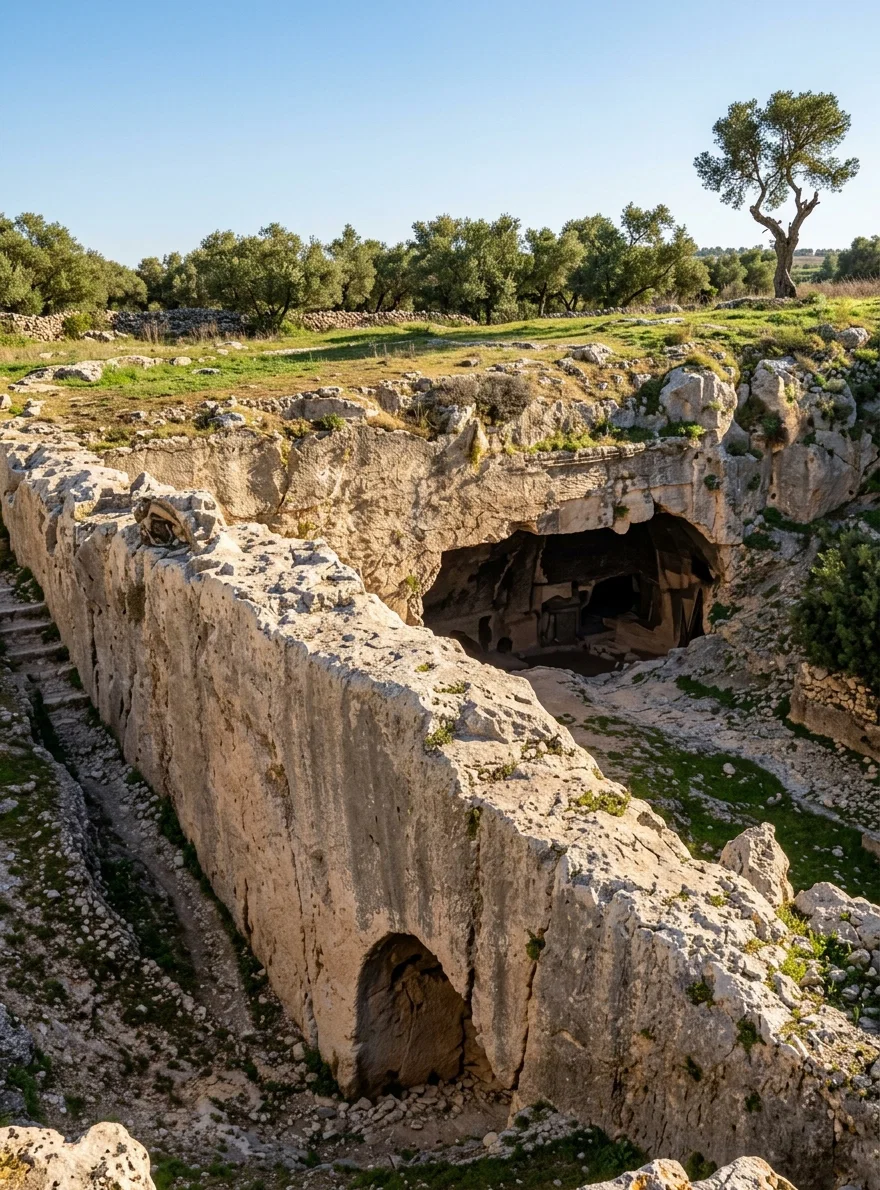
THE way the different nations and peoples of earth, during all the ages, have buried their dead, has always been an interesting study. The care that people have for the dead is a strong and clear indication of what some of their beliefs and superstitions were, and not infrequently does it mark their progress in civilization and enlightenment.
Jerusalem—Tombs of the Kings.
THE Egyptians believed that at some time the soul would of itself return to its body, and so they made mummies of their dead; while the Israelites believed in the resurrection of the dead by the power of God; and hence all they aimed to do was to give their deceased a respectful burial.
THE usual plan of the Israelite was for the burial ground to be on the family estate. And instead of simply burying the body in the earth, as is the custom so generally to-day, they had regular sepulchers cut in the rock, with places in them for entombing the members of the family as they died.
THE tombs, or “sepulchers, of the kings,” shown in our illustration, was in Jerusalem, “the City of David.” The biography of the kings of Judah usually closed with the statement that they were buried in the City of David, in the sepulchers of their fathers; the tombs of the kings of Judah. It is supposed that these sepulchers were near the temple on Mount Zion.
THE tomb has stood with an opening door ever since sin entered the world. Its doors swing ever inward; the dwellers in the “city of the dead,” so far as mere human knowledge can see, may never hope to see the doors turn outward, and give them release. But He with whom it is impossible for a mistake or failure to be made, has said: “Fear not; I am the first and the last, and the Living One; and I was dead, and behold, I am alive forevermore, and I have the keys of death and hades [the grave]. Write therefore the things which thou sawest, and the things which are, and the things which shall come to pass hereafter.” Rev. 1:17–19, R.V.
He who announces Himself as this “Living One,” and who says He has “the keys of death and hades [the grave]” also says, “The hour is coming, in the which all that are in the graves shall hear His voice, and shall come forth; they that have done good, unto the resurrection of life; and they that have done evil, unto the resurrection of damnation.” John 5:28, 29. It would be an absolute impossibility for the resurrection-day not to come. And when the day does come, it will also be an impossibility for the dead not to come forth. For the same voice that called man into existence will also call him from the grave at the resurrection.
WHEN that most glorious day is finally reached, how grand it will be to be found standing among those that are prepared to meet the Lord! It will not only be the “tombs of the kings” in “the City of David” that will possess their interest to us; but every hewn sepulcher, every lone grave, and every dark cavern, that has become the abode of the dead, will have its doors thrown outward that they may allow the sainted sleepers to come forth.
THE evidences all show that the resurrection-day is right at hand. Those of us who are now living may hope to see it without going into the tomb; we have good reason for the hope of being among those who are still living when the Lord comes. Does the thought of that great reunion thrill you with delight? Is your very soul panting for the time to come? If not, you have not yet learned to taste one of the sweetest and the most satisfying joys which God has given.
“Behold, I show you a mystery: We shall not all sleep [go into the grave], but we shall all be changed, in a moment, in the twinkling of an eye, at the last trump; for the trumpet shall sound, and the dead shall be raised incorruptible, and we shall be changed. For this corruptible must put on incorruption, and this mortal must put on immortality. So when this corruptible shall have put on incorruption, and this mortal shall have put on immortality, then shall be brought to pass the saying that is written, Death is swallowed up in victory. O death, where is thy sting? O grave, where is thy victory?” 1 Cor. 15:51-55.
T.

SIGNS OF THE COMING KING.

In the Heavens.

More than eighteen hundred years have elapsed since our Saviour's admonition to all men to watch for the signs of His coming. Sixty generations of men have appeared, acted their brief part on life's stage, and vanished from the scene of action. Do we who are living at the opening of the twentieth century see any indications of the Saviour's soon appearing?—Yes,—
“In the sun, and moon, and stars Signs and wonders have appeared; Earth has groaned with bloody wars, And the hearts of men have feared.
“Soon shall ocean's hoary deep, Tossed with stronger tempests rise, Darker storms the mountains sweep, Fiercer lightnings rend the skies.
“Dread alarms shall shake the proud, Pale amazement, restless fear; And amid the thunder-cloud Shall the Judge of men appear.
“But tho from His awful face Heaven shall fade, and earth shall fly, Fear not ye, His chosen race; Your redemption draweth nigh.”
It is not strange that in the natural world should be exhibited disturbances in premonition of the grand catastrophe by which the whole face of the earth will undergo a complete transformation. Indeed, it seems most appropriate that God should display in the firmament on high portents of His glorious coming in the clouds of heaven, to be seen and known of all men. The prophecy of our Lord designated these phenomena and the time of their appearance. “Immediately after the tribulation of those days shall the sun be darkened, and the moon shall not give her light, and the stars shall fall from heaven, and the powers of the heavens shall be shaken.” Matt. 24:29. The “tribulation of those days” is evidently the same mentioned in verse 21, referring to the persecution of the saints under Papal Rome.
Mark's Gospel presents the time still more exactly,—“In those days, after that tribulation.” Mark 13:24. The 1260 years of Papal supremacy extended to the year 1798; but “for the elect's sake” the days of persecution were shortened. According to history, persecution seems to have ceased about the years 1776 to 1778. About this time Maria Theresa, empress of Austria, abolished the torture in her domains; and “in Italy the arbitrary power of the Inquisition was circumscribed within narrow limits.”—White's History, p. 458. We may then look for the darkening of the sun after 1776 and before 1798. Did any such event occur during these years?—Yes; in the memorable Dark Day of May 19, 1780, and the moon also was darkened on the following night. The following account of this day is from “Annals of Portsmouth:” —
The nineteenth day of May, 1780, was remarkable for its uncommon darkness. The morning was cloudy, attended with a little rain. Between 10 and 11 o'clock the darkness increased, and began to assume the appearance of evening. Fowls went to roost, and cattle collected around the barn-yards, as at the approach of night. Before noon it became so dark as to be difficult to read without a candle; and lights were necessary at dinner, and to transact the ordinary work of a family thru the afternoon. The evening was enveloped in total darkness; the sky could not be distinguished from the ground. The clouds began to separate, and the vapors to disperse, a little before midnight, and some glimmerings of light appeared. . . . The darkness extended thruout New England, and was observed several leagues at sea.
Milo Bostwick, writing from Camden, N. J., March 3, 1848, says:—
The nineteenth day of May, in the year 1780, I well remember. I was then in my sixteenth year. The morning was clear and pleasant; but somewhere about 8 o'clock my father came into the house, and said there was an uncommon appearance in the sun. There were not any clouds; but the air was thick, having a smoky appearance. The sun shone with a pale and yellowish hue, but kept growing darker and darker, until it was hidden from sight. At noon we lit a candle, but it did not give light as in the night, and my father could not see to read with two candles. My father and mother, who were pious, thought the day of judgment was near. They sat up that night, during the latter part of which they said the darkness disappeared, and then the sky seemed as usual; but the moon, which was at its full, had the appearance of blood. The alarm that it caused, and the frequent talk about it, impressed it deeply on my mind.
President Dwight says:—
The nineteenth day of May, 1780, was a remarkably dark day. Candles were lighted in many houses. The birds were silent, and disappeared. The fowls retired to roost. It was the general opinion that the day of judgment was at hand. The Legislature of Connecticut was in session at Hartford, but being unable to transact business, adjourned.—Connecticut Historical Collections.
Other writers, in describing the dark day, have said: “The sun was supernaturally darkened.” “The moon, tho in the full, gave no light.” “The true cause of this remarkable phenomenon is not known.” AUGUSTA W. HEALD.

The Necessity of the Millennial Judgment

THE END OF SIN'S DOMINION.—NO. 4.

The Necessity of the Millennial Judgment.

AND I saw thrones, and they sat upon them, and judgment was given unto them; . . . and they lived and reigned with Christ a thousand years.” “Do ye not know that the saints shall judge the world? . . . Know ye not that we shall judge angels?”
Why the necessity of a judgment session to last one thousand years, in which the “saints,” “blessed and holy,” “have part”? Does not the Lord, who “knows the end from the beginning,” have definite knowledge of just what individuals have attained to Christ’s righteousness, and will therefore be saved; and, on the other hand, who have not availed themselves of the benefits of the great Sacrifice, and who have always resisted the Holy Ghost, instead of appropriating its power to overcome sin, and to bear its fruit in their lives, and will consequently be lost?
To deny the Lord’s knowledge of the final end of all, and the reward for good, or contrariwise the punishment for evil, due each member of the human family, would be to “limit the Holy One of Israel,” and to circumscribe the power of the Infinite One. Then there must exist a real and actual necessity that each case of lost men and angels come in careful review before, and pass the searching scrutiny of, all of the redeemed.
That necessity exists in the fact that the eternal God is accused by Satan, fallen angels, and men, of partiality, of being arbitrary, tyrannical, of ruling by force. Hence, in the very nature of the case, all of the ransomed must see and know that God is just when sentence is pronounced and executed upon the condemned, else the saved could not be supremely happy in the worship of the Father.
The only worship that the Lord accepts, is that in which all the heart, soul, might, mind, and strength are employed, because only in rendering such is complete satisfaction found by the worshiper. Not only have the avowedly wicked pronounced the Lord unjust, but even His professed people have said that the “way of the Lord is not equal,”—not just and equitable; and the boldly defiant, not knowing a fraction of His ways, have pointed the finger of scorn at the Father of all, declaring Him to be a God of “cruelty, injustice, wickedness.”
“Abundant sin! because a mortal man, A worm at best, of small capacity, With scarce an atom of Jehovah’s works Before him, and with scarce an hour to look Upon them, should presume to censure God— The infinite and uncreated God! To sit in judgment on Himself, His works, His providence! and try, accuse, condemn. If there is aught, thought or to think, absurd, Irrational, and wicked, this is more, this most! Wise men accuse themselves, not God.”
“Therefore judge nothing before the time, until the Lord come, who both will bring to light the hidden things of darkness, and will make manifest the counsels of the hearts.” At the present time, and till the close of the millennial judgment session, God is virtually on trial. The saved of each generation of men will doubtless sit in judgment on the cases of the lost of their own generation; and in each case, when the inmost motives of hearts are revealed, when it is made apparent that the lost refused to be redeemed, then those who have gained the victory, and have triumphed over sin, death, and the grave, will join with soul and voice in proclaiming, “Great and marvelous are Thy works, Lord God Almighty, just and true are Thy ways, Thou King of saints.” Then will be revealed,—
“The essential truth—Time gone, the righteous saved, The wicked damned, and Providence approved.”
G. W. REASER.

No Promise of Tomorrow

God has promised forgiveness to your repentance; but He has not promised to-morrow to your procrastination.—Augustine.

The Purification Ceremony of the Hebrews.

From former studies of the Hebrew types and ceremonies, it has been established that each sacrifice they called for pointed to some special phase of Christ’s atonement work for men. Heb. 10:1–3, 8–10. There was one ordinance, however, that was designed to demonstrate faith in Christ as the common Saviour for all. This was the ceremony of sacrificing a red heifer. To fulfil the requirements of the statute demanding this, all the people united in selecting from some flock a perfectly formed creature, having no blemish, and upon which a yoke had never been laid. This was brought to the priest, who led her away from the sanctuary and entirely out of the camp of Israel, where some one was chosen to kill her in the presence of the priest. Num. 19:2, 3.
The demand for a purely red animal in this case is another example of the exactness of God’s purpose. Were a single spot, however small, of any other color to be found upon the intended sacrifice, it instantly became worthless for the purpose intended. But there was good reason for this. The great Antitype—Christ—to whom this sacrifice pointed, was to be figuratively clothed in “red apparel” (Isa. 63:1–3), which symbolized the blood-stains of His wounded body. Rev. 19:13.
Fitly to represent Christ, the red heifer must never have borne a yoke, which was a symbol of bondage. In the sight of heaven sin is a “yoke of bondage.” Gal. 5:1; Lam. 1:14. Christ knew no sin, hence was never under that yoke. 2 Cor. 5:21; 1 Peter 2:21, 22. But notwithstanding this, He was chosen to die for the nation (John 11:49–52), and in due time the people led Him to the cross. Matt. 26:47, 57; 27:1, 2, 26. He was led out of the city and away from the sanctuary, to suffer “without the gate,” pursuant to His purification of the people. Heb. 13:12. In view of this, the exhortation of Inspiration is to all: “Let us go forth therefore unto Him without the camp, bearing His reproach.” Verse 13.
But since Christ tasted death for all men (Heb. 2:9), why the need of this personal exhortation, to go thru singly what He did for all? It will be seen from the law of the typical ceremony that the rite accompanying the sacrifice of the red heifer did not provide an indiscriminate purification for the whole house of Israel. True, the ceremony of the red-heifer sacrifice was performed once for all, and was for the whole people. But by following the ceremony thru, it will be seen that it all looked to a provision of which individuals might avail themselves in order to be freed from personal impurity.
The regulations of that ceremony required that the ashes of the burnt heifer be gathered, and carefully treasured for future use. On coming in contact with any dead carcass, a man was counted unclean, and his body, as the Lord’s tabernacle, was contaminated. Num. 19:13; 1 Cor. 3:16. Should he remain in this condition a certain length of time, he was cut off from God’s people. But that he might be saved from this calamity, it was provided that to a portion of the preserved ashes from the body of the red heifer might be added water from a running brook, and this mixture might be sprinkled with hyssop upon the unclean person, and all his belongings which had been affected by contact with him during his uncleanness.
Thus while general provision was made for every one in such an emergency, whoever refused to avail himself of the provision was excluded from all other benefits coming to God’s people. Num. 19:20. The contamination then received by touching a dead body, represented contact with sinners, who are now, in the discretion of heaven’s law, regarded as dead. Thus the apostle speaks of those who are “dead in trespasses and sins.” Eph. 2:1. Again, in representing himself as being tormented with the lusts of the old man of sin, while longing to be free from them, the distressed apostle passionately cried out, “O wretched man that I am! who shall deliver me from the body of this death?” or as the margin renders it, “from this body of death.”
So, now, those who obey the promptings of sin become defiled as by the touch of a dead body, and need to apply the water of purification, and so be sanctified and cleansed, to the removal of every spot, which heaven counts an unholy blemish. Eph. 5:26, 27. There is no stain of sin so deeply seated that it may not thus be cleansed. Even the terrible crime of David’s life was expunged by this process. In praying to this end, the psalmist exclaimed, “Purge me with hyssop, and I shall be clean; wash me, and I shall be whiter than snow.” Ps. 51:7. This cleansing or whitening process is a quickening with Christ, a passing from death unto life. Eph. 2:1, 4, 5; 1 John 3:14. We may indeed be thankful that the application of the blood of Christ reaches beyond the purification of the flesh, even to purging the conscience from dead works to serve the living God. Heb. 9:13, 14.
J. O. CORLISS.

SPIRITUAL GROWTH.

IT is the Lord's desire that His followers shall grow in grace, that their love shall abound more and more, that they shall be filled with the fruits of righteousness, which are by Jesus Christ, unto the praise and glory of God.
Where there is life, there will be growth and fruit-bearing; but unless we grow in grace, our spirituality will be dwarfed, sickly, fruitless. It is only by growing, by bearing fruit, that we can fulfil God's purpose for us. “Herein is My Father glorified,” Christ said, “that ye bear much fruit.” In order to bear much fruit, we must make the most of our privileges. We must use every opportunity granted us for obtaining strength.
A pure, noble character, with all its grand possibilities, has been provided for every human being. But there are many who have not an earnest longing for such a character. They are not willing to part with the evil that they may have the good. Great opportunities are placed within their reach. But they neglect to grasp the blessings that would place them in harmony with God. They work at cross-purposes with the One who is seeking their good. They are dead branches, having no living union with the Vine. They can not grow.
One of the divine plans for growth is impartation. The Christian is to gain strength by strengthening others. “He that watereth shall be watered also himself.” This is not merely a promise; it is a divine law, a law by which God designs that the streams of benevolence, like the waters of the great deep, shall be kept in constant circulation, continually flowing back to their source. In the fulfilling of this law is the secret of spiritual growth.
Hear Christ's words: “All power is given unto Me in heaven and in earth. Go ye therefore, and teach all nations, baptizing them in the name of the Father, and of the Son, and of the Holy Ghost; teaching them to observe all things whatsoever I have commanded you; and, lo, I am with you alway, even unto the end of the world.” No words can express the blessings received by those who work earnestly to carry out this commission. Of those who after the Saviour's resurrection obeyed His command to impart the light they had received, we read, “They went forth, and preached everywhere, the Lord working with them, and confirming the word with signs following.”
Everything that could be done was done to make our first parents pure and keep them pure. And since the fall the Lord has wrought out His will in the plan of redemption, a plan by which He is seeking to restore man to his original perfection. Christ's death on the cross has made it possible for God to receive and pardon every repentant soul. This was arranged in the councils of love. It is possible for us to be more than conquerors thru Him who gave His life for us. If we come to God in faith, He will receive us and give us strength to climb upward to perfection. If we watch every word and action, that we may do nothing to dishonor the One who has trusted us, if we improve every opportunity granted us, we shall grow into the full stature of men and women in Christ. Exceeding great and precious promises have been given us that we may do this.
Let those who are oppressed under a sense of sin remember that there is hope for them. The salvation of the human race has ever been the object of the councils of heaven. The covenant of mercy was made before the foundation of the world. It has existed from all eternity, and is called the everlasting covenant. So surely as there never was a time when God was not, so surely there never was a moment when it was not the delight of the eternal mind to manifest His grace to humanity. He is ever calling, “Let the wicked forsake his way, and the unrighteous man his thoughts; and let him return unto the Lord, and He will have mercy upon him; and to our God, for He will abundantly pardon.” “Behold, the Lord's hand is not shortened, that it can not save, neither His ear heavy, that it can not hear.”
Christians, is Christ revealed in us? Are we doing all in our power to gain a body that is not easily enfeebled, a mind that looks beyond self to the cause and effect of every movement, that can wrestle with hard problems and conquer them, a will that is firm to resist evil and defend the right? Are we crucifying self? Are we growing up unto the full stature of men and women in Christ, preparing to endure hardness as good soldiers of the cross?
MRS. E. G. WHITE.

THE SABBATH WAS CHANGED BY THE MYSTERY OF INIQUITY.

ADVOCATES of first-day sanctity claim that the Sabbath was changed from the seventh to the first day of the week in the days of the apostles, and by virtue of the resurrection of Christ,—that it was constituted a memorial of that event. The only Bible evidence claimed in support of this theory being of a doubtful, inferential character, the main evidence is drawn from the writings of the early Fathers. But of these same Fathers the great Reformer, Martin Luther, thus testifies:—
When God’s Word is by the Fathers expounded, construed, and glossed, then, in my judgment, it is even like unto one that straineth milk thru a coal-sack, which must needs spoil the milk and make it black. Even so likewise, God’s Word of itself is sufficiently pure, clean, bright, and clear; but thru the doctrines, books, and writings of the Fathers, it is very surely darkened, falsified, and spoiled.—Table Talk, p. 228.
Adam Clarke says:—
We should take heed how we quote the Fathers in proof of the doctrines of the Gospel; because he who knows them best, knows that on many of those subjects they blow hot and cold.—Autobiography, p. 134.
Roman Catholics also appeal to the early Fathers in proof of their claim that the change of the Sabbath was made by their church.
There are two mysteries brought to view in the Bible: the mystery of the Gospel, godliness (see Eph. 6:19; Col. 1:25-27; 1 Tim. 3:16); and the mystery of iniquity (see Rev. 17:5-18). The Sabbath, sign, or seal of the mystery of godliness is the seventh-day Sabbath. See Ex. 31:16, 17. The sabbath of the mystery of iniquity is, of course, a counterfeit of the true Sabbath, and it is the sabbath of Baal, or the sun. The following testimonies are from the Catholics themselves:—
The observance of Sunday by the Protestants is an homage they pay, in spite of themselves, to the authority of the [Catholic] church.—Plain Talk to Protestants, p. 213.
The observance of Sunday is solely a law of the Catholic Church. . . . The church changed the Sabbath to Sunday, and all the world bows down and worships upon that day in silent obedience to the mandates of the Catholic Church.—Father Enright, in Hartford Weekly Call, Feb. 22, 1884.
The Catholic Church claims that the change [of the Sabbath] was her act. . . . And the act is a mark of her ecclesiastical power and authority in religious matters.—H. F. Thomas, Chancellor for Cardinal Gibbons.
The Bible testifies:—
“And all that dwell upon the earth shall worship him, whose names are not written in the book of life of the Lamb slain from the foundation of the world.” Rev. 13:8.
Which will you obey? Is your name in the book of life? See Rom. 6:16; Rev. 20:11–15. A. SMITH.
Grandville, Mich.

THE RIGHT AND THE WRONG USE OF MONEY.

The power to get money is a gift from God. “It is He that giveth thee power to get wealth.” Deut. 8:18. The money is also His. “The silver is Mine, and the gold is Mine.” Hag. 2:8. We are His stewards, and responsible for the way we use His money. If we waste His goods, He will say to us in the end, “Give an account of thy stewardship.”
Now the Lord requires of us tithes and offerings. Yet when these are brought in we should say with David, “Of Thine own have we given Thee.” When these tithes and offerings were not paid, the Lord said to His people, “Ye have robbed Me.” When the people asked wherein, the Lord replied in “tithes and offerings.” Mal. 3:8.
The Lord had said to His people, “The tithe is Mine.” The Saviour recognizes the duty to pay tithe. Matt. 23:23. It is God’s plan that those who preach the Gospel should live of the Gospel.
No doubt there are many readers of the SIGNS who indorse these principles. You may not belong to any church. But will that excuse you from the duty to pay tithes? Should you pay tithe, would you lose anything? Suppose you try it? The Lord promises to pour out a blessing. Do you believe His Word? Can you trust Him?
But to whom shall we pay it? The Lord says bring it into the storehouse. Then God has a storehouse, a treasury from which God’s ministers draw a support. But who are God’s ministers? Those who preach for Him; not those who preach for money, nor those who preach the “doctrines and commandments of men;” but those who preach the Word; those who do not shun to declare the whole counsel of God. And what is their character?—“Be ye clean that bear the vessels of the Lord.” No true minister of God can use fermented wine, or cider or beer, or tobacco, or anything that defiles “the temple of God.” Faithful ministers of God have a right to draw support from His “storehouse.”
Now, dear readers of the SIGNS, remember the tithes of some of God’s servants has been the means of sending you the precious truth. Will you use the money God has given you to aid in advocating error or to aid in advancing what you believe is the truth of God? Think on these things, and may the Lord give you understanding.
Lexington, Ill.
C. H. BLISS.

FILLED WITH THE SPIRIT.

[From Alexander McLaren, D. D., in Sunday School Times.]
The central fact of that day was the gift itself, not the transient symbol, nor the transient consequence. Mark the universality of the gift. “They were all filled.” In old times, prophets and leaders had been endowed with the Spirit for various offices, but in Christ’s kingdom it is to be poured out on “servants” and “handmaidens.” The sun at rising touches only the peaks, but at noonday it floods the valleys. Every Christian possesses that gift, and has a new life given at first, and continuously sustained, by the indwelling Spirit. Alas that so many of them do not recognize the fact! Alas that so few of them are as completely possessed by that Spirit as they might be! For the completeness of the gift is emphatically marked. “They wereall filled,”—their whole nature was charged with the subtle, all-pervading influence, which, permeating every part, would manifest itself thru all vital actions, in the varied manner proper to each. The same life gives swiftness to the foot and strength to the arm, tints the cheek and brightens the eye, clears the mind and melts the heart. “All these worketh that one and the self-same Spirit.” Every Christian may be thus filled with a divine life. But how shrunken the tide, in the case of most of us, compared with the full river of God that might water our souls, and make all manner of things live whithersoever it came!

“HE LEADETH ME.”

AMONG the Rockies, the engineers say, Wherever the water comes dancing down A railway can clamber up; and they Coil round the loftiest Titan’s crown The loops of the lasso of winding track; And up this Romeo ladder they glide To smirch with the murk of the smoky stack The stainless hue of the clouds that hide The brow of old Blanco, scarred with age, Where we rode that night on the “narrow gauge.”
Startled, we heard the shrill whistle scream, And flocks of echoes, scared by its breath, Fluttered and flew thru the hissing steam. Near was the summit, but nearer Death Stood counting his tally. We felt the lurch And heard the brave engine wrench and strain; Then backward, down from the eagle perch, To the far-off valley reeled the train. Fear crumpled our souls, when one out-spoke, “Leap for your lives, the coupling’s broke.”
“The airbrakes are useless,” another one cried, As into the gorge, with a cosmic whir, We fell. Let the poets tell the night ride Of Paul Revere, with his red-wet spur, When he lifted the farms with his warning cry; Or Sheridan, when the long race was done, Smiting Defeat on his boastful face; Of the three who started, when only one Brought the good news from Ghent to Aix, But the thrill of them all was in our veins As we swept from the crest to the distant plains.
We followed the foamy stream, and swerved Where white stars lay in the emerald deeps, Roared thru snow-sheds, leaned and curved, Hung pendulous over the crumbling steeps, Comet-like cut thru the midnight air, Swayed inward, scouring the granite bank, While mingling with the voice of prayer, Torn from its moorings the water tank, Was hurled and tossed in the clanging car, That bore us away to the judgment bar.
One stumble or stagger would surely fling Us all thru the gate of Eternity, When a white-haired woman began to sing That heroic old hymn, “He Leadeth Me.” No wavering air, but clear and full, It rose and fell on that awful din, Triumphant as swims a gleaming gull Thru the ocean’s storms that she revels in, Our cradle was rocking, the Lord beat time, And we were swinging to that old rhyme.
Her faith laid hold on the Father’s arm, We joined in the chorus, and cast our fears To the howling winds; there could come no harm. With the seas and suns and choiring spheres, We swung like the shrine lamps, rhythmic sweet, In Jehovah’s temple, so vague and vast; We clung like His children around His feet, Till we safely stopped on the plain at last, All blessing the saint who beneath His rod Sent that song into the ear of God.
—Robert McIntyre, D. D.

“I AM.”

JESUS was walking on the stormy sea, coming to the aid of His disciples, whom He had seen “toiling in rowing; for the wind was contrary unto them;” “but they, when they saw Him walking on the sea, supposed that it was an apparition, and cried out; for they all saw Him, and were troubled. But He straightway spake with them, and saith unto them, Be of good cheer; it is I; be not afraid.” Mark 6:48-50, R.V.
These were comforting words to the disciples, and they have comforted many disciples since that night on the sea; but the disciples at that time did not derive all the comfort from them they ought, “for their heart was hardened;” and very few of the disciples since that day have seen in the words as they read them all that the Saviour really said.
The words rendered, “It is I,” meant far more than a simple assurance that it was their Teacher, a real person, who was coming to them, and not an apparition. They included that, which was certainly reassuring; but if the hearts of the twelve had not been hardened, they would have found not merely relief from their childish fears, but eternal comfort; for the words that Jesus uttered, literally translated, were, “Be of good cheer; I am.”
Here we see that Jesus identified Himself with the “I AM” who sent Moses to deliver the children of Israel from Egypt. Ex. 3:14. “I AM THAT I AM.” That expresses infinity of existence,—the One “who is, and was, and who is to come, the Almighty.” Of God alone can it be said that “He is.” That means that He is the Source of all existence; for everything that exists, exists solely in Him. “I Am” is the power that creates and upholds. In Jesus is the name of God, “for in Him were all things created.”
The words that Jesus spoke that night on the sea, were used by Him several times, but only once do they appear in our translation, namely, in John 8:58, “Before Abraham was, I am.” But twice more in the same chapter He declares Himself to be the “I Am,” and points us to the cross as proof of the fact. Thus: “When ye have lifted up the Son of man, then shall ye know that I am.” Verse 18. From John 12:32, 33, we know that the lifting up of Christ is His crucifixion. There is no salvation except by the cross of Christ; and the cross, as we have just seen, is the proof that He is the “I Am,” the Creator; therefore He said, “If ye believe not that I am, ye shall die in your sins.” John 8:24.
“I AM” signifies eternal power,—self-existent, independent power. It is the name of Him who is “from everlasting to everlasting,” and who is the dwelling-place of all mankind,—the One in whom “we live, and move, and have our being.” “In His hand are the deep places of the earth; and the strength of the hills is His also. The sea is His, and He made it; and His hands formed the dry land.” Ps. 95:4, 5. So when Jesus said to His disciples, “Be of good cheer; I am,” He really assured them that in Him was the power that made the sea, and that could therefore rule its raging, and that could save them, not only from momentary danger, but from eternal death.
In that name, “I Am,” there is everlasting strength. And it is all our hope. “He that cometh to God must believe that He is, and that He is a rewarder of them that seek after Him.” Heb. 11:6, R.V. To us, as well as to the disciples on the sea, He says, “Be of good cheer; I am.” He is always present, with all power in heaven and on earth. Simply believe that He is, and continue believing, and you have eternal salvation. “I am He that liveth, and was dead; and, behold, I am alive forevermore, and have the keys of hell and of death.” How boundless are those words, “I am.”
“He that hath ears to hear, let him hear.” “To-day, if ye will hear His voice, harden not your hearts,” as did the twelve, and thus lose the infinite comfort and strength that lies in the assurance “I am.” When in deep trouble or temptation, fix your mind upon the fact that He is. Listen to His voice saying, “I am,” and let your soul be swallowed up in contemplation of it, and you will be lost to everything else. Trouble will be light as air, and temptation will lose its power. The tempter will flee from you. What can not one endure, who knows not only that Christ is near, but that His presence creates, upholds, and saves! Let Him be to you the “I am,” and you will find that in Him you have everything that is. For “He that spared not His own Son, but delivered Him up for us all, how shall He not with Him also freely give us all things?” Let this be your confidence, and soon you will see Him as “He is.” E. J. WAGGONER.

DISCOURAGED

ONE of the most fatal things in the Christian life is discouragement. One of the most helpful is cheerfulness. A very wise man once said that in overcoming temptation, cheerfulness was the first thing, cheerfulness the second, and cheerfulness the third. We must expect to conquer. When our hearts are faint, then temptation has power. Satan knows this well, and he always begins his assaults by discouraging us.
The following allegory very forcibly illustrates this truth:—
Satan called together a council of his servants to consult how he might make a good man sin. One evil spirit sprang up and said, “I will make him sin.”
“How will you do it?” asked Satan.
“I will set before him all the pleasures of sin,” was the reply.
“I will tell him of its delights and the rich rewards it brings.”
“Ah,” said Satan, “that will not do; he has tried it, and knows better than that.”
Then another started up and said, “I will make him sin.”
“What will you do?” asked Satan.
“I will tell him of the pains and sorrows of virtue. I will show him that virtue has no delights and brings no rewards.”
“Ah, no!” exclaimed Satan, “that will not do at all; for he has tried it, and knows that wisdom’s ways are pleasantness, and all her paths are peace.”
“Well,” said another imp, starting up, “I will undertake to make him sin.”
“And what will you do?” asked Satan.
“I will discourage his soul!” was the short reply.
“Ah, that will do!” cried Satan. “That will do. We will conquer him now.” And they did.
An old writer says, “All discouragement is from the devil.” We wish every Christian would take this to heart and remember it. We must fly from discouragement as we would from sin.—Words of Faith.
Continue reading: RELIGIOUS PRINCIPLE