In July, 1898, Hawaii was annexed to the United States. Thus this ancient island kingdom and historic mission field came under the American flag.
The group consists of eight inhabited and four uninhabited islands. Honolulu, the capital, is 2,100 miles from San Francisco; 4,400 miles from Sydney, N. S. W.; 2,300 from Tahiti; 3,400 from Yokohama; and 4,900 from Hongkong. It is thus a port of call for vessels trading between San Francisco or Vancouver and South Pacific ports or the Orient, and its commercial importance is apparent.
The islands are volcanic, composed almost entirely of the products of eruption. They are mountainous, but none of the mountains reach the altitude of perpetual snow. Extinct craters abound. One of these, on the island of Maui, is the largest in the world, covering an area of about sixteen square miles, and having a depth of 2,720 feet. Mauna Loa, on the island of Hawaii, is a noted volcano. Sixteen miles from Mauna Loa is a volcano with the largest active crater in the world. A party of missionaries who visited it in 1823 described the crater as “nine miles in circumference, with vertical sides 1,000 feet deep, covered at the bottom with a lake of liquid lava, at one end red and boiling. Around the edge or from the midst of this fiery lake, fifty-one conical craters sent forth jets of lava or smoke and flame.”
A Street in Honolulu.
The scenery is picturesque, as the islands abound in mountains, valleys, and deep ravines. In Oahu “the valleys are remarkable for beautiful scenery, peaks, cliffs, lateral ravines, cascades, and tropical vegetation combining to charm the eye.”
In 1820 these islands were entered by a party of missionaries under the auspices of the American Board. They found a fine race of savages so far as physical development is concerned. Their religion is thus described by Mr. Ellis, an English missionary:—
“Tho less superstitious than the Tahitians, the idolatry of these islands was equally barbarous and sanguinary, as in addition to the chief objects of worship included in the mythology of the other islands, the supernatural beings supposed to reside in the volcanoes and direct the action of subterranean fires, rendered the gods objects of peculiar terror. Vast offerings were presented to the spirits supposed to preside over the volcanoes, especially during the periods of active eruptions. The requisitions of their idolatry were severe, and its rites cruel and bloody. Grotesque and repulsive wooden figures, animals, and the bones of chiefs, were the objects of worship. Human sacrifices were offered whenever a temple was to be dedicated, or a chief was sick, or a war was to be undertaken; and these occasions were frequent. The apprehensions of the people with regard to a future state were undefined, but fearful. The lower orders expected to be slowly devoured by evil spirits, or to dwell with the gods in burning mountains.”
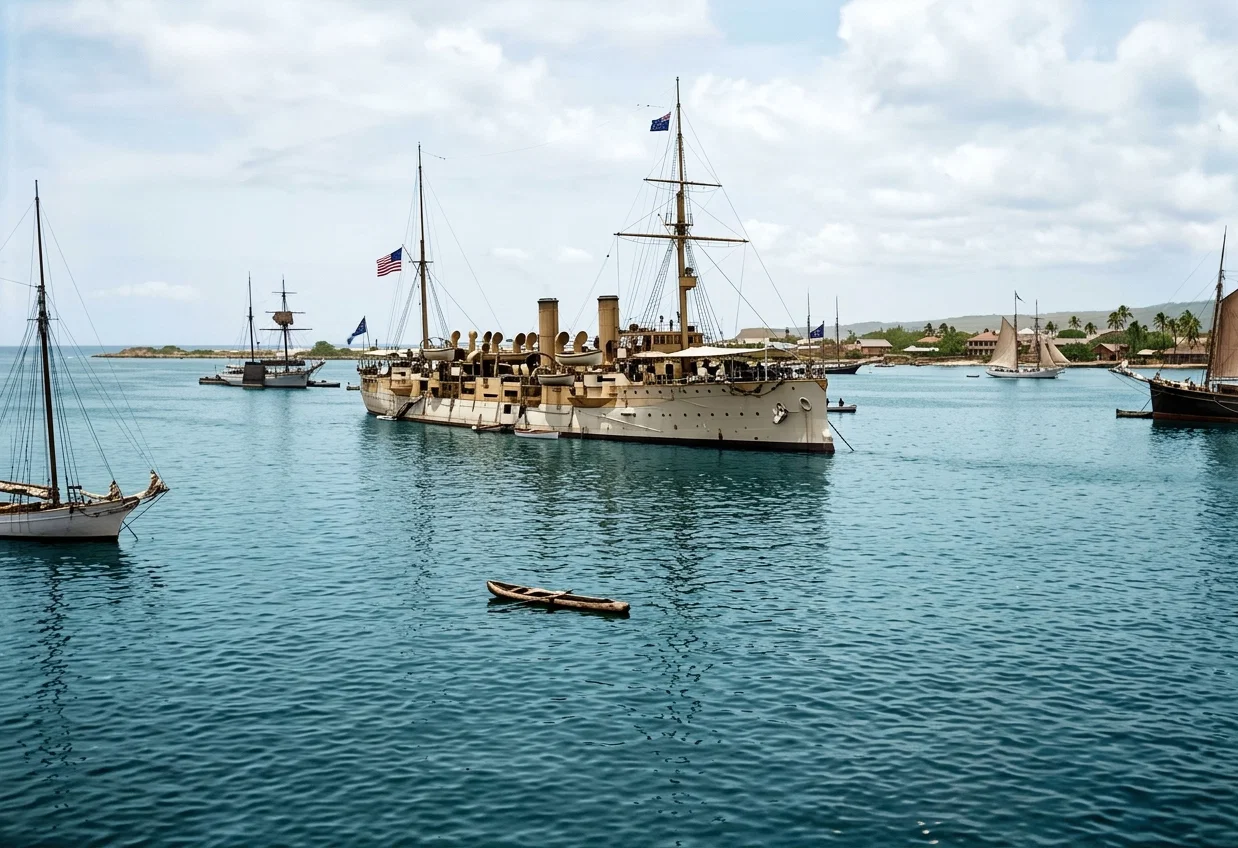
U. S. Cruiser Philadelphia in Honolulu Harbor.
The people ate the heart and liver of victims offered in the temple as a religious rite. The victor chiefs ate the same parts of any prominent warrior slain in battle, believing that this would put them in possession of the valor of the dead man. When the king died, the year before the missionaries came to the islands, a council of chiefs was held to consider what should be done with his remains, and some gravely proposed that he should be eaten. Their counsel, however, did not prevail.
When the missionaries arrived, the new king, Kamehameha II., had abolished taboo and idolatry, and the islands were practically without any religion. This was favorable to their work. But the degradation and superstition of idolatry had not been removed, and the people were no better morally than the natives of other South Sea islands. Infanticide was practised; polygamy and polyandry were common, and virtue was unknown.
The king owned all the land, and apportioned it to the chiefs according to his pleasure. The people were slaves under the chiefs, and anything they had might be taken from them. The missionaries tell of a man who carefully concealed a fattening pig, hoping that he and his family might have a feast. At length the pig was killed; but as it was roasting in the peculiar earth-oven of the islanders, the odor betrayed its whereabouts to a passing chief. He lingered near until it was done, then bore it off in triumph, leaving the poor man and his family to supply as best they could the loss of their roast dinner.
A royal princess came down to the beach to greet some missionaries who had just landed. A native who was standing by had a live sea-fish, probably a squid. The princess could not resist the tempting morsel. She seized the fish, without so much as “by your leave,” and thrust its head into her mouth. With her mouth filled, the black juice that the fish throws out to darken the water in defending itself streaming down her face, and its arms writhing around her cheeks, she greeted the strangers with what she could of dignity and grace.
The king and the chiefs with their families were the first pupils of the missionaries, and the king’s mother was the first convert. In a few years several powerful chiefs were converted, and their earnest work for the people had a great influence for good. The Bible was given to the people in their own language. And when the missionaries had been on the islands eight years, as the fruit of their work there were 12,000 regular church attendants, 445 native teachers, and 26,000 pupils in schools. From 1838 to 1844 there was one of the most remarkable revivals known in history. During these six years 27,000 natives were received into the churches.
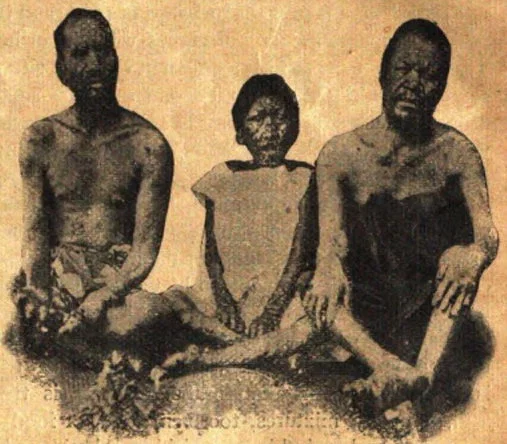
Island Lepers.
In 1850 a missionary society was organized on the Hawaiian Islands, with a board of eighteen managers, one-third of whom must be natives. This society has done effective work in Micronesia and the Marquesas Islands. Thus these people who had so lately received the religion of Christ, sought to impart its blessings to others, showing that the generous love which is the true spirit of the Gospel, had found a place in their hearts.
When Captain Cook discovered these islands, the population was estimated at 400,000. A census taken in 1897 showed the native population to be 31,000, with 8,000 half castes. There were besides, in addition to the Americans and Europeans there, 24,400 Japanese and 21,600 Chinese. Honolulu is said to contain “the most mixed population of any city in the world except Constantinople.” So many foreigners are there, and their influence is so corrupting, that it has been found necessary to keep the churches somewhat under outside supervision.
Leprosy is prevalent; in 1880 there were 800 victims of the disease on the islands. These are isolated on Molokai Island. The Hawaiian Missionary Society is doing good work among these sorely afflicted outcasts.
Christian laborers are at work among the 45,000 Japanese and Chinese, of whom more than 40,000 are said to be Buddhists. Missions and mission schools have been established among them, and a few churches have been organized. The Seventh-day Adventists have a church in Honolulu, with a flourishing school and mission among the Chinese, and a sanitarium which is open to all nationalities.
And so the islands are still missionary ground. Indeed, any place is missionary ground where there are souls to be won to Christ. E. J. B.
PERU AND ECUADOR AS MISSION FIELDS.
By Bishop Ninde
Peru is probably the most intolerant of all the republics of the southern continent. Public worship is strictly forbidden outside the Papal church. I was myself admitted by ticket to the prayer-meeting in Callao. Happily a considerable portion of the people, including many of the magistrates and other public men, are not so bigoted as their laws would indicate, and so the laws are not always as strictly construed as they might be.
At present there is a strong pressure upon Peru in behalf of religious freedom, caused by the example of its immediate neighbor on the north, the republic of Ecuador. Until within the past two years Ecuador has been regarded as the most antiquated and hopelessly papal of all the South American states. But recently a revolution has occurred in which the liberals triumphed. An eminent citizen was recalled13from his voluntary exile by the triumphant liberals, and placed at the head of a new government. The concordat with the pope, dating back in the sixties, was annulled, and new laws enacted which guarantee entire freedom of conscience and worship, and greatly restrict the privileges of the official church. As a consequence, many of the clerics at once fled to Peru, and a great and effectual door has been opened for the Protestant missionary. But no missionaries of any Protestant denomination, that I am aware of, are upon the ground. It should be said that the American Bible Society has its itinerating laborers scattering the pure Word of God thru these vast regions, with their sparse populations, and thus sowing the seeds of a true Christian faith.—Bishop Ninde, in the Gospel in All Lands.
GIVING AND RECEIVING.
By Plass
If deeds of love you would achieve,
This one great truth you must believe:
By giving you can best receive.
With prophet poor your cruse divide;
The little left is multiplied,
And want is kept far from your side.
Give water with a liberal hand;
And tho a famine curse the land,
You never once athirst shall stand.
Scatter the seed across the field;
Expect that when the scythe you wield
Abundant increase it will yield.
Give all you have in faith that more
Will be supplied from God’s own store;
Blessings will fall beside the door.
The naked clothe, the hungry feed;
What would supply a brother’s need
Lay not aside in selfish greed.
God sees the gift before Him laid,
The liberal soul shall fat be made,
The deed of love full well repaid.
—Plass.
ONE WOMAN'S STORY.
HERE is a story from Mission Studies which is the personal experience of a Chinese woman as she told it herself.
The day was hot, a crowd of curious gazers had gathered about in the little room in a native house, where the missionary lady was spending a few days. As the circle thinned out, the teacher noticed one woman lingering. On being asked how she came to know and love the truth, she said:—
“When I first heard the Jesus doctrine, I was a very devout worshiper of many gods, went often to the temples to burn incense and prostrate myself before the images, and at home was regular in such rites. My heart was never at rest. I was always afraid I had neglected something which I should have done to appease the spirits, and so I was always dreading some disaster and trying to avoid it by such offerings as, in my poverty, it was possible to make.
“I liked, from the beginning, to listen to the helper when he preached, and to his wife’s teaching, but it was months before I thought, ‘Perhaps this way of getting forgiveness and help is for me, and Jesus will take away my fear of the gods and evil spirits.’
“I began to pray to Him, and very soon my heart was at peace.
“But there were the paper gods on the wall, and the little mud one in a shrine outside the door! Dare I take them down and destroy them? What would the children’s father say? I had not courage to touch them, but I burned no more incense, and tried not to look at them, while I prayed early and late to the heavenly Father, and begged Him to make me willing to do whatever would please Him.
“One day the children’s father came in and asked me roughly why there was no incense before the shrine and no offering of food for the feast day.
“My heart stood still, but I prayed silently, and answered: ‘I do not worship those gods any more; they are all false. The God of heaven is a Spirit, and does not want offerings of food.’
“The words were scarcely out of my mouth before a blow from his fist knocked me down; and as I crouched on the floor, he beat me until I was so lame and sore I could hardly crawl up on to the kang.
“As I lay there bruised and faint, a great calm came into my heart, which had always been so restless and uncertain before, and I said, ‘O Lord, I will never be afraid again. I will take down the gods in the house that are mine, and never look at the one in the corner, which I did not put up, and so can not destroy.’
“When the boys’ father came home next day, the paper gods were all gone. He looked at the bare wall, and as I dropped on the floor picked a brick from the edge of the kang and pounded me with it until the blood ran from wounds in my head; but I was not frightened or angry, and then I knew that the Jesus religion must be true, and that it surely was the great God who helped and comforted me.
“I was always stupid, and never learned to read much, and I can not teach or help other people like Mrs. Chia and Mrs. Chang; but for these seven years I have had Jesus comfort in my heart.
“I prayed so long I almost despaired, for my boys’ father.
“He stopped beating me after a few months, but he reviled me and the Jesus way whenever he was angry. I thought he would never change; but Mrs. Chia told me how wrong it was to doubt when I prayed, so I just said, ‘I do believe, but give it to me quickly, Lord,’ and after two or three years he too gave up his evil ways.”
The man was a profligate gambler, and now he is a colporter, going about selling books and teaching the Jesus doctrine.
“My daughters have been in school in Peking, and I hope they will be brighter than their mother, and do more than I ever can to help others.”
How many hungry, longing souls are just waiting for some one to bring them the “Bread of Life.”—Union Gospel News.
OUR WORK AND WORKERS.
ON April 21, six persons were baptized at Hanford, Cal., by Brother F. M. Burg.
AT Wendell, Kansas, seven candidates were recently baptized by Brother G. G. Rupert.
ON May 10, seven students of Mount Vernon (Ohio) Academy were baptized by Brother W. H. Wakeham.
A HOUSE of worship at Meigs, Morgan County, Ohio, was dedicated on the 18th ult. Brethren A. G. Haughey and A. C. Shannon conducted the exercises.
A CANVASSERS’ institute is to be held in this city immediately after camp-meeting. An institute for church-school teachers will also be held at the same time.
THE SACRAMENTO branch of the St. Helena Sanitarium is located in the very heart of California’s capital city. It is located in the block adjoining the post-office, a fine government building, and on the principal business street. The branch is conducted by Dr. G. A. Droll and wife, and enjoys an encouraging patronage. Our literature is represented on the table of the waiting-room.
CAMP-MEETINGS now in progress and to be held during June are as follows: Oakland, Cal., 4-16; Anoka, Minn., 4-12; Erie, Pa., 6-16; Grand Rapids, Wis., 12-23; Alpena, Mich., 13-23; Sioux Falls, S. D., 18-24. Several others are to be held during the month, but we are not yet advised as to localities.
FROM the Watchman, Nashville, Tenn., we learn that Brother C. P. Bollman, former president of Tennessee River Conference, is now located in Nashville. At the close of the late General Conference it was decided to move the Sentinel of Liberty from Chicago to that city, and to continue Brother Bollman as one of its editors.
THE following items are from the Gospel Herald, Nashville, Tenn.: “Brother W. H. Armstrong is engaged in evangelical work among the colored people of Winston-Salem, N. C. He reports the work as prospering there. In the city is an organized church of colored people, and there is a good interest among those outside. . . . Brother Armstrong’s field of labor is the Carolinas and Virginia. At Danville, Va., there is a church of some fifty members. . . . The work of the Charity Mission, at Montgomery, Ala., has thus far been successful. Brother T. B. Beckner, who has charge of the mission there, writes that he has had opportunity to speak in several of the most popular churches of his (colored) people, and, as a result, many friends to the work have been made.” The report also states that the school at Montgomery is flourishing, two teachers being employed.
THE work in the San Francisco church has been steadily onward during the past year. Every month has witnessed the baptism of from three to five converts, with one exception, namely, the month of May, in which thirty-four have received the solemn rite. Twenty-nine of these were baptized Sabbath, the 18th, and were all children, ranging from eight to sixteen years of age. All of these were members of the church-school, and embraced every child in the school old enough to understand the benefits of Christian baptism. It is just such a result as this that may be confidently expected in any and every church-school conducted on right lines. Sabbath, the 25th, was another good day for the church, when five adults were added to the church thru the watery grave. One of these was a Japanese of promising appearance, which makes four of that nationality receiving the truth the past year. God is greatly blessing the work in San Francisco, for which we render thanksgiving to His name. J. O. CORLISS.
EGGS
EACH VARIETY $1.00 AND $2.00 PER 15
Fancy Black Langshans, White Wyandottes and Barred Plymouth Rocks.
Illustrated Price-list and Valuable Information free for stamp.
C. H. TYRRELL
SIOUX RAPIDS, IOWA
SOUTH AMERICA AS A MISSION FIELD.
By R. A. Phair
SOUTH AMERICA is a land of churches, but the church is not of the Bride of Christ; its priests are lazy, vicious, and lustful, making themselves to be despised rather than honored as every true pastor is. The Lottery for Souls is one chief feature of making money out of the poor, ignorant people, and it is a common thing to see, in the advertisements of the daily paper, announcements telling of those who won the lucky ticket, and in consequence had the soul of a relative prayed out of purgatory without the usual cost.
Another feature of worship is a ghastly procession, headed by four men carrying a heavy wooden cross, to which is tied a man with hands, feet, and side painted, thus imitating the wounds of Christ, and this man has to be made dead drunk before he will allow himself to be thus treated. Then come the priests followed by a dozen little children dressed to represent angels. This procession marches thru the town like a mob of rowdies. Mr. Linton saw one of the priests standing in his yard with a jug of liquor by his side, intently watching a cock fight. These priests are looked upon by respectable people with contempt, and indeed this can be little wondered at. As you all know, priests never marry, yet in one village a missionary heard of twelve children who claimed the priest as their honored father. This is only one of the many instances which greet the missionary at every turn.
Now turn to the Indian and see a far more deplorable condition,—a poor, despised, degraded race. They are used as slaves in a great many instances, and when they are paid it is only such wages as will keep them in existence; then abuses are resorted to, which make their lives so wretched that a mother often commits infanticide rather than see her children grow up to such darkness, misery, and sin. Yet these poor Indians have souls just as precious in the sight of Christ as ours are. This is the state of the people that have been Christianized according to the Roman Catholic religion. Yet there are at least eight millions of Indians, who, if happiness could be found without Christ, in vast forests, large, flowing rivers, a rude plenty in their homes, fruit in abundance, and without law to oppress, would be so but for that which in every heart reaches out for something beyond the things temporal. O, that men would consider our Lord’s last command to preach the Gospel to every people; for it alone possesses the power to raise them from the condition they are now in.—R. A. Phair, in Christian Worker.
A SPLENDID OPPORTUNITY.
READ, and see if this does not mean you.
ARE you aware that the Sanitarium Medical Missionary Training School has a correspondence department connected with it, and weekly sends out lessons to those whose duties keep them at home? This is the third year this course has been carried on, and scores are availing themselves of it. Studies on eleven subjects are given, missionary work and care and treatment of the sick being prominent.
The tuition fee is $3.00 which barely covers the cost of sending out the lessons and correcting and returning the copies sent in by the students. The books required for this work are furnished at actual cost price. We shall organize a new class in July, which will continue one year, and shall be glad to hear from all those interested. A descriptive circular, giving all particulars, also testimonials from those who are taking the course, will be sent free on application.
Address Cor. Dep't Sanitarium Training School, Battle Creek, Mich.
Baby's First Wardrobe
Hygienic Patterns
Complete outfit based on healthful principles, 22 neat patterns with full instructions for making, and an illustrated booklet on baby's care and clothing. All sent in a plain envelope for 50 cents in stamps or silver. If interested in the best books, patterns, materials, garments, and accessories for mothers or children, enclose a stamp or remit for patterns to Mrs. F. M. Kellogg, 38 Washington Ave., Battle Creek, Mich.
Farmers’ Names Wanted
Farmers’ Names Wanted; Send us the names and post-office addresses of Eleven Farmers who have land to clear or who have use for a Stump Puller, and we will mail Free to your address a copy of our Stories of the Great Northwest, now going to press. Write plainly, and address the W. Smith Grubber Co., La Crosse, Wis.
THE SABBATH SCHOOL
LESSON XII.—JUNE 22.—THE OFFERINGS.
(Concluded)
The Purification-Offering.
[Note to the Student.—These lessons are not designed to be exhaustive, but suggestive. In references to the “Desire of Ages,” in the lessons, the subscription edition is referred to. Those who have only the trade edition will find the matter in chapters 1, 4, 11, 27, 71, 77, 78; also read “Patriarchs and Prophets,” chapters 5 and 30, “Christ Our Advocate,” Bible Students’ Library No. 129 (price, 10 cents), and “Looking unto Jesus” (price, $1.00) will be found a great help. The SIGNS OF THE TIMES will have an article on the subject of each lesson this quarter by J. O. Corliss. Read these articles in connection with the study of the lesson. We have not space to print all the scriptures. Let the student study them carefully from the Bible. Those printed are from the Revised Version.]
SUGGESTIVE QUESTIONS.
1. What command did the Lord give to Moses and Aaron? “And the Lord spake unto Moses and unto Aaron, saying, ‘This is the statute of the law which the Lord hath commanded, saying, Speak unto the children of Israel, that they bring thee a red heifer without spot, wherein is no blemish, and upon which never came yoke.’” Num. 19:1, 2.
2. Who is represented by this red heifer? Ans.—Christ. Why must the heifer be red? (Isa. 63:1-3; Rev. 19:13.)
4. Did Christ ever come under this yoke? “For hereunto were ye called; because Christ also suffered for you, leaving you an example, that ye should follow His steps: who did no sin, neither was guile found in His mouth.” I Peter 2:21, 22. (2 Cor. 5:21.)
5. Who were to bring the red heifer to the priest? Who was to slay it? Where was it to suffer? “This is the statute of the law which the Lord hath commanded, saying, Speak unto the children of Israel, that they bring thee a red heifer without spot, wherein is no blemish, and upon which never came yoke; and ye shall give her unto Eleazar the priest, and he shall bring her forth without the camp, and one shall slay her before his face.” Num. 19:2, 3.
6. Who brought Christ to the priest? Who slew Him? Where did He suffer? “And while He yet spake, lo, Judas, one of the twelve, came, and with him a great multitude with swords and staves, from the chief priests and elders of the people.” “And they that had taken Jesus led Him away to the high priest, where the scribes and the elders were gathered together.” Matt. 26:47, 57. (Matt. 27:2, 26; Heb. 13:12.)
7. What was then done with the offering? What was burnt with it? “And Eleazar the priest shall take of her blood with his finger, and sprinkle of her blood toward the front of the tent of meeting seven times; and one shall burn the heifer in his sight; her skin, and her flesh, and her blood, with her dung, shall he burn; and the priest shall take cedar wood, and hyssop, and scarlet, and cast it into the midst of the burning of the heifer.” Num. 19:4-6.
8. What was done with the ashes? For what purpose were they kept? “And a man that is clean shall gather up the ashes of the heifer, and lay them up without the camp in a clean place, and it shall be kept for the congregation of the children of Israel for a water of separation: it is a sin-offering.” Verse 9.
9. For whose benefit were they used? “And he that gathereth the ashes of the heifer shall wash his clothes, and be unclean until the even; and it shall be unto the children of Israel, and unto the stranger that sojourneth among them, for a statute forever.” Verse 10.
10. Who were to be benefited by the death of Christ? “But we behold Him who hath been made a little lower than the angels, even Jesus, because of the suffering of death crowned with glory and honor, that by the grace of God He should taste death for every man.” Heb. 2:9. (Acts 2:30.)
11. For what was this offering made? What was the effect upon the tabernacle if the person was not clean? “He that toucheth the dead body of any man shall be unclean seven days.” “Whosoever toucheth the dead body of any man that is dead, and purifieth not himself, defileth the tabernacle of the Lord; and that soul shall be cut off from Israel; because the water of separation was not sprinkled upon him, he shall be unclean: his uncleanness is yet upon him.” “And whosoever toucheth in the open field one that is slain with a sword, or a dead body, or a bone of a man, or a grave, shall be unclean seven days.” Num. 19:11, 13, 16.
12. What was the effect upon everything the unclean person touched? “And whatsoever the unclean person toucheth shall be unclean; and the soul that toucheth it shall be unclean until even.” Verse 22. (Hag. 2:13, 14.)
13. What would befall the one who refused to purify himself? “But the man that shall be unclean, and shall not purify himself, that soul shall be cut off from the midst of the assembly, because he hath defiled the sanctuary of the Lord; the water of separation hath not been sprinkled upon him; he is unclean.” Verse 20.
14. Who only will be cut off? “For evil-doers shall be cut off;
But those that wait upon the Lord, they shall inherit the land.” Ps. 37:9.
15. What, then, is represented by touching a dead body?
16. How did Paul feel when he came in contact with sin? “But I see a different law in my members, warring against the law of my mind, and bringing me into captivity under the law of sin which is in my members. O wretched man that I am! who shall deliver me out of this body of death?” Rom. 7:23, 24, margin.
17. Describe the manner of purification. (Num. 19:17-19.)
18. What does the water represent? “That He might sanctify it, having cleansed it by the washing of water with the Word.” Eph. 5:26. (Note 2.)
19. How did David refer to this mode of cleansing? “Purge me with hyssop, and I shall be clean; Wash me, and I shall be whiter than snow.” Ps. 51:7.
20. If the touching of the dead body represented sin and death, what did the cleansing represent? “And you did He quicken, when ye were dead thru your trespasses and sins.” “But God, being rich in mercy, for His great love wherewith He loved us, even when we were dead thru our trespasses, quickened us together with Christ (by grace have ye been saved.)” Eph. 2:1, 4, 5. (Repeat Heb. 9:13, 14.)
NOTES.
1. The yoke represents the yoke of bondage and sin. Christ never came under this yoke. 1 Peter 2:22. He who was above the law, being the Author of the law, voluntarily became sin for us, suffering the penalty of the broken law in our stead. Yet, never having committed sin, He never came under the yoke of bondage. His submission was wholly voluntary.
2. This was called the water of separation, because when sprinkled upon a defiled person it separated him from his uncleanness, and admitted him to all the privileges which he for a time had lost. Num. 5:2. The ashes point to the suffering and death of Christ; the Holy Spirit uses the word (symbolized by the running water) to remind us of that suffering. Ps. 19:7, margin.