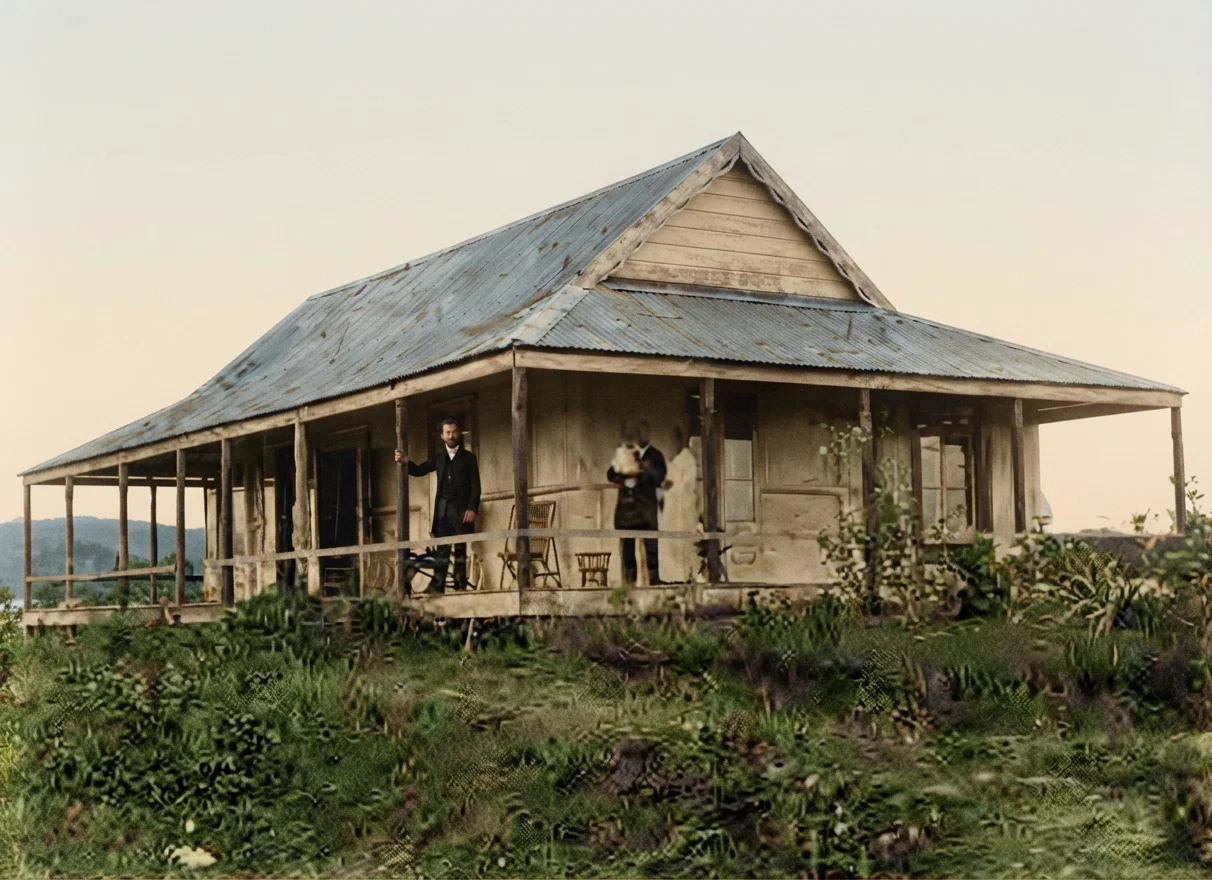
AFTER a stay of one week at Suva Vou, during which several meetings were held, we started in the mission cutter "Cinna" for a cruise among the other islands of the group. It being hurricane season, we were running some risks in taking an extended trip in a craft only thirty feet long; but no disasters happened to us, tho several ships were wrecked a few days before we started. Besides Elders Fulton and Parker there accompanied us Brethren Ambrose and Pauliasi, and two native students, Elaisa and Alipate.
Mission House at Suva Vou, Fiji.
The first night we stayed at Rewa, being entertained at the house of the native magistrate. Here we met one of the high chiefs of Fiji, a near relative of Brother Ambrose.
At his house, perhaps the finest native house in Fiji, he and our two native brethren sat up and talked on Bible truths till daylight. From Rewa, which is on a river of the same name, we passed out into the ocean, and at night were at Ovalau, a small island a few miles from the large island of Viti Levu, sixty miles from home, with tired bodies and faces blistered by the hot sun.
Not being able to quite reach Levuka, the old capital of the group, we stayed overnight at a little native village, where we were hospitably entertained by the natives. Having nothing but a bare mat for a bed—not even a pillow—and having to contend with heat, tobacco smoke (for the natives persisted in sitting up most of the night smoking), mosquitoes, fleas, and ants, I slept but little. The native houses are made very tight, and are closed up at night, probably in an effort to shut out the mosquitoes. In this they differ from the houses in most of the other groups, which allow the free circulation of air.
After spending a little time in and around Levuka, where we had spent considerable time on the occasion of our first visit here, in 1891, and finding the wind unfavorable for sailing north to the big island of Vanua Levu, we decided to try to reach Somai Viti—Middle Fiji—before the Sabbath. This division of Fiji consists of several small islands occupying the central portion of the group.
On account of light winds we did not reach our first stopping-place—Batiki—till 11 P.M. Sabbath, and were compelled to anchor outside of the reef till morning, it being dangerous to attempt to go through the reefs in the dark.
In the morning we passed through in safety, and took breakfast at the home of a sister of Brother Ambrose. This meal was served to us as we sat on mats on the floor, and consisted of boiled taro and yams, without plates or spoons, knives or forks. But the food was excellent and plentiful, and we ate it with thankful hearts.
When the meal was finished, a basin of water was brought, into which Ambrose dipped his hands. As soon as he had done that, some of the natives clapped their hands, which I learned was the customary way of showing respect for his superior rank as high chief.
At night Brother Fulton preached to a fair-sized congregation of natives in the house of this lady, and the next night spoke by invitation in the house of the buli, or district chief. Brother Pauliasi, who was well acquainted here, labored in his quiet way to interest the natives in God's truth for these days. There are no white people in this island, and the people were anxious that some of us should locate among them and teach school. Land was offered for that purpose.
From Batiki we sailed to Ngau, reaching there just at dark, in a heavy storm.
Not being able to see the sunken reefs, we struck one of them, but not with sufficient force to damage our ship. The many hidden reefs around the islands of this group are a constant menace to navigation.
Our time here was spent in trying to interest the natives in God's truth, and in looking for a place which would be favorable for a mission location. Among the natives we found one or two old men who told us that they had been cannibals before the introduction of the Gospel. Our next stop was at Nairai, where we found that there was some prejudice against our work on the part of the religious teachers.
Residence of Old Chief Vanua Levu.
Wishing to reach Savu Savu Bay on Vanua Levu, sixty miles north, before the Sabbath, we decided to run the risk of sailing all night, and so left Nairai Thursday noon with a light wind. All night and all day Friday we sailed, and just before sunset found ourselves apparently but a few miles off a point of land extending into Savu Savu Bay. As the darkness came on, a rain-storm arose, which shut off entirely our view of the land.
Just before the darkness finally shut down on us the clouds lifted, and for a few minutes we saw the point of land, then nothing could be seen clearly. Supposing that we were running directly toward the entrance, we kept on our course for some distance, till we thought we were inside the bay, then came about to run behind the point of land; but we found that we were deceived by the darkness, and were still in the open sea, having lost our bearings, with nothing to guide us into the entrance. Had a storm come on, we would have been in a dangerous position. Brother Pauliasi now took charge of matters, and, guided by the faint roar of the seas on a distant reef, took us through the intense darkness to a place of safety, where we anchored at 2 A.M. Sabbath morning.
After a late breakfast we held a religious service in a grove of coconuts, and spent the rest of the day with the family who owned the grove, whom I had met nine years before.
The next day we crossed the bay and spent a few days with some of our old acquaintances. Our native brethren stayed at the home of the old chief of the native village near by, and found a real interest to investigate the special truths which God had given him.
The old chief, who was formerly a cannibal, urged that one of our missionaries settle among them and teach their children. There being no school near, others in the community among the whites also made the same plea. As soon as possible we hope to comply with their wishes. After spending a few days in this place, we started on our return to Suva, taking with us a young man to attend our school at Cooranbong, Australia. This time we had no lack of wind. At 10 A.M. a strong trade wind came up and continued till night. On we rushed like a race-horse, first on the crest of the waves, then in the trough of the sea, now almost on13our beam ends, the spray dashing over us every few minutes. Soon Brother Pauliasi, Brother Fulton, and the young student were seasick, and lay flat on the deck, drenched every few minutes with sea water, too helpless to move.
About noon we passed a small island and for half an hour were inside of the quiet lagoon, which enabled the sick ones to get up and take their bearings. Getting into the open sea again we rushed on, with no opportunity to take our dinner, till, tired and hungry, we put in at a native village on Ovalau for the night. The next morning early we started for Suva Vou, which we reached about 7 P.M., thankful to God for His care over us.
Having now looked over the field, we held daily councils for prayer and deliberation over future moves. It was decided to begin work at Savu Savu Bay as soon as possible; to get translations of tracts and books on different subjects for circulation among the natives; to engage Brother Pauliasi to assist in translation and in work among the villages near home; and to educate native young men to become missionaries for their race.
Brother and Sister Parker have since this been compelled, on account of poor health, to go to Australia for medical treatment, but they hope to return next year to the work which they love.
March 9, in company with the young student, I left Fiji on the steamer "Birkagate," and nine days later was with my family in New South Wales, after three months' absence.
E. H. GATES.
MISSIONARY HYMN.
By Sara Geraldina Stock
A CRY as of pain,
Again and again,
Is borne o'er the deserts and widespreading main:
A cry from the lands that in darkness are lying,
A cry from the hearts that in sorrow are sighing.
It comes unto me;
It comes unto thee;
O what—O what shall the answer be?
O! hark to the call;
It comes unto all
Whom Jesus hath rescued from sin's deadly thrall;
Come over and help us; in bondage we languish;
Come over and help us; we die in our anguish.
It comes unto me;
It comes unto thee;
O what—O what shall the answer be?
It comes to the soul
That Christ hath made whole,
The heart that is longing His name to extol.
It comes with a chorus or pitiful wailing,
It comes with a plea which is strong and prevailing;
"For Christ's sake" to me;
For Christ's sake to thee;
O what—O what shall the answer be?
—Sara Geraldina Stock.
OUR WORK AND WORKERS.
THE Haskell Home, an institution for the care of orphans, near Battle Creek, Mich., this year raised twenty acres of beets under contract for a sugar factory at Kalamazoo. The work was done mainly by the boys, and a representative of the factory says it was the best beet field he has ever seen.
WRITING to the Welcome Visitor from Birmingham, England, Brother S. G. Haughey notes the accession of twenty-five adherents to the faith in connection with meetings held in that city by Brother E. E. Andross and himself. He says, "One minister is obedient to the faith, and four others are attending our meetings." The interest is spreading, and these brethren have invitations to speak in different parts of the city.
BROTHER J. E. WHITE recently paid a short visit to California, coming here to visit his mother, Mrs. E. G. White, and brother, W. C. White, on their arrival from Australia. He spoke in the Oakland Church Sabbath, September 29, and again on Sunday evening, October 7. On the last occasion he gave an interesting account of his work among the colored people in Mississippi, in which he has been engaged for the past six years. His story was made more realistic by a number of stereopticon views. These were all photographs showing city and country life, thrilling scenes connected with the great flood of two years ago, churches and schools established by the Southern Missionary Society, and also of the missionary steamer Morning Star, which has been a prominent factor and an almost indispensable auxiliary in that difficult yet fruitful field. A lecture on the same subject was given in San Francisco. Altho having met with many obstacles in their work, Brother White and his co-laborers are receiving fresh encouragement, and go forward with renewed hope.
A LOCAL camp-meeting was held at Napa, Cal., September 27 to October 7. There was a good attendance, and a good interest on the part of the community. Mrs. E. G. White was present on both Sabbaths and one Sunday, and spoke three times. The ministering brethren present were C. Santee, president of the conference, M. H. Brown, W. M. Healey, C. N. Martin, C. M. Gardner, J. E. White, and W. C. White. Orders were taken for 147 copies of the new book "Christ's Object Lessons," and the tent fund was augmented by $165.
THE Gospel Help Mission of Brooklyn, N. Y., is located at No. 82 Fulton Street, corner Popular Place. The mission is supported by a laundry, by renting furnished rooms, by donations, and by the sale of fruit and health foods. The superintendent, Brother F. W. Hiddleson, writes that of those who attend the meetings, "many have professed the Saviour, but they go out into the world again, and, in most cases, we never hear of them again. The Lord has said that His Word shall not return unto Him void, and we confidently leave the result with Him. It is our business to scatter the seed, and the Lord will give the increase. Our mission is in a dark part of the city, where sin abounds. Saloons and wicked resorts thrive, and the poor drunkards daily stagger by, or fall by the way. A short distance from us a police station has its sad work to do, and the victims of passion and rum fill its hall almost every day. Next door to the mission is a saloon, which has for its patrons not only many men, but countless women. The latter bring their pails, pass in at the back door, and shortly emerge with them filled and concealed under their aprons or folds of their dresses. They are women of families, and belong to the middle or lower classes, in most cases. In most all of the families of this section the 'growler' (the name of the pail used for beer) is an indispensable article of household furniture. Notwithstanding the light that is shining from the throne at this time, these people seem never to have caught one ray. They seem to think that they can not live without their beer."
OUR tract, periodical, and Bible workers have some rare experiences. The following extracts from a letter published in the Southern Review relate one of these experiences in Chicago:—
"It is wonderful how little some rich professing Christians know about our Saviour. I want to relate one instance. One day I approached one of the finest mansions in the city, and the servant, in answer to my call, asked me for my card. Then I was conducted into the parlor and comfortably seated, while I waited to see the master of the house. In five minutes the servant came and requested me to follow. He led me through the finest decorated rooms I ever saw. Well, you can imagine that I began to shake! But I gained new courage, especially when I thought of the promise that the Lord has given, 'And My words which I have put in thy mouth, shall not depart out of thy mouth.' The fear was all gone when I met the master of the house; he was an elderly man, and was engaged in dictating some letters to a lady stenographer. He asked me if I were the gentleman who wanted to see him. I said, 'Yes,' I was praying all the while and asking God to give me a message for this man. I told him of our needs for the institution and in the field; he was astonished at my boldness, and not much time did he lose in telling me so. I asked if he were a Christian, and received an answer in the affirmative. Then I took out my little compass [thanks be to God for pocket Bibles] and showed him something about the sacrifice Jesus had given to redeem him, a sinner. He told me that no man ever spoke that way before to him, and he had lived half a century. I asked him about his soul, and we had prayer together—the first time he had ever prayed! He has asked me to come again and again to see him. I go there frequently and hold readings. How awful to think that this man has lived fifty years and not a single man had the courage to ask him about his soul, and tell him of the love of Jesus! I praise the Lord for the many similar experiences I have had, and that He takes all fear away."
The Blessing of Peace
By Rev. J. R. Miller, D.D.
PEACE is one of the great words of the Bible. It is a transfigured word. It shines like a brilliant diamond. It is a word which includes in its meaning all the blessings and all the graces of spiritual life. To have peace is to be rich. To be a maker of peace is to be a dispenser of the best that even heaven has to give to men.—Rev. J. R. Miller, D.D.
Christianity in the Twentieth Century
By Rev. R. T. Ely
How many real, sincere Christians will there be in the twentieth century? The skepticism which we most dread is not that based on science, but that which rests back on the disparity between the lives and the professions of those who call themselves Christians.—Rev. R. T. Ely.
WANTED AT ONCE.
By Editor
THE Helping Hand Mission in San Francisco is greatly in need of sheets and pillow-slips. Will not our friends respond promptly to this call? Address, Helping Hand Mission, 641-647 Commercial St., San Francisco, Cal.
Wanted: Agents Everywhere
Wanted.—Agents everywhere for luminous nameplates, signs, numbers. Readable darkest nights. Profits large. Sample case loaned. Right Supply Co., Englewood, Ill.
Of Interest to Agents
By Editor
The events of the past few months have been of such a nature as to force themselves upon the attention of every intelligent man and woman in our country. Many who have not been accustomed to much reading in the past have become interested of late in knowing what is going on in the world.
Now is the opportune time to present to them literature which gives the meaning of the events about which they have been reading. Such literature is the book entitled
Heralds of the Morning
Notice a few of its striking chapter titles:—
This Remarkable CenturyThe Prevalence of Crime a Sign of Our Times"Judgment Is Turned Away Backward"The Earth Is Filled with Violence"The Social Vice""Lovers of Pleasure"Ye Have Heaped Treasure for the Last DaysAnd the Nations Were AngryThe Testimony of the EarthThe Voice of the Elements"And There Shall Be a Time of Trouble"
This book contains 279 pages, and is fully and strikingly illustrated.
A circular showing several reduced pages and illustrations sent free.
Prospectus and outfit for agents, 60 cents, post-paid.
18 "If the inheritance is of the law, it is no more of promise; 19 but God hath granted it to Abraham by promise. What then is the law? It was added because of transgressions, till the Seed should come to whom the promise hath been made; and it was ordained through angels by the hand of a 20 mediator. Now a mediator is not a mediator of one; but 21 God is one. Is the law then against the promises of God? God forbid; for if there had been a law given which could make alive, verily righteousness would have been of the law. 22 Howbeit the Scripture hath shut up all things under sin, that the promise by faith in Jesus Christ might be given to them that believe.
23 "But before faith came, we were kept in ward under the law, shut up unto the faith which should afterwards be revealed. 24 So that the law hath been our tutor to bring us unto Christ, 25 that we might be justified by faith. But now that faith is 26 come, we are no longer under a tutor. For ye are all sons of God, through faith, in Christ Jesus."
"The Scripture hath concluded all under sin," "for all have sinned and come short of the glory of God." The rendering "shut up" is, however, much better than "concluded," solely because it is simpler. The word "concluded" is borrowed from the Latin, and means "shut up," but since it is used in so many accommodated senses, the plain Anglo-Saxon equivalent is more expressive. The idea to be conveyed is that of being shut up in prison, as is shown by the words "in ward."
To the earnest Bible student it will not be necessary to say, Do not become tired of the frequent repetition of the Scripture text, nor of the fact that so few verses are included in each lesson; for he will be glad of as much time and opportunity as possible to meditate upon the sacred words, so that they may unfold their treasures to his understanding. Before studying the verses in this lesson, go over the entire chapter from the beginning, and be sure that you grasp the force of every sentence and every word, and its relation to every other. There is much sweetness in the words of the Lord, —they are sweeter than honey and the honeycomb, —but they often need to be held in the mouth a long time in order that the sweetness may be extracted.
SUGGESTIVE QUESTIONS.
(1) By what means does the inheritance come? (2) How did God give it to Abraham? (3) How sure was the promise made? (4) What effect could the entering of the law have upon the covenant thus confirmed? (5) What, then, was the use of the law? (6) What has the law to do with transgressions?—"By the law is the knowledge of sin." (7) For how long a time will the law stand as the revealer and condemner of sin? (8) Why not longer?—Because after the coming of the Lord and the restoration of all things, there will be no sin to be found in the universe. (9) In whose hand is the law even when given from Sinai? What does this show?—That even the awfulness of Sinai only emphasizes the abundance of the grace of God, and shows the greatness of God's gift by grace. (10) Is the law then against the promises of God? (11) How, then, does it stand in relation to them? (12) Under what conditions would righteousness have come by the law? (13) Can the law make alive?—"The law worketh wrath." Rom. 4: 15. (14) What has the law—the Scripture—done?—"The Scripture hath shut up all under sin." (15) Why hath the Scripture shut up all under sin? Is it to drive them to destruction?—"That the promise by faith of Jesus Christ might be given to them that believe." (16) In what condition is a man who does not believe?—"Before faith came, we were kept in ward under the law, shut up." "He that believeth not is condemned already, because he hath not believed in the name of the only-begotten Son of God." John 3: 18. (17) Unto what are the unbelieving sinners shut up?—"Shut up unto the faith which should afterwards be revealed." (18) What is, then, the office of the law?—"The law hath been our tutor to bring us unto Christ." (19) What for?—"That we might be justified by faith." (20) What takes place when faith comes?—"We are no longer under a tutor." (21) Why not?—"For ye are all the children of God by faith in Christ Jesus."
NOTES.
1. THE law coming in at Sinai was not as an antagonist to the promises of God, but a faithful ally. The law was contained in the promise to Abraham; for the everlasting inheritance is only the fruit of everlasting righteousness, which is manifested in the lives of believers, because the Holy Spirit of promise writes the law in their hearts, making it their life. The entering of the law, with all the terrors of the day of judgment, shows how great is this righteousness, and how utterly impossible it is for anybody to attain to it, and thus gain the inheritance by his own efforts. Thus the law from Sinai works in perfect harmony with the promise, by throwing everybody back upon the sure promise and the oath of God.
2. "By one man sin came into the world, and death by sin."—Sin is death. We were all "dead in trespasses and sins." If the law could make alive, surely righteousness would have come by it, and then there would have been no need of the promises of God. But "the law worketh wrath." It shows the sinfulness of sin, making the offense which seemed trivial, or of which we were ignorant, to abound, to appear just as it is in the sight of God. This is a most useful office. The one who will sharply call our attention to the fact that we are about to walk over a precipice, or to swallow a poison, and thus give us an opportunity to avoid the impending destruction, is counted as our friend.
3. So THE Scripture—the law—hath shut up all men under sin, keeping watch over them, not relaxing one jot or tittle of its claims. We can not break out of that prison; there is only one door of escape, and that is faith in Jesus Christ. The law, instead of requiring men to keep it in order to be saved, as some suppose, will not allow anybody to be saved except by faith in Christ Jesus. The righteousness which is by the faith of Jesus Christ is witnessed to by the law as well as the prophets. See Rom. 3: 20, 22; Acts 10: 43.
4. BUT after that faith is come, we are no longer under a pedagogue. "Being justified by faith, we have peace with God through our Lord Jesus Christ." Rom. 5: 1. The law does not relax any of its claims; but we no longer feel its grip upon us; it no longer holds us in prison, because, seeking its precepts, we walk at liberty. Ps. 119: 45. The undefiled in the way walk in the law of the Lord (Ps. 119: 1), and the law being in them, it can no more be against them. By faith in Christ we are sons of God, the Spirit bearing witness that we are sons; and so, since we walk not after the flesh, but after the Spirit, the righteousness of the law is fulfilled in us. Rom. 8: 4.
1 "AND He said also unto the disciples, There was a certain rich man, which had a steward; and the same was accused 2 unto him that he was wasting his goods. And he called him, and said unto him, What is this that I hear of thee? render the account of thy stewardship; for thou canst be no longer 3 steward. And the steward said within himself, What shall I do, seeing that my lord taketh away the stewardship from me? 4 I have not strength to dig; to beg I am ashamed. I am resolved what to do, that, when I am put out of the steward- 5 ship, they may receive me into their houses. And calling to 6 him each one of his lord's debtors, he said to the first, How much owest thou unto my lord? And he said, A hundred 7 measures of oil. And he said unto him, Take thy bond, and sit down quickly and write fifty. Then said he to another, 8 And how much owest thou? And he said, A hundred measures of wheat. He saith unto him, Take thy bond, and 9 write fourscore. And his lord commended the unrighteous steward because he had done wisely; for the sons of this world are for their own generation wiser than the sons of the 10 light. And I say unto you, Make to yourselves friends by means of the mammon of unrighteousness; that, when it shall 11 fail, they may receive you into the eternal tabernacles. He that is faithful in a very little is faithful also in much; and 12 he that is unrighteous in a very little is unrighteous also in much. If therefore ye have not been faithful in the unrighteous mam- 13 mon, who will commit to your trust the true riches? And if ye have not been faithful in that which is another's, who will give you that which is your own? No servant can serve two masters; for either he will hate the one, and love the other; or else he will hold to one, and despise the other. Ye can not serve God and mammon."
NOTE.—Read Luke 16: 1-18, and study also 1 Tim. 6: 17-19. Give careful heed to the lesson which is taught in this parable. That lesson is that we should use those things with which God has entrusted us in such a way as to make for our eternal good. The unjust steward was wise for his temporal well being. If men of the world show such earnestness, thought, and care in the things which are temporal, certainly the "children of light" should not show less earnestness, thought, and care in providing for their eternal welfare. The Saviour does not commend the unjust steward for an unjust act; but uses His earnestness as an example for those who lack earnestness in laying up treasure in heaven.
Golden Text: "Ye can not serve God and mammon." Luke 16: 13.
SUGGESTIVE QUESTIONS.
(1) Whom does the Saviour address in to-day's lesson? What persons are introduced in the lesson? What accusation had been brought against the steward? V. 1. Note 1. (2) What question did the master ask of his servant? What did he command him to do? What announcement did he make in regard to his stewardship? V. 2. (3) What question did the steward ask of himself? What would be his condition when he had been thrown out of employment? V. 3. (4) What did the steward at once begin to plan for? V. 4. Note 2. (5) What did he immediately do? What did he ask of the first of his master's debtors? V. 5. (6) What was the amount of the first debtor's obligation? What did the unjust steward suggest that the debtor do? V. 6. Note 3. (7) What was the debt of the second man? What reduction did the steward grant in this man's indebtedness? V. 7. (8) What did the landlord do when he learned what his steward had done? What comparison does the Lord make with reference to this transaction? V. 8. Note 4. (9) What injunction did the Saviour then give His disciples? What would be the result of doing this? V. 9. Note 5. (10) What may we expect of those who are faithful in little things? What of those who are unrighteous in the little things? V. 10. (11) What application does the Saviour make of this truth to Christian workers? V. 11. (12) What other question does the Saviour ask in regard to the result of unfaithfulness? V. 12. (13) What does the Saviour declare in reference to serving two masters? What will the servant do who attempts to serve two masters? With what admonition does the lesson close? V. 13.
NOTES.
1. Said also unto His disciples.—The also would imply that this lesson was given at the same time that the Saviour spoke the three parables of the previous chapter. The first two were spoken to the Pharisees; the third to both publicans and Pharisees; and this one to His disciples in the presence of the others. Verse 14 shows that the Pharisees were present at this gathering.
2. I am resolved what to do.—"This unfaithful servant made others sharers with him in his dishonesty. He defrauded his master to advantage them, and by accepting this advantage, they placed themselves under obligation to receive him as a friend into their homes. The worldly man praised the sharpness of the man who had defrauded him. But the rich man's commendation was not the commendation of God. Christ did not commend the unjust steward, but He made use of a well-known occurrence to illustrate the lesson He desired to teach. . . . The servant in the parable had made no provision for the future. The goods entrusted to him for the benefit of others he had used for himself; but he had thought only of the present. When the stewardship should be taken from him, he would have nothing to call his own. But his master's goods were still in his hands, and he determined to use them so as to secure himself against future want. To accomplish this he must work on a new plan. Instead of gathering for himself, he must impart to others. Thus he might secure friends, who, when he should be cast out, would receive him."—Christ's Object Lessons.
3. Take thy bond.—The document which the steward held showing the obligation of the debtor. The steward, having done the business before, would apparently have the right to change the bond. The altered bond, having been made by the steward, would stand in law.
4. Commended the unrighteous steward.—The master had expected to find that his steward had been dishonest; but this display of sharpness, shrewdness, cunning, seems to have pleased him. This shows that he himself was a worldly man, and one who admired unscrupulous cunning. His steward had taken of his goods and distributed them among others, that he might lay up for himself a living; and he commended the steward for doing it. This is all a worldly transaction. Now our Lord permits us to use what He has entrusted to our charge (what we call our talents, our means) in order to lay up for ourselves an eternal living; and our Lord commends us for doing it. All we have is entrusted to us by the Lord. If we use it for our own selfish ends, we will be in a worse condition than the unjust steward when our Lord requires an accounting of us.
5. Make to yourselves friends.—"God and Christ and angels are all ministering to the afflicted, the suffering, and the sinful. Give yourself to God for this work; use His gifts for this purpose, and you enter into partnership with heavenly beings. To you these dwellers in the eternal tabernacles will not be strangers. When earthly things shall have passed away, the watchers at heaven's gates will bid you welcome."—Christ's Object Lessons.
SIOUX RAPIDS, IOWA
By C. H. Tyrrell
Barred Plymouth Rocks, Black Langshans, Fancy White Wyandottes—three best breeds, Poultry Extra Quality. Prices reasonable, satisfaction guaranteed, circular free.
C. H. Tyrrell
SIOUX RAPIDS, IOWA
VIRGINIA HOMES.
You learn all about Virginia lands, soil, water, climate, resources, products, fruits, berries, mode of cultivation, prices, etc., by reading the Virginia Farmer. Send 10 cents, for three months' subscription, to FARMER CO., Emporia, Va.
Scripture Answers to Worldly Questions
A tract that is calculated to be a help to those who are halting between two opinions. A. G. L. No. 33. 25 cents per 100.
PACIFIC PRESS PUBLISHING CO.
New York City Oakland, Cal. Kansas City, Mo.
THERE IS HELP IN GOD
This encouraging statement is clearly established in this very interesting tract. A. G. L. No. 56. 50 cents per 100.
PACIFIC PRESS PUBLISHING CO.
New York City Oakland, Cal. Kansas City, Mo.
Instructions for Ordering.
By Editor
1. REMIT by P. O. Money Order, Express Order, or Bank Draft on New York, Chicago, or San Francisco.
2. If paper money or silver is sent, register the letter.
3. Orders and Drafts should be made payable to the PACIFIC PRESS PUBLISHING CO., or to SIGNS OF THE TIMES.
Postage-stamps.—Please do not send postage-stamps, as they are liable to stick together, and are useless in this condition.
Foreign Money.—Do not send any.
Receipt.—No formal receipt is sent unless by special request. The address label on your paper will indicate the time to which your subscription is paid. In case of non-receipt of papers, or any other irregularity, please notify us immediately.
Expiration of Subscription.—All papers are discontinued at the expiration of the time paid for. Notification will be sent several weeks before date of expiration, thus enabling you to renew in ample time to secure unbroken files. Please be prompt, as we can not always furnish back numbers.
Change of Address.—When ordering change of address, please give both the old and the new address.
Important.—Use a separate sheet for SIGNS orders, separate for other papers, separate for books, for tracts, etc., and if you address the editor, use a separate sheet. All can be sent in one envelope, and the money all sent in one order, but write each kind of business on a separate sheet. In this way each order can be handed to the proper clerk and filled at once.
Articles Desired.—Those which set forth in the Spirit of Christ the great saving truths of God, short and to the point. It is better to treat one important truth clearly, in a short article, than many points vaguely in a long one. We desire no caustic, critical productions, which might minister to personal pride or pleasure, but can not save souls.
TO CONTRIBUTORS.
By Editor
THE SIGNS OF THE TIMES is a purely missionary enterprise. For this reason it has felt free to ask for contributions from its friends. It pays nothing for contributions, either prose or poetry, unless solicited by the editor, and then the fact is stated when the articles are asked for. This is a plan rarely followed, but sometimes deemed expedient.
How Prepared.—Write plainly, with typewriter or ink, with wide space between the lines, to freely admit of editing, writing of subheads, etc. Write on one side of the sheet only. Sign the name to the manuscript, as it becomes oftentimes separated from accompanying letter. Anonymous contributions are not used, whatever their merit. If the writer does not wish his name to appear, let him furnish a pseudonym for the public. But we wish the name.
Manuscript Returned.—We will return all unused manuscript desired if stamp and directions are inclosed. We are forced sometimes to return good manuscript mainly for three reasons: (a) Sometimes the articles are too long; (b) sometimes we have a number on the same subject; (c) sometimes our plans are such that an article can not be used till it is out of date. We therefore hope that no offense will be taken by those who have freely contributed their best thought if their productions are returned. When we receive so much matter, we can not use all.
NOTE.—We wish those who ask questions to take particular notice: (1) Only such questions will be answered here as we believe to be of general interest and information. (2) We can not undertake to explain from four to a dozen scriptures, as in one sentence we are often requested to do. (3) Do not ask to "explain" a certain text or passage. State clearly the point in question. (4) Give full name and address, not for publication unless desired, but as evidence of good faith, and to give us the privilege of replying by letter if deemed best. (5) Unsigned communications of any kind find the quickest way to the waste-basket. (6) It is always well to inclose stamp. (7) "Foolish and unlearned questions avoid," also those that minister to mere curiosity. (8) Study the Scriptures yourselves.