Signs of the Times, Vol. 40, No. 11.

Question Corner

Signs of the Times

Mar 18, 1913

Pacific Press Publishing Association · Mountain View, California · Mar 18, 1913

Question Corner

“IF YE WILL INQUIRE, INQUIRE YE.”
This Inquirers’ Department is conducted for the purpose of helping those who are studying the Bible. The answers are oftentimes only suggestive. They are never to be considered infallible, only as they agree with the infallible Word. The writer who may answer them does not consider that his opinion is infallible. He will simply give the best that he has, and plead with the inquirer to search the Word. Such questions only will be answered as, to the editors, seem to minister to the good of the readers and to the mission of the paper. We can not answer repeatedly in the same volume questions upon the same scripture. The name and address must accompany question, not for publication, but as an evidence of good faith, and that answer may be made by letter if deemed advisable. No letters are answered which do not contain the name of the writer. It is well always to enclose stamp for reply.

4018 — Could Not Go Out and Come In

How could Moses say (Deut. 31:2) that he, on account of his age, could not go out and come in, when Deut. 34:7 says that “his eye was not dim, nor his natural force abated”? A. H.
In Boothroyd’s translation of the Bible, he transposes verses 14, 15, and 23 of chapter 31 to the beginning of the chapter. They certainly belong there, in the order of time. God had just said to Moses, “Behold, thy days approach that thou must die;” and then Moses went and told these things to Israel. “And he said unto them, I am an hundred and twenty years old this day; I shall not longer be able to go out and come in,”—the rendering of the Bible Commentary,—not that he was not able physically, but on account of what God had said to him,—“I shall not longer be able to go out and come in, for the Lord hath said unto me.” There may be also a reference to the thought that now that he had reached that age, the probabilities would be that even tho he were then well, he would not be able to divide the land for them, nor meet all the difficulties which a leader would have to meet, on the other side of the Jordan. All this might be true, and still his eye not be dim, nor his natural force abated.

4019 — What Kind of Fear?

What kind of fear is meant in 1 John 4:18? Is it fear of death, or fear of any kind of destruction that might befall one in life, such as that of cyclones, earthquakes, etc.? M. M. M.
In a modified and accommodated way, these kinds of fear may be included in it, but we do not believe that it is this to which the apostle has reference. Read the 17th verse in connection with it: “Herein is love made perfect with us, that we may have boldness in the day of judgment; because as He is, even so are we in this world. There is no fear in love: but perfect love casteth out fear, because fear hath punishment; and he that feareth is not made perfect in love.” The fear is the fear of meeting God. Physically, some of the purest and strongest Christians would be fearful of cyclones and earthquakes,—they are constitutionally so. But there is one thing far above and beyond all the vicissitudes which this world can bring. Sometime all the children of the world will stand before God. Those who have yielded themselves and their life to Him will be willing to meet Him then, and they will be willing to meet Him because they love Him. Great as His majesty is, little and unworthy as they are, they will feel, after all, that the safest place in all the universe is in His presence. “He that dwelleth in the secret place of the Most High shall abide under the shadow of the Almighty.” God is their Rock and their Fortress; and having this love of Him, and this love having cast out the fear, all these other things will of necessity find much smaller place in life than they otherwise would, because if earthquake or cyclone come, we are safe, after all, in His keeping.

4020 — Platting the Hair

What fashion of hair does “platting the hair” refer to, spoken of in 1 Peter 3:3, and “braiding the hair,” in 1 Tim. 2:9? M. M. M.
Evidently both refer to the same thing, plaiting and braiding. The prohibitions and injunctions of Scripture regarding dress are to avoid extreme fashions, and induce God’s children to dress with becoming modesty and simplicity. It was common in ancient times for them to build up great braids of hair five or six stories high, as some writers have expressed it,—great pyramids of braids two or three feet above the head of the wearer. Sometimes horns were formed of these braids, and sometimes they took other forms. It was against these things that the apostle speaks. We do not understand that it has reference to a simple braiding of the hair, or plaiting of the hair, in order to keep it in proper shape. But we do not believe that all the various changing, foolish fashions, and fashions that make the wearer himself, or herself, appear to be what they are not—really taking away from the dignified, sweet simplicity that a Christian ought to have—are countenanced by these scriptures. The only true rule that we can give in respect to such things is that which the apostle has given (1 Cor. 10:31): “Whether therefore ye eat, or drink, or whatsoever ye do, do all to the glory of God.” If Christians would dress with that in view, they would honor God, and find themselves honored and respected in the honor which they give to the heavenly Father.

4021 — How Long the Torment?

How long will the torment last, spoken of in Rev. 20:10? The language there seems to imply long continuance. M. M. M.
Read the tract No. 111, Bible Students’ Library, “Tormented Forever and Ever,” for a full explanation of this text. It is shown in that tract that the word “torment” in its literal meaning does not imply constant anguish and pain. Its original and fundamental meaning is that of testing. Man through the deception of Satan has claimed an immortality that no material agency can destroy; that to him belongs everlasting existence, whether good or evil. But God has told us in His Word that every man’s work shall be tested: “For the day shall declare it, because it is revealed in fire; and the fire itself shall prove each man’s work, of what sort it is.” See 1 Cor. 3:13. The same thought is expressed in Isa. 33:14,—“Who among us can dwell with the devouring fire? who among us can dwell with everlasting burnings?” But this devouring fire and these everlasting burnings will be kindled by the presence of the glory of the great God. “For a Tophet is prepared of old; yea, for the king it is made ready; he hath made it deep and large; the pile thereof is fire and much wood; the breath of Jehovah, like a stream of brimstone, doth kindle it.” Isa. 30:33. And so we read in Heb. 12:29: “For our God is a consuming fire;” and in Ex. 24:17: “And the appearance of the glory of Jehovah was like devouring fire on the top of the mount in the eyes of the children of Israel;” and the only reason why the whole nation was not consumed at this time was that God in His mercy veiled that glory by the thick clouds. There will come a time, however, when He will be revealed in all His glory, with no dimming clouds between, and the very earth will be kindled by His presence; and then will come the testing of the wicked. The glorious great white throne will appear. In that glory the righteous shall live, just as they lived in the fiery furnace with the angel (Daniel 3); but before that glory the very earth shall be turned into a lake of fire, and in that the wicked who have trusted in the lies of Satan will perish. See Rev. 20:11-15. How long they will linger in that glory we do not know; we do know that they shall be burned up root and branch. Mal. 4:1-3.
Every inflammable thing of which men can think is used to represent the destruction of the wicked. They are like tow, they are like dried flax, they are like chaff, like dead, dry branches, they are like the fat of lambs,—all of which consume away into smoke. And so “the smoke of their torment ascendeth up forever and ever” and is gone. Their continuance in that punishment will depend, no doubt, upon the relative deserts before God.

4022 — Use of Swine’s Products

I believe lard to be just as abominable as pork, and Isa. 66:17 seems to mean that swine eaters will be burned. If that is what it means, who then can be saved? for lard is so universally used in the preparation of food, that I do not see how any one can avoid it entirely, because every one of us must at times partake of food prepared by pork eaters. A. K.
The swine is an unclean animal, in the very nature of the case, and all the products that come from him are also unclean and unfit for food. But Isa. 66:17 seems to have reference to a class that give themselves over to idolatry, who live for eating and drinking. It does not refer to those who are endeavoring to eat and drink to the glory of God, to those who may eat what is set before them, “asking no questions for conscience’ sake,” but who at the same time are endeavoring to eat and drink for strength, so as better to fit themselves for the work which God has for them to do. We would not gather, from the passage referred to, that all swine eaters will be burned. God takes His children just where they are. He does not demand of them impossibilities. And there are many fair souls, white by the blood of Jesus, who do these things that are not for the best, but they are living according to the best light they have. God asks no more of any. The only rule we can lay down is that given by the apostle Paul: “Whether therefore ye eat, or drink, or whatsoever ye do, do all to the glory of God.”

4023 — The Darkness

What think you will be the probable cause of the darkness mentioned in Jer. 4:23? When will it occur?
It would seem, clearly, that it occurs after our Lord comes, when the earth is changed back again to its waste and void condition during the thousand years. See tract on “The Day of the Lord.” See also Isaiah 24, when the earth is broken down and laid waste. The very sun itself shall be darkened, so there will not be the bright, clear light of the sun during that thousand years; but it will be dim and troubled. This, it will be seen by reading verse 26, begins when the Lord comes, for the earth is broken down at His presence. All human life would be destroyed. But God will not make a full end, for the same heavens and earth will again be restored.

4024 — Origin of Stone-Coal

Is it true that stone-coal was once vegetation? and how did it get covered so deeply? W. H. N.
That stone-coal was once vegetation is indicated in the coal itself, in the structure of the coal. Great trees were carbonized. In all probability it was deposited at the time of the Deluge. When the great and mighty currents of the Deluge swept over the earth, whole forests were carried away in drift. These were deposited in valleys; and in the breaking up of the fountains of the great deep, earthquakes which probably took place at that time covered them deeply in the earth, and they were transformed into coal. It is a longer story than this note, but this states it in brief.

4025 — Age of Kingdoms

Do you know on what ground it is claimed that the Chinese and Egyptian kingdoms were in existence prior to creation, according to the chronology given in the King James Version? A. K.
Simply on the ground of their own chronology. They claim a much longer period of existence. Their figures seem to show this; but Oriental records are greatly given to exaggeration. That they are not safe is indicated by the fact that scholars differ greatly regarding them.

Our Bible Band.

Schedule for the Week Ending March 22, 1913
Day Date Reading Chapters
Sunday March 16 Deuteronomy 9, 10
Monday " 17 " 11, 12
Tuesday " 18 " 13, 15
Wednesday " 19 " 17, 18
Thursday " 20 " 19, 20
Friday " 21 " 21, 22
Sabbath " 22 Psalm 105
We continue our readings in Deuteronomy. They are of wonderful interest and intense practical instruction. Chapter 14 is omitted. It rehearses the instruction given in Leviticus 11, regarding clean and unclean meats, which we have already passed over. Also chapter 16, somewhat parallel with Leviticus 23, regarding the yearly feasts. Deuteronomy 13 presents a good test by which to try prophets. The last part of chapter 17 foreshadowed the coming kingdom in Israel, and gave instruction as to what the king ought to be. And chapter 18 contains a direct prophecy of our blessed Lord. We close the week with Psalm 105, a very fitting accompaniment, referring as it does to God's dealings with Israel.

Easter or the Resurrection

“Why seek ye the living among the dead? He is not here, but is risen.”

The Day or the Life

SUNDAY, March 23, there will be many sermons preached on the resurrection of Jesus Christ,—good, bad, and indifferent. There will be “Easter” hats and “Easter” bonnets and “Easter” dresses and “Easter” ties and “Easter” eggs and “Easter” flowers galore. The long, man-imposed fast, beneficial in many respects to the high livers after the winter’s idleness and gorging, will be over. The strictly wealthy ritualist will then lay aside her somber garments and don her robes from the fashion purveyors of the world. But the world is not moved a fraction of a fathom nearer heaven.
THE term “Easter” is idolatrous in origin, coming from the Anglo-Saxon Easter, from Eostra, the goddess of dawn. The Editor’s Encyclopædia says “that as a church festival it is not traceable to the times of the apostles, and that many of the popular observances connected with Easter are clearly of pagan origin.” “The Anglo-Saxon name for April was Estormonath; and it is still known in Germany as Ostermonath.” The same authority says: “It was the usual policy of the ancient church, seeking to convert surrounding pagans, to endeavor to give a Christian significance to such of the rites as could not be rooted out, and in this case the conversion was particularly easy.”
THUS it was that many errors crept into the church, and many of the ritual observances that are in some of the branches of the professed Christian church to-day may be traced back into paganism. They were supposed to be harmless among the heathen, and they were adopted in order better to convert the heathen; but almost invariably these observances hid from the worshiper some great and vital truth. And so in this case the result was that the backslidden Christian church got the pagan customs and the pagan name, and the pagans themselves formed a wrong conception of Christianity, and those who accepted it accepted of a perverted form.
NO doubt many of those early Christians thought that the observance of one day in the year was honoring God, and so also doubtless many believe now. Why is it not a good thing to set aside one Sunday in the year in honor of the resurrection of Jesus Christ? But like all ordinances and observances not enjoined of God, it hides from those who hold it clearer light and greater blessings.
FOR, first of all, Jesus Christ did not rise for a day, but forevermore. Hear His own words: “I am He that liveth, and was dead; and, behold, I am alive forevermore; . . . and have the keys of hell and of death.” Rev. 1:18. His new or resurrection life was a life eternal. It does not abide in the traditions of men, in the customs of ages, or the precepts of church councils or popes. It rests in Him—a personal living Christ—given to the believer not that he may honor it by a day, not that once a year he may recall his risen Lord, but given to the believer for every day and every moment through all time.
JESUS CHRIST is not to be sought in the institutions or traditions or expediences of men, yet many are seeking Him there to-day. The places where He once walked with hallowed feet, the ground over which He passed in His teaching and miracle working, the stone sepulcher in which His body was at last laid, have been places for which millions of lives have been sacrificed and in which and from which millions more have sought relief and blessing. The crusades of four centuries fought to recover the holy sepulcher, and yet if men knew where that sepulcher was located, if they could find the very place where the Lord lay, if it had been untouched by the hand of the spoiler, or not desecrated in any way by the wickedness of men, from that day to this, there is no potency, no power, no life in it for the believer.
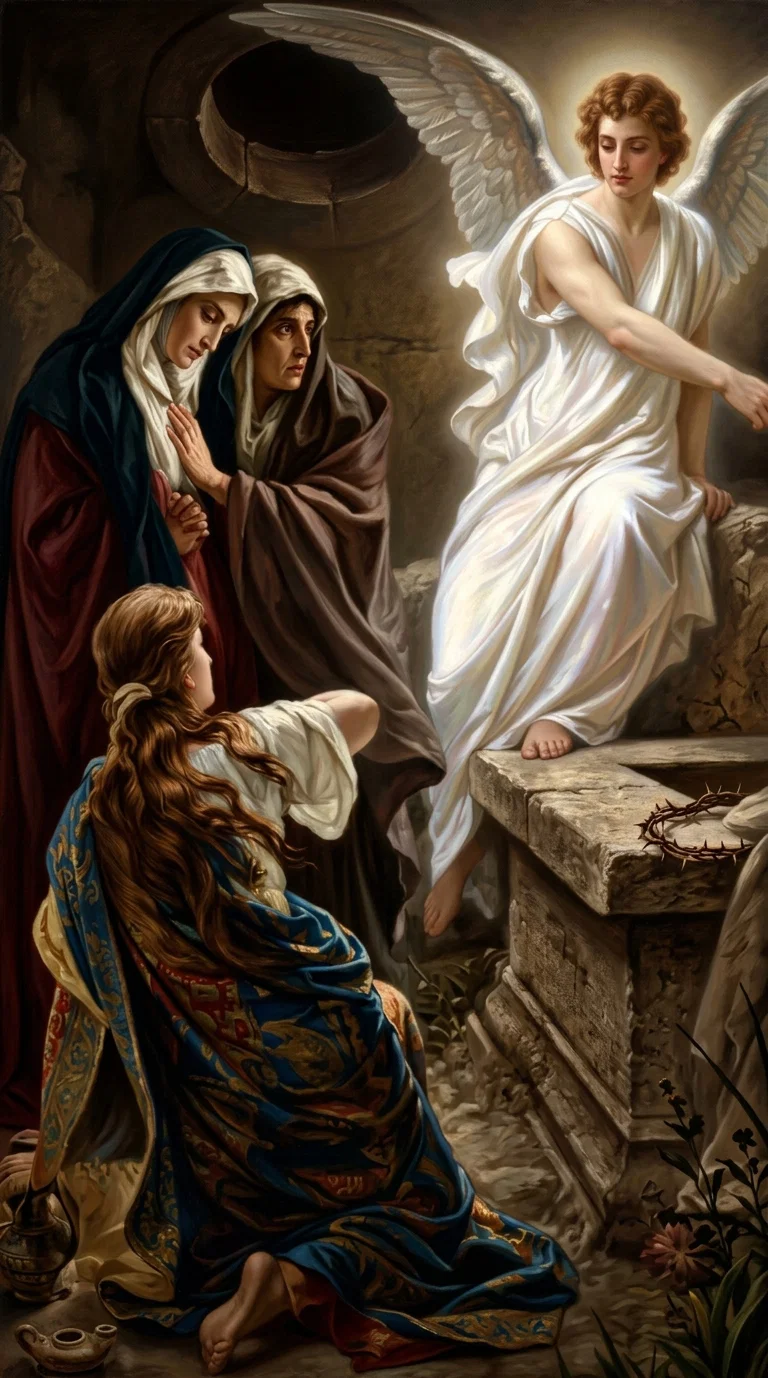
THAT was the lesson that Jesus taught nearly two thousand years ago. It is a potent lesson still. When He arose from the dead on that first-day morning His disciples could not believe it, and they rushed to the sepulcher. They found there the angels of the Lord, and the angels asked them the question, “Why seek ye the living among the dead? He is not here, but is risen.” As given by Mark, the angel knew the longing heart of the disciples. He said to them, “Be not amazed: ye seek Jesus, the Nazarene, who hath been crucified: He is risen; He is not here: behold, the place where they laid Him!” Matthew develops another thought most beautifully: “Fear not ye; for I know that ye seek Jesus, who hath been crucified. He is not here; for He is risen, even as He said. . . . And go quickly, and tell His disciples, He is risen from the dead; and lo, He goeth before you into Galilee;there shall ye see Him: lo, I have told you.”
THE resurrection of Jesus therefore meant life, not death; action, not idleness. It presents to His disciples a forward look, not a backward; progress in God’s work, not retrogression; a great, broad outlook of service in the world, and not self-serving. “Jesus was not to be found among the graves, either of material bodies or of dead traditions, but in the great, living, progressive truth of God and in the great, living, progressive missionary effort for the needy world. ‘He goeth before you into Galilee.’ Out among the needy nations of the earth, there they would find Him; and there He is found still.”
IT need not be said that the observance of a day once a year is not the manifestation to the world of the resurrection of Christ which the Master designed. He has given us something better than that, and that is the life of the believer which begins at baptism,—baptism, the marriage ceremony which unites the believer with Christ (Rom. 7:4; Gal. 3:27) and sets forth in its symbolism the three great facts of the gospel. The apostle Paul writes, “For I delivered unto you first of all that which also I received: that Christ died for our sins according to the Scriptures; and that He was buried; and that He hath been raised on the third day according to the Scriptures” (I Cor. 15:3); and then follows his masterly argument on the resurrection. But these three great facts are symbolized by the baptism of the believer, and so the apostle writes elsewhere: “Or are ye ignorant that all we who were baptized into Christ Jesus were baptized into His death? We were buried therefore with Him through baptism into death: that like as Christ was raised from the dead through the glory of the Father, so we also might walk in newness of life. For if we have become united with Him in the likeness of His death, we shall be also in the likeness of His resurrection.” Rom. 6:3-5. Again: “Having been buried with Him in baptism, wherein ye were also raised with Him through faith in the working of God, who raised Him from the dead.” “If then ye were raised together with Christ, seek the things that are above, where Christ is, seated on the right hand of God.” Col. 2:12; 3:1.
HOW beautifully Bible baptism sets forth the great facts of the Gospel. The convicted sinner accepts of the Lord Jesus Christ, he believes in the death of our Lord for reconciliation to God, he accepts the life of the Lord Jesus Christ as his life, he yields himself to this belief, and in the beautiful symbolism of immersion goes forward declaring to the world his faith, his union with his risen Lord. And so the life of the believer becomes a testimony to the resurrection of Jesus Christ. The matter of baptism alone, the mere form or ceremony, is nothing of itself. That of itself might be as dead and cold as the sepulcher in which Christ lay and of which it could be said, “He is not here;” but if that baptism is connected with a genuine faith in the Lord Jesus, it issues in a life of power and service for God, so that that life of the believer, wherever he goes, is a vital testimony to the power of the risen Lord.
AND, therefore, the mightiest testimony for the resurrection of Christ is a living, growing, consecrated, progressive church; it is the mightiest testimony that can be given to a sinful and gainsaying world. Those who thus compose such a church as that are living epistles, “known and read of all.” They are a demonstration of the life and the power of God. They have died to sin, and the old man, with all his powerful control in passion and unsanctified desire is buried. The individual is seeking the things which are above, where Christ sitteth on the right hand of God. While living in this earth as other mortals live, to a greater or less extent, they are still witnessing to that which other mortals have not,—the power of an endless life.
HOW much better this is than a single day in the year. How much better is the term “resurrection” than “Easter.” How much better every day in the year instead of one day in the year. How much better is a life than a mere empty day of forms. It is the prayer of the writer that the great thought of the resurrection may so take hold upon the readers of the SIGNS OF THE TIMES that man-appointed days shall sink into utter insignificance, and that the great life of the Master may control every day of the year.

Power and Humility of Jesus

By Mrs. E. G. White
Jesus, to obtain a little season of repose, and for the benefit of His disciples, proposed that they should go with Him into a desert place and rest a while. There were suitable places for such retirement beyond the sea from Capernaum, and they entered a boat and made their way thither. But some who were searching for Jesus saw Him depart from the shore, and the anxious people gathered together watching the slowly receding boat. The news spread from city to city that Jesus was crossing the sea; and many who were eager to see and hear Him flocked to the place where it was thought that His boat would land, while others followed Him over the water in boats. So when Jesus and His disciples landed they found themselves in the midst of a multitude of people, pressing forward on all sides to meet them.
Jesus, perceiving all this, beckons to Peter, who is in his boat on the sea, to come nigh. The disciple obeys the signal, and comes to shore. Jesus presses through the throng, and steps into the boat, bidding Peter to thrust out a little from the land. He now sits in the rocking boat of the fisherman, and, in full sight and hearing of the crowd, finishes the long and toilsome day by speaking precious truths to them. The Son of God, leaving the royal courts of Heaven, takes not His position upon David's throne; but from the swaying seat of a fisherman's boat, speaks the words of eternal wisdom which are to be immortalized in the minds of His disciples and given to the world as the legacy of God.
As the sun was setting, Jesus saw before Him five thousand people besides women and children, who had been all day without food. He inquired of Philip concerning the probability of obtaining bread for so large a number, that they might not return to their homes unrefreshed nor faint by the way. This He did to test the faith of His disciples, for He Himself was at no loss how to provide food. He who would not work a miracle to satisfy His own hunger in the wilderness, would not allow the multitude to suffer for lack of food. Philip looked over the sea of heads and thought how impossible it would be to obtain sufficient food to satisfy the wants of such a crowd. He answered that two hundred pennyworth of bread would not be nearly enough to divide among them so that each one might have a little. Jesus inquired how much food could be found among the company. He was told that Andrew had discovered a lad who had with him five barley loaves, and two small fishes. But this was nothing among so many, and they were in a desert place, where no more could be obtained. Jesus commanded that this meager store should be brought to Him. This being done, He directed His disciples to seat the people upon the grass in parties of fifty, and one hundred, to preserve order, and that all might witness the miracle He was about to do. This marshaling of five thousand people into companies, was at length satisfactorily accomplished, and they were all seated in the presence of the Saviour. He then took the loaves and fishes, and, having given thanks, distributed them to the disciples and to the multitudes, in quantities sufficient to satisfy their appetites. The people had arranged themselves in the required order wondering what was to be done, but their amazement knew no bounds when the problem was solved, and they beheld food portioned out to that vast assembly from the slender store scarcely sufficient for a score of persons. The food did not diminish, as Jesus handed it to His disciples, who in their turn served the people. As often as they returned to Him for a fresh supply, it was furnished them. After all had been satisfied, He directed the disciples to gather up the fragments that nothing might be lost; and the broken fragments filled twelve baskets. During this remarkable feast, there was much earnest reflection among those who were so miraculously served. They had followed Jesus to listen to words such as had never before fallen upon their ears. His teachings had sunk into their hearts. He had healed their sick, had comforted their sorrow, and, at last, rather than send them away hungering. He had fed them bounteously. His pure and simple doctrine laid hold of their minds, and His tender benevolence won their hearts. While eating the food He had provided for them, they decided that this was indeed the Messiah. No other one could do so mighty a miracle. No human power could create from five barley loaves and two small fishes, food sufficient tofeed thousands of hungry people. His teachings and work of healing had already nearly convinced them of His divinity, and this miracle crowned their growing conviction with entire belief.
They decided that this was the Prince of Life, the promised Deliverer of the Jews. They perceive that He makes no effort to win the applause of the people. In this He is essentially different from the chief priests and rulers, who are ambitious for titles and the honor of men. They fear that He will never claim His right as King of Israel and take His place on David's throne in Jerusalem. But they decide that what He will not assume for Himself, they will claim for Him. They need no greater evidence of His divine power nor will they wait for any further proof. They quietly consult among themselves, and arrange to take Him by force, and bear Him upon their shoulders, proclaiming Him the King of Israel. The disciples unite with the people in declaring that the throne of David is the rightful inheritance of their Master. Let the arrogant priests and rulers be humbled, and compelled to yield honor to Him who comes clothed with the authority of God. They begin to devise means to accomplish their purpose; but Jesus discerns their plans, which, if followed out, would defeat the very work He designs to do, and put a period to His instruction and deeds of mercy and benevolence.
Already the priests and rulers look upon Him as one who has turned the hearts of the people from them to Himself. Already they so dread His growing influence among them that they seek to take His life. He knows that violence and insurrection would be the result of His exaltation as Israel's king. He did not come into the world to set up a temporal kingdom; His kingdom, as He had stated, was not of this world. The multitude do not perceive the dangers arising from the movement they contemplate; but the calm eye of divine wisdom discovers all the hidden evils. Jesus sees that it is time to change the current of feeling among the people. He calls His disciples to Him and directs them to immediately take the boat and return to Capernaum, leaving Him to dismiss the people. He promises to meet them that night or on the following morning.
They obey in silence. Jesus then turns to the multitude, and perceives that they are thoroly decided to force Him into becoming their king. Their movements must be checked at once. The disciples had already departed, and He now, standing before them with a grand dignity, dismisses them in so firm and decisive a manner that they dare not disobey His commands. The words of praise and exaltation die upon their lips. Their steps are stayed as they are in the very act of advancing to seize Him, and the glad and eager looks fade from their countenances. There were men of strong minds and firm determination in that throng, but the kingly bearing of Jesus, and His few quiet words of authority, quelled the tumult in a moment and frustrated all their designs. Like meek, submissive children, they obey the command of their Lord, submitting humbly, and without question, to a power that they recognize as above all earthly authority.
Jesus looked upon the retreating multitude with yearning compassion. He felt that they were as scattered sheep without a shepherd. The priests who should have been teachers in Israel, were but machines for performing unmeaning ceremonies and repeating the law they did not themselves understand nor practice. When He was left alone He went up into the mountain, and, for many hours, bent in supplication before the Father with bitter agony and tears. Not for Himself were those earnest prayers, but for man, depraved and lost but for redeeming grace. It was for man that the Son of God wrestled with His Father, asking that the poor sinful creature might turn from His guilt to the light of salvation.
Continue reading: Institution of the Sabbath