At St. Helena and Richmond, California, and at Battle Creek, Michigan—Many People Gathered to Show Their Respect—Laid to Rest Beside Her Husband and Children in Oak Hill Cemetery
By MILTON C. WILCOX
THE SIGNS OF THE TIMES has already given a sketch of the life of Mrs. White, who has had so much to do in the establishment and prosperity of this publishing house. It remains simply to give a report of the funeral services, which were held on the Pacific coast and in the East.
She peacefully fell asleep July 16, 1915, in the sunny upper chamber of her Elmshaven, St. Helena, home, where so much of her time had been spent during the last fruitful years of her busy life.
SERVICE AT ST. HELENA
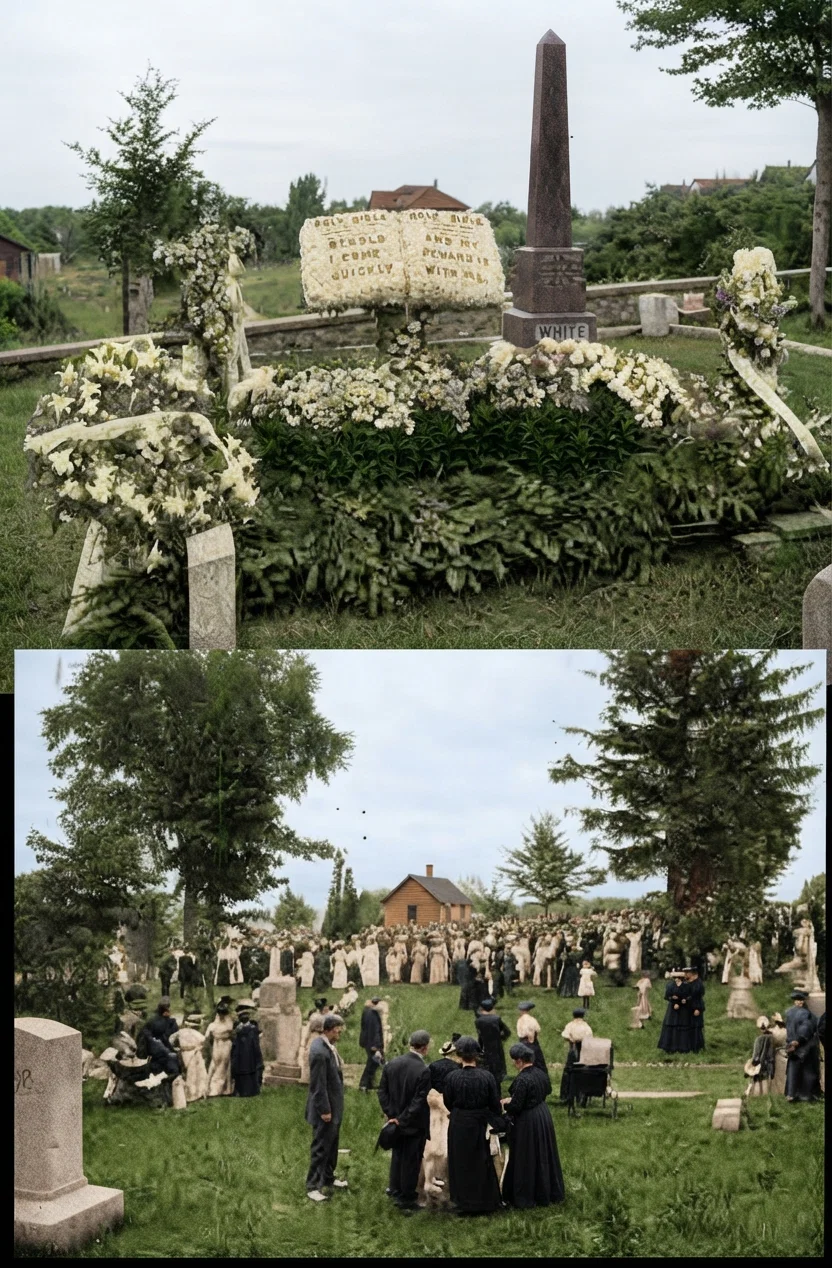
Services were held at Elmshaven on the afternoon of Sunday, July 18, on the lawn under the great elm trees. Nearly five hundred friends and neighbors assembled to pay their last tribute of respect to her memory.
At one end of the lawn, a canopy had been erected for the officiating ministers, while chairs and benches placed beneath the wide-spreading trees furnished seats for all who came. After singing by a double quartet from the Pacific Union College and the St. Helena Sanitarium, Elder R. W. Munson offered prayer. A Scripture reading followed, by George B. Starr, comprising the following passages in whole or in part: Ps. 116: 15; Eccl. 7: 2, 4; Rom. 8: 35, 37-39; John 6: 39, 40; Dan. 12: 2, 3; Rev. 14: 12, 13; Eze. 37: 12-14; Isa. 26: 19; Rev. 7: 9-17; Rev. 21: 4, closing with a few verses especially illustrative of Mrs. White's life experience, in Ps. 40: 9, 10 and Mark 14: 8.
The first speaker was Elder J. N. Loughborough, one of the pioneers in the advent movement, one who had known the deceased longer and more thoroughly than any one else now living. He spoke especially of the working of the Holy Spirit through Mrs. White in connection with her labors. Following this, Elder George B. Starr and Elder E. W. Farnsworth also spoke of various phases of the life and character of Mrs. White. The service closed by the singing of
"We shall meet beyond the river,
Where the surges cease to roll,"
and the benediction by Elder S. T. Hare.
MEMORIAL SERVICE AT RICHMOND
Inasmuch as the California Conference of Seventh-day Adventists was in session at Richmond, a special request was made by the Pacific Union Conference and the California Conference officers that a memorial service be held at Richmond the following day. And inasmuch as this was on the way to the East, where the body would be carried, it was not difficult to arrange for such a service. Announcements were sent out to the larger churches near Richmond; and on the morning of July 19, fully a thousand friends from cities surrounding San Francisco Bay, and even from more distant points, assembled at the Richmond encampment.
The services opened with the hymn "Sweet Be Thy Rest," and Scripture reading by Elder Farnsworth, 1 Cor. 15: 12-20, 35-38, 42-45; 2 Cor. 4: 6-18; 5: 1-10. At this service, Elder J. N. Loughborough offered the invocation. The biographical sketch that has already appeared in the SIGNS OF THE TIMES, was read by Elder A. O. Tait. The funeral discourse was given by Elder E. E. Andross, from the text: "Blessed are the dead which die in the Lord from henceforth: Yea, saith the Spirit, that they may rest from their labors; and their works do follow them." After the singing of a hymn, Elder Farnsworth dismissed the congregation, and the memorial service closed.
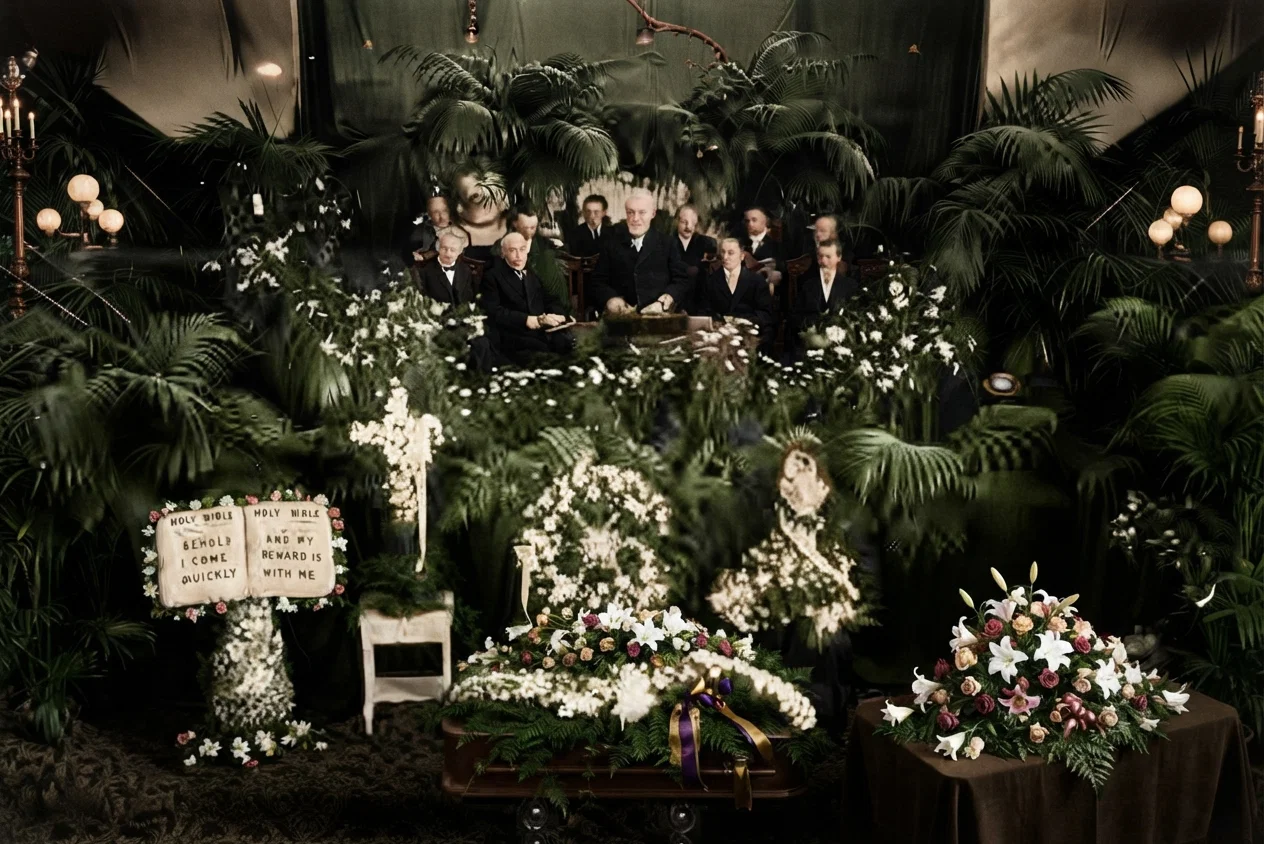
THE ROSTRUM IN THE BATTLE CREEK TABERNACLE DURING THE FUNERAL SERVICES OF MRS. E. G. WHITE
FUNERAL SERVICES AT BATTLE CREEK
The chief funeral service was held at Battle Creek, as was entirely fitting. It was at this place that the very strength of her womanhood was put forth in the service of God. Here it was that she and her husband laid the foundation for a great work, and in Oak Hill Cemetery are the graves of her husband and two children.
The service was held in the great Tabernacle, which has a seating capacity of 3,500—a place of worship to the building of which the whole Adventist people contributed nearly two score of years before, and in which Mrs. White had many times spoken the words of life, and where many of the great decisive General Conferences and meetings of the denomination had been held.
Many friends had come in from cities and towns near, and many citizens of Battle Creek also were present to pay their tribute of respect and love to the memory of the one who had been called to rest. Presidents and executive officers of local conferences and union conferences, as well as the officers of the North American Division Conference and the General Conference, were present.
FLORAL TRIBUTES
The Tabernacle itself had been beautifully and appropriately prepared for such a service. The floral decorations around the pulpit made that part of the building a bower of beauty. The friends at the Battle Creek Sanitarium had sent a wealth of potted palms, ferns, lilies, and marguerites, almost covering the large rostrum, and extending to left and right up the gallery stairs, gently waving in the breeze of a hidden electric fan. At the foot of the rostrum was a mass of flowers and foliage, and here reposed the casket containing the remains of one loved so well.
Many floral pieces had been contributed, symbolical of the occasion and of the hope beyond. The church at Battle Creek presented a broken wheel; the Review and Herald Publishing Association, a broken column surmounted by a crown; the General Conference and the North American Division Conference, a cross and a crown; the Pacific Press Publishing Association, an open Bible of solid white carnations, on the pages of which stood forth, in purple flowers, "Behold, I come quickly; and My reward is with Me."
THE BODY LYING IN STATE
For two hours preceding the service, the body lay in state in front of the rostrum. Guards of honor stood by, while thousands passed to take a last look upon the worn servant of Jesus sleeping her last sleep. The guards, six in all, served in pairs, each pair being relieved after serving twenty minutes.
We do not know of anything connected with the service that was more pathetic than the long line of humanity, many of whom were bent with the weight of years—old friends of Mrs. White, mingled and intermingled with those of middle age and youth, who passed by the casket, pausing for a little while to look upon the well-known features, tears coursing down their cheeks, oftentimes bosom heaving with convulsive sobs. Thus the long procession passed on. We do not know how many thousand there were that passed through the Tabernacle that morning.
When the hour appointed for the service came, the Tabernacle seats were filled, and many were standing. It is estimated that one thousand or more turned away who could not enter.
Among the members of Mrs. White's family who were present were both of her surviving sons,—Elder James Edson White, of Marshall, Michigan, and Elder W. C. White, of St. Helena, California; Mrs. Addie Walling5MacPherson, a niece, living in Suffern, New York; and Miss Sarah McInterfer, of St. Helena, California, who has for so long a time been secretary, companion, and general helper of Mrs. White. There were others there who had at different times been members of her family, and who had been associated more or less closely with the deceased.
The family of Elder W. C. White had said the last farewell at St. Helena. Mrs. Emma White, wife of Elder J. E. White, was prevented from being present, by rheumatic affliction, which for two years has rendered her unable to leave home. There were present many of the leading people of the town and from the sanitarium.
The service was simple and impressive. From the forest of palms, the double quartet sang the always restful, comforting hymn,
"Asleep in Jesus! Blessed sleep,
From which none ever wake to weep!"
Its soft, sweet measures filled the Tabernacle as though they came from the "choir invisible."
The Scripture reading was by Elder F. M. Wilcox, editor of the Review and Herald, of Washington, D. C., from Rev. 21: 1-7; 22: 1-5, dealing with the wonderful promises of God which point us forward to that time when the tabernacle of God would be with men, "and He will dwell with them, and they shall be His people, and God Himself shall be with them, and be their God. And God shall wipe away all tears from their eyes; and there shall be no more death, neither sorrow, nor crying, neither shall there be any more pain: for the former things are passed away." With these were linked some of the precious promises found in the thirty-fifth chapter of Isaiah. Prayer was offered by Elder M. C. Wilcox, of Mountain View, California.
Following the prayer, Professor Frederick Griggs sang "Rest for the Toiling Hand."
A sketch of the life was given by Elder A. G. Daniells, president of the General Conference. He briefly traced the early life and experience of Mrs. White, and also her late labors; told how, in her early life, she took the Bible as her supreme guide; how God especially came to her in her childhood days, revealing to her the work that He had for her to do; and how He had sustained her through all her long life of service. He quoted from the late Uriah Smith, a lifelong associate in this work with Mrs. White, as to the fruit borne in the life and writings of Mrs. White; how her writings lead to the Bible, lead to Christ, point out sin, plead for righteousness, and bring comfort and consolation to many hearts.
Elder Daniells also showed how the views held by Mrs. White touch the great vital, fundamental questions of the sovereignty of God, the divinity of Christ, the efficacy of the gospel, the inspiration of the Scriptures, the majesty of the law, the character of sin, and deliverance from its power, and referred to the fruits of the Spirit seen in her own life. He pointed out that the writings of Mrs. White present most comprehensive views regarding all true reforms in all the various phases of life. They make prominent the responsibilities of the church in home and foreign mission service. They teach that every member of the body of Christ is to be a light to the world, and a blessing to those with whom he may associate; that all must live the unselfish life of the Master for others; and the church in Christian lands must put forth their highest endeavors to evangelize those who are groping in the darkness and superstitions of heathen lands.
Thus, he told us, for seventy years Mrs. White gave her life in active service to the cause of God in behalf of sinful, suffering, sorrowing humanity. After traveling extensively through the United States from 1846 to 1885, she devoted two years of her life to work in Europe. In 1891 she went to Australia, where she remained nine years, returning to the United States in 1900, at the age of seventy-three. Her work from that time on was given largely to the getting out of books and writing for periodicals.
Courtesy Gage Printing Co., Ltd.
Following this very interesting biographical sketch by Elder Daniells, Elder Haskell preached the funeral discourse, from the text, "Precious in the sight of the Lord is the death of His saints" (Ps. 116: 15), bringing from this and other scriptures the comfort which God gives concerning those who sleep in Him, and also pointing out that just as we know each other here by distinct individual characteristics, so in the last great day, when the Lord shall call His children from the grave, we shall know each other.
The service at the Tabernacle was concluded by the singing of the hopeful song,
"We shall meet beyond the river,
In that glorious land of bliss,"
and a prayer by Elder W. T. Knox. The casket was again opened in the vestibule, that the late comers might have a last look — to many a first look — before it was committed to the earth.
The pallbearers, Elders I. H. Evans, W. T. Knox, G. B. Thompson, F. M. Wilcox, and G. E. Langdon, and Prof. Frederick Griggs, bore the casket to the waiting hearse.
But few who attend the funeral service usually go to the cemetery. That was not the case here, however. All the carriages that could be obtained in Battle Creek, many automobiles, and nine street cars, had been secured. In addition to these, there were many other automobiles which came from various sections of the country, which attended the funeral procession to the cemetery. The street cars had been hired by the Battle Creek church.
The services at the grave were as follows: a Scripture reading from John 11 and 1 Corinthians 15, by Elder I. H. Evans; a song by the quartet,
"We shall sleep, but not forever;
There shall be a glorious dawn;
We shall meet, to part, no, never,
On the resurrection morn,"
and prayer and benediction by Elder George B. Thompson.
Very inspiring were the words of the song and of the Scripture and the prayer; and many hearts were lifted heavenward, and saw by faith, in the precious Bible promises, the glorious resurrection day, when all those who sleep in Jesus will come forth to a glad, glorious immortality, which shall never know death or pain or the infirmities of age. Because God lives, His children shall live also.
"God buries His workmen, but He carries on His work;" and as the writer entered his carriage and left the cemetery, there came to him the words of the song written in memory of one of the Mrs. Judsons,
"So have ye buried her. Up and depart
To life and to duty, with undismayed heart."
So God would speak to all those who have been wont to look to Mrs. White for encouragement and strength and help. Her writings remain; but above all things else, God remains. His word is eternal, His love is eternal, Christ is eternal, and the great everlasting gospel is founded in the eternal verities of God. Hoping in that, we shall triumph; and that work to which Mrs. White gave her life, and to which thousands of others are giving life and all, will soon triumph in the glorious second coming of our Lord Jesus Christ.
Faith Without Shame
"WHOSOEVER believeth on Him shall not be ashamed."
Christ Our Pattern of Goodness
"THE Saviour's entire life was characterized by disinterested benevolence and the beauty of holiness. He is our pattern of goodness. From the beginning of His ministry, men began to comprehend more clearly the character of God. He carried out His teachings in His own life. He showed consistency without obstinacy, benevolence without weakness, tenderness and sympathy without sentimentalism."
Papal Claims to Divine Prerogatives
By Jean Vuilleumier
The Prophetic Forecast That the Pope "Shall Magnify Himself"—God upon Earth—The Priests as Creators—The End That Will Come
By JEAN VUILLEUMIER
IN the third place, the prophecy says that the horn "shall magnify himself in his heart," magnify himself "even to the Prince of the host," and shall "stand up against the Prince of princes."
In order to apply this language to the papacy, we must find that she has claimed and does claim to be as high as God Himself, thus standing up "against the Prince of princes," our Lord and Saviour Jesus Christ. Has she done that? Let her own words answer the question.
POPE CLAIMED TO BE CHRIST ON EARTH
Monsignor C. Minneo Janni, in his book on the eucharist and the papacy (Paris, Vic and Amat, 1905), says: "Peter is Jesus Christ in the church by his sovereign, supreme, universal, illimited authority."—Chapter 6. "The pope is Jesus Christ, Vice God, our sweet Christ on earth. . . . We kneel at the feet of the pope as before Jesus in the sacrament."—Chapter 11.
Monsignor Fava, bishop of Grenoble, France, writes, "Leo XIII is our Christ."
The bishop of Angouleme wrote to his diocesans on the occasion of the election of Pius X: "All we see in the one elected is the pope; that is to say, Peter; that is to say, the Christ Himself, which means that our heart's desire is to see in him only the supreme receiver of divine power. . . . We say to him, O king, live forever." (Italics ours.)
ON EARTH AS GOD IN HEAVEN
The Paris periodical Les Annales Catholiques makes the following statement: "As vicar of Jesus Christ, the pope is truly upon earth the sign of God. The earth, to honor him, has placed upon his brow the diadem of kings; but God, to honor him more, has placed upon him the reflection of His own attributes. . . . Thou, says God to the pope, . . . art on earth as I am in heaven; I and thou, both immutable, both eternal."
These assumptions, being entirely unknown in the teachings of Christ and His apostles, are therefore confessedly false and self-made, and thus they come fully and squarely under the prophetic arraignment, "It magnified itself, even to the Prince of the host;" and this action, on the part of a man or an angel, is made directly "against the Prince of princes." In any sphere, a rival is the adversary of the one whose legitimate position or office he usurps or desires to usurp. This is why the one who said, "I will make myself like the Most High" (Isa. 14:14), has ever since borne the name "Satan," literally, the adversary.
THE PRIESTS AS CREATORS
According to this rule, not only is the pope an adversary of the Prince of princes, but such also is every priest in the communion of the Church of Rome, and this on account of the phenomenal assumptions made for the priest in the celebration of the eucharist. These claims are made from every Catholic pulpit, are printed in their books of theology, and form a part of the teaching given every seminarist preparing for the priesthood. They were printed in the Montreal Sentinel of the Blessed Sacrament of December, 1912. A rather full statement of this doctrine was published a few years ago in a work printed in Paris under the seal of ecclesiastical authorities, by Abbot Naureze. Here is a literal translation of the statement:
"What is the priest? — He is between God in heaven and man who seeks him on earth, a being God and man, who brings them together and sums them up.
"I am not flattering you by pious hyperbole. . . . This is not a rhetorical falsehood. . . . You are creators, just like Mary in her coöperation in the incarnation. You are creators as God in time. . . . You are creators as God in eternity. Our creation, our daily creation, is nothing less than the Word made flesh Himself.
"God can bring forth new universes. But He cannot do a greater thing under heaven than what is being done in your sacrifice [of the mass]. For in this moment, He places in your hands all that He has and all that He is. . . . I am not a little lower than the cherubim and the seraphim in the government of the world. I am far above them; for they are only servants of God, while we are His assistants [coadjutors]."
ANGELS AFFRIGHTED
"The angels, who see the volume of wealth which each day passes through our hands, are frightened at our prerogatives. I fill three sublime offices with regard to the God of our altars: I bring Him down, I serve Him to the people, I watch over Him. . . . Jesus dwells under your lock and key; His audience hours are opened and closed by you; He does not move without your consent; He does not bless without your coöperation; He does not give but through your hands; and His dependence is so dear to Him, that for eighteen hundred years, He has not escaped from the church to disappear in the glory of His Father."
Any one who has read the Bible, knows that Christ, at His ascension, went up to heaven; that He promised His disciples He would return at the end of the world, to take them to Himself; that He is now sitting at the right hand of the Father, offering in the heavenly temple His precious blood in favor of those who believe; and that in His absence, He has sent "another Comforter," the Holy Spirit, who is to be with us and in us. John 14:3, 16, 17; Acts 1:11; Heb. 8:1; 9:11, 12. This being true, then all the above about the transubstantiation and real presence of Christ on the altars, is sheer falsehood. But in this exaltation of the priest, the falsehood becomes blasphemy.
ABOVE HUMAN CONDITIONS
The abbot continues: "By his office, the Catholic priest is raised above human conditions at an immeasurable height; for at the confessional, he exercises the supreme power, the power that God shall exercise at the final Judgment, the formidable power to retain and to remit sins, to condemn or to absolve; and if he happens to be at the deathbed, the priest has the power to send the impenitent or repentant soul either into the eternity of reward or into the eternity of punishment. . . . Who is the privileged creature on whom the ministration of such a sacrifice has been conferred? Is it the angel? Is it Mary? — No; the angels and Mary shall worship, says Abbot Hubert Lebon; the priest alone shall have the prodigious power to create his Creator." (Italics ours.)
These words seem so awful, that comment or protest becomes superfluous, except to exclaim: How has prophecy been fulfilled! How true are the words of God! How completely has the papacy incarnated the divine photograph taken thousands of years ago, announcing that she should magnify herself "against the Prince of princes"! For not only has she magnified herself in her heart, like the fallen cherub, but she does not hesitate to proclaim such astounding assumptions in the hearing of the multitudes.
PUNISHMENT IS COMING
Dan. 8:25. "But he shall be broken without hand," is the next statement of the prophecy. Ah, yes, the day is coming when519the power which has been allowed to intrench itself in the place of God in the hearts and over the bodies of millions, and to live haughtily and luxuriously with the untold wealth derived from her deceptions, will be judged and rewarded. This day of reward is fully described in Revelation, chapters 17, 18, 19, and 20. Let the reader turn to them.
"And the vision of the evenings and mornings which hath been told is true; but shut thou up the vision; for it belongeth to many days to come." Dan. 8:26.
That the vision is true, we have more evidence than Daniel had. We have more than the words of an angel. We have before us twenty-five centuries of marvelous fulfillments. We can therefore say, The vision is no longer shut up, for we have reached the "latter time of the indignation," "the appointed time of the end."
Triumph of His Eternal Purpose
By George W. Reaser
The Earth Was to Be Peopled—Final Triumph of the Plan in Christ—God Must Manifest His Love
By GEORGE W. REASER
The scope of this present article will not permit the development of the several interesting topics—all vital to the plan of salvation—comprehended in the expression, "the dispensation of the fullness of times." Eph. 1: 10. Suffice it to say that the injection of sin into the world with the express design of defeating Jehovah's eternal purpose, demanded the launching of the plan of salvation, with sufficient time to carry it to completion, in order to make the eternal purpose effectual.
NATURE OF SIN MUST BE DEMONSTRATED
A dispensation of time must be given to demonstrate the nature and the results of sin and rebellion, and to make manifest the character of their author. The utter helplessness of humanity to attain character development to fit into God's eternal purpose, without the coming of the Son of God, Immanuel, to dwell with us, was demonstrated by four millenniums of human history; and "when the fullness of the time was come, God sent forth His Son, made of a woman, made under the law, to redeem them that were under the law, that we might receive the adoption of sons." Gal. 4: 4, 5.
A dispensation of time must also be devoted to the work of deciding who, among the sons and daughters of Adam's race, will, by character development, finally fit into the completed purpose (Rev. 3: 5), as well as to decide the destiny of those whose character development will not justify their being beneficiaries of the priceless blessings included in the eternal purpose (Rev. 20: 4).
MUST MAKE KNOWN THAT GOD IS LOVE
But above all other things comprehended in the expression "the dispensation of the fullness of times" for the gathering "together in one all things in Christ," time and events must make manifest the great truth essential to the eternal happiness of every creature in the universe; namely, that "God is love." This fundamental truth being questioned, as it has been all down the stream of time, a "dispensation of the fullness of times" must be given for the manifestation of the character of God.
Awful calamity that sin was, it nevertheless offered the opportunity for the revelation of the character of God in the attributes of long-suffering, mercy, justice, love. "God so loved the world, that He gave His only-begotten Son, that whosoever believeth in Him should not perish, but have everlasting life." John 3: 16. Thus when the great drama of sin is past, the opportunity that it afforded for the manifestation of the character of God, will result in the universal chorus, "Just and true are Thy ways, Thou King of saints." Rev. 15: 3.
The dispensations briefly outlined, largely overlap one another in point of time, and are all embraced in the expression, "the dispensation of the fullness of times."
THE ETERNAL PURPOSE IN THE FIRST COMMISSION
If Jehovah had a definite purpose for our world, to be accomplished through the co-operation of the highest order of created beings placed on this planet, would it not be both logical and natural that He should state this purpose to such beings as soon as they were brought into existence, and, having stated His design for the world, place His divine blessing upon them, thus empowering them to fulfill their part in the accomplishment of His will?
The Steamer Eastland
This is precisely the thing that Jehovah did. Man was the masterpiece, the crowning act, of God's creative work pertaining to our world. Immediately the first human pair had been created in His own image, God blessed them, and said to them, "Be fruitful, and multiply, and replenish the earth, and subdue it: and have dominion." Gen. 1: 28.
COMMANDED TO PEOPLE THE EARTH
We thus learn that the very first recorded commission given to the parents of our race in Eden comprehended the proper peopling of the earth with their own family and descendants. This commission, if it had been carried to completion without the injection of sin and the consequent fall, would have constituted the accomplishment of Jehovah's eternal purpose as related to our world. As the commission was given before sin entered, it did not contemplate replenishing the earth with sinful beings.
Other portions of Holy Writ make it perfectly clear that the replenishing of the earth with the offspring and descendants of Adam and Eve contemplated the filling of the earth with sinless and deathless beings.
Let us consider the wisdom displayed in designing the eternal purpose, and the desirability of its being carried to completion.
PERFECTION OF DESIGN IS SEEN
With the mental conception of a Being who is able to create and uphold a universe, there must be associated the idea of definite design in all His works. The organism of everything in the vegetable and animal kingdoms, as well as the perfection of the organized universe, proves absolute perfection of design in all of Jehovah's works.
A perfect design for the peopling of a planet could not be accomplished by filling such planet with unaffiliated individual units, but instead, by having all correlated, sympathetic members of a common family.
Furthermore, in a perfect plan, there must be certain limitations to the number included. To have the human family multiplied to such extent as to permit of simply standing room for all upon the surface of the earth, would be a condition not to be contemplated. To have the earth finally peopled so sparsely as to provide but a single individual for each ten thousand square mile area, would seem too lonely for happiness. Therefore the replenishing of the earth with the human family must have contemplated a definite number in the mind of the Creator. With the completion of this number, the divine plan must have been that the multiplication of the human family should cease. A divine record must be kept of the increase of the human family until the completion of the plan,—the replenishing of the earth. Such a family record was started, and faithfully kept at least from the launching of the plan of salvation. It is called "the book of life of the Lamb slain from the foundation of the world." Rev. 13: 8.520
HIS PLAN CANNOT BE OVERTHROWN
Again, if God is all-wise, He knew the end from the beginning. If His very nature is love, in whatever plan He conceived, He had as His objective, in its ultimate completion, the highest happiness, the best interests, of all intelligent creatures in any wise related to the plan. This being true, then the plan devised ought to be carried to completion, regardless of all opposing agencies.
If He is all-powerful, His purpose for our world will be carried to completion, no matter what forces may oppose. If sin opposes, it must be nullified. If Satan, "the adversary," undertakes to block the completion of the plan, he must be circumscribed in power. If, as the ages follow in succession, any influence arises that threatens defeat to the plan, Jehovah, pledged by His own word to carry it to completion, must with His omnipotent hand brush aside such opposing agency.
If the first human agents commissioned of Heaven to accomplish His eternal purpose, shall perchance default, and become helpless to carry that all-wise purpose to completion,—if they and their offspring shall, because of yielding to sin, return to non-sentient dust,—then the only way for the accomplishment of the purpose must be to introduce into the human family a member of the Godhead, who, supplanting Adam, to whom the first commission was given, becomes "the everlasting Father" of the redeemed human family; and thus, help being laid upon One who is mighty to save, the eternal purpose of God for our world, comprehended in the first commission given to Adam and Eve in Eden, will be accomplished.
The facts and eternal principles thus outlined, logically explain the dealings of Jehovah with the righteous and the wicked. Some charge God with tyranny, injustice, and favoritism, in His dealings with the race. Even His own professed people have said that He is "unequal" in His ways with the human family. Careful study of God's eternal purpose should fully satisfy every mind that Jehovah is just and true in all His ways.