Your ShelfYour Projects

Signs of the Times, Vol. 28, No. 49.

THE REVELATION OF JESUS CHRIST

Signs of the Times

Dec 3, 1902

Pacific Press Publishing Company · Oakland, California · Dec 3, 1902

“THE REVELATION OF JESUS CHRIST.”

Corrupted by the World.
THE Bible is a book of types. The Lord has not mentioned by name the men and women, the nations and kings, the history and biography, the causes and effects, of the pregnant past in order to satisfy our curiosity or to make a readable story. Many times the human reason thinks that the story is incomplete, and the human curiosity wishes that fuller details had been given. It is not to satisfy either that the Lord has given us the Bible. The lesson is complete; the book meets the purpose for which it is given. All these records are types, are warnings, are instructions, are encouragements, for all the future. The histories of nations given are types of other nations. Apostasies recorded are types of later apostasies. Individual characters are types of other individual characters yet to come; and so it is that every nation, every church, every single soul may find in God’s Word the very thing he needs.
WHEN, therefore, God would give us instructions concerning His own church and its spiritual condition from the time of His first advent to the second, He takes seven churches in Asia, a fitting type of the world, to represent the entire career of His church in general. For that period of time when union of Church and State was coming in with rapid strides; when persecution had ceased and the world was seeking the favor of the church; when the ambitious bishop, assuming authority which God had not given over the flock, and the unscrupulous politician, began to feel that each was necessary to the other’s success; when pagan philosophy and practise were finding equal place in the nominal church with the Bible; when charms and amulets and relics and pilgrimages, and all the senseless superstitions of a dead religion had taken the place of faith in the living Word of God;—for that period God chose the church in Pergamum to represent His true church in the Roman kingdom, of which the city of Rome was the head, and the moulding power.
The Lord’s letter to the Pergamum state of the church is found in Rev. 2:12–17 and the scripture itself will be found in the following:—

Questions on the Text.

To which of the seven churches does the third letter apply?
“To the angel of the church in Pergamum write.”¹ Verse 12.
How does the Master reveal Himself?
“These things saith He that hath the sharp two-edged sword.”² Verse 12.
What is said of the character of the church’s surroundings?
“I know where thou dwellest, even where Satan’s throne is.”³ Verse 13.
How had the church borne her part?
“Thou holdest fast My name, and didst not deny My faith, even in the days of Antipas My witness, My faithful one, who was killed among you, where Satan dwelleth.”⁴ Verse 13.
In what had the church not been faithful?
“I have a few things against thee, because thou hast there some that hold the teaching of Balaam, who taught Balak to cast a stumbling-block before the children of Israel, to eat things sacrificed to idols, and to commit fornication. So hast thou also some that hold the teaching of the Nicolaitans in like manner.”⁵ Verses 14, 15.
What warning is given the church?
“Repent therefore; or else I come to thee quickly, and I will make war against them with the sword of My mouth.”⁶ Verse 16.
What promise is made to the overcomer?
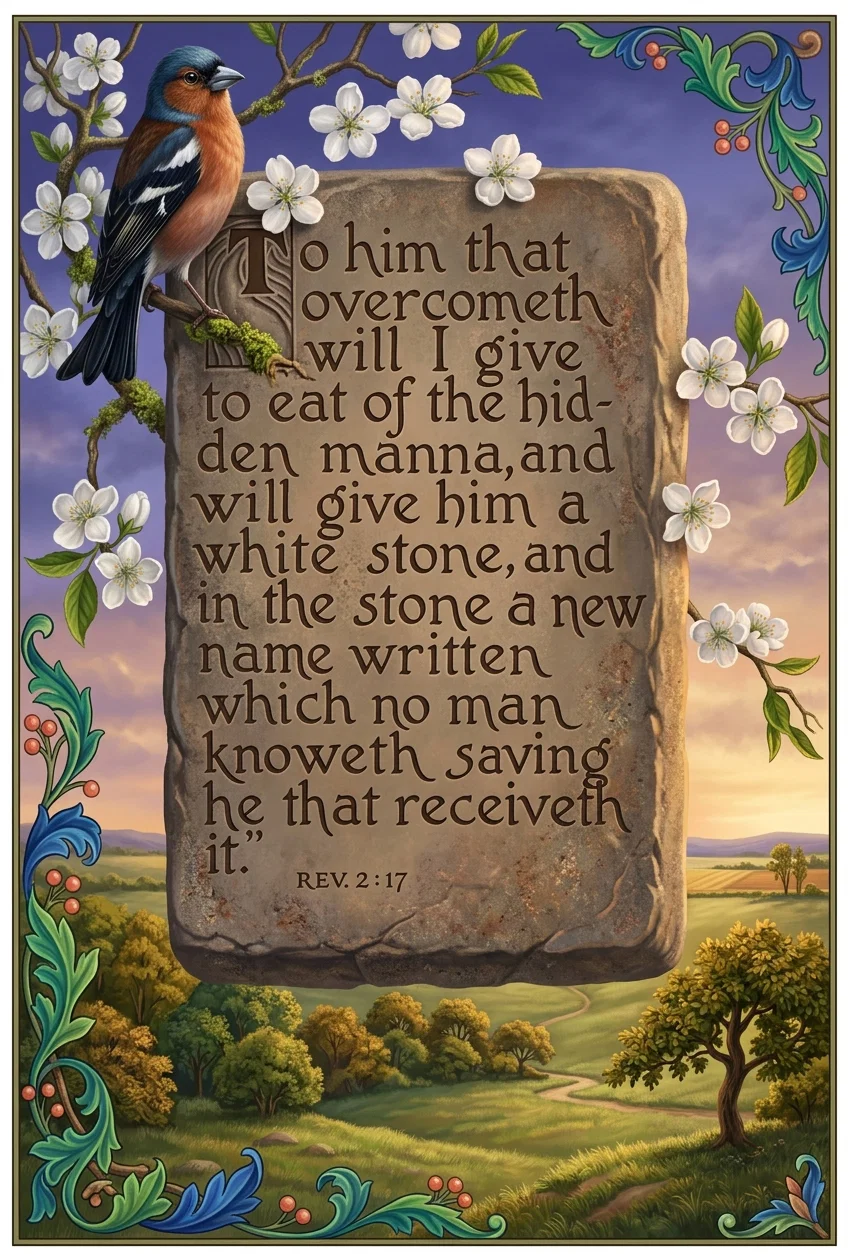
“He that hath an ear, let him hear what the Spirit saith to the churches. To him that overcometh, to him will I give of the hidden manna, and I will give him a white stone, and upon the stone a new name written, which no one knoweth but he that receiveth it.”⁷ Verse 17.
1. “Church in Pergamum.”—Pergamum (or Pergamos) is said to have derived its name from Pergamus, the son of Pyrrhus, who settled there. Others connect it with the Greek pergos, tower, height, elevation, because of a hill in the city held sacred. The city was in western Asia Minor, about eighty miles north of Ephesus, twenty miles from the sea. It was at the time of John’s writing a rival of Ephesus, a pagan-cathedral city, a university town, having a library that rivaled the famous Alexandrian, and a royal residence of the Attalic kings. Here were temples to Jupiter, Minerva, Apollo, Bacchus, Venus, and Esculapius, the latter, the god of medicine, known by the name of the Pergamene god. He was given the title of “Saviour.” His characteristic emblem is the serpent. Truly it could be said to be a place where Satan dwelt, where his throne was, a fit emblem of the church of Christ during that period, when she became corrupted by contact and converse with the pagan world. The whole city was given up to the worship of sense, even as was the empire of Rome.
2. “The sharp two-edged sword.”—See 1:16. The sword is “the Word of God,” sharp, penetrating, living, mighty. “For the Word of God is living, and active, and sharper than any two-edged sword, and piercing even to the dividing of soul and spirit, of both joints and marrow, and quick to discern the thoughts and intents of the heart.” Heb. 4:12. Our Lord Himself is called “the Word of God” (Rev. 19:13; John 1:1–3), because He is the One through whom the Father has spoken to this world. And the word which He speaks is fitly likened to a sword cutting both ways. It is a flaming, burning sword, destroying and consuming sin, and all identified with it. 2 Thess. 2:8. That Word is the only weapon given to the Christian warrior, even as Christ is his only captain. By it the child of God can discern and destroy sin, and win souls to Christ.
3. “Where Satan’s throne is.”—God uses earthly agencies, so also does Satan, the great arch-enemy. But God’s throne is in the heaven, and His Kingdom ruleth over all. Satan was cast down to this earth, he and his angels. He has his army. His forces are organized. He has his headquarters—his throne. Where is that throne?—Obviously at the capital of the ruling power of earth. In the time of Babylon’s evil days the real “king of Babylon” was “Lucifer, the son of the morning.” Isa. 14:4, 12. In the days of Tyre’s supremacy the visible ruler was but “the prince of Tyre,” the real “king of Tyre” was the apostate covering cherub, Satan. Eze. 28:2, 11–16. It was Satan which gave the beast representing the apostate powers of earth its throne and great authority. Rev. 12:9; 13:2. In the days when the church was passing through the Pergamum stage, Rome was dominant among the powers of earth, and the bishop of Rome was under the influence of Constantine wielding the greatest worldly influence among the bishops, and assuming himself to be the head over all the holy churches. In Rome Satan ruled. The wicked pagan emperors were his agents. The backslidden and worldly church was eclipsing before the world the true church of Christ. But God regarded His own, He knew the fearful age, the overpowering influence of worldliness, popularity, and outward prosperity. The few were faithful to God, holding fast His name—His character, His righteousness—even under the strongest temptations.
4. “Antipas My witness.”—Antipas (another form of Antipater) is by some derived from anti, “against,” and pater, “father” or pope; that is, against popery. Antipas may have been the name of a martyr in Pergamum, and symbolical of those who were persecuted for opposing the rising power of the Papacy.
5. “The teachings of Balaam.”—(Num. 31:16; Josephus, Ant. 4:6:6.)—Balak invited the Israelites to a gormandizing, idolatrous, and licentious feast, given in honor of Moab’s gods. (See Numbers 25; Ps. 106:28–31.) So the early church was led away by men in the church who professed to be children of God, led away to the false doctrines of pagan philosophy regarding God and the soul and man’s duty to his Maker, and to commit fornication with the kings of the earth. (See Acts 20:29, 30; Gal. 4:8–10; 2 Thess. 2:2–7; 2 Peter 2:1–3.) It was the time of backsliding, and God’s best people were yielding to it, by tolerating the evil. To sacrifice to idols is to sacrifice to the dead; for the pagan deities were but deified dead heroes. But to sacrifice to the dead is to sacrifice to demons, for the supposed spirits of the dead are but demons in disguise. Compare Num. 25:2; Ps. 106:28; 1 Cor. 10:20. The ancient pagan belief meets its counterpart in the blinded Christian church in Mariolatry, adoration of saints, and modern Spiritism. In doing these things the church herself becomes a sacrifice on the pagan altars. The teaching of the Nicolaitans—licentiousness, fornication, physical and spiritual—which were hated in the Ephesus state of the church were tolerated in the Pergamum state of the church. “By beholding we become changed.” How true are the words of the poet:—
“Vice is a monster of so frightful mien That to be hated needs but to be seen; But seen too oft, familiar with his face. We first endure, then pity, then embrace.”
6. “Repent therefore or else.”—It is not a threat; it is what God must do if the church proves false. She must turn for her own sake intrinsically; she is out of harmony with God. When God wars against men, woe be to them. When God permitted that union of Church and State, the compromising church fell before it, turned and was persecuted. The only safety, the only hope of a backslider is to “repent and do the first works,” whatever the conditions; for repenting is not a mere emotion, but a change of purpose, a right-about-face, a yielding to the will of God.
7. “The hidden manna.”—Christ Jesus, “the bread of God” “which cometh down out of heaven, and giveth life unto the world.” John 6:33. A portion of manna was placed in the most holy place of the sanctuary (Ex. 16:33, 34), where it was hidden from all observers. Jesus Christ has passed into the heavens, but the child of God can truly feed upon Him, tho He is invisible, even as He fed upon the bread from heaven (John 4:32). “A white stone”—“a new name.” White, the emblem of purity and righteousness, like the white diamond of the priest’s breastplate, through which God’s will was revealed. It is God’s reality opposed to the superstitious charms and amulets of that age. It is the pledge of divine guidance and fellowship between God and the faithful believer, the covenant token that on His part can never fail. “Name” is significant of character. By that fellowship of righteousness with Christ Jesus the child of faith is changed in character. In other words he is by the power of God in daily fellowship with Christ Jesus spelling out the new name of his new character. “Which no one knoweth.”—Every soul has its individuality, its own sins, sorrows, weaknesses, victories, experiences. No one can know them but he who has experienced them all. Hence the new name is unknown save to the Giver—who is with every soul in all its conflicts—and the receiver. The white stone and the new name represent, therefore, the glorious, blessed, secret experience between the believer and Christ Jesus our Lord.

"IN ALL POINTS TEMPTED LIKE AS WE ARE."

BY MRS. E. G. WHITE.
Christ came to this world as a man, to prove to angels and to men that man may overcome, that in every emergency he may know that the powers of Heaven are ready to help him. Our Saviour took the nature of man, with all its possibilities. We have nothing to endure that He has not endured.
At Christ's baptism the glory of God rested upon Him, as a dove of burnished gold. Light from the throne of God encircled Him, while from heaven were heard the words, “This is My beloved Son, in whom I am well pleased.”
Then Christ was led by the Spirit into the wilderness; and here His test came. He went into the wilderness to be alone, to contemplate His mission and work. By fasting and prayer He was to brace Himself for the bloodstained path He must travel. But Satan knew that the Saviour had gone into the wilderness; and he thought this the best time to approach Him.
Before beginning His public ministry, Christ submitted to the fierce assaults of the enemy, knowing that without conflict there could be no victory. He condescended to engage in the contest under any circumstances that the foe might require. In all things He was made “like unto His brethren.” He was “in all points tempted like as we are.” “In that He Himself hath suffered being tempted, He is able to succor them that are tempted.”
In the wilderness Christ and Satan met in combat, Christ in the weakness of humanity, apparently with not a friend to aid Him. Satan is subtle. It is by falsehood that he seeks to prevail. With all the power that he possessed, he tried to overcome the Son of Man. Could he lead the Saviour to swerve a hair's breadth from His allegiance to God, the victory would be his. The world would pass under his control.
Satan charmed the first Adam by his sophistry, just as he charms men and women to-day, leading them to believe a lie. Adam did not reach above his humanity for divine power. He believed the words of Satan. But the second Adam was not to become the enemy's bondslave.
Adam had the advantage over Christ, in that when he was assailed by the tempter, none of the effects of sin were upon him. He stood in the strength of perfect manhood, possessing full vigor of body and mind. He was surrounded with the glories of Eden, and was in daily communion with heavenly beings. It was not thus with Jesus when He entered the wilderness to cope with Satan. For four thousand years the race had been decreasing in physical strength, in mental power, in moral worth; and Christ took upon Him the infirmities of degenerate humanity. Only thus could He rescue man from the lowest depths of degradation.
Every device that the enemy could suggest was brought against Him. It was when Christ was in a weakened condition, after His longfast of forty days, that the wisest of the fallen angels used the most enticing words at his command in an effort to compel the mind of Christ to yield to his mind.
“If Thou be the Son of God, command that these stones be made bread.” Here is the insinuation of distrust. In the tones of the tempter's voice is an expression of utter incredulity. Would God treat His own Son thus? Would He leave Him in the desert with wild beasts, without food, without companions, without comfort? Satan insinuated that God never meant His Son to be in such a state as this. “If Thou be the Son of God,” he says, “show Thy power by relieving Thyself of this pressing hunger. Command that this stone be made bread.”
In His reply Christ made no reference to the doubt. He was not to prove His divinity to Satan, or to explain the reason of His humiliation. “It is written,” He said, “Man shall not live by bread alone, but by every word that proceedeth out of the mouth of God.” He met Satan with the words of Scripture. In every temptation the weapon of His warfare was the Word of God. Satan demanded of Christ a miracle as the sign of His divinity. But that which is greater than all miracles, a firm reliance on a “Thus saith the Lord,” was a sign that could not be controverted. So long as Christ held this position, the tempter could gain no advantage.
When Christ said to Satan, “Man shall not live by bread alone, but by every word that proceedeth out of the mouth of God,” He repeated the words that, more than fourteen hundred years before, He had spoken to Israel: “The Lord thy God led thee these forty years in the wilderness, . . . and He humbled thee, and suffered thee to hunger, and fed thee with manna, which thou knewest not, neither did thy fathers know; that He might make thee know that man doth not live by bread only, but by every word that proceedeth out of the mouth of the Lord doth man live.” In the wilderness, when all means of sustenance failed, God sent His people manna from heaven, and a sufficient and constant supply was given. This provision was to teach them that while they trusted in God, and walked in His ways, He would not forsake them. The Saviour now practised the lesson He had taught to Israel. By the word of God succor had been given the Hebrew host, and by the same word it would be given to Jesus. He awaited God's time to bring relief. He was in the wilderness in obedience to God, and He would not consent to obtain food by following the suggestions of Satan. In the presence of the witnessing universe He testified that it is a less calamity to suffer whatever may befall than to depart in any manner from the will of God.
(Concluded next week.)

RICH, BUT DIDN'T KNOW IT.

A BEGGAR one day found a neatly printed slip of paper by the road, and tho he could not read it, he thought it might be worth putting away in his bundle. Days and weeks of hunger followed; sickness came; and for want of care and food, he died. The authorities were about to consign his bundle to the fire, when the printed slip fell out, and lo! it was a fifty pound note! Right there in his grasp he held the means of food, and care, and comfort; but alas! he knew it not.
How many a poor Christian, all unmindful of its value, is carrying that great talisman of God, the name of Jesus Christ, and that wonderful check book, the Word of God! Sick, long-faced and disheartened, and poor, when up there in the bank of infinite resource he has unlimited credit. Do we believe it? Do we receive it? Why not? Here is the Book filled with promises to pay; there is the treasure; and the Banker's voice comes down to us, “If ye shall ask anything in My name, I will do it.” “Ask, and ye shall receive, that your joy may be full.” EDISON DRIVER.

THE FOURTH.

More than six hundred years before Christ, the Lord had said of those trusting in Him, “When thou walkest through the fire, thou shalt not be burned; neither shall the flame kindle upon thee” (Isa. 43:2). More than one hundred years later the three Hebrew children submitted to be placed in the intensely heated fiery furnace rather than worship Nebuchadnezzar’s golden image. They said to the king of Babylon, “Our God whom we serve is able to deliver us from the burning fiery furnace, and He will deliver us out of thine hand, O king.” Dan. 3:17. Great was the astonishment of the king, shortly after casting these worthy men bound into the fiery furnace, to see them loose and walking in the midst of the fire. He said to his counselors, “Did not we cast three men bound into the midst of the fire? They answered and said unto the king, True, O king. He answered and said, Lo, I see four men loose, walking in the midst of the fire, and they have no hurt; and the form of the fourth is like the Son of God.” Dan. 3:24, 25.
The record of these three worthies is full of thrilling interest, showing how, through faith, they “quenched the violence of fire.” Heb. 11:34. They trusted in God, and the Fourth—the Son of God—was with them. The precious privilege is granted to us of claiming the presence of this same Fourth; if not in the same demonstration as in the case of these worshipers of the true God, in the manner that will please Him. Has He not said, “If two of you shall agree on earth as touching anything that they shall ask, it shall be done for them of My Father which is in heaven? For where two or three are gathered together in My name, there am I in the midst of them.” Matt. 18:19, 20.
Those who persevere in meeting together to seek the Lord in earnest prayer and social service, tho their numbers are but few, will surely realize the fulfilment of this promise. I call to mind a very interesting circumstance of this kind which occurred in the State of Michigan. In the year 1854 three devoted women accepted the present truth, their husbands not uniting with them at the time. For three years these three sisters met every Sabbath for prayer and the study of the Scriptures. No matter what the weather they always had their meeting, notwithstanding one of them had to come about two miles. Finally the husband of one of the sisters said, “What do you three women find that is of such interest to you that you meet so regularly every week?” He was told what interesting meetings they had, for “the Lord met with them.” He requested the privilege of meeting with them the next Sabbath, and told the husband of the sister in whose house they met, “You do not know what you are losing. Their meeting was the best meeting I was ever in in my life.” So the next Sabbath this man also met with them, and then the two men said to the women, “Our neighbors have got to know something about this. We are going to send for one of your ministers and have meetings in the school-house.” So they did. A revival was the result. A meeting-house was built, and a church organized that remains to this day, tho many of the first members, and two of the three sisters are sleeping in Jesus. Great was the joy of the three sisters who so perseveringly had sought and obtained the presence of the Fourth.
Different was the position of a professor of religion who told me that in her neighborhood they had discontinued their prayer-meetings, “for,” said she, “there were only three of us that met together.” I said, “Then there were four there.” “Well,” said she, “I was there, and you were not, I think I ought to know.” “Yes,” I said, “You were there and I was not, but did not Christ say, ‘Where two or three are gathered together in My name, there am I in the midst of them?’ If you three gathered in His name He was there, and that made the four; but you three could not afford to meet Him, because there were no more.” This sister suddenly began to look at matters in a different light, and replied, “We will start our meetings again;” a wise conclusion indeed.
My surprise was still greater, not long since, to hear of a leader of a prayer-meeting who said he could not afford to spend the time to attend a prayer-meeting where only two or three came in. As I heard this I thought to myself, The Lord, who upholds all things by the word of His power must be exceedingly busy, but not so much so but that He has made a standing promise to meet with even two or three. Is it consistent for us to be so busy that we can not be there to welcome the presence of the Fourth? May the Lord help us all to come up to our high privilege of sharing the presence of Him who meets the earnest, praying ones, and “that to bless.”
J. N. LOUGHBOROUGH.

FAITH

I WILL not doubt, tho all my ships at sea Come drifting home with broken masts and sails; I will believe the Hand which never fails, From seeming evil worketh good for me. And tho I weep because those sails are tattered, Still will I cry, while my best hopes lie shattered, “I trust in Thee.”
I will not doubt, tho all my prayers return Unanswered from the still, white realm above; I will believe it is an all-wise love Which has refused these things for which I yearn; And tho at times I can not keep from grieving, Yet the pure ardor of my fixed believing Undimmed shall burn.
I will not doubt, tho sorrows fall like rain, And troubles swarm like bees about a hive; I will believe the heights for which I strive Are only reached by anguish and by pain; And tho I groan and writhe beneath my crosses, I yet shall see through my severest losses, The greater gain.
I will not doubt. Well anchored is this faith. Like some staunch ship, my soul braves every gale; So strong its courage that it will not quail To breast the mighty unknown sea of death. O, may I cry, tho body parts with spirit, “I do not doubt,” so listening worlds may hear it With my last breath.
—Anon.

Scattering Sunshine Through Sorrow

“Blessed be all the heroes and heroines who, in spite of pain, sorrow, and disaster, smile bravely, and scatter sunshine as they go! These people do not cross bridges before they come to them. They revel in the glints of sunlight that fall across their path, and, when the shadows fall, the reflection of those treasured gleams still serves to keep their hearts warm and trusting, and to illuminate their faces.”

The Prophecy of Zechariah

By Roderick S. Owen

THE LATTER RAIN.

Chapter 10.
“Ask ye of the Lord rain in the time of the latter rain; so the Lord shall make bright clouds, and give them showers of rain, to every one grass in the field.” Verse 1.
In the land of Palestine there were two rainy seasons, one in the winter when the seed was sown, called the early rain; another in the spring to fill out the heads, and thus insure a bountiful harvest, called the latter rain.
In the Scripture, rain is taken as the symbol of the Holy Spirit as it falls upon the heart in copious showers to produce in the life the fruits of grace. So we understand it is used in this text, and that the showers here spoken of are the outpourings of the Spirit of God. Then we learn from this verse that there is a set time for the latter rain; that in that time it will be the duty of the people of God to seek the Lord, and to pray for it; that in response to their petitions there will be frequent manifestations of the power of God. From this we may also learn that the people of God may know when that time comes, else how could they be expected to ask for it in that time? Since the time is not specified in this prophecy, we must look to other scriptures to determine it.
“He hath given you the former rain moderately, and He will cause to come down for you the rain, the former rain, and the latter rain in the first month.” Joel 2:23. The marginal reading indicates that this rain would be the preaching of righteousness, and the statement is that while the early rain would come in a moderate way, the latter would come in such copious showers that it could only be fittingly represented by a combining of the early with the latter.
In the second chapter of the book of Acts we find the account of the great outpouring of the Holy Spirit at the beginning of the work at Jerusalem. The apostle Peter speaks of that manifestation of the glory of God as the fulfilment of the words of Joel. Hence we look upon it as the early rain of this dispensation, and indeed it fell in copious showers bringing forth for fruit an abundance of souls; yea, even thousands in a single day opened their hearts to receive the life-giving rain from heaven. The gifts of the Spirit were set in the church, and began to produce the fruit of the Spirit on every side. But the prophecy teaches that at the time of the latter rain we may expect a more abundant outpouring than at the first, for there is to be, as it were, a doubling of the showers.
As we see the power and blessing of the Lord which accompanies this first or former rain, how we should rejoice at the prospects of the latter, and surely in its time we will, with one accord, ask for it, that the showers may come, accompanied by all the gifts of the Spirit. These will confirm the words spoken in the spirit and power of Elijah, and prepare a people to be translated, and to stand with the Lamb on the sea of glass, having the harps of God.

The Remnant Church.

That this glorious experience is for the remnant of God’s people is clearly shown by the following:—
“And the dragon was wroth with the woman, and went to make war with the remnant of her seed, which keep the commandments of God, and have the testimony of Jesus Christ.” Rev. 12:17.
“The testimony of Jesus is the spirit of prophecy.” Rev. 19:10. Rev. 14:12 describes a company of believers developed under the last message of mercy to this world; and of them it is said, “Here are they that keep the commandments of God [all of them], and the faith of Jesus [in all its fulness].” This certainly includes the gifts of the Spirit. With this fully agree the words of the prophet Joel, for in closing the prophecy referred to in chapter 2, he says: “For in Mount Zion and in Jerusalem shall be deliverance, as the Lord hath said, and in the remnant whom the Lord shall call.”
The early rain brought a wonderful deliverance in Mount Zion and in Jerusalem; and so shall the latter rain bring as glorious a deliverance in the remnant of God’s people.
Again the apostle Paul in 1 Cor. 1:6, 7, speaking of the experience of God’s people, says: “Even as the testimony of Christ [spirit of prophecy] was confirmed in you; so that ye come behind in no gift; waiting for the coming of our Lord Jesus Christ.” Thus we see that those who wait for the coming of the Lord will be wanting in no spiritual gift.
As we see the deceptions which are everywhere in the land, as we see the darkness settling down over the people, and the great dearth of the Spirit of God in all the churches, who can but say, O hasten on, glad day.
The last clause of Zech. 10:1 indicates that the supply will be abundant for all. Verses 2–4 show that while the gifts of the Spirit are being manifested among the remnant, there will be counterfeit manifestations in diviners, dreamers, etc. But God will make His people like a goodly horse in battle, and will punish the false ones.
In the succeeding verses we find mention made of Judah, Joseph, and Ephraim. Why should God use these terms in speaking of His people?—It certainly must be because of the special significance of each. The term Israel used in prophecy signifies God’s people in a general way. The term Judah points to the remnant, because when the majority of Israel were carried away captive, Judah was left in the land. Joseph, used as a type in prophecy, points to a class beloved by the Father, but hated and condemned by their brethren. Ephraim signifies a class who had given themselves over to their idols. Of him God said, “Ephraim is joined to idols; let him alone.”
The following will show that each of these terms can be fittingly applied to the remnant people. (1) Judah; because the days of the coming of the Son of Man are to be like the days of Noah, in this particular, that the plagues will then, as the Flood did in Noah’s time, come and take away all the wicked, and only the remnant will be left to meet the Lord. (2) Ephraim; because they had cherished their idols; but when the First Angel’s Message of Rev. 14:7 came to them saying, “Fear God, and give glory to Him; for the hour of His judgment is come; and worship Him that made heaven, and earth, and the sea, and the fountains of waters,” they put aside their idols, and worshiped and obeyed the true God, and Him alone. (3) They are called Joseph because the Third Angel’s Message, warning against the worship of the beast or his image, or receiving his mark, follows the first, and under it is the remnant who keep the commandments of God, and they are beloved by the Father, for by keeping His commandments they abide in His love.

Characteristics of the Remnant.

In Rev. 12:17 this same remnant is described, and it is stated that the dragon makes war with them because they keep the commandments of God, and have the testimony of Jesus; and in Rev. 13:15 we find a sentence of death passed against all who do not worship the beast or his image or receive the mark. Thus we see that the remnant are condemned to die.
The keeping of the commandments of God calls for obedience to the Sabbath of the fourth commandment (the seventh day of the week), which is the memorial of the name of the true God, and because they cling to this memorial of the Father’s name they are hated and cast out by other brethren who profess to be the Lord’s people. God says to this class in Isa. 66:5:—
“Hear the word of the Lord, ye that tremble at His word; your brethren that hated you, that cast you out for My name’s sake, said, Let the Lord [Jesus] be glorified; but He [Jesus] shall appear to your joy, and they shall be ashamed.”
So we see that the remnant will, like Joseph, be beloved by the Father, but hated, cast out, and condemned to die; but that they shall be preserved, and shall hail the coming of the Lord with joy.
In this remnant will be fulfilled the statements of verses 5–12. The victory of verse 5 will be theirs. The strength, the salvation, and the mercy of verse 6 belong to them. God will hear them, and, as stated in verse 7 and onward, by turning from their idols they shall rejoice in the Lord with their children, and God will gather them because He has redeemed them, and they shall increase, for the Lord will sow them (as seed) among the people, and they shall remember God in far countries; and others led to believe through them shall, as their children, live with them. And God shall bring them out of Egypt (darkness), and out of Assyria (oppression), and shall bring them to a land whose sun shines as bright, and whose breezes are as balmy and fragrant as the land of Gilead, a land as fertile and glorious in its appearance as Lebanon with its cedars. In this land with all affliction in the past, and all enemies overthrown, they shall forever dwell with their God.
But before this joy can be theirs, verse 12 must be a constant experience with them. They must be strengthened in the Lord, and stand by His truth, and uphold the memorial of His name; they must walk up and down in the name of the Lord; they must know His name; His name must be in their foreheads. And because they think upon His name, God has said, “They shall be Mine, saith the Lord of Hosts, in that day when I make up My jewels; and I will spare them, as a man spareth his own son that serveth him.”
Brethren, ye that love the Lord well know that the latter rain must come to prepare the harvest before the Lord comes. As we see the signs fulfilling which show that coming near, even at the door, and as we witness the proclamation of righteousness by faith going abroad in the land, must we not conclude that we are now living in the time of the latter rain, even when it is overdue, and ought not we to now be praying for and receiving it in more abundant measure than we have yet experienced? So let it be.
[The next article is “The Flock of God.”]
Continue reading: CONSIDER HIM