Your ShelfYour Projects

Signs of the Times, Vol. 36, No. 3.

Our Lord’s Plan of a United Church

Signs of the Times

Jan 20, 1909

Pacific Press Publishing Association · Mountain View, California · Jan 20, 1909

Our Lord’s Plan of a United Church

The Means and the Object

“I pray for them: I pray not for the world, but for them which Thou hast given Me; for they are Thine. And all Mine are Thine, and Thine are Mine; and I am glorified in them. And now I am no more in the world, but these are in the world, and I come to Thee. Holy Father, keep through Thine own name those whom Thou hast given Me, that THEY MAY BE ONE, AS WE ARE. . . . I have given them THY WORD; and the world hath hated them, because they are not of the world, even as I am not of the world. I pray not that Thou shouldest take them out of the world, but that Thou shouldest keep them from the evil. THEY ARE NOT OF THE WORLD, even as I am not of the world. SANCTIFY THEM THROUGH THY TRUTH: THY WORD IS TRUTH. As Thou hast sent Me into the world, even so have I also sent them into the world. And for their sakes I sanctify Myself, that they also might be sanctified through the truth. Neither pray I for these alone, but for them also that shall believe on Me through their word; that they ALL MAY BE ONE; AS THOU, FATHER, ART IN ME, AND I IN THEE, that they also may be one in Us; that the world may believe that Thou hast sent Me. And the glory which Thou hast given Me I have given them; that THEY MAY BE ONE, EVEN AS WE ARE ONE; I IN THEM, AND THOU IN ME, that they may be made perfect in one; and THAT THE WORLD MAY KNOW that THOU DIDST SEND ME, and hast loved them as Thou hast loved Me.”

Question Corner

2702.—The First Day of the Week.

Will you please explain Acts 20:7? Did some of the apostles keep the first day of the week as the Sabbath? M. N.
If you will read the text carefully you will note this, that there is absolutely nothing regarding Sabbath-keeping in the text; nor either in the context. The first six verses tell us of the journeys of Paul and how he came at last to Troas where he stayed seven days, then as he was about to leave, he held a farewell meeting with the brethren. Verses 7 to 11 simply give us an account of this meeting. The meeting was an evening meeting, held on what is our Saturday night, for the day began at sunset. Paul preached until midnight, then the young man Eutychus, overcome with sleep, fell from a window and was taken up for dead. Paul restored him again, came up, talked again a long time, broke bread with them, and at break of day departed.
The evident reason for speaking of the meeting is doubtless on account of the miracle that was there wrought. There was absolutely nothing in the record to indicate that the day was a sacred day. The breaking of bread was evidently the meal that was taken together before they left. If it referred to the Lord’s Supper, that did not constitute the day holy, nor establish a custom. The day began, according to the Bible reckoning, in the evening. The remainder of that day was spent by the apostle Paul in travel, waiting until daybreak, and then going across the peninsula to Assos, a journey of about twenty miles. If that first day had been a Sabbath day, evidently the apostle Paul would have observed it with the Christians at Troas, while Luke and the others would have waited for him at Assos; but he used it as a common day for work.
If it is thought, as some speculate, that the meeting was held on Sunday night, there is then nothing to show that the day was kept as a Sabbath, and the breaking of the bread came on what we would call Monday morning.
This is the one text used almost above all others to prove that Sunday is a holy day, but candor must admit that there is nothing in either text or context which intimates such a thing.

2703.—Taking an Oath.

Is it right to be sworn? See James 5:12. or Matt. 5:34. J. K.
These scriptures forbid extrajudicial oaths. There are many people who seem to think their word will not be believed unless they connect with it some oath; such as “I hope to die,” or they swear by the earth, or by their head, or by some saint, or prophet. All these things the Lord tells us are wrong. All extrajudicial oaths are out of place, but when authorities require us to take oath, it is proper for us so to do. Even so Jesus was sworn at the time of His trial. See Matt. 26:63. “I adjure thee by the living God,” was the form of the oath that was put to the Lord by the high priest. Before this Jesus answered nothing, but when the oath was put to Him by the priest, He replied. So we read in Hebrews 6 that the Lord swore by Himself. It is proper on right occasions for the Christian to take oath.

2704.—The Number 666.

Will you please give us proof of number 666 which is on the pope’s crown? J. L. W.
There is no present papal crown extant which bears the words “Vicarivs Filii Dei,” the numeral letters of which aggregate 666 in the Roman notation. That is, using those letters for numbers that have numerical value. That would mean: V equals 5; I, 1; C, 100; I, 1; U, the same as V in the Roman alphabet, 5; I, 1; L, 50; I, 1; I, 1; D, 500; I, 1, making a total of 666. Catholics do not dispute that there was such a crown as that at one time, nor do they at all dispute the title, because they do believe that the pope is the Vicar of the Son of God.
The idea of the 666 is not a new thing. It is a very widely spread belief. There are some who hold that it refers to all antichristian systems, but having special references to these days. The idea did not originate with Seventh-day Adventists at all. It has been presented for many years. The scripture itself does not indicate that it must be on the crown, but in the name; and one of the special titles of the Papacy is “The Vicegerent of the Son of God.” There are those also who find the same values in the Hebrew and Greek words which they hold also apply to the Papacy.

2705.—Creating Evil.

Please explain Isa. 45:7, and Amos 3:6. J. E. G.
The former text reads: “I form the light, and create darkness; I make peace, and create evil; I am Jehovah that doeth all these things.” The expression in Amos 3:6 is, “Shall evil befall a city, and Jehovah hath not done it?” What is meant here is not evil in the sense of sin, but evil in the sense of judgment. God has ordered that sin shall result in destruction. That is necessary for the very maintenance of the universe. “Sin, when it is finished, bringeth forth death.” And it is in God’s plan that that arrangement exists. So in that sense God has created the evil through the judgment which follows.

2706.—Swine’s Flesh.

Is it a sin to eat swine’s flesh, or to touch the swine or its flesh? There are conscientious women who do not use swine’s flesh, but whose husbands use it, and expect them to cook it for them. Would they not be held innocent when brought under the light of Numbers 30? And if it is a sin to touch swine’s flesh, is it not equally wrong to touch the dead body of a human being? See Num. 19:11. Would it not also be wrong to carry a dead body into a building dedicated to God? J. E. G.
The root idea of sin is missing the mark; and the one who misses the mark sins. Sometimes, because of ignorance, God does not count this sin. There are also two kinds of laws implied in this question. One is moral law; the other is physical law. By physical laws we mean those which govern our physical being. Moral law is that which expresses our duties to God and our fellow men. If one eats swine’s flesh, he transgresses physical law because the flesh of the swine is unwholesome. Many doubtless who use it, are not affected by it because of strong constitutions, and yet most of them are, probably unknown to themselves. The flesh of swine is full of corruption, and that corruption affects the blood—the system. Yet on the other hand if one were starving, and that was all the food that was set before him, it certainly would look as though he were justified in eating it.
As to whether it is a sin against God for him to do this, depends on the motive which prompts him. One can eat the best food in the world simply to satisfy perverted appetite, and so make a glutton of himself; that would be sinning. If he ate it ignorantly to give him strength to do the duties and tasks devolving upon him, that would be another question. The transgression of physical law is not always the transgression of moral law. It seems clearly evident that our Lord transgressed physical law again and again in His arduous labors for His people, and finally died upon the cross; laid down His life, literally, in His love for the children of men; but He did not transgress moral law.
Anciently the Lord prohibited the use of swine’s flesh, and called it unclean. It was not made ceremonially unclean because God said so, but He said so because by nature it was unclean; and we have no idea that it has changed its nature yet. Still there are those who eat it; and if a husband desired it, we do not believe that a wife would be accounted guilty if she cooked it for him. There were certain things which brought ceremonial uncleanness. Among those was the touching of a dead body, and yet it was only ceremonial uncleanness. Some had to do this, and the Lord made cleansing easy. The one object-lesson which He wished to make impressive was that death came in consequence of sin. He wanted His people to look back to the cause of these things. There may have been a health reason in that very thing also. Many times people are very careless concerning those who are dead, and the disease of which they died; consequently contagion spreads, and the whole neighborhood becomes affected. It would be well for us, if we would give more attention to the laws which the Lord laid down for Israel. They are among the most hygienic in the world.
As to bringing the dead body of a person into the house of worship; it is usually protected by the embalmer’s art, and would hardly be said to touch the house of worship, and yet we can not help believing that the old methods which they had, were better; that the dead should be buried shortly after their decease. Memorial services could be held just the same if the remains were not present.

2707.—Duty of Women in Churches.

Will you kindly explain 1 Cor. 14:34, 35? A sister would like very much to learn just her duty in reference to this matter. B. B. 865.
There are some things having local application at the time that they were written, which we will never understand and never can understand unless all those things are revealed to us. That may be some time in the judgment, but not now. This scripture above mentioned is one of those. That the apostle did not mean that women should not witness for God is evident from the fact that in this very letter, chapter 11:5, he tells us how women should conduct themselves while teaching or praying. We read in Acts 21:9 of one man who had four daughters who prophesied. We read in Acts 2, that “your sons and your daughters shall prophesy.” And then Paul speaks of those women who helped him in the Gospel; for instance, there was Priscilla, who with her husband Aquila, taught in the church of God, and even taught as eminent a man as Apollos.
Read the last chapter of Romans and see how many names of women occur there. This we may learn from the text: The apostle did not wish any woman to be immodest or forward, or take upon herself that which was outside of her proper line of work. There are some things which are unseemly for men to do, and it is just as true that there are some things unseemly for women to do. But the whole spirit of the Scriptures, and of the writings of the apostle Paul are in perfect harmony with any soul who has been touched by the grace and love of the Lord Jesus Christ telling of that in a proper manner in public.

2708.—Man and the Kingdom of God.

Please explain 1 Cor. 15:50. Paul says, “Flesh and blood can not inherit the kingdom of God.” How can Christ be the same Christ if He isn’t flesh and blood? M. E. W.
Our identity does not rest upon material elements, but in character. By “flesh and blood” the apostle evidently means the natural, mortal, human, such as are all the children of earth. Man in that state, in his mortal, dying, fallible state, can not inherit the kingdom of God. A change must take place, and that changes the mortal to immortal. Jesus is the same being that He was here upon the earth, but He nevertheless is changed. When He came forth from the grave He came an immortalized human as well as the Son of God. To us it seems clear that the earth man, deriving his life through generation from sinful Adam, is a being whose “life is in the blood,” as the Scriptures declare; but the second Adam, who will call to life all His sleeping children, is one whose life comes not from blood, but from spirit. The first Adam became a “living soul,” the last Adam a “life-giving spirit.” God bestows His Spirit upon His children who are flesh and blood now; that spirit life is a higher life than the blood life, subject to a higher law; and it seems very clear to us that the immortalized man will be quickened all through and through, body and soul, with the spirit life.

“The Near East”

By Claude D. AcMoody
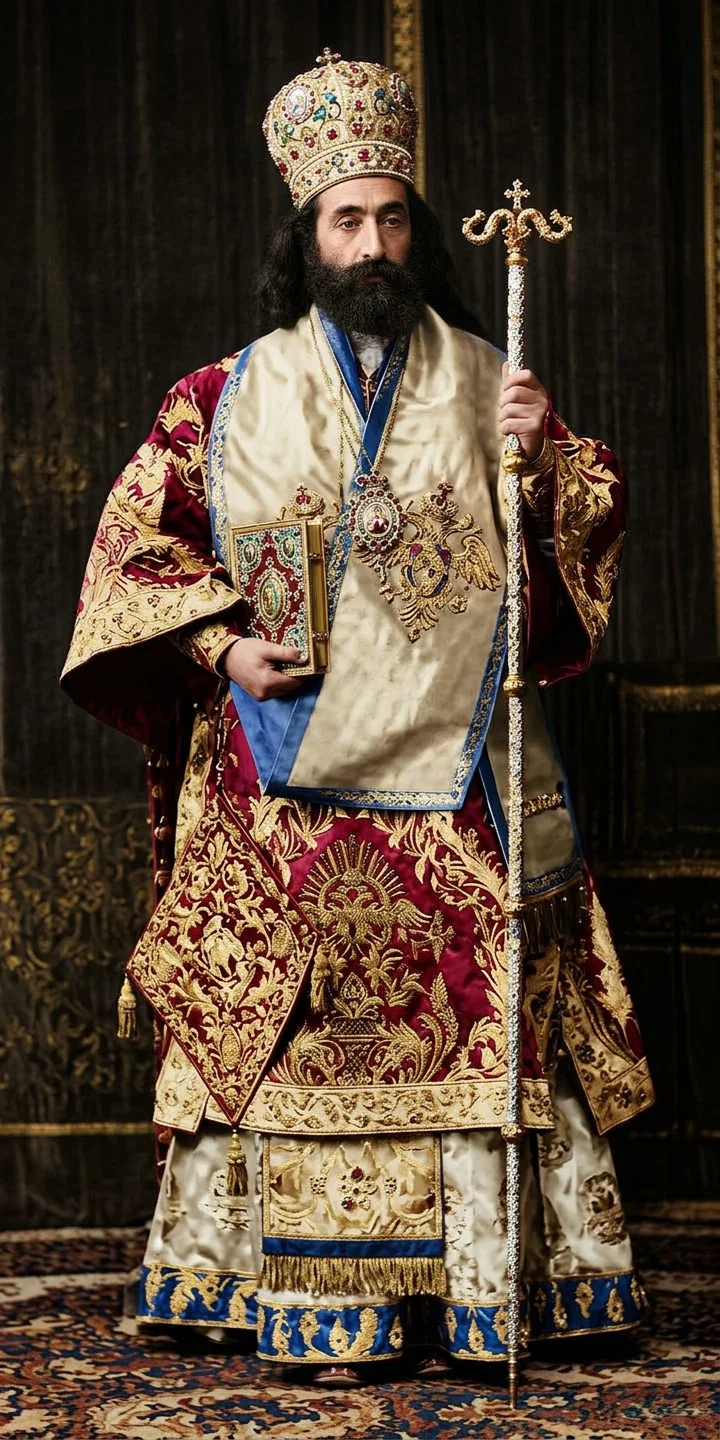
HIS HOLINESS JOACHIM III.
Panorama of Modern Smyrna.
[We regret that this could not have been printed before, but it is of interest now. It throws light upon present problems, shows the unsettled condition of things, and emphasizes the fact that now is the time to work for souls.—EDITOR.]
Since the close of the Russo-Japanese War there has been a renaissance in the Eastern world. The victory of the yellow race over a powerful European nation has awakened China from her millenniums of sleep, and has aroused her to follow the lead of Japan in organizing a form of constitutional government. For several months Persia has been in the throes of a revolution,—the travail occasioned in the effort to bring forth constitutional government. And now, only a month ago, comes the Sultan of Turkey, following in the path of the general awakening, granting a constitution, and calling for the election of a parliament. This is the third Asiatic power—to say nothing of Russia, which, with Turkey, is both a European and an Asiatic power—which has been struggling in the same revolution to establish a constitutional monarchy. The next on the program would seem to be India. The seismic disturbance, originating in the “Land of the Rising Sun,” has shaken a whole “continent from Tokyo to Monastir.”
To just what extent the events in the “Far East” may affect the politics of Europe and the rule of the white race, remains to be worked out in the near future. The “Near East” is the field of greatest political importance just now. Mohammedan government has had the Koran as its constitution and the absolute will of the Calif as the executive, judicial, and legislative functions, all in one. The present departure toward representative government is entirely incompatible with the fundamental principles of Moslem government. The present constitution is not the first attempt at constitutional government, but the Midhat Constitution granted in 1876 was but a fraud, and was drafted for the purpose of side-tracking Europe for the time being.
Ever since the days of Peter the Great, aggression upon Turkey has been a fixed factor in Russian policy. The climax of the first epoch of this policy was reached in the Crimean War. But the articles of the treaty of Paris in 1856 have evidently never been considered as final on the part of Russia. Carefully has she worked up European
public opinion to the belief that another Russo-Turkish war was necessary, so that in 1877 she again burst upon Turkey. European powers watched carefully the progress of things, but with a hand-off policy, until the treaty of San Stephano, signed on March 30, 1878. The stipulations of the
treaty being a patent violation of the articles of the treaty of Paris, the powers demanded that the former be submitted before the signatory powers of the latter for consideration. Russia at first demurred, but finally consented, and a congress was called at Berlin. Russia being thus forced to place her exorbitant demands upon Turkey before the powers, Count Schouvaloff maintained that the treaty of San Stephano was only drafted for the purpose of informing Turkey what plans Russia would formulate before the other powers. Thus did smooth-tongued diplomacy suffice for another temporary settlement of the affairs in the Balkans.
But in the Berlin congress the Bulgarian Empire was born. Since then Russia has been using Bulgaria as a tool to stir up trouble in Macedonia, and to excite war with Turkey, if possible. The same old plea is raised that in the interests of humanity something must be done for the pacification of Macedonia. We have heard much about the activities of Greek bands, of Albanians and Turks in Macedonia. We also hear of Bulgarian bands, but whatever depredations are done by Bulgarians are usually construed as being defensive, that the Greeks, Albanians, or the Turks are to blame for all the trouble. Bulgaria simply plays in the hands of Russia. England also has done all in her power to magnify the virtues of Bulgaria. Bulgaria fears nothing, because she has big guardians of her interests near at hand. Last spring Grand Duke Vladimir made a speech in Sofia in which he gave encouragement to Bulgarian aspirations. This stirred the Komitadjis anew in their campaign in Macedonia. I would state here that the Komitadjis are organized ostensibly for the purpose of protecting Bulgarian interests in Macedonia, but are really being used in the great game of working up trouble in Macedonia, and massacring the Greeks within their borders.
I can do no better in setting forth the real condition of affairs relative to Bulgaria’s propaganda, than to quote Mr. Gregory Natchevitch’s confession when he resigned several months ago from the position of Bulgarian diplomatic agent in Constantinople.
**“I left Constantinople because I was toodeeply ashamed to look the world in the face. . . . I desired Bulgaria to be regarded, throughout the world, as a model of order and tranquillity, a land of liberty and progress, where law is respected, life and property safeguarded to all, without any distinction of race or creed. Read the ‘Vetcherna Patcha’ and you will see what is the idea of Daskaloff and his mighty protector. They dream of nothing but war upon the Greeks, persecution, ruin, and destruction of them on Bulgarian soil. Their instruments are brigandage, sedition, and atrocity. And it is this land of anarchy which is to pose as the savior of Macedonia! We have seen how she is saving it!”**
True it is that nothing can be said in behalf of Turkish administration. It has been corrupt to the core. No one could be trusted. But it must also be admitted that the Christian nations of Europe, and especially Russia through her Bulgarian arms, have only aggravated the difficulties in Macedonia. Since 1840 Turkey has been the “shuttlecock of Europe.” Whenever it is more advantageous for a European power to be at war than at peace, the Eastern Question is always revived in one way or another.
For several months the whole attention of Europe had been directed to the Macedonian question as it has not been since 1878. Plans had been conceived for bringing Macedonia under a governorship, the governor, of course, to be appointed by the powers. King Edward visited the Czar at Reval, and an understanding was reached whereby the foregoing plan was to be put into execution. It is also reported that Germany had “accepted the English note on Macedonia.” Austria was the only power whose decision remained questionable, and then the storm broke in Constantinople, and on July 24 the Sultan granted a constitution and called for the election of a parliament.
This came as a surprise. It came about in this way: For months there had been disaffection in the army in Macedonia, but no particular attention was given to it outside of Turkey. For a long time the Young Turks had been organized and had been working against the old regime of government. A great secret army of them had developed. Suddenly, when the opportune time came, part of the garrison at Monastir left the barracks, and carrying a good store of fire-arms and ammunition, retired to the mountains. Immediately a Turkish pasha was sent from Mitrovitza to quell the revolt, but he was killed immediately. The whole garrison revolted. Another pasha was then sent, and, while reading a severe message from the Sultan, was shot in the presence of 2,000 troops, and not a hand was raised to molest the man who did the firing. It was soon seen that the whole Macedonian army was going over to the Young Turkey Party, and the Sultan could resort to nothing but to grant their requests, and establish a constitutional government.
So far the new regime has things fully in hand. The work of the bands in Macedonia seems to have subsided. Constantinople, though heated to a high degree, is held within bounds. But it remains to be seen whether Turkey can pull herself together, and permanently correct existing evils,—shall I say to the satisfaction of the powers?—No, but so that the powers will have no further excuse for performing humanitarian work for Macedonia. Some other excuse would then have to be found for driving the Turk out of Europe. Necessarily Sir Edward Grey’s plan is nipped for the present. Russia has sent a note to the powers to the effect that she will withhold from interfering in the affairs of the Porte until the new regime has proved whether it is capable of correcting the existing evils or not; but that in the event that it is not able, she shall continue to press her claims with reference to reforms in Macedonia.
This is a most critical moment in the Near East. We almost hold our breath to see which way the scale will tip. Europe is destined to work out her drama of nations in the theater of the “Sick Man.” What will be next? The most unexpected has just come. Will the next act be as unexpected?
Lord Cromer, in a recent speech before the House of Lords, said:
“I would ask, in the present condition of Europe, what is the main duty which devolves upon the government of this country? For my part I have no sort of hesitation in replying to this question, for their main duty is to make provision betimes for the European conflict which might probably be forced upon us before many years have elapsed. It is the duty of the government to provide betimes for that danger of which I, in common, I believe, with most people who can speak with real authority on foreign affairs, am very firmly convinced.”
The European Conflict must come, and Constantinople will be the storm-center. In spite of all the attempts at bringing in universal peace, war, not peace, is the ultimate in the minds of the greatest statesmen. Once Constantinople passes from its present neutral position, and the winds are let loose.
Now is the time for missionary effort in Turkey. The door is thrown open. The new form of government grants equal rights to all religions in the empire. Christian nations, so called, can never bring about the conversion of the Moslem world. They may intrigue against her, they can conquer with the sword, but the powers can not fill the place of the divine power. They can not carry the Christ to the Moslem. Christ never taught us to carry His message with the sword of steel. Only the true missionary can be the agent of real reform to the inhabitants of Turkey.
Now is the time for the Christian world to bestir itself. Not as nations; for they are astir, but as Christians,—citizens of the commonwealth of heaven. Christ has defined the last act in the drama of nations,—His kingdom will be established.
Christian, watch, work, pray, and look for the “Coming King.”
Bagtchedjik, Asia Minor, Sept. 4, 1908.
Panorama of Modern Mytilene.

Is the Sabbath Jewish?

By J. C. Stevens.
[Five reasons were given in our last issue for the universality and perpetuity of the Sabbath. Five more are given in the article which follows. — EDITOR.]

VI.

That law which took the form of ten precepts at Sinai was written in the fleshly tables of man’s heart in the day of his creation. “Let Us make man in Our image,” we read in Gen. 1:27. “God made man upright,” says the wise man. Eccl. 7:29. To make man in His image was to make him in His character. The law, as we have proved, is a transcript of God’s character, and this was written in the fleshly tables of man’s heart, to use a scriptural figure. Adam’s life before he sinned was in perfect accord with that law which was afterward written on tables of stone. Who will deny it? And who will deny that even to-day there are faint traces of the fact that in man’s creation the law was written in his heart? Read of the Gentile heathen in Rom. 2:12-16. Do not say that the Sabbath commandment is physical and ceremonial, while the other nine are moral. Remember that the Sabbath was made to partake of God’s holiness even as man was. Gen. 2:3. God blessed it, and sanctified it, and also remember that the One who first rested on the seventh day “fainteth not, neither is weary,” and that man when first given the Sabbath, did not labor “in the sweat of his face.” But who will deny that rest is written in man’s nature?
Now the Gospel is a definite provision to restore that original image, and to write that law anew in the fleshly tables of our heart. Read Col. 3:8-10; 2 Cor. 3:3; Jer. 31:33. The Sabbath is a part of this law. If the law is written in our hearts, will not our life outwardly be in harmony with the letter of the law so far as our knowledge goes? Nothing else is possible. Is this privilege of the restored image of God and the writing of the law in the heart for the Jews only? — Surely not.
VII. The law of God is not dispensational. Neither is grace. They both work hand in hand. Paul says: “Moreover the law entered that the offense might abound, but where sin abounded, grace did much more abound.” Rom. 5:20. Where did the law enter? — At Sinai. Why was it given in that particular manner? — That the offense [sin] might abound. But right thereat Sinai, grace did much more abound. The law and grace must work together for man’s salvation. The law gives a knowledge of sin (Rom. 3:20; 7:7; 1 John 3:4), and therefore places the transgressor under its condemnation, but through the grace of God in Christ he can be forgiven his sin, and brought from under its condemnation into harmony with it. So the man who is under grace is the man who is living in harmony with the law, having the victory over sin instead of sin’s having the dominion over him. The law then holds out no terrors for him. But if he is breaking any precept of that law, he is under the law, and feels condemned, providing his conscience is not “seared with a hot iron.” This is Paul’s teaching in Rom. 6:14. Let us not construe this verse to excuse ourselves in Sabbath breaking, and at the same time logically excuse us in idolatry, blasphemy, murder, adultery, theft, etc. We are under obligation to keep the entire Ten-commandment law, and the Gospel is the provision unto that end. The Sabbath is a part of that law.
VIII. Neither can the Sabbath be confined to covenants; for it was made in the beginning, before even sin entered, before there was any necessity for any covenant involving the salvation of man; and Isaiah tells us it will be kept in the new earth by all of God’s people, when all things are restored (Acts 3:20); when the first dominion shall come to the second Adam (Micah 4:8); when the curse of sin is all removed (Rev. 21:3); when the earth, man’s eternal home (Matt. 5:5), in its Eden state, will be the center of the everlasting kingdom of our Lord and Saviour, in that blessed state, where we shall see the result of the new covenant. Heb. 8:11; Jer. 31:31-33.
IX. It is acknowledged by all of the principal Protestant denominations that the Ten-commandment law, separate and distinct from all other laws given to the Jews, is binding on us. The Methodists say, “No Christian is free from the obedience of the commandments which are called moral.” The Baptists say, “We believe that the law is the eternal and unchangeable rule of God’s moral government.” And the Presbyterians say, “The moral law is of use to all men, to inform them of the holy nature and will of God, and of their duty, binding them to walk accordingly.” So we might go through the entire list.
X. It is therefore evident from every reasonable and scriptural consideration that the seventh-day Sabbath is not a Jewish institution, that it is no more Jewish than “Thou shalt not kill,” or “Thou shalt not steal,” and that it is manifestly wrong to localize it by styling it “Jewish” when it was made for MAN. It is equally wrong to stigmatize it by calling it “Jewish,” when the law calls it, “the Sabbath of the Lord, thy God,” and the Lord calls it, “My holy day.” Ex. 20:8-11; Isa. 58:13. Let us not be so inconsistent as to confine the Sabbath to Jews, any more than we would think of confining to them also righteousness, mercy, or truth, etc., simply because they were given to the Jews. Remember that God called them out of Egypt to make them the depositaries of His truth. Paul says that the adoption, the covenants (both old and new), the promises, are of Israel. Rom. 9:4. He describes the case of the Gentiles without these things handed down through Israel as “without hope and without God in the world,” and “aliens from the commonwealth of Israel.” Eph. 2:12. And Christ said: “Salvation is of the Jews.” John 4:22.
I conclude with this appropriate verse by different authors:

It’s Jewish.

When we present God’s holy law, And arguments from Scripture draw, Objectors say, to pick a flaw, “It’s Jewish!”
Tho at the first Jehovah blest And sanctified His day of rest, The same belief is still expressed — “It’s Jewish!”
Tho with Creation this rest began, And thence through all the Scriptures ran, And Jesus said ’twas made for MAN, “It’s Jewish!”
Tho with the Jewish rites — which passed, But with the moral law ’twas classed: Which must exist while time shall last, “It’s Jewish!”
If from the Bible we present The Sabbath meaning and intent, This answers every argument — “It’s Jewish!”
Tho the disciples, Luke and Paul, Continue still this rest to call The “Sabbath day,” this answers all — “It’s Jewish!”
The Gospel teachers’ plain expression, That sin is of the law transgression, Seems not to make the least impression — “It’s Jewish!”
They love the day of man’s invention, But if Jehovah’s rest we mention, This puts an end to all contention, “It’s Jewish!”
O, ye who thus God’s law abuse Simply because ’twas kept by Jews: The Saviour, too, you must refuse — He’s Jewish!
The Scriptures, then, we may expect. For the same reason you’ll reject; For if you will but recollect, They’re Jewish!
Thus the apostles, too, must fall; For Andrew, Peter, James, and Paul, Thomas and Matthew, John and all, Were Jewish!
So, to your hapless state resign Yourself in wretchedness to pine; Salvation surely you’ll decline — It’s Jewish!
79 Olive St., Bridgeport, Conn.

The Strength of Conscious Weakness.

SELF-SATISFACTION has a great deal more to do with people’s so-called religious doubts than they like to admit. One who is ready to look at himself as he really is finds little room left for self-satisfaction, and for the spiritual and intellectual fogs that go with it. An earnest Christian worker recently thanked God “for a sufficient consciousness of sinful nature and nothingness when alone, to keep me from any doubt as to the need of a Saviour, and that success in doing God’s will and work is wholly a question of the Holy Spirit’s choosing and using as an instrument.” There is safety, efficiency, and clear vision of truth, in that prayer of thanksgiving. The only man whom God can not help is the man who will not admit his need of God’s help.—S. S. Times.
Continue reading: Truth’s Power to Sanctify