What the Earth May Teach Us — The Universe a Great Lesson Book
By ELIZA H. MORTON
(All rights reserved)
There was an air of expectancy in the Arnold home one evening as Mrs. Arnold came into the parlor with her Bible in her hands. She had promised the children, Kate and Will, that she would give them a series of gospel lessons supplementary to their regular geography lessons in the public school.
“What is there in the Bible about geography?” asked Kate, with an amused look on her face.
“I do not know,” replied Will, “but I am sure that mother does, and she will tell us all about it.”
Mrs. Arnold smiled, and replied, “The first thing we want to know is, what is the great object of all geographical study? Read Rom. 1:20.”
Tom read, “For the invisible things of Him from the creation of the world are clearly seen, being understood by the things that are made, even His eternal power and Godhead; so that they are without excuse.” What does that mean?
“It means,” said Kate, “that by studying geography, we may learn about God; for there is enough in the natural world to teach us that there is a God.”
“Good!” exclaimed Mrs. Arnold. “You expressed that thought very clearly. The whole physical world is full of object lessons that impart spiritual truths. ‘The earth is God’s universal temple, where everything speaks of His glory.’ Read Job 12:8.”
“Speak to the earth, and it shall teach thee.”
“Yes,” said Mrs. Arnold, “the earth is God’s picture book, illustrating His written word, the Bible. When we study the one in the light of the other, God draws near by His Spirit, and becomes our Teacher. ‘Who is a teacher like unto Him?’ Job 36:22, A. R. V.
“You have learned in Sabbath school how God created the earth through Christ (Col. 1:16), and that we can understand how that was by faith (Heb. 11:3). ‘He spake, and it was done.’ Ps. 33:9. God’s purpose in creating it was that it should be inhabited. Isa. 45:18. It was a perfect world (Gen. 1:31), but soon was marred by sin (Gen. 3:17, 18). It is about the earth thus marred that geography teaches. Yet, in spite of the curse that came because of sin, the earth is still beautiful. You may read the first gospel note, and tell us what it has to do with geography. Gen. 3:15.”
“And I will put enmity between thee and the woman, and between thy seed and her seed; it shall bruise thy head, and thou shalt bruise his heel.”
“I think I can tell what that means,” said Will. “It means that through Christ, the power of Satan was broken. I have often bruised the head of a snake beneath my heel; and so Christ will bruise the head of Satan, although Satan may for a time persecute the church of God.”
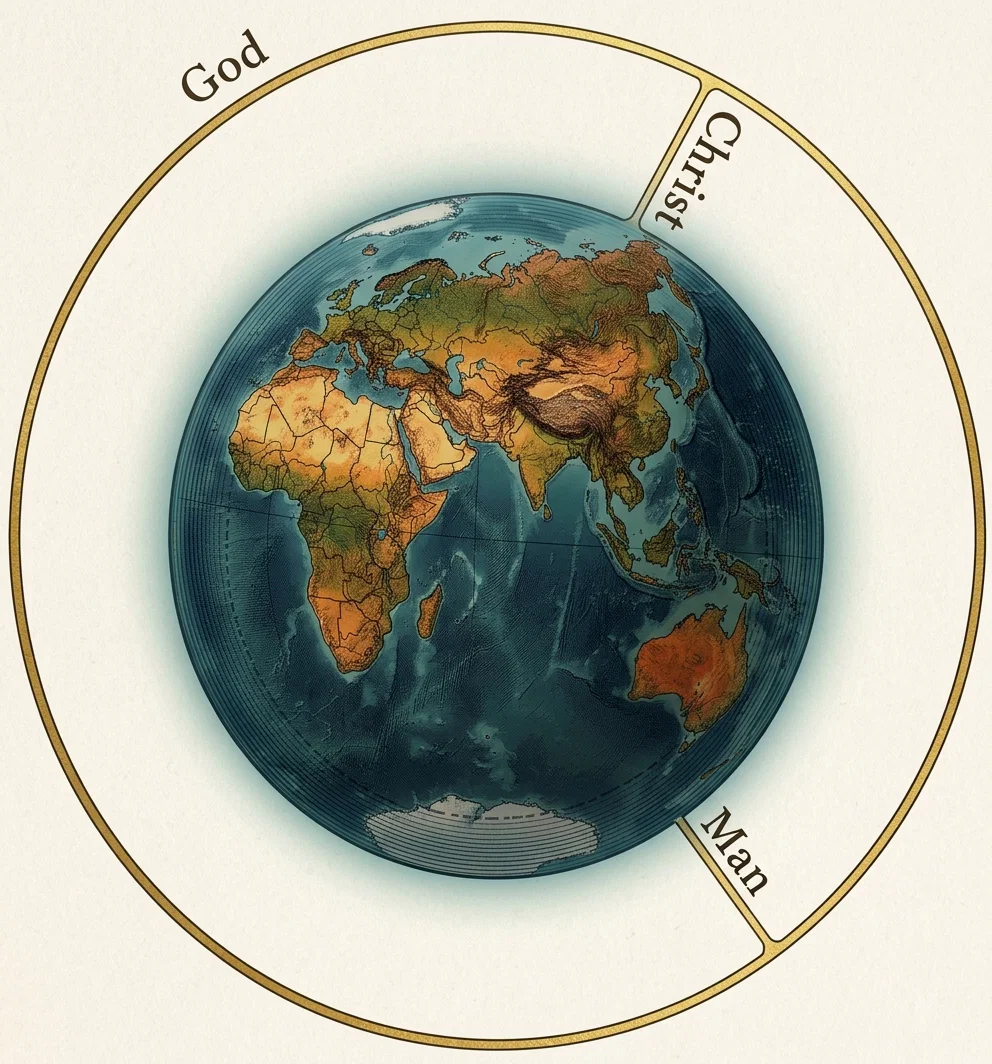
“I am glad that you remember so well what you have been taught in Sabbath school,” replied Mrs. Arnold. “When man sinned, he cut himself and the earth entirely off from God; but Christ made a connecting link, as I will show you by a blackboard diagram.
“While geography treats of the earth in its relation to man, it should also include the relation of the earth and man to God.
“Geography in its broadest sense is such a description of the earth as ‘will interpret the things of God, and speak of His glory.’”
“What were the special topics in your geography lesson to-day?”
“We studied about the relation of the earth to the universe, and about our solar system.”
“We have seen,” said Mrs. Arnold, “that God has associated spiritual lessons with every object in nature, and He desires us to think of those lessons when we look at the objects. The firmament, with its suns, moons, and stars, is a silent witness that there is a God. Ps. 19:1-6; Job 26:14.”
“You must always bear in mind the fact that nature is not God, as some men affirm, but simply that which God has made.”
“The earth, compared with the universe, is but as a grain of sand on the seashore. Jer. 33:22. Its vastness shows the infinity of its Maker. God counts the stars, and knows the name of each. Ps. 147:4.”
“Yes,” replied Kate; “and I have been thinking, as you read that passage of Scripture, that the smallest thing on earth is not beneath God’s notice; for He counts the hairs of our head, and notices when a sparrow falls to the ground.”
“That is true,” said Mrs. Arnold; “and as God has a plan for each star (Job 38:31, 32), so also He has a plan for each life. One must, however, cooperate with God in working out the plan of his life, if he would have it perfected. The earth is the workshop, and Christ is the perfect pattern.”
“While talking about the universe,” said Will, “we might speak of the beauty of the stars. It says in 1 Cor. 15:41 that ‘one star differeth from another star in glory.’ I wonder what that means.”
“It means,” replied Mrs. Arnold, “that each one has its own distinctive individuality. When viewed through a telescope, they show all the colors of the rainbow, and fill the mind with delight. They are as beautiful in detail and finish as the flowers of the earth.”
“We talked about the sun at school,” said Kate. “I wonder if we can find any spiritual lesson in that.”
“Yes,” said Mrs. Arnold. “Our sun is the controlling center of our solar system; and as it is upheld by God, so we may be kept from sin by God’s power. Heb. 1:3; Isa. 41:10.”
“Our sun is a light-bearer. It reflects light from God. When we sit down in the sunlight, we sit down in God’s glory.”
“Our solar system may be compared to a family. As there are many solar systems in the universe, so there are many families on the earth. God cares for all; but there is one special family, to which if we do not belong, we are not light-bearers for Him. Eph. 3:15; Luke 16:13.”
“I think,” said Will, “that there is a lesson in the fact that the sun shines alike on the evil and on the good.”
“But the Sun of Righteousness does not shine with saving power on the wicked,” said Kate.
“No,” replied Mrs. Arnold; “one must yield one’s self to its influence in order to be benefited by it. John 1:9, 12.”
“I read something the other day,” said Will, “that has a bearing on this subject. It was to the effect that our earth, compared with the other planets, is neither the largest nor the smallest, neither the swiftest nor the slowest, neither the warmest nor the coldest; yet it is the one world that Christ came down from heaven to redeem from sin—the one lost sheep.”
“That is to the point,” said Mrs. Arnold. “It is a beautiful thought, also, that this earth where Jesus suffered and died will eventually be honored above all the other worlds, for God’s throne will be here. Rev. 22:3.”
“We shall not have time to carry this subject farther this evening. Next time, we will take up the same topics you have in your school.”
“What a delightful evening we have had!” exclaimed the children.