ISRAEL as a distinct family in lineal succession from Abraham were given up. Babylon also went to the dust. But Israel as a spiritual body, Zion as a spiritual city, and Babylon as a spiritual city also, still continue. All who follow the spiritual life of Abraham and of Christ are accounted for the seed. So “if ye be Christ’s then are ye Abraham’s seed, and heirs according to the promise.” The commonwealth of Israel continues; for no promise was ever yet made to a gentile as a gentile. He must first be circumcised with the circumcision made without hands, and become an Israelite indeed—that is, in the heart; “he is a Jew which is one inwardly.” So he becomes partaker of the promise of the heirship of the world, which was made to Abraham. Rom. 4:13. Hence the true Israel, according to God’s original design, continues on, and Zion, “the holy city,” that is, the church of God, is spoken of as of yore.
So also is Babylon, she is still “that great city,” the “mother of harlots and abominations of the earth,” still proud and disdainful, haughty and implacable. She is still the oppressor of God’s people, and drunk with their blood, gaudy in attire, the lady of kingdoms, still saying as of old, “I sit a queen, and am no widow, and shall see no sorrow.” Rev. 18:7; Isa. 47:8. Her merchants are the same sorcerers and prognosticators as of old. Rev. 18:23; Isa. 47:13–15. The picture is the same throughout. She is filled with wise men and witchery, and is still the mother of all abominations.
So, as Israel, and even the name of the twelve tribes, are continued in the New Testament (see James 1:1; Rev. 7:4–8; 21:12), we are bound also to recognize Babylon upon the same principle. They who are of the “holy city” now, are Christlike in life and character; they who are of the “great city Babylon,” are of another type, wholly sensual and given up to the delusions of Satan.
Zion and Babylon represent two types of religion; for Satan ruled Babylon through her wizards and wise men. Everybody must be religious. Statute law was very strict. They were in the thrall of lying spirits completely. She was a sorceress, a devout devotee of Baal. In fact, the two types of religion stand out very plainly; the one has the worship of the living God, according to his law, the other the worship of demons, that is, of Satan. Babylon in her spiritual length and breadth and authority has continued on since the literal city went down. And the warning cry of the prophets, as in Isa. 48:20, “Go ye forth of Babylon,” is a prophecy applicable to all time. In the same prophecy we read a little farther on, “Depart ye, depart ye, go ye out from thence, touch no unclean thing; go ye out of the midst of her.” Isa. 52:11. The force of these exhortations will hereafter be shown.
One familiar with the book of Revelation will remember the various references to Babylon, and calls to come forth and flee from her. In Revelation 18 especially, the final call from Babylon is made, and in conjunction with this Zion is restored and everlasting joy extended to her.
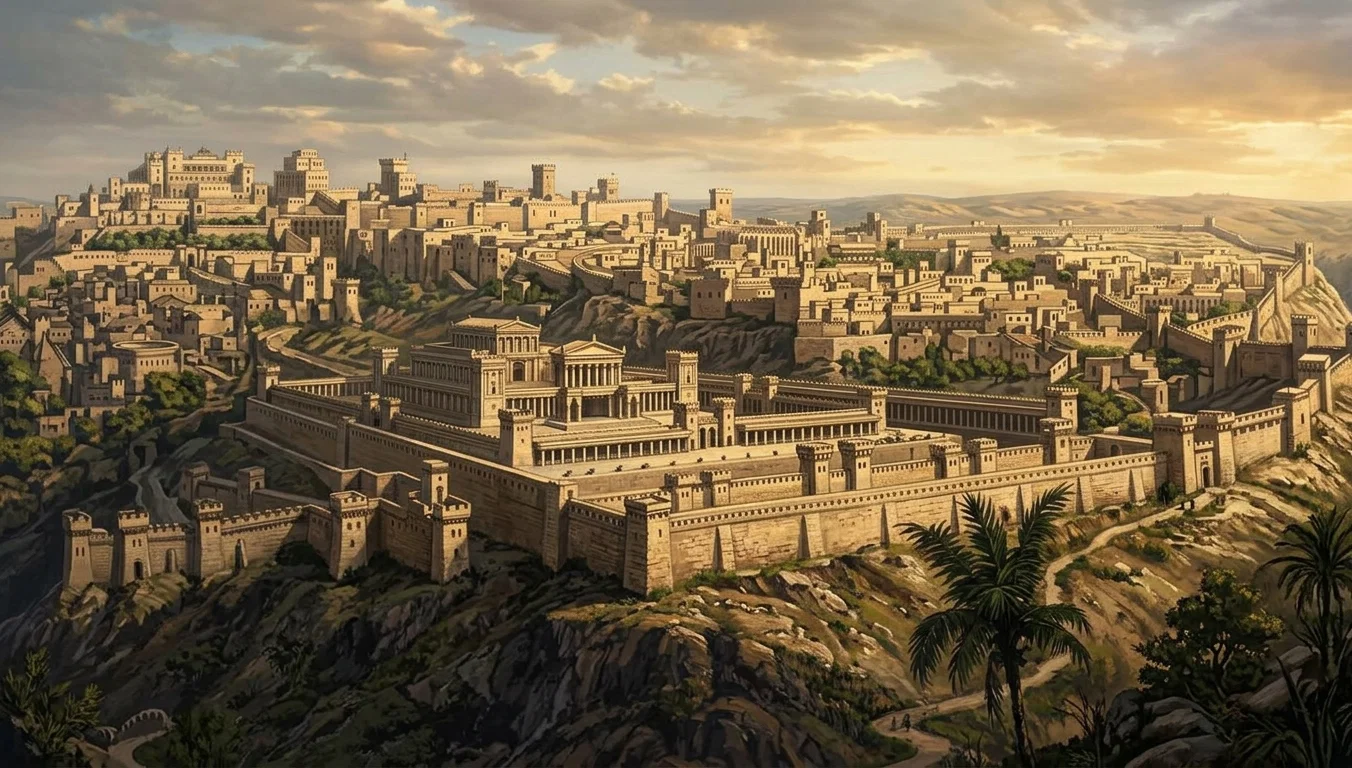
But it is needful to glance once again at the two spiritual cities to which I have called attention. Because not literal, some may conceive of them indefinitely. The prophet Isaiah continually mentions Zion as a city and as a woman. Looking forward to the times of Christ, he speaks of her bulwarks of salvation, and her gates of praise, which are swung open day and night that the forces of the gentiles may be brought. These same sons of the strangers are to build up her walls. And she is called “The holy people, The redeemed of the Lord; and thou shalt be called, Sought out, A city not forsaken.” This holy people, sought out and gathered “one by one,” is the church of Jesus Christ, as all will probably acknowledge. It is likewise mentioned in the New Testament as “a holy nation,” “a peculiar people,” “the holy city,” and is set forth in Revelation 12 under the figure of a woman, the same as in Isaiah. None will doubt, then, that the spiritual city Zion stands to-day.
Now just what is perpetuated from the ancient Zion which makes the Zion of to-day?—Her God, her ruler, her king, her obedient children, her walls of salvation, her gates of praise, her laws. And yet if you turn to Rev. 11:2, 3, you will find this holy city with her walls and bulwarks broken down for a period of 42 months, or 1,260 prophetical days (meaning years), during which time she is over trampled by the gentiles; the uncircumcised and the unclean pass through her gates. But “in the day that thy walls are to be built,” following this time, “there shall no more come into thee the uncircumcised and the unclean.”
And just what is Babylon?—It is that false system of religion which proceeds from Satan, for he was and is her ruler (see Isaiah 14), as it was given forth by her wise men, her sorcerers, and has been passed out in her279golden wine cup—a poisonous draught to all nations. So her ruler, her laws, and her subjects continue; for she has brought all nations under her spiritual sovereignty.
In Revelation 12 the dragon is revealed with seven heads. The dragon is Satan. His spirit and life are in the system; for so the word declares. So the seven heads are Satan’s heads and mouthpieces; but those heads are kingdoms, as shown by the crowns thereon; and, moreover, the dragon becomes metamorphosed into the seven-headed beast of Revelation 13, who possesses the power, seat, and authority which the dragon before possessed. And the seven heads are now explained to be mountains, or kingdoms. Chapter 17:9, 10. These kingdoms come and go consecutively; and five are declared to be fallen. The word also states that the woman Babylon has her seat upon and reigns over these kingdoms. I before said that Satan rules these kingdoms, but as God is an husband unto his people (Jer. 31:32), and we are married to Christ (Rom. 7:4), and consequently Christ and the Father, who are One, come unto us and make their abode with us (John 14:23), so this woman Babylon is the bride of Satan, and they twain are one.
There is reason to believe that the number seven is to be taken literally, not in a figurative sense of entirety or fulness, but that just seven great kingdoms whose animus and life are Satanic will thus appear. One of them appearing twice over makes its reappearance at the last as an eighth head, and yet is the same former beast—one of the seven. It is easy to count the five which are now fallen, as we read (Rev. 17:10); for beginning with Satan’s kingdom of Babylon, the first head, we find a second head in the Medo-Persian Kingdom, and a third in the Grecian, while Pagan Rome constitutes the fourth; and I must now set down the Roman Kingdom of the Dark Ages as ruled by the popes, for the fifth. I am a little forward in this; for, while all will acknowledge the power of Satan in the first four, the fifth, or papal head, which was equally potent with the other four, some conceive to have been the kingdom of God. Now in this connection I can not stop to prove the assertion that the papal kingdom of Rome was wholly Satanic; I will prove this presently.
Paganism, therefore, is the essential feature of Babylon; but I speak of paganism as of Catholicism or Protestantism as a religion. The word originally signified the religion of the peasants. The peasantry of Rome retained their heathen rites and religion long after Christianity was acknowledged in the cities. Paganism is the last extreme from infidelity. Its essential principle is sorcery or dealings with familiar spirits, who come under the guise of the spirits of the dead. It makes no effort to bring about gravity of morals, but is rather the great weight which sinks her devotees into the abyss of pollution.
In the day when Christ appeared among men, it will be remembered that his own received him not. They were proud, haughty, and covetous, doing their works to be seen of men, and devouring widows’ houses; they chose the murderer instead of Christ; for they were murderers. Babylon, who has caused her wickedness to pass upon all the nations, could claim the Jewish nation at that time for her subjects. They were in spiritual Babylon; for their life comported with the Babylonian rather than the God-given standard. They were Satan’s children (John 8:44); unclean demons possessed many, while the Spirit of God possessed few.
As formerly the Babylonian scepter had been stretched out over Judea in a spiritual conquest, so Christ saw the chosen people serving the Babylonian prince—Satan—and opposed to God. “Go ye forth of Babylon,” “go ye out of the midst of her,” was applicable then. As when the Jesus of former days led back Zion’s captives to thy pleasant land, and laid the foundation of the temple under the decree of Cyrus, so Jesus, our Leader and Deliverer, went forth with a multitude of captives, and laid the foundation of the spiritual temple, which shall never be overthrown. “And since that time even until now hath it been in building, and yet it is not finished.” Ezra 5:16.
As formerly great sorrow was mingled with great joy at the laying of the foundation, so when the new temple of Christ began to ascend, some who looked to the former glory mourned, while others rejoiced. As the golden vessels of the former temple, for a time locked in the temple of Bel, were again brought forth and restored to the new, so the “vessels unto honor,” who were “meet for the Master’s use,” were transferred to the temple of Christ. All who were anointed by the grace of God, came unto Christ to serve in the new temple. As formerly, they began with abundant powers to finish all the work, but were hindered and hindered by the massed forces of the enemy, who were finally successful, and, under the decrees of the impostor Smerdis the work of building was stayed, and the walls and gates broken down. So the Gospel restoration was hindered, the walls of salvation (Isa. 26:1) thrown down, the gates of praise burned in the fire by the wicked impostor, the antichrist of Rome. But another decree was forthcoming, and a third finished the work. Of these we will hereafter speak.