“The Fruit of the Spirit Is Love.”—Our notes last week were upon the subject of fruit-bearing; and the word of God was there set forth as showing that to be fruit-bearers, we must possess life; and to be fruit-bearers for God, we must have the life of God, inflowing from the great Source of life. This life is the Spirit of God; and the fruit of that life is the fruit of that Spirit. Let it be our privilege and pleasure, dear reader, to study this fruit in its various forms; and as we behold it, may the blessed Spirit of life transform us into the same image, “from glory to glory.”
Love.—Not the love between man and wife, not common friendship which often exists between mortals, but the love which springs from God, which is the essential nature of God, which is manifest in all the works of God; “for God is love.” This is the love—“the love of God”—which is the fruit of the Spirit; for “the love of God is shed abroad in our hearts by the Holy Ghost [Spirit] which is given unto us.” It is the love which God exercises toward man, the responsive love of man to God, and the love from God through men to his followers.
A Living Principle.—This love is not mere emotion, or feeling, or passion. It arouses and gives birth to all of these; but it is more. It is a holy principle of life. It abides when emotion is past, when feeling is dead, when passion grows cold. “Love is stronger than death.” “Many waters can not quench love, neither can the floods drown it; if a man would give all the substance of his house for love, it would be utterly contemned.” It is of infinite power and strength and breadth and height; “for God is love.”
Love Manifest.—Earthly loves are capricious. Some of them exist in word only. Some of them are purely selfish. But the love (the agapē) of God is the perfection of unselfishness. God loves not because the object is so dear, but because it is his nature to love. He can do nothing else but love, even to love the unlovely. And this is not manifest in mere words. He has told us that he loves us. He has said, “I have loved thee with an everlasting love.” He has taken the most devoted love of earth as an illustration, and declared: “Can a woman forget her sucking child, that she should not have compassion on the son of her womb? Yea, they may forget, yet will I not forget thee.” And this wonderful love God has demonstrated in deeds for his children. The earth, as it came from his hand spoke of his love. Leafy tree, fragrant flower, dewy grass, balmy air fragrant with every sweet perfume, all spoke of God’s love for man. This was his home. It knew no death, no curse, no wo nor sorrow, till sin, which is not of love, entered and blasted the fair domain of the children of God. Before that time, man could read the love of God on leaf and flower and blade of grass, on tree and lake and cloud and sky; and even now, despite the curse, the beautiful things of nature look through the fog and miasma of sin, and tell of the love, the wondrous love, of God.
The Great Proof.—But the greatest manifestation of God’s love, in fact, the One-All-Comprehending Gift, is that of the Son of God’s love, Jesus Christ, our Lord. “Hereby perceive we the love of God, because he laid down his life for us.” “In this was manifested the love of God toward us, because that God sent his only-begotten Son into the world that we might live through him.” (1 John 3:16; 4:9.) And this he did, not for the righteous, but for sinners, for those who did not love God. “Herein is love, not that we loved God, but that he loved us, and sent his Son to be the propitiation of our sins.” (Verse 10.) “But God commendeth his love toward us, in that, while we were yet sinners, Christ died for us.” Jesus Christ was “God manifest in the flesh.” “God was in Christ reconciling the world unto himself.” Therefore all that was seen in Jesus while he walked the earth—the pure life, the unparalleled and exalted teaching, the kindly and never-tiring ministry to the poor and needy, the sick and sinful—was the manifestations of God’s life, was the working out of the law of God. And when at last the climax of the garden and cross was reached, the agony and the darkness and the cruel death itself said, “See how much God loves.” “God so loved the world, that he gave his only-begotten Son.”
“Love divine, all love excelling.”
“We Love Because He First Loved Us.”—Not only that we love Him, as the common version gives it, but we love, love as he loved, not because of anything in us, or because of anything we have done or can do, but “because he first loved us.” He loved us that we might have life to love. (1 John 4:9.) Through faith he gives us the Spirit of life, and by that Spirit the love of God is shed abroad in our hearts. The carnal heart is changed. God gives us a new heart, a new mind, a new spirit. “If any man be in Christ, there is a new creation.” (2 Cor. 5:17, R. V., margin.) The old hatred to God’s law is gone; and we love him and all mankind. Yea, “we know that we have passed from death unto life; because we love the brethren.” We have a burden for souls as did he. Our hearts go out to the soul-sick and sin-burdened ones around us. We give our lives for the work for which Christ gave his life, and count ourselves debtors to Greeks and barbarians, to the wise and unwise, constrained by the love of Christ. (See 1 John 3:16; Rom. 1:14; 2 Cor. 5:14.)
In Deed.—But our love for God, if we possess his love, will not be revealed in mere word; altho he who loves God will tell it. “My little children, let us not love in word, neither in tongue; but in deed and in truth.” (1 John 3:15.) True love is therefore manifest in the doing of the truth; and God’s “word is truth.” (John 17:17.) Love must be manifest in deeds, in the doing. “But whoso hath this world’s good, and seeth his brother have need, and shutteth up his bowels of compassion from him, how dwelleth the love of God in him?” (1 John 3:16, 17.)
The Highest Test.—But while we know that we have passed from death unto life, because we love the brethren, yet how do we know that we truly love the brethren? This is the crucial test, and the same apostle, in the same epistle, makes it very plain. He first lays down the foundation of all Christian experience, faith in Christ: “Whosoever believeth that Jesus is the Christ is born [begotten, R. V.] of God.” But faith brings the Spirit, and the Spirit sheds abroad the love of God; therefore, “everyone that loveth Him [God] that begat, loveth him [the child of God] also that is begotten of Him.” This is the love of God manifest in the love of the children of God. But further: How may we know that we love the children of God? The answer is explicit: “By this we know that we love the children of God, when we love God, and keep his commandments. For this is the love of God that we keep his commandments; and his commandments are not grievous.” (1 John 5:1–3.) This is the supreme test of our love to God. Said Jesus: “Ye are my friends, if ye do whatsoever I command you.” “If ye love me, keep my commandments.” “If ye keep my commandments, ye shall abide in my love.” (John 15:10, 14; 14:15.) We may say that we love God; that Jesus is our Lord, but his answer will be, “Why call ye me, Lord, Lord, and do not the things that I say?” It is the doer of God’s will that will enter heaven, and doing it from the heart—and God’s will can be done in no other way—is the proof, the fruit, of our love.
Living His Life.—This simply means living the life of Jesus over again. He, when on earth, possessed the Spirit of God, and therefore lived God’s life, kept God’s commandments. He said when about to come: “I delight to do thy will, O my God; yea, thy law is within my heart.” (Ps. 40:8.) At the close of his earth-ministry he could say, “I have kept my Father’s commandments, and abide in his love.” (John 15:10.) He did not reason that the letter of God’s law was dead; that the outward command or precept was nothing. He obeyed God’s commandments, every one of the ten words of God, not in their negative sense alone of not doing wrong, but in their positive and life-giving sense; a life of devoted ministry to God and man. If we have his Spirit, we will live his life. That Spirit will work out in our lives, if we will permit, just what it wrought out in Jesus of Nazareth. Therefore, “he that saith he abideth in Him ought himself also so to walk, even as He walked.” (1 John 2:6.) If we love God, we will serve him with delight, counting no command too small, too hard, too grievous or burdensome, too humiliating, if it only be that God gave it; that will be sufficient for love.
Wondrous Love.—But we could never tell all of love. Love is a life; it must be lived to be known. Love is a power; it must be experienced to be understood. It is the one essential above all others; it is the one Christian principle in the church militant which survives all storms, perils, disasters, and abides throughout the eternity of the church triumphant. Read the wonderful panegyric of love by the apostle Paul in 1 Corinthians 13. For “charity” read “love,” for it is the same word. Wondrous love! It gave to man this world in its beauty, unmarred and untraced by sin. It gave a holy law like the character of God, by which man might build character. When man sinned, Love gave earth’s Creator, Heaven’s best gift, the eternal Son of God, to die, that man might live and love and not die.
“Wide as the world is Thy command,
Vast as eternity Thy love.”
Surely God’s love should awaken responsive love in the heart of every son and daughter of Adam. “Love is of God.”
“Whatever things be sweet and fair,
Love makes them so.”
All of earth that is beauteous and enjoyable is so because of God’s love in Jesus Christ. All the blessings of earth are blood-bought, purchased by Infinite Love at the cost of the eternal sacrifice of the Son of God. And the love that gave Christ, is the love that will give all things the soul needs. (Rom. 8:32.) Nay, it has already given all things in him. Can we not say:—
“Love so amazing, so divine,
Demands my life, my soul, my all.”
THOUGHTS ON REVELATION XVII.
The Closing of the Great Controversy.
In previous studies we have learned that the great seven-headed dragon of Revelation 12 was a symbol of Satan in his relation to, and control of, the great ruling powers of earth, revealing the great fact that he is the instigator of all oppression, tyranny, and persecution. In chapter 13, verses 1 to 10, the direct agent of persecution is revealed in symbol. It is a seven-headed beast, with ten horns, representing the entire system of Satanic rule in the earth from the time of Babylon forward, the different phases of that system being symbolized by the seven heads.
This evil system is composed of a union of church and state in some of its various forms. It represents a religious system in which man, or a combination of men, put themselves in the place of God, seek to control conscience, direct worship, and become sponsors of the souls of men. Sometimes in this system the civil power has been dominant, with religion subject to the state, as in most pagan countries; sometimes the state has been dominated by the ecclesiastical power, as in the case of the Papacy. In all forms and conditions the system has been composed of a union of the two, and has always resulted in the oppression and persecution of the good and true, and the inevitable ruin of both church and state. The various forms of this system, as before set forth, down to the present time, may be named as follows: Babylon, Medo-Persia, Grecia, Pagan Rome, Papal Rome, and Pago-Christian governments of Europe as now existing.
Chapter 17 brings in a new feature in the system. Chapter 12 reveals the originator and instigator of all—the devil. Chapter 13 reveals the direct agent of the violence done—the lawmaking powers of corrupt government. But in chapter 17 we are shown the means by which the devil seduces and controls the powers of earth, and that is by religion, through the corrupt church, represented in chapter 17 by a harlot. The entire chapter, set from the Revised Version, because a little plainer and from better Greek copies than the Common Version, is as follows:—
The Message. Verses 1, 2.
“And there came one of the seven angels that had the seven bowls, and spake with me, saying, Come hither, I will shew thee the judgment of the great harlot that sitteth upon many waters; with whom the kings of the earth committed fornication, and they that dwell in the earth were made drunken with the wine of her fornication.”
The Vision. Verses 3–6.
“And he carried me away in the Spirit into a wilderness; and I saw a woman sitting upon a scarlet-coloured beast, full of names of blasphemy, having seven heads and ten horns. And the woman was arrayed in purple and scarlet, and decked with gold and precious stones and pearls, having in her hand a golden cup full of abominations, even the unclean things of her fornication, and upon her forehead a name written, MYSTERY, BABYLON THE GREAT, THE MOTHER OF THE HARLOTS AND OF THE ABOMINATIONS OF THE EARTH. And I saw the woman drunken with the blood of the saints, and with the blood of the martyrs of Jesus. And when I saw her, I wondered with a great wonder.”
The Explanation. Verses 7–18.
“And the angel said unto me, Wherefore didst thou wonder? I will tell thee the mystery of the woman, and of the beast that carrieth her, which hath the seven heads and the ten horns. The beast that thou sawest was, and is not; and is about to come up out of the abyss, and to go into perdition. And they that dwell on the earth shall wonder, they whose name hath not been written in the book of life from the foundation of the world, when they behold the beast, how that he is, and is not, and shall come. Here is the mind which hath wisdom. The seven heads are seven mountains, on which the woman sitteth; and they are seven kings; the five are fallen, the one is, the other is not yet come; and when he cometh, he must continue a little while. And the beast that was, and is not, is himself also an eighth, and is of the seven; and he goeth into perdition. And the ten horns that thou sawest are ten kings, which have received no kingdom as yet; but they receive authority as kings, with the beast, for one hour. These have one mind, and they give their power and authority unto the beast. These shall war against the Lamb, and the Lamb shall overcome them, for he is Lord of lords, and King of kings; and they also shall overcome that are with him, called and chosen and faithful. And he saith unto me, The waters which thou sawest, where the harlot sitteth, are peoples, and multitudes, and nations, and tongues. And the ten horns which thou sawest, and the beast, these shall hate the harlot, and shall make her desolate and naked, and shall eat her flesh, and shall burn her utterly with fire. For God did put in their hearts to do his mind, and to come to one mind, and to give their kingdom unto the beast, until the words of God should be accomplished. And the woman whom thou sawest is the great city, which reigneth over the kings of the earth.”
The Symbols.
1. The beast is identical with that of Rev. 13:1–10, representing the same dragonic system of government. This is shown by the seven heads, the ten horns, the blasphemies upon the heads, and the work that it does.
These identify the symbols as representing the same thing beyond the shadow of a doubt. The beast is the agent of the devil, the dragon, because it does its work. It is thought by some that this is indicated by the color. But the color of the dragon is red, or rather fire-colored, or sun-colored, a natural, inherent color, evidently connecting it with the great apostate religion—sun-worship; but the beast is scarlet, a bright red color produced by dye, symbolical of great cruelty and bloodshed.
2. The woman represents a corrupt church. She is elsewhere symbolized as a city. (See verse 18; chapter 18:10; 16:19), because of the ancient city Babylon which grew out of the first great apostasy this side of the flood. (Gen. 11:1–9; 10:10.) But it is not fornication for a literal city to unite with the kings of the earth. It is not fornication for two earthly powers to unite together. The woman does not therefore represent a city, but both symbols—the city and the woman—represent a power, or system, which in uniting with the kingdoms of earth, commit fornication.
The meaning of these symbols is not far to seek. The word of God abounds in illustrations of both. Again and again is the true church of God likened “to a comely and delicate woman” (Jer. 6:2), and over and over again is she called Zion, the daughter of Zion, Jerusalem, and the daughter of Jerusalem. (See Isa. 1:8; 37:22; Jer. 4:11, 31; Lam. 1:6, et al.) Her husband is the Lord of hosts. (Jer. 31:32; 2 Cor. 11:2.) To him alone is she to look for help. He alone should be loved and honored by her; but when the daughter of Zion turns to the nations of the world instead of to God, she becomes a harlot, the daughter of Babylon. In other words, she commits fornication with the kings of the earth, and confusion follows. (See Jeremiah, chapters 2, 3; Isa. 47:15; Eze. 16:28; Zech. 2:7; et al.) The harlot Babylon, of the Revelation, is therefore the church which has wandered from truth and set up earthly standards, and thus brought confusion; she has turned from God, her strength, to the world; and, losing the power of his Spirit, she has besought with all the arts of the harlot the power and influence of the world, and made the nations of earth drunken with her wine, the wine of her fornication. The wine, therefore, represents the false doctrines—doctrines not grounded on God’s word, but on human wisdom, doctrines which apostasy would not relinquish for the truth of the Gospel, doctrines to support which she united with the kings of the earth.
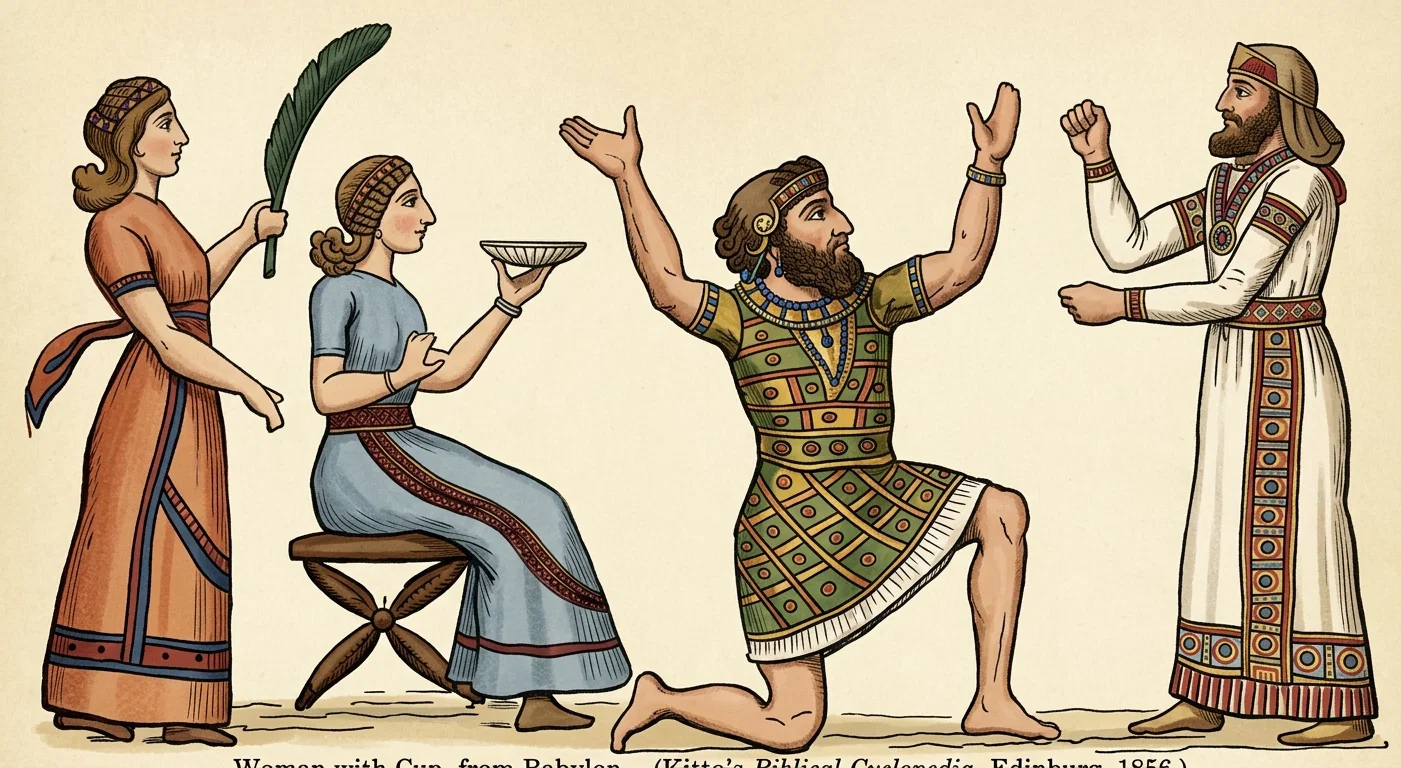
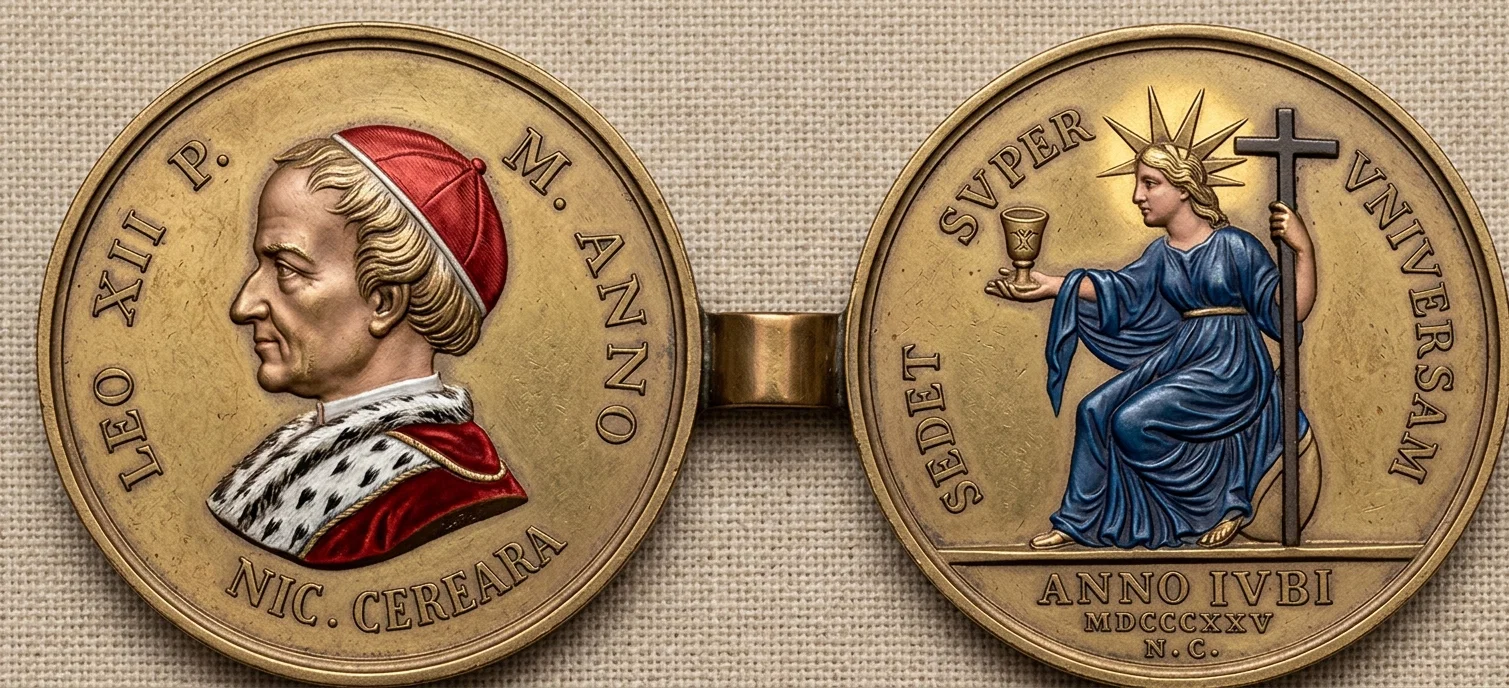
And all the nations of earth have been poisoned with this union of church and state, which began with Babylon of old. The rulers of earth have been seduced by the religious teachers and priests. They have quaffed of the cup held out by the siren of the nations, and all have been made drunken. This seducing of the nations, even as a harlot, was characteristic of Babylon of old (Jer. 51:7), and is engraved on her monuments; as also mystical Babylon has engraved her character upon her medals. (See the accompanying cuts.) As we have learned the meanings of the symbols, let us notice in brief some of the more prominent features of the prophecy:—
Its Chronological Application.
By this we mean the time to which it applies. Every prophecy of the Apocalypse was given in John’s day, when the prophet was a prisoner on the isle of Patmos, whether the prophecy concerned the beginning of Christ’s work in the heavenly sanctuary (chapter 5), or the destruction of sin and Satan (chapter 20). But the times to which these prophecies apply, their chronological applications, are widely different. The former applies to the time of Christ’s ascension from Olivet, the latter to the end of the millennium which will follow the second advent of our Lord. Revelation 13 was a prophecy of that great system of evil when it was just entering upon its work under the masterpiece of church and state government—the Papacy. In it is also shown its connection with the past forms of government.
But the chronological application of chapter 17 is at a later period, when the judgment of God is impending, when the Papacy has finished its greatest work, when the wilderness state of the church, the 1260 years of persecution, is in the past. That the application of this prophecy is to the last days is shown:—
1. By the angel that showed John the vision. He is one of those angels to whom is intrusted the fearful mission of pouring out the plagues of God’s wrath upon the world. (See verse 1, above.) These angels do not appear in the prophecy except in connection with its closing events.
2. He comes to show John, not the great work of the harlot, but her judgment, after her great work is in the past. (Verse 1.)
3. The deceiving of the nations, the making them drunken with the wine of her fornication, is also in the past when the angel “The Roman Church has actually taken this very symbol [woman with cup] as her own chosen emblem. In 1825, on the occasion of the Jubilee, Pope Leo XII. struck a medal, bearing on the one side his own image, and on the other, that of the Church of Rome, symbolized as a ‘Woman,’ holding in her left hand a cross, and in her right a cup, with the legend around her, ‘Sedet super universum.’ ‘The whole world is her seat.’”—Two Babylons, p. 6. See also Rev. 17:1, 18. What a striking fulfilment! appears to John. “With whom the kings of the earth committed fornication, and they that dwell in the earth were made drunken with the wine of her fornication.” (R. V.)
4. The wilderness state of the church, the very condition which John had before seen was in the past. (Chapter 12:6, 14.) During this time the true church, the daughter of Zion, was hunted, persecuted, wasted; but the false church, Babylon, was riding in triumphant carnage, drunken with the blood of the saints and the martyrs of Jesus. It has been well said that it was the midnight of the world; but it was the noonday of Babylon. No wonder that the prophet said: “And when I saw her, I wondered with great wonder.” (R. V.)
5. The chronological application of the prophecy is shown by verses 7 and 8. (See above.) The beast that John saw was the beast controlled by the head which existed during the wilderness state of the church. It was during this period that the great apostate church was drunken with the blood of the saints, when it is estimated that fifty millions or more of the martyrs of truth were put to death. At the time this prophecy applies, the papal beast, or the beast under the papal head, that which gave the beast the character he then had, existed, from 538 to 1798. The papal beast then “was” as a persecuting power. In 1798 its power to persecute, its recognized spiritual domination over the nations, ceased. Since 1798 as a controlling church and state power in the world it is not. The system of church and state continues to exist in the governments of the Old World, but in a decidedly different form, hence represented by a different head.
But the papal head is to be restored, the beast in that character “is ABOUT TO COME up out of the abyss, and to go into perdition,” indicating that its appearance would be soon and sudden, and its existence brief, so much so that those who “dwell on the earth shall wonder when they behold the beast, how that he was and is not, and shall come,” not, “and yet is,” as in the Common Version.
Rotherham renders the last clause of verse 8, “shall be present;” the Emphatic Diaglott the same. Murdock’s Syriac translation renders the last clause, “which was, and is not, and approacheth.” Etheridge’s Syriac translation renders, “who was, and is not, and draweth nigh.” Alford renders, “he was, and is not, and shall come again,” with the following marginal note: “So all our ancient MSS.; some of the late have, ‘and is present;’ but none read as the Authorized Version.” “Shall come,” “draweth nigh,” or “shall come again,” is the proper reading.
Then, when the beast in that phase “shall come again,” will be fulfilled Rev. 13:3: “And his deadly wound [death stroke] was healed, and all the world wondered after the beast.”
“Was” “Is” and “Shall Ascend.”
A word right here in regard to the tenses used in verse 8—“was,” “is,” “shall ascend,” past, present, future. It may be said that the “is” refers to John’s day. But nothing is more common in the prophecies of Old and New Testament than the use of the present tense with reference to the future. The prophet is carried forward to the time when the prophecy will be fulfilled, to the time of its application, and there he stands as the representative of the people of God. A few examples will make this plain. In Ps. 2:7 the Lord through the psalmist speaks prophetically of Christ’s resurrection, “Thou art my Son; this day have I begotten thee;” but this refers to the resurrection of Christ. (Acts 13:33.) “For the day of vengeance is in mine heart, and the year of my redeemed is come” (Isa. 63:4), is another example. It refers to the great day of God’s wrath, three millenniums to come. Rev. 14:7 is another example—“the hour of his judgment is come,” not come when the angel told John; but in the future, at the close of the great prophetic period of Dan. 8:14. It is just the same with the “is” of Rev. 17:8; the “is” refers to that period of time following the overthrow of the persecuting power of the Papacy. The “was” applies to the time when the Papacy was in its strength. The “shall ascend” refers to the Papacy restored, for it is the same beast. The head restored is not the immediate successor of the head which received the deadly wound. There is a head which intervenes between the fall and restoration of Papal Rome. “Five are fallen [Babylon, Medo-Persia, Grecia, Pagan Rome, Papal Rome], and one is [the Pago-Christian governments of Europe], and the other [Papal Rome restored] is not yet come.” Having established the chronological application of the prophecy, the various tenses fall into their proper place, and all is harmony.
Mountains and Kings.
The fulfilment of verses 9 and 10 has already been set forth in considering the seven heads of the dragon and the beast. They are said to be “seven mountains on which the woman sitteth.” “Mountain” is a symbol of strength; and the world has been so deceived by the wine of Babylon as to believe that the various forms of church and state government were the strength of these governments. Upon the supposed strength of this union the apostate church has always rested, from Babylon to the present time.
“And they [the mountains] are seven kings,” or forms of government, which have supported all through the ages the great Babylonian apostasy, founded in earth by Lucifer, “king of Babylon.” (Isa. 14:4, 12.) That these forms are successive we have before assumed. Here it is proved: “The five are fallen, the one is, the other is not yet come, and when he cometh, he must continue a little while.” The six have been named in the past. The restoration of the papal head will be an eighth; for “the beast that was, and is not, is himself also an eighth, and is of the seven; and he goeth into perdition.” (Verse 11.) That is, he has already existed as one of the seven, and when he comes forth again, he will be an eighth, tho not counted in chapters 12 and 13, because a repetition of a form which had once existed, and because it unites with the seventh to form an eighth. As the restoration of the papal head forms the eighth, and as the sixth head now exists, it is evident that another must arise before the Papacy is fully restored.
What Is the Seventh Head?
This we will consider in our next.
Woman with Cup, from Babylon. (Kitto's Biblical Cyclopedia, Edinburg, 1856.)
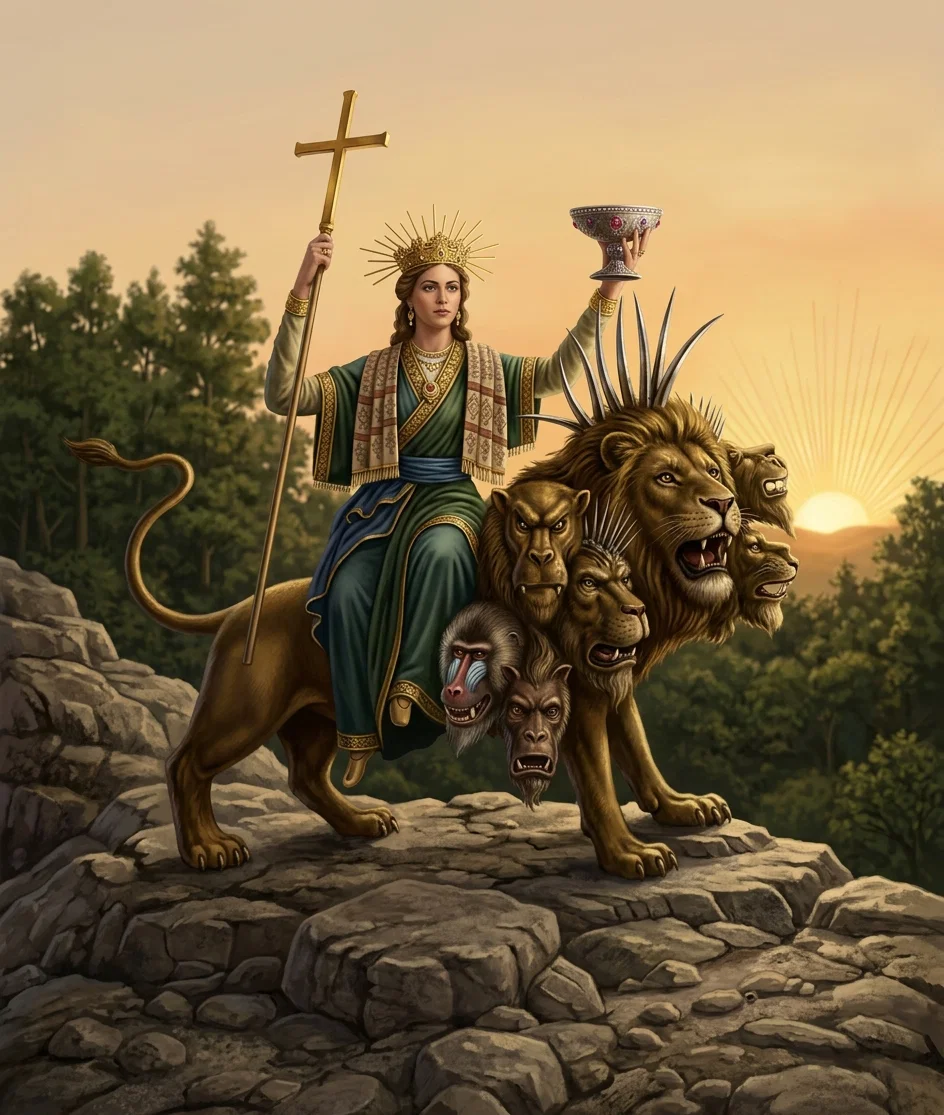
Woman with Cup, from Rome. (Elliott's Horæ Apocalypticæ, London, 1851.)