"Let the Revelation speak and tell what is truth. . . . Uplift Jesus as the center of all hope"
GOD'S LIVING HEAVENLY AGENCIES
Four Seals Broken
THE sealed book of Revelation 5 contained that which could only be opened by the sacrifice and victory of the Son of God. But as Christ won the victory in human flesh that we might win it by His dwelling in us (Heb. 5:7-9; 1 John 4:2, 4), as He died that we might be saved from sin and live in Him (2 Cor. 5:21; Gal. 2:20), so that book must contain the Good Tidings of God, the message of life to a dying world. It was that mystery which was "kept in silence through times eternal" till disclosed by the sacrifice and victory of Christ Jesus our Lord. Rom. 16:25; Col. 1:26, 27. It existed in prophecy and promise from the time that God brought hope to our first parents till Jesus our Saviour "abolished death, and brought life and immortality to light through the Gospel." 2 Tim. 1:10.
Just as long as that mystery existed in promises there was room at least for trembling, halting faith. Man sinned and died. Man by God's grace overcame sin and died. Generation after generation passed away, century after century was tolled off by the great bell of time, and still wickedness and corruption continued and extended their dominion as humanity increased. The graves did not open, the enemy and usurper loosed not his prisoners, bound in the narrow cells of the cold tombs. Would evil eternally triumph? Had "God clean forgotten?" True, the power of sin and death had been broken by the ascension of Enoch in the patriarchal age and Elijah in the Levitical; and now and then one had been brought back from the cold embrace of death to temporal life. But in present distresses, calamities, sore trials, persecutions, these incidents were forgotten; and devout men asked God, "How long shall the wicked triumph?" And when they looked at their own pitiful case they cried in despairing agony, "For Thy sake we are killed all the day long; we are accounted as sheep for the slaughter." And as they saw the oppression and cruelty around them, the suffering of the righteous, the innocent, from agonized heart arose the pitiful question, "How long, O Lord, how long?"
Even the devil must have counted on victory when the Seed became flesh, the Son of the woman. Through all the ages had Satan been practising on the deception and overthrow of souls, that he might deceive, ensnare, entrap, drive to despair the Second Adam, who was to come in all the weakness of humanity.
That very spirit the demons spread abroad in humankind; and when the Son of God came in voluntary abasement in the stead and for the sake of man, His own
rejected Him, and at last put Him to death who voluntarily "poured out His soul" to save them and all sinners. Satan and his legions held high carnival when the Man of Sorrows was locked in the Roman sealed sepulcher; and yet the devil must have doubted his own triumph as he remembered that never once had the Man yielded to temptation, never once had He sinned.
John's weeping in vision was a figure of the disappointed ones as Jesus died. But the peoples of earth had meditated a vain thing; and all counsel "against Jehovah, and against His Anointed," was a thing of naught. "He that sitteth in the heavens shall laugh: the Lord shall have them in derision." And the Father declares, "Yet [despite their counsel] have I set My King upon My holy hill of Zion;" and that King responds: "I will declare the decree: the Lord hath said unto Me, Thou art My Son; this day have I begotten Thee. Ask of Me, and I shall give Thee the heathen for Thine inheritance, and the uttermost parts of the earth for Thy possession." (Read the whole of Psalm 2.)
All this the Lamb won by sacrifice, and became "worthy to open the book." The long doubts of the ages were solved to every loyal heart. Christ had conquered; Christ
"is risen." Let the doubters doubt, let the professed teachers criticize and throw doubt upon the Record they profess to regard; God and man and Book are triumphant. "Worthy is the Lamb."
But He has not yet come into the inheritance given Him. It is still held by rebellious and sinful and unsubmissive rulers. He is, however, regenerating souls and fitting them for that kingdom. He pleads with all to come, and the kingdom pleads for Him. Of this will we learn more as the seals are opened.
The Answer of the Text
[The answers to the questions are from the American Revised Version. Omitting questions, and disregarding sometimes the capital at the beginning and the period at the close of an answer, the text may be read continuously. In notes and comments both versions are used without designation.]
1. What occurred when the first seal was opened?
And I saw when the Lamb opened one of the seven seals, and I heard one of the four living creatures saying as with a voice of thunder, Come.
2. What response was there to the appeal?
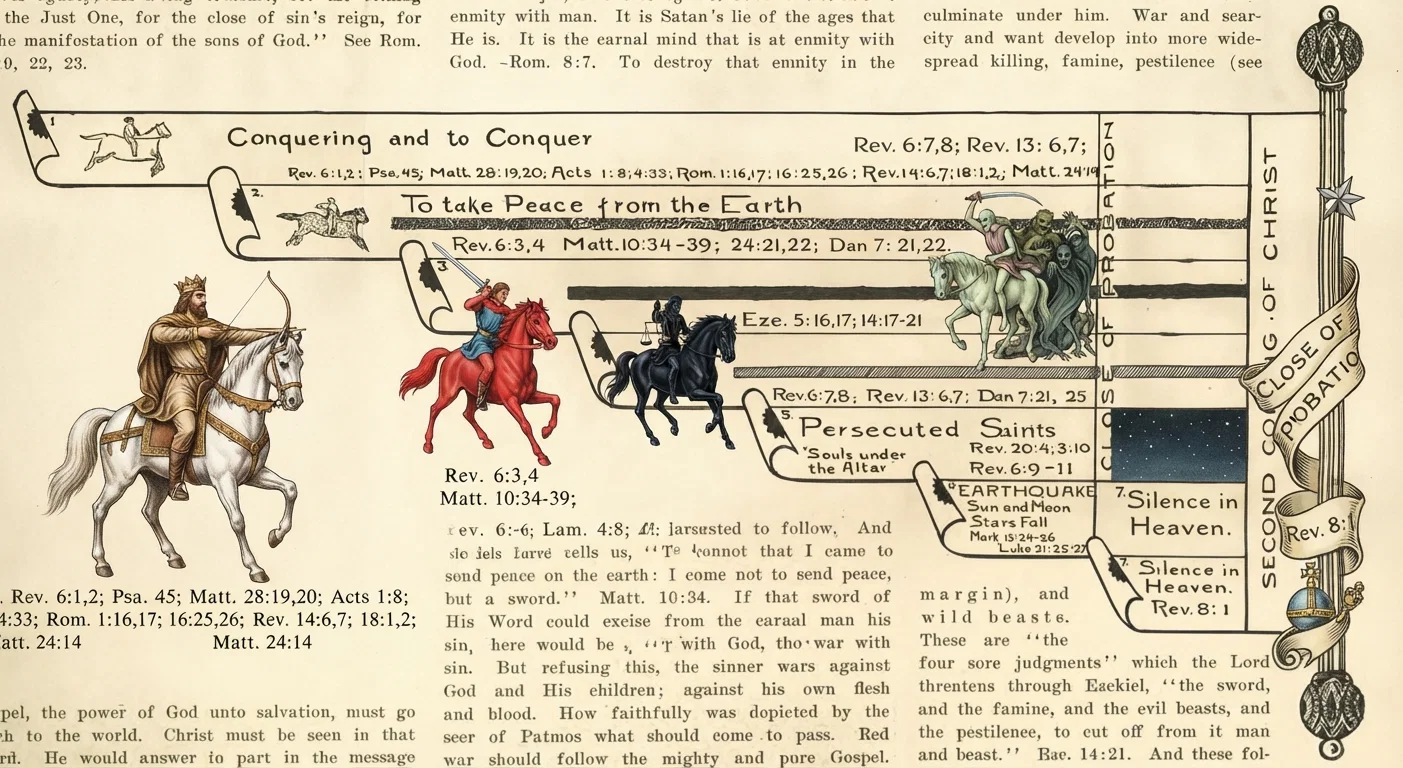
And I saw, and behold, a white horse, and he that sat thereon had a bow.
3. What was given him?
And there was given unto him a crown.
4. What did he do?
And he came forth conquering, and to conquer.
5. What occurred when He opened the second seal?
And when He opened the second seal, I heard the second living creature saying, Come.
6. What was the response to the call?
And another horse came forth, a red horse.
7. What was the work of the rider, and what was given to him?
And to him that sat thereon it was given to take peace from the earth, and that they should slay one another: and there was given unto him a great sword.
8. What occurred when the third seal was opened?
And when He opened the third seal, I heard the third living creature saying, Come. And I saw, and behold, a black horse; and he that sat thereon had a balance in his hand.
9. What did a voice say?
And I heard as it were a voice in the midst of the four living creatures saying, A measure of wheat for a shilling, and three measures of barley for a shilling; and the oil and the wine hurt thou not.
10. What occurred when the Lamb opened the fourth seal?
And when He opened the fourth seal, I heard the voice of the fourth living creature saying, Come.
11. What followed in response?
And I saw, and behold, a pale horse: and he that sat upon him, his name was Death; and Hades followed with him. And there was given unto them authority over the fourth part of the earth, to kill with sword, and with famine, and with death, and by the wild beasts of the earth.
7
Note and Comment
1. One of the four living creatures, the first, the lion, indicated also by the voice of thunder, emblem of power and majesty. Come.—Not "Come and see." The best Greek texts have "Come." John was already seeing. It was not a curiosity exhibition; it was an invitation. To whom? Is not the answer furnished by numerous passages in the book? "Him who is and who was and who is to come." 1:4, 8; 4:8. "Behold, He cometh." 1:7. "I come quickly." 3:11; 22:20. "Come, Lord Jesus." 22:20. It is creation's groaning, agonizing appeal echoed by this divine agency, the living creature, for the coming of the Just One, for the close of sin's reign, for "the manifestation of the sons of God." See Rom. 8:19, 22, 23.
2. A white horse.—Horse is a symbol of war in the Scriptures. White signifies purity and righteousness. The Roman commanders rode white horses in their triumphs. A bow.—An instrument of war, a direct reference perhaps to Hab. 3:8, 9, where God is represented as riding forth for the salvation of His people.
3. A crown.—The rider was a conqueror, one who had won the right to reign; a crown was placed upon his head. His career was a conquering one.
4. Conquering, and to conquer.—The Bible student has already concluded that this rider is a symbol of Jesus Christ in His Gospel. He can not yet answer the invitation, "Come." A work must be done yet among the sons of men. The Gospel, the power of God unto salvation, must go forth to the world. Christ must be seen in that Word. He would answer in part in the message of a risen victorious Christ for the salvation of men. The imagery is not akin to that of the conquering horses of Zechariah, but has direct reference to that prophecy of Christ in Psalm 45:
"My heart overfloweth with a goodly matter;
I speak the things which I have made touching the King:
Thou art fairer than the children of men;
Grace is poured into Thy lips;
Therefore God hath blessed Thee forever.
Gird Thy sword upon Thy thigh, O Mighty One,
Thy glory and Thy majesty.
And in Thy majesty ride on prosperously,
Because of truth and meekness and righteousness:
And Thy right hand shall teach Thee terrible things.
Thine arrows are sharp;
The peoples fall under Thee;
They are in the heart of the King's enemies.
Thy throne, O God, is forever and ever:
A scepter of equity is the scepter of Thy kingdom.
Thou hast loved righteousness, and hated wickedness:
Therefore God, Thy God, hath anointed Thee
With the oil of gladness above Thy fellows."
To all earth goes the mighty healing message of His Gospel, not for a little time, but till He shall respond in full to the invitation, "Come." His arrows in the heart of the sinner arouse conviction; and surrender to Him means salvation. Men may turn from and pervert that Gospel in their own heart, but it has gone and will again go in the closing days of earth's struggles in all its early power and purity. Rev. 14:6, 7. And the Master echoes the invitation to all earth's needy, burdened ones, "Come unto Me."
5. The second seal.—As each of these seals is opened, enough of the scroll of the vision is unrolled that we may discern its character. The second living creature, the calf, or ox. It speaks of sacrifice, of patience, of service. The invitation is still, "Come."
6. A red horse, the symbolic color of war, strife; the color of blood. See Zech. 6:1-8. Note the horses and the four winds, symbolic of strife. Yet God overruled all for good. Verse 8.
7. To take peace.—If the mission and message of the first rider had been received, the second rider would not have gone forth. There is no war message in the Gospel, save that against sin. God is not at enmity with man. It is Satan's lie of the ages that He is. It is the carnal mind that is at enmity with God. Rom. 8:7. To destroy that enmity in the flesh and bring man to peace with God, the Gospel is given, Jesus Christ came. Eph. 2:14, 15. But if the rebellious heart will not give up the sin, will retain its enmity against God, fierce carnal strife is bound to follow. And so the Lord tells us, "Think not that I came to send peace on the earth: I came not to send peace, but a sword." Matt. 10:34. If that sword of His Word could excise from the carnal man his sin, there would be peace with God, the war with sin. But refusing this, the sinner wars against God and His children; against his own flesh and blood. How faithfully was depicted by the seer of Patmos what should come to pass. Red war should follow the mighty and pure Gospel. Men should "slay one another." The great sword of bloodshed would eclipse the sword of the Spirit of the white-horse rider. How faithfully the centuries have fulfilled the prediction, in strife and war between nations, within nations; strife and war for religion's sake! Think of the myriads that have fallen in the name of Christ Jesus the Prince of Peace! God has permitted it that man might see how evil is his own way. No wonder the living creature of sacrifice calls to the glorious King of righteousness and peace, "Come."
8. Third living creature, with the face of the man, the calculating, planning creature; referring to God's work, indicating wisdom, and suggesting the Man Christ Jesus. And the appeal is again, Come. A black horse.—Black is a symbol of want, famine, mourning. "Judah mourneth, and the gates thereof languish, they sit in black upon the ground." See Jer. 14:2-6. Balance.—Weighing; justice, scarcity, both are implied.
9. As it were a voice.—Not perhaps an actual voice, but the demand of actual conditions, demanding the instruction which followed, God speaking in His providence. So He spoke to Moses of old from between the cherubim. A measure of wheat.—A choenix, about a quart of wheat for seventeen cents; in our time a bushel for $5.40, indicating great scarcity. Usually from 15 to 20 measures were given for a "penny," or shilling, the price of a day's work. Oil and wine, the luxuries specially needed by the sick to be spared. In wrath God remembers mercy. By the scarcity of food and the necessities of life, always consequent on transgression, God would call His children back to Him; and these very conditions in the earth call for the coming of Him whose reign is peace and plenty.
10. The fourth living creature.—The flying eagle, indicating here perhaps swiftness of judgment.
11. A pale horse.—"That greenish pallor which we know as livid; the color of the corpse in incipient decay, or the complexion extremely pale through disease."—Alford. The rider is Death personified. Hades, the grave, with its ever-hungry maw for the victims of death, is represented as a monster following the work of death. The fourth part.—Four is the earth number. Death is one of the four riders. The ills of the second and third riders culminate under him. War and scarcity and want develop into more widespread killing, famine, pestilence (see margin), and wild beasts. These are "the four sore judgments" which the Lord threatens through Ezekiel, "the sword, and the famine, and the evil beasts, and the pestilence, to cut off from it man and beast." Eze. 14:21. And these followed transgression as of old. Apostasy brought union of Church and State, and Christendom was cursed by persecution and war. "Heretics" were slain by the myriads. Mohammedans scourged without pity the apostate church; pestilence followed war, and millions so died. Even now scores of thousands die in India every year from wild beasts. How much greater must have been the number of victims before firearms were invented in all parts of the world. And the "wild beasts" (therion) may be symbolical of Church and State persecuting governments, the wild beasts (the same Greek word) of Rev. 13:1, 11; 17:3. Fearful was the slaughter, the crimes against God and humanity, the results of sin during the long Dark Ages. No wonder there came the cry to the Master and Victor of all, Come. The groaning, suffering creation, wounded to its very heart by sin, cries to the Deliverer in a fourfold voice of power, suffering, agony, and terror, Come, COME, COME, COME. Surely, He will come sometime in His glory, and end the sad living picture forever; but not yet. In the meantime the horses and their riders drive on. But over all and through all and in all earth's strife and suffering, may be heard by the intent longing soul the voice of the compassionate Christ, who waits in patience the wisest time, "the fulness of time," to come unto His own, pleading with the burdened, weary ones of earth, "Come unto Me, . . . and I will give you rest."