Signs of the Times, Vol. 37, No. 21.

Promises of Our God

Signs of the Times

May 31, 1910

Pacific Press Publishing Association · Mountain View, California · May 31, 1910

Promises of Our God

“We have thought on Thy loving-kindness, O God, In the midst of Thy temple. As is Thy name, O God, So is Thy praise unto the ends of the earth: Thy right hand is full of righteousness. Let Mount Zion be glad, Let the daughters of Judah rejoice, Because of Thy judgments. Walk about Zion, and go round about her; Number the towers thereof; Mark ye well her bulwarks; Consider her palaces: That ye may tell it to the generation following. For this God is our God forever and ever: He will be our guide even unto death.”

Question Corner

“IF YE WILL INQUIRE, INQUIRE YE.”
This Inquirers’ Department is conducted for the purpose of helping those who are studying the Bible. The answers are oftentimes only suggestive. They are never to be considered infallible, only as they agree with the infallible Word. The writer who may answer them does not consider that his opinion is infallible. He will simply give the best that he has, and plead with the inquirer to search the Word. Such questions only will be answered as, to the editors, seem to minister to the good of the readers and to the mission of the paper. We can not answer repeatedly in the same volume questions upon the same scripture. The name and address must accompany question, not for publication, but as an evidence of good faith, and that answer may be made by letter if deemed advisable. No letters are answered which do not contain the name of the writer. It is well always to enclose stamp for reply.

3138.— Born under the Law

Will you please explain Gal. 4:4, where it says that Christ was made or born “under the law”? A SUBSCRIBER.
The text reads in the Revised Version as follows: “But when the fulness of the time came, God sent forth His Son, born of a woman, born under the law.” First, “the fulness of the time” means God’s own appointed time, predicted by the prophets of the coming of His Son. That Son was sent forth on the mission for which He was appointed. He became a brother to man in the flesh, and therefore was born of a woman. This, too, is according to the Scripture recorded in Gen. 3:15, that the Seed of the woman should bruise the serpent’s head. He was “born under the law;” that is, like all the rest of humanity, because He came to stand in the place of man. We read in Rom. 1:3 that He was “born of the seed of David according to the flesh.” He therefore stood before God just as the seed of David did. Note what His mission was: “God sent forth His Son, born of a woman, born under the law, that He might redeem them that were under the law, that we might receive the adoption of sons.” This is parallel to 2 Cor. 5:21: “Him who knew no sin He made to be sin on our behalf; that we might become the righteousness of God in Him.”
Jesus took the sins of mankind upon Himself, took the nature of man upon Himself, became “under the law,” that He might take man from under the law and place the law within his heart; He was condemned not for Himself, but condemned in our behalf, and died in our behalf, that we might live. “Under the law” in this text, as in verse 21 and Rom. 6:14, means condemned by the law, and Christ died condemned by the law, not because He had sinned Himself, but because He stood in the place of the sinner.
“Surely He hath borne our griefs, and carried our sorrows; yet we did esteem Him stricken, smitten of God, and afflicted. But He was wounded for our transgressions, He was bruised for our iniquities; the chastisement of our peace was upon Him; and with His stripes we are healed. All we like sheep have gone astray; we have turned every one to his own way; and Jehovah hath laid on Him the iniquity of us all.” There is very much more in the Word to the same effect.

3139.— The Seven Last Plagues

Will you please explain the sixteenth chapter of Revelation? For instance, in the fourth verse must we understand that the rivers and fountains of water became blood? Where abode the righteous people at that time? And so in connection with all the rest of the plagues; will they be sent only upon the wicked people? How will the righteous escape if all are here upon the earth at that time? A. Y.
It is impossible to give anything like an explanation of Revelation 16 in the Question Corner. This may be remarked, however,—that the plagues are poured out upon the wicked. That is shown in all the plagues themselves. That the judgments spoken of are literal we have just as much reason to believe, as we have that the plagues poured out upon Egypt were literal. See Exodus, chapters 7-11. There seems to be no question among Bible believers that the river was turned to blood. It is very clearly said by the angel in Revelation 16, “Blood hast thou given them to drink; they are worthy.”
How much God’s people may incidentally suffer from these things we do not know; but this we may know,—that He who is mighty to bring the plagues, or even by the withdrawal of His Spirit permits the plagues to come, can also care for His own people. We need only to remember the promises which He has Himself given, as for instance Psalm 91: “He that dwelleth in the secret place of the Most High shall abide under the shadow of the Almighty.” God’s child can say then, “I will say of Jehovah, He is my Refuge and my Fortress; my God, in whom I trust.” Then the promise: “He will deliver thee from the snare of the fowler, and from the deadly pestilence. He will cover thee with His pinions, and under His wings shalt thou take refuge: His truth is a shield and a buckler. Thou shalt not be afraid for the terror by night, nor for the arrow that flieth by day; for the pestilence that walketh in darkness, nor for the destruction that wasteth at noonday. A thousand shall fall at thy side, and ten thousand at thy right hand; but it shall not come nigh thee. Only with thine eyes shalt thou behold, and see the reward of the wicked. For Thou, O Jehovah, art my Refuge! Thou hast made the Most High thy habitation; there shall no evil befall thee, neither shall any plague come nigh thy tent.” And so throughout the entire psalm. As to food and drink, we may read in Isa. 33:16 of God’s child in that time of trouble, “He shall dwell on high; his place of defense shall be the munitions of rocks; his bread shall be given him; his water shall be sure.” God is able to care for His children.

3140.— The Great Week of Time

In the SIGNS of April 12, page 5, is a statement that one thousand years constitute each day of the week. If that is true, would not the seventh or Sabbath day be a period of a thousand years also? I have always contended that the creation week was a week of seven days. C. E. W.
And it is. The week of Genesis 1 is a week of seven days, each day governed by the sun. But that week has been held by many Christians to represent or symbolize the time of this earth’s period to the final judgment-day to which the writer in the SIGNS refers. Each day of that Genesis week represents a thousand years in the history of this earth under sin, the Sabbath representing the thousand years in which this earth shall lie desolate. Another type also comes in here, and that is the land of Judea. The Lord told the children of Israel through Jeremiah that the land would lay desolate 70 years until it had enjoyed its Sabbaths, 2 Chron. 36:21. For 490 years the children of Israel had been transgressing God’s law; they had not kept the Sabbath to the land. In consequence of that transgression and others connected with it, that land should be desolate for 70 years. That will be true with this earth. For six thousand long years it has borne the curse of sin, and men generally have walked in rebellion against God; have ignored His creatorship, His ownership, His kingship, and have despised His Sabbaths, the sign of His Godhead. The seventh millennium of this earth’s history in connection with sin will be that time when the earth shall lie desolate. Whether time is literal time, or prophetic time, is usually clearly indicated in the text or context of the scripture under consideration. The historical record of Genesis 1 shows clearly that the day is a twenty-four-hour day. The writer in the SIGNS is simply speaking of the great antitype of the week—the history of our world.

3141.— The One Tree. Isa. 65:4; 66:17

Will you please explain Isa. 65:4; 66:17? What is represented by the one tree? F. A. A.
Isa. 65:4 reads, “Which remain among the graves, and lodge in the monuments, which eat swine’s flesh, and broth of abominable things is in their vessels.” Isa. 66:17 reads, “They that sanctify themselves, and purify themselves in the gardens behind one tree in the midst, eating swine’s flesh, and the abomination, and the mouse, shall be consumed together, saith the Lord.” Read the last scripture as in the margin, “One after another.” These texts simply show the backslidden among those who profess to be children of God. The context clearly indicates this. Instead of giving thought to what God asks, instead of humbling their heart before Him, and trembling at His Word (Isa. 66:2), they are lifted up in their own eyes. They go on regardless of their sins, and their whole thought seems to be their own self-indulgence. Remaining “among the graves” may have reference to old, dead traditions. “Eating swine’s flesh, and broth of abominable things,” shows that they have no regard for their body as the temple of God, for these things are condemned of God. That class who live in that way certainly would be among those that would meet the judgments of God when He appeared “with fire and with His chariots.” They have shown themselves unworthy of life; consequently they will die. The true child of God will have regard for the whole man, mentally, physically, and spiritually. He will eat and drink to God’s glory. 1 Cor. 10:31.

3142.— Baptized for the Dead

“Else what shall they do which are baptized for the dead, if the dead rise not at all? Why are they then baptized for the dead?” Will you please explain it? M. F.
The text to our mind can be understood by taking into consideration the whole argument of the apostle in that wonderful chapter. His whole point is to show that the only hope for life at all is in the resurrection of the dead. Some have thought that he simply used the custom which was in vogue then, without saying whether that custom was true or false, to argue for the hope of the resurrection. But we can not see it in that light. It seems to us that the meaning of the text is this, that they are baptized in view of the fact that all men are condemned to die and that the only hope is in the resurrection of the dead. See Rom. 6:3-6. In that way he is baptized with the thought of the dead in his mind. Now if the dead rise not at all, of what account is his baptism, or what profit is their belief? This to our mind is the point in the apostle’s argument. They are baptized for the dead; baptized in view of the fact that they are dead by reason of sin, that Christ Himself died for them, and that only in His resurrection do they find hope.

3143.— Making Atonement

Please explain the 6th verse of the 16th chapter of Leviticus. M. F. B.
The verse is a statement of Aaron’s duty before he offers the atonement for the people. He himself is a sinful man; and that sinfulness of his must be recognized before God, before he himself can offer for the people. That bullock which he offered represented the Lord Jesus Christ. He himself and his house must stand clear before God before he can represent our Lord Jesus Christ in making the final atonement in the offering of the goat.

3144.— The Death of the Soul

Does not the statement that “the soul that sinneth, it shall die,” mean the first and also the second death? C. E. W.
Certainly, all men have sinned and all men have died. That is true concerning the first death. It comes in consequence of sin; that will be also forever true of the soul that abides in sin. The soul that abides in sin, that identifies itself with sin, that rejects God’s means of taking away sin, will eternally die.

Bible Biographies

By Mrs. E. G. White
Christ and Peter
Christ and Peter
THE lives recorded in the Bible are authentic histories of actual individuals. From Adam down through successive generations to the times of the apostles, we have a plain, unvarnished account of what actually occurred, and the genuine experience of real characters.
It is a subject of wonder to many that inspired history should narrate events in the lives of good men that show defects in their moral characters. Infidels seize upon these sins with great satisfaction, and hold their perpetrators up to ridicule. But the inspired writers did not testify to falsehoods, to prevent the pages of sacred history from being clouded by the record of human frailties and faults. The scribes of God wrote as they were dictated to by the Holy Spirit; they penned the literal truth; and stern, forbidding facts are revealed for reasons that our finite minds can not fully comprehend.
It is one of the best evidences of the authenticity of the Scriptures, that the truth is not glossed over, nor the sins of its chief characters suppressed. Men may urge that it is an easy matter to relate what has occurred in an ordinary life; but it has been proved that it is an impossibility for a human biographer to give an impartial account of a contemporary; and it is almost as difficult to narrate the story of any person or people with whose career we have become acquainted, without deviating from the exact truth. The human mind is so subject to prejudice that it is almost impossible for it to treat any subject impartially. Either the faults of the person under review stand out in glaring relief, or his virtues shine with undimmed luster, just as the writer is prejudiced for or against him. However impartial the historian may design to be, all critics will agree that it is a very difficult matter to be truly so.
But divine unction, lifted above the weaknesses of humanity, tells the simple, naked truth. How many biographies have been written of faultless Christians, who, in their ordinary home life and church relations, shone as examples of immaculate piety. No blemish marred the beauty of their holiness; no fault is recorded to remind us that they were common clay, and subject to the ordinary temptations of humanity. Yet had the pen of Inspiration written their history, how different would they have appeared. Human weaknesses would have been revealed, struggles with selfishness, bigotry, and pride, hidden sins perhaps, and the continual warfare between the spirit and the flesh.
Even private journals may contain a faithful account of praiseworthy acts and noble endeavors; but they do not reveal the writer’s sinful deeds. Sometimes the conflicts with evil are recorded, but usually only when the right has gained the victory; this, too, when the writer honestly intends to keep a faithful journal of his life. It is almost beyond human nature to lay open our faults for the possible inspection of our friends.
Had our good Bible been written by uninspired persons, it would have presented quite a different appearance, and would have been a discouraging study to erring mortals, who are contending with natural frailties and the temptations of a wily foe.
But as it is, we have a correct record of the religious experiences of marked characters in Bible history. Men favored of God, and to whom He entrusted great responsibilities, were sometimes overcome by temptation, and committed sin, even as we of the present day strive, waver, and frequently fall into error. But it is encouraging to our desponding hearts to know that through God’s grace they could gain fresh vigor to rise above their evil nature; and, remembering this, we are ready to renew the conflict ourselves.
The murmurings of ancient Israel, their rebellious discontent, and the punishment of their idolatry and ingratitude, as well as the mighty miracles wrought in their favor, are recorded for our benefit. Their example is given as a warning to the people of God, that we may avoid unbelief and escape His wrath. If the iniquities of the Hebrews had been omitted from the Sacred Record, and only their virtues recounted, their history would fail to teach us the lesson God intended it should teach.
Infidels and lovers of sin excuse their crimes by citing the wickedness of men to whom God gave authority in olden times. They argue that if these holy men yielded to temptation and committed sin, it is not to be wondered at that they, too, should be guilty of wrongdoing; and they intimate that they are not so bad after all, since they have such illustrious examples of iniquity before them.
But in these records we discernthe evidences of divine wisdom. The principles of justice required a faithful narration of facts for the benefit of all who should ever read the Sacred Record. We are required to obey the law of God, and are not only instructed as to the penalty of disobedience, but for our benefit and warning the history of Adam and Eve in Paradise, with an account of the sad results of their disobedience to God’s commands, is narrated. The account is full and explicit. The law given to man in Eden is recorded, together with the penalty accruing in case of its disobedience. Then follows the story of the temptation and fall, and the punishment inflicted. This example is given us as a warning against disobedience, that we may know that the wages of sin is death, that God’s retributive justice never fails, and that He exacts from His creatures a strict regard for His commandments. When the law was proclaimed at Sinai, how definite was the penalty annexed, how sure was the punishment to follow the transgression of that law, and how plain are the cases recorded in evidence of that fact!
The pen of Inspiration, true to its task, tells of the sins that overcame Noah, Lot, Moses, Abraham, David, and Solomon, and how even Elijah’s strong spirit sank under temptation during his fearful trial. Jonah’s disobedience and Israel’s idolatry are faithfully recorded. Peter’s denial of Christ, the sharp contention of Paul and Barnabas, the failings and infirmities of the prophets and apostles, are all laid bare by the Holy Spirit, who lifts the veil from the human heart. There before us lie the lives of the believers, with all their faults and follies; and they are intended to be a lesson to all the generations following them. If they had been without foible, they would have been more than human, and we in our sinful natures would despair of ever reaching such a point of excellence. But seeing where they struggled and fell, where they took heart again and conquered through the grace of God, we are encouraged, and led to press on, and surmount the obstacles placed in our way.
God has ever been faithful to punish crime. He sent His prophets to warn the guilty, to denounce their sins, and to pronounce judgment upon them. Those who question why the Word of God brings out the sins of His people in so plain a manner for scoffers to deride and saints to deplore, should consider that it was all written for their instruction, that they may avoid the evils recorded, and imitate only the righteousness of those who served the Lord.
We need just such lessons as the Bible gives us; for with the revelation of sin is recorded the retribution which follows. The sorrow and penitence of the guilty, and the wailing of the sin-sick soul, come to us from the past, telling us that man was then, as now, in need of the pardoning mercy of God. We are taught that while He is a punisher of crime, our heavenly Father pities and forgives the repenting sinner.
God is as powerful to save from sin to-day as He was in the times of the patriarchs, of David, and of the prophets and apostles. The multitude of cases recorded in sacred history, where God has delivered His people from the results of their own iniquities, should make the Christian of this time eager to receive divine instruction, and zealous to perfect a character that will bear the close inspection of the judgment.
Bible history stays the fainting heart with the hope of God’s mercy. We need not despair when we see that others have struggled through discouragements like our own, have fallen under temptation, even as we have done, and yet have recovered their ground and been blessed of God. The words of Inspiration comfort and cheer the erring soul. Altho the patriarchs and apostles were subject to human frailties, yet through faith they obtained a good report, fought their battles in the strength of the Lord, and conquered gloriously. Thus may we trust in the virtue of the atoning sacrifice, and be overcomers in the name of Jesus. Humanity is humanity the world over, from the time of Adam down to the present generation, and the love of God through all ages is without a parallel.

The Holy Spirit

By John Orr Corliss

VII. The Work of Evangelists, Pastors, and Teachers

No needless gift of God’s Spirit has ever been conferred upon men; nor has one been given that did not have a definite mission in God’s system of government. While there are “diversities of gifts,” and “diversities of operations” of these different gifts, distributed among men as God wills (1 Cor. 12: 4, 5, 11), yet these various talents and operations must, if they do a perfect work for men, and without confusion, have each a distinct place to fill, and work harmoniously side by side, without overlapping the functions of any other gift.

A Variety of Gifts among Many

A moment’s reflection will show this conclusion to be correct; else why are these gifts divided among men? In other words, why not have one broad, strong gift, compassing every need of man, and have this administered through a single individual in the church? The reason why this could not be best, is quite clear. In such case, but one person would be looked to for direction; and that one, if swayed by human bias, as might be possible, would lead the entire church astray. Besides, the homage offered such a person would be possible idolatry. But by distributing the gifts freely, this danger was more likely to be averted.
Then again, by such discreet arrangement, the gift of wisdom would not so likely be counteracted by the gift of miracle working; or the gift of spirit discerning, by the gift of tongues; and so on through the entire list. It was therefore made apparent that each gift of the Spirit was of so great importance as to require the undivided attention of the receiver. So in the apportionment of His gifts when Christ “ascended up on high,” among other endowments imparted, He gave “some, evangelists; and some, pastors and teachers.” Eph. 4: 11.
Before noting the order of these gifts, and the duties belonging to each, we will do well to inquire the object of their bestowal. We are distinctly told that the purpose was for “the perfecting [complete adjustment] of the saints, for the work of the ministry, for the edifying [building up] of the body of Christ; till we all come in the unity of the faith, and of the knowledge of the Son of God, unto a perfect [complete] man, unto the measure of the stature [greatness] of the fulness of Christ.”
What a remarkable work to be consummated! These gifts provide that men may be taken in all their native defects, and so taught and ministered to as to raise them to a full knowledge of Christ, even unto the measure of His infinite greatness. Surely no natural gift in man is sufficient for such a standard of acquirement, since to the natural mind these things can not be known, being accounted by it as folly. 1 Cor. 2:14. This uplifting power, then, belongs alone to God. But to link man with Himself in the elevation of the fallen race, God endows the human agent with the faculty of receiving the knowledge needed.

Evangelists

For this reason Christ bestows spiritual gifts upon men. Some He makes evangelists; that is, “bearers of good tidings” from heaven to earth. Such are preachers of the Gospel of Christ,—the saving mercy of Jehovah; in fact the word signifying to “preach,” in most New Testament texts is from the same original as “evangelist.” In some cases, however, a varying primitive word occurs; but it conveys the same idea, with the additional sense of proclaiming the Gospel as a herald, or forerunner, as tho the preacher were but an advance agent of the Master’s appearance and power.
The word “evangelist” occurs but once in the English text in connection with persuasive discourse; and that is where Paul exhorts Timothy to “endure afflictions,” to “do the work of an evangelist,” and to “make full proof” of his ministry. 2 Tim. 4: 5. From this and preceding texts it would appear that such a work properly performed, calls for courage and wisdom to withstand opposition; it is also evident that if one fail in doing this, success in the ministry will not be apparent.
The evangelist is called to stand before men morally blind, and so to minister as to “open their eyes, and to turn them from darkness to light, and from the power of Satan unto God, that they may receive forgiveness of sins.” Acts 26: 18. Thus to enter the realm of Satan, for the purpose ofturning souls from his service to do homage to the King of heaven, can not fail to bring the wrath of God’s enemy upon him. He has, however, the blessed assurance in his commission that Christ will be and is with him in all his labors. In case he cherishes this promise, he may know that even bonds and afflictions await him everywhere; yet with one of old he may say, “But none of these things move me, neither count I my life dear unto myself, so that I might finish my course with joy.” Acts 20: 24.

Pastors

Endowed with such a gift, one need not languish for opportunity in the line of work assigned him by the Spirit. He may safely leave the labors of a pastor, to be cared for by one who has been called to that work by the gift of the Spirit. Having proved his calling in that branch of the ministry which leads one out into pioneer work, let those who have responded to the call of repentance be left with a pastor—a “shepherd,” or “feeder”—of the gathered flock. Pastoral work is a distinct calling, requiring a special gift of the Spirit to perform. It is not done amid the storm of opposition met by the evangelist, and the talent required for it is not adapted to breaking up the fallow ground of the unregenerate heart. The pastor’s gift should not lap over onto the gift of the evangelist, nor the gift of the evangelist too far over that of the pastor.
The pastor’s study is to feed the flock; not simply to preach an occasional discourse to them, but to lead them into nourishing pasture “beside the still waters.” As expressed in the original text in the Saviour’s charge to Peter, “Shepherd My sheep.” John 21: 17. Properly to feed the Lord’s sheep, is to lead them,—go before them in the way,—to the “comely place” of the “beautiful Shepherd,” where they may “go in and out, and find pasture.”

Teachers

The gift of teaching embraces the art of “nurturing” as of a child. This thought is suggested by the words of Paul to the Roman brethren, when referring to their supposed ability to be “teachers of babes.” Rom. 2: 20. This is in contrast with the statement in 1 Cor. 4: 15, wherein the apostle said that tho the church at Corinth had “ten thousand instructors in Christ,” yet he alone was their father in the Gospel. The word here rendered “instructor” comes from paidagogos, and means a “child conductor,” or one who attends the child to and from school with a rod of instruction. But as a father, Paul nurtured the church; that is, taught its members by personal contact, as a parent teaches his child. Persons taught the principles of the Gospel after this method, grow up stronger, and more loyal followers of Christ, than those educated simply by pulpit utterances. This, however, is a spiritual gift that not even all pastors possess, but must be in addition to the natural gift if the flock of God attains the highest efficiency.

“Out of Babylon to Zion”

By Prof. Lucas A. Reed
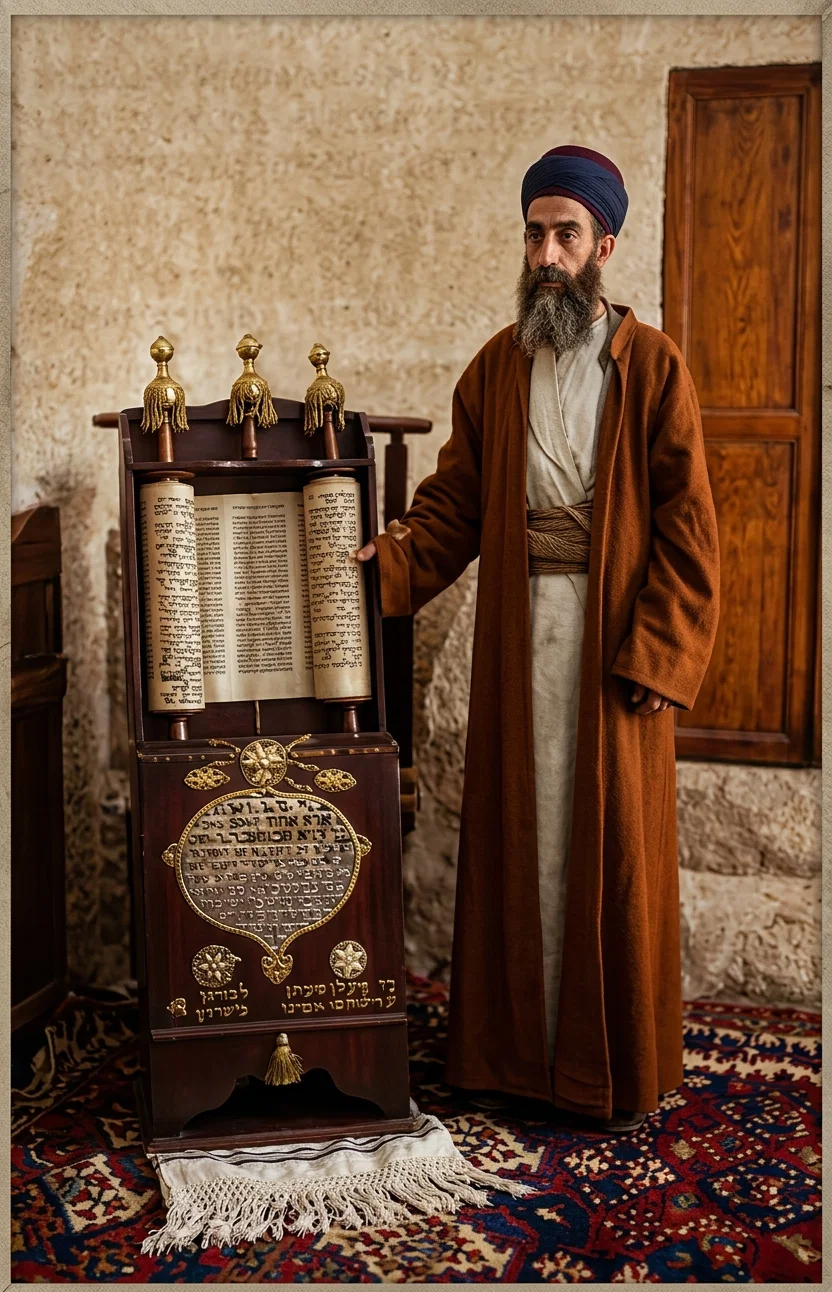
A Samaritan High Priest and Scroll of To-day

VIII. God’s Overruling Providences

The Samaritans being refused the privilege of joining the Jews in the erection of the temple, their efforts from this time on are centered upon giving the Jews as much trouble as possible, and the final result of it is that the Samaritans built a rival temple on Mount Gerizim. Altho they worshiped in accordance with the Mosaic ritual, they did not wholly renounce idolatry. Disasters attended them; their temple was finally destroyed by their enemies. They seemed to be under a curse. Still they clung to their traditions and their form of worship, and would not acknowledge the temple at Jerusalem as the house of God, nor admit that the religion of the Jews was any better than their own.
In Ezra 4 we read the story of the opposition of the Samaritans in their interference with the builders of the temple:
“Then the people of the land weakened the hands of the people of Judah, and troubled them in building, and hired counselors against them, to frustrate their purpose, all the days of Cyrus king of Persia, even until the reign of Darius king of Persia.” Ezra 4: 4, 5.
This must have happened no earlier than the second year of Cyrus; for the Jews went to Jerusalem in the first year of Cyrus, and in the second year of their coming they laid the foundations of the house of God, and then their trouble with the Samaritans followed.

Power of Prayer

Turning to the 10th chapter of Daniel we find that in the third year of Cyrus king of Persia Daniel was mourning three full weeks; that he ate no pleasant bread, neither came flesh nor wine into his mouth, neither did he anoint himself at all till three whole weeks were fulfilled. Is there any connection between this mourning of Daniel and the troubles of the children of Israel in the Holy Land? There very evidently is. The time is at the very point when the Samaritans have sent word to Cyrus, have made their false reports in order to prejudice the king and to get him to stop the work at Jerusalem. There is very plain evidence that Cyrus was giving consideration to their story, and that there was grave danger that the work of God was about to be hindered.
This is very clear when we read the words of the angel that appeared to Daniel as recorded in Daniel 10. The angel tells Daniel that from the moment he began to pray and to seek God, he, the angel of God, was commissioned to go to the court of Persia and to work upon the heart of Cyrus the king. So strong, however, was the representation of the Samaritans, that the angel states that the prince of the kingdom of Persia withstood the angel of God three weeks, or twenty-one days. All this time Daniel is praying and fasting, seeking God for His people; and so Michael, the Lord of glory Himself, comes down to the Persian court, and the angel is no longer needed with the king of Persia.
“But the prince of the kingdom of Persia withstood me one and twenty days; but, lo, Michael, one of the chief princes, came to help me: and I was not needed there with the kings of Persia.” Dan. 10:13, Revised Version, margin.
And so when Christ Himself takes up the work of influencing the mind of the king, the angel is free to come to the faithful prophet Daniel, and tell him not only the immediate future of the chosen people, but what should befall them in the latter days. Dan. 10:14. Having helped and strengthened Daniel, the angel said, “Now will I return to fight with the prince of Persia; and when I am gone forth, lo, the prince of Grecia shall come.” Thus the curtain drops before that invisible world of which we here catch just a glimpse, and yet we know that this is not a rare case. We know that God rules in the kingdom of men, and gives it to whomsoever He pleases. We know that a representative of heaven was in the Persian court through all the years that it stood; and when in the providence of God it had fulfilled its purpose, God’s protection over the Persians ceased, and another nation that would obey Him more perfectly came to take its place.

The Most High Rules

But at this time we know that the counsels of heaven prevailed. We know that the work of the Lord and of His angel upon the heart of the Persian king, and their influence in that royal court, were such as to work no hardship upon God’s pioneers in building the temple. They were not interfered with during the reign either of Cyrus or of his successor Cambyses to any serious extent. Yet the Samaritans did not give up their efforts to cause trouble. They “troubled them in building, and hired counselors against them, to frustrate their purpose, all the days of Cyrus king of Persia.” Ezra 4: 4, 5.

Under Cambyses

And when Cyrus died, and Cambyses, the Ahasuerus of Ezra, took his place, the Samaritans at once brought in new accusations, and sought to work upon the new king to bring about a cessation of labor at Jerusalem.
“And in the reign of Ahasuerus, in the beginning of his reign, wrote they unto him an accusation against the inhabitants of Judah and Jerusalem.” Ezra 4: 6.
They sent in their accusation to Cambyses, but that is all that there was about it. It seems that by this time the opposition of the Samaritans was pretty well understood. Cambyses followed out the policy of his father, and so the work was not interrupted. We know that this is so; because as soon as Gomates, the usurper, came to the throne, they brought in still another accusation which was successful in stopping the work, for we find that they obtained a decree to stop the work, and made the builders cease by force and power. Ezra 4: 23. This shows that they were actively engaged in the work during the reign of Cambyses.
And now we come to the time when the work of God at Jerusalem actually is interrupted. God’s faithful people are prevented by kingly authority from further pushing forward the good work of restoration. What had happened in the Persian kingdom to bring this about, and how it is all overruled to the glory of God and the advancement of His name, and how it brings us at once to the opening process of the book of Zechariah, is a subject so intensely interesting that it must not fail to be told.
(To be continued)

The Heavenly Vision

LET us not quarrel with the visions of religion. Whether science or religion be the channel, whether the intellect or the heart be the instrument, God is the author of the vision. One vision is earthly, another heavenly, but both are from God. Visionary men are about the most important men in the world, provided they are not merely visionary. They are the men who amount to something. They are landmarks in the path of history, showing the progress of the race. The thing to do with the heavenly vision is to obey it. “I was not disobedient unto the heavenly vision.” Paul followed the vision and it led him to the skies. No grander life was ever lived save one, and it began in a vision. Judas also had a vision of Christ, but he disobeyed, and will forever remain a monument of the folly of disobedience to a heavenly vision.—Christian Advocate.

Doing Good to All Men

“As we have therefore opportunity, let us do good unto all men.” Gal. 6:10.
Continue reading: Higher Criticism