Your ShelfYour Projects

Signs of the Times, Vol. 22, No. 25.

IN CHRIST
Earlier text: TO SAVE MEN'S LIVES

Question Corner

“Enquire, and make search, and ask diligently.”

No. 360. Earth Desolated.

IS THE earth desolate during the millennial period. Are the wicked destroyed? Where do the saints dwell during that period? W. P.
That the earth will be desolated by the destruction of the wicked is clearly shown by such texts as Isa. 24:1-3; 34:8-15; Zeph. 1:2, 3, and other scriptures. This is declared by the prophet to occur at the presence of the Lord (Jer. 4:23-27), and by the apostle at Christ’s coming, which is the same thing (2 Thess. 2:8; Rev. 19:21). It will be noticed that those who have not been slain by plague and battle (“the remnant,” those who remain left) perish by the presence of Christ and the words he speaks. Previous to this, or in connection with Christ’s coming, the righteous dead are raised, and all the righteous are changed to immortality, and are taken by Christ to the mansions he has gone to prepare, in the New Jerusalem, the city of God in heaven. See 1 Thess. 4:16; compare with John 13:36; 14:1-3. In harmony with this we are told that the saints “have in heaven a better and an enduring substance.” Heb. 10:34. In holy vision John saw them there before the throne on the crystal sea (Rev. 14:1-3), and heard the sound of the multitude of voices praising God (Rev. 19:1). Now, as the righteous are taken to heaven and the wicked all slain, the earth must be desolate. How long it is desolate is shown by two scriptures, “many days” (Isa. 24:21, 22), “until the thousand years were finished” (Rev. 20:5). At the end of this period the wicked are raised from the dead; the New Jerusalem, the capital of the new earth, descends from heaven with the saints; Satan and his host strive to take the city (Rev. 20:7-9), and the devouring fire of God’s presence destroys them. The earth is then restored for the eternal inheritance of the righteous. Rev. 21:1-7. Thus the righteous are “recompensed in the earth; much more the wicked and the sinner.” Prov. 11:31. A fuller setting forth of this subject is given in Bible Students’ Library, No. 65, entitled “The Great Day of the Lord.” Price, 5 cents.

No. 361. “Shall Be Set Up.”

DANIEL 12:11 says “the abomination that maketh desolate” shall be “set up” at the end of the 1,290 days. The Papacy was overthrown in 1798, not “set up.” Please explain. J. B.
Take the margin, “to set up,” or in order to set up, etc., reading thus: “And from the time that the daily [continual desolation] shall be taken away in order to set up the abomination of desolation,” etc. Rabbi Isaac Leeser’s translation reads: “And from the time that the continual sacrifice will be removed, even to set up the desolating abomination, there will be a thousand two hundred and ninety days.” The setting up is at the beginning of the days instead of the end.

No. 362. The “Other Sheep.”

WHAT did Christ mean in John 10:16 by “other sheep I have”? F. R. M.
He meant those who would accept him among all the nations of earth, all uniting in the one fold, where there is no distinction made on account of nation or sex. Compare with Eph. 2:11-19; 1 Cor. 12:13.

No. 363. Who Was Melchizedek.

PLEASE explain who Melchizedek, of Hebrews 7, is. Do you think it was Christ? A. J. R.
Melchizedek was king of the city of Salem in the time of Abraham. See Gen. 14:18-20. His character, his name, and the city over which he ruled, made him a fitting type of Christ. Melchizedek means king of righteousness, so is Christ the “LORD OUR RIGHTEOUSNESS.” Melchizedek was king of Salem, or peace; so Christ “is our peace.” Melchizedek was priest of the Most High God; so Christ is our great High Priest. The priesthood of Melchizedek began with no other before him, nor ended with others after him, and we have no account of his genealogy; so also Christ’s priesthood came from no other nor passes to any other; it is the age-lasting priesthood, and, as a priest, he has no genealogy. In all these respects Melchizedek was a type of Christ, or Christ was a king-priest “after the order of Melchizedek.” But Melchizedek was not Christ; for he was a type of Christ.

No. 364. 1 Peter 3:18-21.

PLEASE give an answer to the following questions: 1 Peter 3:18, 19, 20, 21. Verse 21 would seem to make baptism essential to salvation. Did the Lord in spirit after his death and before his resurrection preach to the spirits in prison? G. B. D.
(1) Verse 18 states a very simple truth, that Christ died for us to bring us to God, and was made alive by the Spirit. (2) Verse 19 tells us that the same Spirit that quickened Christ, or made him alive, was the Spirit by which Christ preached to the spirits or souls of men shut up in the prison-house of sin. (3) Verse 20 tells us when this was, namely, in the days of Noah, while the ark was preparing. The Spirit of Christ there spoke through Noah, a preacher of righteousness by faith. 2Peter 2:5; Heb. 11:7; Gen. 6:3. (4) Verse 21 shows that what saved them there was not form, but faith, as effectual baptism must be. The mere form of baptism, the empty act, will avail nothing; it is faith—faith that lays hold of the resurrection power, that cleanses the conscience, that saves from sin. We may learn from the text that the Gospel is everlasting, that the “eternal Spirit” wrought in Noah’s day as in ours, and that Jesus Christ is the one unchangeable Saviour, yesterday, to-day, and forever the same.

No. 365. Meaning of Horns.

WHAT is meant by horns in Ps. 75:10 and 18:2?
It was customary among the nations of the east to wear one or more horns on the head as a symbol of power, and as such it is used in the above passages. The horns (power, honor) of the wicked God will destroy, but the horns (power, honor) of the righteous shall be exalted. In Ps. 18:2 David tells us that his horn, his exaltation, power, honor, is God; and in that great day of the Lord, God alone will be exalted. Isa. 2:17.

No. 366. Picking Hops Again.

A CORRESPONDENT finds fault with the SIGNS in what was said some time ago on hop-picking, and says:—
Tho the word “hops” is not mentioned in the Bible, is it not a most important question as regards temperance? Does not the Bible say, “Wo to him that giveth his neighbor drink”? In a way it is a matter of conscience, but whose conscience would let him pick hops that are to be used in making liquor? A great many are uneasy regarding the subject, but “the ministers do it, and it must be all right,” so they pick them against their conscience.
1. We say again that we know nothing in the word of God against picking hops. If any other person does, he or she should not pick them. It is better to starve than to sin. A Christian should regulate his conscience according to God’s word, not according to any minister.
2. Hops are largely used in brewing beer, but thousands of tons are put up in packages for domestic and medicinal use, for the manufacture of lupulin and yeast, and other purposes. So also barley is used for beer, corn and rye for whisky, molasses for rum, staves for barrels, and barrels for liquor. But should men therefore refuse to make staves or barrels, or raise barley or rye or corn or sugar cane? Has a carpenter no right to build a house for a mean man? Has a shoemaker no right to make a pair of shoes for a man whose feet he knows run to mischief? We see no harm in engaging in any employment that is honorable in itself; and the writer knows no reason why the raising of hops is not as honorable as the raising of beets or the digging of sarsaparilla roots. However, if any man has good conscience against picking hops, by all means let him not do it; for “whatsoever is not of faith is sin.”

No. 367. The New Covenant. Heb. 8:10-13.
If the Ten Commandments are referred to in Heb. 8:10-13 as you say, how are we to understand verses 8 to 12? How was the first covenant faulty? How was it to grow old and vanish away? J. B.
In the SIGNS of May 21, page 4, it is stated that “Heb. 8:10-13 has reference to the Ten Commandment law and no other,” but this does not mean that the Ten Commandments are the “old covenant.” The law mentioned in Heb. 8:10-13 is the Decalogue, the law of God. The “old covenant,” so far as man’s righteousness was concerned, was based on man’s promise. See Ex. 19:8. It was therefore faulty because the promise was weak. The law was not at fault, but the people were. Heb. 8:7, 8. In the new covenant, based on God’s promise, God writes that same law in the heart. Every soul which has not wholly yielded to Christ, and yet is endeavoring to do right, is attempting to do just what Israel attempted to do when they hoped to obey through their promise. They bring themselves into bondage. See Rom. 7:15-19. But when self is yielded and Christ is accepted, the old covenant of man’s works vanishes away in the glory of Christ’s power, which enables us to keep the law. There are other phases of the covenants which we have not space here to discuss.

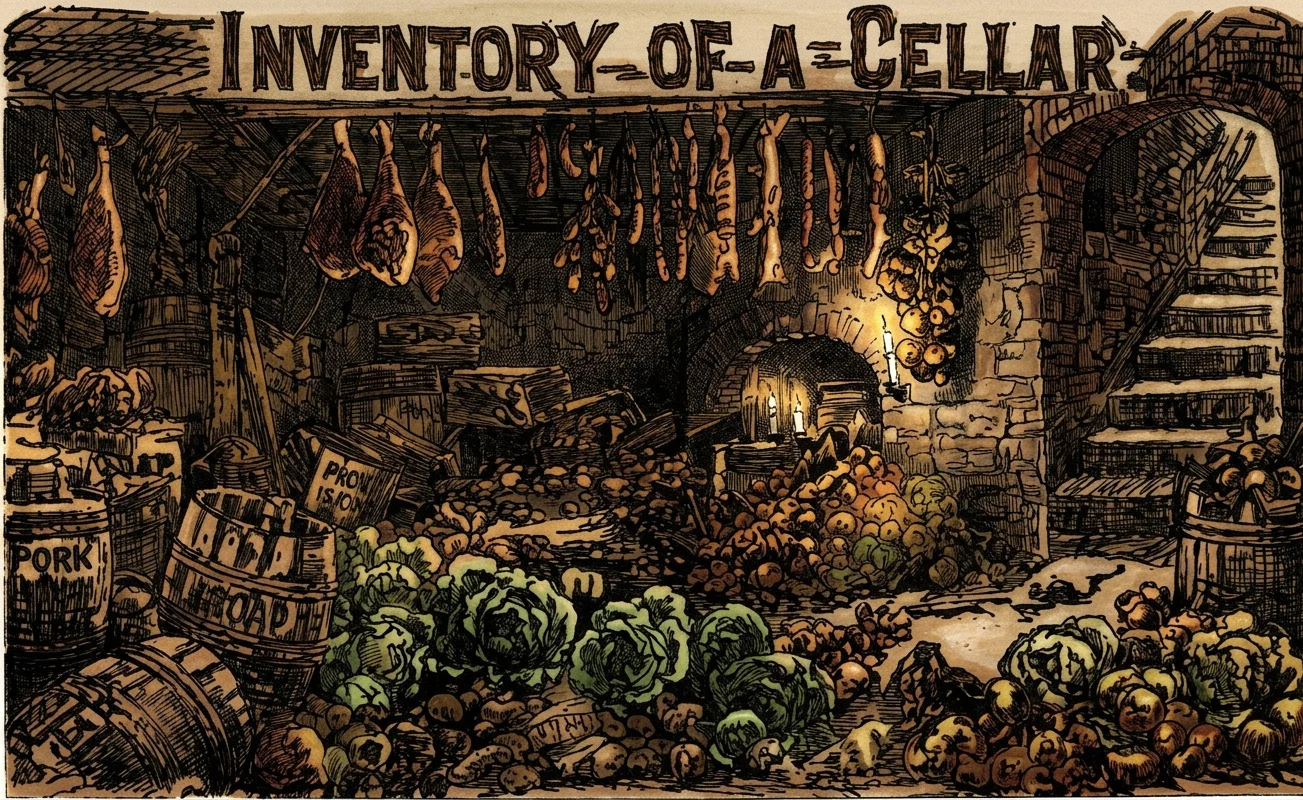
INVENTORY-OF-A-CELLAR

BY J. H. KELLOGG, M.D.
Give us a light, and let us take a peep into the regions below. Susie has a sore throat, and Jamie is just over an attack of cerebro-spinal fever, as the doctor called it, and the hired girl had a run of typhoid fever a month ago; and now spring is coming on, and the whole family are expecting to have the annual visitation of “spring sickness” and other maladies, which experience has told them is pretty sure to come with the first indications of approaching spring. Somehow, we have a suspicion that some of the family sickness may be the result of causes nearer home than most people would imagine, and we are going to make a sanitary survey of the premises. To-day we are to take a peep into the cellar. We must have a light, as no ray of sunlight ever enters into this subterranean storehouse. We open the door to descend. Whew! what a “smell”! A “smell,” did we say? Not one, but many smells—a conglomeration of vile odors of every variety and degree. Let us descend. As we grope about, the air seems thick, and the candle burns dimly. A suffocating sensation tells of carbonic-acid gas, and a stinging smart in the nose suggests ammonia, while a sharp headache setting in betrays the presence of that deadly gas, sulphuretted hydrogen.
Where do they come from, these pestilential gases?—Sources are abundant. Here is a bin of potatoes laid away for winter’s use. The warm, close air of the unventilated cellar has hastened their decay, and the peculiar penetrating odor which arises is evidence that we have located at least one “smell.” Here is a barrel which emits a moldy, vinegar-like odor, and a close inspection shows it to be half filled with rotten apples. Each day the cook picks out the sounder ones, and leaves the balance to decay and mold.
A peculiarly offensive odor attracts us to a corner in which has been stored a heap of cabbages and other products of the vegetable garden. The insufferable stench arising assures us that the sulphuretted hydrogen and its allies have here a stronghold. Half-decomposed cabbages and turnips contribute their share to the general stench. Overhead hang sundry stubs of moldy bacon, a smoked ham covered with a green coat, and a half-rotten codfish which has been forgotten. A glance around shows mold and mildew everywhere. A student of fungi would here find a rich field for specimens.
An unmistakable odor of sewer gas attracts us to a depression in the floor, which proves to be a half-stopped drain, communicating with a cesspool in the back yard. From it issues a constant stream of mephitic gases as deadly as those which were said to arise in ancient times from the dreaded Lake Avern.
But still there is one smell which is unaccounted for,—a sickening odor of animal decay, which would delight the nostrils of a turkey buzzard. We rummage about among the boxes and barrels, disturbing myriads of ants and centipedes, and at last discover, in an out-of-the-way corner, the decaying carcass of a rat, which suddenly fell sick from eating a slice of poisoned bread and butter.
There are sundry suspicious-looking barrels and boxes into which we have not looked, some of them having smells strongly suggestive of soft soap and soap-grease; but we dare not longer risk our lives amid these death-dealing stenches, and hasten to depart.
Many a time have we all visited just this sort of cellars. Is it any wonder that a house with such a “pit of corruption” under it, has always some one sick in it? If the United States were an absolute monarchy, and we the monarch, an edict should be issued prohibiting the construction of vegetable cellars under dwellings. They are undoubtedly a cause of much disease and many deaths. Thousands of sore throats, diphtherias, and other maladies find their origin in this dark, damp hole beneath the dwelling.
Vegetables, meats, and all decomposable stuffs, should be kept in an apartment separate from the dwelling-house. A vegetable cellar should certainly be separated from the dwelling, so that contamination of the air of the building will be impossible.
But there are cellars which contain no vegetables or other decomposable stuff, and yet are not healthful. A cellar which is damp, or one which is not cemented at the sides or bottom, is properly open to suspicion. A dry, well-ventilated cellar or basement adds to the healthfulness of a house; but a cellar which is filled with damp or stagnant air is productive of disease. This is particularly true during those seasons of the year when a house is likely to have its doors and windows closed, and fires burning in grates or stoves. The heating of the air in the living rooms of the house creates an upward draft, which draws up through every crack and crevice in the floor streams of stale, damp, cellar air, spreading it through the entire building. This is undoubtedly a source of numberless sore throats, catarrhs, rheumatisms, and other maladies which are wrongfully charged to Providence or the weather.
Cellars with uncemented walls and floors are certain to be filled with bad air derived from the soil, known to sanitary scientists as “ground air.” Scientific investigations have shown that the air of the soil is always more or less impure, and it may be so greatly contaminated as to become deadly in its effects. A cesspool, or vault, or leaky drain in the vicinity of a house, is certain to contaminate the soil, and thus render the ground air not only bad, but highly dangerous to life. A house the cellar of which has walls not made impervious to air, is constantly exposed to this danger. Poisoning by ground air is the source of the constant ill health which destroys the peace and happiness of thousands of families.
All cellars and basements under houses should be thoroughly drained and well ventilated, and should have walls so made as to be impervious to air and water. An ordinary brick or stone wall is inefficient; butsuch a wall, plastered smooth with good cement, outside as well as inside, is practically safe.

A TRUE WOMAN.

SHE never found fault with you, never implied You wrong by her right: and yet men at her side Grew nobler, girls purer, as, thro the whole town, The children were gladder that pulled at her gown, The weak and the gentle, the ribald and rude. She took as she found them, and did them all good. None knelt at her feet, confessed lovers in thrall, They knelt more to God than they used—that was all. —Elizabeth Barrett Browning.

KEEPING S'LOON.

The following true story—“only the name was not Smith”—is told in the Pittsburg Dispatch:—
“I hear that Smith has just sold out his saloon,” said one of a couple of middle-aged men, who sat sipping their beer and eating a bit of cheese in a Smithfield saloon.
“Yes,” responded the other, rather slowly.
“What was the reason? I thought that he was just coining money there.”
The other nibbled a cracker abstractedly for a moment and then said: “It’s rather a funny story. Smith, you know, lives on Mount Washington, right near me, where he has an excellent wife, a nice home, and three as pretty children as ever played outdoors—all boys, you know, the oldest not over nine, and all about the same size. Smith is a pretty respectable sort of citizen—never drinks or gambles, and thinks the world of his family.
“Well, he went home one afternoon last week and found his wife out shopping or something of that sort. He went through the house into the back yard, and there under the apple tree were the little fellows playing. They had a bench and some bottles and tumblers, and were playing ‘keep saloon.’ He noticed that they were drinking something out of a pail, and that they acted tipsy. The youngest, who was behind the bar, had a towel tied around his waist, and was setting the drinks up pretty free. Smith walked over and looked in the pail. It was beer, and two of the boys were so drunk that they staggered. A neighbor’s boy, two years older, lay asleep behind the tree.
“Boys! boys! you must not drink that!” he said, as he lifted the six-year-old from behind the bench.
“We’s playin’ s’loon, papa, an’ I was a-sellin’ it just like you,” said the little fellow. Smith poured out the beer, carried the drunken boy home, and then took his own boys home, and put them to bed. When his wife came back, she found him crying like a child. He came down town that night, and sold out his business, and says he will never sell or drink another drop of liquor. His wife told mine about it, and she broke down crying while she told it.”

MORBUS SABBATICUS.

THERE is a fearful disease which is prevalent among a great many church members, and in order that they may recognize its presence and its danger, we give the following description from an exchange:—
Morbus sabbaticus, or Sabbath sickness, a disease peculiar to church members. The disease comes on suddenly every Sabbath; no symptoms are felt on the preceding night; the patient sleeps well and awakes feeling well, eats a hearty breakfast, but about church time the attack comes on and continues until services are over for the morning. Then the patient feels easy and eats a hearty dinner. In the afternoon he feels much better and is able to take a walk, talk about politics, and read the newspapers; he eats a hearty supper, but about church time he has another attack, and stays at home. He retires early, sleeps well, wakes up next morning refreshed and able to go to work, and does not have any symptoms of the disease until the following Sabbath. The peculiar features are as follows:—
  1. It always attacks members of the church.
  2. It never makes its appearance except on the Sabbath.
  3. The symptoms vary, but it never interferes with the sleep or appetite.
  4. It never lasts more than twenty-four hours.
  5. It generally attacks the head of the family.
  6. No physician is ever called.
  7. It always proves fatal in the end—to the soul.
  8. No remedy is known for it except prayer.
  9. Religion is the only antidote.
  10. This disease is often called “systematic lying,” but its true name is morbus sabbaticus, or Sabbath sickness.
  11. It is becoming fearfully prevalent, and is sweeping thousands every year prematurely to the devil.—Selected.

HEALTH TALKS TO CHILDREN.

BY DR. C. W. LYMAN.
THERE are ever so many creatures and things trying to get a living in this world. Some of them, like cows and horses, we have a great deal of use for. Others, like mosquitoes, bedbugs, weeds, poison ivy, and English sparrows, give us a good deal of trouble, without doing us the least good that we know of. So we try to keep them out, drive them away, or else kill them if they insist on coming in where we are trying to live ourselves.
You know how weeds will keep vegetables from growing in the garden. You know how lice will stop hens from laying. We have to kill these weeds and lice, or else they will kill our plants and chickens. If they don't kill them, they certainly stop their growing, and make them feel wretchedly.
Now there are things like weeds and lice so very small that it is impossible ever to see them with our eyes. They are a hundred times smaller than the separated grains of corn meal, smaller even than the particles that make white flour. Some of them are alive, like lice, and some are very little plants or weeds. Some live in water, some in the ground; some float around like dust, in the air; some grow on other things, just as lice grow under chickens' feathers, or as moss grows on rotten logs or the bark of trees.
Most of these tiny plants and animals do no harm. They live, like skating bugs, on ponds, enjoying themselves in their own ways, and having little or nothing to do with us, good or bad. But there are some of them, especially those that cling to other things, that may do a great deal of harm, just as lice do chickens. Some live in our clothes, some in our hair, some on our feet, and some in our mouths. Wherever they find a layer of dirt, they grow faster, and get more dirty and bad-smelling themselves, and then our clothes and hair and bodies get dirty and bad-smelling too. What we have to do is to take water and soap and wash them off. In our mouths we use tooth-brushes and powder to brush them away from the teeth and tongue, where they grow in hundreds and thousands. It is like hoeing out the weeds from a garden. Some very bad-smelling little creatures live only on our feet. It's a nice thing, then, to wash them away from our feet and stockings almost every day.
The ones that live in our hair we need to brush out and wash out. But the most important ones to get at are those inside our mouths. They have such a chance to go down inside our bodies and make still worse trouble even than where they lodge first. They make the breath smell, and the teeth decay, if we don't get rid of them. Now you can see one reason why it is better to breathe through the nose and not the mouth. The nose has a sort of sieve in it, and stops them from floating in with the air. The mouth hasn't any sieve, and lets them in, perhaps clear into our lungs.—The Voice.

WE LIVE IN A PAPER WORLD.

THIS is the paper age. Paper is now used for a hundred things which only a few years ago would have been deemed impossibilities, so far as making them of paper is concerned.
Paper for silk dress material is now manufactured from spruce-sawdust, cotton, or jute waste, and alcohol. In the near future we will dine off paper dishes a la Japanese. Hats made of paper, which will be fire proof, are a possibility. In Paris bonnets and hats—frame, trimming, and ornaments—are made of paper. Paper parasols will yet be made impervious to rain. The paper trunk is the only trunk which successfully resists the onslaught of the baggage smasher. Paper car wheels are no longer a novelty. The paper coffins made at Westfield, Mass., are the bane of high-priced undertakers, and in steady demand, altho this is a business which all of us wish may not be too brisk. In Russia and Germany paper rails have long been used, and they seem to wear better than steel rails.
Despite the fact that the horse is rapidly being supplanted by electricity, paper horse-shoes are manufactured by the thousands, and, like Othello’s, the blacksmith’s occupation will soon be gone. Soft paper pulp is now used by sculptors for modeling.
Wood pulp ceilings and wall decorations are very fashionable, and under skilful manipulation handsome embossed effects are secured. Paper pails, water coolers, and cuspidors are part of the modern kitchen furnishings. They are destined to supplant many of the awkward and heavy utensils which unnecessarily tax the housewife’s strength.
A hundred things are sent to us now in paper boxes from the grocer, the confectioner, the shoemaker, the dry goods store, the dress-maker, and so on. Milk now is delivered by the watery-eyed milkman in paper bags.
The Japanese might be called the paper nation; they live in paper houses and sail in paper boats. With them the use of paper is a fine art.
Last, but not least, we have paper pipes for carrying water, steam, or electricity.—Epworth Herald.

MADE OF THE RIGHT STUFF.

On the corner of one of the business streets of the city the other morning, a shoe-black had just finished polishing the shoes of a well-dressed and gentle appearing man. The latter was unfortunate in having a deformity which compelled him to wear a shoe on one of his feet with an exceedingly thick sole, thus endeavoring to make up mechanically for what nature had denied him. “How much shall I pay you?” he asked the boy. “Five cents, sir.” “O, but you should have more than five cents for polishing my shoes!” said the gentleman, tapping the thick sole significantly with his cane. “No, sir,” said the boy, “five cents is enough. I don’t want to make no money out o’ your hard luck.” The customer handed out a coin, laid his hand on the youngster’s head for a moment, and passed on. Who says the days of chivalry are over?—Exchange.

HER ONLY FRIENDS.

“MAMA,” asked the little four-year-old, “how do you spell ‘ginger’?” “Put away your book, dear. It is time for you to go to bed.” “Papa, how do you”— “Don't bother me, Katie.” “What does it mean when it says”— “Didn't you hear your mother?” Katie threw the book on the floor. “I don't believe there's anybody that loves me,” she burst forth, “‘cept grandpa and God. Grandpa, he's in Michigan, an I don't know where God is!”—Exchange.

ARE MISSIONS IN SOUTH AFRICA A FAILURE?

In the San Francisco Examiner of January last there appeared an article under the heading, “How Hypocritical Dutch Boers in South Africa Demoralize the Kaffirs.”—“Missions said to Do Great Harm.” The article referred to may have passed the memory of many of your readers, but to my mind it does great injustice to the Dutch Boers and the missionary effort among the Kaffirs. It is no more than just that we “give the devil his due.” It is true that South Africa is settled by many of the same class of people that came to the American shores two hundred years ago or more. But the conditions were very different. These French Huguenots, who sailed from the shores of Holland, where they had fled from the fierce hand of persecution, to seek a home in the Netherlands, brought with them to Africa the same disposition to enforce religious laws that the Puritans carried to the eastern part of America. The large Dutch element which came with them brought the same spirit of persecution. In the New World it developed into burning witches, whipping innocent Quakers, banishing Baptists, etc. But in Africa this principle of persecution expended itself upon the helpless Kaffirs.
Among the Dutch, however, there are as fine people as can be found in the world. From the European standpoint they are not as enterprising as the Yankee, who is noted the world over for his wits and his genius for inventing “wooden nutmegs,” “wooden clocks,” as also the larger and more important inventions at which the world wonders. But people forget that it was the circumstances that made the American what he is. Becoming an independent nation, mingling with every class of Europeans, have called forth that inventive genius and intelligence which characterize the Yankee. He has had the advantage of the world’s intelligence by the exchange of ideas with the most enlightened of the world. But those who went to Africa settled among the natives, who were nothing but children of nature, without God or any knowledge of civilization whatever. These Huguenots and Dutch, in the course of two generations, were blended into one element, known as the Dutch Boers.
These emigrants settled on large plantations, many of them never seeing the extent of their domains, having only natives for associates. This excluded them from the civilization of the outer world; and with the reforms of the nineteenth century they are unacquainted. Civilization is not the work of a day or a year, or even of a century. The great improvements in the United States are the product of the nineteenth century. The previous century had prepared the way for it, so as we entered upon the present hundred years, arts and sciences rapidly developed. Not so with Africa; they knew comparatively nothing of this progress, and so, from the American standpoint, they are greatly behind in the world’s improvements. Neither do they realize their condition. They have lived in much the same way year after year, generation after generation, fighting the lion and the tiger, and tribes of natives, which are neither human nor animal, until, to the Christianized people of the Western Continent, they seem quite hardened. The Dutchmen of South Africa are a religious people, but are behind in many things, and if left to themselves would have laws similar to the proverbial “blue laws” of Connecticut.
Admitting all of this to be true, it is not right or just to charge upon the Dutch Boer the immorality of the native. It is not by any means the Dutchmen who have given the greatest mold to the natives. Neither is it the Christian element or missions that have corrupted the natives. It can not be said that the Kaffir is naturally truthful and honest. It is well known from those who have much to do with them, that they have habits that are far from what we term honest. They are, and have been for thousands of years, educated to the idea that lying and stealing are all right if not found out. This is as natural for them as it is for the Christian people to believe that it is wrong to lie or steal. I have known many professed Christian people, even in California, to palm off on the unsuspecting, worthless articles as valuable. In view of these things is it a great marvel if occasionally the poor native falls into some of his former habits after becoming enlightened? And is it surprising that the Dutch, living as they have in this dark continent of Africa so long, should have formed some of those habits?
But what is it that so demoralizes the natives? The question is easily answered. When any mission is established in any country for the evangelization of the heathen, or any commercial relation is introduced, the unprincipled white man with his accursed liquor traffic establishes himself, and introduces many vices the natives never would have known if not brought to them. These vices once introduced among the untutored natives, who have no moral training to hold their passions in check, carry every wicked habit to excess. Not knowing the effect of these vices upon them physically or morally, there is no restraint upon them. As for those natives who have been educated in Christian mission schools, the number who make a success in life will compare favorably with those who have passed examinations at Harvard or some other college of repute. There is dishonesty among both classes, and there are the honest and enterprising. But dishonesty in America may wear a different dress than in Africa, and it is the same in other countries. Every people clothe their sins in a garment most fitting, according to their own ideas.
It is true that the moral standing of the people in a country like South Africa is not as high generally as in countries more enlightened, especially in those countries where they have schools in abundance and meetinghouses in every town. I have traveled in Europe, Asia, and Africa, and I find human nature the same, with this exception, that vice wears a different garb in different countries. They have different ways and different customs, and there are many recognized customs in one land that would be discarded as entirely out of character in another. So were we to judge the people in any one country by the standard in another, they would fall far below par. There is much truth in the story, that has gone its round, of a Quaker who said to his wife, “Is it not strange, Dorothy, that all the world is queer but thee and me? And I think thee a little queer sometimes.” I would as soon trust myself with those of the natives who come from the mission schools in South Africa as from our schools in America. There are the good and the bad in both instances. Remove the missionary influence from the native African and you have a dark people indeed. And we can but think that people who can see no good in the missions take a very superficial view of the situation. They certainly have a wrong idea of the true condition of affairs.
As to my nationality, I am an American, having spent several years in the noble state of California. I am not ignorant of the ways and customs of that people, neither am I altogether ignorant of the vices of the native African. There are large tribes who have very strict laws against any unprincipled European settling among them, unless he has some legitimate business, professedly, at least, that will benefit the native. One of these is the Basuto tribe. For something over sixty years the French Evangelical Society have had their missions in the country. Their influence is felt all through the tribe to a greater or less extent. No land is sold, or even leased, to any one. None but those having a legitimate business are allowed to remain in the country. At the request of natives and the missionaries no intoxicating liquor is permitted to be brought into the country, and there is a heavy penalty for violation of the law. Here is a class of heathen natives that have not come in contact with the unprincipled white man, as in other tribes. A more hospitable people you never saw. You will not find a more friendly people, always ready to assist you in any lawful enterprise. Any one who has ever been among them, and has also been among other tribes, will at once see a contrast between those who have had a Christian influence, without the white man’s liquor traffic and accompanying vices, and those who have had the influence of missions counteracted by the unprincipled white man scattering seeds of vice of every kind among them.
I am not speaking from mere reports, but from what I know, from what I have seen and experienced among them. I have shared the hospitality of the Basuto in his hut or house, have traveled from village to village among them, and have met them under varied circumstances. In cultivating the soil they have many of the late American improvements, and yet they are heathen. There is one thing that should be remembered in this country, and that is, the Dutch Boors are not the persons to establish missions among any class of natives. They do not believe in missionary effort among them. Like the writer in the Examiner, they think it makes the natives worse. So upon this point they are well guarded. But those establishing missions are among the best of men, whose influence is good anywhere.
Therefore, while we would be far from saying that there are not some bad natives where missionary effort has been put forth, and perhaps even worse than before coming in contact with such effort, yet it gives an entirely wrong impression to say that the missionary influence is in any way responsiblefor such result. It is also far from correct to suppose that the Dutch Boer, with all his sins, is responsible for it. The charge properly comes back upon the unprincipled white man, who carries vices into their midst, such as the liquor traffic and all the wickedness that goes with it. Those who take a strong position against the Dutch on these grounds, and because of the mission effort among the natives, have not a clear knowledge of the facts, or are unduly prejudiced against the Christian religion.
S. N. HASKELL.
Cape Town, South Africa, March 18, 1896.

COMING TO CHRIST.

BY W. W. LOOMIS.
How sweet the story that is told Upon the page, so hoar and old, Of Samuel’s call and his reply, In childish accents, “Here am I”!
To us this voice is speaking still; It says that whosoever will May come, and all his wants supply From God’s great storehouse, ere he die.
Why do we halt, when God’s dear Son Has victory promised every one Who to his cross will kneel and cry, “Save or I perish; here am I”?
The spring is here with bloss’ ming trees, And tropic air, and balmy breeze; The fruitage season hastes apace; So might it be in realms of grace.
He calleth me, he calleth thee, Whoever, reader, thou may’st be; O, would you then to Jesus fly, Haste; for he calls—say, “Here am I”!
Hopevale, Conn.
Continue reading: OUR WORK AND WORKERS