Your ShelfYour Projects

Review and Herald, Vol. 91, No. 31.

THE WORK AND THE WORKERS

Review and Herald

Jul 30, 1914

Review and Herald Publishing Association · Tacoma Park Station, Washington, D. C. · Jul 30, 1914

THE WORK AND THE WORKERS
THE article “The Priesthood” in the August Protestant, now ready, will give you unquestionable proofs that the Papacy fulfills the predictions made concerning it in the Bible.
A NUMBER of our faithful book colporteurs are planning to sell the August or “Temperance” Life and Health Saturday nights and Sundays, thereby securing means to tide them over until delivery time.
SUPPLY your public library and Y. M. C. A. reading room with Life and Health, Liberty, and the Protestant Magazine for one year, for only $1.90. Regular price, $2.35. Mention “library” rate when ordering.
SPEAKING of the August or “Temperance” Life and Health, Brother J. W. Siler, field missionary agent of the North Carolina Conference, writes: “Temperance is becoming a live issue, and I hope we shall be able to do a good work in its behalf.”
DON’T forget to order a liberal supply of the new “Church and State,” “Blue Laws,” and “Temperance” number of Liberty, just off the press. Just the document to hand to leaders in your community. Send $1.00 for 20 or $2.00 for 50 copies today. Cover design shows Statue of Liberty in New York harbor. Sells readily.
EVERY minister, Bible worker, and lay member will thank the publishers of the August Protestant for that wonderful twelve-page article on “The Priesthood.” The Catholic quotations which it contains more than prove that the Papacy is that “mouth that spake very great things,” or “great words against the Most High,” Dan. 7:8, 20, 25.
PROF. SAMUEL A. WALLIS, of the Protestant Episcopal Theological Seminary, Fairfax County, Virginia, writes: “As a regular and interested reader of the Protestant Magazine, I want to congratulate you most heartily for your noble and righteous stand. Your magazine has already done much to arouse the American people to a sense of their danger. I wish you abundant success in exposing the political activities and the doctrinal errors of the Roman Catholic Church.” A valuable testimonial for all Protestant Magazine workers.
ALREADY thousands of copies of the August or “Papal Priesthood” and “Roman Boycott” number of the Protestant Magazine are being ordered. It tells of the proposed Catholic boycott of the Panama-Pacific Exposition, and why; also of Catholic approval of the burning of Bibles in the Philippines, of the brave defense of a Protestant assembly in Barcelona, Spain, by the “Catholic” (?) mayor, of the blasphemous claims made in behalf of the Catholic priesthood—direct fulfillments of the Bible prophecies concerning the Papacy. A great number! Order early.
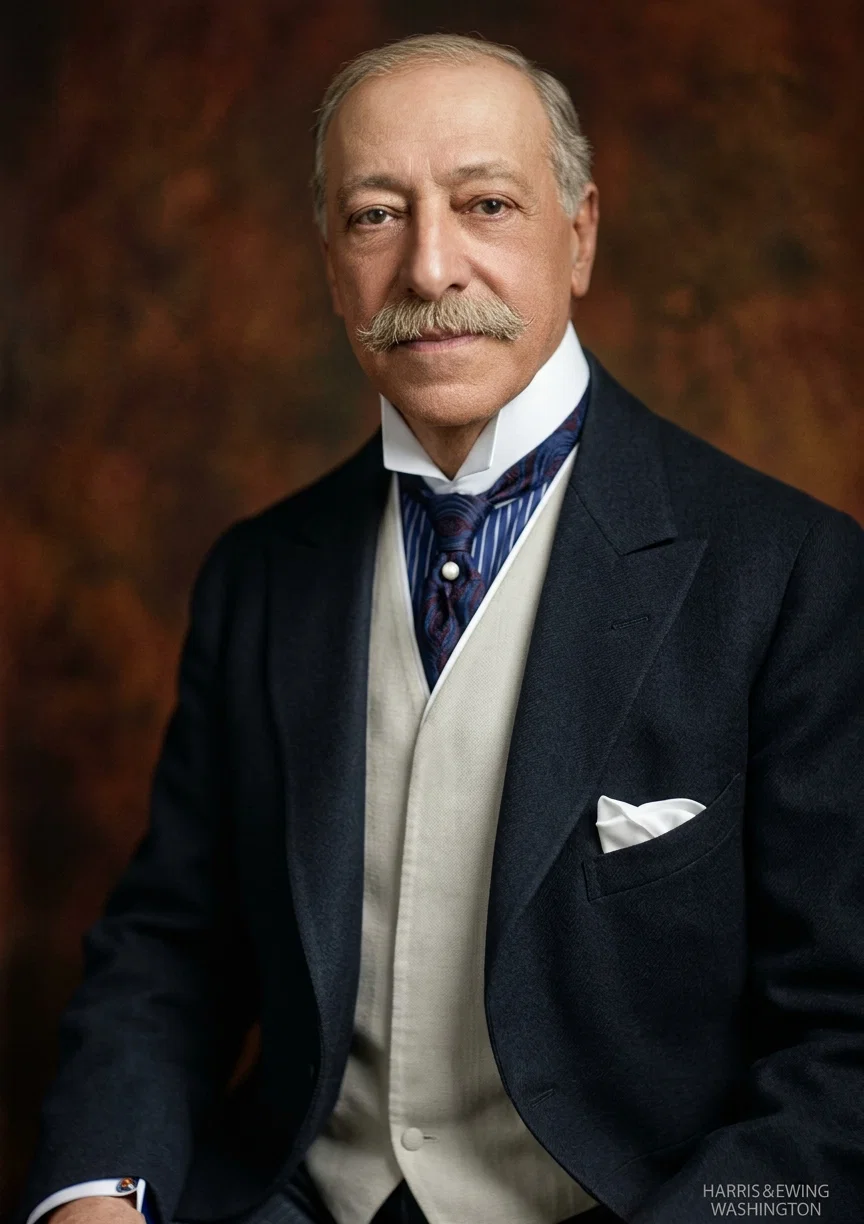
SIGNOR ERNESTO NATHAN, REPRESENTATIVE OF ITALY AT THE PANAMA EXPOSITION
THIS denomination now has two great “entering wedges,” preparing the minds of the people for the reception of the full message: (1) Our health and temperance literature; (2) the Protestant Magazine. The following letter addressed to Brother H. F. Kirk, now field missionary agent of the West Virginia Conference, by a faithful Protestant Magazine colporteur, is of interest: “Feeling impressed to take the Protestant Magazine to the preachers of Dayton, Ohio, I did so one day, with success, 98 of them taking the magazine, and some subscribing. They asked me to their meetings. I always went. Some asked me to sing. Last Sunday afternoon I gave a talk on the ‘Seven Last Plagues.’ In the evening I sang for them ‘Take Time to Be Holy.’ They then asked to come to my house for a prayer meeting, and asked me to take charge of the meeting; so I turned it into a Bible reading, and Elder Marietta gave the reading. We had a fine meeting. The Lord met with us. Fourteen persons turned out. One young minister was so interested that he has turned his hall over to us on Thursday evenings for Bible readings.” Are there not others in our large cities who have a burden to do a work similar to this among the Protestant clergymen? Why not send $2.00 for 50 copies of the August Protestant and go to work?

Simplicity and Economy

MRS. E. G. WHITE
OUR sanitariums are to be conducted upon principles that will meet the approbation of the great Medical Missionary who went about all Galilee, teaching in their synagogues, and healing all manner of disease among the people. . . .
In the establishment and carrying forward of the work, the strictest economy is ever to be shown. Workers are to be employed who will be producers as well as consumers. In no case is money to be invested for display. The gospel medical missionary work is to be carried forward in simplicity, as was the work of the Majesty of heaven, who, seeing the necessities of a lost, sinful world, laid aside his royal robe and kingly crown, and clothed his divinity with humanity, that he might stand at the head of humanity. He so conducted his missionary work as to leave a perfect example for human beings to follow. “If any man will come after me,” he declared, “let him deny himself, and take up his cross, and follow me.” Every true medical missionary will obey these words. He will not strain every nerve to follow worldly customs, and make a display, thus thinking to win souls to the Saviour. No, no! If the Majesty of heaven could leave his glorious home to come to a world all seared and marred by the curse, to establish correct methods of doing medical missionary work, we his followers ought to practice the same self-denial and self-sacrifice.
Christ gives to all the invitation: “Come unto me, all ye that labor and are heavy-laden, and I will give you rest. Take my yoke upon you, and learn of me; for I am meek and lowly in heart: and ye shall find rest unto your souls. For my yoke is easy, and my burden is light.” If all will wear Christ’s yoke, if all will learn in his school the lessons that he teaches, there will be sufficient means to establish gospel medical missionary work in many places.
Let none say, “I will engage in this work for a stipulated sum. If I do not receive this sum, I will not do the work.” Those who say this show that they are not wearing Christ’s yoke; they are not learning his meekness and lowliness. Christ might have come to this world with a retinue of angels; but instead he came as a babe, and lived a life of lowliness and poverty. His glory was in his simplicity. He suffered for us the privations of poverty. Shall we refuse to deny ourselves for his sake? Shall we refuse to become medical missionary workers unless we can follow the customs of the world, making a display such as worldlings make? Consider the life and sufferings of the Son of the infinite God. To save a race of sinners he lived a life of poverty and self-denial. To one who asked if he might follow him, he said, “Foxes have holes, and the birds of the air have nests; but the Son of man hath not where to lay his head.” Shall those who profess to be his followers refuse to engage in the work of helping their suffering fellow beings unless they can be placed in a position that will not lessen their dignity?
My brother, my sister, take up your work right where you are. Do your best, ever looking to Jesus, the author and finisher of our faith. In no other way can we do the work of God and magnify his truth than by following in the footsteps of him who gave up his high command to come to our world that through his humiliation and suffering, human beings might become partakers of the divine nature. For our sake he became poor, that through his poverty we might come into possession of the eternal riches.
It is not being rich in the wealth of the world that increases our value in God’s sight. It is the meek and the contrite that the Lord acknowledges and honors. Read the fifty-seventh chapter of Isaiah. Study this chapter carefully; for it means much to the people of God. I will make no comments upon it. If you will study it carefully and prayerfully, you will become wise unto salvation. . . .
Intelligent, self-denying, self-sacrificing men are now needed,—men who realize the solemnity and importance of God’s work, and who as Christian philanthropists will fulfill the commission of Christ. The medical missionary work given us to do means something to every one of us. It is a work of soul saving; it is the proclamation of the gospel message.

The Second Advent Movement

— No. 4
J. N. LOUGHBOROUGH
LET us look at the situation after the Turkish crisis of 1840. According to Revelation 10, at the close of the sixth trumpet a message, already given to the Lord’s messengers, must go in a powerful manner, by sea and land, proclaiming that the time had come for the finishing of “the mystery of God,” the gospel work.
Previous to that time very few were engaged in publicly preaching the soon coming of Christ. In the Midnight Cry of Sept. 13, 1844, Elder Himes said: “When we commenced the work with Brother Miller in 1840, he had been lecturing nine years. During that time he stood almost alone.” In other countries some were speaking and printing on the subject; Hentzepeter in Holland, Mason in Scotland, Kelber in Germany, Wolff, etc. But suddenly scores came to the front to proclaim the message.
In September, 1844, Brother Miller stated that he had the names and addresses of three thousand in various parts of the world who were preaching the faith, and the most of these were in America and the British provinces.
As an illustration of the sudden rise of public interest, I will relate an incident. In 1840 E. C. Williams, of Rochester, N. Y., an extensive tent and sail maker, embraced the advent doctrine, and invited Brethren Miller and Himes to come to Rochester and speak to the thousands of that city. He also gave them the free use of a 120-foot circular tent. In telling this to me, he said: “They came, and thetent would not hold half the people who came to hear. I put in a 40-foot splice, making a tent 160 x 120 feet. This was filled with people daily, and hundreds outside crowded near to hear.” This tent was used also in Cincinnati and other Western cities. A tent that would seat 3,000 persons was made for Eastern city work. Crowds came to hear, and a power went with the work which reminded one of the face like the sun and the feet like pillars of fire. See Rev. 10:1. Whether the message was sung, prayed, or preached, the mighty power of God sent home the truth to hearts.
I call to mind the first advent meeting I attended. It was the last week in December, 1843. The largest meeting-house in that section was crowded to its utmost capacity of both seating and standing room. Though such a crowd, there was almost breathless silence. A solemn awe pervaded the place. The meeting was opened by the singing of a peculiar hymn. In a clear and musical voice came from one corner of the room the words, “Hail you! And where did you come from?” From the opposite corner a melodious response, “I am come from the land of Egypt.” Then the question, “Hail you! And where are you bound for?” followed by the reply, “I am bound for the land of Canaan.” Then a full choir of all parts gave the chorus,—
“O Canaan, bright Canaan! I am bound for the land of Canaan. O Canaan, it is my happy home; I am bound for the land of Canaan.”
Then, in the same manner, came questions and answers relative to captain, pilot, cargo, etc. Simple as were these words, the power of God filled the house, and the people were in tears.
In the pulpit was the pastor of the church, and James Barry, the advent minister, whose topic for the evening was “The Judgment.” What a solemn place! As the Spirit of God sent home the truth, it seemed as if we stood at the judgment bar of God. And when, at the close of the discourse, a call was made for sinners to seek God, there was a crowding for the “anxious seats,” the writer among the rest. Not much attention, however, seemed to be paid to the twelve-year-olds. One of the class leaders, as he passed along, said, “Johnnie, you want to be a good boy?” I replied, “Yes, sir.” In my adolescent state, I was, like other boys, up and down. But from that night I almost daily prayed to God, but did not make a public profession of religion until the spring of 1848, under the advent revivals, when that confusion of nations was on in the Old World.
From 1840-44 the advent message not only spread with great rapidity and mighty power, but it was also given in the right place to fulfill the prophecy. The call is represented as the call to supper, the last meal of the day. That call was to go to “them that were bidden.” Luke 14:17. These were in the churches, and to them the message went. In those revivals 256,000 sinners were converted to God. Elder Himes, in speaking of Brother Miller’s labors up to the spring of 1844, said, “He labored among all parties and sects, without interfering with their organization or discipline.” Of his own labors, as combined with those of Elder Miller, he said, “Most of the ministers and churches that opened their doors to us and our brethren who were proclaiming the advent doctrine, cooperated with us until the last year,” the spring of 1844.
Those preaching the message said, “The period may terminate with the close of the Jewish national year 1843, about the equinox of our year 1844.” With such manifestations of God’s power in connection with the preaching of his coming “at the doors,” and with the rejoicing of thousands who were turning from sin to serve the Lord and to wait for his Son from heaven, they came up to the date of their expectation. “But the Lord did not come. The conviction with the devoted and thoughtful, however, was that they had moved in harmony with the mind of the Lord, and that in due time all would be made plain.”
*Lodi, Cal.

Redeeming the Time

WALTER P. MCLENNAN
It is the belief of every one who has accepted the threefold message of Revelation 14, and who understands its import, that it is the last message of mercy to be given to the world. Not until this message has been proclaimed to the world, will the blessed Jesus return to receive his people. We are often heard saying that the Lord is holding back the winds of strife until the servants of God are sealed in their foreheads with the seal of God. Recent developments in the Far East have stirred our minds. But is it not true that we should have witnessed even greater and more stirring indications of the nearness of the battle of Armageddon if we had been more faithful in the work to which God has called us? Have we not permitted the “cares of this life” to occupy so much of our time that we have devoted little to the salvation of the precious souls who are hungering for this message?
Our Saviour knew that we should be in danger, and so gave us the following word of warning: “And take heed to yourselves, lest at any time your hearts be overcharged with surfeiting, and drunkenness, and cares of this life, and so that day come upon you unawares.” How thankful we should be that Jesus has pointed out so plainly this great danger that threatens our eternal interests. “Had the purpose of God been carried out by his people in giving to the world the message of mercy, Christ would, ere this, have come to the earth, and the saints would have received their welcome into the city of God.”—“Testimonies for the Church,” Vol. VI, page 450.
To know that we have delayed the coming of Christ, and that through the neglect of his work, is indeed sad. But should it not spur us on to greater activity and earnestness in the Master’s service? Has not the time come to “redeem the time” by so consecrating ourselves to his work that through us he can finish the work and cut it short in righteousness? Surely we should feel thankful that God has said “he will finish the work.” Rom. 9:28. This is what we are looking forward to with such pleasant anticipation.
But, we ask, How can it be finished? “It is not alone by men in high positions of responsibility, not alone by men holding positions on boards or committees, not alone by the managers of our sanitariums and publishing houses, that the work is to be done which will cause the earth to be filled with the knowledge of the Lord as the waters cover the sea. This work can be accomplished only by the whole church acting their part under the guidance and in the power of Christ.”—Id., Vol. VIII, page 47.
What a grand and glorious work, that of winning souls to Christ and preparing them for his coming! No wonder Matthew Henry said as his mind dwelt upon this thought, “I would think it greater happiness to win one soul for Christ than to gain mountains of gold and silver for myself.” This is the wisest course for any one to follow. Solomon said, “He that winneth souls is wise.” Prov. 11:30. How true are the words of Hallenbeck: “There are many worthy pursuits in life, there are many desires to which we may rightly cling, but there is only one passion for a blood-bought heart; that is the all-controlling purpose which brought the Son of God from the skies and drove him to the cross, the passion for the salvation of men.”
But the question is asked, How can I obtain a burden for the salvation of souls? This is an important question, in view of what we have already said. What shall the answer be? In Isa. 6:5 we read: “Then said I, Woe is me! for I am undone; because I am a man of unclean lips, and I dwell in the midst of a people of unclean lips: for mine eyes have seen the King, the Lord of hosts.” Who was it he saw?—“The King, the Lord of hosts.” In the eighth verse he says that he heard the Lord say, “Whom shall I send, and who will go for us?” How did Isaiah respond?—“Here am I; send me.” That is the result of seeing the Lord of hosts.
The apostle Paul had a similar experience. “As he journeyed, he came near Damascus: and suddenly there shined round about him a light from heaven: and he fell to the earth, and heard a voice saying unto him, Saul, Saul, why persecutest thou me? And he said, Who art thou, Lord? And the Lord said, I am Jesus whom thou persecutest. . . . And he . . . said, Lord, what wilt thou have me to do?” The first thing Paul wanted to know when he saw the Lord Jesus was, “What wilt thou have me to do?” Is not that the experience we need as a people? Will not the sightof Jesus beget in all of us a passion for souls and a willingness to do the Lord’s will?
First, we need to see Jesus as a Saviour from sin. We need to follow him once more to the garden of Gethsemane, and thence to the cross of Calvary. Let us read again and again the closing chapters of “The Desire of Ages,” beginning with the one on his agony in the garden of Gethsemane. Is it not true of many of us, as it was of Job, that we have heard of him by the hearing of the ear? And is it not time that we get to the place where we can with Job say, “Now mine eye seeth thee?” Job 42:5.
Second, we need to see Jesus as our great high priest in the heavenly sanctuary, carrying forward the great anti-typical work of atonement. We need to realize more than we do, that the work of judgment, which has been in progress seventy years, is about to be finished. How solemn this thought! Should it not arouse those of us who have been “at ease in Zion”?
Third, we need to see Jesus as he appeared upon the mount of transfiguration. Our view of his second coming must be more real. We need to constantly remember that “the day of the Lord cometh, cruel both with wrath and fierce anger.” Isa. 13:9. “Knowing therefore the terror of the Lord, we persuade men.” 2 Cor. 5:11.
When we see Jesus in his fullness, surely we cannot but persuade men to turn to the Lamb of God, which taketh away the sin of the world.
Shreveport, La.

A. E. PLACE

“Judge Not”—No. 3

A. E. PLACE

LET us now present the following simple propositions:—
1. Man by nature is decidedly human. This means man in its fullest sense—you, me, us, no matter what our position, location, or profession.
2. Being human, “we have all missed the mark.”
3. Living in different degrees of light and shadow, it is but reasonable—it could not be otherwise—that our views should differ concerning many things; in fact, it would be a miracle, and a mighty one, that would bring all to see alike on all things.
4. Every person not abandoned by the Holy Spirit (and this class is doubtless much smaller than many think) has some honesty, and desires to do what he sees and believes to be right.
5. A man will follow his convictions to the extent that he is truly honest, and to that extent he is accepted by the Lord, for to that extent God is in him, though the man does many things which his brother or neighbor may condemn.
6. We believe that honesty is measured rightfully by him who sits in the sanctuary above, and not by any man; and God’s measure is quality rather than quantity. To illustrate: A may have, so to speak, twice the honesty that B has, and yet God may regard B’s as more precious than A’s. Some two-ounce peaches are intrinsically better than others weighing eight ounces. Yet in each case the color of the skin and the smell may be the same.
Experience has taught us that color, smell, and weight are each and all deceptive. Fruit must be tasted to determine quality; but even when this test is applied, men and women disagree.
7. By the greatest teacher this world has ever known, we are told, “There is none good but one, that is, God.” “Where is boasting then?” Where has man any basis for preeminence? Where has God located a seat in this world where any living soul may claim the right to sit in judgment on any other living soul? “It is excluded. By what law? of works? Nay: but by the law of faith.” How much better to trust than to judge!
8. Our righteousness must “exceed the righteousness of the scribes and Pharisees,” or we cannot get into either the kingdom of grace or of glory. We cannot judge till we get into the latter, and when we get there we shall have lost all desire to judge, and shall simply sit with Christ to sanction Heaven’s decisions.
9. Every individual, in religious matters, is responsible both now and in the judgment for his actions. You cannot present my case there, neither can I present yours; for “we must all appear before the judgment seat of Christ; that every one may receive the things done in his body, according to that he hath done.” See also Rom. 14:12.
10. My ways do not please everybody, not even my best friends. All my ways do not please anybody who knows me; in fact, they do not please myself. Neither do other people’s ways always please me. I have known but few people who really met my ideals, and had I been permitted to “summer and winter” with them, my view of their perfection might have been marred. And I say this with the consciousness that my ideals may be, and doubtless are, far from perfect.
11. Traits which I admire, another does not. Traits which another may condemn, may seem right and good to me. What does this prove? One of two things, and possibly both; namely, either we do not all have the same measuring rod, or we do not all read the figures alike, or correctly. Would it be too strong to say that probably neither of us sees them correctly?
12. By an act or acts we may please God and at the same time displease our fellow men, or we may please man and in so doing displease God. Then let us draw and consider carefully the following conclusions:—
He who tries to please all men, no matter what his calling or ability, has before him a hopeless and thankless task; and he who tries to please both man and God will make just as great a failure. But he who honestly seeks to please God, regardless of criticism, condemnation, or judgment, will not only please God, but in this way will please more of his fellow men than he could possibly do in any other way; and last, but not least, he will find in it a pleasure, yea, a joy and peace, which the world cannot give nor take away.
San Jose, Cal.

Laughter

ELIZA H. MORTON
A SPECIES of the hyena laughs, but man is the only animal that smiles. Laughter is usually preceded by smiles. A little girl was once told that the Bible nowhere says that Jesus smiled. She replied, “I know that he did smile, for he called the children to him and blessed them, and they would not have gone had he not smiled.”
It is true that the word smile does not occur in the Bible, but the word laughter is mentioned a number of times. It says there is a time to laugh (Eccl. 3:4), and the whole tenor of the Scriptures goes to show that God’s people should be a glad, joyful people. The laughter of fools, however, is like the crackling of thorns under a pot (Eccl. 7:6); and when the feet are in the ways of death, the lips may laugh and yet the heart be heavy and sorrowful (Prov. 14:13). This class of people are counseled to turn their laughter to mourning (James 4:9),—mourning for sin,—which, if genuine repentance, will cause them to receive the oil of joy for heaviness, and gladness for sorrow.
It is always true that the Christian should avoid frivolity; and in these days when God is working a strange work in the earth, it is especially true that they should be sober, walking softly before the Lord, and wrestling with him for that victory over sin which will bring a holy joy to illuminate the countenance with the light of life. When God turns again the captivity of Zion, those who now weep shall laugh, and shall say among the heathen, “The Lord hath done great things for us.” Ps. 126: 1, 2.
Portland, Maine.

He Is Our Father

“ONCE a great emperor was riding in a chariot through a city when a little boy ran through the lines of soldiers toward the chariot. The soldiers cried, ‘Stop! that is the emperor.’ He answered, ‘He is your emperor, but he is my father,’ and so he kept on, and was taken by his father into the chariot. So the mighty God, who rules the winds, is our Father, and we are not afraid to come to him in prayer.”

The Virtues of Work

THANK God every morning when you get up that you have something to do that day which must be done, whether you like it or not. Being forced to work, and forced to do your best, will breed in you temperance and self-control, diligence and strength in will, cheerfulness and content, and a hundred virtues which the idle never know.—Charles Kingsley.

Good Cheer

“Good cheer is the heart’s constant springtide.”

Gathering Trouble

THE present affords its full load of trial and perplexity. We do not need to borrow of the past nor of the future. There are some who carry a threefold load,—the trouble they have had in the past, present trouble, and the trouble they expect in the future.
We need to forget the things that are behind. Wherein sin has marred the record let us repent of the wrong, gather from it lessons for present need, and then bury the record.
We need to meet bravely the trials and perplexities of the present hour. If we stand with God, then he is on our side, and what need we fear? He who has preserved us from dangers seen and unseen in the past, will take us through dangers that compass us now.
Then let us not anticipate the future. Its revelations belong to God. We may not know what waits on the morrow, but God knows, and he doeth all things well. If we will but trust him, he will choose our way for us. Let us cultivate hope and cheerfulness. Let us cultivate joy in our hearts, and songs in our experience.
F. M. W.

Building for the Better World

THE man of the world builds for time, but the Christian for eternity. The one grasps that which is near at hand and will perish with the present. The other looks beyond to what the future holds, and chooses that which will endure. Satan holds the present close to our eyes that we may not see what God has for us in the better world,—the enduring substance of an eternal inheritance.
This life is not given to us that we may use it to minister to the lusts of the flesh. It is given to us as an opportunity to demonstrate whether we will be loyal or disloyal; whether we will choose that which God sets before us as the best, or choose that which would work ruin to ourselves and our associates and bring further discord into the universe of God. Faith and hope and trust and loyal obedience,—these show the better choosing; these demonstrate a determination to be aligned on the side of God, and to be in harmony with his purpose. They bring blessings to those who manifest them, and make the manifestants a blessing to those with whom they mingle.
While men and women of the world delve, and toil, and worry, and strive for that which they cannot take with them when the last summons comes, the Christian uses this life as an opportunity for entrance into the grander one in which he can enjoy all that is good, and be free from every interference of unrighteousness. He whose hope of enjoyment is bounded by the cradle and the grave and beset on all sides by the forces of selfishness overreaching one another, has no anchor that can hold when human courage fails and human strength gives out.
We cannot build for this life only and build safely. We cannot turn our attention and our energies upon our own desires if we expect one day to let our eyes rest in pleasure upon “the King in his beauty.” Paul says, “If in this life only we have hope in Christ, we are of all men most miserable.” We cannot stop with this life and be Christians. We cannot make this life our chief consideration and be true children of God, true members of the household of faith. The Christian’s hope takes hold on eternity. The Christian’s work must be a work for eternity.
Speaking of that great hope around which cluster the warnings and prophecies and encouragements of the whole Bible, the writer of the epistle to the Hebrews declares: “Which we have as an anchor of the soul, a hope both sure and steadfast and entering into that which is within the veil.” Heb. 6:19. Christ is within the veil; he holds the anchor. As long as the child of God clings to that anchorage, he cannot drift. There is no power on earth that can sweep him away; there is no power in heaven that will. But apart from that anchorage, there is no power to save man from eternal ruin. Outside Heaven’s purpose for man there is no power that cares to do so. And because that is so, and men are drifting away from that true anchorage, we find an ever-increasing proportion of the human family losing hope, trust, and courage, and launching themselves into eternity with no preparation to meet God.Year by year the number of self-destructions increases—a sure indication that with each new year an ever-increasing number are losing their anchorage, and their courage and hope. They narrow their vision to the things of this world, and when disappointment comes, they have no anchor.
The causes for this condition are manifold. The increase of skepticism, outside and inside the church, fostered by the destructive criticism of the Bible in the hands of an unconverted ministry, is doing perhaps as much as any other one thing to bring about this sad condition in the world. When a great portion of humanity loses faith in the Word of God, there is nothing but human power left to encourage, or guide, or even restrain. Their interest in even the things of this temporal life seems to loosen and unwind like the strands of a frayed rope. Every tremor of wavering in the pulpits of the land is increased and intensified in the great aggregate audience that listens. One note of doubt in the pulpit can make more skeptics than all the rest of the sermon can make converts. If he whose business it is to proclaim the Word doubts it, he has lost every leverage he might have employed to bring souls to the anxious seat.
The land is filled today with these discords of doubt emanating from the pulpits of spiritual advisers. The hired choir has done its work of disintegration in the church; but the result of even its work is completely lost in the greater maelstrom of ruin created by a doubting pulpit. From every seed of infidelity scattered by such hands there spring up a hundred tares to choke out the aspirations of the soul, to destroy trust in God, and to ruin respect for divine law. With these gone, there is nothing but fear of man to restrain the hand; and more and more frequently is it found that this does not control, or restrain, or even retard.
This world is losing hope because it is coming to have nothing but this life to hope in; because it has seen man’s only sure anchor disparaged; because it has seen the Word of God belittled by those who were paid to expound it.
But this confederacy of ruin should not surprise the child of God. We have been forewarned by that very Word that in the last days scoffers would arise, that seducing spirits and doctrines of devils would be abroad, that genuine faith would be scarce in the earth, and that infidelity and sin would abound on every hand. Men have placed their hopes in the accomplishment of some great purpose, and when the storm of disappointment has come, their bark has dragged anchor, and they have lost their souls. Many indeed have seen their brightest hopes fade and wither and become the plaything of the winds of misfortune, and in that stress of spirit they have carried their case to judgment in their own hands, with no advocate at the bar. Truly the world is losing its hold on God, because it has been building upon the sands of time instead of upon the Rock of eternal ages.
At such a time how the Christian should labor to place before the world the only hope worthy of the name! “Hope thou in God.” The hope of the Christian is real. Building on that hope, we build secure. It spans the gulf between death and the resurrection. It bridges the strait between Paradise lost and Paradise restored. The Golden Gate toward which the Christian looks is the pearl-hinged gate of the city of God. Inside that is life everlasting, the fruition of hope long deferred, the companionship of the Christ who bought us with his blood.
In spite of the fact that the world is losing hope, the true Christian, who has been building for eternity, may now look up and lift up his head, knowing that “our redemption draweth nigh.” When he who is our life shall appear, then will be demonstrated who has builded most wisely, the one who has builded upon the foundation of the Word and greets its Author with rejoicing, or the one who has doubted the Word, builded upon his doubts, and flees to the mountains to hide from the face of him whom he has denied and defied. Let us choose that better foundation that our building may stand when everything earthly shall have been destroyed.
C. M. S.
Continue reading: President Wilson and the Lord’s Day Congress